Tag: featured

  • The (nuclear) alchemists of Darmstadt and the doubly magic tin-100 nucleus

    The (nuclear) alchemists of Darmstadt and the doubly magic tin-100 nucleus

    An international group of researchers announced in the journal Nature that they had succeeded in creating tin-100.   This experiment helps us understand how heavy elements have formed.  A few minutes after the Big Bang the universe contained no other elements than the lightest; hydrogen and helium.

    We, the objects around us, the Earth and the other planets all contain heavier elements; carbon, oxygen, silicon, tin, iron etc.  These elements came into existence later than hydrogen and helium.  They formed through the fusion of atomic nuclei inside of stars.  Elements heavier than iron owe their existence to gigantic stellar explosions called supernovas.  Tin-100 is a very unstable, yet important, element for the understanding the formation of these heavier elements.

    A multinational team headed by nuclear physicists from the Technische Universitat Munchen, the Cluster of Excellence Origin and Structures of the Universe and the GSI in Darmstadt carried out these precision experiments.  They shot xenon-124 ions at a sheet of beryllium to create the tin-100 atoms.  The subsequently measured the half-life and decay energy of tin-100 and its decay products using specially developed particle detectors.

    What is our world made from?

    The inspiration of creating new elements can be traced to alchemical traditions.  Alchemy is an arcane tradition, that can be viewed as a proto-science, a precursor to chemistry and nuclear physics.  It’s prime objective was to produce the mythical philosopher’s stone, which was said to be capable of turning base metals into gold or silver, and also act as an elixir of life that would confer youth and immortality upon its user.
    The Alchemist, 1771 painting by Joseph Wright of Derby. Image credit: Wikipedia, image copyright has expired.

    It did bring to chemistry many ideas and provided procedures, equipment, and terminology that are still in use.  It also provided the inspiration for the creation of new elements.  Now we understand to create new elements requires a combination of precision equipment and experimental procedures coupled with a sound understanding of quantum theory.

    So what is tin-100 and why is it useful to understand the astrophysics of heavy element formation?

    Most people will recognise that matter around us is composed of atoms.   Atoms of carbon, hydrogen, oxygen for example form the building blocks to make organic molecules and silicon and oxygen bond together to make common beach sand and are fused together to make glass.  The familiar metals are solids made of one type of atom, for example gold and aluminium, or combinations, bronze being made of copper and tin atoms.

    Atoms in turn are a central nucleus of protons and neutrons surrounded by a swarm of electrons.  The number of protons distinguishes one element from another.  This atomic number is used to designate an element 1 for hydrogen, 8 for oxygen and 50 for tin, for example.  Stable tin comprises 112 nuclear particles – 50 protons and 62 neutrons.  The neutrons act as a kind of buffer between the electrically repelling protons and prevent normal tin from decaying.  Each atom will contain an equal number of electrons to its protons.  Remove or add an electron and the atom becomes an ion, a charged particle.

    The strange quantum world of the nuclei

    Quantum mechanics which, amongst other things,  explains how the electrons form into shells around the nucleus.  Elements which have filled outer shells, helium, neon, argon, xenon are ‘noble’ gases, chemically inert – not the least reactive.  Nuclei are also complex quantum objects.

    As far as we know, nuclei are the smallest objects that can be split up into their constituents.  They are therefore the smallest entities which emergent properties – patterns that arise from complexity – can be studied.  Nuclear scientists study these emergent phenomena and are using them to decipher the nature of the nuclear force.  In contrast to the structure of atoms, for which the fundamental interaction between the electrons and the nucleus – the electromagnetic force – is known with great precision, the interaction between the nucleons – the strong nuclear force – is not so well known.

    In nature not all combinations of nucleons are stable.  As a general rule the more protons present then more neutrons are required to stablise the nuclei.  A useful graphical presentation of this is the Segre table of radionuclides.
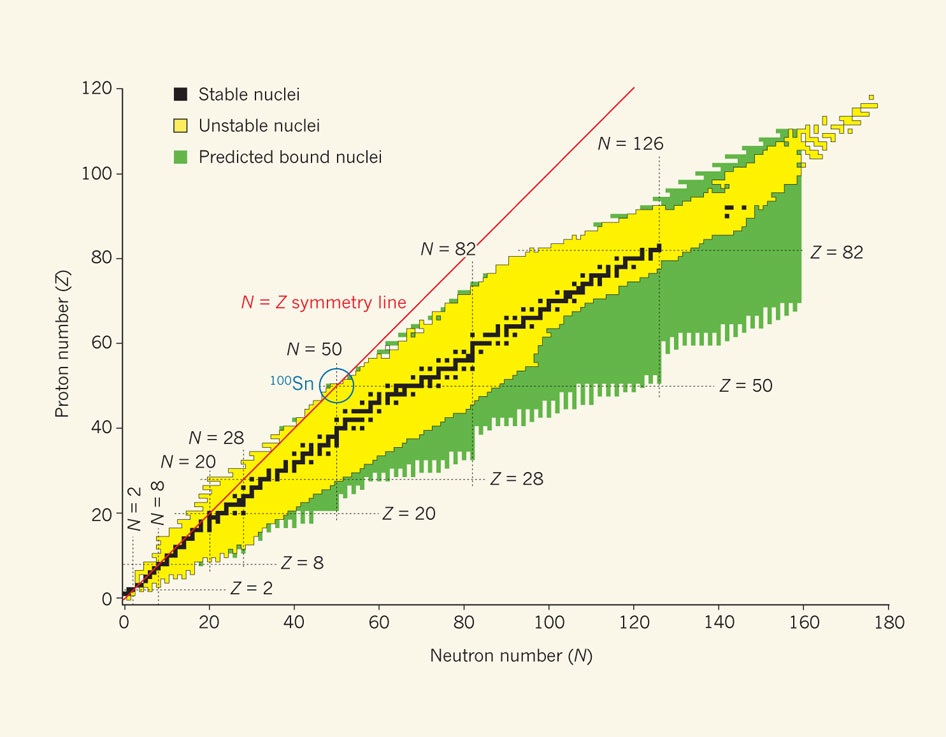
    Location of nuclei as a function of their neutron number (N) and proton number (Z). Image credit Daniel Bazin Michigan State University.

    If the shell structure of electrons was difficult at first for scientists to come to terms with, then the shell structure exhibited by nucleons is not only unexpected it is complex enough not to be discussed in many quantum physics texts.  It was first thought that such densely packed and strongly interacting objects as the nucleons would exhibit a liquid-like behavior, much like the flow of electrons in a good conductor such as a metal.

    That is what makes these experiments so exciting.

    Stability and magic numbers

    Magic numbers are the number of protons or neutrons that form full shells in an atomic nucleus.  The term is thought to have been coined by the physicist Eugene Wigner.  The model has been used to explain – at least for stable nuclei – the observed sequence of magic numbers: 2, 8, 28, 50, 82 and 126.

    Nuclei that have a magic number of neutrons or protons are more tightly bound than there non-magic counterparts.  This intrinsic simplicity makes them prime candidates for testing proposed models of nuclear structure.  Even more attractive are the doubly magic nuclei.  The lighter nuclei helium-4, oxygen-16 and calcium-40 do follow the magic number sequence.

    However because of the repulsion between protons the line of stable nuclei veers away from the symmetry line.  As a result tin-100 represents the largest nuclei to follow the sequence.  It is bound but unstable.  It is very close to the edge of nuclear stability, where the nuclear force between the protons and neutrons can no longer bind them into a nucleus.  Unfortunately, what makes this nucleus so attractive to study is what also makes it so difficult.

    How to make a new element

    In nature elements heavier than iron come into being only in powerful stellar explosions – supernovas.  These include, for example, the precious metals gold and silver and the radioactive uranium.  The cauldron of a supernova gives rise to a whole array of high-mass atomic nuclei.  these decay to stable elements via different short-lived intermediate stages.

    There are two ways to create new elements in the laboratory.  The first is is to fuse two nuclei in a manner that minimises the loss of protons or α-particles (helium-4 nuclei).  The second is is more brutal, fragmenting a small part off a heavier nuclei in a collision.
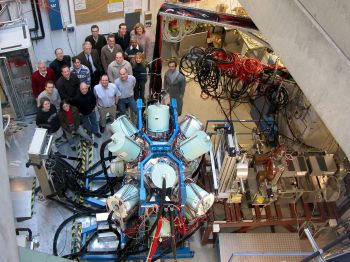
    The detector set-up at GSI. Photo credit: GSI

    In these experiments energetic xenon-124 is sheared by making it collide with a target beryllium foil leaving a residue that is composed of 50 neutrons and 50 protons.  Out of the 120,000,000,000,000 xenon-124 accelerated in the experiment, only 259 tin-100 nuclei were identified.  These results were sufficient though for the decay of tin-100 to be studied with great precision.

    The results, excitedly for the researchers, demonstrated a ‘superallowed Gamow-Teller decay‘.  This type of β-decay is beyond the scope of this essay to explain, needless to say it does provide new experimental depth to the models of nuclear chemistry.  It is an important decay transition that occurs in the collapse of supernovae.  It also is important in putting boundaries on the possible mass of the neutrino.  Both of which are important validations of the current nuclear theories as well as providing real experimental data to fine tune the theoretical models.

    This allows more real models of nuclear synthesis to be constructed.  Allowing a deeper understanding of how the atoms that make up our universe were created.

    Now other laboratories around the world will work on improving the production rates of tin-100 and other exotic nuclei, based on these experiments.  Allowing the emergent properties of these nuclei can be studied in more detail.  Giving us greater understanding of the forces that bind these particles together – to make us!

  • It’s a wheel!  It’s a wheel – a wheel on Mars!

    It’s a wheel! It’s a wheel – a wheel on Mars!

    NASA’s rover Curiosity was safely on Mars.  It was a perfect landing.  The novel sky-crane method had proved its detractors wrong and its designers right.  What was needed then was signs that Curiosity was working as designed.  NASA had said that the first pictures may be anything up to 2 hours after landing.  A long time for the audiences, waiting, live, all over Earth.

    It's a wheel on Mars. Photo credit NASA/JPL

    “Got thumbnails.” Pause in the control centre, then someone else yells “Its a wheel, its a wheel!” “A wheel on Mars!”  For the second time that momentous afternoon the NASA/Jet propulsion Lab crowd erupted into spontaneous and joyful applause.  Not only had they landed the rover, Curiosity, safely on Mars, they had received the first images back from its cameras.  Sometimes the unscripted, unexpurgated exclamations make for the best history.

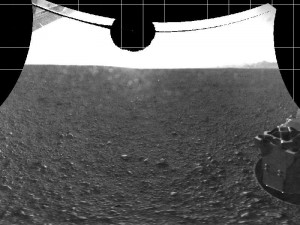
    The first two pictures were from the front and back navigation cameras.  They were low resolution black and white thumbnails taken through the dust caps that protected the cameras during landing.  As the minutes ticked by higher resolution images came through from the rover.  The business as usual, familiar image enhancement bought into sharp clarity the ‘first’ two images from the robot explorer.

    The 'first' image enhanced view from the rear hazard camera, Mars Curiosity Sol 0.

    The first week on Mars

    After the exuberance and press conference came the trademark NASA precision and methodical approach.  An approach that gets missions safely to Mars, at the same time can make the audacious appear mundane.

    Mission controllers at NASA’s Jet Propulsion Laboratory in Pasadena, are now checking out Curiosity’s subsystems and 10 instruments.  Curiosity is in the opening days of a two-year mission to investigate whether conditions have been favorable for microbial life and preserving clues in the rocks about possible past life.

    Mission team members are “living” on Mars time.  A Martian day is approximately 40 minutes longer than an Earth day, meaning team members start their shift 40 minutes later each day.

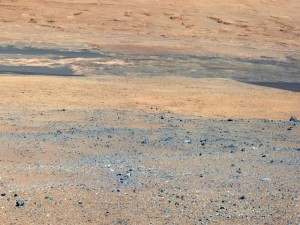
    View of Mount Sharp, Curiosity's roving destination. Image credit NASA/JPL

    Amongst the important system events in this first week was a software upgrade.  It took four days to successfully upgrade Curiosity’s software in its main and back-up computer.  The software had been uploaded during its trek to Mars, but not activated until now.  The software to date was focused on getting Curiosity through the Martian atmosphere and safely to its destination in Gale Crater.  The software upgrade is to cover its surface exploration activity, roving and controlling the various scientific instruments.

    Curiosity Ready to Roll

    “There will be a lot of important firsts that will be taking place for Curiosity over the next few weeks, but the first motion of its wheels, the first time our roving laboratory on Mars does some actual roving, that will be something special,” said Michael Watkins, mission manager for Curiosity from the Jet Propulsion Laboratory.

    Mission engineers are devoting more time to planning the first rove of Curiosity.  In the coming days, the rover will exercise each of its four steerable (front and back) wheels, turning each of them side-to-side before ending up with each wheel pointing straight ahead.  On a later day, the rover will drive forward about one rover-length 3 metres, turn 90 degrees, and then kick into reverse for about 2 metres.  Exciting times for the rover driver team!

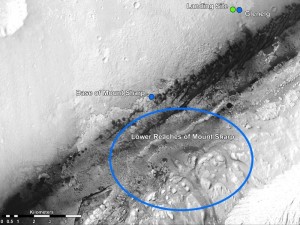
    This image shows the landing site of NASA's Curiosity rover and destinations scientists want to investigate. Photo credit NASA/JPL

    The scientists and engineers of NASA’s Curiosity rover mission have selected the first driving destination for Curiosity.  The target area, named Glenelg, is a natural intersection of three kinds of terrain.  The trek to Glenelg will send the rover 400 metres east-southeast of its landing site.  One of the three types of terrain intersecting at Glenelg is layered bedrock, which is attractive as the first drilling target.

    The choice described by Curiosity Principal Investigator John Grotzinger of the California Institute of Technology as, “With such a great landing spot in Gale Crater, we literally had every degree of the compass to choose from for our first drive.”  “We had a bunch of strong contenders.  It is the kind of dilemma planetary scientists dream of, but you can only go one place for the first drilling for a rock sample on Mars.  That first drilling will be a huge moment in the history of Mars exploration.”

    Grotzinger estimated the rover’s journey would take between three weeks and two months to arrive at Glenelg, where it will stay for roughly a month before heading to the base of Mount Sharp.

    It may be a full year before the remote-controlled rover gets to the base of the peak, which is within 20 kilometres of the rover’s landing site.

    Zapping rocks and doing science

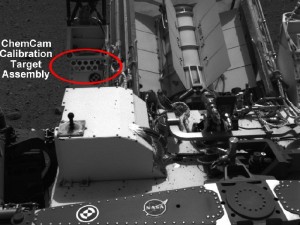
    Before Curiosity heads off to Glenelg another first will occur.  The team in charge of Curiosity’s Chemistry and Camera instrument, is planning to give their mast-mounted, rock-zapping laser and telescope combination a thorough checkout.  ChemCam has “zapped” its first rock in the name of planetary science.  It was the first time such a powerful laser has been used on the surface of another world.

    The Chemistry Camera calibration target, as seen by the camera. Photo credit NASA/JPL.

    The technique is called ‘laser-induced breakdown spectroscopy’.  The high-powered, narrow-focused, laser beam vaporises the rock from a distance generating a plasma plume with temperatures in excess of 100,000°C.  At the high temperatures during the early plasma, the vaporised material breaks down into excited ionic and atomic species.  As it cools to 5,000–20,000°C the characteristic atomic emission lines of the elements can be recorded by the camera.  This data is compared to the ‘standards’ that the rover carries to identify the rock components.

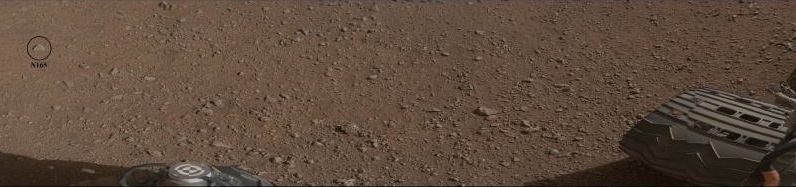
    The soon to be famous rock N165, target for testing the Chemistry Camera laser and analysis. Photo credit NASA/JPL.

    As Roger Wiens, principal investigator of the ChemCam instrument from the Los Alamos National Laboratory explained earlier, “Rock N165 looks like your typical Mars rock, about three inches wide. It’s about 10 feet away.” “We are going to hit it with 14 millijoules of energy 30 times in 10 seconds.  It is not only going to be an excellent test of our system, it should be pretty cool too.”

    Pretty cool indeed.

    First weather report in 30 years

    It is currently just above freezing point in gale Crater where Curiosity is.

    Grotzinger noted the team’s report on the Martian crater’s temperature was “really an important benchmark for Mars science”.

    “It’s been exactly 30 years since the last long duration monitoring weather station was present on Mars,” when Viking 1 stopped communicating with Earth in 1982,” he said.  Then Viking 1 lander recorded temperatures that varied from −17.2 °C to −107 °C.

    Sensors on two finger-like mini-booms extending horizontally from the mast of NASA’s Mars rover Curiosity will monitor wind speed, wind direction and air temperature. One also will monitor humidity; the other also will monitor ground temperature. The sensors are part of the Rover Environmental Monitoring Station, provided by Spain for the Mars Science Laboratory mission.

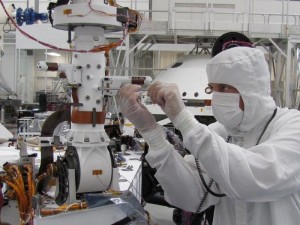
    The weather station devices on Curiosity being tested prior to launch. Photo credit NASA/JPL.

    In this image, the spacecraft specialist’s hands are just below one of the Rover Environmental Monitoring Station mini-booms. The other mini-boom extends to the left a little farther up the mast.

    As Curiosity’s primary mission is for a full Martian year it will be able to record the seasonal variations that occur for Mars.

    On the ground radiation monitoring and weather conditions will be crucial for any future exploration or habitation by humans.  This mission by Curiosity represents an important step towards these aspirations.

  • Is there life on Mars?  Sojourner, Spirit, Opportunity and Curiosity go roving

    Is there life on Mars? Sojourner, Spirit, Opportunity and Curiosity go roving

    The NASA rover Curiosity is expected to be landing on Mars at 3:31 am August 6, 2012 (AEST).  It’s mission, lasting one Martian-year (98 Earth weeks),  is of scientific significance and perhaps even of human significance.  Curiosity will be fulfilling the prospecting stage of a step-by-step program of exploration, reconnaissance, prospecting and mining evidence for a definitive answer to the question “Has life existed on Mars?

  • A brand new boson?

    A brand new boson?

    It’s official. As was the subject of a press conference here in Europe this morning, the LHC has discovered a new particle. Is it the much talked about Higgs boson? Evidently it’s far too early to say with certainty. But whatever it is, it’s a brand new subatomic particle, it’s consistent with a Higgs boson signature, and it’s enough to make CERN physicists quite excited.Whatever it may turn out to be, it’s brand new and never seen before.

    This is physics at its most fundamental. The standard model of particle physics is probably our best depiction of how the universe operates at subatomic scales, but our picture is incomplete. A jigsaw puzzle with missing pieces which must still be searched for. One of those pieces is a piece so basic that for a long time it was simply overlooked. Why do objects have mass at all? The existence of the Higgs boson in the Standard Model seeks to address that question. It posits that all the universe is filled with a so-called Higgs Field. Any particles, protons or neutrons for instance, passing through that field will interract with it, and it will interract via Higgs bosons. Any particle which exists in this field will effectively be surrounded by a cluster of these Higgs bosons. The more bosons, the stronger the interraction, and the more massive that particle will be.

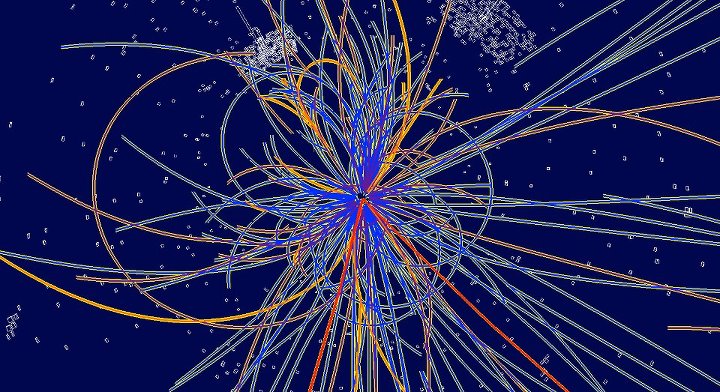
    Simulation of Higgs Boson decay.

    But exactly what it is that’s been discovered is still being analysed. Amid a press conference full of journalists asking pointed questions about “the Higgs boson”, scientists were noticeably hesitant to outright say that this is what they’ve discovered. And for good reason too, because science doesn’t work like that, no matter how many people might want to run through the streets naked shouting ‘Eureka’. In all of this, only one thing is certain – a new particle has been discovered with a mass of approximately 126 giga electron volts (126 GeV), with a statistical significance of 4.9 standard deviations (4.9 σ).

    Peter Higgs himself, declined to make any comment twice during the conference, simply stating that it would not be appropriate to answer detailed questions at this stage. The other members of the panel too, agree that it’s very difficult to say anything definitively right now and that “Higgs-like” would be a better description of what they’ve found. It’s compatible with a Higgs boson detection, but the “uncertainties are still large”. While definitely being “consistent with a Higgs boson”, interestingly it’s noted that they cannot say if this is the Higgs boson (i.e. the one required by the Standard Model), rather at this stage it may be a Higgs boson. Scientifically speaking, it’s far better to only make statements on what’s known to be true, rather than to make brash announcements which may prove to be incorrect a few months later.

    Whatever happens after the months of data analysis which are due to follow is that we’re set to unravel a lot more about the fundamentals of the universe. This discovery is on the very edge of human understanding. It may help to refine our knowledge of the Standard Model of particle physics, or it may hint that this particular Higgs boson is not a part of the standard model – a prospect which ATLAS experiment director Fabiola Gianotti seemed visibly quite excited by.

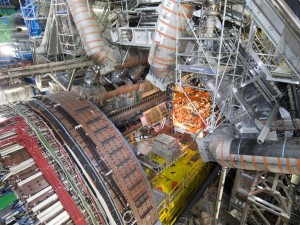
    The ATLAS instrument, a detector in the LHC.

    Rolf Heuer stressed the fact that the most exciting thing here is the fact that they have a discovery of something brand new, perhaps suggesting that we shouldn’t get too caught up in our expectations and simply enjoy the excitement of there being something never before seen in physics in the process of being analysed. Moreover, this could be the very first fundamental scalar particle, and the first gauge boson which actually has any mass. If it does turn out to be a Higgs boson, then this holds the additional thrill that this particle has a relationship to the state of the universe itself, embodying the substance to all other particles which exist.

    In the meantime, as the LHC prepares to power down for a couple of years of maintenance, this discovery will certainly stoke the fires of curiosity in thousands of scientists worldwide. The data are still being picked apart too, for things which are completely unknown. Perhaps even more brand new physics is still waiting to be found. It’s an exciting time in physics right now!

  • In the year 2023, and humans are on Mars for all to see

    In the year 2023, and humans are on Mars for all to see

    Do you wish to become a Martizen, a citizen of Mars, anytime in the near future?  If you are serious about this then Dutchman, Bas Lansdorp is your man.

    Bas Lansdorp is a person with an audacious ambition.  Through his company, Mars One, he plans to establish the first human settlement on Mars by April 2023.  In addition to this he intends that a new team of four settlers will join the Martian settlement every two years.  By 2033 there will be over twenty people living, working, and they believe, flourishing on Mars, their new home.

    If the Mars one publicity is believable, and on this point there is no real reason to doubt it, organizing a manned mission to Mars has been Bas Lansdorp’s dream for many years.  Bas has been working on Mars One with partner Arno Wielders since January 2011.  During 2011 they had confidential discussions with possible equipment suppliers to ensure that there was reality in their idea.  In May 2012 they announced their vision to the world.

    Like any large entrepreneurial venture their success will predicated on the skill, experience and credibility of the venture and the people involved.  To be credible they will need to be convincing in, at least, these four aspects of the venture; technological; financial; psychological; and finally ethical.  They will need to be convincing in a way that engages and excites both investors and participants.

    It is rocket science

    Getting to Mars is not trivial, if it were, well I expect there would be more than the spectacular array of NASA super, and superannuated rovers there currently is on Mars.  Mars One have developed and made integral to their model a simple theme to get to and live on Mars: buy already developed technology from existing component manufacturers.

    Take the Falcon Heavy lifter from SpaceX, to boost the components into low earth orbit.  Combine a SpaceX Dragon capsule as the landing stage, add a transit living module from Thales Alenia Space and attach to two propellant stages which are a variant of the SpaceX Falcon 9 upper stage rockets and you have the vehicle to get from low earth orbit to orbit around Mars via a Hohmann transfer trajectory.

    The seven-month trip to mars will be Spartan, similar to, but more cramped, than current conditions experienced on the International Space Station.  This is where rigorous training will first pay off:

    “Showering won’t be an option; instead they will have to make do with wet wipes like the International Space Station astronauts.  Tinned food only, constant noise from the ventilators and equipment and a regimented routine of three hours of exercise a day to keep up muscle mass all add to their trials.  If they are hit by a solar storm they will have to take refuge in the shelter area of the rocket, which provides the best protection, for as long as several days.”

    When the first 4 settlers land on Mars in April 2023 they will arrive at an established site.  They will be picked up from their SpaceX Dragon capsule and taxied to the settlement by two robotic Mars rovers designed and built by MDA Space Missions.  To get to this point is an ambitious and tight timeline.

    2013 Settler selection begins.  Replica of Mars settlement is built on an Earth desert to help the settlers prepare and train, and for a realistic environment in which to test the equipment.  The settler selection and the preparations in the simulated Mars base will be broadcast on television and online for the public to view.
    2014 Preparation for the supplies mission.  Production of the first Mars communication satellites.
    2016 January launch of the supplies mission, landing in October, includes the first habitat module (modified Dragon capsule) and 2500kg of supplies.
    2018 First robotic rover lands (again in a modified Dragon capsule) to enable the pick of the specific settlement site.
    2021 A total of 2 robot rovers, 2 living units, 2 life support units and 2 supply units are now all present at the Mars settlement site.
    2022 All H2O, O2, and atmosphere production will be ready before a go-ahead to launch the settlers.
    2023 First 4 settlers arrive at the Mars settlement.
    2025 Second group of 4 settlers arrive, to be no doubt enthusiastically greeted by the pioneering first four.

    Once arrived there will be work for the settlers to connect up the various habitats.  However once complete they will have substantial living space, 50m²+ each, equipped with showers, flushing toilets and kitchens.  The living units are a Dragon capsule with an inflatable living section supplied by ILC Dover, who have supplied NASA with space suits and landing bags for the previous Mars rovers Opportunity and Spirit.  The inflatable living sections are to be covered in Martian regolith to provide adequate radiation shielding.

    Mars One

    When moving around on the Mars surface the settlers will be wearing Mars suits, similar to the suits worn by the Apollo astronauts on the Moon.  These suits will be made by Paragon Space Developments, the same company who provide NASA with ‘extra-vehicular’ suits, for when astronauts work in space outside the International Space Station.

    By focussing on proven existing technologies Mars One are certainly presenting a reliable low cost technology solution.  It is also deceptively simple.  Let us remind ourselves this is a first, these conditions will be new.

    For example the first step to settlement, safely landing the settlers on Mars, is unproven at present.  NASA has described the process of entering the Red Planet’s atmosphere and slowing down to land as “six minutes of terror.”  Computer graphics of Mars landings, in full colour and exquisite detail do not provide the simple fact that landing payloads that are large enough to bring humans and sustain their survival on the Red Planet is still beyond our capability.  Currently NASA expects to have testable solutions to this some time in 2014.

    Similarly we could look at the Mars suits and pose, repairs? replacements?  These will be an absolute necessity for survival, however you won’t be able to buy a replacement online or wander down to high street shops to get an upgraded model or new one for a growing Martizen child.

    Competent and knowledgeable engineers and specialists, as well as countless armchair experts, will no doubt be picking apart the technology of the Mars One mission, as I have just briefly done.  There is no doubt that each step of the timetable above has a myriad of ‘first-time’ problems that will require solutions, some of which can be inferred some which will only become apparent as the experience proceeds.  I hope that all involved have read Gregory Benson’s 1999 novel, The Martian Race, a gripping primer to life on Mars.

    Show me the money

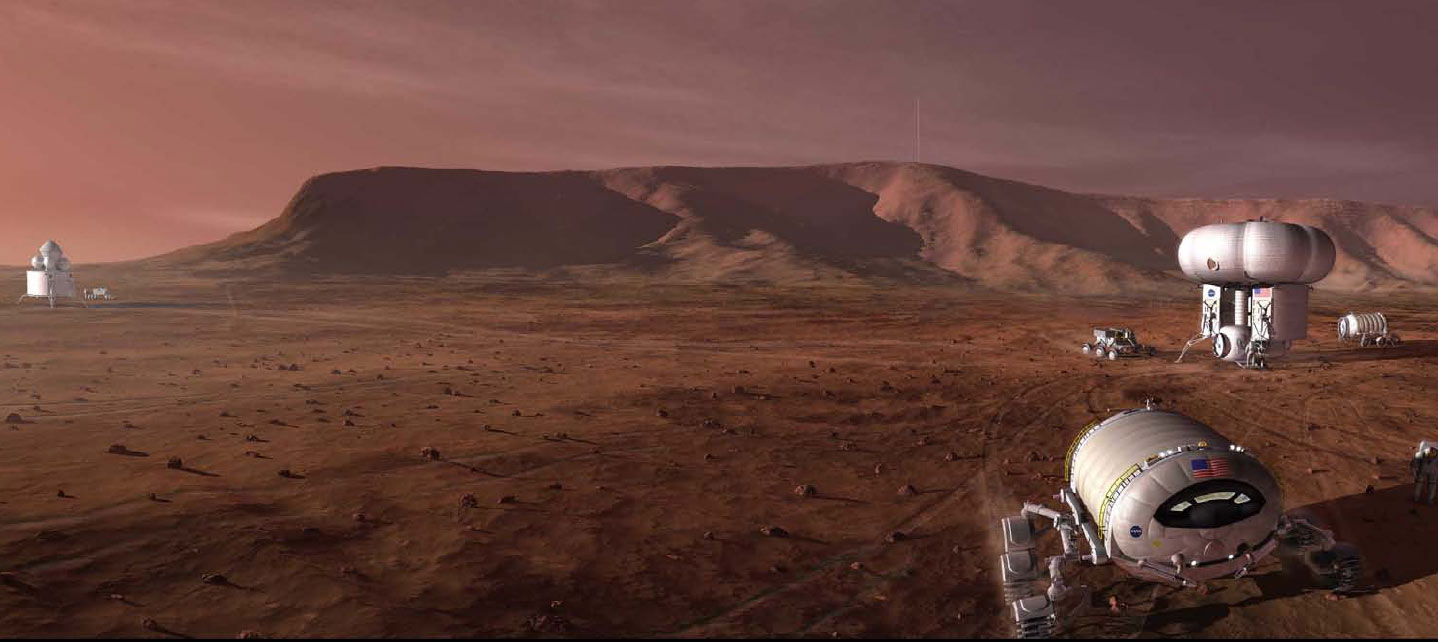
    Mars manned mission. Image credit: NASA

    Getting to Mars is not cheap.  Since the late 1940s there have been many proposals for manned exploration and settlements on mars.  A commonality is that they are all pitched 10-20 years in the future and large sums of money are mentioned.  To put this into today’s context on August 6 (EDT), 2012 NASA’s Mars rover, Curiosity, will land on Mars.  This mission will place an 899kg six-wheeled, un-manned science laboratory on Mars; for the approximate mission cost of US$2.5B.  It is expected that a 2030s NASA mission to Mars will be of the order of US$20B.  Mars One says it will cost them US$6B to put the first four settlers on Mars.

    In many ways focusing on the mission cost is a furphy.  NASA mission budgets come from USA public purses and there is always great argument in the US Senate about the value of such publically funded scientific enterprise.  In the US this argument is always balanced by the technology and enterprise that this brings to US companies and the economy.  Mars One have no such public funding in mind.  They intend to buy the above technologies based on price and quality, not through political or national preferences.

    Colonisation of Mars 2023, Mars One. Image Credit: Ariukux

    The ability to fund such a mission will depend on what value it returns for investors.  Here is the Mars One point of difference; funding will be via sponsorship and as the World’s largest media event.  If I were a settler having ILC Dover and Paragon Space Development would be more reassuring than IKEA on my Living and Life Support Modules.  As for the thought of a 7 months trip to Mars eating McDonalds pre-prepared ‘meals’ that would be unpalatable.  Choose the sponsors wisely Mars One.

    There are no stated scientific or economic goals.  Instead they see it this way:

    “A manned mission to Mars is one of the most exciting, inspiring and ambitious adventures that mankind can take on.  We see this as a journey that belongs to us all, and it is for this reason that we will make every step one that we take together.  This will also be our way to finance the mission: the mission to Mars will be the biggest media event ever!  The entire world will be able to watch and help with decisions as the teams of settlers are selected, follow their extensive training and preparation for the mission and of course observe their settling on Mars once arrived.  The emigrated astronauts will share their experiences with us as they build their new home, conduct experiments, and explore Mars.  The mission itself will provide us with invaluable scientific and social knowledge that will be accessible to everyone, not just an elite select few.”

    To assist in making this worldwide media frenzy Mars One has enlisted Paul Römer as an ambassador.  An established expert on grasping the attention of a global public, he was the co-creator of the worldwide phenomenon “Big Brother” – the television program that revolutionized reality television.

    The 24/7 Martizen lab-rat

    More than the tangibles of this venture, I believe it will be the intangible elements that make this a standout human endeavour.  Especially the ethics and psychology of the Martizen being media fodder 24/7.  A previous article has already questioned the ethics of such, admitedly voluntary, surveillance.

    The psychology of such surveillance is fascinating and worrying.  Even the most extroverted of people have private lives.  Only the totally naive display ‘real’ faces through the public media.  Media such as facebook display a mixture unconscious representations, as well as carefully and foolishly contrived facets of our lives.  In many cases events are morphed and selectively recorded on media such as facebook and twitter.  It is one thing to post to your facebook friends, it is quite a different thing to know that all that you do will be on display for a public you do not know.

    It is hopefully obvious that the narcissist, wastrel, celebrity personalities that populated the many versions of Big Brother are not what will make a great four-person team on Mars.  I also am happy to be labelled an ‘elitist’ and state that public participation via stringent selection processes, such as voting-off someone you don’t like, will be a disaster for a serious mission.

    I am unsure how history’s first off-world conception, birth and death will go as media events.  I can appreciate the lure for marketers of such landmark voyeuristic events, I am at the same time unsure how the participants of such private events will feel.

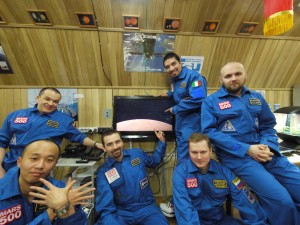
    Mars500 crew. Photo credit ESA

    There is psychologically a world of difference between the isolation that would be experienced in genuine remote exploration, think Antarctica, to the pseudo-isolation of contrived event that has a definite endpoint, think Big Brother and Survivor.  The Marsonauts of Mars500 ended with smiling faces after their 17 month long isolation experiment.   The European Space Agency’s Directorate of Human Spaceflight has a long tradition of conducting research on the physiological and psychological aspects of spaceflight.  In light of this, ESA undertook the Mars500 cooperative project with the Russian Institute for Biomedical Problems (IBMP) in Moscow, in 2010-11.  This all male crew experiment is instructive, and illuminating for Mars One, however no matter how ‘isolated’ Moscow may feel, like the people in the Big Brother household, they could if they chose leave at any stage.

    Despite this a key science project during Mars500 was to determine the implications of personal values held by individual crew-members for compatibility within the group as a whole or otherwise, and for individual coping strategies and adaptation during long lasting confinement.  On a human exploration mission to Mars, the psychological resilience of the crew will play a critical role for the maintenance of health and performance and hence the success of the mission.  One factor impacting on psychological resilience is the personal values of crew members defining their motivational goals and attitudes.  Crew member selection is for real, not a game where if a poor choice is made they leave the set or you re-boot the computer.

    It’s a one-way trip

    That is one clear distinction this is a one-way journey.  Since returning astronauts from the surface of Mars is one of the most difficult, and expensive, parts of a Mars mission, the idea of a one-way trip to Mars has been proposed several times.  The notion of settlers, rather than expedition astronauts changes the technology and psychology of the mission.

    A one-way trip scenario has been proposed seriously a number of times since 1998.  Including a 2004 proposal by Paul Davies.  Another organisation, Mars to Stay, proposed that astronauts sent to Mars for the first time should stay there indefinitely, both to reduce mission cost and to ensure permanent settlement of Mars.  Among many notable Mars to Stay advocates, former Apollo astronaut Buzz Aldrin is a particularly outspoken promoter who has suggested in numerous forums “Forget the Moon, Let’s Head to Mars!”

    During a 2009 public hearing of the U.S. Human Space Flight Plans Committee at which Robert Zubrin presented a summary of the arguments in book The Case for Mars, dozens of placards reading “Mars Direct Cowards Return to the Moon” were placed throughout the Carnegie Institute.  The passionate uproar among space exploration advocates – both favourable and critical – is an indication of the interest in Mars exploration.

    I find the Mars to Stay idea appealing and compelling for both economic and safety reasons.  More emphatically, I find it a representation of the spirit of human exploration and discovery.  Also personally it is a fulfilment of the ultimate mandate by which manned space programs (US, European, Russian, Chinese, Indian, Japanese etc.) are sold, at least philosophically and long-term, as a step to colonizing other worlds.  I hope that Mars One either credibly fulfils this trust or propels alternative programs that deliver human settlement on Mars via a well-defined (i.e. non-suicidal) exploration program.

  • Mars One: The Martian Chronicles or Big Brother Live on Mars?

    Mars One: The Martian Chronicles or Big Brother Live on Mars?


    This week we have seen beautiful Venus transiting directly between the Earth and the Sun, which brought plenty of the media attention, and yesterday one of the greatest science fiction writers Ray Bradbury died during Venus transit. He was best known for his dystopian novel Fahrenheit 451 and for the science fiction stories collection The Martian ChroniclesBoth the Earth and Mars lost one of their most famous citizens.

    Speaking of Venus, Mars, science fiction and non-fiction, I want to share something with you that a colleague of mine drew the attention to, the other day. It is a private space start up from the Netherlands called the Mars One project, whose goal is to send four volunteer astronauts on a one-way journey to Mars. Take a look at the promotional video to get the sense of this endeavor.

    The idea of the privately financed Dutch company is to establish the first human colony on Mars by 2023. ‘’A habitable settlement will be waiting for the settlers when they land. The settlement will support them while they live and work on Mars the rest of their lives.

  • Saving Australia’s Koalas

    Saving Australia’s Koalas

    In an emergency room at Beerwah, Queensland, the phone rings almost 100 times a day.


    The emergency room is one at the Australian Wildlife Hospital, providing veterinary care for sick and injured wildlife — admitting anywhere in the region of 30 different species on a daily basis — with injuries resulting from accidents, acts of deliberate cruelty, or conflict.

    Arethusa came into the emergency room suffering from fractured ribs and internal abdominal bleeding. Frodo came in with a gunshot wound, sustaining a fractured skull and significant damage to the stomach and intestines. Travis and his mother were run over by a hit and run vehicle.

    These four were koalas, but the hospital deals in animals common to the Australian landscape — from Brushtail Possums to Bearded Dragons.

    The koalas themselves, cute cuddly creatures, with a sleepy demeanour, renowned as a representation of Australia have recently been in the news for being endangered and for a curious case of koala chlamydia. Koalas are in serious decline, suffering from many of the effects the veterinarians at the Australian Wildlife Hospital see on a daily basis — as well as habitat destruction, domestic dog attacks, bushfires and disease. The Australian Koala Foundation estimates that there are less than 80,000 koalas left in the wild, possibly as few as 43,000.

    Over the past few years researchers have been distilling and putting together a case to add another reason for koala decline to the list. Roughly 600 koalas per year are seen to at the hospital, and most present with other primary conditions. A number of koalas, however, have presented at the hospital with serious illness associated with regenerative anaemia and now trypanosome infections.

    The trypanosome is a parasite we commonly associate with African Trypanosomiasis (as well Chagas disease). In reality, the trypanosome also infects rats, cattle, and even kangaroos.

    To say little is known about systemic and blood parasites of native wildlife in Australia would be an understatement. Researchers are only just beginning to understand the diversity of trypanosomes in Australian marsupials. Much is still to be learnt. Their evolutionary biology, transmission, and resulting potential impact on the wildlife. The possibility that indigenous wildlife trypanosomes can act as a reservoir for human pathogenic infections is all to be seen.

    What we do know is that, in Australia, the introduction of trypanosomes are as a direct result of human activities. Being almost certainly responsible for introducing trypanosomes from one wildlife population to another. The vector — what transmits the parasite from animal to animal — of Australian trypanosomes is not known. Although, researchers have the flea in mind as the usual suspect.

    To date around 10 trypanosome species and genotypes have been identi

  • The social network of solitary lizards

    The social network of solitary lizards

    Burra, South Australia. Dirt roads link sparsely populated towns and communities once home to copper miners that lived in tiny dugouts along the banks of the creek. Burra is a place capsulated by hot, dry summers and cool moist winters. Across the arid place a grey-brown reptile with short limbs and a large cumbersome head shuffles along the dirt in search of the place it calls home. No other living thing is in sight. For all intents and purposes, this lizard is the last being in existence.

    The Pygmy Bluetongue Lizard is the smallest of the genus Tiliqua and, unlike the other members of the genus, it has a pink tongue. Its home is a vertical burrow constructed by spiders. The bluetongue lizard is generally territorial and lives a  life of solitude. The solitary lizards rarely leave home, and when they do rarely for any great amount of time, taking solace within their holes for many months at a time and rarely encountering a neighbour outside of mating season.

    The lizard’s use of wolf and trapdoor spider holes as a home is only a recent discovery. It really makes no modifications to its lodging, using it for day time shelter, retreat sites for hiding, ambush sites for hunting passing prey, basking sites for thermoregulation, and birthing sites. Really from cradle to the grave.

    At the height of the mining boom, the population of miners living in the Burra region was in the area of 5000, approximately the number of lizards that currently roam the grasslands near Burra today. Bluetongue lizards are now endangered and under threat from climate change, the changing of the natural soil under its feet due to ploughing of native grassy understorey, and — most importantly — from parasites.

    The lizards are host to an ixodid tick, Bothriocroton hydrosauri, and an oxyurid nematode, Pharyngodon wandillahensis. Two parasites that don’t really go out of their way to be parasitic.

    How a host acts can be very beneficial for a parasite or pathogen. Parasites evolve to get the most out of their host… by hook or by crook. Some parasites go to great lengths to change the behaviour of their hosts. The Tom & Jerry dynamic witnessed in Toxoplasma gondii, and zombie ants are the more popular examples.

    One of the challenges of disease ecology in a wildlife setting is to identify and map how different parasites and pathogens spread and establish a foothold within a population. From influenza to measles to HIV to foot and mouth to real or hypothetical diseases, the modelling is all very similar. The patterns of contact among hosts within a population are likely to play a central role in how parasites spread. A good social network is key to any disease transmission.

    Why would the bluetongue lizard make a good animal to study the spread of disease through a population, given its less than social nature? And the more pertinent question of how can a parasite remain successful with an anti-social host? These were the questions that faced researchers at Flinders University in South Australia.

    The spread of parasites is one that often relies on the modification of host behaviour, but in the case of the tick and the nematode, the parasite takes advantage of the lizard’s less than social nature.

    The tick requires three hosts, and each developmental stage of the tick is on a different host. Larvae, nymphs and adult females each attach to a host, feed and then detach. The detached larvae and nymphs then moult to the next developmental stage. Whereas the female lay eggs that hatch into larvae.

    Tick activity and development occur in the spring and summer months when the weather is warm and the lizards are at their most adventurous (lizard activity is at its peak). The tick adopts a ‘sit and wait’ strategy to find its next host. Once detached from its host, it will move less than half a metre to find the next host. It simply waits for the lizard to find it.

    The oxyurid nematode has a more astute strategy. Lizards use their tongues to sense environmental cues, and the bluetongue lizard uses its tongue to inspect scats other lizards use to mark their territory. This is when transmission occurs.

    Both tick and nematode are working against the clock. The tick must be found by a lizard within a relatively short amount of time (40 days). Whereas the eggs of the nematode are thought to have no more than 10 days to find its next host before they die.

    The parasites rely on the more adventurous lizards within the population to be mobile enough to disperse the disease. Those that act as dispersers, wandering from neighbouring settlements. These dispersing lizards behave more cautiously, and are more likely to inspect any scats with its tongue as they move through occupied habitat. And thus, more likely to encounter a parasite.

    These parasites, unlike most, have to rely on the rare occasions of interpersonal contact patterns between lizards. These parasites have to rely on the social network of antisocial, solitary lizards.

  • Connected and Free: World Wide Web professionals at #WWW2012

    Connected and Free: World Wide Web professionals at #WWW2012

    This is the Part II from the highlights of the World Wide Web 2012 (#WWW2012) conference and here are some notes of mine but this time focusing on people, attendants who have been actively participating in the web professionals meeting and their impressions of the conference. 

    Beside numerous tracks, sessions, workshops, and tutorials – the #WWW2012 offered interesting keynotes by the leading and prominent professionals in Web industry, research, and policy. The main keynote speakers were Tim Berners Lee, the inventor of Web, Bernard Stiegler – a director of IRI (Innovation and Research Institute) at the Georges Pompidou Center in Paris, a professor at the University of Technology of Compiègne where he teaches philosophy, Chris Welty – a Research Scientist at the IBM T.J. Watson Research Center in New York, and Neelie Kroes, a Vice President of the European Commission and European Digital Agenda Commissioner.

    I asked some of the many colleagues, peers, and presenters about their preferred event on the World Wide Web 2012 conference, and what presentation/session/keynote/workshop made the best impression on them, and why.  Here are some interesting thoughts.

    New software paradigm, and Social Media in Response to a Crisis

    I’ll start with volunteers at the conference since they had a great job to do and many of them are web researchers, students, and professors.

    Jean-Tiare LE BIGOT: “I am currently studying telecommunications in Lyon (France) and attended the www2012 as a Volunteer. In my spare time, I try to create an archive of network status map.  As a Volunteer, it has been quite tricky for me to choose and attend the presentations. Nonetheless, I had the luck to see all keynotes in the auditorium. As many of the attendees, I appreciated TBL talk on the values of the Web and also the debate of the following day. But the one I preferred was the one by Chris Welty. He talked about IBM’s Watson project and the steps which enabled Watson to defeat humans in the Jeopardy show. I really enjoyed the humor in his explanations when he showed us the biggest fails :). ”

    Watson is an Artificial Intelligence system designed to answer real world questions as in the Jeopardy show or financial/medical world. During his presentation, Chris Welty stressed on point: Machine’s understanding is in no way the same as human’s. This is to illustrate this point that he showed us some failed answer which is obvious for a human being. An example:

    Source

    Cindy Hui:  I am a post-doctoral researcher at the Rutgers University. My research includes modeling and simulation, social networks, social computing, and disaster research. I presented a paper at Social Web for Disaster Management Workshop titled “Information Cascades in Social Media in Response to a Crisis: A Preliminary Model and a Case study.”

     “There were so many interesting workshops and sessions at WWW2012 that covered such a variety of topics, but I mostly attended the ones that focused on social networks and social media since those are my areas of interest.  In particular, I was very excited about the Social Web for Disaster Management and the Making Sense of Microposts workshops since there’s such a growing focus on how to analyze and make use of these community-driven, collective information from various social media platforms. It really brings together people from computer science, social science and policy practitioners, each contributing important pieces to the overall focus.

  • Here be Dragons

    Here be Dragons

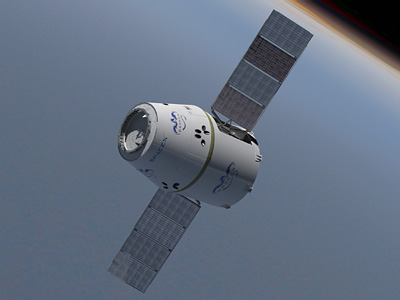
    On May 11, a Dragon will mate with the International Space station.  Rather than some mythical creature, this Dragon is of human artifice.  The Dragon’s rendezvous and berthing with the International Space Station presages a new chapter in human exploration of space.

    The significance of this event is Dragon is a reusable spacecraft, developed, and built by the American company Space Exploration Technologies, SpaceX, as it is more commonly known.  Established in 2002, SpaceX has developed a new family of launch and cargo and crew capsules from the ground up.

    The commercial race to space

    NASA has now “set it sights on exploring once again beyond low earth orbit.

  • These rocks just got a little bit older

    These rocks just got a little bit older

    Have you ever had a moment when person responds to you in a way that just makes you feel a little bit older than you did before?  You comment, for example, about a music group to someone, only to be met with that incredulous stare that conveys the message to you that their parents liked that music, and that you must be a little older than you at first appeared.

    An international research team just gave the Earth such a moment.  The researchers did this, not by experimenting on musicians, rather by measuring the radioactive decay of samarium-146; one of the isotopes used to chart the evolution of the Solar System.

    By using a more precise technique to remeasure the half-life of samarium-146, they shrank the chronology of early events in the solar system, like the formation of planets, into a shorter time span.  It also means some of the oldest rocks on Earth would have formed even earlier.  Some Australian rocks forming as early as 120 million years after the solar system formed.

    Understanding how a seemingly simple measurement, such as the half-life of samarium-146, can have such far-reaching results will take us on an exhilarating journey through many areas of science.

    How did our Solar System form?

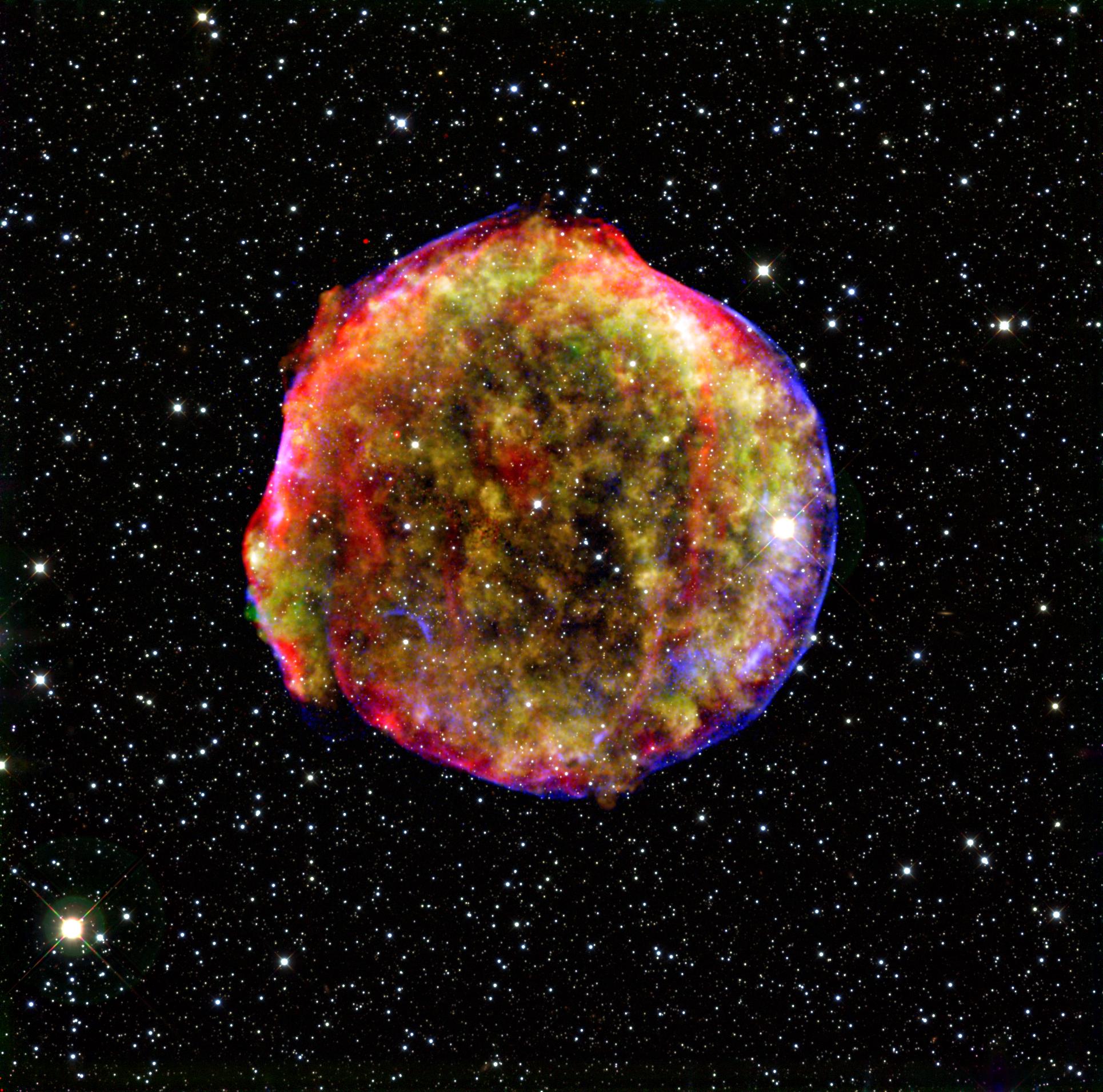
    According to current theory, everything in our Solar System formed from stardust several billion years ago.  Some of this dust was formed in giant supernovae explosions.  These explosions then supplied most of the heavy elements for the objects that make up our Solar System.  The synthesis of the elements we see on Earth, in rock samples from the Moon and Mars, as well as from meteorites and asteroids, is a subject of great interest.  By understanding the physics of the nucleo-synthesis of the isotopes of these elements it has become obvious that the dust and molecules that coalesced to form our solar system came from a number of different processes.

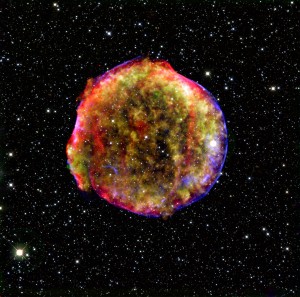
    Multiwavelength composite image of the remnant of Tycho's supernova, SN 1572. Photo credit: NASA/MPIA/Calar Alto Observatory, Oliver Krause et al.

    The formation of the terrestrial planets (the rocky planets Mercury, Venus, Earth, Mars and their respective moons) is generally divided into three major stages based on the different physical processes involved and their respective time scales: (1) the stardust aggregates into planetismals, like individuals forming into swarms of nomadic tribes; (2) then runaway and oligarchic growth of embryos from planetismals resulting several tens to 100 Lunar- to Mars-mass embryos embedded, like mediaeval barons, in a swarm of remnant planetismals; and (3) the final stage of terrestrial planet formation by high-velocity impacts between embryos over a span of ~10-100 million years, forming the planets as we know them.

    The Allende meteorite and the age of the Solar System

    The age of the Solar System can be defined as the time of formation of the first solid grains in the nebular disk surrounding the proto-Sun.  This age is estimated by dating calcium-aluminium-rich inclusions in meteorites.  All chronology, by convention, is referenced to T0, which is the abbreviation for the age of the oldest known solid material in the solar nebula.

    Scientists have found that calcium-aluminum-rich inclusions are some of the oldest objects in the solar system.  These inclusions, roughly millimetres to centimetres in size, are believed to have formed very early in the evolution of the solar system and had contact with nebular gas, either as solid condensates or as molten droplets.

    Relative to planetary materials, calcium-aluminium-rich inclusions are enriched with the lightest oxygen isotope and are believed to record the oxygen composition of solar nebular gas where they grew.  Calcium-aluminium-rich inclusions, at 4.57 billion years old, are millions of years older than more modern objects in the solar system, such as planets, which formed about 10-50 million years after them.

    In recent research, a US team led by Justin Simon from NASA Johnson Space Centre and University of California Berkeley, studied a specific calcium-aluminium-rich inclusion found in a piece of the Allende meteorite.  Allende is the largest carbonaceous chondrite meteorite ever found on Earth.  It fell to the ground in 1969 over the Mexican state of Chihuahua and is notable for possessing abundant calcium-aluminium-rich inclusions.

    Carbonaceous chondritic meteorites are stony meteorites that have not been modified due to melting or differentiation of the parent body.  They formed in oxygen-rich regions of the early, first stage, Solar System so that most of the metal is not found in its free form but as silicates, oxides, or sulfides.  Most of them contain water or minerals that have been altered in the presence of water, and some of them contain larger amounts of carbon as well as organic compounds.  The Allende meteorite is a ‘pristine’ meteorite, so called because its provenance is known.  It was found and sampled under conditions that precluded contamination from terrestrial chemicals and minerals.

    Their findings imply that calcium-aluminium-rich inclusions formed from several oxygen reservoirs, likely located in distinct regions of the solar nebula.  Calcium-aluminium-rich inclusions travelled within the nebula by lofting outward away from the sun and then later falling back into the mid-plane of the Solar System or by spiralling through shock waves around the Sun.

    Through oxygen isotopic analysis, the team found that meteorite material surrounding the calcium-aluminium-rich inclusion show that late in the calcium-aluminium-rich inclusion’s evolution, it was in a nebular environment distinct from where it originated.  This latter region was closer in composition to the protoplanetary disk, the environment in which the building materials of the terrestrial planets formed.  A protoplanetary disk is an area of dense gas surrounding any newly formed star.  In this case, the calcium-aluminium-rich inclusion formed when our Sun was quite young.

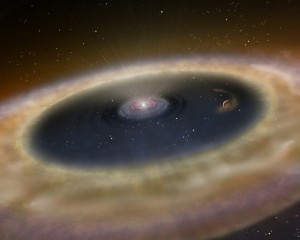
    Artist concept of proto-planets. Image credit: NASABlueshift

    The formation of the Solar System as we know it today, was complex and dynamic process.  The protoplanetary disk evolves through accretion to the star, the particles and molecules being gravitational attracted to the proto-Sun.  Each particle’s attraction was mediated or dampened by collisions, the viscous drag of the gaseous nebula, coupled with an outward ‘fling’ due to their angular momentum.

    Radioactive dating the age of the Solar System

    Timescales of early Solar System processes rely on precise, accurate and consistent ages obtained with radiometric dating.  The relative abundance of different nuclei and their correlation or non-correlation with models of their formation and their radioactive decay provide a series of clocks to determine when and how material was formed.

    Recent advances in instrumentation now allow scientists to make more precise measurements.  Some of these measurements are revealing inconsistencies in the ages of samples as well as clearing up existing inconsistencies.

    For example, recent analysis, by Audrey Bouvier and Meenakshi Wadhwa from Arizona State University, of the meteorite, Northwest Africa 2364, found that the age of the Solar System predates previous estimates by up to 1.9 million years.  They used a radioactive chronometer based on the decay of isotopes of uranium to lead.

    By using this lead-lead dating technique these researchers were able to calculate the age of a calcium-aluminium-rich inclusion contained within the Northwest Africa 2364 chondritic meteorite.  In lead-lead dating the lead isotope, 207Pb/206Pb ratios are measured; these lead-207 and lead-209 isotopes are the decay products of the uranium isotopes 235U and 238U respectively.

    The study’s findings fix the age of the Solar System at 4.5682 billion years old, between 0.3 and 1.9 million years older than previous estimates.  This relatively small revision to the currently accepted age of about 4.56 billion years is significant since some of the most important events that shaped the Solar System occurred within the first ~10 million years of its formation.

    This relatively small age adjustment means that there was as much as twice the amount of iron-60, a certain short-lived isotope of iron, in the early Solar System than previously determined.  This higher initial abundance of this isotope in the Solar System can only be explained by supernova injection.  The researchers believe the supernova event, and possibly others, could have triggered the formation of the Solar System.  By studying meteorites and their isotopic characteristics, they bring new clues about the stellar environment of our Sun at birth.

    This work also helps to resolve some long-standing inconsistencies in early Solar System time scales as obtained by different high-resolution chronometers.  The story is not yet complete, it will be important to conduct high precision chronologic measurements of calcium-aluminium-rich inclusions from other pristine meteorites.  We also need to understand the reasons why the calcium-aluminium-rich inclusions measured previously from two other chondritic meteorites, Allende and Efremovka, have yielded younger ages.

    One significant aspect of this study is that it is the first published lead-lead isotopic investigation that takes into account the possible variation of the uranium isotope composition.  Earlier work conducted in Wadhwa’s laboratory by a graduate student Gregory Brennecka, in collaboration with Ariel Anbar, has shown that the uranium isotope composition of calcium-aluminium-rich inclusions, long assumed to be constant, can in fact be highly variable and this has important implications for the calculation of the precise lead-lead ages of these objects.

    Using the relationship demonstrated by Brennecka and colleagues between the uranium isotope composition and other geochemical indicators in calcium-aluminium-rich inclusion, Bouvier and Wadhwa inferred a uranium isotope composition for the calcium-aluminium-rich inclusion for which they reported the lead-lead age.

    This work can help researchers better understand the sequence of events that took place within the first few million years of the Solar System formation, such as the accretion and melting of proto-planetary bodies.  All these processes happened extremely rapidly, and only by reaching such a precision on isotopic measurements and chronology can we find out about these processes of planetary formation.

    The importance of the half-life of the isotope samarium-146

    As well as the lead-lead dating technique the radioactive chronometer based on the isotope samarium-146 is one of interest for this story.  Samarium-146, or 146Sm, is unstable and occasionally emits an alpha particle, a helium-4 particle, which changes the atom into a different element, neodymium-142.

    As samarium-146 decays slowly—on the order of millions of years—many models use it to help determine the age of the Solar System.  In particular, in models of terrestrial planetary formation, rather than dating calcium-aluminium-rich inclusions in meteorites used in studying early Solar System formation.

    Although samarium-146 decays slowly, it is still short compared to the time-scale of solar system evolution.  For a known number of any isotope type, the number of years it takes for this to radioactively decay by half of its number, is called its half-life.  Since samarium-146 emits particles so rarely, it takes a sophisticated instrument to measure this half-life.  The half-life of samarium-146 allows its use as a determinator of the time between the end of its synthesis in the early Solar System and the inclusion of it in a solid body in the solar system.

    What scientists look for are disparities in the relative abundances of samarium isotopes in terrestrial rocks and in the relative abundances of samarium and neodymium and neodymium isotopes.  The reason for interest in the samarium-146 to neodymium-142 is that the half-life means that samarium-146 present at the time of solidification would no longer be available for observation at the present-time; it all will have decayed to neodymium-142.  Therefore the isotopic composition of neodymium will vary with the amount of samarium, which was present at solidification.

    The researchers remeasured the half-life of samarium-146 using the sophisticated instrument at the Argonne Tandem Linac Accelerator System, Kanazawa University, and the University of Tsukuba in Japan.  What they did was very clever and very precise.

    Firstly, they synthesised samples of samarium-146, in three independent nuclear-synthesis reactions, from samples of isotopically enriched samarium-147.  The different techniques gave analysis samples with different contaminants and samarium-146 levels.  Secondly, they measured the decay of these samples over a period of months using highly accurate detectors.

    The Argonne Tandem Linac Accelerator System was then used as a mass spectrometer, in two different experimental set-ups, to pick out the small number of samarium-146 in the samples, one in tens of billions of atoms.  These measurements took into account contributions from contaminants such neodymium-146, which caused contamination problems in earlier experiments.  Neodymium-146 has the same atomic mass as samarium-146, and in mass spectroscopic measurements they cannot easily be separated.

    By accurately counting the number samarium-146 atoms and tracking the particles that the sample emits, the team came up with a new calculation for its half-life: just 68 million years.

    This is significantly shorter than the previously used value of 102.6 and 103.1 million years of recent (1966 and 1987 respectively) measurements.  At the same time the result is closer to earlier measurements of ~50 million years and 74 million years from 1953 and 1964 respectively.

    A new samarium-146 half-life measurement; now what?

    The new value patches some holes in current understanding.  The new time scale now matches up with a recent, precise dating taken from a lunar rock, and is in better agreement with dates obtained with other chronometers.

    Applying this new half-life to rocks from Greenland and Australia gives them revised ages.  These rocks are now dated to be 50 million years older than previously thought.  That is they were formed only 120 million years after T0, the time of solar system formation, rather than the 170 million years from previous results.  Similarly rocks from Quebec were found to be over 80 million years older than previous measurements.  These are now found to have formed 205 million years, rather than 287 million years, after Solar System formation.  These results illustrate that the events that formed terrestrial rocks occurred at much earlier ages than we even recently thought.

    Analyses of moon rock samples have also shown an increase in their ages, in this case by over 70 million years.  These are now found to have formed 170 and 175 million years, rather than 242 and 250 million years respectively, after Solar System formation.  These new lunar results now bring ages of these rocks, using two different chronometers, the samarium-146 and lead-lead techniques, into the same ranges.

    The early days of Earth and the other terrestrial planets are looking quite different than previously thought.  All this is thanks to some precision measurements of the half-life of an extinct isotope of an exotic rare-earth element, samarium.

  • Weighty thoughts on antimatter

    Weighty thoughts on antimatter

    A pulse of particles speeds into the vacuum chamber.  Positrons, 20,000,000 antimatter particles, clumped in a pulse one nanosecond deep.  Like a silent, angry swarm they are targeted into a porous silica target.  The positrons are confined by a magnetic field, increasing their interaction with the silica.  Some attract electrons and synthesize into positronium, a hybrid unstable ‘molecule’.  Before it can decay the positronium is excited first by a burst of ultra-violet laser light.  Then a second burst, this time in the infrared.  With each excitation the positronium puffs-up. The still bound, positron and electron orbit further and further away from each other.  Decreasing their opportunity to meet.  Increasing the lifetime of the positronium.  Eventually they meet.  They annihilate.  Mutually destructing in a soundless flash of energy.  A pair of gamma rays to remind us of a nanosecond long courtship.

    Producing positronium, binding the negatively charged electron with its antimatter equivalent, the positively charged positron, is not a normal occurrence in our world.  If this experiment sounds a little like science fiction, the reason for doing it is part of an even more exotic tale.  This laboratory experiment is to produce ‘long-lived’ positronium is so that the researchers can measure the effect of gravity on it.  Published in January 2012, this success represents 10 years of hard work for Allen Mills and his team from the University of California, Riverside.

    The positron is the antimatter version of the electron.  It has the identical mass to the electron, but a positive charge.  The researchers are trying to find whether matter and antimatter behave the same way under gravity.  That is, do they weigh differently?  If they find such behaviour it would truly rock the physics world.

    Antimatter.  The idea of it is weird.  The idea of weighing it is stranger still.

    The weirdness of antimatter

    Antimatter has been one of the most fascinating fields of research ever since the prediction of its existence by Paul Dirac in 1929.  Paul Dirac solved the basic equations of quantum mechanics.  In doing so he found their solution implied the existence of antimatter particles.  At the time most physicists, Dirac included, thought the idea was preposterous.

    Within a short time, experimenters looking at cosmic rays bombarding the Earth found particles that behaved like electrons, but with a positive charge.  In 1932 Carl Anderson carried out the definitive experiments demonstrating the existence of the anti-electron, naming it the positron, and being awarded the Nobel Prize in 1936 for his discovery.

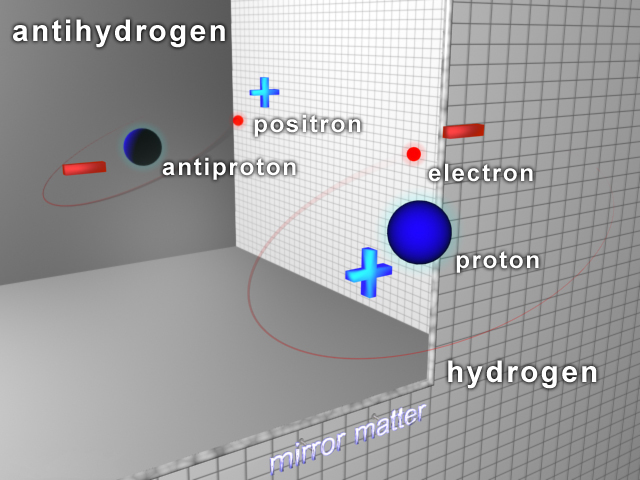
    3D image of Antihydrogen. Source: NSF

    Dirac had postulated in 1931 that each of the fundamental particles has an equivalent antimatter partner.  Furthermore, when matter and its antimatter opposite come into contact they annihilate each other, releasing energy into two equal energy photons.  Their energy is given by Einstein’s famous equation E=mc².  This latter relationship has been much exploited by science fiction writers.  Matter – antimatter reactions powered the star-ship USS Enterprise in the 60s hit TV show Star Trek.

    Work with high-energy antiparticles is now commonplace in physics and materials science.  Anti-electrons are used regularly in the medical technique of positron emission scanning tomography.  Perhaps more importantly, the equivalence model of matter and antimatter has been fully incorporated into the Standard Model of Particle Physics.  Matter particles and their anti-matter pairs have the same mass and equal, but opposite charge.

    The most important point in all of this focusses on when our universe came into being, the Big Bang.  Models of the Big Bang predict that equal amounts of matter and antimatter were formed initially.  Ordinary matter is clearly what our observable Universe is made of today.  Where is the antimatter?  A glaring, niggling, imbalance that begs for an explanation.

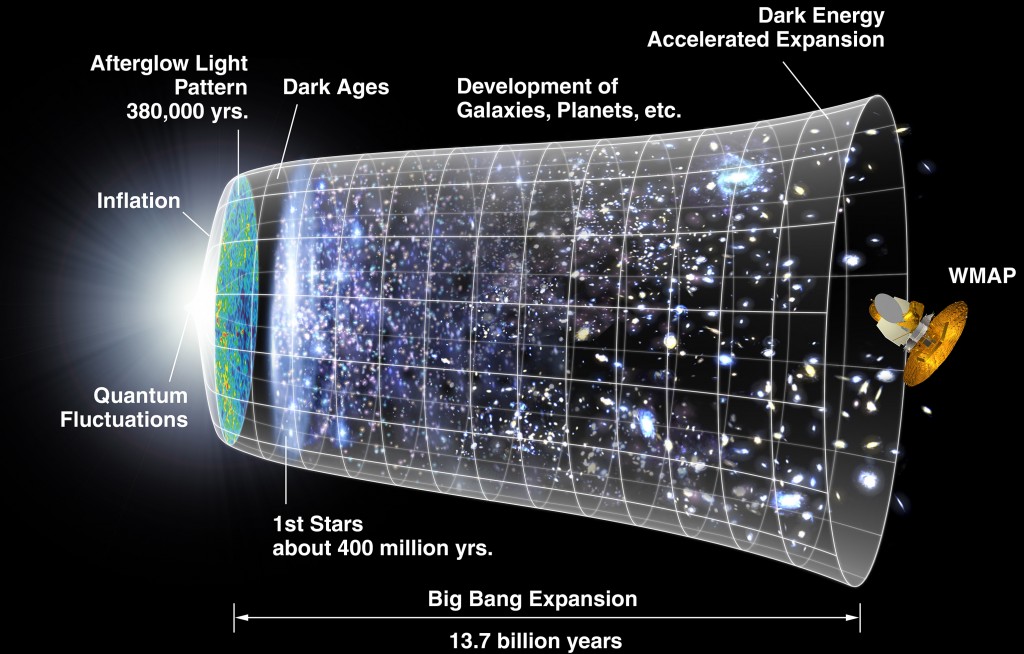
    Timeline of the Universe: Big bang to present time. Source: NASA/WMAP Science Team

    This imbalance could be explained by a slight difference in one of the fundamental properties of particle-antiparticle pairs (such as charge or mass).  There isn’t yet any experimental evidence for such a difference.  Another alternative might be a difference in their gravitational attractiveness.  It is widely expected that the gravitational interaction of matter and antimatter should be identical.  If they were not, then this could explain the preponderance of matter in our universe.

    Elementary antimatter particles naturally occur in radioactive decays and in cosmic radiation.  Some of them, such as the positron and the antiproton, have been studied extensively and even compared to their matter equivalents.  Measurements with charged antiparticles are difficult because gravity is a far weaker force than the electromagnetic force.  The first experiments to measure the gravitational attraction of antimatter were at the University of Stanford and CERN in 1974 and 1993 respectively.  Both used charged antimatter particles.  The experiments were marred by stray electric fields and did not produce satisfactory results.

    Trying to do experiments like this requires precision and reproducible backgrounds.  The world is a rather messy place to measure these relationships.  Neutral positronium, such as in Mill’s experiments, or an anti-atom could be used to test the effect of gravity on antimatter for the first time, because it is immune to stray electromagnetic fields that have hampered the previous studies with charged antimatter particles.

    Does antimatter fall down?

    Understanding gravity has proven to be a little more complicated than falling apples.  To the Greek philosopher and polymath Aristotle, the concept that heavy objects fell faster than light objects was obvious.  His elegant, but fanciful, notion persisted well into the Middle Ages.  The Italian physicist, mathematician, and astronomer Galileo Galilei successfully challenged Aristotle’s impractical theories of motion.  Experiments using the swing of pendulums proved him correct.  Observing their swing rates was more practical than the dropping of objects from the Leaning Tower of Pisa, as Galileo had originally proposed.

    Galileo also put forward the basic principle of relativity, that the laws of physics are the same in any system that is moving at a constant speed in a straight line, regardless of its particular speed or direction.  Hence, there is no absolute motion or absolute rest.  This principle is central to Einstein’s special theory of relativity.

    The key point under consideration here is the correlation between inertial mass and gravitational mass.  This is the correlation between the forces measured on a mass when it is falling under gravity or being accelerated.  The earliest experiments were done by English natural philosopher Isaac Newton and improved upon by the German mathematician and astronomer Friedrich Wilhelm Bessel in the 1820s.

    The problem is that Newton’s theories and his mathematical formulae did not and do not explain the equivalence of the behavior of various masses under the influence of gravity, independent of the quantities of matter involved.  The observation that the gravitational mass and the inertial mass is the same for all objects is unexplained within Newton’s Theories.  The experiments of Galileo Galilei, decades before Newton, established that objects that have the same air or fluid resistance are accelerated by the force of the Earth’s gravity equally, regardless of their different inertial masses. Yet, the forces and energies that are required to accelerate various masses is completely dependent upon their different inertial masses, as can be seen from Newton’s Second Law of Motion, F = ma.

    Precision measurements by the Hungarian physicist Loránd Eötvös originally in 1885, and then again with improved instruments and precision between 1906 and 1909, established the universality of Newton’s law of gravitation.  These were followed with a series of similar but more accurate experiments, these included experiments with different types of materials, on moving ships and in different locations around the Earth.  These experiments demonstrated the equivalence of gravitational and inertial mass for ordinary matter.  In turn, these experiments led to the modern understanding of the equivalence principle encoded in general relativity, which states that the gravitational and inertial masses are the same.

    So far, so good, for understanding the behaviour of ordinary matter.  Rather than disembodied logic alone, the combination of experiment, measurement, and sound reasoning proving to be the correct way to discern the laws that represent reality.

    Gravity is now best described by general relativity.  General relativity is a classical theory that does not imply the existence of antimatter.  In the 1980s a quantum-mechanical formulation of gravity allowed for non-Newtonian contributions to the force which might lead to a difference in the gravitational force on matter and antimatter.

    A number of theories propose how differential interactions between matter and antimatter may be explained.  It must also be pointed out that numerous models and experiments with matter have been used to derive upper limits on the possible differences in the nature of such gravitational attractions.

    Direct investigation of antimatter, experimentally, is characterised by an almost complete lack of data.

    The experimenters

    Allen Mills is not alone in his quest to measure the weight of antimatter.

    In 2011 the AEgIS collaboration at CERN, had funding approved to use antihydrogen to measure any difference in the gravitational force on matter and antimatter.  CERN is Europe’s particle-physics research lab located near Geneva in Switzerland.  Perhaps currently best known for its search for the Higgs boson, the co-called God particle.  The funding scale of the AEgIS experiment (Antimatter Experiment: Gravity, Interferometry, Spectroscopy) is more modest.  It’s goal, to create a horizontal beam of antihydrogen and to study its free fall in the Earth’s gravitational field with a matter wave interferometry apparatus, is scientifically equally far-reaching.

    The quest to create, trap and study antihydrogen is now entering its third decade at CERN.

    In 2002, the ATHENA experiment at CERN’s Antiproton Decelerator was the first to produce copious amounts of cold antihydrogen, the simplest atomic antimatter system.  The ATHENA (AnTiHydrogEN Apparatus) experiment had the objective to produce, to store and to study antihydrogen at extremely low temperatures, at less than 1 Kelvin temperature.  The goal was to compare the energy levels of antihydrogen and hydrogen with extreme accuracy.  The ATHENA set-up was used as a proof of concept in this case for the successor experiment AEgIS.

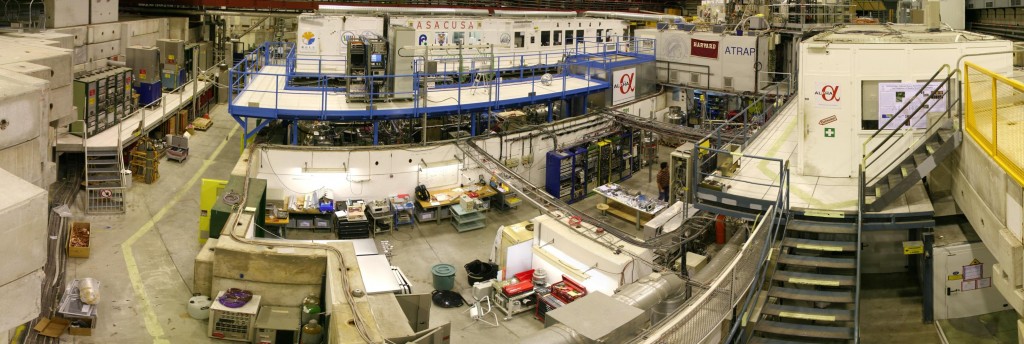
    Experimental area of CERN's Antiproton Decelerator Hall, showing ALPHA experiment. Source: CERN/Mikkel D. Lund

    The antiprotons supplied by the Antiproton Decelerator were trapped and cooled, and brought into overlap with positrons from a radioactive sodium source in a cylindrical Penning trap.  The produced anti-atoms, no longer confined in the charged-particle trap, drifted radially outward and annihilated on the electrodes.  ATHENA’s sophisticated detector allowed the temporally and spatially resolved reconstruction of these annihilation events.

    During the data taking periods in 2003 and 2004, the experimental parameters were optimized in order to maximize the antihydrogen production rate, and the temperature and internal quantum states of the anti-atoms were determined.  ATHENA was not configured to measure the gravitational attraction of antihydrogen.  Data taking with ATHENA has now ended.

    It was collaborators from the ATHENA experiment, along with new groups from other institutes, that have designed the successor experiment, AEgIS, with the aim of performing gravitational studies with antimatter.  The AEgIS proposal was submitted in January 2008 and approved by the CERN Research Board in December 2008.  Construction began in early 2010.

    Meanwhile the CERN group has been building on its expertise for the production and trapping of antihydrogen.  A new experimental collaboration called ALPHA (Antihydrogen Laser PHysics Apparatus) is another successor to ATHENA.  In late 2010 the ALPHA group managed, 38 times to confine single antihydrogen atoms for 172 milliseconds.  At the time the spokesperson Jeffrey Hangst said, “We’re ecstatic.  This is five years of hard work.”

    By July 2011 they had confined seven antihydrogen anti-atoms for 1,000 seconds, extending their earlier results by nearly four orders of magnitude.  To compare with these CERN successes, Mills, in his late 2011 experiment, produced 12 positronium atoms that did not annihilate until they hit the chamber wall.  This journey of a few centimetres takes about a microsecond.

    Based on these results Mills believes he can produce a collimated, long-lived beam for the direct measurement of the gravitational free fall of positronium atoms.

    Kudos and plaudits

    We have in 2012 then, two experiments, both different in their experimental make-up.  Both are trying to measure the gravitational free-fall of antimatter: one using antihydrogen, one using positronium.  Assuming that both will be successful, then one will be used as a confirmation of the results of the other.

    This is how great science is done.  Great scientists are nonetheless people.  People are competitive.  In years to come, the science textbooks will record, and perhaps laud, who was first to measure the weight of antimatter.

  • Space worms

    Space worms

    We begin with a confession. There comes a time in every boy’s life that they realise, or rather they make peace with the fact, that they’ll never play professional sports. Basketball, rugby, football, hockey… the sport of choice changes, but the realisation stays the same.

    I mention this only as an analogy. A segue into the real realisation that matters. I have come to the realisation that I will never go into space. A realisation not fueled from a fear of flying or vertigo or any other physical barrier to space flight (apparently almost half of all the medication used by astronauts are sea-sickness tablets. Sea-sickness in space is such a problem they even have a scale for it. The Garn scale. Did not know that). This realisation, not based on anything tangible and not based on any kind of pragmatism.

    Allow me to explain. As a child of that generation lost between science and science fiction. Born and living through a time when space exploration was not only real — as told through NASA space shuttle launches, Hubble, Discovery, Lunar landers and the rarely mentioned, unsuccessful Beagle II — but also when space exploration was hyper-real. As told through popular culture. A love affair with space, cultivated from TV shows, movies and science fiction.

    After all of this, how could a Space that has been romanticised by popular culture be frightening? How could infinite possibilities, far off worlds and the chance to understand things we haven’t even come into contact yet with… how could all of that be scary?

    The answer: I am a parasitologist. What that means is that for years I have tried to understand the inner-workings of life… in one way or another, through detailed biochemistry, biology at the molecular level, stripping life down to its basic parts and trying to build it back up again. From a basic grounding in biological chemistry I have sought to apply what I had learned to things more relevant and with a more clear goal. I chose disease. Not just any disease… diseases of a tropical and infectious nature. Parasites! Diseases that not only use you, but need you to survive. Diseases that prey on our vulnerabilities as well as our strengths. Diseases that use our patterns of everyday living against us to get what they need. Diseases that go out of their way to change us to help them procreate and survive.

    Apply this to space and you begin to see my problem. Still, hidden within this is a fascination… a fascination predicated on the simple question “what happens when we do encounter alien parasites?