Joanne Manaster is a cell and molecular biology lecturer at the University of Illinois. She currently works as an online course developer and lecturer of science courses for the School of Integrative Biology. Prior to this current position, Joanne has taught histology, cell biology, and tissue engineering laboratories to biology and bioengineering students for nearly 20 years. Beside her academic career, she is a science writer and communicator, science video host, and STEM advocate. Joanne has run a girls’ bioengineering camp, and helped with the iGEM synthetic biology team and other outreach activities. She also makes video reviews of popular science books as well as whimsical science experiments with cats, cookies, gummy bears and make-up.
Welcome to Australian Science! Would you, please, tell our readers a little bit more about yourself? What is your scientific background, and your professional scope?
Thank you for asking me to join you!
I am a faculty lecturer at the University of Illinois. I initially started my college studies with plans to head to medical school but through my course of studies I found I really clicked with cell and molecular biology and was very adept at lab work. Through various opportunities, I also discovered I had a knack for explaining scientific concepts so eventually changed my path to teach at the university level. I studied muscle development at the microscopic level in grad school and eventually transitioned to teaching cell biology and histology.
How did you initially get interested in science? When did you start to express your curiosity for science?
I always loved nature and had a fascination with human health. I spent a lot of time in nature and did a lot of reading on science topics. I didn’t know any scientists. I knew they existed from reading textbooks, but the whole field seemed shrouded in mystery. However, I understood what doctors did and thought that becoming a physician would be a valid way to pursue my passion for science. As I mentioned above, it wasn’t until college that I realized how scientists did their work, and could then consider that as a career path.
It is interesting to mention that you are a former international model, back in the days of your adolescence. Did you find something scientific in the world of modeling and fashion?
As far as modeling goes, I was discovered while I was in high school. Initially, I wasn’t enthusiastic about it but realized it would be a great way to earn money for medical school. While I was modeling, I wasn’t thinking about it in any scientific manner as I was learning to interact with a very new and somewhat foreign world. It wasn’t until I completed my science training in college did I really start to see how science explained just about everything. In my course of teaching students, I also began to see the value in piquing their interest by talking about things they could relate to in terms of science, and that extends to my online outreach!
Would you tell us more about your role within executing online courses for current and future science teachers?
After many years of giving lectures and running laboratory classes which overlapped with my online outreach, I realized that I could apply my ability to communicate online to my instructing position so I transitioned to teaching cutting edge biology through my online program for middle school and high school teachers who want to obtain their Master of Science Teaching. I have designed and executed three courses for this program so far: The Human Genome and Bioinformatics, Evolution and Medicine and Emerging Infectious Diseases. I enjoy mixing primary scientific literature with popular science communication to both train the teachers and to give them resources for their classrooms. Teachers make the best students!
You have a very unique approach for science book reviews using video as a format for presentation, encouraging everyone to read. Other videos are an interesting and whimsical introduction to the world of science disguised in everyday items. How did you get inspired to make such videos?
Book reviews are a natural for me. I love to read and I love science! The gummi bear videos began from a question asked by one of my college students. He asked if a gummy bear could be liquefied through the process of sonication (using high frequency sound waves). I then considered how I could subject the gummy bears to other lab techniques!
One of my favorite videos is Cats In Sinks, which was inspired by a fun website that showed numerous cats in sinks and it made me think I could talk about theoretical vs. experimental science by trying to figure out how many cats could fit in my large lab sink.
I also really enjoyed using cookies as my models of blood cells to create a series about those cells called “Blood Cell Bakery
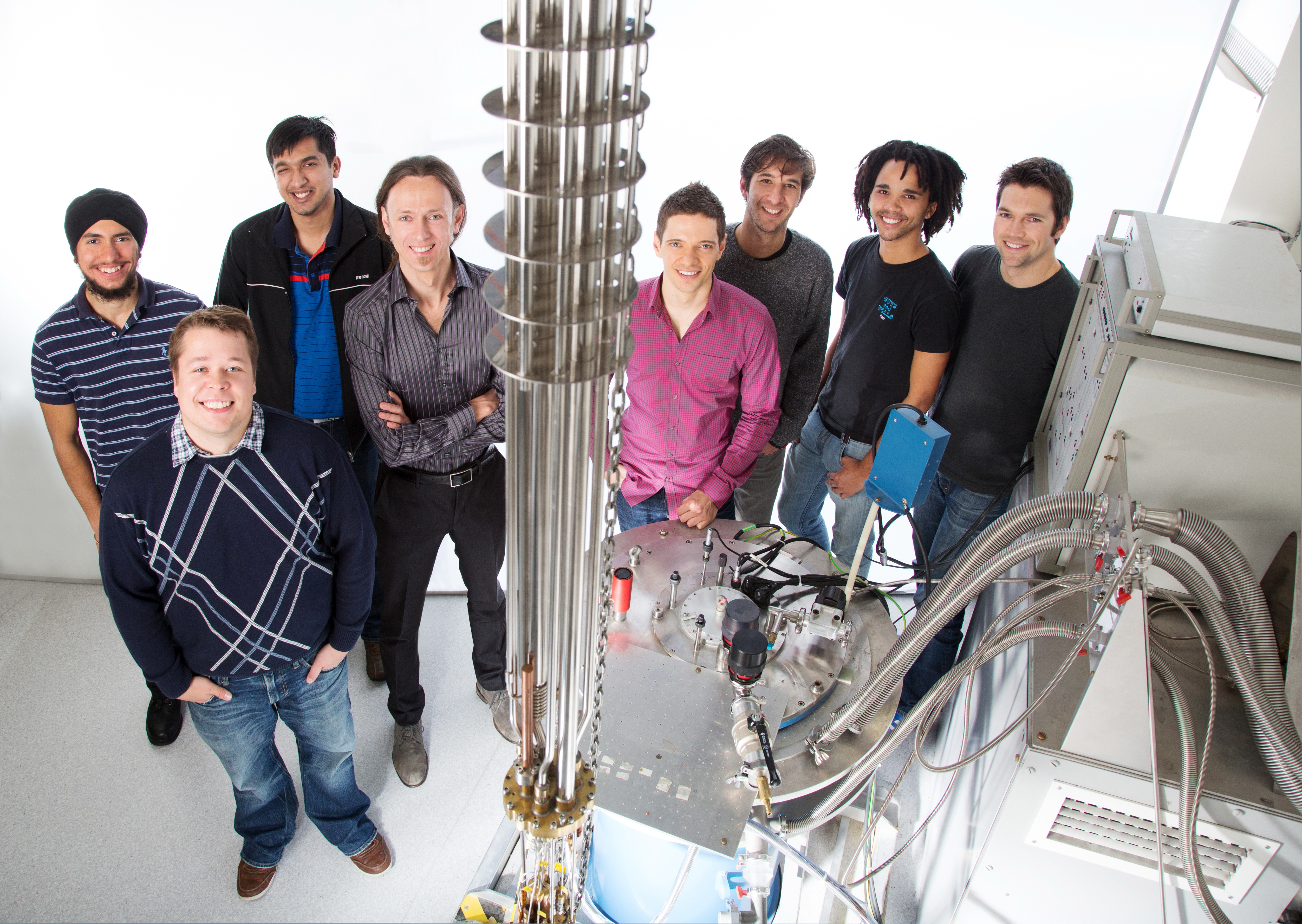
Let us introduce you a leading Australian quantum physicist and probably one of the most promising scientists in the world. His name is Andrea Morello. He is an electrical engineer and a quantum physicist. At the moment he is Associate Professor in Quantum Nanosystems at University of NSW and a Program Manager in the ARC Centre of Excellence for Quantum Computation and Communication Technology (CQC2T). His research is focused on building a quantum computer based on single spins in silicon. In addition to the research, Andrea is actively engaged in science outreach and education. So, let’s start with our talk.
(1) Well, Andrea, we had a brief conversation before this interview and you introduced something about the projects you work on. Could you, please, take a closer look at what you do and explain to our audience what a quantum computing is and how quantum systems work?
A quantum computer is a machine that performs calculations, but stores and elaborates the information into “quantum-bits
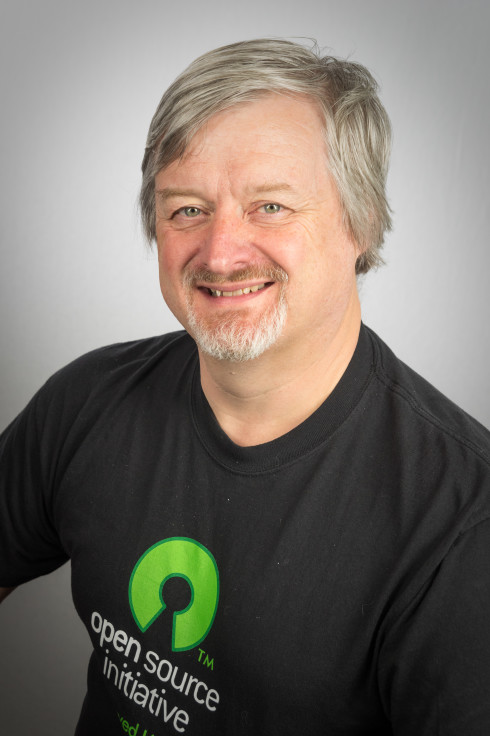
One could call Simon Phipps a real eclectic geek, having in mind his background and activism globally: from campaigning for digital liberties, open data, open source software and political transparency, through his columns at InfoWorld to presidenting at the Open Source Initiative.
Simon studied electronic engineering at the University of Southampton, after which he worked for IBM, being involved in introducing the Java programming language, then he was leading Sun’s open source projects for Sun Microsystems – where he also worked on open source licenses. When Sun Microsystems and Oracle merged in 2010, Simon joined ForgeRock startup as Chief Strategy Officer. Now, he heads his own consulting company, Meshed Insights Ltd.
He is the president of the Open Source Initiative (OSI) since 2012 – the non-profit organisation that advocates for open source software and builds bridges between open source communities and maintains the open source licenses. Also, he is a board director at the Open Rights Group in the UK and on the advisory board of Open Source for America.
Simon has been giving talks at many conferences on open source, free software, digital rights, etc. I had a chance to meet Simon couple of years ago in Oxford (UK), at the Transfer Summit conference on open innovation, development and collaboration, and ever since I’ve been following his work online and offline.
Welcome to Australian Science. Would you, please, tell our readers a little bit more about yourself? Where do you come from, both geographically and philosophically?
I’m originally from south London but have lived in Southampton for 35 years. I’ve been programming computers and making electronics since I was a teenager, with other interests in general science. I’ve always been fascinated by networks and the capacity for action at a distance, so my career has embraced many aspects of both.
Back in the days of Sun Microsystems, you were leading Sun’s open source projects, and later got involved in the Open Source Initiative. How did you initially get interested in open source software?
At one point I ran a company that helped programmers create and distribute software as Shareware. I realised most people who use software could be trusted to support the developers behind it; our business was successful as a result! That opened my eyes to the deeper reality that underlies open source software. If you remove the obstacle of needing permission to contribute, a community will naturally collaborate to create what they need individually and share it with everyone else. So when I arrived at Sun from IBM, I already believed that open source was a crucial part of the new society emerging because of the Internet. At Sun I was privileged to oversee the relicensing of pretty much the whole of Sun’s software portfolio, including Java, identity management, Solaris, and much more. The legacy we created is still important, especially the code that has ended up as LibreOffice and the ongoing releases of Java under the GPL.
Would you explain to our readers what do Open Source Initiative (OSI), beside promoting open-source software, do for the Internet, science, research, and academia?
OSI was formed in 1998 as the steward of the then-newly-coined “Open Source
Henry Story studied Analytic Philosophy at Kings College London, Computing at Imperial College, worked for AltaVista where he developed the BabelFish machine translation service, worked at Sun Microsystems on Blogging platforms and the development of the Social Web where he developed the decentralised identity and authentication protocol known as WebID, which is under standardisation at the W3C (World Wide Web Consortium). He contributed to the Atom syndication format at the IETF (The Internet Engineering Task Force), to the Linked Data Protocol at the W3C, and is currently writing an Open Source platform for co-operating systems in Scala based on all those standards.
Henry has been giving talks on the philosophy of the Social Web at the Sorbonne University, and various other places. We took a moment to have a conversation with Henry on very interesting topics – from the early years of the World Wide Web, first search engines, Semantic Web, metadata and ontologies, to the current initiatives within the Web Consortium (W3C), WebID Incubator group activities and its impact on the scientific research.
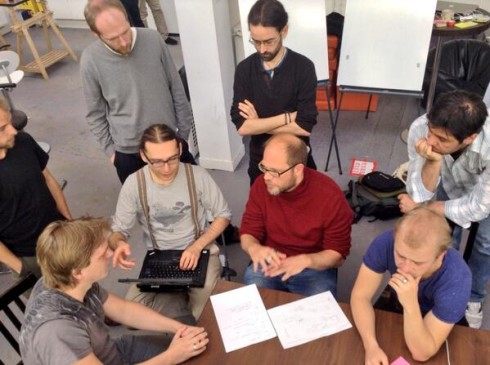
Henry in red at the OuiShare labs workshop in Paris in May 2014.
Welcome! Would you, please, tell our readers a little bit more about yourself? Where do you come from, both geographically and philosophically? What is your scientific background, and your professional scope?
Hi, thanks for inviting me over. My background is one that crosses frontiers: both geographic/national ones as well as disciplinary ones. I somehow found myself at the intersection of philosophy, logic, programming, web architecture, standards and social networks development and recently startup creation. Furthermore my work has been more and more about exactly this: how to help people co-operate across such disciplinary boundaries in a global open manner.
To help make sense of this tangle it helps to go back a little bit in time. My father is English and received his PhD in Washington DC, my mother is Austrian and a sculptor, and both lived in France where my father taught until recently political economy at the INSEAD Business school. That explains the geographical/national tangle.
INSEAD is also where I learnt computing on a DEC 2020 around 1980 as I was 13 or so. I wanted to ask the computer how to solve the Rubix cube. Of course I was told that it would not be that easy. I had to learn to communicate with the machine and learn how to ask the question. This lead me to learn the programming language Basic, and soon after that Pascal which was a revelation – no GOTO loops needing rewriting whenever a new line was added to the program – just procedures. So I wondered what could there be that was better. I discovered Lisp which made it easy to conceive of a program that could write itself, and from there the questions of Artificial Intelligence and so of philosophy started to open up.
I could see around 1984 the beginnings of the internet appear as I went to the Centre Mondial in Paris that had Lisp Machines available and connections to 4 different centres around the world.
But at the time computers were changing too quickly – I was stunned when I saw the 1984 Apple Macintosh in a shop window, and how it had left the terminal behind for just a graphical interface – so I decided to learn something which seemed more stable and took maths, physics and English literature for A levels (in the UK) and then later analytic philosophy at Kings College London, which was the philosophy that emerged out on the work by Frege and later Bertrand Russel of mathematical logic. I returned to computers to do a MSc at Imperial College later, where I learnt about Unix, Prolog, Agent Oriented Programming, Functional Programming, and Category Theory. At the time I was wondering how all this would come in useful. How would they tie up together? It turns out that in my work on building a distributed decentralised secure social web what I learnt in philosophy as well as what I learnt at Imperial College are all immensely relevant. Indeed in the last few years I have been giving talks on the philosophy of the Social Web at the Sorbonne, and various other venues that do just that.
At the time I did not know it. At Imperial College we had participated in the early stages of the Web. We were using Sun workstations, publishing web pages, and I even saw the birth of Java, the language that promised to allow one to write code that could run on every computer – a must for distributing programs on the World Wide Web. Its success was assured as it was released with Netscape Navigator in 1995. I learnt it, wrote a little Fractal Applet for my homework, put it on my web page, and flew to San Francisco to the first JavaOne conference. In the UK most job agencies had either not heard of the web, or had no access to it. But in California it was completely different. When I told a student at Berkeley about my Web page he asked me for the URL, had a look at it on the spot and suggested I go to the WestTech conference in San Jose. There were 400 tech companies there looking to employ young people – the biggest equivalent in the UK I had seen was a job fair with 40 companies. As I was about to leave a few days later I received a call from AltaVista the top search engine at the time which had indexed 50 million web pages (!) which was a lot at the time. The web was growing exponentially as every person who wrote a web page linked up to other web pages they found interesting hoping to receive perhaps a link back in return, and so make their page visible on the web. This turned every publisher into a web advocate. I went to the interview and got the job. Finally I was back in the US 28 years after I had left it as a child of 5.
This one is very interesting for those who remember the early days of World Wide Web and the first translation engines. In the 90’s you worked as a senior software engineer for AltaVista on the BabelFish machine translation service. What happened with BabelFish?
Yes, at AltaVista, Louis Monier one of the founders with Mike Burroughs, presented me with the project to adapt the Systran translation engines as a web service. Those translation machines had an old history. In the 1960s they were written in assembly code – the low level code machines understand – and had slowly been ported to C, a low level but more easily portable language which operating systems are written in. But they were not designed to be run on the biggest web service at the time, with potentially 100s of thousands or even millions of users.
As the translations were not always that good I played on this weakness by naming the machine babelfish.altavista.com, in reference to the character from the BBC Comedy Series «The Hitch Hikers Guide to the Galaxy»: a fish that when placed in a person’s ear could feed on brainwave energy and translate every known language in the universe. I pushed out a quick version, and it was immediately very successful. Then I spent a lot of time trying to write a more advanced version in Java, but the compilers at the time produced code that ran much too slowly. Finally around 1999 big speedups arrived making it competitive with C, and it was possible to launch the final version of the servers, and move up to a million or 2 translations a day.
AltaVista’s big advantage initially was Digital Equipment Corporation’s 64 bit machines, that were 10 years ahead of Intel, allowing massive and efficient indexes to be built. AltaVista started by fetching the initial pages of Yahoo a human built directory of interesting web pages, retrieving links to pages, then fetching those, and so on recursively. It would then index all the words it found allowing users to instantaneously find information on the web. Sadly AltaVista never was able to take full account of the links between the pages to help with the ranking. Google worked out how to use the information that each web page author published when he links a web page to another one, thereby voting for it in a sense. Using the collective intelligence of the World Wide Web, Google came to produce more and more relevant results, overtaking AltaVista in 2001 as the largest search destination in the World.
Furthermore AltaVista was constantly undermined by management changes. First it was bought by Compaq (which was later to be bought by HP), then it was sold to CMGI which popped in the dot com bust of 2001, was then bought by Yahoo, and finally Yahoo closed it recently. I left well before in 2000 to join a translation startup, then came back to Europe.
In the end these hand written translators were overrun by Google’s translators tuned by statistical algorithms working on massive amounts of published text available on the web or scanned from books.
Also, you’ve been working on the Semantic Web since 2004 at Sun Microsystems. Semantic Web explorations and practical implementations were so popular, what happened to Semantic Web?
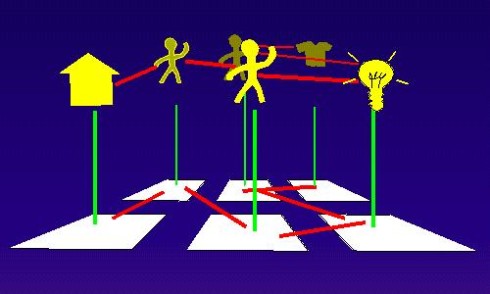
Tim Berners-Lee the inventor of the Web, first spoke of the Semantic Web in 1994 at the first World Wide Web conference, as a way to enable the web to not just be a web of linked human readable pages, but also a web of linked data. As the web was a hyper-text system, so the semantic web could become a hyper-data publication platform allowing people to connect data across organisational and national boundaries.
Tim Berners Lee’s www 1994 slide on the semantic web
The first RDF standards appeared in the period 1999-2001. Blogging, one of the first applications of RDF, was started at the end of the millennium, and growing at exponential speeds. Around 2004 I had some time for myself and decided to write a blog. I found that James Gosling – the father of Java – had written and Open Source blog editor called BlogEd. I used that, fixed some bugs in it, then adapted it with a local RDF store. As a result he offered me a job at Sun Microsystems which I gladly took.
Sun Microsystems was a great company that had produced in 1981 the first colour graphical work station running Unix, the internet operating system, based on open standards that had emerged from the break up of AT&T. In 2004 Sun was emerging from the dot com bust, and was facing strong competition from Linux, the open source Unix clone developed in a distributed manner by a world wide community of engineers, which powered Google’s servers since the beginning, and was making inroad everywhere. But Sun had produced some of the best technology around, created a huge Unix and Java community. The CEO Jonathan Schwartz in a bold move had decided to move all of Sun’s code Open Source to compete with Linux. He also allowed and even encouraged us to all blog online, so that we could present a human face of what was a research focused engineering company.
What did blogging add to the web? In short it allowed everyone to publish information and let others know through a syndication feed (RSS then Atom a.k.a RFC 4287, which I contributed to) to subscribe to their updates. This allowed increasing distribution of content publication, allowing everyone to get the latest updates from their preferred authors world wide without needing to wait for the search engines to index those pages, a process which could potentially take months to reach updates, as they had to crawl the whole web for content.
Another very interesting application of the semantic web was FOAF – the Friend of a Friend ontology, put together by Dan Brickley and Libby Miller, and that was evolving in a friendly open source manner through open online discussions. FOAF allowed one to publish one’s profile on one’s web server, and link one’s profile to that of one’s friends who also published it on their web server. So just as with blogging and the web, everybody could participate in a distributed social web.
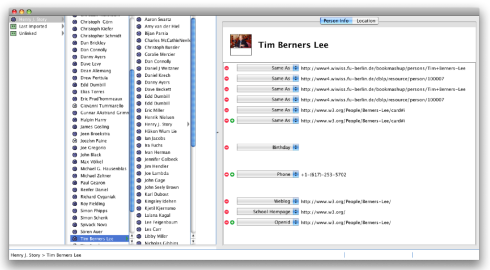
I wrote a distributed Address Book called Beatnik (take a look at this video), which made it easy to see how one could drag a FOAF profile from a web page onto the address book, and it would show you someone’s friends. You could then click on one of the friends to find their name, photo, contact information find out potentially where they currently were on the globe and follow explore their friends. All of this was totally distributed.
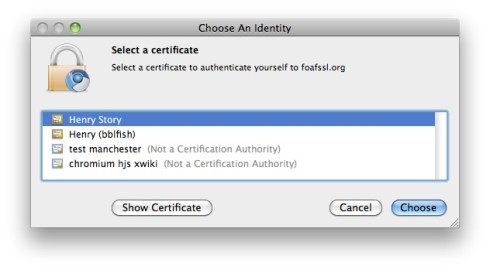
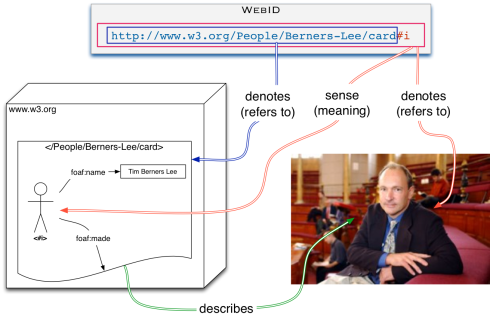
But at the time Facebook was starting to grow and people wanted privacy too. So the criticism I received was that this was all and good for publishing open distributed social networks but that one could not publish confidential information. To do that one needed a global identification system, so that one could connect to any web server one had never before gone to, authenticate with a global identifier, and be then given access to the resource if allowed. There was a standard for doing this that was gaining traction called OpenID, but OpenID was very slow requiring 7 http connections and required the user to type a URL in by hand. Having worked on large sites such as AltaVista this seemed to me very inefficient. I wondered if one could reduce those 7 connections down to one, while also removing the need for the user to even type anything. I asked around on the IETF mailing lists and by luck a few people answered, each one with a third of the solution. WebID was born. It allowed us to use TLS the security system used for commercial transactions on the web and built into every browser to enable authentication in one click to any web site securely using public key cryptography.
What we found was a beautiful hack to transform a system that was up to then used in a purely centralised manner, into a purely decentralised one. Usually client side certificates require one to have a certificate authority to sign the users information. This is expensive, cumbersome, not very flexible, and on the whole not even as trustworthy as it should be. WebID bypasses the certificate authority, and moves trust to the Social Web of published relations between people.
Would you explain to our readers a bit about the W3C WebID Incubator, for those in the science and technology who may not be familiar with the Incubator? Would you tell us more about your role within W3C WebID Incubator group?
We initially developed the protocol on an open mailing list called foaf-protocols. There we tested the ideas by listening to feedback from implementors from every walk of life. In a few years we had verified that this indeed could work correctly. We found the weaknesses in certain browsers and sent them bug reports. We slowly improved the description of the protocol. But as it became clear that it was workable and that we had nearly a dozen implementations we thought it would be time to go through a more formal process, and create a more formal looking document that would give people confidence in it. There the unofficial mailing list was no longer the correct venue.
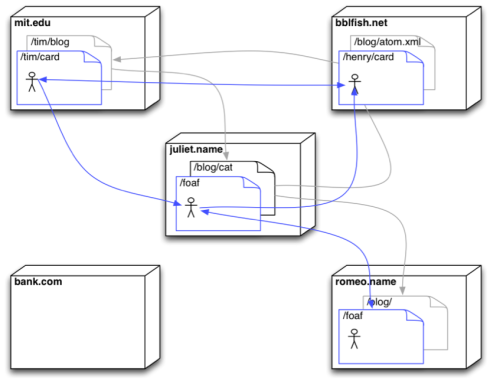
Very early on I had sat down next to Tim Berners Lee to show him what we were calling at the time foaf+ssl protocol, and he immediately understood it even suggesting we use the name WebID. Tim had some of his students use it to work on developing a big picture of what this was leading to, which he called Socially Aware Cloud storage. So later when we asked him if we could have a space on the W3C to put together a standard for WebID. He approved completely. Nevertheless there are a lot of standards for identity competing for each other, and so this was a bit of a political mine field, and we settled for a low profile Incubator group status of which I am the chair.
Can you share with us some personal notes regarding the WebID Incubator, any challenges you faced along the way, and the outcome?
The beauty of WebID is its simplicity. So my role as the WebID Incubator group chair has been to try to keep it that way. I think small standards that do one thing well but that are designed to compose with other standards work best.
There was a lot of pressure by some folks who came in later to make things much more complex. Usually when one looks closer at those protocols, that complexity hides some centralising architectural presupposition, a number of security issues, or wishful thinking as to how things may work.
I did make a mistake initially by allowing myself to be argued into making WebID more general than it needed to be. It felt nice: it felt like we could have a standard that would encompass all identity systems. This is an easy mistake to make. It is one thing to design a protocol to make it easy to generalise, but it is another one to make it so general that it is difficult to implement. And initially what is needed is to keep it simple and clear so that implementors can follow a spec to write an implementation that works. Vendors often have an opposite need in that the more complexity they can manage the more they can distinguish themselves (they can tick more boxes on their software features set). This is where the rough consensus and working code mottos of the IETF and the W3C are key. A standard comes from having interoperable implementations written by different organisations that may not even know of each other’s existence. If nobody can implement the full standard, then it is not well specified enough.
So under the good advice of Tim Berners-Lee a couple of years ago we decided to return back to the roots and create two specs, one that defines what a WebID is independently of authentication, and another that defines the WebID over TLS authentication. This means that we can get WebID to work with potentially other authentication mechanisms such as BrowserID (now called Mozilla Persona) that was a rising star a few years ago, but has run into trouble because it only had the promise of being decentralised sometime in the future, perhaps….
It now ties in very nicely with a number of emerging standards at the W3C such as:
•The Linked Data Protocol: is a standard to turn the web into a read/write web that has been Tim Berners-Lee’s ambition since the beginning. It takes the best of WebDAV and the Atom protocols that came before it, but simplifies them by integrating them in the semantic web. The Linked Data Protocol is being worked on by IBM, Oracle, Fujitsu, and a number of other companies. I represent Apache there, and probably had one of the first implementations of it, which I worked on with Alexandre Bertails of the W3C that was part of a proof of concept that led to the formation of the Working Group.
•Web Access Control: is a simple ontology and a pattern of linking a resource to it so that a client can (if allowed to) work out who has access to a resource and edit (using LDP) the access control rules which are themselves expressed in RDF. Authentication can be done with WebID over TLS, or other methods. This is still just a wiki page but it has a number of implementations.
Finally, what are you currently working on? Where do you see this leading to? How do you see this impacting the scientific research?
We have now the standards to build a platform for distributed creation, edition, and protection of any kind of information resource be it textual, image, video or data on the web, in way to allow the whole world to connect in ways only dreamed of until now. This of course opens up huge spaces of possibilities in every field.
We have built an implementation of this in Scala, a very interesting programming language that compiles to Java byte code or to JavaScript (with Scala-JS), available under an Apache licence on the read-write-web GitHub repository.
Scala is multi-paradigm programming language that mixes Object Oriented and Functional concepts, which in a world where Moore’s law can only continue progressing through parallelization is becoming essential. Consider that Sun’s latest CPU the T5 cpu contains 16 cores for a maximum of 128 threads per processor, for a total of 1024 on an 8 socket system. Old style Object Oriented programming with mutable objects requires complex systems of locks that are prone to dead-locks. Here mathematical programming which is what functional programming is all about is the cure. By working with non mutable data structures (objects) in a functional way that composes – hence the importance of Category Theory which is the study of such composability – one can guarantee that code can be parallelised.
With the advent of LDP+WAC+WEBID we now not only have paralellisation inside one CPU but now across organisations, where our servers potentially have to communicate constantly with 1000s of other servers. Here again the functional nature of Scala makes asynchronous programming vastly more efficient than traditional thread based programming, saving GB of RAM just to process connections on the internet.
With the advent of Scala-JS we can now envisage writing code that works inside the web browser as well as on the server. So we have now come to build a fully distributed agent platform with declarative and inferential semantics (RDF), speech/document acts (LDP) powered by functional programming languages, bringing together all the fields that I had studied twenty years ago at Imperial College in London.
This platform will allow researchers to connect up seamlessly, link up different data sets together, tie articles to the data sets they were based on, link research up with enterprises, banks, governments and individuals in a seamless manner, whilst still always allowing divergence of opinion and subjectivity to remain, and without the very real danger of polical/economic control that centralised networks present.
The big project is now to re-build all the tools that we have to work with this platform, to create easy user interfaces that need to be aware of the subjectivity of information, so as to allow anybody to always ask about any piece of information: where did this come from? Who said it? What was it the logical consequence of? It should be possible to take different points of views on data: skeptical, trusting, etc… to see what kinds of possibilities are entailed by it.
At present we are busy building a platform for co-operating systems using all the above mentioned standards and tools. The platform is open allowing students, researchers or anyone else to join us on the read-write-web project. We are already working with non-profit organisations such as the French Virtual Assembly that are connecting a number of non profit actors in a network based on a concept they call ‘pair to pair’ where pair stands for project actor idea resource.
Thank you Henry for taking your time to talk with me. Thank you for the Interview!
Lana Ostojic is a young applied science professional with the real-world experience in criminal forensics. She is a researcher at the Research and Development Department at the Office of Chief of Medical Examiner (OCME), NYC. Lana is also a PhD candidate at the University of Belgrade, Faculty of Molecular Biology and Physiology. Her primary field is molecular biology and physiology. Recently, July 2012, she got in house OCME creativity award for developing an interesting new method where organic glue is used to collect cell samples for forensic purposes in a much more efficient way than the traditional methods.
Welcome to Australian Science. Would you, please, tell our readers a little bit more about yourself? Where do you come from, both geographically and philosophically? What is your scientific background,and your professional scope?
I think my early childhood experiences shaped my passion for learning and work ethic at a very early age. My family has lived for 3 generations in Vukovar, Yugoslavia, currently known as Republic of Croatia. Having withstood the bombing of Vukovar in WWII by Allied forces, and rationing that followed, my Grandmother instilled in me at a very early age to make the best of what you have and to be resourceful. This is a lesson I would learn firsthand at age 9 when bombs fell again in Vukovar in 1991 marking the beginning of a bitter and bloody civil war. We left our classroom as tanks rolled in our streets and fled to Belgrade. There I found a supportive academic culture of learning to be fascinating and quickly immersed and excelled in a school specializing in Math and Sciences, achieving the maximum grade point average. The bombing would fall again as I applied to Universities as NATO cruise missiles and fighters took aim on Belgrade leveling bridges and power plants. Despite the difficulties of an economic embargo, I was accepted under a rare full scholarship grant program by Belgrade University specializing in Molecular Biology and Physiology. After graduation I was granted an opportunity to continue my work at the University of Milan to conduct research on a skin cancer, it was fascinating to work in the presence of such talented scientists. I accepted an opportunity to immigrate to the US under resident status to work at the Office of the Chief Medical Examiner in NYC as a Criminalist. There I specialized in the applied science of DNA testing for a Crime Lab along with testifying in court as an expert witness on behalf of the District Attorney. It is fascinating work with many more advancements in forensic science yet to be applied. So to reflect back on what drives my interest in my field of applied science, I have to say that helping people through Science is rewarding for me, especially if it means someone life will be saved or justice will be served because of my work.
Would you explain to our readers a bit about Department at the Office of Chief of Medical Examiner (OCME), for those in the science and technology who may not be familiar with the Office?
The City of New York Office of Chief Medical Examiner investigates all sudden, violent, or unexpected deaths in New York City, performs pathologic examinations necessary to determine cause and manner of death, identifies decedents, provides for the disposition of unclaimed human remains, and performs forensic anthropology, toxicology and DNA analysis as appropriate. The OCME houses the country’s largest public forensic DNA laboratory, and is a leader in technology and research. The Department of Forensic Biology is staffed by more than 150 forensic scientists, performing DNA testing on biological evidence from all types of crimes committed in New York City. The lab is widely regarded for utilizing progressive methods and generating exceptionally high quality results. The OCME is the only public forensic laboratory in the nation accredited to perform High Sensitivity DNA testing on samples from which very small amounts of DNA are recovered, and is one of the few public forensic laboratories in the nation that performs mitochondrial DNA testing.
The Office of the Chief Medical Examiner in New York City. Credit: http://www.perkinseastman.com/project_2400273_new_york_city_ocme_dna_forensics_biology_laboratory
What’s your main role at the OCME?
At OCME I have a double role, being a Criminalist and being a research scientist. As a Criminalist I am examining the crime scene evidence for the presence of the biological material. I am involved in entire DNA testing process, analysis and interpretation of the results along with testifying in court as an expert witness on behalf of the District Attorney Office. As a research scientist I am helping developing more sensitive and effective methodologies for DNA testing process.
Do you collaborate with similar organisations/institutions worldwide in the field of the criminal forensics ? Would you tell us more about your involvement within projects in the Office?
OCME is an independent agency. Our collaborations are more involved in sharing scientific knowledge and experiences with other institutions that conduct forensic DNA testing worldwide. Many of our employees are also faculty members at New York City’s colleges, which allow us to extend our facility as a resource to accomplish graduate degree work for students at our research and development labs. The major focus of OCME is casework rotation. Criminalists, such as me, working on casework rotation aim to generate DNA profiles to identify the source of biological material found on crime scene evidence. Storing eligible DNA profiles in CODIS (Combined DNA Index System) which is primarily managed by FBI (Federal Bureau of Investigation), we are helping solving other crimes in reminder of NY state and other states of USA. As a research scientist I am co-investigator on an NIJ funded project (National Institute of Justice) where we are trying to minimize or eliminate mixtures via micromanipulation techniques as well as optimize testing method for biological materials that contain degraded or minute amounts of DNA.
Finally, what are you currently working on? What’s your current projects and research about? In current project we are evaluating manual and robotic micromanipulation techniques to efficiently lift the cells from a piece of mock evidence and developing DNA testing method that displays higher level of sensitivity than traditionally used method, we are aiming to obtain database eligible DNA profiles.
Thank you Lana for taking your time to talk with us!
Well okay, maybe a little more than a minute. Three minutes tops. Well okay, maybe five minutes and throw in an appreciation of watching cartoons and Youtube videos. That’s it.
I was skeptical when I stumbled on Henry Reich’s MinutePhysics Youtube channel one night. How could anyone explain light, The Big Bang or relativity in just minutes and be understood? I decided to watch one in the expectation that I would be sent to sleep. It was well past midnight. In the end, I didn’t go to sleep until after I had watched every MinutePhysics video in existence. I was hooked. It all started with an explanation of what fire is.
I come across people who have not heard of MinutePhysics so here I am telling everyone on the internet. Each of Henry’s videos is well researched and easy to understand. It is firmly on the list of Youtube channels that I have subscribed to.
Henry Reich
Henry creates every MinutePhysics stop motion video himself. He draws, narrates and edits the entire thing. This is because while Henry has a Masters in Physics from the Perimeter Institute for Theoretical Physics he had also pursued filmmaking as a hobby. After the masters was finished, Henry pursued filmmaking more seriously and discovered that Youtube isn’t just about cute cat videos.
“After I finished my masters at the Perimeter Institute for Theoretical Physics, I took some time to work in film/video and ended up working for the youtube channel “Freddiew” where I learned that you could actually make videos intentionally for youtube,” says Henry.
“I’ve also always enjoyed explaining complicated things, so it seemed like it might be fun to try making some videos to explain complicated physics to the public.”
This is what Henry does and he does it well. Nothing seems too small or too big to tackle. He reads every personal message that is sent to him on Youtube and Facebook and does his best to respond. When asked on how he judges a video to be successful, it is not the number of views or whether it has gone viral. The answer Henry gives is humble and reflective.
“I know a video is successful when a middle schooler and the Nobel Laureate who did the research I’m explaining both tell me how much they liked the video.”
Henry doesn’t just make videos on physics found in textbooks and highlights how they do influence our everyday lives whether we think about it or not. He also makes videos on physics discoveries as they happen. One great example of this was when the Higgs Boson discovery was announced. He made a three part video series found its way onto New Scientist, Huffington Post, and NBC.
This is the first video in the Higgs Boson series.
Henry’s enthusiasm for theoretical physics is evident in his videos as he unpacks ideas and concepts for his audience and it is infectious. The videos spawn endless conversation on his Youtube and Facebook pages. After more than a year working on MinutePhysics, Henry has teamed up with other scientists creating MinuteEarth, a Youtube channel bringing together biology, geology, ecology, anthropology, and more.
So if you have a minute, you can learn just about anything.
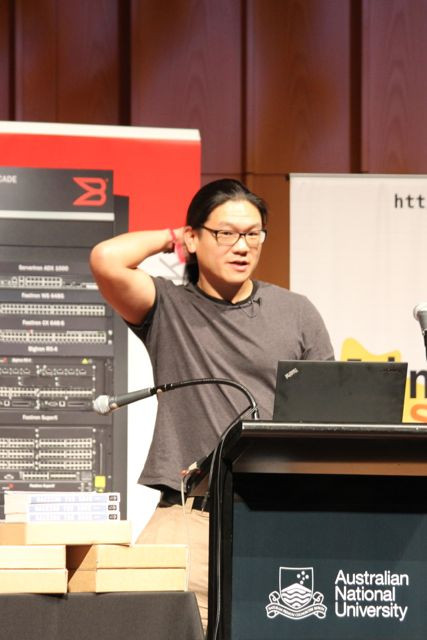
As a Free & Open Source Software (FOSS) geek, I was really looking very much forward to anything coming out from the linux.conf.au, better known as LCA. And for a huge bouquet of surprises, this year’s edition was one.
Andrew “bunnie” Huang (@bunniestudios) at LCA2013: “Do what it takes to solve the problem, and no more”. Photo by @kinshasha on Twitter
Along with Radia Perlman and Bdale Garbee, there was Andrew ‘bunnie’ Huang. He is a very interesting person, and his activities go beyond just-basic-nerdiness. Huang happens to be the person responsible for the jailbreaking of Microsoft’s Xbox360, something he wrote a book about in 2003. Moreover, he holds a PhD in engineering from the MIT. What I really like Bunnie for is all his great coverage of Chinese manufacturing, while sourcing suppliers for Chumby. Chumby is a gem: a totally open and hackable device designed from the ground up complete with open source hardware. This embedded computer provides internet access through a WiFi connection, and is able to run a wide range of software widgets once connected. The hardware being open, everyone willing to use Chumby is encouraged to get into the device and make it his/her own.
You may be blinking a bit thinking “OMG, how come I don’t know this guy!
Australian Science travelled to Canberra for the linux.conf.au (Linux Conference Australia) last week and had the opportunity for exclusive one-on-one interviews with a number of the keynote speakers. You may have been a little hesitant reading the first word of the title of this article, ‘Linux’, but perhaps the ‘Open Source Ecosystem’ in the latter part put your mind at ease. We are a computing world, a society heavily dependent upon computers. Computers, in their many shapes and sizes, are touching even greater areas of our lives and reaching a far greater number of people than ever before. Open source is revolutionizing the way we communicate. So while we all may not understand coding and app development, we can understand the end products that allow us digital consumers to produce and share our experiences and stories. The person who has had a tremendous impact in the Linux world is Bdale Garbee. And this is his open source ecosystem.
Bdale Garbee is a computer genius. Although he retired in 2012 after a long career with HP, serving as Open Source and Linux Chief Technologist, he shows no signs of slowing down. Quite the contrary, his workload may be picking up with the number of projects he is involved with, such as serving on the boards of The Freedombox Foundation and The Linux Foundation.
“Linux – euphemism for entire open source ecosystem and idea of collaborated development and maintenance of software and related data
A little before 9am on Tuesday 29th January, I filed into ANU’s Llewellyn Hall along with approximately 700 other Linux.conf.au delegates to listen to the daily keynote speech. I’m now a little embarrassed to admit that I had never heard of Radia Perlman. A little over an hour later, I was a fangirl.
Radia delivered an engaging, funny, and highly-technical keynote address at LCA2013, and the audience of IT professionals and enthusiasts present lapped it up. In it, she placed the technical details of the network protocols she and her colleagues developed in an historical context. She half-jokingly explained that this was the only way in which anyone could hope to understand why the protocols we work with today include ‘features’ in their design that would otherwise seem crazy to an outside observer.
In delivering her keynote, Radia gave us not just the technical detail behind the development of networking protocols, but also wove in details from her creative side, as well as tidbits about her children’s involvement in her technical life. The crowd was delighted as Radia shared with us the poem that she created (an ‘Algorhyme’) shortly after devising the Spanning Tree Protocol in 1985 while at DEC. For as she says, “Every algorithm deserves an algorhyme…” (You can hear Radia reciting her AlgoRhyme in Dan’s video interview with Radia below, and read the text here.) There is also a recording of Radia’s daughter, Dawn Perlner, singing the Algorhyme set to music by Radia’s son, Ray Perlner. Radia also mentioned her son Ray’s involvement in the creation of an AlgoRhyme V2 to mark the creation of her most recent network protocol, TRILL.
Later in the week, I had the pleasure of heading off to lunch with Radia and a small group of fellow delegates during a break in technical sessions. She is engaging and thoughtful, and concerned as much with solutions for societal issues as solutions for thorny networking challenges. Radia is eternally self-effacing, and repeatedly claimed that she had “never done anything difficult
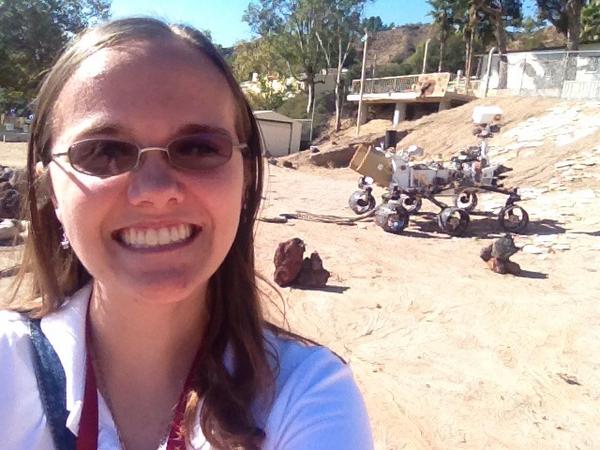
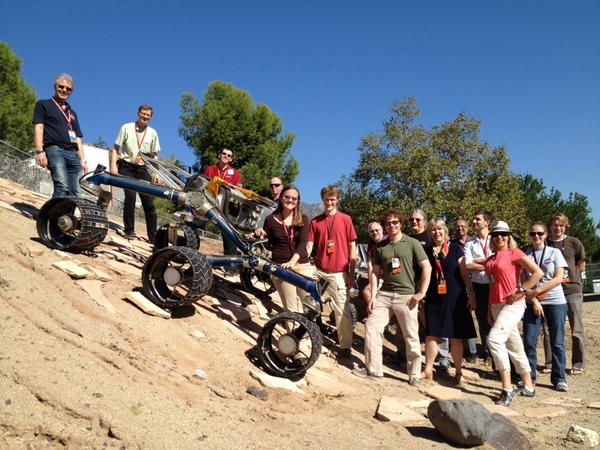
Keri Bean in the NASA JPL Mars Yard, with the Curiosity test-bed twin ‘Maggie’
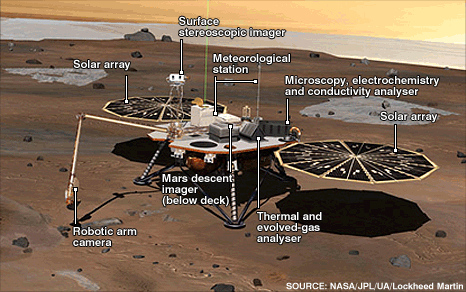
Keri Bean is a meteorologist specialising in the atmospherics of other planets. She is on the team operating the Curiosity Rover for NASA’s Mars Science Laboratory mission. Prior to MSL, Keri has had roles in the missions for other Mars rovers Spirit and Opportunity, a prototype Moon rover, the Phoenix Mars Lander, and the Hubble Space telescope. And she’s just 25 years old! That’s a pretty incredible CV to rack up already.
In this interview, Keri talks with me about her work on MSL and the other missions, plus how and why she got into space science. It all started when a tornado hit her pre-school.
Keri (centre) with many of the MSL team and ‘Scarecrow’, the other Curiosity test rover (Scarecrow is lighter than Curiosity so that it mirrors the lower Mars gravity).
A GIF of the partial solar eclipse by Mars moon Phobos, as captured by the Curiosity rover—an image capture task coordinated by Keri.
A photo of Phobos (highly zoomed it, and hence quite grainy) taken by Curiosity just after dusk on 21 September using one of its Mastcams, showing its ‘potato’ shape.
The ‘Chariot’ Lunar rover prototype for which Keri worked on camera design (and which James May managed to have a minor accident with when filming an episode of Top Gear!).
As an internet researcher and social media consultant, I ask some of the guests of the Australian Science magazine and knowledge network to tell me and my readers more about themselves, their current projects, and their views on topics including internet technology, the use of the Web in science and education, and certain aspects of the digital technologies that influence our everyday lives and work. You can see the published interviews so far – here.
Welcome to Australian Science. Would you, please, tell our readers a little bit more about yourself? Where do you come from, both geographically and philosophically? What is your scientific background, and your professional scope?
Certainly. I was born and grew up in the Northern part of Germany, in a town called Lübeck, at the coast of the Baltic Sea, about an hour from Hamburg. After high school I moved what appears to be as far away diagonally as possible within Germany in order to commence a computer science degree at the University of Furtwangen in the Black Forest that offered a – at the time – unique specialisation: Medieninformatik which combined technology applications and media studies. This was in 1997. The internet was just starting to become commercially successful, and many current students were still working on kiosk installations and multimedia CD-ROMs which were the latest fad at the time.
This degree program included two industry internships as well as an opportunity to study abroad. Together with friends of mine we looked at a number of options and eventually applied for advanced standing into the Bachelor of Multimedia program at Griffith University in Brisbane where we continued our studies in 2000. Due to the credit transfer, we were able to graduate at the end of 2000. This was my first year in Australia, and I had an amazing time. So much so that I decided to take advantage of a Government initiative that made it easier for recent IT graduates to apply for permanent residency. I was also lucky that my application was processed very rapidly: I applied in March 2001 and returned to Brisbane in July 2001 on my PR visa.
I had finished all my coursework for the German CompSc degree, and all that was left to do was the graduation thesis. In the meantime, I enrolled into a Master of Arts in Digital Media program at Queensland University of Technology which was flexible enough to comprise project units that allowed me to write my thesis “Backing up the Smart State: E-Security in Queensland’s Small and Medium Enterprises.
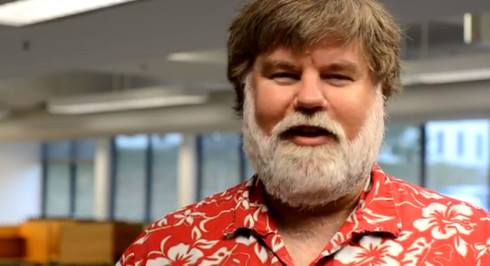
Being a Semantic Web, Open Linked Data, Open Source enthusiast, and at some point the contributor to the AP for the FOAF and other metadata standards, recently I had an opportunity to talk with Kingsley Idehen on his current projects, views on the use of the Web technologies, Open Linked Data, WebID, serendipity, and certain aspects of the Internet that influence our everyday lives.
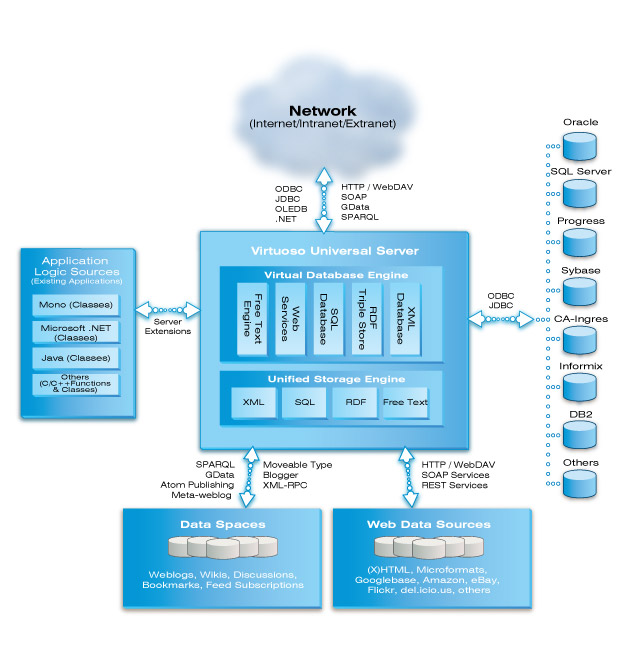
Kingsley Idehen is the Founder & CEO of OpenLink Software. He is a recognized technology enthusiast and expert in areas such as: Data Connectivity middleware, Linked Data, Data Integration, and Data Management. He is also a founding member of DBpedia project via OpenLink Software. Kingsley’s background is quite varied: he had planned to become a scientist in the genetic engineering realm but ended up being more fascinated by the power Information Technology and its potential to reshape mankind. From science, accounting, and programming, he followed his scientific instincts to architect OpenLinkVirtuoso, a powerful and innovative open source virtual database for SQL, XML, and Web services. The Virtuoso History page tells the whole story about Kingsley’s vision and accomplishments. You can follow him on Twitter and read his Google+ posts.
Would you explain to our readers a bit about the OpenLink Software, for those in the Web technology who may not be familiar with it? Can you give us a story about the inception, history, work and achievements of the OpenLink Software?
OpenLink Software develops, deploys, and supports bleeding edge technology covering the following realms:
1. Relational Database Connectivity Middleware — ODBC, JDBC, ADO.NET, OLE-DB, and XMLA Drivers/Providers
2. Disparate Data Virtualization
3. Personal & Enterprise Collaboration
4. Relational Tables (RDBMS) and Relational Property Graph (Graph DB) based Database Management Systems
5. Federated Identity Management.
I founded OpenLink in 1992 with open database connectivity middleware supporting all major RDBMS products as our focus. By 1998 we evolved our vision to include RDBMS virtualization, and by 2000 we decided that the Semantic Web technology stack provided all the critical standards that would enable us extend data virtualization to include other data sources and formats beyond the RDBMS.
OpenLink was initially associated with dispelling the performance myth that undermined the early promotion of the Open Database Connectivity (ODBC) standard from Microsoft. In the Semantic Web and Linked Data realms our Virtuoso hybrid data server underlies critical parts of the Linked Open Data cloud (starting with DBpedia which lies at the core) as well as offering the largest publicly accessible Linked Data space on the planet, against which anything (human or machine) can perform ad-hoc queries that drive lookups while also aiding the emergence of other Linked Data Spaces on the LOD cloud.
Naturally, our technologies are used extensively across enterprises worldwide due to performance, scalability, and security that underlies every item in our product portfolio.
Is there any existing tools and methodologies developed by either you or your team in the OpenLink Software or others that you would like to mention?
* High-Performance ODBC Drivers for all the major RDBMS databases
* ODBC Drivers for the World Wide Web — yes, the World Wide Web of Linked Data (or LOD cloud) is exploitable and accessible to any ODBC, JDBC, ADO.NET, or OLE-DB compliant application
* Virtuoso — high-performance and massively scalable hybrid DBMS (relational tables and property graphs).
* Linked Data Middleware — that transform output from a plethora of Web 2.0 and SOA services into structured Linked Data
* URIBurner — a public instance of the middleware mentioned above that enables anyone transform existing data into Linked Data
* OpenLink Data Spaces — platform for enterprise and personal data spaces that includes in-built Federated Identity and sophisticated Linked Data functionality
* DBpedia — Linked Open Data Cloud nexus that runs on Virtuoso (re. Linked Data Deployment and Data Management).
Do you collaborate with similar organisations/institutions worldwide in the field of the Open Linked Data? Would you tell us more about your involvement within the DBpedia project?
Yes, as demonstrated by DBpedia (Frei University and University of Leipzig), Sindice (DERI), and Bio2RDF(Carleton University and others).
Virtuoso is the Linked Data Publishing and Database Management system behind DBpedia. Net effect of Virtuoso is you have a massive collection of Linked Data derived from Wikipedia that’s available to the entire public. This instance enables you browser through pages that describe entities while also delivering ad-hoc query functionality via a Web Service that supports the SPARQL query language, results serialization formats, and HTTP based wire protocol.
In addition to providing the live instance, we also provide quality assurance, support and maintenance. Publishing and maintaining DBpedia is a challenge, and we even offer packages that enable others instantiate personal or service specific instances via Amazon EC2 AMIs (virtual machines).
DBpedia is basically germination of the seed planted by the Linked Data meme published by TimBL circa. 2005. In turn, DBpedia enabled the emergence of the massive Linked Data Cloud that exists today.
In his recent keynote, at the WWW2012, Tim Berners-Leetalked about the importance of the openness and urged for governments to embrace the movement of open data. Following that, you showed me how one can successfully kill spam using the WebID protocol as a Web-scale verifiable identity mechanism. Thus, for those who are not familiar with WebID – beside allowing to identify self online and exchange the WebID with other people and social web services – are there some other uses aimed at solving real problems?
Here are the fundamental problems solved by unadulterated open data connectivity:
1. generating capital from high quality government data via open data initiatives the leverage Linked Data principles — this is better than dysfunctional financial engineering that’s plunged the world into an economic fragility
2. big data and small data virtualization that simplifies the process of discovering and sharing insights for individuals and enterprises alike
3. achieving the goals above without compromising privacy and security.
There’s nothing more useful than 1-3 and there’s no technology to date that’s achieved that without some kind of platform specificity that ultimately becomes a dysfunctional silo. This is where the Web is unique, as its impact on mankind has already demonstrated with aplomb.
I always ask people who are in the ICTs (Information-Communication Technologies): do you think that Web is one big serendipity machine from the computing and the scientific point of view?
As the links to structured data increase on the Web, its density increases, which ultimately means that you require fewer and fewer link hops to find whatever you seek, with precision.
For instance, you can Find all Blog Posts about a Subject Matter Topic based on the attributes of the topic since the Post, Topic, and their Connection are all denoted (named) using hyperlinks (de-referencable) URIs. These URIs resolve to content in the form of fine-grained links taking the form: entity-attribute-value or subject-predicate-object. See my presentation that covers the basics of structured of data.
Do you think that Web apps and software architects are killing the serendipity moment with their search algorithms, mechanical turks and other mechanisms?
No, the worst that can happen is artificial protraction of a journey to an inevitable destination i.e., the Web as mankind’s distributed database and serendipity machine.
What are you currently working on? What’s your current projects and research about? What can we expect from the OpenLink Softwarein the upcoming period?
Addressing the Read-Write dimension of the Web, hence the recent emphasis on WebID and the WebID authentication protocol. Verifiable Identity is a critical piece of the Web that hasn’t manifested coherently until the emergence of the WebID and Read-Write Web community groups from the W3C.
All our products are WebID enabled, so our current focus is getting the world to understand why federated identity matters by product offerings that address:
1. Personal Data Spaces or Data Lockers — how users take full control of their identity, profiles, data, and privacy
2. Data Wikis – basically reapplying the Wiki Content pattern to Linked Data such that crowdsourcing and social networking add new virtuous dimensions to Linked Data product and quality.
What is taking up the most my time these days is finalizing a boat load of new product releases that increasingly simplify the power inherent in our products and the infrastructure provided by the World Wide Web. Also, OpenLink Software is finalizing new editions of Virtuoso, OpenLink Data Spaces, and its suite of ODBC and JDBC compliant data access drivers which support all major DBMS engines.
Thank you Kingsley for taking your time to talk with me!
Keita Bando is a Digital Repository Librarian and Coordinator for Scholarly Communication database called MyOpenArchive we have presented MyOpenArchive earlier this year. Founded in September 2007, MyOpenArchive is an international Non-Profit Organization that advocates Open Access for never-before-published research papers on the web and provides Self-Archiving platform to enable better knowledge sharing in a way that’s easy to publish. We talked with Keita about Open Access (OA), scientific and scholarly publishing, and the current situation of the OA in the world.
Welcome! Would you, please, tell our readers a little bit more about yourself? What is your scientific background, and your professional scope?
Hello, Australian Science and its readers! Nice to meet you. I have been devoted my time on Open Access, Scholarly Communication, and recently Altmetrics. That’s why we (two colleagues and me) founded MyOpenArchive five years ago. An engineer and an designer helped me to develop my initial effort.
Also much of my time have been devoted on OA advocacy relations. For example, an presentation at 2008 Open Access Day, hosting Japanese website during Open Access Week 2009, and we hosted an event at that week. Furthermore, in 2011 we attended two conferences in Europe and the US, to make great acquaintances with those who deeply committed into Open Repository relations.
Besides, I have been devoted my time on Mendeley Advisor relations. Mendeley is a great service for me, and that’s why I advocate Mendeley in Japan. On one hand, Mendeley is famous as Reference manager. On the other hand, Mendeley is a Self-Archiving, Institutional Repository friendly service. Personally I am an OA Advocate who is interested in Mendeley Advisor relations.
As a volunteer I have been devoted my time on those relations, for I have a full-time job at an University (as a staff, but not a librarian).
How many individual and organizational ‘self-archiving’ units or members do you have within MyOpenArchive? What science disciplines the archive covers?
MyOpenArchive is not a sectional repository (arXiv, PMC etc). You can publish and share any type of research paper, of any section (Journal Article, Thesis or Dissertation, others) using Creative Commons License (or Public Domain). Users can upload material from any field, all science disciplines are present in the articles.
The first 3 years (2007-2010) we attracted 393 users and 210 posts. After 2010 renewal, 292 users and 166 posts. On the new site, we introduced Twitter/Facebook Sign in/up system to find that Twitter users overwhelmed Facebook users (214 vs. 78).
What do you think about “self archiving” today in the hyper connected networked surrounding and advancement of digital technologies? Do people deposit more or less?
Self archiving, so far, meant that librarians conduct the posting author’s final draft and/or others to Institutional Repository. These years, however, increasing number of users found their way to publish research papers to Mendeley, ResearchGATE, academia.edu and so on because those social networking services for researchers taps self archiving features into their site.
Thus, Self archiving can be achieved without IR. FigShare, PeerEvaluation, MyOpenArchive and numerous Social iR(s) represent Self archiving without help of librarians or IR. Researchers can do the self archiving, literally, on their own.
On the other, experimental efforts are increasing in order to match SNS for researchers and IR. For example, I am interested in DURA project, on which Mendeley and Cambridge University Library join forces upon JISC subsidy. Technology evolution let those services interact each other, and SWORD, Symplectic is critical on the Self archiving movement to advocate OA.
How do you see OA development in the next five years? How do you see the impact of open access on the science, education, and communication online?
In my opinion, altmetrics is the key to innovate OA relations. PLoS is the most important contribute to altmetrics innovation. It focuses on article level metrics, on which they can enhance the real time impact of individual papers. PLoS hires some of altmetrics guru, such as Cameron Neylon and Martin Fenner to the effort. Besides, PLoS talents like Mark Patterson and Peter Binfield (they are keen on altmetrics) are going to launch new OA journal (eLife Science, PeerJ) with some of Mendeley staff (Ian Mulvany, Jason Hoyt). Also, BMC show their understandings on OA journal. Hopefully Publication companies will increasingly submit altmetrics.com plans on and on.
I feel the importance of “being the part” of Open Access movement to know the global trend. Thus I am taking part in Facebook, LinkedIn, Google plus groups, while I follow them on Twitter to know the status of “person” as much as “information”. Most importantly, I can say that being the part of real friendship is critical. Last year I attended several international conferences as real friendship needed. “Why don’t we contribute” happens on these efforts, personally.
I know that you are very active online, collaborating with other Open Access chapters and nonprofit organisations. What are your current plans in the organisation and Open Access movement globally?
For example, Sridhar Gutam of Open Access India became allies with us, to share the Asia relations. On the partnership we hope to enhance the collaborations among those parties around the world.
We are going to attend Edinburgh Open Repositories 2012, on 9-13 July.
Berlin 10 Open Access Conference and Open Access Week also mean a lot for us, so this is going to be a “being the part” of discussion and real networking.
Thank you Keita for taking your time to talk with me!
This is the Part II from the highlights of the World Wide Web 2012 (#WWW2012) conference and here are some notes of mine but this time focusing on people, attendants who have been actively participating in the web professionals meeting and their impressions of the conference.
Beside numerous tracks, sessions, workshops, and tutorials – the #WWW2012 offered interesting keynotes by the leading and prominent professionals in Web industry, research, and policy. The main keynote speakers were Tim Berners Lee, the inventor of Web, Bernard Stiegler – a director of IRI (Innovation and Research Institute) at the Georges Pompidou Center in Paris, a professor at the University of Technology of Compiègne where he teaches philosophy, Chris Welty – a Research Scientist at the IBM T.J. Watson Research Center in New York, and Neelie Kroes, a Vice President of the European Commission and European Digital Agenda Commissioner.
I asked some of the many colleagues, peers, and presenters about their preferred event on the World Wide Web 2012 conference, and what presentation/session/keynote/workshop made the best impression on them, and why. Here are some interesting thoughts.
New software paradigm, and Social Media in Response to a Crisis
I’ll start with volunteers at the conference since they had a great job to do and many of them are web researchers, students, and professors.
Jean-Tiare LE BIGOT: “I am currently studying telecommunications in Lyon (France) and attended the www2012 as a Volunteer. In my spare time, I try to create an archive of network status map. As a Volunteer, it has been quite tricky for me to choose and attend the presentations. Nonetheless, I had the luck to see all keynotes in the auditorium. As many of the attendees, I appreciated TBL talk on the values of the Web and also the debate of the following day. But the one I preferred was the one by Chris Welty. He talked about IBM’s Watson project and the steps which enabled Watson to defeat humans in the Jeopardy show. I really enjoyed the humor in his explanations when he showed us the biggest fails :). ”
Watson is an Artificial Intelligence system designed to answer real world questions as in the Jeopardy show or financial/medical world. During his presentation, Chris Welty stressed on point: Machine’s understanding is in no way the same as human’s. This is to illustrate this point that he showed us some failed answer which is obvious for a human being. An example:
Cindy Hui: I am a post-doctoral researcher at the Rutgers University. My research includes modeling and simulation, social networks, social computing, and disaster research. I presented a paper at Social Web for Disaster Management Workshop titled “Information Cascades in Social Media in Response to a Crisis: A Preliminary Model and a Case study.”
“There were so many interesting workshops and sessions at WWW2012 that covered such a variety of topics, but I mostly attended the ones that focused on social networks and social media since those are my areas of interest. In particular, I was very excited about the Social Web for Disaster Management and the Making Sense of Microposts workshops since there’s such a growing focus on how to analyze and make use of these community-driven, collective information from various social media platforms. It really brings together people from computer science, social science and policy practitioners, each contributing important pieces to the overall focus.
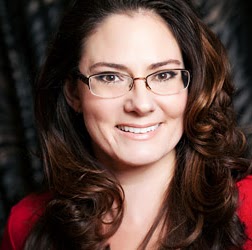 Joanne Manaster is a cell and molecular biology lecturer at the University of Illinois. She currently works as an online course developer and lecturer of science courses for the School of Integrative Biology. Prior to this current position, Joanne has taught histology, cell biology, and tissue engineering laboratories to biology and bioengineering students for nearly 20 years. Beside her academic career, she is a science writer and communicator, science video host, and STEM advocate. Joanne has run a girls’ bioengineering camp, and helped with the iGEM synthetic biology team and other outreach activities. She also makes video reviews of popular science books as well as whimsical science experiments with cats, cookies, gummy bears and make-up.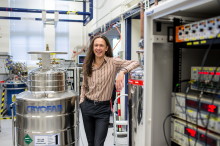
 One could call

 Lana Ostojic is a young applied science professional with the real-world experience in criminal forensics. She is a researcher at the Research and Development Department at the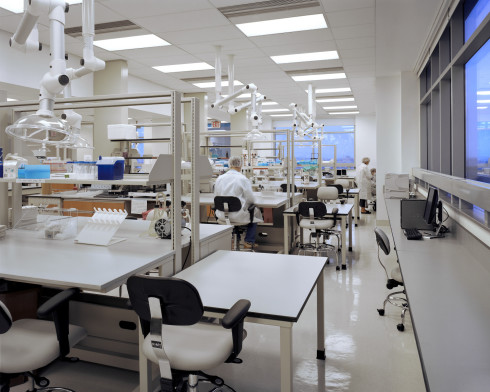





 Kingsley Idehen
 Keita Bando is a Digital Repository Librarian and Coordinator for Scholarly Communication database called MyOpenArchive we have