Are you watching the new Cosmos: A Spacetime Odyssey – the scientific documentary television series? I am, and I’m thoroughly enjoying it! The series is a follow-up to the 1980 television series Cosmos: A Personal Voyage, which was presented by Carl Sagan. The all new Cosmos: A Spacetime Odyssey science documentary consists of thirteen episodes and just like the original program, continues to use a storytelling approach to present complex astronomy and science concepts in an accessible and entertaining manner. The episodes feature the latest information which has been updated since the 1980 series and uses substantial computer-generated special effects and animation to illustrate and enhance the narration.
The series is hosted and presented by astrophysicist and science communicator Neil deGrasse Tyson, who was inspired by Sagan as a college student. He created a new version of the series, aiming to reach a wider audience and not just those specifically interested in the sciences.
The entire Cosmos: A Spacetime Odyssey series is dedicated to exploring how we discovered different laws of nature and explaining how scientists found our Earthly coordinates in space and time in relation to the universe and created a vision of the cosmos. Listening to the great narratives, watching the stars, and contemplating the scale of space and time relative to Earth, is enough to humble any scientifically curious soul.
All of the greatest explorations undertaken by humanity have been hindered by unexpected variables, the Mars One mission is no exception. The first settlers on Mars are currently projected to begin colonization in 2025, making homo sapiens an inter-planetary species. With so much progress and many promising suppliers to propel the mission there are plenty of reasons to be excited!
Mars One is an ambitious project that aims to make the human species multi-planetary. According to the Mars One website, “Mars One is a not-for-profit foundation that will establish a permanent human settlement on Mars.
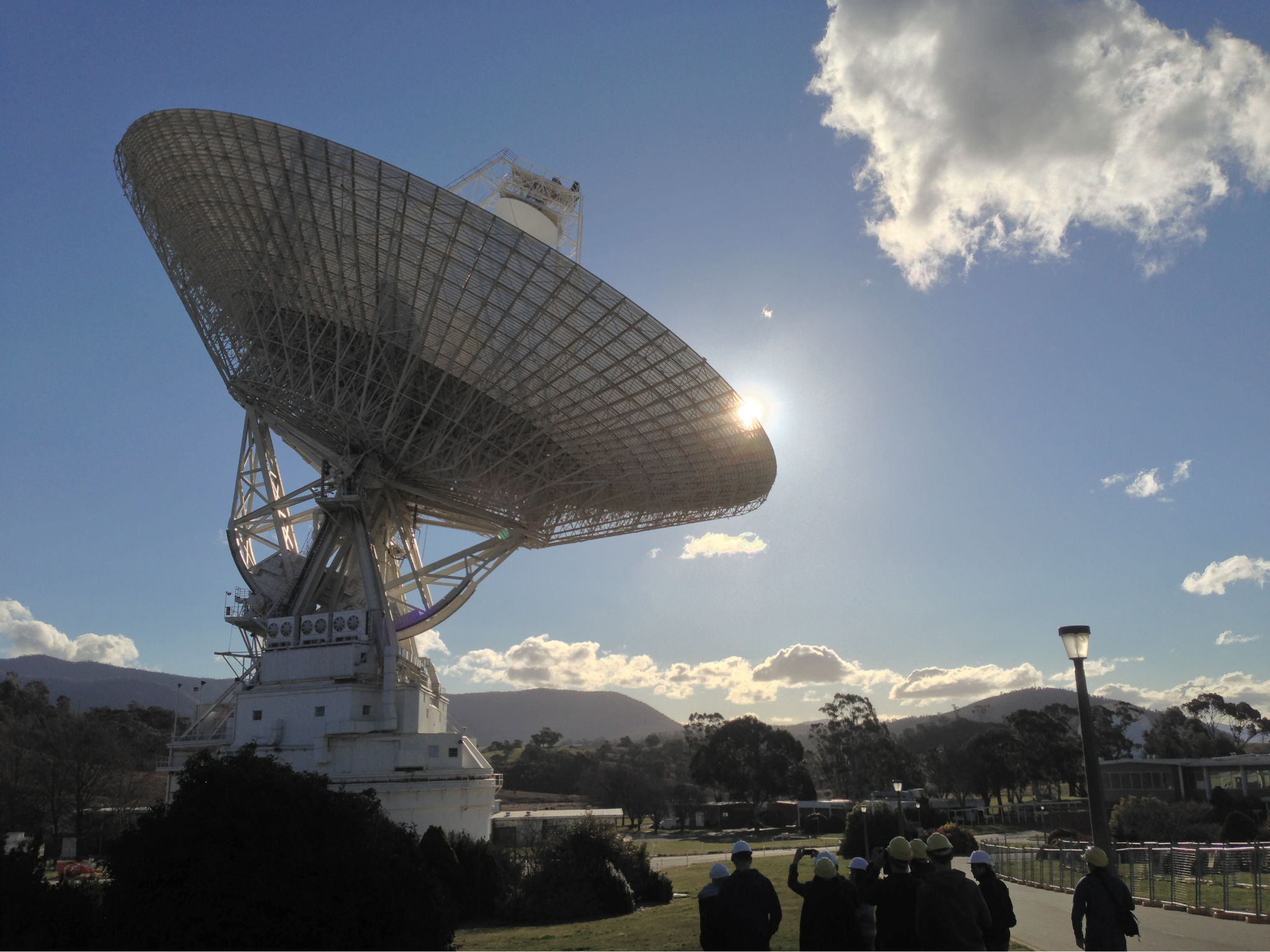
The Canberra Deep Space Communication Complex (CDSCC), located on the rural outskirts of Canberra at Tidbinbilla, is one of only three NASA deep space tracking stations spread around the globe. On Sunday 18th August, as part of National Science Week they held their biennial ‘Space Open Day‘, affording a rare opportunity for visitors to tour areas of the facility that are normally off-limits to the public. My partner and I have recently joined the ranks of volunteers at CDSCC, and Space Open Day was to be our first outing in that role, along with a small team of new and long-time volunteers.
Our hour-long trek to the facility started bright and early (for a Sunday) in order to catch the volunteer briefing before the gates opened at 9am. Briefing done, it was time to head ‘front of house’ to greet the incoming visitors and attend to our rostered duties. Throughout the day, visitors were able to hop on a bus tour of the entire complex, join a guided walking tour of “the big dish” (DSS-43), and complete a self-guided walk to the dish for fantastic photo opportunities. In addition, the Visitor Centre displays, video presentations, and hands-on computer terminals were available as normal.
A CDSCC staff member explains the technology & history behind DSS-43 to a tour group on Space Open Day
Special talks were conducted throughout the day, with Education & Outreach Manager Glen Nagle first talking about CDSCC’s crucial role in the recent launch and landing of the Mars Science Laboratory, ‘Curiosity’, on Mars. CSIRO held a ‘Tweetup’ for the launch of Curiosity in November 2011, and a followup public event for the audacious landing in August the following year. (While guests were enthralled watching the Curiosity mission unfold, CDSCC staff were hard at work receiving telemetry and tracking data direct from the spacecraft and relaying it to Mission Control at NASA’s JPL in Pasadena, California.) Later in the day, Mike Dinn gave a talk on the Apollo missions. Mike was a technician at Honeysuckle Creek Tracking Station during the Apollo era, and it was a real treat for centre visitors to be able to hear about that iconic period of spaceflight from someone who actually worked on the missions.
Bus tours of the complex ran every 20 minutes for the entire day. Despite having a fleet of three buses on rotation, there was a queue for the tours all day—attendance for the day was just under 3,000 visitors, by far the largest turnout for any event at the complex. Operational staff from the centre volunteered their time to act as tour guides, providing behind-the-scenes insights into the ongoing and historical operations of the complex. The guided walking tours of the 70m dish, DSS-43, were also incredibly popular, with people happily queueing for over half an hour to hear about the engineering, technology, and history of the large dish and the whole complex. Again, current and former CDSCC staff were on hand to provide a wealth of technical information.
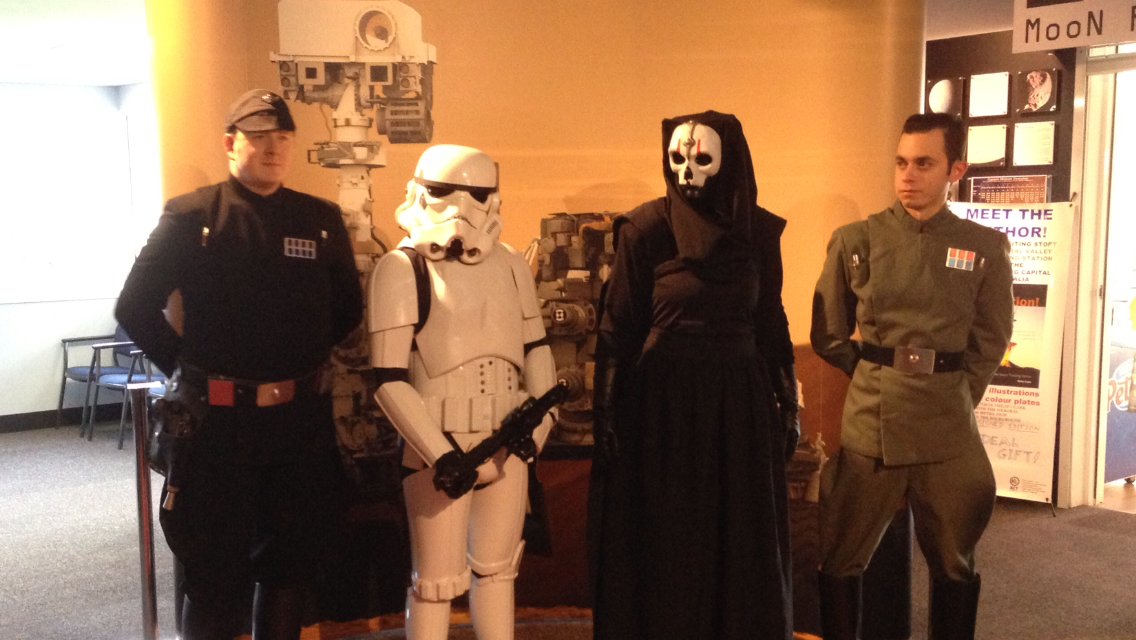
Adding to the excitement for the young geeks-in-training visiting CDSCC on the day were special appearances by a number of representatives from the Galactic Empire, who assured us that they were on a “routine inspection tour” of the facility. I do believe that they consider the Communication Complex to be an Empire outpost under their control—and I wasn’t about to be the one to risk contradicting them! In all seriousness though, the members of the 501st Legion who attended were fantastic, and continued the long tradition of science fiction helping to inspire the next generation of real-world scientists and engineers.
Darth Nihilus, Imperial officers & Stormtrooper from the 501st Legion NSW/ACT Garrison survey their ‘outpost’
Glen Nagle and his small team (Korinne McDonnell and Leanne George) run the CDSCC Visitor Centre—which is open 364 days of the year—as well as all of the Education and Outreach programmes on a modest budget. That they were able to promote and smoothly stage an event that proved to be wildly popular with the public is a testament to their passion and dedication to the mission of CDSCC and to science communication and outreach in general.
For myself and the other volunteers, the day was quite tiring but immensely enjoyable. How often do you get a chance to take people on tours of a deep space tracking station, and spend time chatting to members of the public about robotic and human spaceflight, physics and astrophysics, cosmology, and radio astronomy? I’m sure that there are some people for whom that sounds like a painful day, but for myself and the other volunteers it was pretty close to Nerdvana.
Explore further You can follow the Canberra Deep Space Communication Complex on Twitter: @CanberraDSN
Full disclosure: Jessica is a volunteer at the CDSCC
This article is one of a series of articles in which I will profile every woman astronaut, cosmonaut and taikonaut who has been into space. Last time we looked at the career of Sally Ride. Today I’m profiling astronaut Judith Resnik. (The feature image above is a collection of drawings of women astronauts by artist Phillip J Bond. You can find Phillip’s wonderful series on women astronauts here.)
When the space shuttle Challenger was due to launch in the middle of the night (Australian time) on the 28th of January of 1986 – I was in the middle of a standard teenage baby sitting gig. The kids must have been 6 or 7 years old and we were all very excited by the upcoming launch, but disappointed by the late hour. As I tucked the kids into bed I agreed to wake them up during the night so we could watch the launch. We didn’t get up during the night, I don’t remember why – maybe I didn’t set the alarm, maybe I decided not to wake them, maybe I just forgot. When I woke in the morning and turned on the TV, the images of the Challenger exploding a minute into launch were so horrifying they still affect me today.
Judith Resnik (NASA image)
Judith Resnik broke many records during her short life. She was the only person in her high school graduating year to score a perfect college entrance score, she was the second American woman in space (2 missions/145hours), the first Jewish woman in space, and she was, sadly, a member of the first shuttle crew to perish during a mission.
Judith was born in 1949 in Akron, Ohio to Jewish parents who had emigrated from the Ukraine. She had a younger brother, Charles. When a student at Firestone High School, Judith excelled in mathematics and played classical piano. She went on to graduate from Carnegie Mellon University with a B.S. in electrical engineering, and then received her PhD in electrical engineering from the University of Maryland. Judith married fellow student Michael Oldak in 1970; although the subsequently divorced in 1974 they remained close friends. Michael even travelled to Kennedy Space Centre to watch Judith’s first mission launch.
Judith in space (NASA image)
After graduation from Carnegie Mellon Judith worked as a design engineer on various NASA projects contracted through her employer, the RCA Corporation. She also worked with the US National Institute of Health as a biomedical engineer, and as a systems engineer with Xerox Corporation during her PhD. When Judith heard that NASA was looking for female astronauts she sought advice from her faculty advisor and mentor Angel Jordan, who encouraged her to apply. In an interview with the Carnegie Mellon newspaper Jordan said, ‘she was an amazing person’, and he still feels responsible for her loss, ‘I pushed her to excel, and I live with that memory every day’.
Judith Resnick, like Sally Ride, was recruited into the astronaut program by actress Nichelle Nichols (Lieutenant Uhura on Star Trek) who worked as a recruiter for NASA from the mid 1970’s until the mid 1980’s. NASA selected Judith as an astronaut candidate in January of 1978. She completed the year-long training and evaluation period in August 1979. Judith’s first mission was as mission specialist on the maiden voyage of Discovery on 30 August 1984 (STS41-D). She worked on a number of projects in support of Orbiter development, including experiment software, the Remote Manipulator System (RMS), and training techniques.
During the mission the crew of STS41-D activated the OAST-1 solar cell wing experiment, deployed three satellites, and completed a number of experiments. STS 41-D completed 96 orbits of the Earth before landing at Edwards Air Force Base, California, on September 5, 1984. Judith’s first space mission caused plenty of publicity for NASA , during her mission Judith showed a playful sense of humour, doing extensive periods of aerobatics, and holding a sign reading ‘Hi Dad’ up to the camera. According to her ex-husband, Judith ‘had a great sense of humor and was always willing to try anything’. She made waves during her first mission with images of her long flowing locks of hair, viewers were used to seeing the mundane cropped hair styles of men during missions. Resnik didn’t like to be pigeonholed as a woman astronaut or a Jewish astronaut, she considered herself ‘just another astronaut, period.’
STS51-L Crew (NASA image)
Judith’s second mission was also as mission specialist, aboard Challenger (STS51-L), which was launched from the Kennedy Space Center, Florida, at 11:38 on January 28, 1986. Challenger crew included the commander, Mr. F.R. Scobee, the pilot, Commander M.J. Smith (USN), fellow mission specialists, Dr. R.E. McNair, and Lieutenant Colonel E.S. Onizuka (USAF), as well as two civilian payload specialists, Mr. G.B. Jarvis and Mrs. S. C. McAuliffe (NASA Teacher in Space). During the mission crew were expected to deploy tracking and data relay satellites, carry out the first flight of the Shuttle-Pointed Tool for Astronomy (SPARTAN-203), deploy the Halley’s Comet Experiment in order to observe Halley’s Comet and complete a number of lessons as part of the Teacher in Space Project.
The STS 51-L crew died on January 28, 1986 when Challenger exploded shortly after launch.
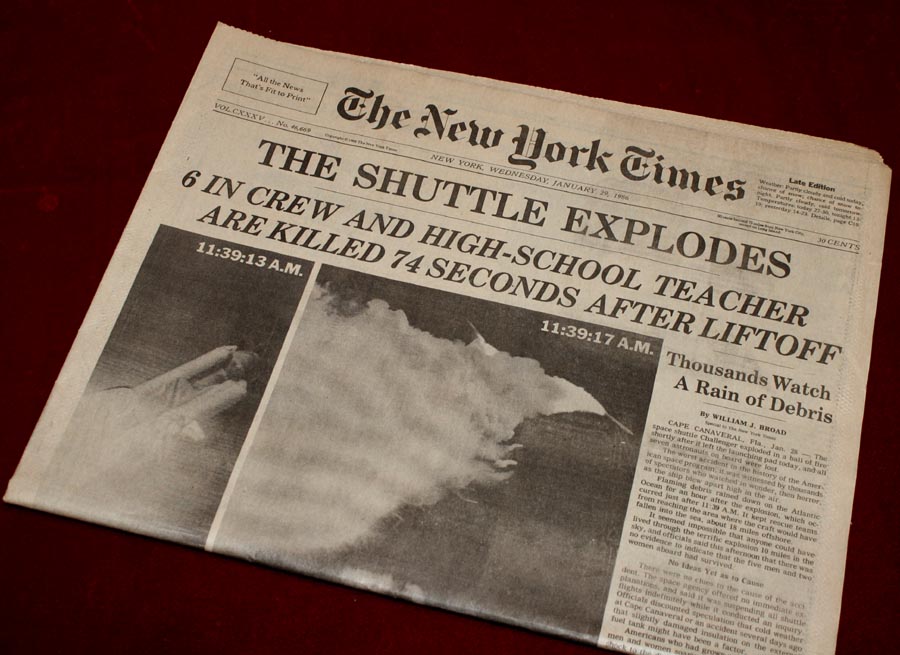
The facts of the Challenger disaster are well known. Challenger blasted off from Kennedy Space Centre (KSC) at 11:38 hours on 28 January 1986. 73 seconds after lift off, during the ascent phase, Challenger experienced a catastrophic structural failure resulting in the loss of the crew and vehicle.
How news of the Challenger disaster broke
Naturally, after such a catastrophic incident there was a Presidential review, the resulting Rogers Commission findings are publicly available.
Judith has been honoured many times, including lunar crater ‘Resnik’, a dormitory at Carnegie Mellon, the main engineering hall at University of Maryland all named in her honour. A memorial to Resnik and the crew of Space Shuttle Challenger has been dedicated in Seabrook, Texas where Resnik once lived, the IEEE (Institute of Electrical and Electronics Engineers) ‘Judith Resnik Award’ for space engineering is also named in her honor, and a memorial to Judith resides at the base of Hammerschlag Hall, at Carnegie Mellon University. Members of Tau Beta Pi, the National Engineering Honor Society, help maintain the monument.
‘The future is not free: the story of all human progress is one of a struggle against all odds. We learned again that this America, which Abraham Lincoln called the last, best hope of man on Earth, was built on heroism and noble sacrifice, It was built by men and women like our seven star voyagers, who answered a call beyond duty, who gave more than was expected or required and who gave it little thought of worldly reward.’
A false-colour view of Australia during the drought season. Credit: NASA images created by Jesse Allen, Earth Observatory, using data obtained courtesy of USDA FAS and processed by Jennifer Small and Assaf Anyamba, NASA GIMMS Group at Goddard Space Flight Center
Despite its lack of a space agency, Australia has a rich space heritage. Its telescopes, many of which are set up in desert areas, provide excellent views of the nighttime sky. It has dishes that stay in touch with NASA spacecraft (perhaps most famously, broadcasting Apollo 11 as the first lunar landing crew worked on the surface.) There also are many professionals that work in space, whether in astronomy, engineering, various sciences or other fields.
Dempster’s plea isn’t the first such one. In 2008, as he points out, the Australian Senate Standing Committee on Economics wrote a report (called “Lost In Space“). Besides repeating the oft-made observation that Australia is alone among its OECD peers in not having a space program, the report stated that Australia’s work “in space science and industry has drifted and the sense of purpose has been lost.”
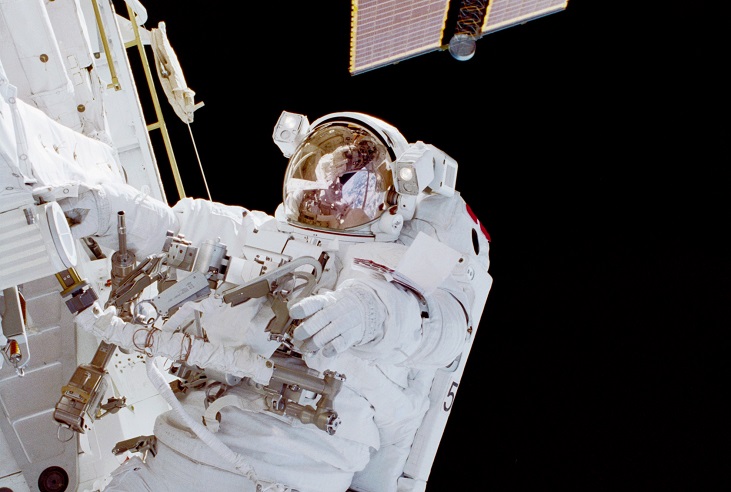
A few Australians have flown in space, such as Andy Thomas, who is pictured here during a spacewalk on mission STS-102 in 2001. Credit: NASA
The report, and Dempster in his new article, both urged the government to set a policy to make it easier for industry to figure out where to go next.
“Personally, my problem with Australia’s reactive approach to overseas approaches on space missions is only partly that we don’t have the competence of a space agency to answer such questions from foreign agencies. More important is that we don’t have the people to ask them,” he wrote. “There is no one in Australia dedicated to finding satellite solutions to Australia’s problems.”
There are other benefits that would flow as well from having an established space program, Dempster said. Space funding would be stabilized, technical responsibilities would be better understood, and satellite work in particular could accelerate. In a country that is so sparsely populated, satellites are essential for Australian communications as well as to view agriculture, forest fires and other features from above.
Australia’s Parkes Observatory received the first transmissions of human steps on the moon in 1969. Credit: NASA/YouTube screenshot
A space program, once established, would not be a panacea for all problems. NASA, for example, is currently fighting a hard battle in Congress to get funding for the commercial spaceflight partner programs it wants to bring human launches back to American soil. Canada’s space program recently received criticism in a government-issued report that said the lack of funding stability is hampering its goals. Money will always be a problem, whether there is an established space agency or not.
What must be established is whether a space agency is a good point of access for external stakeholders to forge partnerships with Australia, if universities and industry require a connecting node to form relationships, and if the economy itself requires a spur to put money into space — a government spur that could front money during tough economic conditions, for example, to stimulate the economy.
What is your feeling on the matter? Feel free to leave your comments below.
I was awake at stupid o’clock last Sunday morning to watch NASA’s livestream of the launch of the HTV-4 resupply vehicle. At precisely 05:48:46AM AEST, JAXA H-IIB F4 launch vehicle lifted off smoothly en route to resupply the International Space Station (ISS). The 5.4 tonne payload comprised all the usual suspects: water, replacement and upgraded electronics for various ISS systems, spares for major station components, and new equipment and supplies for experiments.
Nestled in amongst the other cargo were four tiny ‘CubeSats’, two of which were funded by a Kickstarter project: ArduSat. These tiny satellites are the first example of crowdfunded space operations, and represent an exciting new development in the recent popularisation of ‘citizen science’.
Commercial satellite launches are immensely expensive, costing hundreds of millions of dollars using current rocket-based technology. The idea behind the ArduSat project is to provide low-cost access to real, orbiting satellites to students and space enthusiasts. By designing payloads small enough to fit into gaps in the main cargo area, innovative satellite operators are able to hitch a ride on commercial space launches at a fraction of the cost. The dramatic cost reduction has finally made it viable to create an orbiting educational platform, a remarkable achievement.
The two crowd-funded cubesats, ArduSat-1 and ArduSat-X, really are tiny—just 10 x 10 x 10cm and weighing only 1kg each. But their size is deceptive. Each satellite not only has its own flight stabilisation systems, but also incorporates a camera, an impressive suite of sensors (see list below), and 16 fully-functional Arduino-based computers. Each of those computing modules is capable of running experiments either independently or in concert with multiple other modules. The ‘experiments’ that can be run are essentially computer programs which can access data from the onboard sensors.
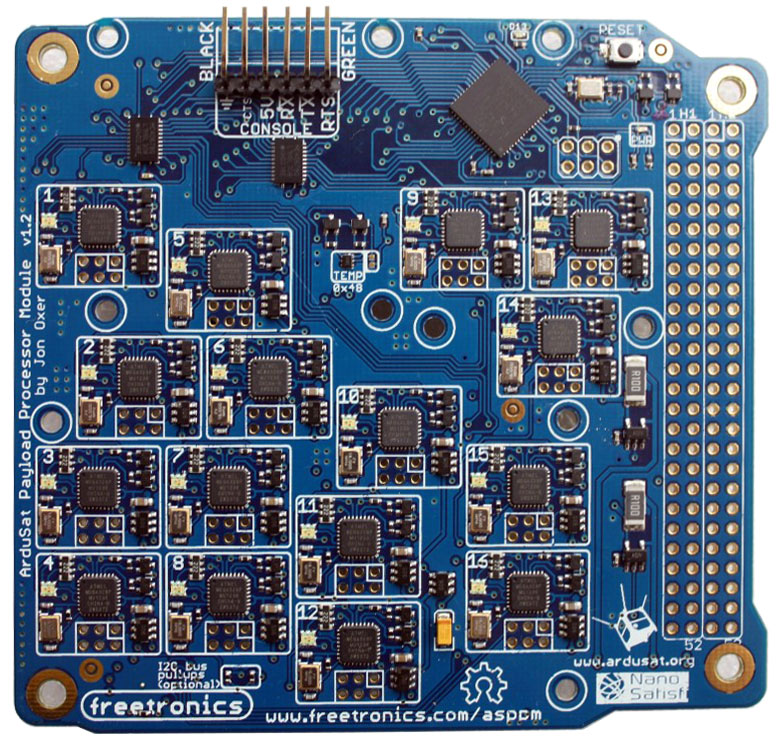
It is the onboard Arduino computers from which the ArduSats take their name. Arduino is a popular open source computing platform designed for hobbyists, enthusiasts, and professionals who use the ‘computer on a board’ platform to build everything from retro video game consoles, to home automation systems, through to… orbital experiment platforms! The ArduSat project is a global collaboration. NanoSatisfi is the company that was formed to create the Kickstarter project, and is headquartered in San Francisco. The main ArduSat Payload Processor Module (pictured below) was designed by Australian Aurduino guru, Jonathan Oxer, who I talked to after the launch. Jonathan co-authored the popular how-to book, Practical Arduino, and has subsequently founded Freetronics, a Melbourne-based company specialising in designing and producing Arduino-based boards, kits, and components.
The ArduSat payload processor module. [Image credit: Jonathan Oxer]
Arduino is open source hardware, which means that it is explicitly intended to be assembled, disassembled, studied, understood, and built upon. At the most basic level, people are able to build their own Arduino-compatible boards from common electronics components. Pre-built Arduino and Arduino-compatible boards are also available for under $50, allowing experimenters to get started at incredibly low cost even if they don’t wish to build the boards themselves. The effective removal of the entry barrier means that Arduino has made physical computing far more widely accessible than ever before.
The extremely low cost of building and launching the ArduSats creates an exciting opportunity for science education and outreach. Schools around the world are able to purchase experiment time on the satellites for only $300 for a full week of access. As Jonathan put it, “That’s an amazing price-point compared to anything previously available, and it makes it attainable even to individuals and small groups. A typical science class could run a bake sale, raise $10 per student, and then run their own experiments in space for a week!
The Kirobo robot that will be on board the International Space Station. Credit: ToyotaEurope (YouTube screen shot)
Living alone can be an isolating experience, whether you’re in a remote area of the Outback, in a condo in downtown Sydney, or floating in the International Space Station. In the latter spot, to be sure, there are other astronauts on board and Mission Control is only a radio call away. Still, however, you’re away from family in a dangerous environment.
Japan has just sent up a cute robot, called Kirobo. It talks in Japanese and is intended to be a sometimes companion to astronaut Kochi Wakata, who will arrive on station in November if the schedule holds. The cargo spacecraft, with Kirobo on board, is en route to the station and should arrive Aug. 9.
“The Kibo robot has a special mission: to help solve the problems brought about by a society that has become more individualized and less communicative,” the Japanese space agency (JAXA) stated. “Nowadays, more and more people are living alone. It’s not just the elderly — with today’s changing lifestyles, it’s people of all ages. With a new style of robot-human interface, perhaps a new way to solve this problem could be found.”
This could have applications for Australians that are living alone or in rural areas. In June, there was a program on ABC Australia radio exploring loneliness for men that are in rural areas. Statistically, the scientists said, men are more likely to die from lung cancer and suicide than women, and it is difficult to get them to talk about their health — especially in remote areas. You can listen to their suggestions here.
Loneliness is also a common problem among the Australian elderly, which was explored in this 2010 Health and Social Care in the Community paper. “Participants expressed the importance of maintaining social contact and having a sense of connection and belonging to the community,” the researchers wrote.
If you’re feeling lonely yourself, this fact sheet from ReachOut.com has coping strategies such as talking to others, reducing your workload and working through negative patterns of thinking through bolstering self-talk.
Working in space is just slightly more remote than working in the Outback. Credit: NASA
Perhaps the ultimate expression of Australian self-sufficiency is those workers in the remote areas of the Outback, digging for oil or dinosaur treasure or perhaps using a telescope to gaze at the stars, far from light pollution. In much of Australia, if something breaks, you’re going to have to find a way to fix it yourself.
That’s pretty similar to what astronauts face on the International Space Station. If a toilet or treadmill snaps, or if a solar panel fizzles, the astronauts can surely call for help to Mission Control to get some procedures. Ultimately, however, the men and women on board will need to fix the problem themselves with whatever tools are there.
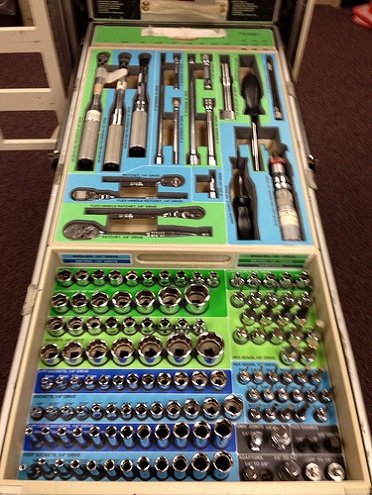
Enter these pictures of an astronaut toolbox making the rounds in several media reports. Tim Peake, an astronaut with the European Space Agency, posted a photoset of a toolbox that astronauts use on the space station. The array of screwdrivers and washers and clamps is impressive, and demonstrates how the station partners are trying to prepare for just about any eventuality.
A single drawer in a toolbox used aboard the International Space Station. Credit: Tim Peake/Flickr
What’s even more impressive is the tools that are used during spacewalks. This, in fact, prompted one astronaut crew (STS-61) to find itself on the American show Home Improvement during the 1990s — simply because they had fixed the Hubble Space Telescope in orbit.
“It’s a lot like using tools here on Earth, except there’s no gravity, so you don’t have to worry about dropping a tool on your foot,” joked commander Richard Covey on the show, a Season 3 episode called “Reality Bytes.” At least two other NASA crews appeared in future seasons of the show because of their work during spacewalks.
Just goes to show you that a repair, whether in space or on Earth, can take you to unexpected places.
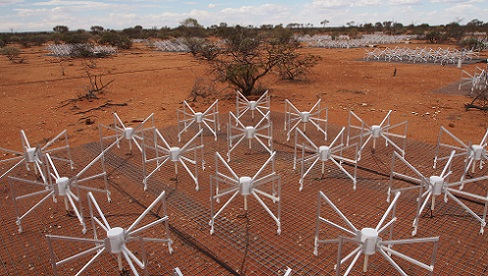
Australia’s Murchison Widefield Array, a precursor to the Square Kilometre Array. Credit: SKA
Those white insect-like things you see in the picture are not spiders on Mars, but the array that they’re a part of could help astronomers understand how the universe and its life came to be.
What you see there is the Murchison Widefield Array, a newly ready radio telescope in western Australia in a remote area about 300 kilometres northeast of Geraldton. Using more than 2,000 antennas (some of which you can see in that picture), astronomers will soon pick up very faint signals from far into space.
“In addition to helping us see back to the origins of the universe, the array will also help us to understand the interaction between the earth and the sun, give early warning of destructive solar flares and study our galaxy and other galaxies,
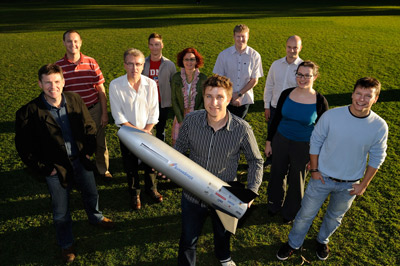
The University of Queensland Scramspace team with a smaller prototype of the 1.8m long hypersonic scramjet. Credit: University of Queensland
Space rocket launches tend to get a lot of attention in the media, particularly when humans are on board. There’s something a little … strange … about watching a human-made object make it into orbit, even as we’re well into our sixth decade of sending stuff into the solar system.
While many people think that a space rocket will always make it into orbit around Earth, at the least, that’s not the way orbital mechanics works. Rockets must reach a certain height and speed in order to orbit our planet. Anything less, and the rocket is considered a suborbital one — one that essentially blasts up and then falls back down to Earth.
These launches are still valuable, however. Because they’re cheaper than orbital missions, they provide a platform for small businesses as well as universities to perform work. For example, they often can feature a few minutes of weightlessness where researchers can get a quick glimpse of how microgravity affects manufacturing or life processes. They’re also good for a scout of weather conditions or even to perform quick bursts of astronomy.
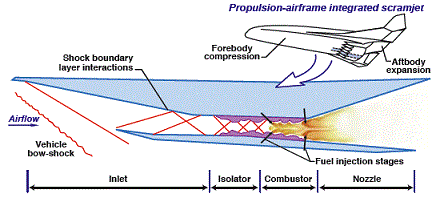
The University of Queensland plans to launch a scramjet aboard a suborbital rocket. This type of engine, which can be used in hypersonic speeds, is expected to reach 8,600 kilometres an hour during its launch from the Andøya Rocket Range, a Norwegian launch site 300 kilometres inside the Arctic circle.
An illustration of how a scramjet works. Credit: NASA
“We have been working with our project partners to test the components of this scramjet in the laboratory with wind tunnels and simulations for the past three years, but testing the scramjet in real flight conditions will be the ultimate test,” stated Russell Boyce , the hypersonics university chair who leads the “Scramspace” project.
“The test period itself will last for just three seconds before the scramjet completely combusts, but the amount of data we can collect in those seconds is enormous. It will give us insights into hypersonic physics, hypersonic combustion, performance of materials and components and how we will make these vehicles fly in future.”
The scramjet will be shipped there in August. It would be a spectacular test to watch, as it will go up to 340 kilometres in altitude on a two-stage rocket. Then the scramjet vehicle will separate itself from the launch vehicle and prepare for re-entry — reaching Mach 8 before it undergoes a planned self-destruction over the water.
While Australia is one player in the scramjet research field, the applications of this research are also reaching international agencies such as NASA and DARPA (the U.S. Defense Advanced Research Project Agency). DARPA, in fact, has done testing with the Australian Defence Science and Technology Organization, such as this 2007 examination that was supposed to examine how to create an engine with efficient thrust compared to drag.
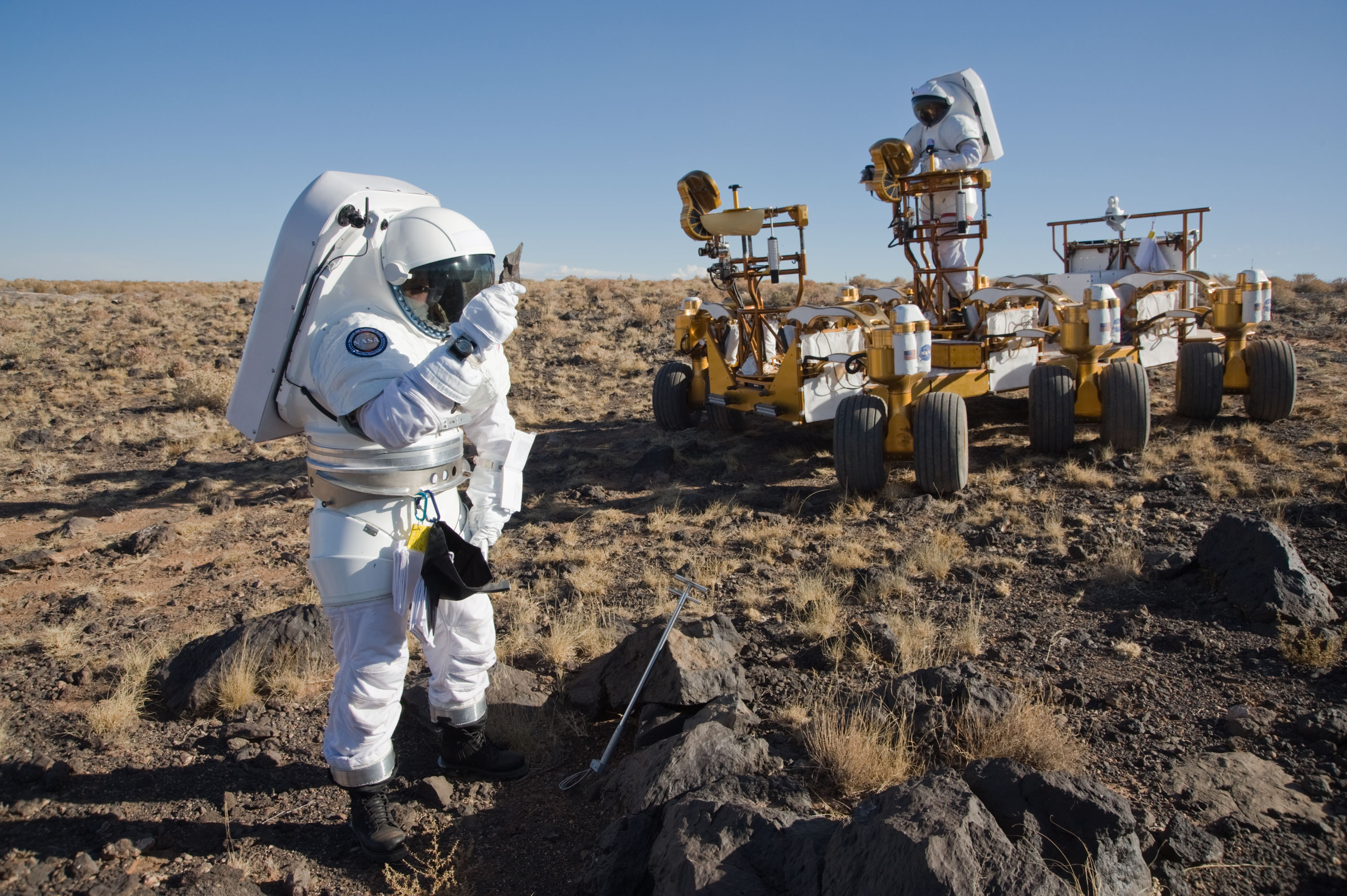
Researchers simulate Mars exploration during a 2008 NASA Desert RATS (Research and Technology Studies) exercise in Arizona. Credit: NASA
How do you rehearse for a Martian space trip? Simulations can only bring astronauts so far when they’re figuring out a mission. A typical person training for the International Space Station can expect a combination of classroom work, spacewalk rehearsals in the water, and robotic arm training using articles that are very close to the real deal.
Exploring another world is a complex problem yet again. Astronauts in the Apollo mission received hundreds of hours in geology training, for example, and flew to areas ranging from Meteor Crater in Arizona to the site of a huge crater in Sudbury, Ont. Today, NASA and other research institutions carry out Mars mission research at two Mars Society sites in Canada and Utah, among other locations.
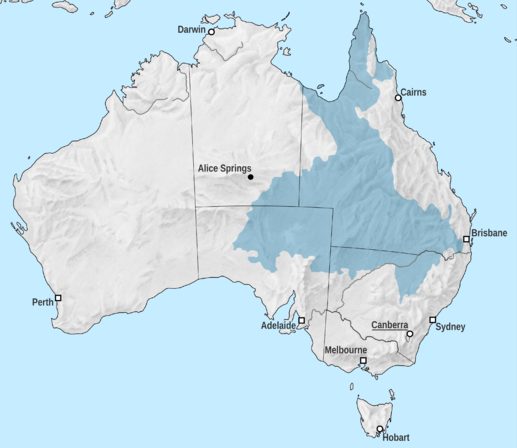
Turns out Australia’s challenging environment could also be a good analog for the Red Planet. The Great Artesian Basin, which stretches across much of the east side of the continent, is the site of “acidic weathering” that could be similar to what was experienced on Mars, a new study says. Perhaps future Martian trainees could add Australia to their list of destinations.
A map of the Great Artesian Basin. Credit: Wikimedia Commons
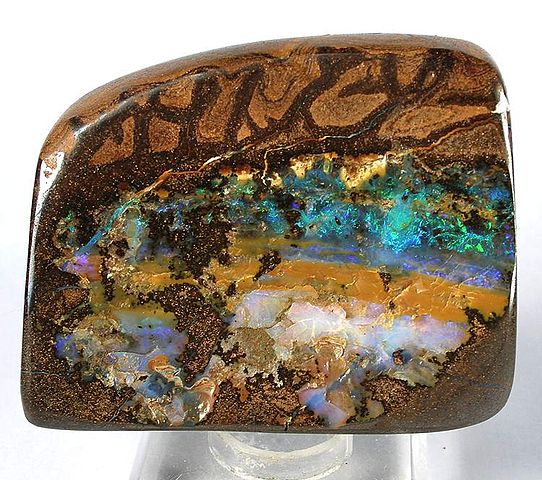
The tough environment has an economic link to Australia: precious opals, the national gemstone of the country. The May 2013 paper in the Australian Journal of Earth Sciences suggests not only a way that opals form.
“Interestingly, acidic oxidative weathering has been documented at the surface of Mars, which shares an intriguing set of attributes with the Great Artesian Basin,” stated the scientific paper.
These characteristics include sandstones that appear very similar between the locations, a “drying out” period that created clay and opaline silica, and even a similar red color, the paper noted. The opals themselves were formed after the acidic weathering dried out the landscape amid the Eromanga Sea receding about 100 million years ago.
A sample of precious opal. Credit: Wikimedia Commons
So what are the implications of this link between Australia and Mars?
It could help us better understand geological features. Rovers on Mars keep stumbling across evidence of minerals that formed in water, “including opal-bearing mineral assemblages”, the paper noted. Research on the Red Planet is thus helping us to better understand how opal formed in Australia, it added, and how the area was dehydrated during the Late Cretaceous.
It could teach us more about each planet’s history. Both areas are very red, suggesting that “oxidative weathering played an important role during and after the dehydration of Mars’ surface”, the paper stated. From a wider perspective, comparative planetology between Mars and Earth could help us understand how a planet can lose much of its atmosphere (as Mars did) or hang on to it (as Earth has, so far.)
Australia could be a good training ground for budding Martian scientists. This finding has already generated a lot of interest in the greater space community (it was picked up by a NASA astrobiology publication, for example) and will likely bring about more research into the links. This could potentially bring Australia to more prominence as a potential training ground for Mars exploration. Geologists could train for searching on Mars by searching in the Great Artesian Basin.
Human Mars exploration is likely still years away, but at the very least, Australia could be a spot where technology is tested out and Martian geological exploration is simulated. The Mars Society has talked about putting in a “Mars-OZ” base in Australia, for example.
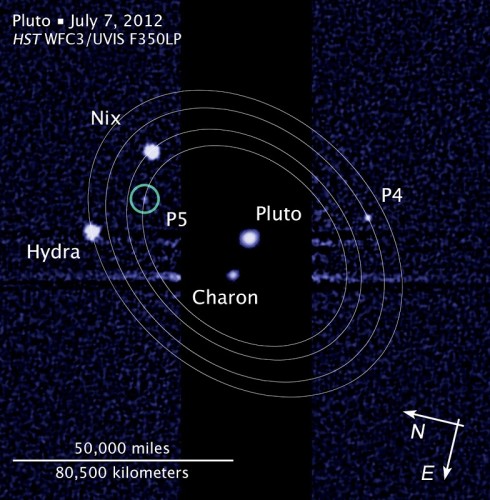
This image, taken by the NASA/ESA Hubble Space Telescope, shows five moons orbiting Pluto, the distant, icy dwarf planet (ESA/Hubble/AFP/Showalter)
The dwarf planet, Pluto, can still generate plenty of public interest – if the naming of its two recently discovered moons is anything to go by. After their discovery, the leader of the research team, Mark Showalter, called for a public vote to suggest names for the two objects. The on-line contest, aptly named ‘Pluto Rocks!‘, concluded with Vulcan as the outright favorite, after a William Shatner led push by Star Trek fans. The names Cerberus and Styx ranking second and third respectively. The International Astronomical Union (IAU) has announced that the names Kerberos and Styx have officially been recognised for these fourth and fifth moons of Pluto. A decision that is probably correct, even if it proves not to be the most popular.
The moons of Pluto
The new moons were discovered in 2011 and 2012, during observations of the Pluto system made with the NASA/ESA Hubble Space Telescope. Their discovery increasing the number of known Pluto moons to five. Kerberos lies between the orbits of Nix and Hydra, two bigger moons discovered by Hubble in 2005, and Styx lies between Charon, the innermost and biggest moon, and Nix. Both have circular orbits assumed to be in the plane of the other satellites in the system. Kerberos has an estimated diameter of 13 to 34 kilometres, and Styx is thought to be irregular in shape and is 10 to 25 kilometres across.
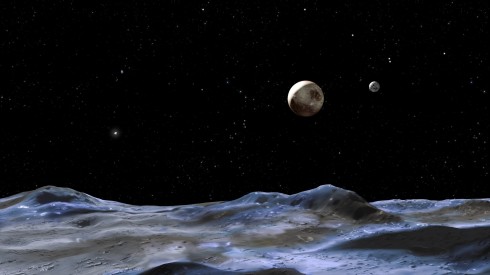
Artist illustration of Pluto (centre) from one of its small moons. The largest moon Charon is on the right. Credit: NASA, ESA and G. Bacon (STScI)
The recent discoveries of the two small moons orbiting Pluto raise interesting new questions about how the dwarf planet formed. We now know that a total of four outer moons circle around a central “double-planet” comprising Pluto and its large, nearby moon Charon.
No home for Spock
The International Astronomical Union (IAU) is the arbiter of the naming process of celestial bodies, and is advised and supported by astronomers active in different fields. On discovery, astronomical objects receive unambiguous and official catalogue designations. When common names are assigned, the IAU rules ensure that the names work across different languages and cultures in order to support collaborative worldwide research and avoid confusion.
To be consistent with the names of the other Pluto satellites, the names had to be picked from classical European mythology, in particular with reference to the underworld — the realm where the souls of the deceased go in the afterlife. Showalter submitted Vulcan and Cerberus to the IAU where the Working Group for Planetary System Nomenclature (WGPSN) and the Committee on Small Body Nomenclature (WGSBN) discussed the names for approval.
After a final deliberation, the IAU Working Group and Committee agreed to change Cerberus to Kerberos — the Greek spelling of the word, to avoid confusion with an asteroid called 1865 Cerberus. According to mythology, Cerberus was a many-headed dog that guarded the entrance to the underworld. In keeping with the underworld theme the third most popular name was chosen — Styx, the name of the goddess who ruled over the underworld river, also called the Styx.
The IAU decided against the name Vulcan for a number of reasons: Vulcan had already been used for a hypothetical planet between Mercury and the Sun (although this planet was found not to exist), the term “vulcanoid
Gamma ray bursts are the most violent and energetic events in the entire universe. Powerful blasts of high energy gamma radiation, bright enough to be seen from literally the very edge of the visible Universe. And yet, we know surprisingly little about them. Of course, we have theories, but every now and again astronomers spot something which those theories don’t fully cover. Such as a couple of years ago, when an international team of astronomers caught a glimpse of the longest lasting gamma ray burst ever seen.
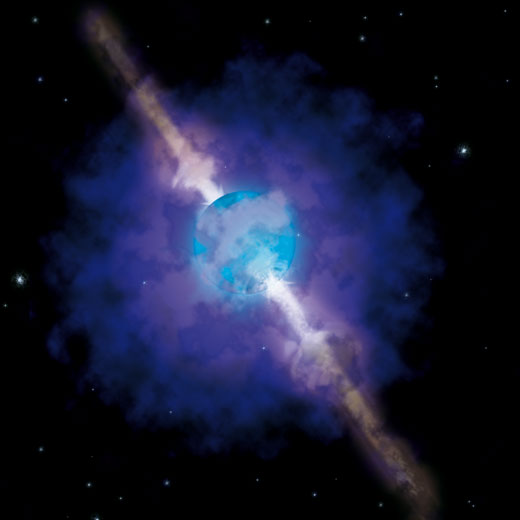
December 9th, 2011. NASA’s Swift telescope detected a sudden spike of gamma rays from somewhere within the constellation of Phoenix, visible in the Southern hemisphere. Gamma ray bursts (GRBs for short) like these are normally subdivided into two types, short bursts and long bursts, which have different causes. Short bursts last for just a couple of seconds, while long bursts can last for several minutes. But this particular burst, dubbed GRB 111209A (pictured above), was very different. One of a unique, rare breed of extra long lived GRBs, and by far the longest ever observed – lasting an unprecedented 7 hours!
Ever since then, astronomers have been picking at the data which were recorded, trying to work out exactly what kind of unusual circumstances would cause such a goliath GRB. One team, a collaboration between Bruce Gendre now at the French National Center for Scientific Research, and David Coward and Eric Howell at the University of Western Australia, managed to get to what may be the bottom of the puzzle. In short, these extra long GRBs are caused by the deaths of the Universe’s most massive stars.
It’s a sobering fact that all stars die. Some burn slowly for billions of years. The very smallest may burn for trillions. But the most massive stars burn out rapidly before dying in titanic explosions which we know as supernovae. It seems that the most massive of the massive, exceptionally rare, die in a unique type of GRB.
So far, only three of these ultra-long GRBs have been found, appearing so bright that some astronomers initially believed that they came from inside our own galaxy. As it happens, this wasn’t the case. Analysing GRB 111209A, Gendre and his colleagues hypothesised the source of it to be an extremely hot, massive star.
A furiously burning blue supergiant (possibly a hypergiant), hundreds of times the diameter of the Sun. When a star like this dies, its core collapses into a black hole, which then proceeds to start devouring the star from the inside out. As that black hole hungrily eats, its mammoth gravitational forces brutally tearing matter apart at the subatomic level, it generates an immense amount of energy which causes two jets of material to shoot out from its north and south poles. These are blasted outwards out with such ferocity that they actually punch two holes in the doomed star.
Read that again. A star which is hundred of times as massive as the sun, and these jets are powerful enough to blast two holes in it! The amount of energy required to accomplish that is truly difficult to comprehend.
The stars which die in these titanic events still require a specific set of circumstances. These stars are apparently enriched in elements heavier than helium (astronomers refer to these as “metals”, even though chemists would disagree on a few counts). More of these heavier elements cause a star’s stellar wind to increase, causing its rotation speed to slow as it loses material. But faster spinning stars seem to be more likely to cause these long bursts, which led some to wonder if the massive star behind GRB 111209A was also cannibalising another nearby star – a process which could possibly cause its rotation to speed up.
The exact cause is still a matter of puzzles and hypotheses. We won’t know more until we observe more of these ultra-long GRBs, and seeing as we’ve only ever spotted 3 of them, it may remain a puzzle for a while yet. But a tantalising glimpse like this of one of the Universe’s most extreme events gives us a good reason to keep watching and waiting. When we do finally understand, it will almost certainly have been worth waiting for.
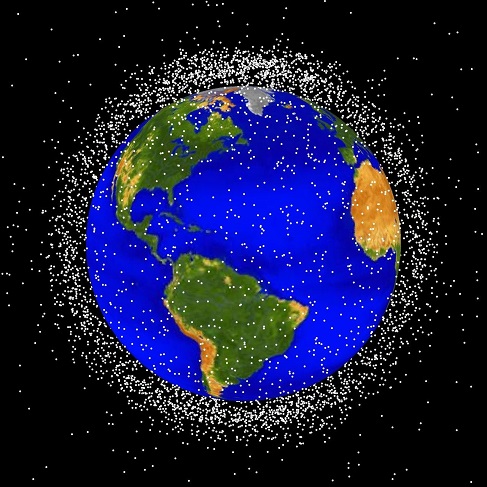
Thousands of objects surround Earth, but one Australian archaeologist argues care must be taken before getting rid of them. Credit: NASA Orbital Debris Program Office
Please don’t go all Chicken Little on us, but do be aware: there’s thousands of pieces of metal orbiting above your head. Many of these satellites are dead (read: out of fuel and uncontrollable.) And if one happens to smash into another, the results could be catastrophic. Humans depend on satellites for everything from the Internet, to weather forecasts, to ATMs.
This is a growing problem that is preoccupying entities such as NASA, which has an Orbital Debris Program Office. The Europeans recently had a space debris conference where experts estimated there is 1 billion Euros of infrastructure that must be protected. They called for some sort of retrieval solution as soon as possible.
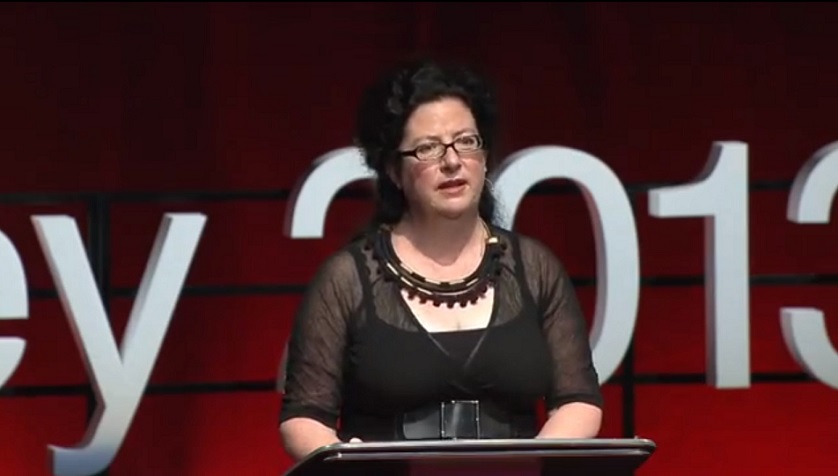
Against this backdrop stands Alice Gorman, a space archaeologist at Flinders University in Adelaide. She says she’s fully aware of the problem, but urges the relevant authorities not to take out these satellites willy-nilly. Part of Australia’s and the world’s cultural heritage rests in these bits of metal, she said at TEDxSydney last month.
Alice Gorman, a space archaeologist at Flinders University, delivers a talk at TEDxSydney in May 2013. Credit: TEDxSydney/YouTube (screenshot)
“Before we start trying to get rid of some of this stuff,” she told attendees in a speech later put on the web, “[ask] does any of it any have cultural significance for us? Does it have heritage value? And do we want to do something sensible about it, instead of destroy all that without thinking?”
Australia is among the nations that could stand to lose that heritage if satellites are destroyed without forethought, she said. Among those is a satellite that was designed by amateurs and was one of the first Australian ones to make it into space.
Called Australis-OSCAR-5, students at the University of Melbourne constructed the small amateur radio satellite out of whatever parts they could scrounge on a small budget. In some cases, pieces came off-the-shelf — not from satellite manufacturers, but from local stores, Gorman said. It launched in 1970 and has been dead for decades, she added, but there is still history attached with it.
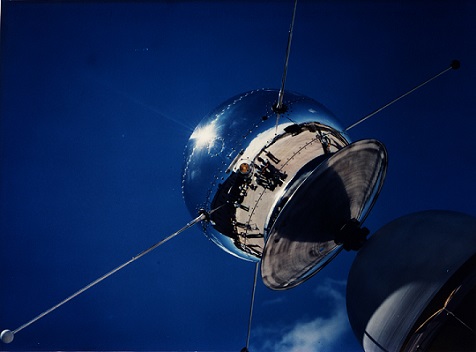
One of NASA’s Vanguard satellites. Vanguard 1, launched in 1958, remains the oldest human object in orbit. Credit: NASA
Australian ground infrastructure is also, in a way, represented in space. Vanguard 1 is the oldest human object to exist in orbit. Launched in 1958 by the United States, it signalled the country’s entry into the Space Race of competing missions that occupied Americans and Russians for at least the better part of a decade. (It came to a symbolic end when Apollo 11 landed on the moon in 1969, although the Russians were already pursuing other goals than moon missions by this time.)
When the United States was getting ready to lob Vanguard into space, officials approached several countries (including Australia) to set up a network to track the satellite in orbit, Gorman said.
Additionally, worldwide groups of amateurs (including Australians) were invited to send in their observations of Vanguard 1. Remember, satellites were rare machines in those days, so initiatives such as that would have gained a lot of attention.
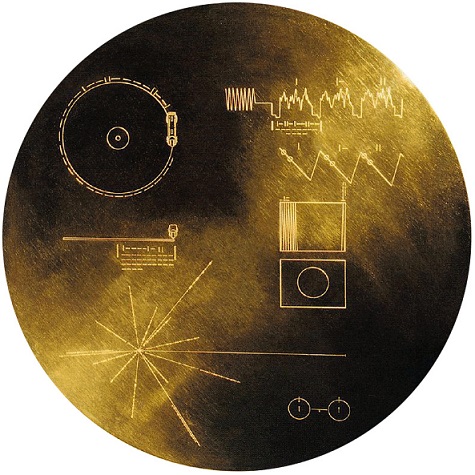
Voyager’s Golden Record, which includes sounds recorded from Australian aboriginals. Credit: NASA
Gorman said these objects, although they haven’t been functional for years, are symbolic pieces of us in space. Perhaps the ultimate expression for Australians is the Golden Record that travelled on each of the Voyager spacecraft that are on a one-way trip out of the solar system. The sounds of Earth recorded on them include some from Australian aboriginals.
“The [spacecraft] remind us that space isn’t just empty and vast and black and dark, and somewhere else out there we’re actually part of it,” Gorman added.
“It is something we should be feeling connected with, not cut off from. Our cultural heritage — these places and these artifacts — demonstrate the kinds of attachments and meanings we can give to these space places.”
To space authorities, Gorman seems to be saying: your move. There is a need to remove objects fairly quickly and efficiently, but before doing so, perhaps their history should be taken into account.
That said, this opens up questions about how to deem one piece of debris more culturally significant than another. Perhaps an international office of sorts could be established to deal with these questions, basing its work on that of heritage organizations around the world.