Category: Space

  • Women in Space – Valentina Tereshkova

    Women in Space – Valentina Tereshkova

    This article is the first in a series of articles in which I will profile every woman astronaut, cosmonaut and taikonaut who has been into space.  The last time I checked 58 women have travelled into space, by the end of this year there may be a few more!  We’re going to start this series at the beginning – with Russian cosmonaut Valentina Tereshkova, the first woman in space.  (The feature image above is a collection of drawings of women astronauts by artist Phillip J Bond.  You can find Phillip’s wonderful series on women astronauts here.)

    Valentina Tereshkova

    Born in 1937, Tereshkova was a textile worker from Maslennikovo, a small village in the far west of Russia.  Tereshkova never yearned to go into space, she left school early to support her family, but continued her education by correspondence. Tereshkova worked in the local textile mill, and earned certification as a cotton spinning technology expert.  She went on to become the secretary of the local Komsomol (Young Communist League).  Tereshkova’s passion was parachuting. She was introduced to the sport of parachuting by a friend and was so taken by the sport she soon began parachuting regularly and set up the Textile Mill Workers Parachute Club.

    In 1962 when the Soviet Air Force advertised for 50 cosmonauts to join the new space program, it included 5 positions for women.  At the time Nikita Khrushchev thought that the U.S. was considering sending women from the Mercury Program into space. This spurred the Russians on to select a number of women for their own space program, with the aim of getting them into space before the US.
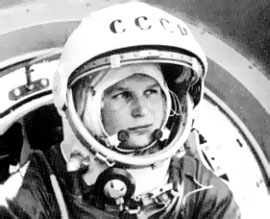
    Valentina Tereshkova
    Valentina Tereshkova (Photo Credit NASA)

    The requirement to be a cosmonaut did not include any piloting skills, but they did require all applicants to be experienced parachutists, under 170cm tall, under 70kg in weight, under 30 years of age, be fit and be ‘ideologically pure’.  Tereshkova met all the criteria.  In addition, she was the daughter of a local war hero who had been declared MIA (presumed dead) during the Russian/Finnish war.

    Tereshkova was one of 50 out of a pool of 400 applicants that were accepted for further testing.  Eventually 5 women passed the assessment test to become a cosmonaut. Over a period of 15 months the 5 women undertook all the same training that the men did, including weightless flights, isolation tests, centrifuge tests, rocket theory, spacecraft engineering, 120 parachute jumps and pilot training in jet fighters.  In a 2005 interview Tereshkova recalled that the training was strict and that they were ‘locked inside the classroom to study theory all day long’.  As Tereshkova was a civilian she was inducted into the Soviet Air Force as a Lieutenant so that she could become a member of the cosmonaut corps.

    Valentina Tereshkova
    Valentina Tereshkova (Image Credit Wikimedia)

    Tereshkova was originally intended to launch first in Vostok 5, and another female cosmonaut, Valentina Leonidovna Ponomaryova was to pilot Vostok 6. However, a few months before launch, the flight plan was altered so that Tereshkova would pilot Vostok 6 and Valery Bykovsky would pilot Vostok 5. In an interview Tereshkova was asked if the other members were jealous that she got to fly.  She responded ‘The other women were upset – but our friendship is still alive’.  She recalled that when she was driven off towards Vosktok 6 for the launch that her back up Irina Solovyova remained in the bus, fully clothed in her space suit, prepared for launch should Tereshkova not be ready or able to launch.

    At 1430 hours on 16 June 1963, 26 year old Russian Cosmonaut Valentina Tereshkova blasted into space aboard Vostok 6, becoming the first woman in space.  Tereshkova’s mission was to orbit the earth for 24 hours and to conduct a number of tests on herself to collect data on the female body’s reaction to spaceflight.  Soon after launch when she settled into orbit Tereshkova realised that the spacecraft was moving away from Earth, rather than heading towards it.  She quickly reported the error to ground control, which then provided a new landing algorithm.  However, this meant that her mission was extended to 2 days 22 hours and 50 minutes.  Because of this, Tereshkova spent more time in orbit than all the U.S. Mercury astronauts combined.  At the time there was no mention made of the potentially fatal miscalculation.  This information was only released in the 1990s.
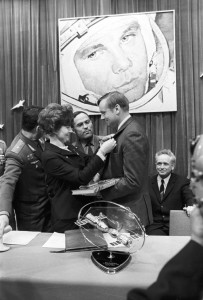
    Valentina Tereshkova, presenting a badge to U.S. astronaut Neil Armstrong in memory of his visit to the Gagarin Cosmonaut Training Center in Star City.
    Valentina Tereshkova, presenting a badge to U.S. astronaut Neil Armstrong in memory of his visit to the Gagarin Cosmonaut Training Center in Star City. Photo Credit RIA Novosti

    Although it’s often reported that Tereshkova got severe space sickness during her flight, in fact she found that it was actually the space food provided that made her ill.  However, this had no impact on her performance of her duties during the mission.

    Tereshkova orbited the earth 48 times and landed as planned, with only a minor bruise to her nose from impact with her helmet during landing.  In November of 1963 Valentina married cosmonaut Andrian Nikolayev   On June 8, 1964, she gave birth to their daughter Elena Andrianovna Nikolaeva-Tereshkova, who is now a doctor and was the first person to have both a mother and father who had travelled into space.  Tereshkova and Nikolayev divorced in 1982.

    After her flight, Tereshkova studied at the Zhukovsky Air Force Academy and graduated as a cosmonaut engineer. She went on to be a test pilot and instructor.  In 1977 she earned a doctorate in engineering. She went on to become a prominent member of the Communist Party of the Soviet Union, President of the Soviet Women’s Committee and prominent supporter of women’s rights. Tereshkova is considered a heroine in post-Soviet Russia.
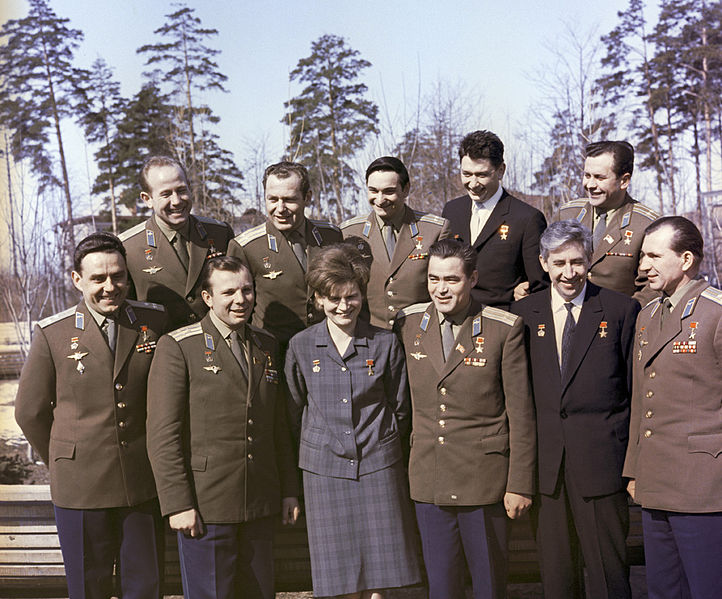
    Soviet cosmonauts
    Soviet cosmonauts (front row, from left): Vladimir Komarov, Yuri Gagarin, Valentina Tereshkova, Andrian Nikolayev, Konstantin Feoktistov, Pavel Belyaev, second row: Alexei Leonov, German Titov, Valery Bykovsky, Boris Yegorov, and Pavel Popovich. Photo Credit RIA Novosti

    Tereshkova and her fellow female cosmonauts were not considered by some to be a part of the cosmonaut corps, and were not considered for flight assignments on an equal basis with the ‘regular’ male cosmonauts. Unfortunately, during this period space flights manned by women were considered for propaganda purposes. There was fierce competition from the men for a flight position, and placing a woman on the flight would mean that she would be taking the place of a man.  An all female Voskhod flight was considered, but eventually cancelled.  There is some suggestion that male cosmonauts objected to the women in the corps as a distraction. None of the other four women in Tereshkova’s early group flew, and in October 1969 the pioneering female cosmonaut group was dissolved.  Even though there were numerous plans for further flights by women, it was a further 19 years before the second woman Svetlana Savitskaya, flew into space.

    Valentina was the recipient of many honours and awards including:

    • The Hero of the Soviet Union
    • Order of Lenin
    • Order of the October Revolution
    • Order of Merit for the Fatherland
    • Order of Friendship
    • Russian Federation State Prize
    • United Nations Gold Medal of Peace
    • Simba International Women’s Movement Award
    • Honorary Doctorate from University of Edinburgh
    • Named a crater on the moon ‘Tereshkova Crater’
    • Eduard Rhein Ring of Honor
    • Asteroid 1671 named Chaika (Her callsign for Vostok 6 ‘Seagull’)
    • Joliot-Curie Gold Medal

    Tereshkova is now 75 years old, living quietly and enjoying life with her grandchildren.  She remains the only woman in history to have made a solo space flight.
  • Fascinating short film about NASA’s Dawn: the very beginning of us

    Fascinating short film about NASA’s Dawn: the very beginning of us

    This fascinating video, narrated by Leonard Nemoy, gives you a glimpse into the origins of our solar system and NASA Dawn mission’s  journey to Vesta & Ceres and its hope to unveil clues as to what was going on at the very beginning of our solar system’s formation!


    NASA’s Dawn mission is a spacecraft designed to collect data from the asteroid belt. The ship itself is a marvel. Outfitted with massive solar panel wings that can power it for years, Dawn converts xenon gas into plasma, which it propels from its engine at speeds up to 78,000 miles per hour (or 21 miles per second) for maximum acceleration. In fact, Dawn is the fastest ship NASA has ever launched. Even at top speeds, Dawn required four years to reach its first stop, the asteroid Vesta, the brightest asteroid in the solar system and the only one visible to the naked eye. Departing Earth in 2007, the ship reached Vesta in July of 2011 and departed last September for the asteroid Ceres, which it will reach in February of 2015.  Via OpenCulture.

    For those visually driven – please take a look at the beautiful interactive map of our stellar neighborhood. With over 100,000 stars in an interactive visualisation, you can take a walk through the stellar neighborhood.

  • The Risk of Human Space Flight to Mars

    The Risk of Human Space Flight to Mars

    This past week NASA announced that in 2015 they would be sending two astronauts to the International Space Station (ISS) for a year-long mission. This is an expected, and necessary step in the preparation for human spaceflight to Mars. If we are to have human explorers on the surface of Mars, we need to understand the effects on humans of long-term space travel. At the moment trips to the ISS last on average 5-6 months. A mission to Mars may take 6-8 months, plus an extended time on the planet, and a 6-8 month return trip. In reality astronauts could be sent on missions of 2 years or longer.

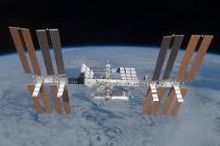
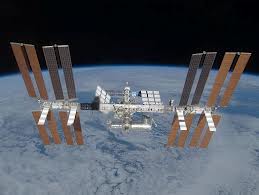
    The ISS as it orbits Earth. Photo credit NASA.
    The ISS as it orbits Earth. Photo credit NASA.

    Astronauts are exposed to a number of conditions in space that can pose serious health risks, especially if exposure takes place over a long period of time. There are lots of hazards and risks for humans in space, including: ascent and descent accidents; space sickness; debris collisions; micrometeorites; hazardous and toxic gas leaks on the spacecraft; EVA (Extra Vehicular Activity) accidents; sudden unexpected illness and the list goes on. Today I’m talking about the specific issues that affect astronauts during long distance flights. (By the way I use the term ‘astronaut’ as a general term, which includes astronauts from various nations, including cosmonauts from Russia, and teikonauts from China.)

    Some of the major issues for astronauts during long duration space flights include:

    Exposure to radiation – Astronauts live and work well above the protective atmosphere of earth, so they are subject to the full force of the sun’s radioactive output as well as high energy cosmic rays that originate outside of our solar system. Long distance missions do not have the benefit of Earth’s protective atmosphere and magnetic field. Material shielding is effective against low energy radiation, but may create damaging secondary radiation for higher energy particles. The ISS uses aluminium to protect the spacecraft and crew. As the thickness of the shielding material increases, the probability that the particle will survive with enough energy to damage human issue is decreased. Low levels of radiation generally do not pose a significant health risk to astronauts, however the effects of radiation are cumulative, so long term exposure increases the lifetime risk to astronauts. Crews of future long duration interplanetary missions will have to travel through the Van Allen radiation belts, and be exposed to more galactic cosmic rays, and as a result will be exposed to higher levels of radiation than those remaining in Earth’s orbit. Increased and prolonged exposure to radiation has serious health consequences for astronauts, including cancer, leukaemia, heart disease, and damage to the central nervous system.

    Muscle atrophy – Our muscles, bones and organs have adapted to work in the environment we inhabit, which is exposed to the effects of gravity. When exposed to an environment where there is little or no gravity, our muscles, bones and organs begin to lose condition – becoming more problematic the longer the astronaut is in space. On Earth, our muscles are constantly working against gravity. In space there is no force of gravity for muscles to work against, so astronauts will lose muscle tone. Loss of muscle tone starts to occur shortly after launch, and continues whilst the astronaut is in a reduced-gravity environment. During longer missions, muscles may atrophy, and astronauts may experience uncontrolled muscle twitching, and a loss of fine motor control. The loss of muscle tone, strength and control can be mitigated with regular exercise during the mission.

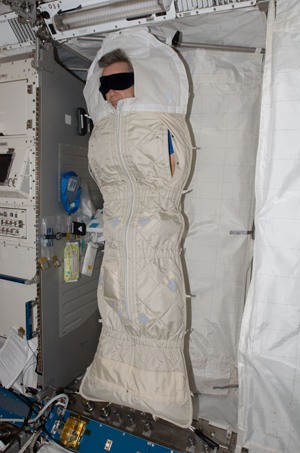
    Astronaut Robert Thirsk, asleep in his sleeping quarters in the ISS. Photo credit NASA.
    Astronaut Robert Thirsk, asleep in his sleeping quarters in the ISS. Photo credit NASA.

    Cardiovascular damage – When in space, the body no longer needs to maintain the powerful heart muscles needed on Earth, so heart tissue begins to shrink. In space, astronauts experience a redistribution of body fluids, which results in changes to cardiovascular physiology. The heart doesn’t have to work as hard pumping blood in a microgravity environment as it does on earth so crew members are encouraged to undertake aerobic exercise as part of their daily routine, in addition to exercises designed specifically to maintain as much muscle tone as possible. Whist exercise is beneficial, it appears that it cannot reverse the process, but can help slow it down.

    Bone density – In microgravity, the lack of impacts in weight bearing exercise means that newly created bone tissue is not incorporated into bones as normal, so as bone tissue is created it is absorbed into the system, not used as it would be on Earth. This results in high calcium levels elsewhere in the body, which can lead to significant health issues. Studies have revealed a significant loss of calcium from weight bearing bones of astronauts. This is a concern for astronauts as it suggests a risk of renal stone formation on long duration missions. Density in such bones as the pelvis and legs decreases by approximately 1 to 2 percent a month on average, which presents concerns for astronauts during long haul missions. Unfortunately exercise does not seem to reduce the level of bone loss, but is beneficial for many other issues as discussed previously.

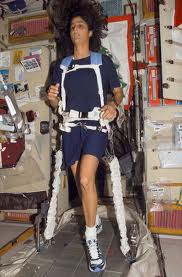
    Sunita Williams exercising on the ISS. Photo credit NASA.
    Sunita Williams exercising on the ISS. Photo credit NASA.

    Hyperarousal – Don’t worry – it’s not what you think! Astronauts may experience hyperarousal, their reaction to a changed schedule, working under pressure, sleep deprivation, and the excitement of being in space. Hyperarousal can cause insomnia, disrupt the appetite, result in impaired concentration, cognitive dysfunction, and decreased co-ordination. Fatigue is often a side effect of hyperarousal, as is anorexia and sudden weight loss. Over time space agencies have developed strategies to deal with hyperarousal, including giving crews adequate rest time, control over some of their tasks, adequate leisure time, and regular contact with family and friends.

    Sleep deprivation – The amount and quality of sleep experienced in space is poor for a number of reasons including: variable cycles of ‘day’ and ‘night’; poor illumination during daytime hours in the space craft; environment outside the windows at the ‘wrong’ time of day; hectic work schedule; noise of the spacecraft; altered diet; and the physical challenge of sleeping in space. Sleep deprivation may compromise the immune system, which whilst not a significant issue during short term missions, is a potentially debilitating condition during long-term missions. Sustained physical stress over a long term period may result in an immune system that is so compromised that the body is unable to fight serious infections. Precautions include wearing sleeping masks and earplugs, anchoring themselves down to sleep, maintaining a steady routine of work and sleep, and using shades and other devices to block out the windows.

    Psychological Issues Working away from friends and family, and working with people from other cultures presents a number of psychological and social challenges. The psychological welfare of a crew of astronauts is critical to the success of a space mission. Interpersonal relationships during a mission may be a significant source of psychological stress. Crews do many things in space to try to maintain a sense of ‘normalcy’ during long stays in space. When crews aren’t required to work, they are encouraged to undertake other activities, which include reading, listening to music, writing e-mails and letters to family and friends, and exercising. In 2007 American astronaut Sunita Williams ran the Boston Marathon on the treadmill in the ISS, completing the race in just over 4 hours. During low earth orbit missions crews receive periodic care packages from their family with CDs, DVDs, books, magazines, photos, and letters. In addition to the packages, the ISS also has library lockers that contain music, books, and videos.

    Over the last 40 years humanity has overcome enormous social, technical and physical challenges to put humans into space. When Yuri Gagarin became the first human in space by orbiting the Earth for 108 minutes on the 12th of April 1961, very little was known about the space environment and how it would affect humans. Just over 40 years later we now have a permanent presence in space with the introduction of the ISS into low Earth orbit. We know a lot about the physiology and psychology of humans in space, and have made space a relatively comfortable existence for astronauts. The future of space exploration may include human missions to other planets within our solar system, such as Mars. Before any long-term exploration of Mars could be contemplated, further research is needed in a number of areas to ensure the safety, and longevity of all crew members during the mission and beyond.

  • Apollo 17: last men on the moon

    Apollo 17: last men on the moon

    image
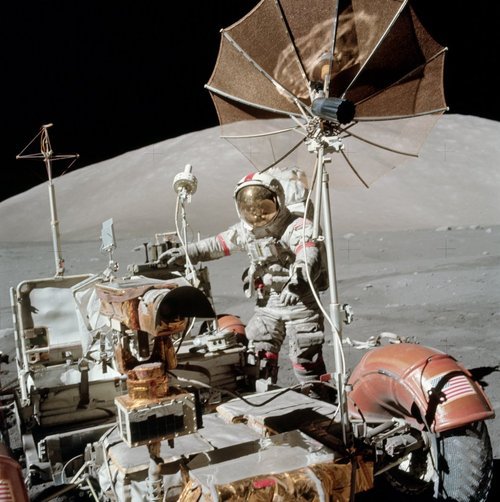
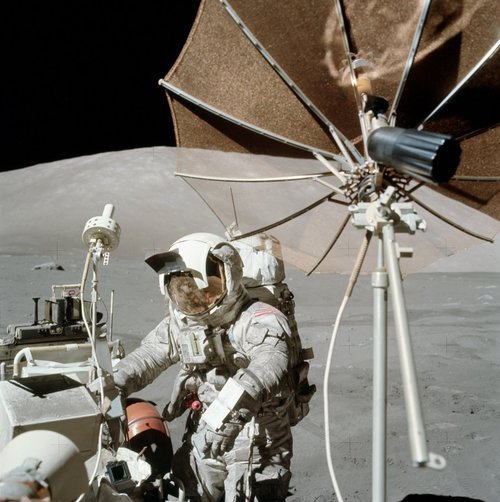
    Apollo 17 Commander, Eugene Cernan, next to the lunar rover. Image credit NASA.

    After kangaroo hopping back to the lunar rover, Eugene and Jack drove back to the lunar module, Challenger. There they dusted each other off and loaded the last of their 100kg of lunar rock samples. Jack cleaned up inside While Eugene parked the rover a kilometre and a half away so the takeoff could be televised. Then hopping and skipping in the low lunar gravity he made the most of his last moments on the moon. Once back at the lunar module, one foot on the Challenger’s landing pad, Eugene Cernan lifted his other from the moon, and said:

    As I take these last steps from the surface for some time to come, I’d just like to record that America’s challenge of today has forged man’s destiny of tomorrow.

    The next day, December 14, 1972, they blasted off from the moon, ending the sixth and last human exploration of the moon for the 20th century.

    The last of the lunar Apollos

    The Apollo program was a child of the cold war between the USA and Soviet Russia. It was invigorated by President Kennedy’s 1961 challenge to put man on the moon and return him safely before the decade was over. Once the landing of Apollo 11 was achieved in July 1969, the Apollo and NASA budgets came under savage scrutiny. It was the time of the war in Vietnam, budget problems for the 1972 fiscal year and followed the scare of Apollo 13.

    The final two scheduled Apollo missions, 18 and 19, were finally cancelled in September 2, 1970. Apollo 20 had already been cancelled on January 2 so that its Saturn V rocket could be used as the launch vehicle for the Skylab space-station in 1973.

    image
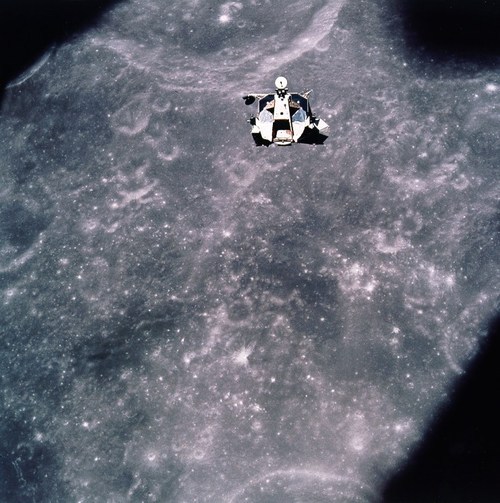
    The first part of the return journey as the Lunar module, Challenger, approaches Apollo 17 Command Service Module, America, after blasting off the lunar surface. Photo credit NASA

    The Apollo program was an incredible, successful human feat. It remains the only program to have placed humans beyond low-earth orbit and onto another celestial body. Apollo 8 was the first manned spacecraft to orbit another celestial body, while Apollo 11 landed the first humans on another world. The program returned 382 kg of lunar rocks and soil to Earth, contributing to the understanding of lunar geology.

    It laid the foundation for NASA’s current human spaceflight capability, and funded construction of its Johnson Space Center and Kennedy Space Center. Apollo also spurred advances in many areas of technology incidental to rocketry and manned spaceflight and the start of huge opportunities for technology transfer, leading to more than 1,500 successful spinoffs related to areas as disparate as heart monitors, solar panels, and cordless innovation. More recently, we’ve seen a fledgling private-sector American space industry complete its first cargo delivery to the international space station.

    Stepping up, walking tall

    There is a marvelous fascination with human exploration. The Apollo missions are a great representation of that drive and curiosity. Apollo 17 astronauts, Eugene Cernan, Harrison Schmitt and Ron Evans, exemplified those attributes.

    image
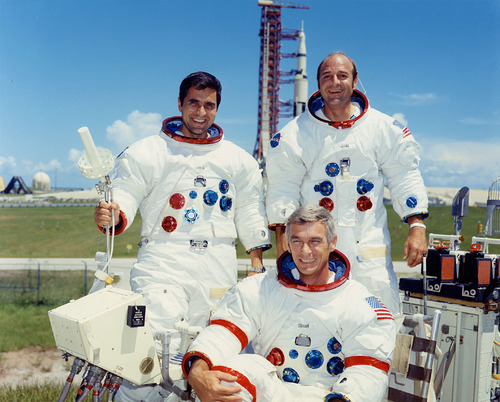
    Publicity shot of the Apollo 17 crew with their Saturn V vehicle in the background. (L-R): jack Schmitt, Eugene Cernan (seated) and Ron Evans.

    Eugene Cernan is ‘Captain America’ to a tee. A US Navy pilot who, like much of America, was caught up in the early space race. In 1962 he watched, captivated, on TV the launch of John Glenn. Who in the third manned Mercury capsule became the first American to orbit the earth. Cernan at the time lacked the coveted ‘test-pilot’ wings to be selected in the September 1962 second group of astronauts, which included Apollo 11 commander, Neil Armstrong. Cernan was picked, in October 1963, for the third astronaut group – which included the other Apollo 11 astronauts Buzz Aldrin and Michael Collins.

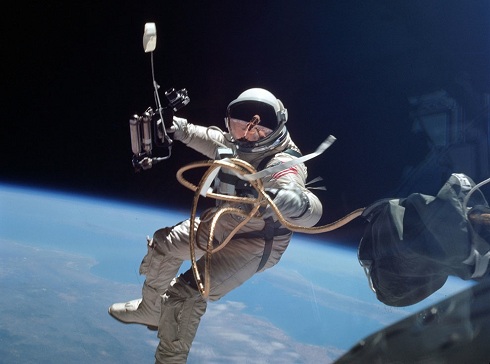
    Cernan became the second American astronaut, after Ed White on June 3 1965, to perform an extra-vehicular activity – a spacewalk. His Gemini 9 spacewalk lasted 2 hours and nine minutes, travelling 57,600 km, and rated as one most difficult achievements of his life.  The brutal mechanics of Newton’s third law in action in space making seemingly simple tasks into exhausting and challenging experiences, resulting in fogging his helmet and pushing his heart rate to 188 bpm. His experiences made NASA rethink the training required for future extra-vehicular activities.

    image
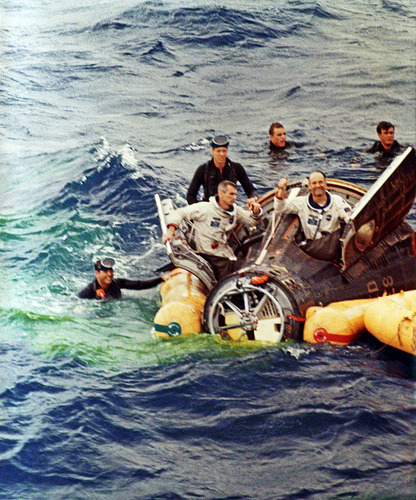
    Gemini 9 splashdown with Eugene Cernan (L) and a smiling Tom Stafford (R).

    On January 27, 1967 Tom Stafford, John Young and Cernan were in an altitude chamber “trying to bring a new, untried, stubborn spacecraft up to launch standards”. Meanwhile, in an identical craft, Apollo 1 astronauts veteran Gus Grissom, first American spacewalker Ed White and Cernan’s closest friend the rookie Roger Chaffee, were conducting similar tests atop a Saturn rocket at Cape Kennedy. Minutes later they were dead, killed in a fire – a tragedy stunning the close-knit space community.

    In May 1969, Cernan, as part of the Apollo 10 crew along with Tom Stafford and John Young achieved a number of records and a “dry-run” for the Apollo 11 landing two months later. As befitting a crew of test pilots they set the record for the highest speed attained by a manned vehicle at 39,897 km/h during the return from the Moon on May 26, 1969 and hold the record of being the humans who have traveled to the farthest point away from home, some 408,950 kilometres. Cernan and Stafford came within 15.6km of the lunar surface in their lunar module Snoopy.

    image
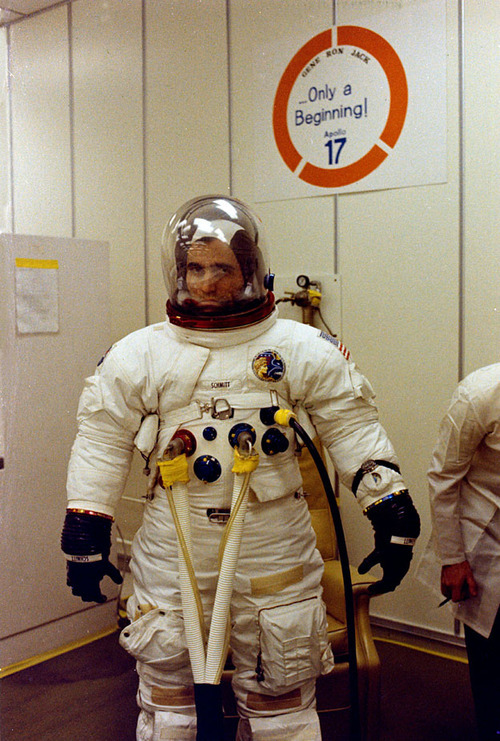
    Jack Schmitt being suited up for dress rehearsal prior to launch. Photo credit NASA.

    Harrison “Jack” Schmitt is a geologist and one of the NASA  group 4 astronauts, “the scientists“, that were announced on June 28, 1965. His and their story is worthy of is own post, coming in January 2013.

    image
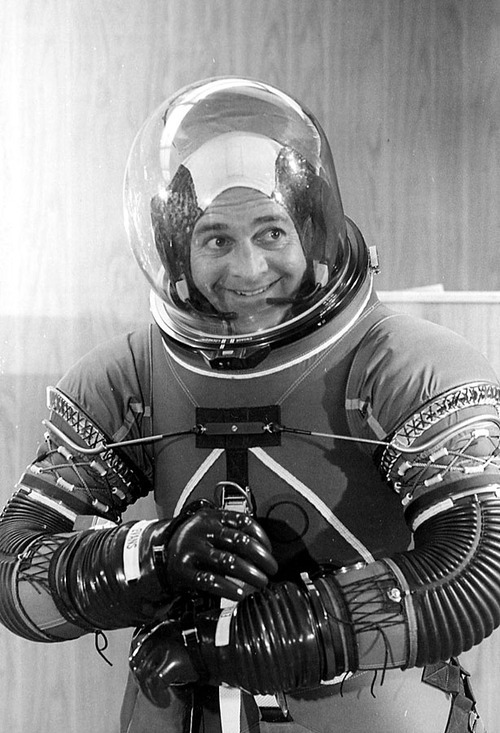
    Ron Evans having a suit fitting during the pre-launch phase. Photo credit NASA.

    Ron Evans was picked as a Command Module specialist from the beginning of his NASA career. Chosen in April 1966, one of the group 5 astronauts, he was support crew for Apollo 1 and back-up command module pilot for Apollo 14. I found him notable for his almost invisibility in memoirs of the time. In both Deke Slayton’s and Eugene Cernan’s fascinating autobiographies Ron Evans is there an accepted, uncontroversial part of the missions, without a strong personality, extremely competent – obviously the perfect man for the pilot seat of the command module America.

    Adventures in the Taurus-Littrow valley

    A moon landing was the payoff for all the hard-work, according to Cernan, “the ultimate dream for any pilot.” Following the tradition began by Neil Armstrong on Apollo 11, Cernan, as Commander, was first out on the moon. As he skipped around Schmitt quipped, “Hey, whose been tracking up my lunar surface?” and then stepped out onto a geologist’s paradise – the moon.

    The primary objectives for Apollo 17 were: to sample lunar highland material older than the impact that formed Mare Imbrium and investigate the possibility of relatively young volcanic activity in the same vicinity. The Taurus-Littrow valley was selected with the prospects of finding highland material in the valley’s north and south walls and the possibility that several craters in the valley surrounded by dark material could be linked to volcanic activity

    Cernan and Schmitt had a  three-day lunar surface stay, conducting three periods of extra-vehicular activity, either moonwalking or driving around in the third Lunar Roving Vehicle. They amassed over 22 hours on the surface during these periods in which they collected lunar samples and deployed scientific instruments.

    image
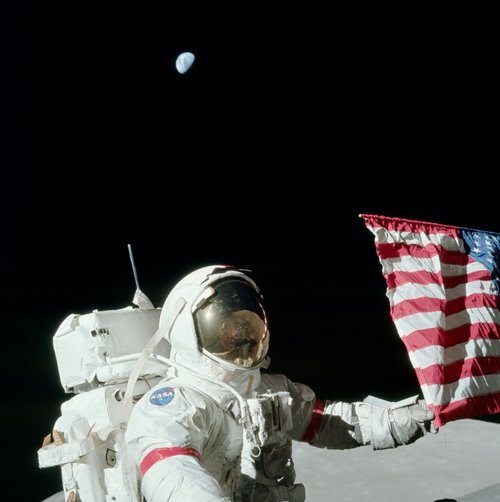
    Eugene Cernan on the first EVA, suits still pristine and the Earth above his head. Evocative shot by Jack Schmitt. Photo credit NASA.

    The largest haul of lunar rocks was collected by the two moon-walkers as well as deploying the Apollo lunar surface experiments package (ALSEP), a feature of all manned lunar missions. The stations ran from deployment until they were turned off on 30 September 1977 due to: budgetary considerations, the power packs could not run both the transmitter and any other instrument, and the ALSEP control room was needed for the attempt to reactivate Skylab.

    They also carried out gravimeter experiments to learn about the moon’s internal structure. The gravimeter was used to obtain readings at the landing site in the immediate vicinity of the lunar module, as well as various locations on the mission’s roving routes.

    image
    Eugene Cernan next to the lunar rover vehicle. Photo credit NASA.

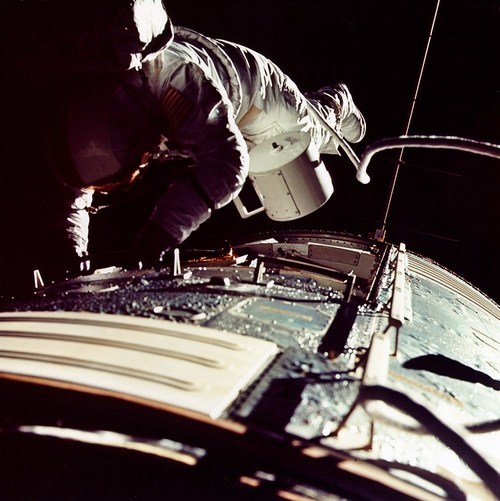
    Meanwhile the command module also housed a series of scientific experiments. A special bay housed three experiments (as well as cameras and altimeter) for use in lunar orbit: a lunar sounder, an infrared scanning radiometer, and a far-ultraviolet spectrometer. The film canisters were recovered by Ron Evans in a spacewalk after docking with the returned lunar module.

    image
    Ron Evans on his space-walk to retrieve film canisters from the outside of the service module prior to separation of the command module and return to earth. Photo credit NASA.

    Splashdown in the Pacific on December 19, 1972 brought this “first phase” of human space exploration to a close – I now wait for the second phase to begin and wonder who might it be?

  • Come on in, the Water is…Frozen

    Come on in, the Water is…Frozen

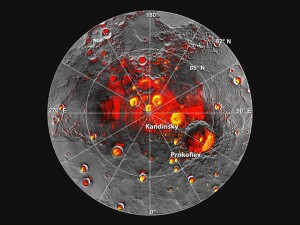
    MESSENGER detected the presence of polar ice on Mercury. The spots shown in yellow are craters containing ice. Source: Image Credit: NASA/Johns Hopkins University Applied Physics Laboratory/Carnegie Institution of Washington/National Astronomy and Ionosphere Center, Arecibo Observatory

    Water – the source of all life. It’s been found on what we have believed for many moons to be that little hot-tempered planet named Mercury. It seems the celestial body has a shady side, a split personality perhaps; one side ferociously hot, while its polar opposite features some craters of ice. NASA scientists have unequivocally confirmed the presence of water on the planet. Ready for a swim? Ice-skating may be more appropriate.

    The Finding

    Rarely does consensus on discoveries such as this occur. Three methods, neutron spectrometry, near-infrared reflectance and thermal models from MESSENGER, were used to conclude and confirm the presence of water and organic material on Mercury.

    The duality of Mercury is somewhat perplexing; can you imagine living on a planet with a temperature range between -223C and 427C? It is in these shaded, cold regions, those that never see the sun, where the ice lies bare and exposed. However, data from MESSENGER also show that frozen water is found in slightly warmer areas. It lies buried beneath a dark material, an insulator of some sort covering it, and there’s a lot of it. Estimates put the amount of water ice on Mercury between 100 billion and 1 trillion metric tons. That’s enough water to cover an area the size of Washington, D.C., 3.2 kilometers deep.

    Where Did the Water Come From?

    Much the way Earth came to have water and organic material, it is thought that comet impacts and asteroid strikes created the same organic building blocks of life on Mercury. At last Thursday’s news conference, researchers were bouncing around all sorts of hypotheses on what this discovery could mean for life in other parts of our solar system. Messenger principal investigator Sean Solomon, of Columbia University’s Lamont-Doherty Earth Observatory said “there’s a lot of water out there, as there is a lot of water around other stars, but at substantial distance. “The solar system is “a soggy place ” according to Jim Green, director of NASA’s Planetary Science Division. Green went on to explain his enthusiasm with that statement, indicating “it really bodes well for us to continue on the exploration, following the water and its signs throughout the solar system.” How water was brought to Earth and Mercury, were probably brought to other planets.

    With any good find, come more questions…

    These observations, while extraordinary, can only heighten our curiosity about Mercury and the rest of the galaxy. Is the dark material in the polar craters on Mercury mainly organic compounds? If so, what sorts of chemical reactions has that organic material undergone? Is this the same material that gave rise to life on our planet? Are there regions on Mercury that have both liquid water and organic compounds? Only by continued exploration of space can we hope to find answers to these questions.

    Life as we know it, will probably not be found on Mercury given its ultra-thin atmosphere and proximity to the sun. The discovery of water ice and dark organic material can still inform the hunt for organisms beyond Earth and help scientists piece together the puzzle of how life began on our planet. We still do not fully understand the beginnings of life and the chemical reactions associated with those beginnings on our own planet.

    Last week’s discovery of water and organic material on Mercury will indicate we have a lot to learn. Hopefully, it opens up vast areas of research that radiate outward, showing the connections of our segmented universe. How we see view and study other planets has great value for how we analyze and safeguard ours. For instance, what are the implications for planetary warming (climate change)? What can the ice trapped beneath the organic carbon material tell us? The thermostat of astrobiology has just been ratcheted up a notch.

  • The Case for Neptune

    The Case for Neptune

    Take a moment to consider Neptune. The eighth planet in our solar system, the planet farthest from the Sun, and the third most massive planet in our solar system.  Also one of the least visited, and consequently one of the least understood planets in our solar system. Neptune was discovered in 1846.  Forty years later, in 1886, astronomer Sir Robert Ball wrote ‘Besides this brief sketch of the discovery of Neptune, we have little to tell with regard to this distant planet.  With a good telescope and a suitable magnifying power we can indeed see that Neptune has a disc, but no features on that disc can be identified’.

    Unfortunately in the last 126 years not much has changed. Due to its enormous distance from Earth (~ 30 Astronomical Units) Neptune remains little more than a blurry disk in the eyepiece of the most powerful ground based telescopes.  In the past astronomers  studied Neptune by examining the planet as it occulted, or passed in front of the light of another object, usually a star, allowing scientists to calculate its diameter, chemical composition, and temperature.  The opportunity to study the gas giant only improved when Voyager flew by Neptune in 1989, and the Hubble Space Telescope was launched in 1990.

    Voyager 2 launched in 1977, and reached Neptune on the 25th of August 1989 (click here for an impressive animation of the Voyager 2 flyby of Neptune). Although Voyager 2 began imaging the planet from about 35,000,000 million miles out, most of the data we have today is from a 24 hour period, during which Voyager 2 passed 4,500 kilometres above Neptune’s north pole at an eye watering 67,000 km per hour.  During the trip to Neptune Voyager gathered about 5 trillion bits of information or about .5 of a Terabyte of data. That doesn’t sound much now, but back in 1977 the 3 computers on the Voyager spacecraft had a combined memory of 68Kb, so Voyager sent back almost 15 million times more data that could be stored in it’s memory!!

    Scientists were thrilled by the data from Voyager 2 and set to work learning as much as they could about the distant blue planet.  We learnt that Neptune is mostly composed of gas, is likely to have a rocky or metallic core, and that the majority of Netpune’s mass is hydrogen and helium, with traces of water, methane, ammonia, and other compounds.  Thanks to Voyager 2 we learnt an enormous amount about Neptune’s atmosphere, weather systems, magnetic field, moons, and ring system.  But that was over 30 years ago – and we now have more questions than answers.

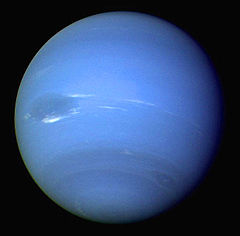
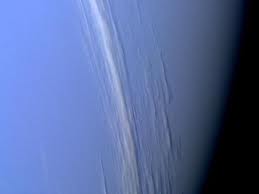
    Images from Voyager 2 showed that the most obvious feature of Neptune is its stunning blue colour, the result of methane in the atmosphere.  Voyager 2 also revealed a more dynamic and turbulent atmosphere than anyone expected.  Neptune’s atmosphere consists of layers of clouds, banded features, and unexpected structures, including what was termed the Great Dark Spot (GDS). Neptune generates the strongest jet streams anywhere in the solar system, reaching speeds of up to 2,400 kms per hour. Voyager detected weak auroras, similar to those on Earth, but because of Neptune’s complex magnetic field, the auroras appear over wide regions of the planet, not just near the planet’s poles.  Despite what we do know, the structure and composition of Neptune’s atmosphere remains poorly understood. What accounts for the relatively high percentage of methane and lack of hydrogen and helium? What is the energy source responsible for powering the incredibly high speed winds and variable storm systems? What happened to the Great Dark Spot (observed by Voyager in 1989, but no where to be seen when Hubble observed the planet in 1994). Why is the temperature of Neptune’s thermosphere, a staggeringly high 750K (4760 degrees celsius)?  How can Neptune be so cold and distant from the Sun, and yet radiate so much energy?

    Thanks to Voyager 2 we know that Neptune’s magnetic field is approximately 25 times stronger than Earths, and that it’s lopsided (like Uranus), at 47to the rotation axis and offset from the planet’s centre.  Although we suspect that Neptune’s magnetic field is generated by currents within Neptune’s icy mantle – we do not fully understand why Neptune’s magnetic field is oriented the way it is, or what processes could generate such an off-kilter magnetic field.

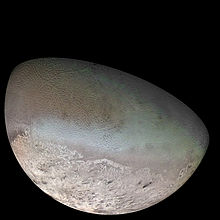
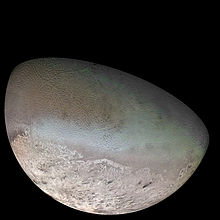
    Voyager 2 image of Triton (Credit Nasa)
    Voyager 2 image of Triton (Credit NASA)

    Before Voyager 2, Neptune was thought to have 2 moons, Triton and Nereid. Voyager 2 discovered 6 new moons, and since Voyager’s visit, astronomers have discovered a further 5 moons.  Most of what we know of Triton, Neptune’s largest satellite, was acquired in a single encounter by the Voyager 2 spacecraft, which imaged about 40% of its surface.  If scientists were surprised by the images from Neptune, they were stunned by the images of Triton.  Triton, is an icy moon with a surface temperature of -235o, the coldest place known in the solar system.  Voyager’s images revealed a geologically active planet, geysers spewing nitrogen gas and dust particles high into the atmosphere, rocky outcrops, canyons, and plains of frozen methane.  Triton has a very thin nitrogen atmosphere with small amounts of methane, above a scarred and cracked surface.  Triton showed no fresh impact craters, an indication of an active planet experiencing periodic resurfacing.  But there’s still a lot to learn. Perhaps the most tantalising questions are about Neptune’s largest moon.  Was Triton formed near Neptune, or is it a captured object from the Kuiper belt?  What is the composition of Triton, and what causes the geologic activity, and has the distribution of the ice geysers changed dramatically since the Voyager flyby?  Will further analysis of Triton tell us more about the solar system, and our place in it?  Is there a sub surface ocean? Could Triton harbour life?

    Earth-based observations during the 1980s suggested that there were a number of partial rings surrounding Neptune, and Voyager 2 discovered a system of equatorial, circular rings.  Although Voyager 2 gave us a good look at Neptune’s rings, the details of their composition is still uncertain, we don’t know how long they’ve been there, or even if they are stable.

    Despite the valuable insights bought to us by the Voyager mission, the Hubble Space Telescope and other studies, clearly there are still a number of questions about Neptune that still need to be answered. Technology has advanced enormously since 1977 and any new mission would be well equipped to examine Neptune, its rings and a number of its moons.  A mission to Neptune would enable us to learn more about our outer solar system, and exploration of Triton may provide our best opportunity to examine the surface and atmosphere of a Kuiper Belt Object in orbit around a planet in our solar system.  In 2003 NASA proposed a Neptune Orbiter/Triton Explorer, however, that mission appears defunct.  Neither NASA nor ESA have any current or future plans for the exploration of Neptune.

    I think that needs to change.

  • Weekly Science Picks

    Weekly Science Picks

    The midlife crisis is more complicated than first thought. It might be time to stop blaming troubled marriages and feeling obsolete in a sea of younger colleagues. A study published in the Proceedings of the Natural Academy of Sciences has revealed that chimpanzees and orangutans also experience a midlife crisis.

    Having a midlife crisis may not just be the result of a troubled marriage or the thought that life may be halfway over. It might be part of primate biology. That’s right, hardwired into us.

    Economist Andrew Oswald told ABC Science that it might be beneficial.

    “Maybe discontent lights a fire under people, causing them to achieve more for themselves and their family.”

    A shiny new red sports car might just indeed lead to better things.

    Danielle Spencer runs a science club at Mitchelton State School in Queensland and explored where gender stereotypes in science began. Where does the perception that men do the “hard” sciences and women do the “soft” sciences come from? A group of 45 primary school students were surveyed and it was found that a majority of students thought that science was accessible to both genders.

    When asked why there are more men than women in engineering roles, the students responded with gender based answers like “Girls like dancing and other jobs.” and “Women are more suited to caring and developing jobs like childcare and nursing.”. There was no response that challenging this observation. This was despite 75% of the group thinking that science was accessible to them. It is disheartening to hear.

    Students were asked whether their science club should be split into a boys only and girls only science club, there was overwhelming support for a combined science club. There was an appreciation and acknowledgement that irrespective of gender, everyone had a valuable contribution. At the moment this cohort of students believe that science is something that everyone can do. The question remains though, how do we get adults to believe this?

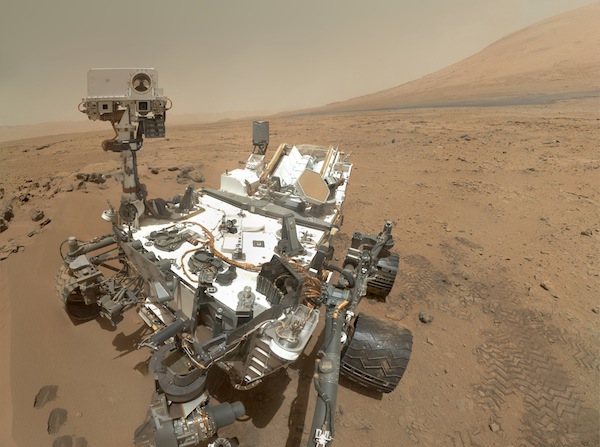
    As this week drew to a close, attention focused on NASA’s Jet Propulsion Laboratory in Pasadena, California. A story broke at NPR reporting that the Curiosity Rover may have found some exciting news. Project Scientist at the Mars Science Laboratory, John Grotzinger was quoted to saying:

    “We’re getting data from SAM as we sit here and speak, and the data looks really interesting.”

    SAM, the Sample Analysis at Mars  is a miniaturised chemistry lab. On board is a Gas Chromatograph, Quadrupole Mass Spectrometer, Tunable Laser Spectrometer as well as sample processing systems that allow heating and chemically treating samples. Normally these instruments would fill the space in a laboratory but on Curiosity it’s around the size of a microwave. SAM is being used to collect information about the past and present chemistry of Mars. As well as this SAM is also identifying organic and inorganic chemical molecules known to be important to life on Earth.

    So what has SAM found? Nothing has been confirmed but it does sound like there is something especially when Grotzinger says:

    “This data is gonna be one for the history books.”

    We will have to wait at least several weeks before NASA makes an announcement.

    New Zealand’s volcano, Mount Tongariro made it into this week’s news with an eruption on Wednesday. Luckily there have been no reports of damage or injuries. However, a group of travellers and journalists hiking at the time witnessed and filmed the eruption.
     

  • Weekly Science Picks

    Weekly Science Picks

    Ah, the weekend! Time to kick back, relax, and look back over everything that’s happened over the past few days. And I’m rather happy to say that some quite interesting things have happened, including the Leonid meteor shower which peaked on Friday night (though if you step outside after dark and watch the sky, you may still see a few stragglers). So what else has caught my eye this week, science-wise?

    Well first off, the Curiosity Rover has been busy over on the planet next door. I can’t help but find everything about the Curiosity rover exciting, especially as it’s paving the way for actual manned exploration to another planet. As many people will agree, no matter how sophisticated a rover can be, it will never be as good as a team of properly equipped geologists exploring a site in person. As it turns out, this idea just came a step closer to being reality…

    Astronauts Could Survive Mars Radiation, Curiosity Rover Finds

    The findings demonstrate that Mars’ atmosphere, though just 1 percent as thick as that of Earth, does provide a significant amount of shielding from dangerous, fast-moving cosmic particles.


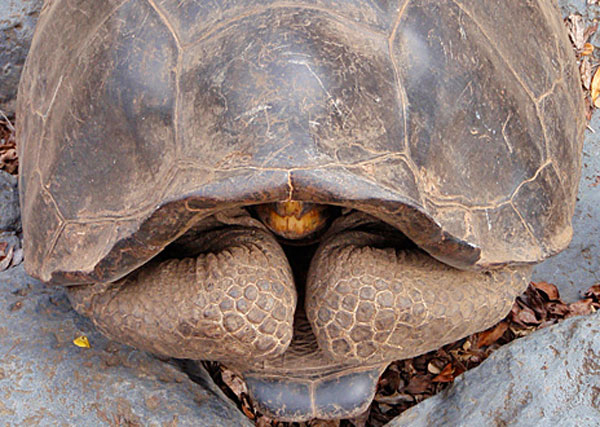
    Some people may recall the death of an aged tortoise nicknamed Lonesome George, so called because he was thought to be the last surviving member of his species. I know I do, and was rather saddened by it. While it may be an inescapable part of the way life on our planet works, there’s something quite humbling about being forced to simply watch a species go extinct and not be able to do anything about it. But then, was George’s death really the end of the story? As it happens, perhaps not…

    DNA tests show Lonesome George may not have been last of his species

    “These giant tortoises are of crucial importance to the ecosystems of the Galapagos Islands, and the reintroduction of these species will help preserve their evolutionary legacy,” said Danielle Edwards, postdoctoral research associate at Yale and lead author on the study.


    Lisa Grossman at New Scientist discusses the phenomenon of rogue planets – planets roaming interstellar space after being forcibly ejected from their home systems. It’s a concept which I’ve thought about in great detail in the past, as have many others, including astrophysicists, astrobiologists, and science fiction authors.

    Astrophile: Lonely planet roams with stellar outcasts

    The wanderers are no longer gravitationally linked, but they are headed in the same direction. “Like when you kick a clod of sand, the grains don’t stick together anymore but they have the same common motion,” Delorme says.


    In chemistry, I’ve always held a certain fascination with noble gas compounds. Molecules formed from atoms which aren’t supposed to react and form molecules always seemed rather exotic and curious. Several of these compounds have been predicted involving Xenon, one of the heaviest noble gasses. And there may be a lot of Xenon trapped inside the Earth this way…

    Professor predicts stable compounds of oxygen and ‘inert’ gas xenon

    “In addition to providing a likely solution to the missing xenon paradox and clarifying essential aspects of xenon chemistry, our study may result in practical applications,” says [Artem R.] Oganov. “For example, the ability of xenon to form strong chemical bonds with oxygen and other elements, and to be trapped in crystalline defects, suggests their use as non-classical luminescence centers and active sites for catalysis”.


    And to end on a humourous note, XKCD wrote a comic this week describing the Apollo Spacecraft and Saturn V rockets using only the 1000 most commonly used words in the English language. The result was slightly hilarious and rather enlightening about how often writers like myself use words which aren’t in that top 1000. A testament to XKCD’s popularity is how many people in the online space and astronomy communities mentioned it – including at least one astronaut!

    xkcd: Up Goer Five

    Lots of fire comes out here. This end should point toward the ground if you want to go into space. If it starts pointing toward space you are having a bad problem and you will not go into space today.


    Hope you’re having a good weekend!


  • Interview: Keri Bean—Mars meteorologist, Curiosity Rover team member

    Interview: Keri Bean—Mars meteorologist, Curiosity Rover team member

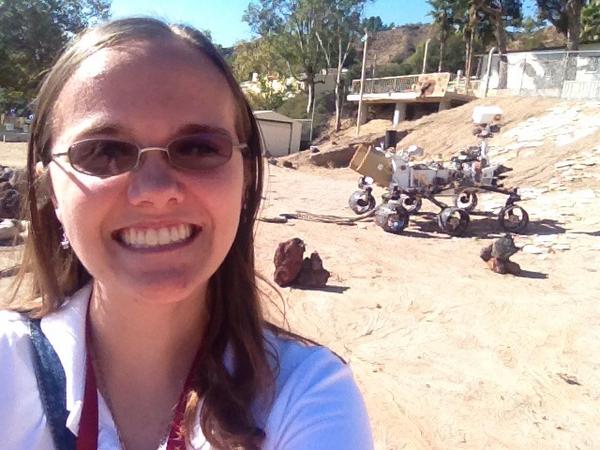
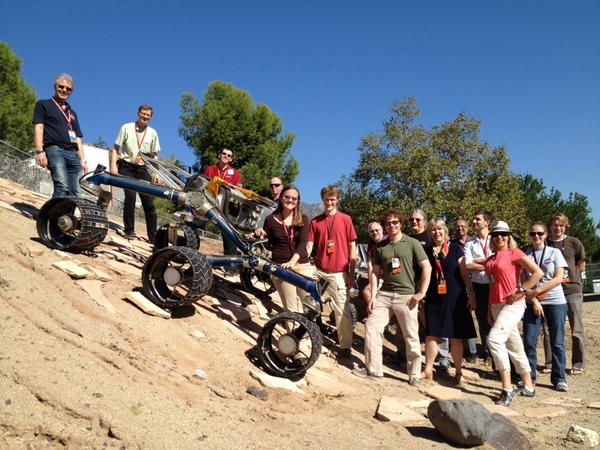
    Keri Bean in the NASA JPL Mars Yard, with the Curiosity test-bed twin ‘Maggie’

    Keri Bean is a meteorologist specialising in the atmospherics of other planets. She is on the team operating the Curiosity Rover for NASA’s Mars Science Laboratory mission. Prior to MSL, Keri has had roles in the missions for other Mars rovers Spirit and Opportunity, a prototype Moon rover, the Phoenix Mars Lander, and the Hubble Space telescope. And she’s just 25 years old! That’s a pretty incredible CV to rack up already.

    In this interview, Keri talks with me about her work on MSL and the other missions, plus how and why she got into space science. It all started when a tornado hit her pre-school.

    Australian Science on SoundCloud.

    Keri (centre) with many of the MSL team and ‘Scarecrow’, the other Curiosity test rover (Scarecrow is lighter than Curiosity so that it mirrors the lower Mars gravity).

    A GIF of the partial solar eclipse by Mars moon Phobos, as captured by the Curiosity rover—an image capture task coordinated by Keri.

    A photo of Phobos (highly zoomed it, and hence quite grainy) taken by Curiosity just after dusk on 21 September using one of its Mastcams, showing its ‘potato’ shape.

    The ‘Chariot’ Lunar rover prototype for which Keri worked on camera design (and which James May managed to have a minor accident with when filming an episode of Top Gear!).

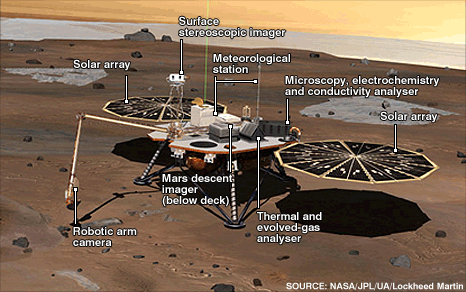
    The Mars Phoenix Lander.

  • Weekly Science Picks

    Weekly Science Picks

    It seems the rate of everything has increased exponentially. A very bold, vague, yet intriguing statement, you might say.

    During the course of the past 2 weeks, Hurricane Sandy devastated the East Coast of America, followed closely by a nor’easter. So my science picks for this week center on the themes of natural disasters, planning, global warming and Space, and the rate of which we have to increase our thinking and innovation in order to get ahead of these issues, before they become serious problems.

    So let’s get started.

    I was out of town when Hurricane Sandy struck. My neighborhood in Brooklyn was pretty much untouched. While I heard reports from friends not having power, and subways and airports being closed, it wasn’t until watching the hurricane relief telethon that I realized the magnitude of destruction. And I chose the following article by our very own Charles Ebikeme because it is important to remember that Haiti has yet to recover from several rounds of natural disasters. The U.S. will rebuild. Considering a large portion of the Haitian population still remains housed in tents from the earthquake, will they be able to rebuild? Before the next natural disaster strikes?

    Sandy’s aftermath by Charles Ebikeme

    While most of the focus of western media centred on the damage Sandy caused in America, especially this close to a Presidential election; there were few news outlets that reported what had passed in the Caribbean — outside the death tolls and damaged infrastructure. Indeed, as it is becoming more and more apparent, it is always the blogosphere that provides an adequate source of information. Hurricane Sandy’s progression was followed by bloggers on the ground, giving another side of the story we don’t often get to see.

    But it is in Haiti, a country that has yet to recover from tropical storm Isaac that hit in August of this year, as well as the earthquake of 2010, that felt the worst of Sandy’s wrath. 1.8 million people in Haiti are affected by the storm, according to the United Nations relief agency.

    This next story appears in the current issue of Scientific American and drives home the point why immediate action on climate change, energy and planning (community planning) is necessary to attempt to prevent incidences such as Sandy, or at least lessen the amount of destruction as much as possible. Obama won re-election this week. And while there is no shortage of issues to tackle, the President needs to implement an energy policy for this country. And it’s called global warming, so I hope the world can come together within the next four years and knock out a sound plan.

    Global Warming: Faster Than Expected? by John Carey

    The potential for faster feedbacks has turned some scientists into vocal Cassandras. Those experts are saying that even if nations do suddenly get serious about reducing greenhouse gas emissions enough to stay under the 450-ppm limit, which seems increasingly unlikely, that could be too little, too late. Unless the world slashes CO2 levels back to 350 ppm, “we will have started a process that is out of humanity’s control,

  • Does my science look big in this? The astrobiology edition

    Does my science look big in this? The astrobiology edition

    During the 20th century a powerful new idea gradually entered our consciousness and culture: cosmic evolution.  We are all par of a huge narrative: a cosmos billions of years old and billions of light years in extent. It is this idea that caught my attention this month via the proceedings of the Sao Paulo Advanced School of Astrobiology SPASA 2011, published in the October International Journal of Astrobiology.

    Although the question of extraterrestrial life is very old, the concept of full-blown cosmic evolution – the connected evolution of planets, stars galaxies and life on Earth and beyond – is much younger. In a rather breathtaking paper, Steven Dick formerly of the Aerospace History at the National Air & Space Museum places his arguments for cosmic evolution. Dick traces the idea from its roots in the 19th century theories of Pierre-Simon Laplace and Robert Chambers through its philosophical, astronomical, and biological upbringing to the present day. He examines evolution, the worldview that it had become in the 1950s and 1960s and how it had permeated culture in numerous ways and different cultures in diverse ways. Dick cautions us though noting “we need to remember that ‘culture’ is not monolithic and that ‘impact’ is a notoriously vague term.”

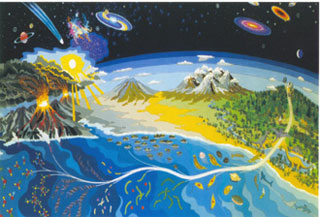
    Cosmic evolution. Image credit: Harvard University.

    In addition to the impact of our new understanding on culture, cosmic evolution also provides a window on long-term human destiny, asserts Dick. He presents this idea via three scenarios, the: the physical , biological, and postbiological universe. Life is unique to earth in the physical universe scenario, and the options flow from this situation – think of Isaac Asimov’s Foundation series. We will certainly interact with extraterrestrials in the biological universe – here cosmic evolution commonly ends in life, mind and intelligence. Cultural evolution in a biological universe may replace biologicals with artificial intelligence creating what Dick calls a postbiological universe. We do not know yet, which of these is our reality, that is one of the challenges of astrobiology, maintains Dick.

    In a second ‘big-picture’ paper Marcelo Gleiser presents his four ages of astrobiology. For Gleiser the influx of astrophysical data, particularly on the prevalence of exoplanets “indicates that there are plenty of potentially life-bearing platforms within our galaxy.” He then presents the ‘history’ of life in the universe in terms of the steps needed for matter to have sequentially self-organised into more and more complex structures. His sequence is best viewed as a prelude to the physical or biological universe scenarios of Dick. Gleiser’s fourth age, the Cognitive Age (the age of thinking biomolecules), really addresses whether we are unique or not i.e. which of Dick’s two scenarios, the physical or biological are reality. Gleiser’s first three ages: physical, the creation  of stars and planets from atomic nuclei; chemical, in which elements organise into biomolecules; and thirdly biological, in which living creatures of growing complexity form from biomolecules. the papers by Dick and Gleiser are both papers heady and exhilarating conceptual reads.

    Jorge Horvath and Douglas Galante accept the premiss that life exists, and then argue we need to take high-energy astrophysical events seriously. Scientists and the public account for meteor impacts in both academic studies, science-fiction writing and film – not so for events such as supernovae, gamma-ray bursts and flares. They show that these events are more frequent than asteroid strikes and that the effects are non-negligible (academic speak for potentially fatal to planet based species). They conclude that just because we have not yet been wiped out by such events can be seen as either a measure of earthlife’s resilience or a threat we are statistically yet to encounter.

    My attention was captured by two other papers from the proceedings. Martin Brasier and David Wacey address the problem of studying life in deep space – comparing it to study of life remote in time. This view is pertinent, as it is non-trivial for scientists to determine what is a viable signal of extinct life. The authors develop a set of protocols and then apply these to earth samples, of varying ages. They do this to show how we could interpret similar samples, where much of the desirable information (the context) has been filtered out during the process of transmission (either physical or data) across vast distances of space, or time or both (as is likely on Mars). Even 10 years ago these questions were moot, but we have learned much over the recent past about metabolic pathways and living microbial systems. Brasier and Wacey conclude that there is still work required on pseudo-fossils, structures that arise naturally within complex physico-chemical systems, so that we can confidently agree on signs of life that are remote in space and time.

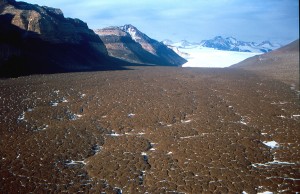
    The Dry Valleys in Antarctica. Photo credit: NASA

    My final pick is an experimental paper that looks at the ExoMars mission. The European Space Agency and (initially NASA ) ExoMars mission is scheduled for launch in 2018 – specifically to detect life signatures on the surface and subsurface of Mars. This probe will carry, for the first time, a Raman spectrometer,  a technique with proven ability to determine the spectral signals of key biochemicals. The authors support these assertions by assessing samples acquired from Arctic and Antarctic cold deserts and a meteorite crater. These terrestrial environments are similar to those found on Mars. The experimental results presented in this paper demonstrate that it will be possible using this technique to assess and detect spectral signals of extra-terrestrial (Mars in this case) extremophilic life signatures.

  • The astronauts who put the USA on the moon

    The astronauts who put the USA on the moon

    The Soviet Union launched Sputnik 1 into an elliptical low Earth orbit on October 4, 1957. This surprise precipitated the space age and triggered the space race. The success ushered in new technological, political, military, and scientific developments.

    On April 12, 1961, Yuri Gagarin became the first person in history to leave the Earth’s atmosphere and venture into space. His flight aboard a Soviet Vostok rocket lasted 108 minutes, at the end of it he had ignited the manned space race.

    Who were men who responded to these Soviet firsts, launching America into space and then onto the moon?

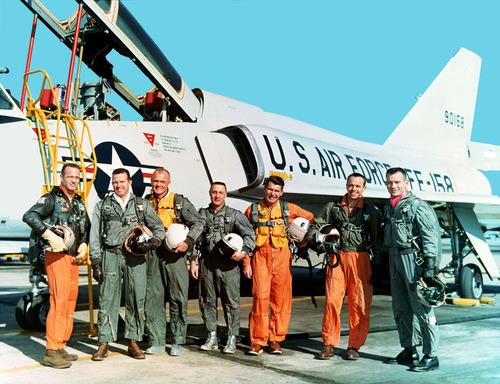
    NASA selected the first US astronauts, the Original Seven (also referred to as the Mercury Seven and Astronaut Group 1), on April 9, 1959. This was the only astronaut group with members who flew on all classes of NASA manned orbital spacecraft of the 20th century — Mercury, Gemini, Apollo, and the Space Shuttle.

    The Mercury Seven stand in front of a F-106 Delta Dart. Photo credit NASA.

    The original seven were Alan B Shepard Jr, Virgil I “Gus” Grissom, John Herschel Glenn Jr, M Scott Carpenter, Walter M “Wally” Schirra, Leroy Gordon Cooper Jr, and Donald K “Deke” Slayton.

    The first American launched into space was Alan Shepard, followed by Gus Grissom. Their ballistic flights were followed by orbital flights by John Glenn then Scott Carpenter, each managing three orbits. Wally Schirra made six orbits and Gordon Cooper completed the Mercury project with 22 orbits. Cooper was the first American travelling in space for over a day and the last American to be launched solo into Earth orbit. Deke Slayton, was grounded in 1962 due to a heart arrhythmia, but reinstated in 1972 and flew on the Apollo-Soyuz Test Project in 1975.

    The New Nine. Back row: See, McDivitt, Lovell, White, & Stafford. Front row: Conrad, Borman, Armstrong, & Young. Photo credit NASA.

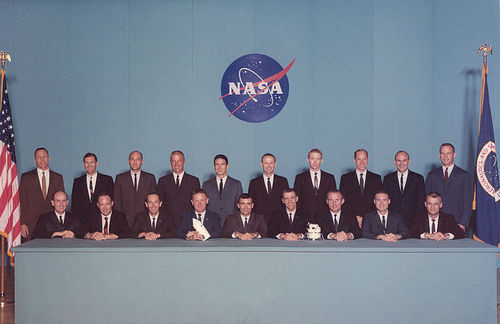
    With the announcement of the Gemini program and planning of the Apollo program a second group of astronauts were selected by NASA and announced on September 17, 1962. The New Nine augmented the original Mercury 7. While the original seven had been selected to accomplish the simpler task of orbital flight, the new challenges of rendezvous and lunar landing led to the selection of candidates with advanced engineering degrees (for four of the New Nine) as well as test pilot experience.

    This illustrious group became the first group with civilian test pilots in the group; Neil A Armstrong, first man on the moon and Elliott M See Jr, killed in a plane crash four months before he was due to pilot Gemini 9. Two of this group, Charles Conrad Jr and James A Lovell Jr, had been candidates for the original seven, but were not selected then for medical reasons. In addition, the group was Frank F Borman Jr, James A McDivitt, Thomas P Stafford, Edward H White II, and John W Young.

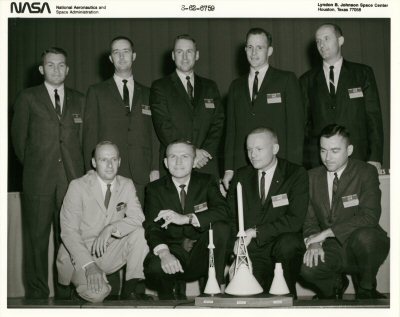
    NASA announced the third group of astronauts, the “Apollo fourteen” in October 1963.  Four (Charles A Bassett II, Roger B Chaffee, Theodore C Freeman, and Clifton C Williams Jr) died in training accidents before they could fly in space. Chaffee was killed along with Grissom and White in the Apollo 1 fire. All of the surviving ten (Edwin E “Buzz” Aldrin Jr, William A Anders, Alan A Bean, Eugene A Cernan, Michael Collins, R Walter Cunningham, Donn F Eisele, Richard F Gordon Jr, Russell “Rusty” L Schwiekart, and David R Scott) flew in the Apollo program; five (Aldrin, Cernan, Collins, Gordon, and Scott) also flew Gemini missions. Aldrin, Bean, Cernan and Scott walked on the Moon.

    The Fourteen (seated, left to right) Aldrin, Anders, Bassett, Bean, Cernan, and Chaffee. Standing (left to right) are Collins, Cunninham, Eisele, Freeman, Gordon, Schweickart, Scott and Williams. Photo credit NASA.

    Group 3 was the first group to include candidates with no test pilot background. They are the only ones of the first 19 NASA astronaut groups to have no members at all fly on the Space Shuttle.

    The fourth group of astronauts, the Scientists, selected by NASA in June 1965, came as a rude shock to the existing astronauts. While the astronauts of the previous three groups were required to have college and some advanced degrees, they were chosen for their test pilot expertise. The six members of this group, on the other hand, were chosen for their research and academic backgrounds. Doctorate degrees were required and minimum flight time requirements were waived for this group.

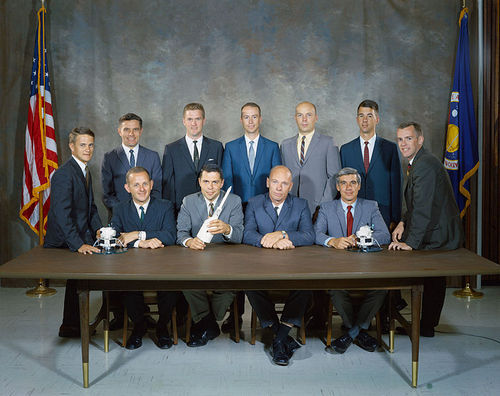
    Scientist-Astronauts: Front row, L-R: Michel, Schmitt, and Kerwin. Back row, L-R: Garriot, and Gibson. Photo credit NASA.

    This group included the science poster boy, Harrison H Schmitt, a geologist, the only scientist to walk on the Moon. Owen K Garriott, Edward G Gibson and Joseph P Kerwin all flew to Skylab. Garriott also flew on the Space Shuttle. While Duane E Graveline and F Curtis Michel left NASA without flying in space.

    John Young labelled the next astronaut group, selected by NASA in April 1966, the “Original Nineteen” in parody of the original seven Mercury astronauts. Of the six Lunar Module Pilots that walked on the Moon, three came from this group (Charles M Duke Jr, James B Irwin, and Edward D Mitchell). This group is also distinctive in being the only time when NASA hired a person into the astronaut corps who had already earned astronaut wings, X-15 pilot Joseph “Joe” H Engle.

    The Original Nineteen. Photo credit NASA.

    The group as a whole is roughly split between the half who flew Apollo (Duke, Ronald E Evans Jr, Fred W Haise Jr, Irwin, T Kenneth Mattingly II, Mitchell, Stuart A Roosa, John Swigert Jr, and Alfred M Worden) and the other half who flew Skylab and Shuttle (Vance D Brand, Gerald P Carr, Engle, Don L Lind, Jack R Lousma, Bruce McCandless II, William R Pogue, and Paul J Weitz) providing the core of Shuttle Commanders early in that program. John S Bull resigned from the program for medical reasons, whilst Edward G Givens Jr died in a car crash after being support crew for Apollo 7.

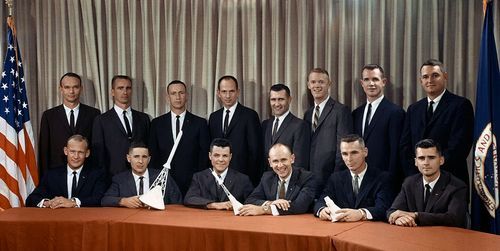
    The final group of this era, the second group of scientist-astronauts, were appointed by NASA on August 11, 1967. They were labelled the “excess Eleven” with only five, including the first Australian born astronaut Philip Chapman, given formal assignments in the Apollo Program, and these were all non-flying. These were: Joseph P Allen, Chapman, Anthony W England, Karl G Henize, and Robert A R Parker. Chapman resigned from NASA in July 1972 due to lack of space-flight opportunities. Three others, Donald L Holmquest, Anthony A Llewellyn, and Brian T O’Leary resigned earlier from the group for various reasons.

    The Excess Eleven civilian scientists. Seated at the table, L to R: Chapman, Parker, Thornton, and Llewellyn. Standing, L to R: Allen, Henize, England, Holmquest, Musgrave, Lenoir, and O'Leary. Photo credit NASA.

    Assignments for the group were delayed by the requirement to spend a full year to become qualified as jet pilots (as were the Group 4 scientists before them). This requirement for scientists to be trained as jet pilots was eventually lifted with the creation of the Mission Specialist position in the Shuttle Program. The seven members (Allan, England, Henize, William “Bill” Lenoir, Story Musgrave, Parker, and William E Thornton) of Group 6 who stayed with the program after Apollo went on to form the core of Shuttle Mission Specialists, accomplishing a total of 15 flights.

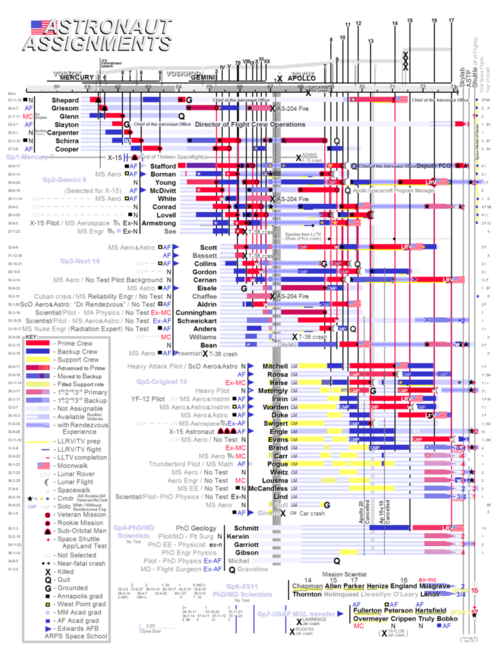
    This chart organizes each NASA astronaut group by order of their assignment to fly. Codes as explained in the legend illustrate each person's skills and accomplishments. Image credit: Tdadamemd

    In all 66 men became NASA astronauts during this first era of manned space exploration. No women were included – although there was an unofficial group called the First Lady Astronaut Trainees– not being jet test pilots there were ineligible to become astronauts.

    Was this a “boys’ own adventure”? Was this a period of great social upheaval in the USA? Did this era cement in the US politicians and public the image of supremacy and isolationism in space endeavors? Yes, is the answer to all three questions.

    There are a myriad of stories from these groups’ exploits. These stories have a contemporary relevance as we reach an era of: new commercial space opportunities (leisure, exploration and mining), new entrants (China and India), and find the US and Europe hampered by self-imposed budget challenges and hurdles.

  • Payload

    Payload

    Source: http://www.payloadfilm.com/about/

    Science Fiction

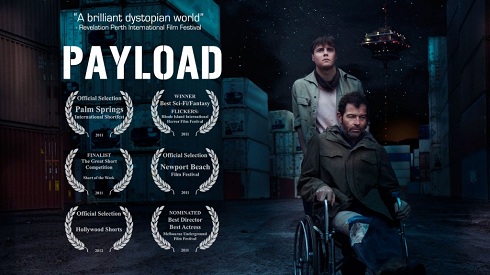
    This may not be the usual topic for a blog post normally displayed on Australian Science, but when our editor Danica mentioned she saw this great Aussie short and asked if one of us writers wanted to do a narrative, I jumped at it. The next 17:55 of my lunch break left me in awe.

    A movie doesn’t have to be a full length feature to have an impact or drive home a message. And Payload really packs a punch. There were so many messages; messages of a society that travelled down a drainpipe. Clarke’s Town is a place that would have just about every council of the United Nations mired in details and confusion and working round the clock. The issues raised in this fictional setting being human trafficking, prostitution, the sale of human organs or body parts, smuggling, security, poverty, gender, food, clothing, education… corruption is everywhere. You get a sense of normalcy among the Carter clan, but that normalcy is faced against the outside operations of a world that does not make sense,which is far bigger than the Carters. Sacrifice is the only way for survival.

    Clarke’s Town is a functioning spaceport, which is a character in and of itself in this story. This spaceport, this crawler, is painted as an escape to freedom and perhaps to normalcy – from dystopia to utopia. Is that why the mother never came back? Is Davinia “Dave” Carter now saved from what one can only suspect was to be a dreadful and despairing existence? Simon Carter may have been doing what he had to do, but he is Davinia’s hero. The main characters – Simon, Adam Carter (the father) and Kate Henshaw – each went through a visible transformation, almost a metamorphosis of sorts. They took what little there was of a moral high ground when it came to the reasoning of right and wrong (no matter how wrong). With Davinia, as she says goodbye to Simon at the spaceport, she leaves you with the thought that her transformation, her payload, is yet to come. I find it rather apropos the meaning of the name Davinia/David is “beloved”.

    I’m having a hard recalling when exactly was the last time a movie moved me as much as this little motion picture has. From the setting, to the haunting yet soothing tones of the music, it makes you think what society, our world, would be like without some of the resources we take for granted every day. More so, I think it makes you think about some of the countries, or communities, in this world just struggling to gain access to basic resources.

    Writer and director Stuart Willis mentioned extending Payload into a feature – set 10 years later when Earth is being evacuated. Will answers be given to the questions raised in the short? My synapses are already firing up hypothetical synopses. If there were a motion picture category for the Nobel Prize, I would say award it to Mr. Willis straight away.

    Watch the movie.

  • Pioneer anomaly explained?

    Pioneer anomaly explained?

    Pioneer 10 and 11 unveiled the solar system during the golden-age of robotic exploration. Their missions were a success; Pioneer 10 threading the asteroid belt to provide our first close view of Jupiter and its moons, Pioneer 11 catapulting past Jupiter and foraying through the plane of Saturn’s rings.

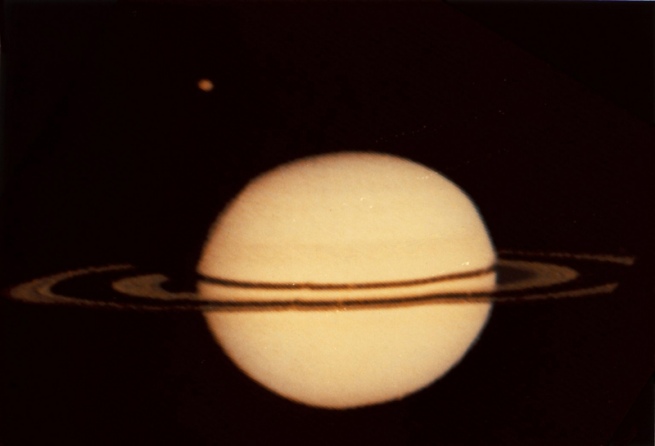
    Saturn and its moon Titan imaged by Pioneer 11 in 1979. Photo credit NASA/JPL.

    The Pioneers, true to their name, kept travelling – out of the solar system – into space legend. We lost communication with Pioneer 11 in 1995, and with Pioneer 10 in 2003 when it had reached a distance 80 times further than the Earth from the Sun. Some years prior to this, when the probes had traveled only one quarter of this distance, scientists realized both were thousands of kilometres closer to the Sun than expected.

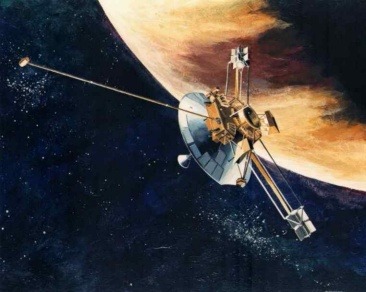
    Pioneer 10, articts conception. Image credit NASA/JPL.

    Space exploration depends on precise measurements of every factor involved in the mission – particularly distance. Beams of radio waves were sent and bounced off the Pioneer spacecraft to measure the probes’ movement. The distance to the spacecraft and its speed were calculated from the photons’ round trip time and their Doppler shift (the frequency change you hear as an ambulance siren approaches and then recedes from you).

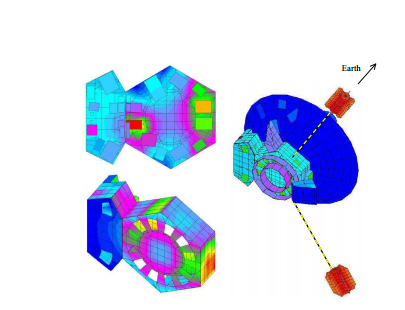
    Gas leakage, measurement error or other mundane reasons might explain the Pioneer anomaly. Heat, unevenly radiating off the probes, slowing their voyage, is proposed by Jet Propulsion Lab scientists, in a new Physical Review Letters article, to account for the anomaly. After constructing a finite-element thermal model of the two spacecraft, the authors modeled the effects of thermal recoil forces on Pioneer 10 at various distances from the Sun.

    Finite element analysis of thermal radiation from Pioneer 10. Image credit JPL.

    A second paper in a sister journal, Physical Review D, proposes a totally different cause and conclusion. Flat (neither expanding nor contracting) background spacetime with a solar system gravitationally isolated from the rest of the Universe is the cornerstone of current theory. The new study extends this theoretical concept, formalizing the description of particles and photons moving in the gravitational field of a localized astronomical system now embedded in an expanding universe.

    The proposed changes to the astrophysics theory are mathematically complex, the paper is densely populated with “post-Newtonian cosmological field equations” – the conclusions though are emphatically clear. Terms, proportional to the local expansion of the universe, are missing from the equations of light propagation currently used by space navigation centres for fitting distance and speed observations of satellites and celestial bodies. With this correction the Pioneer anomaly disappears; the photons were moving faster than expected from the theory, the spacecraft were actually travelling the correct speed.

    NASA New Horizons space probe. Image credit NASA/JPL.

    So which of these two competing papers explains the Pioneer anomaly? Which will solve this nagging problem and be of benefit to future interstellar travel? We may need to wait beyond 2015 to find an answer. With no new Pioneer data, proof will rely on measurement from NASA’s New Horizons mission, launched in 2006 and set to reach Pluto in 2015.