NASA’s rover Curiosity was safely on Mars. It was a perfect landing. The novel sky-crane method had proved its detractors wrong and its designers right. What was needed then was signs that Curiosity was working as designed. NASA had said that the first pictures may be anything up to 2 hours after landing. A long time for the audiences, waiting, live, all over Earth.
It's a wheel on Mars. Photo credit NASA/JPL
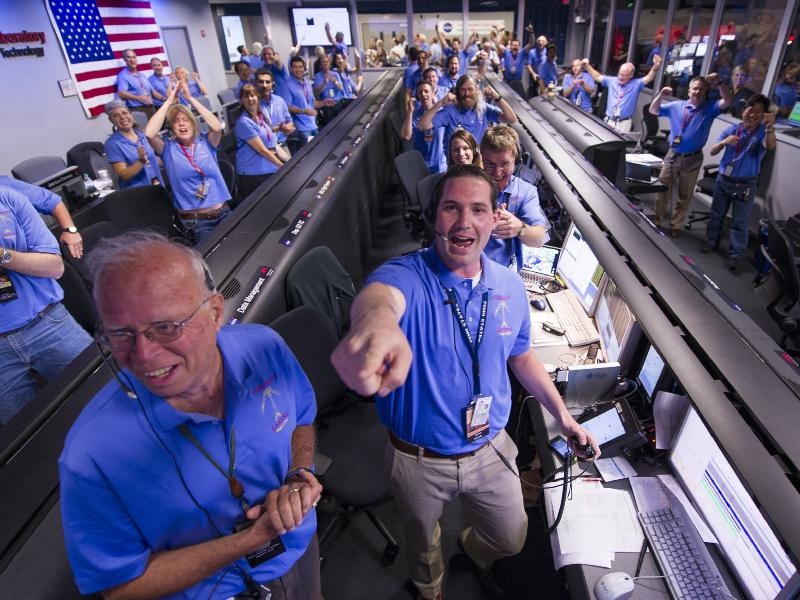
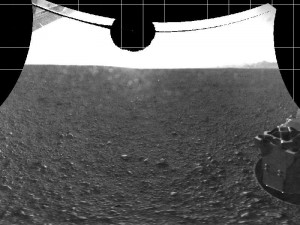
“Got thumbnails.” Pause in the control centre, then someone else yells “Its a wheel, its a wheel!” “A wheel on Mars!” For the second time that momentous afternoon the NASA/Jet propulsion Lab crowd erupted into spontaneous and joyful applause. Not only had they landed the rover, Curiosity, safely on Mars, they had received the first images back from its cameras. Sometimes the unscripted, unexpurgated exclamations make for the best history.
The first two pictures were from the front and back navigation cameras. They were low resolution black and white thumbnails taken through the dust caps that protected the cameras during landing. As the minutes ticked by higher resolution images came through from the rover. The business as usual, familiar image enhancement bought into sharp clarity the ‘first’ two images from the robot explorer.
The 'first' image enhanced view from the rear hazard camera, Mars Curiosity Sol 0.
The first week on Mars
After the exuberance and press conference came the trademark NASA precision and methodical approach. An approach that gets missions safely to Mars, at the same time can make the audacious appear mundane.
Mission controllers at NASA’s Jet Propulsion Laboratory in Pasadena, are now checking out Curiosity’s subsystems and 10 instruments. Curiosity is in the opening days of a two-year mission to investigate whether conditions have been favorable for microbial life and preserving clues in the rocks about possible past life.
Mission team members are “living” on Mars time. A Martian day is approximately 40 minutes longer than an Earth day, meaning team members start their shift 40 minutes later each day.
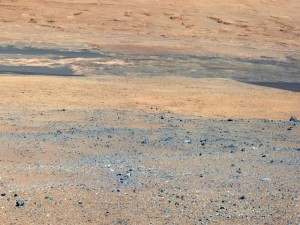
View of Mount Sharp, Curiosity's roving destination. Image credit NASA/JPL
Amongst the important system events in this first week was a software upgrade. It took four days to successfully upgrade Curiosity’s software in its main and back-up computer. The software had been uploaded during its trek to Mars, but not activated until now. The software to date was focused on getting Curiosity through the Martian atmosphere and safely to its destination in Gale Crater. The software upgrade is to cover its surface exploration activity, roving and controlling the various scientific instruments.
Curiosity Ready to Roll
“There will be a lot of important firsts that will be taking place for Curiosity over the next few weeks, but the first motion of its wheels, the first time our roving laboratory on Mars does some actual roving, that will be something special,” said Michael Watkins, mission manager for Curiosity from the Jet Propulsion Laboratory.
Mission engineers are devoting more time to planning the first rove of Curiosity. In the coming days, the rover will exercise each of its four steerable (front and back) wheels, turning each of them side-to-side before ending up with each wheel pointing straight ahead. On a later day, the rover will drive forward about one rover-length 3 metres, turn 90 degrees, and then kick into reverse for about 2 metres. Exciting times for the rover driver team!
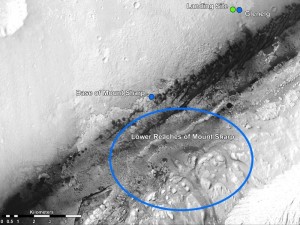
This image shows the landing site of NASA's Curiosity rover and destinations scientists want to investigate. Photo credit NASA/JPL
The scientists and engineers of NASA’s Curiosity rover mission have selected the first driving destination for Curiosity. The target area, named Glenelg, is a natural intersection of three kinds of terrain. The trek to Glenelg will send the rover 400 metres east-southeast of its landing site. One of the three types of terrain intersecting at Glenelg is layered bedrock, which is attractive as the first drilling target.
The choice described by Curiosity Principal Investigator John Grotzinger of the California Institute of Technology as, “With such a great landing spot in Gale Crater, we literally had every degree of the compass to choose from for our first drive.” “We had a bunch of strong contenders. It is the kind of dilemma planetary scientists dream of, but you can only go one place for the first drilling for a rock sample on Mars. That first drilling will be a huge moment in the history of Mars exploration.”
Grotzinger estimated the rover’s journey would take between three weeks and two months to arrive at Glenelg, where it will stay for roughly a month before heading to the base of Mount Sharp.
It may be a full year before the remote-controlled rover gets to the base of the peak, which is within 20 kilometres of the rover’s landing site.
Zapping rocks and doing science
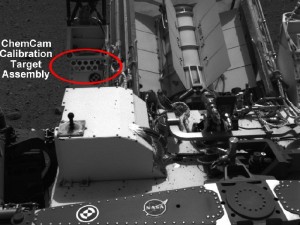
Before Curiosity heads off to Glenelg another first will occur. The team in charge of Curiosity’s Chemistry and Camera instrument, is planning to give their mast-mounted, rock-zapping laser and telescope combination a thorough checkout. ChemCam has “zapped” its first rock in the name of planetary science. It was the first time such a powerful laser has been used on the surface of another world.
The Chemistry Camera calibration target, as seen by the camera. Photo credit NASA/JPL.
The technique is called ‘laser-induced breakdown spectroscopy’. The high-powered, narrow-focused, laser beam vaporises the rock from a distance generating a plasma plume with temperatures in excess of 100,000°C. At the high temperatures during the early plasma, the vaporised material breaks down into excited ionic and atomic species. As it cools to 5,000–20,000°C the characteristic atomic emission lines of the elements can be recorded by the camera. This data is compared to the ‘standards’ that the rover carries to identify the rock components.
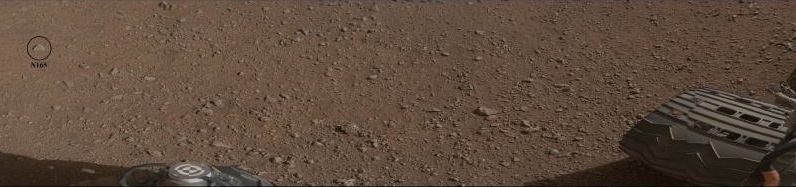
The soon to be famous rock N165, target for testing the Chemistry Camera laser and analysis. Photo credit NASA/JPL.
As Roger Wiens, principal investigator of the ChemCam instrument from the Los Alamos National Laboratory explained earlier, “Rock N165 looks like your typical Mars rock, about three inches wide. It’s about 10 feet away.” “We are going to hit it with 14 millijoules of energy 30 times in 10 seconds. It is not only going to be an excellent test of our system, it should be pretty cool too.”
Pretty cool indeed.
First weather report in 30 years
It is currently just above freezing point in gale Crater where Curiosity is.
Grotzinger noted the team’s report on the Martian crater’s temperature was “really an important benchmark for Mars science”.
“It’s been exactly 30 years since the last long duration monitoring weather station was present on Mars,” when Viking 1 stopped communicating with Earth in 1982,” he said. Then Viking 1 lander recorded temperatures that varied from −17.2 °C to −107 °C.
Sensors on two finger-like mini-booms extending horizontally from the mast of NASA’s Mars rover Curiosity will monitor wind speed, wind direction and air temperature. One also will monitor humidity; the other also will monitor ground temperature. The sensors are part of the Rover Environmental Monitoring Station, provided by Spain for the Mars Science Laboratory mission.
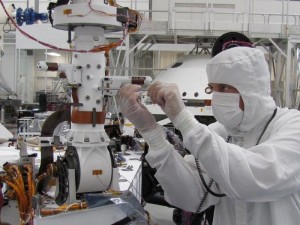
The weather station devices on Curiosity being tested prior to launch. Photo credit NASA/JPL.
In this image, the spacecraft specialist’s hands are just below one of the Rover Environmental Monitoring Station mini-booms. The other mini-boom extends to the left a little farther up the mast.
As Curiosity’s primary mission is for a full Martian year it will be able to record the seasonal variations that occur for Mars.
On the ground radiation monitoring and weather conditions will be crucial for any future exploration or habitation by humans. This mission by Curiosity represents an important step towards these aspirations.
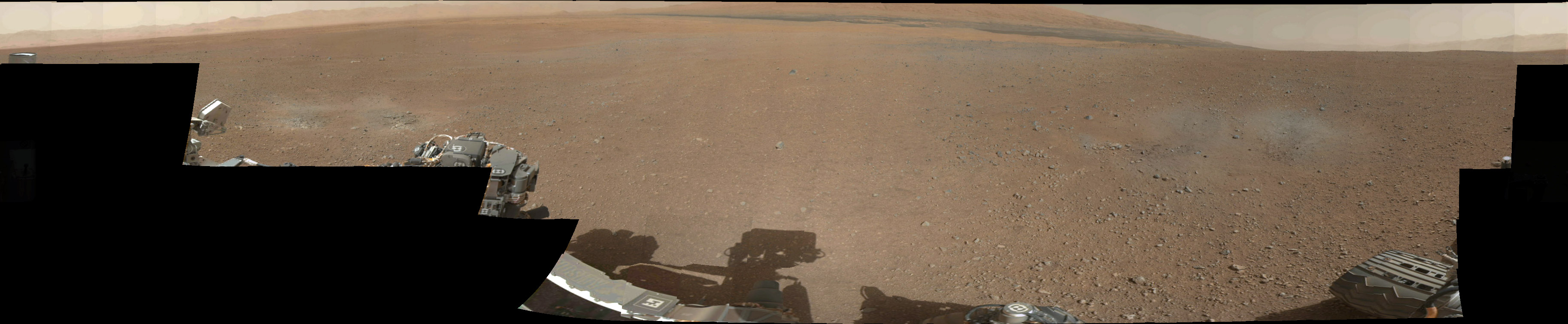
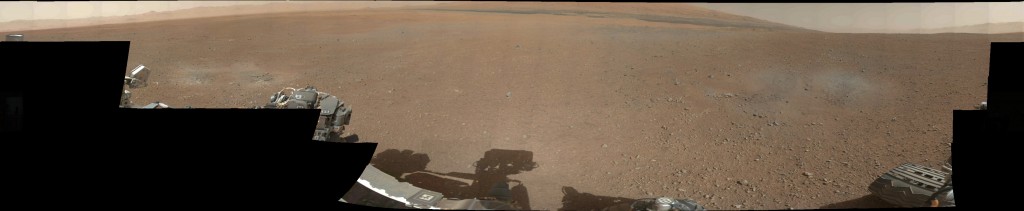
This is the first 360-degree panorama in color of the Gale Crater landing site taken by NASA’s Curiosity rover. The panorama was made from thumbnail versions of images taken by the Mast Camera.
Scientists will take a closer look at several splotches in the foreground that appear gray. These areas show the effects of the descent stage’s rocket engines blasting the ground. What appeared as a dark strip of dunes in previous, black-and-white pictures from Curiosity can be seen along the top of this mosaic, but the color images also reveal additional shades of reddish brown around the dunes, likely indicating different textures or materials.
The images were taken on Aug. 9, 2012, by the 34-millimeter Mast Camera. This panorama mosaic was made of 130 images of 144 by 144 pixels each. Selected full frames from this panorama, which are 1,200 by 1,200 pixels each, are expected to be transmitted to Earth later. The images in this panorama were brightened in the processing. Mars only receives half the sunlight Earth does and this image was taken in the late Martian afternoon.
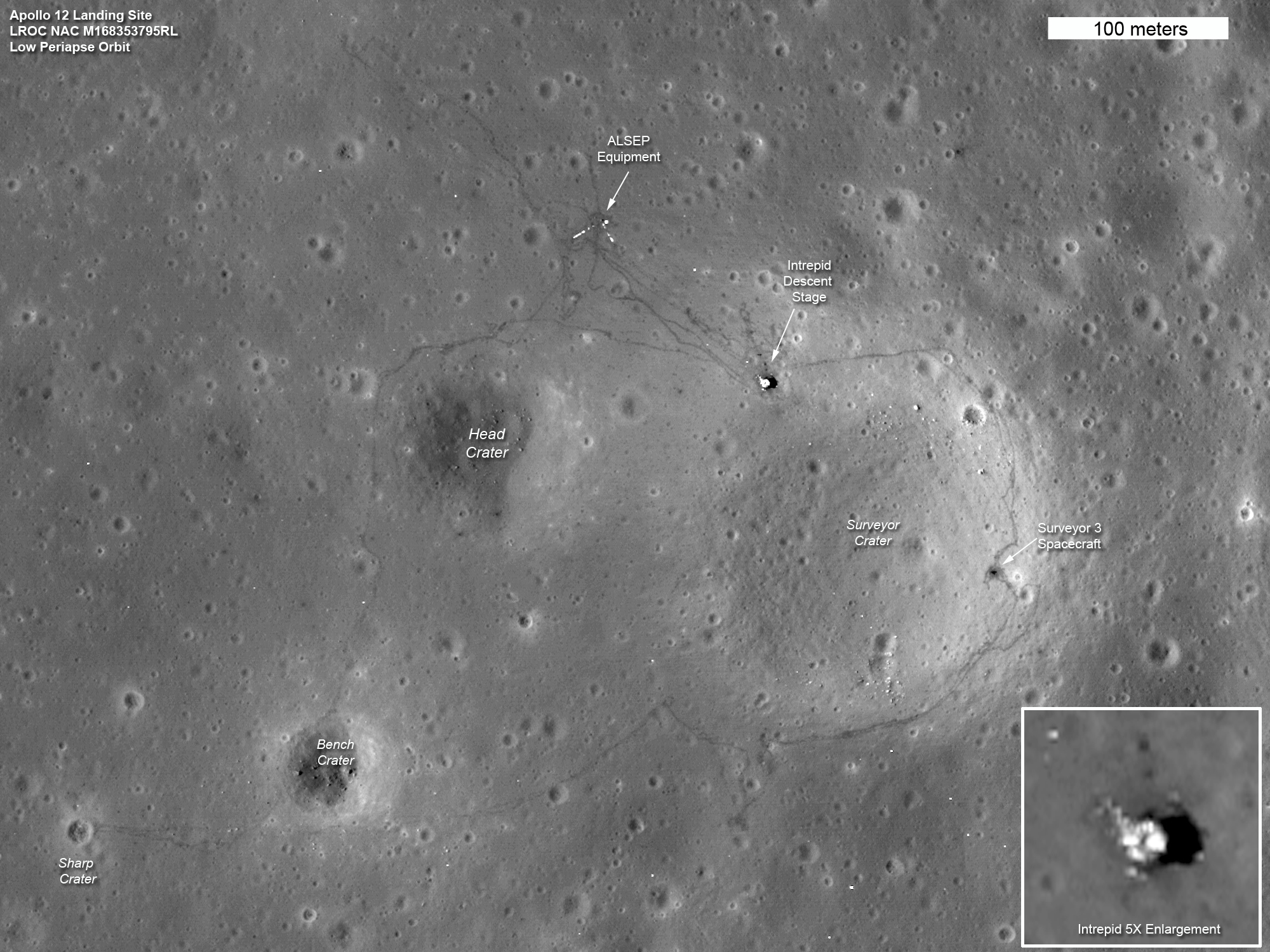
Apollo 12 landing site, taken from NASA's Lunar Reconnaissance Orbiter in 2011
Earlier this year, the New York Times had an interesting piece about museums seeking to protect small areas of the Moon around the Apollo landing sites. And a good thing too: “…the next generation of people visiting the moon might carelessly obliterate the site of one of humanity’s greatest accomplishments.”
But isn’t that a bit like how Cairo almost swallows the Pyramids?
Surely we need to go further? Much further?
For thousands of years, all of Earth-bound humanity will gaze up on the Earth side of the Moon. And it’s exactly the same view looked upon by all of humanity throughout history.
Surely that whole view is worthy of protection? After all, any changes made that are visible from Earth will be visible forever. There’s no atmosphere or weather to sweep away our transgressions over time. What is done on the Moon stays done…
I raised these concerns with a NASA engineer a couple of years ago after his presentation at the Questacon national science museum about the (now ill-fated) Constellation project to return to the Moon.
It seemed to me that the American disposable society mantra was writ large in their plans, with leftover bits free to crashland wherever once done with. It’s that sort of mentality that’s got us into a spacejunk problem in Earth orbit.
I have no doubt that there will come a day – possibly while I’m still alive – that we are strip-mining parts of the Moon for minerals to build spaceships and Moonbase buildings and to fuel them.
But surely there should be a commitment from all nations for this sort of permanent scarring to be limited to the far side (the incorrectly named dark side!) of the Moon only. And for communications facilities and potentially colonies to be positioned around the Earthside perimeter for minimal visual impact, while maintaining direct communications.
There should also be strict controls on escape of artificial light. Surely the sort of light pollution that we spew pointlessly upwards from our Earth should not be shining back at us one day from the Moon?
We owe our future generations that much, I believe.
And while looking back – enjoy this handheld footage of the Earthrise, from Apollo 10, right out at the Moon, to very fitting music:
Mars is full of secrets and mysteries. The classic definition of a desert world, our planet’s arid sibling is a parched wilderness of dunes and planetwide dust storms. With a thin carbon dioxide atmosphere and only 38% the gravitational pull of Earth, there are a lot of puzzles about this cold and frosty little planet, and a lot of scientists who are longing to solve them.
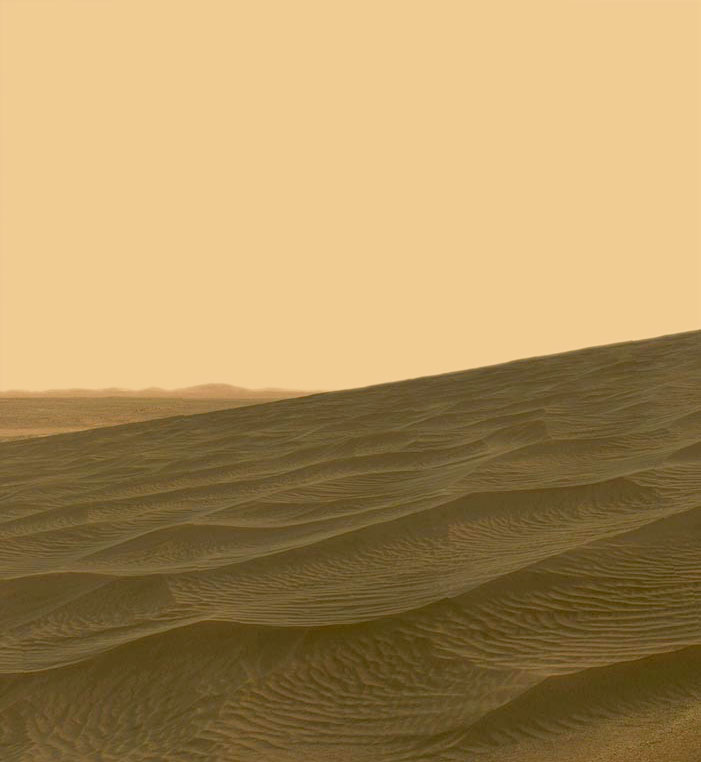
El Dorado, Gusev Crater. Mars is a world of dust and dunes…
By now, anyone keeping up with the news is bound to have heard that NASA’s Curiosity rover made a flawless descent through the atmosphere of Mars and is now busy eyeing up its new home in the Gale Crater. As was discussed previously here on Australian Science, a big question still on everyone’s mind is the same one which David Bowie sang about back in 1971. Is there life on Mars? However, it seems that NASA’s plans are not to answer this question directly. John Grotzinger, project scientist for the Curiosity mission, is quoted as saying; “Curiosity is not a life detection mission. We’re not actually looking for life; we don’t have the ability to detect life if it was there.” Instead, the main objective of Curiosity is to look for signs of life.
The trouble is that looking for life directly is a difficult task. Back here on Earth, new discoveries are still being made frequently, with life being found in environments and habitats where no one was expecting. There’s a lot which we still don’t fully understand about life here on our own world. When we’re talking about another planet, it’s safe to say that all bets are off. As a result, Curiosity’s goal is to look for the various elements and chemical compounds which life might use – or might have used once upon a time when the planet may have been more hospitable. The focus has shifted from the search for life on Mars right now, to life which may once have lived there.
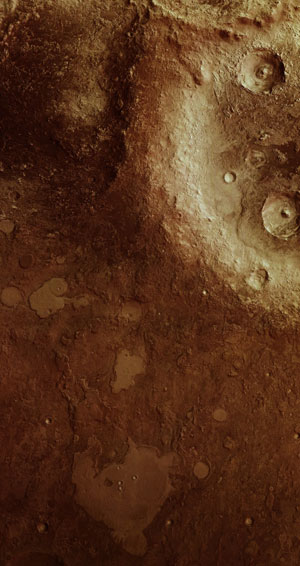
Arabia Terra – one of the three locations on Mars where methane plumes have been spotted.
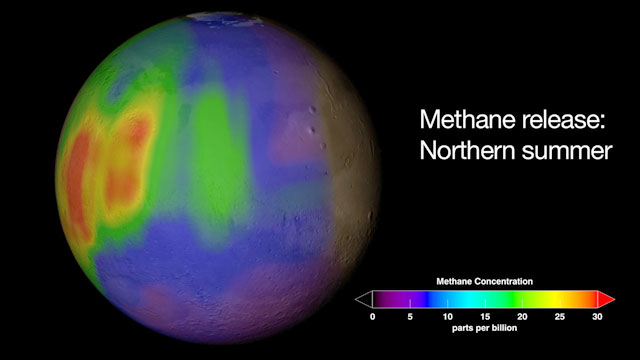
One point which is worth remembering right now, however, is that there’s one big unsolved mystery about Mars. A gaseous mystery. Large quantities of methane have been detected in the martian atmosphere, which gives rise to a real puzzle. Methane is destroyed by sunlight, and with the thin atmosphere found on Mars, any methane should be rapidly broken apart by solar ultraviolet. The only possible conclusion is that the methane seen on Mars is being replenished somehow. There are only really two possibilities for how this might happen.
One scenario sees the martian methane caused by a geological process called serpentinisation. This is where a type of mineral known as olivine (more familiar to us as the gemstone peridot) chemically reacts with water and carbon dioxide. The reaction creates methane and a green mineral called serpentine (commonly found in certain parts of Western Australia and Tasmania), and releases methane gas. If this is the process which is occurring, it would mean that not only is there a suitable amount of water somewhere under the surface of Mars, but there must also be geological activity for that water to continue being brought into contact with further olivine to react with. This would suggest that there are things which we don’t know about current geological processes on Mars.
The other possibility, more radically, is that this methane is being produced by life. Here on Earth, bacteria known as methanogens are responsible for most of the methane present in Earth’s atmosphere. In fact, on Earth, methane is so regularly produced by living organisms that it can used as an indicator of biological activity.
When three distinct plumes of methane were discovered on Mars in 2009, it was noted that there was an equal probability of either of those two scenarios being the source of the methane – and that both would be huge revelations in our understanding of our neighbouring world. So maybe the Curiosity rover isn’t set up to hunt for life, and maybe it won’t be directly looking for it. But I, for one, do hope it finds some clues about the origin of the mysterious martian methane. Just as any scientist should, I love a good mystery!
The three methane plumes seen on Mars at South-East Syrtis Major, Nili Fossae and Arabia Terra.
Image credits:
Top – NASA JPL/Cornell
Middle – ESA/DLR/FU Berlin (G. Neukum)
Bottom – NASA
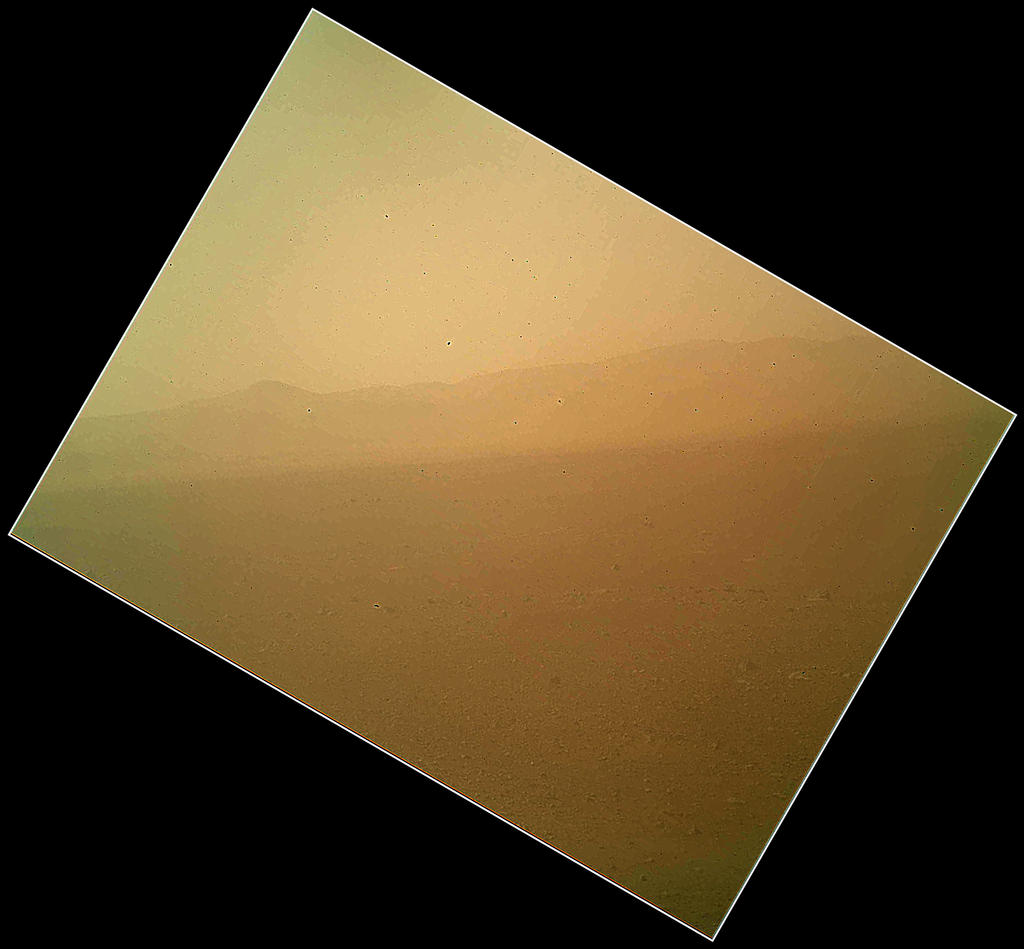
This view of the landscape to the north of NASA’s Mars rover Curiosity acquired by the Mars Hand Lens Imager (MAHLI) on the afternoon of the first day after landing. (The team calls this day Sol 1, which is the first Martian day of operations; Sol 1 began on Aug. 6, 2012.)
In the distance, the image shows the north wall and rim of Gale Crater. The image is murky because the MAHLI’s removable dust cover is apparently coated with dust blown onto the camera during the rover’s terminal descent. Images taken without the dust cover in place are expected during checkout of the robotic arm in coming weeks.
First Color Image of the Martian Landscape Returned from Curiosity
The MAHLI is located on the turret at the end of Curiosity’s robotic arm. At the time the MAHLI Sol 1 image was acquired, the robotic arm was in its stowed position. It has been stowed since the rover was packaged for its Nov. 26, 2011, launch.
The MAHLI has a transparent dust cover. This image was acquired with the dust cover closed. The cover will not be opened until more than a week after the landing.
When the robotic arm, turret, and MAHLI are stowed, the MAHLI is in a position that is rotated 30 degrees relative to the rover deck. The MAHLI image shown here has been rotated to correct for that tilt, so that the sky is “up” and the ground is “down”.
When the robotic arm, turret, and MAHLI are stowed, the MAHLI is looking out from the front left side of the rover. This is much like the view from the driver’s side of cars sold in the USA.
The main purpose of Curiosity’s MAHLI camera is to acquire close-up, high-resolution views of rocks and soil at the rover’s Gale Crater field site. The camera is capable of focusing on any target at distances of about 0.8 inch (2.1 centimeters) to infinity. This means it can, as shown here, also obtain pictures of the Martian landscape.
Image Credit: NASA/JPL-Caltech/Malin Space Science Systems
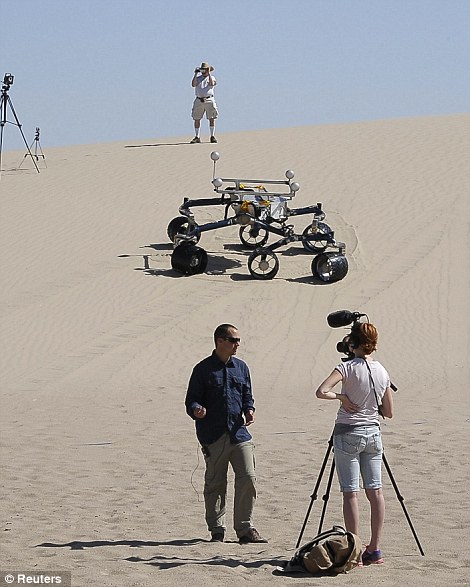
Matt Heverly during testing of rover double "Scarecrow" in the desert near Death Valley. Source: Daily Mail UK
When the Mars Science Laboratory – Curiosity – touches down on Mars today, one of the people there ready to take control of it will be Matt Heverly.
Matt is an engineer with NASA’s Jet Propulsion Laboratory in Pasadena, California and has been working on the design and build of Curiosity, as well as being one of the drivers of the lone surviving rover currently on Mars – Opportunity.
And Matt has been appointed by NASA as the lead driver for Curiosity.
Last week I interviewed Matt about this important role, about driving rovers in general, and about the science work that he’ll be helping with.
When Matt came online, he’d quite literally been in the “Mars Yard” conducting some testing with Curiosity’s twin, and he had parked it right behind himself before joining me on Skype. You can see the rover in the background.
(There are a couple of spots where the Skype signal dropped down and a warning dialogue came over the screen. I wanted to get the interview posted prior to the landing day, so no finessing the video editing…)
There are actually two “twins” of Curiosity used for testing back here on Earth. The one behind Matt is an exact twin is all respects except the plutonium power supply. The other – nicknamed Scarecrow – is a slimmed down version that is designed to weigh as much as Curiosity would in the lower gravity of Mars. It is used to test driving conditions. The following video shows you Scarecrow in action in the Mars Yard:
We also talked about Athlete – a rover design originally destined for the Moon. Check this video of Athlete busting some moves:
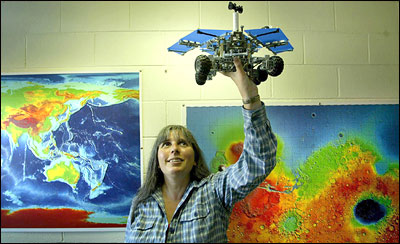
Australian geologist Marion Anderson, with a model of Curiosity's predecessor rover Opportunity. Source: The Age
You’ve sunk more than $2 billion into a car-sized rover and you’re ready to send it to explore Mars. But where exactly on Mars do you send it?
Of course you want it and its controllers back here to be able to do the best possible science. So apparently that is exactly what NASA did – consulted the geology scientists of the world.
One of those scientists was Marion Anderson of Melbourne’s Monash University.
In this interview recorded on 2 August 2012, Marion explains to me what went into the selection of Gale Crater as the landing site for the Mars Curiosity rover, what to expect from the rover as it begins to explore the crater after its landing there on Monday 6 August, and why Curiosity is NOT looking for life, despite what many media people are saying (running time 20 mins).
Marion also talks about her role in selecting the landing sites for those other Mars rovers Spirit and Opportunity, and where next after Mars?
If you are interested in learning more about the geology of Mars, I highly recommend the one-hour lecture by Richard Pogge titled The Deserts of Marsfrom an entire – free – university course in Astrobiology from Ohio State University (also available on iTunes).
In the interview you’ll hear Marion talk about how Mount Sharp in the centre of Gale Crater is actually higher than the surrounding crater walls – some five kilometres high. In this lecture, listen for an explanation why Olympus Mons is the highest volcanic cone in our Solar System, and probably explaining the height of Mount Sharp too.
Last week marked the 40th anniversary of the Landsat satellite program (http://landsat.gsfc.nasa.gov/) —now the longest-running continuous acquisition of satellite images of the Earth’s surface. The entire Landsat7 imagery archives are publicly accessible through Google Earth Engine (http://goo.gl/fjTZL), with a new and improved featured gallery, which includes zoomable time-lapse videos and a beautiful new interface: http://earthengine.google.org/#intro!
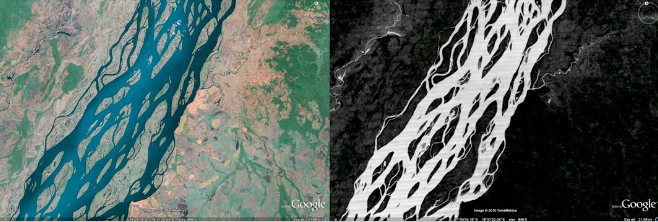
Google Earth Engine enables scientists to use our extensive computing infrastructure—the Google cloud—to analyze an unprecedented amount of satellite imagery and data. The new gallery includes what may be the largest video frame ever created. At 1.78 terapixels, if you tried to view all at once, it would take 18 football fields’ worth of computer screens laid side-by-side.
Google Earth Engine technology has already been used to compute the forested areas of Mexico (http://earthengine.google.org/#intro/MexicoTreeCover), identify deforestation in the Amazon (Monitoring Forests From the Ground to the Cloud) and map roadless areas of the world (http://earthengine.google.org/#intro/Roadless1km).
We look forward to seeing the full potential of the Landsat archives revealed, as Google Earth Engine and other tools enable non-professionals to explore this valuable trove of data.
The NASA rover Curiosity is expected to be landing on Mars at 3:31 am August 6, 2012 (AEST). It’s mission, lasting one Martian-year (98 Earth weeks), is of scientific significance and perhaps even of human significance. Curiosity will be fulfilling the prospecting stage of a step-by-step program of exploration, reconnaissance, prospecting and mining evidence for a definitive answer to the question “Has life existed on Mars?
In 1969, on September 28, the skies near Murchison, Victoria (not to be confused with Murchison, Western Australia) were illuminated by a dramatic sight. A spectacular fireball blazed its way through Earth’s atmosphere, its outer layers heated to extreme temperatures by its speed. Residents of the town reported seeing the fireball split into three pieces before it faded from view, leaving a trail of smoke in its wake. Seconds later, a tremor was heard as meteorite fragments crashed into the ground, signalling the arrival of what would become one of the most well studied meteorites ever.
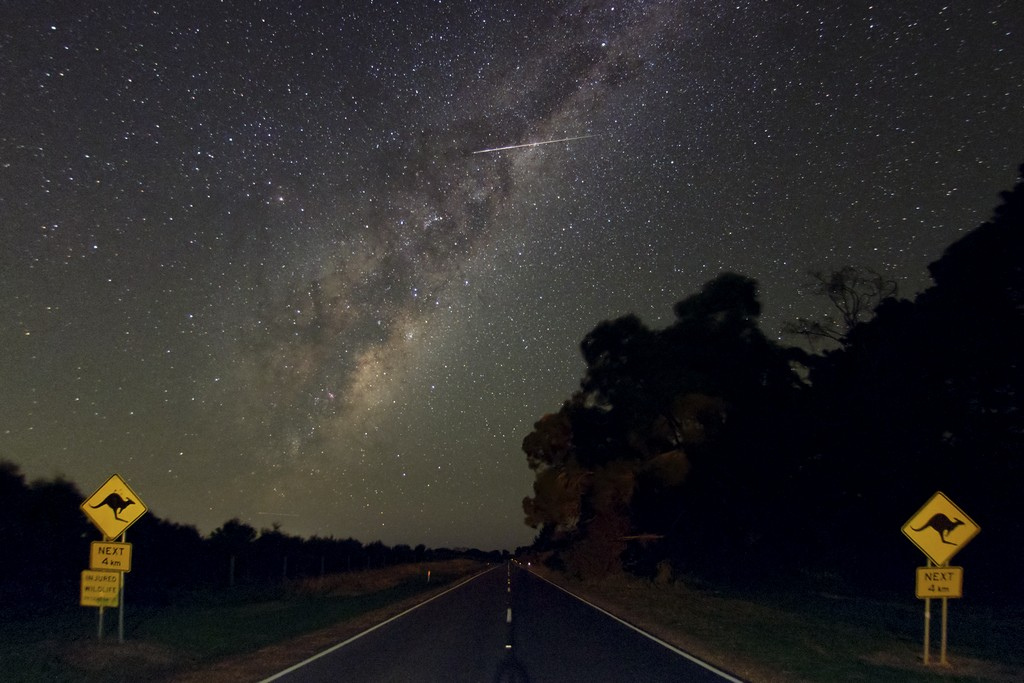
A meteorite streaks across the Australian night sky, in front of the Milky Way. But just what might it be carrying with it? Image credit: Alex Cherney/terrastro.com
If you like to watch the sky at night, chances are good that you’ve seen a meteor or two streaking across the night sky, and while many of them burn up in the atmosphere, it’s quite possible that one which you’ve seen might have eventually reached the ground. Meteorites strike Earth a lot more frequently than most people realise. By most estimates, a few hundred tons of meteorite material make it to our planet’s surface every day. Large meteorites like the Murchison meteorite, however, are a lot less common.
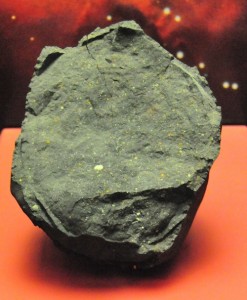
A fragment of the famous Murchison meteorite. Image credit: Art Bromage, Wikimedia Commons
While the Murchison meteorite shattered into fragments before it landed (known as an “airburst”), over 100 kg of meteorite have been collected from around Murchison, and scientists have been analysing those fragments ever since. This particular meteorite is a specific type known as a carbonaceous chondrite. These meteorites are fascinating to scientists, because carbonaceous chondrites are chemically very primitive – they’re thought to be very close in composition to the solar nebula from which the Sun and planets condensed 4.5 billion years ago. In other words, the meteorite which crash landed in Murchison 43 years ago was probably older than our entire planet!
Several things about the Murchison meteorite are very interesting. For one, it shows evidence that it was altered by water. This would have happened a long time ago, wherever this meteorite originally formed, and certainly a long time before it landed on Earth. Secondly, it’s peppered with Calcium-Aluminium-Inclusions (CAIs). These humble crystals are older than the Sun itself. When they formed, the Sun itself was little more than a huge cloud of warm hydrogen gas. Most interestingly to some scientists, however, is the fact that the Murchison meteorite is full of amino acids.
Uracil, one of the four "nucleobases" used by DNA to encode genetic information, was discovered inside the Murchison meteorite.
Amino acids are one of the basic building blocks of all living things. The proteins which make up almost everything in your body are made from these small molecules. To date, over 100 amino acids have been found inside the meteorite, including many of those used by life on Earth. Several things about the chemical and isotopic compositions of these molecules suggest that they didn’t come from Earth, but were in this meteorite when it landed. As an example, amino acids have two forms, referred to as left-handed and right-handed. Earth life only uses the left-handed forms, while the acids discovered in this meteorite are a mixture of the two (known to chemists as a racemic mixture). Other Earthly molecules which frequently show up as contaminants were absent from the samples analysed, suggesting that these molecules, the bare essentials of life, are extraterrestrial in origin.
These amino acids aren’t the only familiar molecules in the Murchison meteorite either. Amongst over 14000 different molecules found inside the meteorite, the chemists who were analysing the meteorite discovered ring-shaped molecules called purines and pyrimidines. These ring molecules are from the same family as the four nucleobases which make up DNA.One of the molecules found was one called uracil, which is actually used by DNA. This same molecule is in every strand of DNA in your body.
While some still argue over the validity of these studies, if they’re correct then the overall conclusion is a breathtaking one. This space rock is older than the Sun, and it already contained all of the basic ingredients for life to form back when Earth was nothing more than a patch of interstellar dust. We might never know exactly how life started on Earth. Though maybe in the distant past, life’s raw materials crash landed here on Earth in meteorites, just like one meteorite did in Murchison that night 43 years ago.
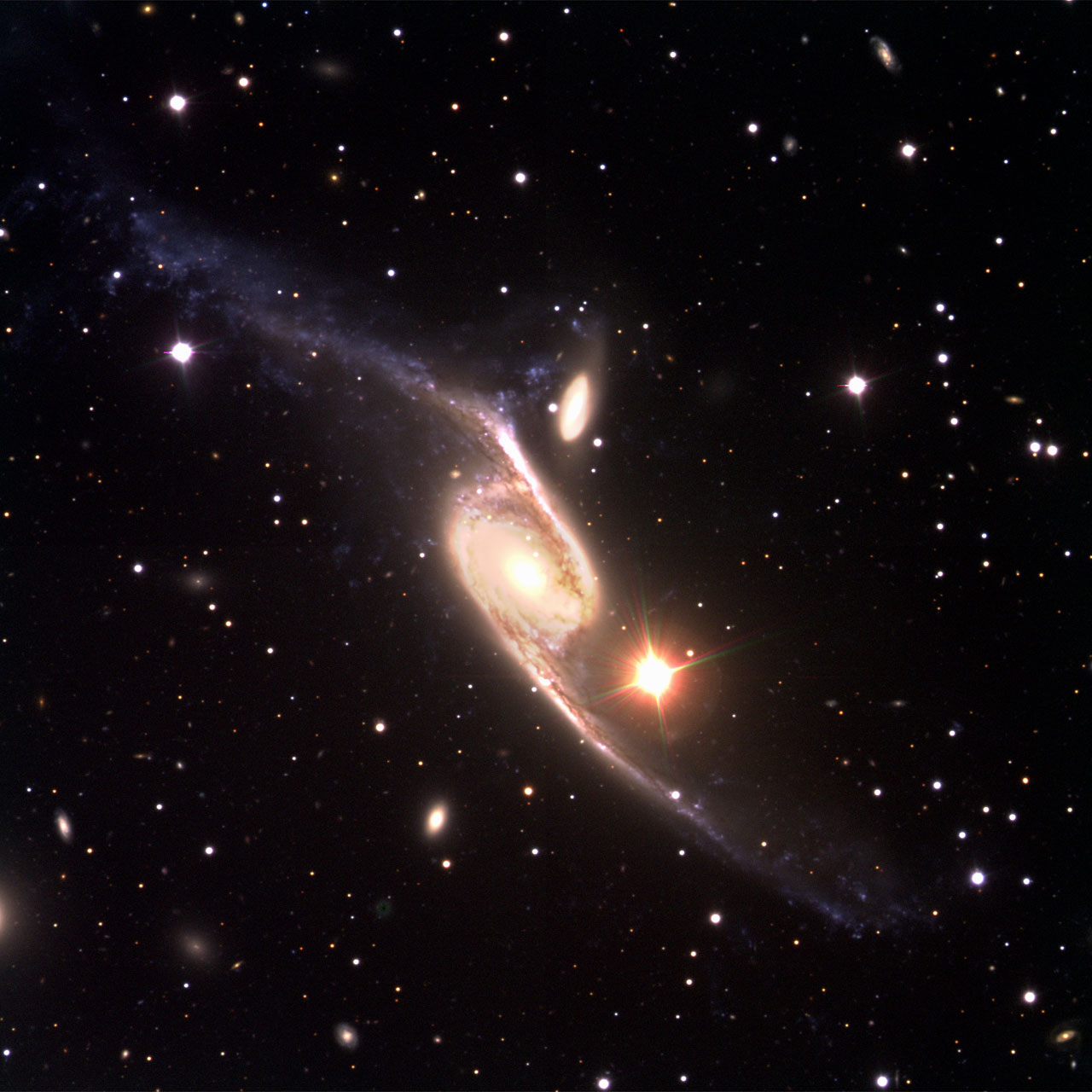
Three-colour composite reproduced from one blue (B), one green-yellow (V) and one red (R) exposure, obtained with FORS1 at ANTU (VLT). The field size is again 6.8×6.8 arcmin 2. It shows the spectacular barred spiral galaxy NGC 6872 that is shaped like an “integral sign”. It is of type SBb and is accompanied by a smaller, interacting galaxy, IC 4970 of type S0 (just above the centre).
The bright object to the lower right of the galaxies is a star in the Milky Way whose image has been strongly overexposed and exhibits multiple optical reflections in the telescope and instrument. There are also many other, fainter and more distant galaxies of many different forms in the field. They are particularly well visible on the “Normal” and “Full Resolution” versions of the photo.
The upper left spiral arm of NGC 6872 is significantly disturbed and is populated by a plethora of blueish objects, many of which are star-forming regions. This may have been be caused by a recent passage of IC 4970 through it. This interesting system is located in the southern constellation Pavo (The Peacock). It is comparatively distant, almost 300 million light-years away. It extends over more than 7 arcmin in the sky and its real size from tip to tip is thus nearly 750,000 light-years. It is in fact one of the largest known, barred spiral galaxies.
In order to image all of this extraordinary object within the available field of the FORS1 camera, the instrument was rotated so that the galaxy extends along the diagonal. For this reason, the orientation is such that North is to the upper right and East is to the upper left.
Credit: ESO
VY Canis Majoris, the largest known star in our galaxy, with it's huge smoky clouds of gas and dust being lost into interstellar space. Credit: NASA, ESA, and R. Humphreys (University of Minnesota)
The ancient Greeks once believed that the heavens were immutable. A vast starry vista, eternally unchanging above our heads. But we now know this to be untrue in the slightest. A lot has changed since then, however, and over the past few hundred years, astronomers have unfurled ever increasing knowledge of the lives of stars. Look out across a starry night sky and you can see stars in all stages of their lives, from brightly burning newborn stars, to ageing giants in their final gasping breaths. As stars near the ends of their lives, they begin to shine a rich red colour as they expand and dramatically increase in size.
As red giants, these stars are burning the last of their fuel, and as they do so they begin to sputter and gasp. Just as a candle flame does when it starts to burn out, red giant stars flicker – though for these, the largest stars in the universe, those flickers can take thousands of years each. These final bursts of energy are known as thermal pulses, and they mark the star’s final days. During the last couple of million years of its life, a red giant star will lose incredble amounts of material to interstellar space. Even when not caught mid-pulse, these stars lose several times the mass of our planet every year. And the puzzle of exactly how they do so has been recently been unravelled by a team of astronomers led by researchers at the University of Sydney.
All stars emit a stellar wind – a steady stream of particles being constantly accelerated outwards by the star. Even the Sun emits its own solar wind (with a speed measured at 535 kilometres per second as I write this). The wind from red giant stars is slightly different. As the star loses more mass, stellar material cools and condenses into dust. This dust then catches starlight which is so intense near to the star that it actually pushes that dust outwards. This effect, known as radiation pressure, causes the tiny reflective dust grains to act like minute sails and accelerates them away. Each dust grain is tiny compared to the kind of dust we find on our bookshelves, much more like fine smoke than any dust we’d recognise. Instead of being called stardust, it could easily be called starsmoke!
“The winds that stream from the upper atmosphere of the red giant stars are responsible for removing massive amounts of matter. The grains that we have discovered here will come as a real shock to the accepted wisdom in the field. They are both much larger and much closer to the stellar surface than anyone expected.” said Barnaby Norris, a PhD student at the University of Sydney, and lead author on the research published earlier this year in Nature.
This stardust emitted by these smoky smouldering old stars is transparent, not unlike finely powdered glass. The implications of this stardust being detected to close to an ageing star could help us to better understand the processes that occur in stars as they die, and how they manage to lose such prodigous amounts of mass so rapidly. As Norris said, “Hopefully our findings will help to illuminate a key step in the grand cycle as matter is expelled from stars into the galaxy only to seed new generations of stellar and planetary birth.”
On a final poetic note, all of the chemical elements essential to life are created within stars, before being seeded back into the cosmos when stars die. This means that this condensing stardust contains the fundamental raw materials needed for life to eventually form. As Carl Sagan so often used to muse, we are literally made of stardust.
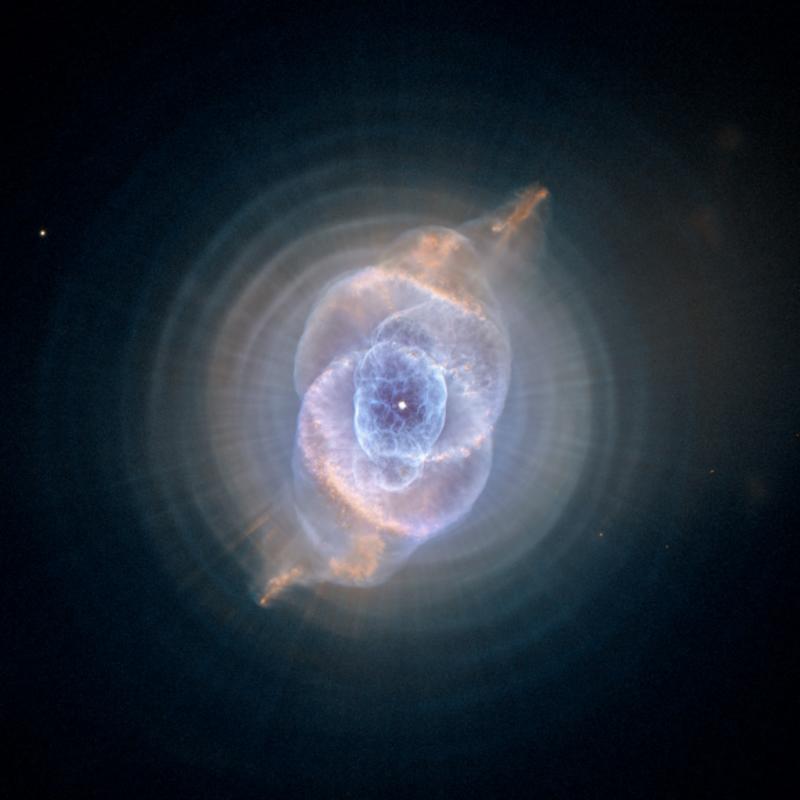
The Cat's Eye nebula, a star which has now ended its life and is casting its outer layers into the cosmos. The concentric rings show material lost as stellar wind during the star's final thermal pulses.. Credit: ESA, NASA, HEIC and The Hubble Heritage Team (STScI/AURA)
Originally conceived over 20 years ago, there’s a project being undertaken by scientists and engineers across the whole world to help us all better understand the mysteries of the galaxy and the very beginnings of the Universe. It’s estimated to be completed by around 2024,costing $1.85 billion AUS (€1.5 billion). Once completed, it’s set to be the most complex and technologically advanced machine ever built by humanity. It will use enough optic fibre to wrap twice around the Earth and will need a computer capable of performing 10^18 operations per second – about three million times the number of stars in our galaxy. It will produce over 980 Exabytes of data every day (equivalent to about 15 million 64GB iPods) and to cope with that, it will need to handle data transfer rates over 10 times as high as the current global internet traffic. No, it isn’t a starship. But it might just be the next best thing.
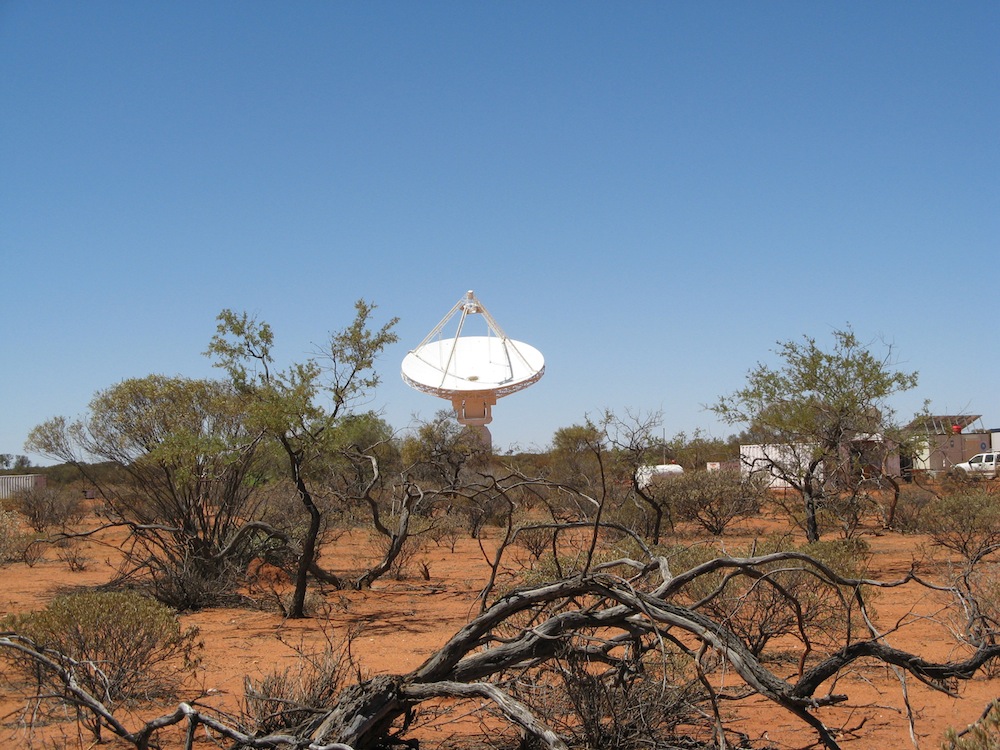
One of the first components of the SKA, constructed in Western Australia. Credit: Dave DeBoer, CSIRO.
The Square Kilometre Array (SKA) is one of the most ambitious scientific projects ever devised, and when completed it will comprise a huge number of telescope antennae which will work as one to form a single radio telescope so powerful that it could detect an airport radar on a planet 50 light years away. The sensitivity of any telescope is defined by the area it uses to collect data. With optical telescopes, this is the size of the mirror, and with radio telescopes it’s typically the size of the dish. The SKA gets its name because when fully constructed, all of the detectors and antennae that make it up will have a combined area of one square kilometre, or one million square metres. To put that properly into perspective, the Green Bank Telescope is currently the largest steerable single dish radio telescope, and its area is just under 8000 square metres.
Being astronomy’s answer to the large hadron collider, the SKA is a staggeringly large international collaboration. I was lucky enough to attend a major meeting regarding the planning of the SKA (the headquarters are to be based here in the UK in Manchester), and the myriad different languages and nationalities represented was impressive to say the least. Over 24 major organisations from countries spanning 5 continents are involved in the project, ranging from universities to industrial engineering companies. New technologies, both software and hardware, are still being developed as a result of this project. Based on the huge data storage and transfer requirements of a machine as complex as the SKA, many of those new technologies are likely to feed straight back into society by offering profound improvements to computing resources like the internet. In fact, as the world’s largest project for sorting and storing data, the SKA is expected to be literally bigger than Google!
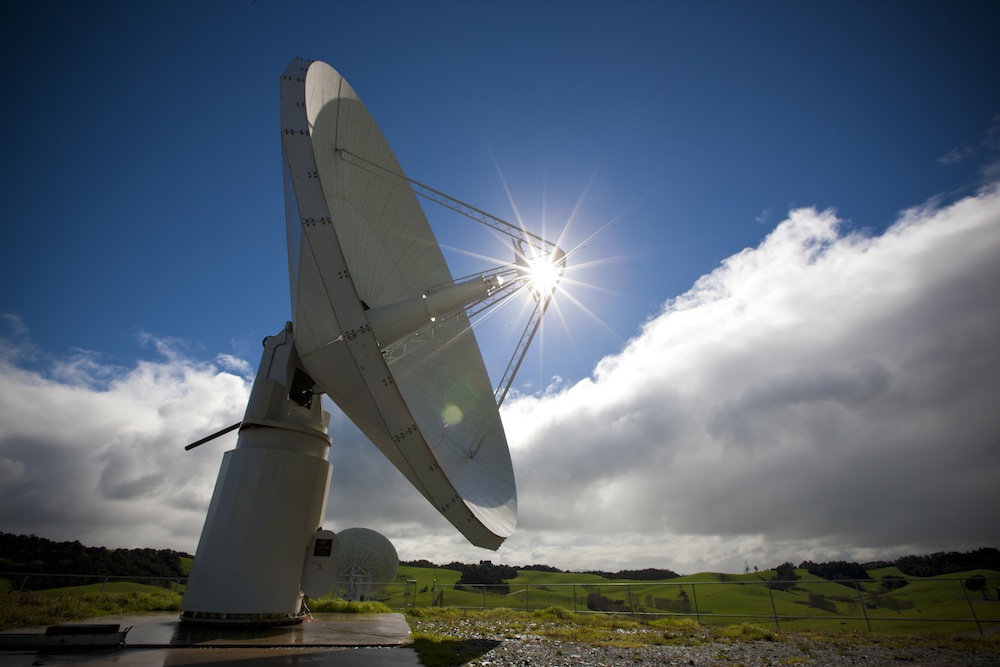
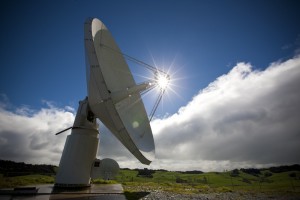
The Warkworth antenna in New Zealand – an important part of early SKA science. Credit: Alex Wallace.
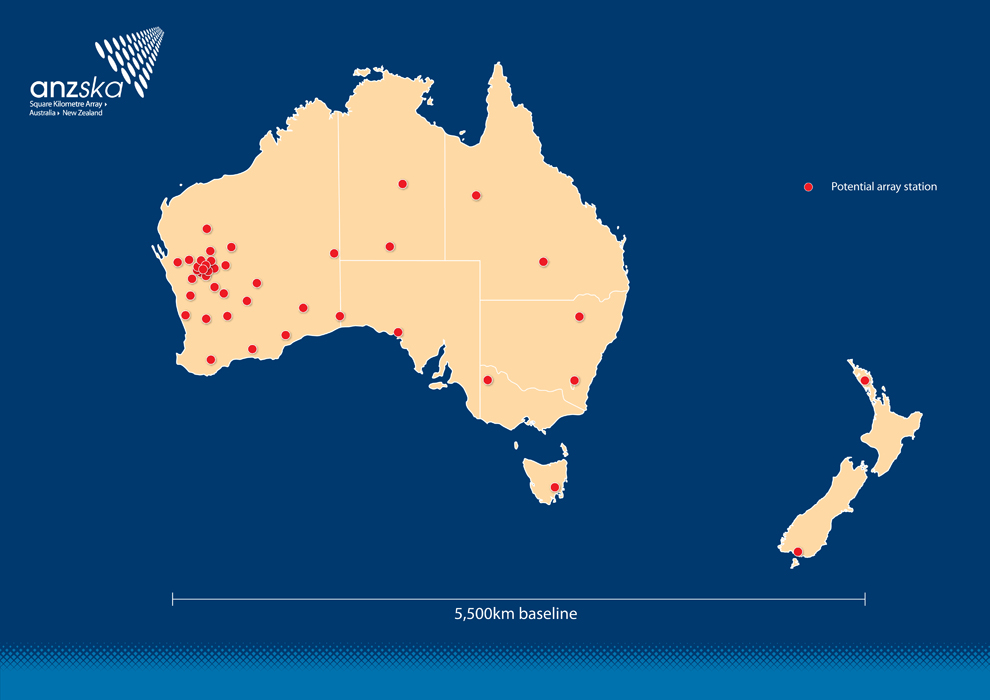
The most difficult decision, understandably, has been where precisely to build it. Humanity has an unfortunate tendancy to fill the atmosphere of our planet with noise, bouncing radio waves to and fro and filling the air with radio frequency chatter. A radio telescope array this sensitive needs to be placed somewhere quiet to gain the full benefits, and the most recent decision has been to effectively split the SKA into two components, to be built in Southern Africa and Australia. While this may seem like an odd thing to do, it actually makes perfect sense. The SKA actually has three types of antenna operating at different frequencies. Intended to cover a huge range of radio frequencies (from 70 to 100000 MHz), three types of antenna are needed, because no single technology can actually operate across such a wide range. So the decision was made to build the lowest frequency detectors across Australia, centred at Murchison in outback Western Australia. Murchison is blessed with being one of the few places on our planet which isn’t flooded with FM radio at the low end of the frequency scale. From a radio astronomer’s point of view, it’s the quietest place on Earth.
This is set to be complemented by the higher frequency steerable dishes which are set to be constructed across Africa. Both South Africa and Australia have put extensive efforts into developing the SKA, and Australian-developed technology is still set to be implemented in the African telescopes. This will mean a huge influx to the African astronomical community and numerous African nations won’t lose out on the economic boost from contributing to such a prestigious project. It’s an ideal situation where everyone wins.
All in all, it’s an exciting time to be an astronomer. An epic project like this is likely to attract all manner of researchers from across the world to both continents. Just maybe, it could also finally help us to answer the really big questions, like how the galaxy formed, how the Universe began, and whether or not there’s anyone else out there.
Do you wish to become a Martizen, a citizen of Mars, anytime in the near future? If you are serious about this then Dutchman, Bas Lansdorp is your man.
Bas Lansdorp is a person with an audacious ambition. Through his company, Mars One, he plans to establish the first human settlement on Mars by April 2023. In addition to this he intends that a new team of four settlers will join the Martian settlement every two years. By 2033 there will be over twenty people living, working, and they believe, flourishing on Mars, their new home.
If the Mars one publicity is believable, and on this point there is no real reason to doubt it, organizing a manned mission to Mars has been Bas Lansdorp’s dream for many years. Bas has been working on Mars One with partner Arno Wielders since January 2011. During 2011 they had confidential discussions with possible equipment suppliers to ensure that there was reality in their idea. In May 2012 they announced their vision to the world.
Like any large entrepreneurial venture their success will predicated on the skill, experience and credibility of the venture and the people involved. To be credible they will need to be convincing in, at least, these four aspects of the venture; technological; financial; psychological; and finally ethical. They will need to be convincing in a way that engages and excites both investors and participants.
It is rocket science
Getting to Mars is not trivial, if it were, well I expect there would be more than the spectacular array of NASAsuper, and superannuated rovers there currently is on Mars. Mars One have developed and made integral to their model a simple theme to get to and live on Mars: buy already developed technology from existing component manufacturers.
Take the Falcon Heavy lifter from SpaceX, to boost the components into low earth orbit. Combine a SpaceX Dragon capsule as the landing stage, add a transit living module from Thales Alenia Space and attach to two propellant stages which are a variant of the SpaceX Falcon 9 upper stage rockets and you have the vehicle to get from low earth orbit to orbit around Mars via a Hohmann transfer trajectory.
The seven-month trip to mars will be Spartan, similar to, but more cramped, than current conditions experienced on the International Space Station. This is where rigorous training will first pay off:
“Showering won’t be an option; instead they will have to make do with wet wipes like the International Space Station astronauts. Tinned food only, constant noise from the ventilators and equipment and a regimented routine of three hours of exercise a day to keep up muscle mass all add to their trials. If they are hit by a solar storm they will have to take refuge in the shelter area of the rocket, which provides the best protection, for as long as several days.”
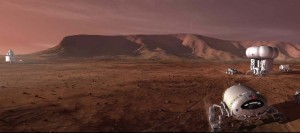
When the first 4 settlers land on Mars in April 2023 they will arrive at an established site. They will be picked up from their SpaceX Dragon capsule and taxied to the settlement by two robotic Mars rovers designed and built by MDA Space Missions. To get to this point is an ambitious and tight timeline.
2013
Settler selection begins. Replica of Mars settlement is built on an Earth desert to help the settlers prepare and train, and for a realistic environment in which to test the equipment. The settler selection and the preparations in the simulated Mars base will be broadcast on television and online for the public to view.
2014
Preparation for the supplies mission. Production of the first Mars communication satellites.
2016
January launch of the supplies mission, landing in October, includes the first habitat module (modified Dragon capsule) and 2500kg of supplies.
2018
First robotic rover lands (again in a modified Dragon capsule) to enable the pick of the specific settlement site.
2021
A total of 2 robot rovers, 2 living units, 2 life support units and 2 supply units are now all present at the Mars settlement site.
2022
All H2O, O2, and atmosphere production will be ready before a go-ahead to launch the settlers.
2023
First 4 settlers arrive at the Mars settlement.
2025
Second group of 4 settlers arrive, to be no doubt enthusiastically greeted by the pioneering first four.
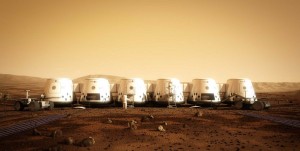
Once arrived there will be work for the settlers to connect up the various habitats. However once complete they will have substantial living space, 50m²+ each, equipped with showers, flushing toilets and kitchens. The living units are a Dragon capsule with an inflatable living section supplied by ILC Dover, who have supplied NASA with space suits and landing bags for the previous Mars rovers Opportunity and Spirit. The inflatable living sections are to be covered in Martian regolith to provide adequate radiation shielding.
Mars One
When moving around on the Mars surface the settlers will be wearing Mars suits, similar to the suits worn by the Apollo astronauts on the Moon. These suits will be made by Paragon Space Developments, the same company who provide NASA with ‘extra-vehicular’ suits, for when astronauts work in space outside the International Space Station.
By focussing on proven existing technologies Mars One are certainly presenting a reliable low cost technology solution. It is also deceptively simple. Let us remind ourselves this is a first, these conditions will be new.
For example the first step to settlement, safely landing the settlers on Mars, is unproven at present. NASA has described the process of entering the Red Planet’s atmosphere and slowing down to land as “six minutes of terror.” Computer graphics of Mars landings, in full colour and exquisite detail do not provide the simple fact that landing payloads that are large enough to bring humans and sustain their survival on the Red Planet is still beyond our capability. Currently NASA expects to have testable solutions to this some time in 2014.
Similarly we could look at the Mars suits and pose, repairs? replacements? These will be an absolute necessity for survival, however you won’t be able to buy a replacement online or wander down to high street shops to get an upgraded model or new one for a growing Martizen child.
Competent and knowledgeable engineers and specialists, as well as countless armchair experts, will no doubt be picking apart the technology of the Mars One mission, as I have just briefly done. There is no doubt that each step of the timetable above has a myriad of ‘first-time’ problems that will require solutions, some of which can be inferred some which will only become apparent as the experience proceeds. I hope that all involved have read Gregory Benson’s 1999 novel, The Martian Race, a gripping primer to life on Mars.
Show me the money
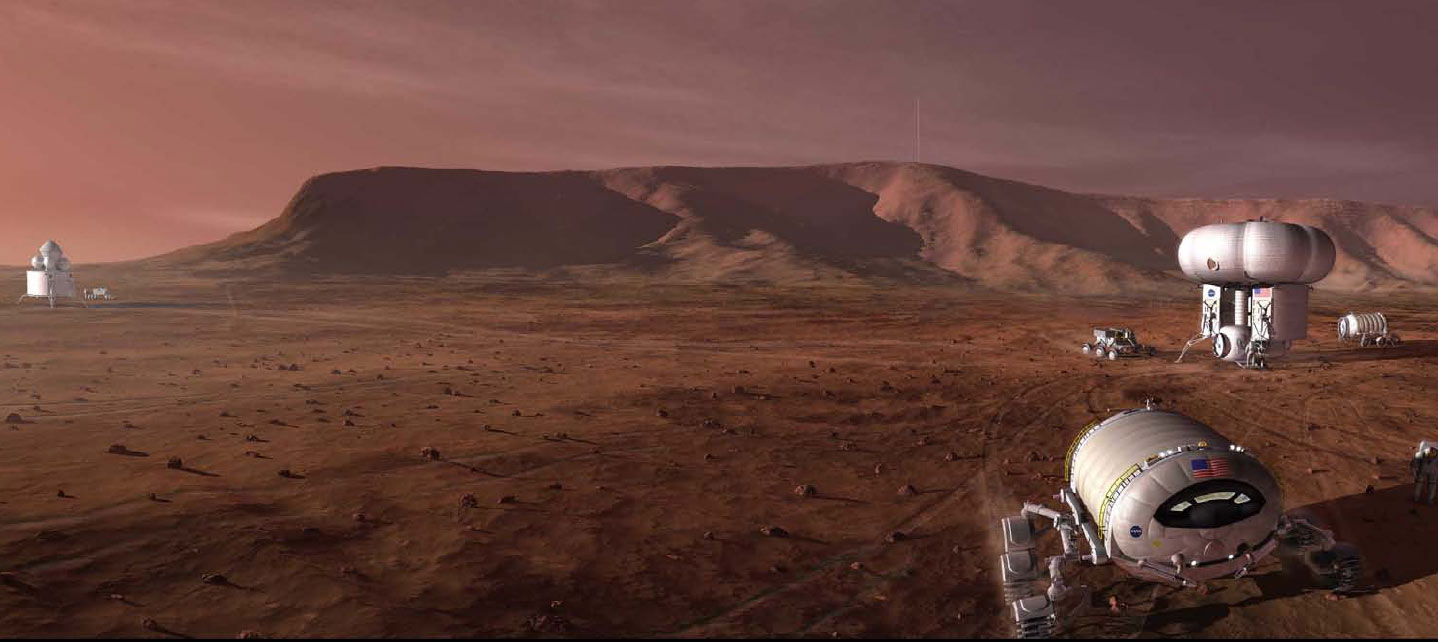
Mars manned mission. Image credit: NASA
Getting to Mars is not cheap. Since the late 1940s there have been many proposals for manned exploration and settlements on mars. A commonality is that they are all pitched 10-20 years in the future and large sums of money are mentioned. To put this into today’s context on August 6 (EDT), 2012 NASA’s Mars rover, Curiosity, will land on Mars. This mission will place an 899kg six-wheeled, un-manned science laboratory on Mars; for the approximate mission cost of US$2.5B. It is expected that a 2030s NASA mission to Mars will be of the order of US$20B. Mars One says it will cost them US$6B to put the first four settlers on Mars.
In many ways focusing on the mission cost is a furphy. NASA mission budgets come from USA public purses and there is always great argument in the US Senate about the value of such publically funded scientific enterprise. In the US this argument is always balanced by the technology and enterprise that this brings to US companies and the economy. Mars One have no such public funding in mind. They intend to buy the above technologies based on price and quality, not through political or national preferences.
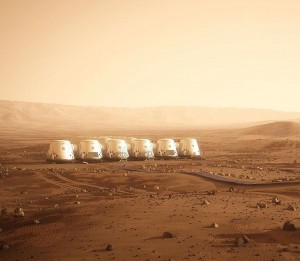
Colonisation of Mars 2023, Mars One. Image Credit: Ariukux
The ability to fund such a mission will depend on what value it returns for investors. Here is the Mars One point of difference; funding will be via sponsorship and as the World’s largest media event. If I were a settler having ILC Dover and Paragon Space Development would be more reassuring than IKEA on my Living and Life Support Modules. As for the thought of a 7 months trip to Mars eating McDonalds pre-prepared ‘meals’ that would be unpalatable. Choose the sponsors wisely Mars One.
There are no stated scientific or economic goals. Instead they see it this way:
“A manned mission to Mars is one of the most exciting, inspiring and ambitious adventures that mankind can take on. We see this as a journey that belongs to us all, and it is for this reason that we will make every step one that we take together. This will also be our way to finance the mission: the mission to Mars will be the biggest media event ever! The entire world will be able to watch and help with decisions as the teams of settlers are selected, follow their extensive training and preparation for the mission and of course observe their settling on Mars once arrived. The emigrated astronauts will share their experiences with us as they build their new home, conduct experiments, and explore Mars. The mission itself will provide us with invaluable scientific and social knowledge that will be accessible to everyone, not just an elite select few.”
To assist in making this worldwide media frenzy Mars One has enlisted Paul Römer as an ambassador. An established expert on grasping the attention of a global public, he was the co-creator of the worldwide phenomenon “Big Brother” – the television program that revolutionized reality television.
The 24/7 Martizen lab-rat
More than the tangibles of this venture, I believe it will be the intangible elements that make this a standout human endeavour. Especially the ethics and psychology of the Martizen being media fodder 24/7. A previous article has already questioned the ethics of such, admitedly voluntary, surveillance.
The psychology of such surveillance is fascinating and worrying. Even the most extroverted of people have private lives. Only the totally naive display ‘real’ faces through the public media. Media such as facebook display a mixture unconscious representations, as well as carefully and foolishly contrived facets of our lives. In many cases events are morphed and selectively recorded on media such as facebook and twitter. It is one thing to post to your facebook friends, it is quite a different thing to know that all that you do will be on display for a public you do not know.
It is hopefully obvious that the narcissist, wastrel, celebrity personalities that populated the many versions of Big Brother are not what will make a great four-person team on Mars. I also am happy to be labelled an ‘elitist’ and state that public participation via stringent selection processes, such as voting-off someone you don’t like, will be a disaster for a serious mission.
I am unsure how history’s first off-world conception, birth and death will go as media events. I can appreciate the lure for marketers of such landmark voyeuristic events, I am at the same time unsure how the participants of such private events will feel.
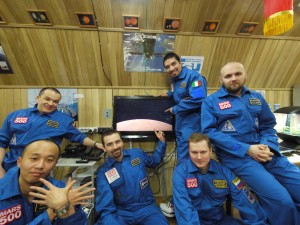
Mars500 crew. Photo credit ESA
There is psychologically a world of difference between the isolation that would be experienced in genuine remote exploration, think Antarctica, to the pseudo-isolation of contrived event that has a definite endpoint, think Big Brother and Survivor. The Marsonauts of Mars500 ended with smiling faces after their 17 month long isolation experiment. The European Space Agency’s Directorate of Human Spaceflight has a long tradition of conducting research on the physiological and psychological aspects of spaceflight. In light of this, ESA undertook the Mars500 cooperative project with the Russian Institute for Biomedical Problems (IBMP) in Moscow, in 2010-11. This all male crew experiment is instructive, and illuminating for Mars One, however no matter how ‘isolated’ Moscow may feel, like the people in the Big Brother household, they could if they chose leave at any stage.
Despite this a key science project during Mars500 was to determine the implications of personal values held by individual crew-members for compatibility within the group as a whole or otherwise, and for individual coping strategies and adaptation during long lasting confinement. On a human exploration mission to Mars, the psychological resilience of the crew will play a critical role for the maintenance of health and performance and hence the success of the mission. One factor impacting on psychological resilience is the personal values of crew members defining their motivational goals and attitudes. Crew member selection is for real, not a game where if a poor choice is made they leave the set or you re-boot the computer.
It’s a one-way trip
That is one clear distinction this is a one-way journey. Since returning astronauts from the surface of Mars is one of the most difficult, and expensive, parts of a Mars mission, the idea of a one-way trip to Mars has been proposed several times. The notion of settlers, rather than expedition astronauts changes the technology and psychology of the mission.
A one-way trip scenario has been proposed seriously a number of times since 1998. Including a 2004 proposal by Paul Davies. Another organisation, Mars to Stay, proposed that astronauts sent to Mars for the first time should stay there indefinitely, both to reduce mission cost and to ensure permanent settlement of Mars. Among many notable Mars to Stay advocates, former Apollo astronaut Buzz Aldrin is a particularly outspoken promoter who has suggested in numerous forums “Forget the Moon, Let’s Head to Mars!”
During a 2009 public hearing of the U.S. Human Space Flight Plans Committee at which Robert Zubrin presented a summary of the arguments in book The Case for Mars, dozens of placards reading “Mars Direct Cowards Return to the Moon” were placed throughout the Carnegie Institute.The passionate uproar among space exploration advocates – both favourable and critical – is an indication of the interest in Mars exploration.
I find the Mars to Stay idea appealing and compelling for both economic and safety reasons. More emphatically, I find it a representation of the spirit of human exploration and discovery. Also personally it is a fulfilment of the ultimate mandate by which manned space programs (US, European, Russian, Chinese, Indian, Japanese etc.) are sold, at least philosophically and long-term, as a step to colonizing other worlds. I hope that Mars One either credibly fulfils this trust or propels alternative programs that deliver human settlement on Mars via a well-defined (i.e. non-suicidal) exploration program.

 Google Earth Engine technology has already been used to compute the forested areas of Mexico (http://earthengine.google.org/#intro/MexicoTreeCover), identify deforestation in the Amazon (Monitoring Forests From the Ground to the Cloud) and map roadless areas of the world (http://earthengine.google.org/#intro/Roadless1km).