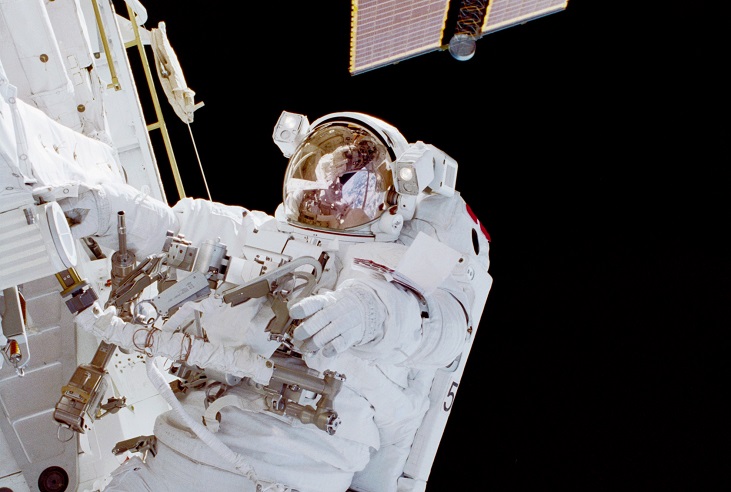
Australian Andy Thomas during a spacewalk on mission STS-102 in 2001. Credit: NASA
A flurry of press articles went out this week after NASA announced its eight new astronaut candidates. The agency touted these people, who range from doctors to fighter pilots, as a generation of astronauts that will at last be trained for missions beyond Earth’s orbit.
The agency is eyeing the moon, and Mars, as eventual destinations for astronauts in the coming decades. The long-term plan for NASA keeps shifting every few years, but right now it is embracing a sort of “flexible destination” approach that is intended to bring humans further into space.
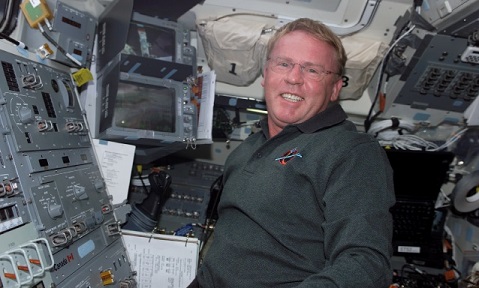
Australia, of course, does not have an astronaut program of its own. But it does have Andy Thomas, an Adelaide-born mechanical engineer who flew four times in space, most recently on STS-114 Discovery in 2005. When asked by NASA about his aspirations as a kid in a country without an astronaut program, he expressed optimism about the situation:
Andy Thomas aboard Discovery on STS-114. Credit: NASA
“I think for a young kid growing up in Australia at that time, the prospects of becoming an astronaut were remote, to say the least,” he said in a 2005 interview with NASA.
“But I’ve always believed that the pathway to many interesting experiences can be opened if you have the right kind of education, and certainly that’s true in my case. I think education, in fact, can open doors that you can’t even imagine and that would forever remain closed if you did not seek good education. And that’s been true in my case.”
While he ended up working in the United States and becoming a citizen there, it is worth noting that Thomas is a product of Australian education: he received two mechanical engineering degrees (including his Ph.D.) at the University of Adelaide.
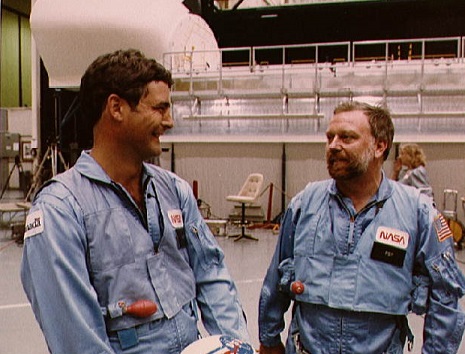
Paul Desmond Scully-Power (right) with fellow STS-41 astronaut Marc Garneau, a Canadian. Credit: NASA
Another Australian graduate was Paul Desmond Scully-Power, who flew into space aboard STS-41G Challenger. A graduate of the University of Sydney, he also began the first oceanographic group for the Royal Australian Navy.
Upon realizing that it’s been eight years since an Australian has been in space, and that few of the country have made it there, it might be natural for some to worry about whether one will make it again there soon.
There are initiatives within the country, however, to continue promoting educational opportunities that could one day set up students for that career path. One prominent example is Young Astronauts Space Schools Australia, a network focusing on both space and science education. Even if the path does not lead to space, there are opportunities in the country to perform astronomy and other forms of space science.
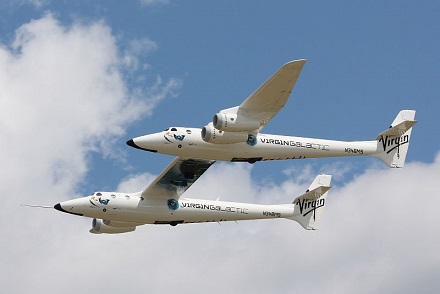
WhiteKnightTwo, the carrier craft aiming to eventually bring Virgin Galactic’s SpaceShipTwo into space. Credit: D. Miller/Wikimedia Commons
But with no Australian professional astronauts currently bound for space, it’s quite possible the next person from the country to make it into orbit will be one paying for a ticket aboard a private spaceship. Virgin Galactic is expected to fly its first flights in 2014, and XCOR is projecting flights in the next couple of years as well.
Hundreds of people have expressed a willingness to climb on board these flights, and there are at least eight companies in Australia willing to help you buy that ticket.
Perhaps the next Australian in space will be a “tourist”. This could be a business person who has spent their lifetime building up products in the country. Or perhaps they are simply an ordinary person who stashed away thousands of dollars in savings for what was an impossible dream a few years ago, but seems closer than ever today.
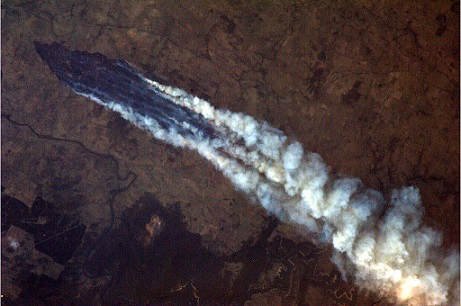
A brushfire near Burrinjuck Dam in New South Wales, Australia. Credit: Chris Hadfield/NASA
Earthlings were spoiled when Chris Hadfield turned his camera to Earth. The astronaut, just returned in May from a five-month mission to the International Space Station, uploaded dozens of pictures of Australia to his Twitter feed and other social networks.
His observations ranged from the whimsical — “Jackson Pollock would have been even further inspired by seeing the Outback from orbit” — to scientific: “Another of the Australian bushfires, this one near Burrinjuck Dam. Look closely and you can see the flames from orbit.”
While the pictures may have appeared to be taken at random, astronauts receive serious training in photography before undertaking any flight to the International Space Station.
Their role as Earth ambassadors in orbit extends to also keeping watch over the planet. If their orbital track passes over a hurricane that threatens the Australian basin, or Outback fires that are threatening a town, NASA will request the astronauts take photos to assist Earthly emergency responders. Astronauts also take note of long-term changes in Earth’s environment.
Science and disaster management
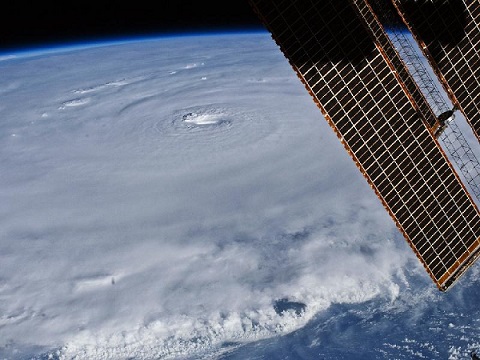
Hurricane Earl near Puerto Rico in August 2010, as seen from the International Space Station. Credit: NASA
The first astronaut photos took place along with the beginning of the space program. Both Soviet and American astronauts snapped pictures in the 1960s using small, handheld cameras. Photography took on a more serious role as missions progressed, perhaps most notably in the Apollo moon mission era of 1968-1972. Geologists on Earth depended on astronauts’ photography of features on the moon to help identify the context in which rocks appeared.
Closer to Earth, however, astronauts play an important supplemental role in capturing images. There are many Earth-gazing satellites that orbit overhead, but sometimes their ground tracks — the path their spacecraft takes over the planet — do not fly over, say, a volcanic eruption soon enough.
Also, satellites are preprogrammed machines that can only be altered with a great cost of time and effort. With astronauts, however, changing their program is a simple radio call away from a ground control center.
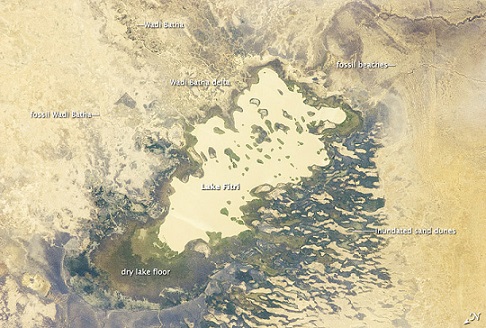
NASA’s Gateway to Astronaut Photography of Earth website features thousands upon thousands of images taken by astronauts in its various programs. With the International Space Station now the agency’s main focus, the images can be taken by astronauts of any nationality — not just American. The space station partners ensure their respective astronauts receive instructions on how to observe the oceans, the environment and the weather from their orbital perch.
“Messages are routinely sent to the station crew members listing the best opportunities for photographing target site areas,” the agency wrote. “The sites include major deltas in South and East Asia, coral reefs, major cities, smog over industrial regions, areas that typically experience floods or droughts triggered by El Nino cycles, alpine glaciers, long-term ecological research sites, tectonic structures, and features on Earth, such as impact craters, that are analogous to structures on Mars.
Neutron stars are some of the strangest and least understood objects in the entire Universe. Over 1.5 times the mass of our whole solar system, squeezed into an object comparable in size with a city, these curious objects wield titanic gravitational fields and, often, immense magnetic fields. They’re also so incredibly dense that it’s difficult to fully appreciate* And sometimes, for reasons we don’t fully understand, their rotational speed suddenly changes.
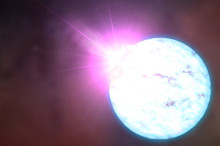
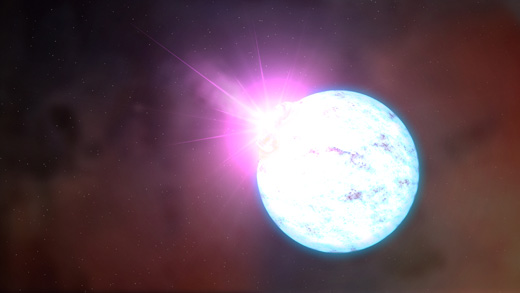
These sudden changes in rotation are known as glitches, and they happen to a particular, rare type of neutron star, known as a magnetar – a neutron star with an exceptionally strong magnetic field, which occasionally undergoes violent outbursts known as starquakes. These starquakes have been known to cause the rotation speed of a neutron star to suddenly increase. But one of these oddities is an oddity among oddities. A magnetar known as 1E 2259+586 was recently observed not to speed up, but to slow down. The reason? No one knows.
The team in charge of this work, led by Victoria Kaspi at McGill University, Montreal, summed up their observation in a press release by saying that it “constitute[s] a new theoretical challenge.” Now, to someone like me, this is very exciting. Specifically because this means that, working with existing theories, they don’t know what’s going on. It’s currently unexplainable. And when this sort of thing happens, it means we’ve discovered something which we didn’t know before.
Any good scientist should be thrilled when they don’t understand something, because this means that there’s something new to understand. In this particular case, the fact that this magnetar seems to have done the opposite of what it should has managed to throw a spanner in the works**.
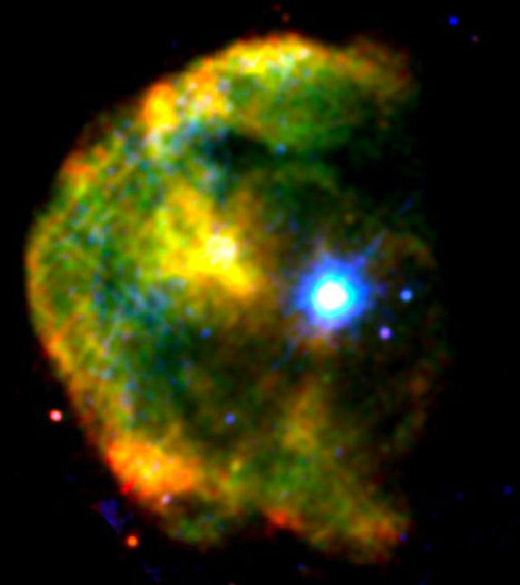
An x-ray image of the neutron star 1E 2259 586 in false colour. Low energy x-rays are shown in red, medium energy in green, and high in blue. Credit: ESA/XMM-Newton/M. Sasaki et al.
“Astronomers have witnessed hundreds of events, called glitches, associated with sudden increases in the spin of neutron stars, but this sudden spin-down caught us off guard,” Kaspi explained. Indeed, the regular type of glitch is, we think, quite well understood.
What precisely might be found beneath the ultra hard crust of a neutron star is a mystery. We might perhaps never be able to directly observe it and find out (neutron stars aren’t fond of guests, and have a tendency to turn anything which lands on them into a large thermonuclear explosion). But what we can deduce is that the interior of a neutron star is a kind of superfluid, composed mostly of neutrons. At the surface of a neutron star, high energy particles are accelerated outwards. This is known as a pulsar wind, and it’s the main mechanism through which neutron stars cool.
As this pulsar wind carries away energy, it gradually grains energy and momentum from the surface of the neutron star. But this causes stress to build up under the surface. After enough stress builds up, the crust ruptures with an almighty crack. This causes the star to emit a huge burst of x-rays. It also allows the crust to catch up with the rotation speed of the interior. Neutron stars slow down when they’re ready to and not a moment sooner.
The neutron star in question, 2259+586, lies around 10,000 light years away in the constellation of Cassiopaeia and rotates once every 7 seconds or so. In the x-ray image shown above, it’s quite obvious in high energy x-rays (coloured blue in the image). The lower energy x-rays show a pulsar wind nebula as those high energy particles streaming away from it crash headlong into the surrounding interstellar medium.
Crust fractures in neutron stars sometimes go by the name of starquakes, and they can be caused by tangled up magnetic field lines too. But it’s this particular mechanism which causes these stars to glitch. 2259+586, however, is going against the grain. Because it’s been observed to do the opposite of what it should, this previously unknown phenomenon has been dubbed an ‘anti-glitch’. What’s more, not content with its abrupt slowdown, 2259+586 is also slowing its speed faster than it was previously observed to (an effect known as “spinning down”).
Sometime in late April, before the anti-glitch was discovered, the Fermi space telescope picked up a powerful x-ray burst. Lasting just 36 milliseconds, the researchers believe that it was this burst which signalled the magnetar’s unprecedented drop in rotational speed. Robert Archibald, the lead author on the paper published on this work, explained, “What is really remarkable about this event is the combination of the magnetar’s abrupt slowdown, the X-ray outburst, and the fact we now observe the star spinning down at a faster rate than before.”
As for why this has happened? Well, now we need to wait for the theoreticians to solve the puzzle. And, at least for some of us, that’s the fun part!
Artist’s impression of a starquake on a magnetar’s surface. Credit: NASA Goddard
* As one tumblr user so wonderfully described it, “an average printed period, if it were as dense as a neutron star, would weigh about as much as a train car FILLED WITH BRICKS.”
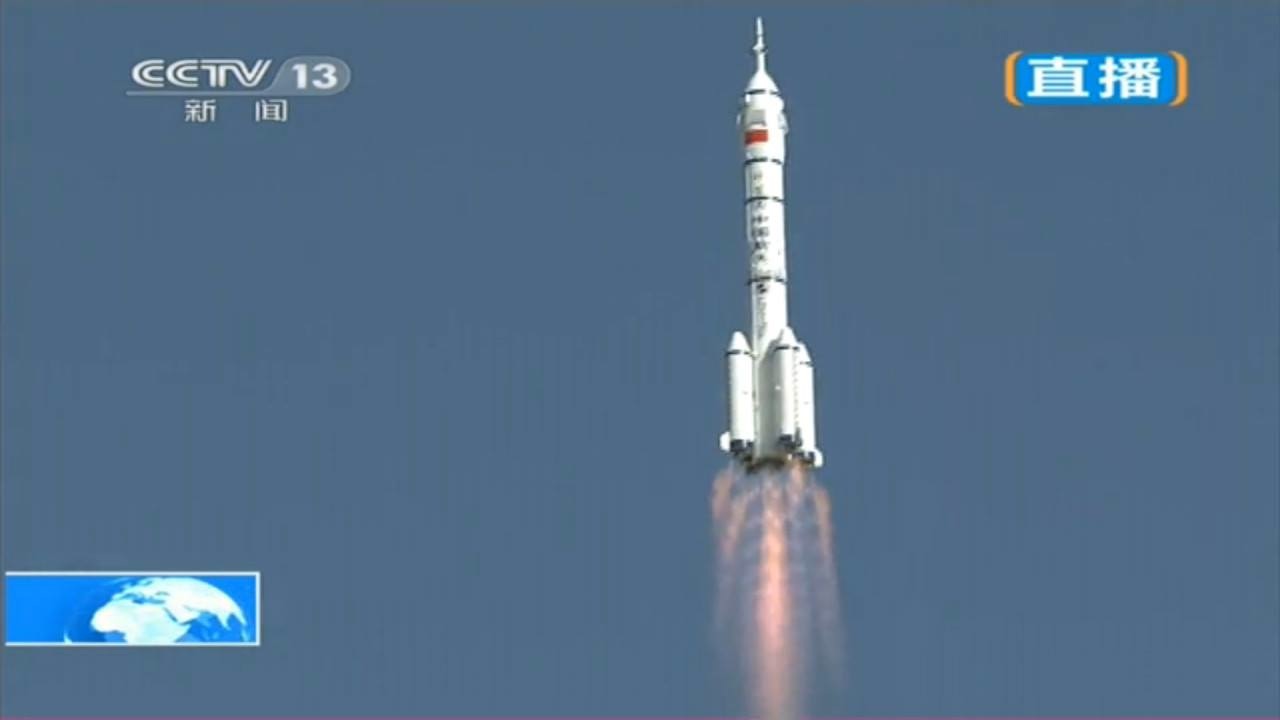
The Long March 2F rocket, Shenzhou 10, seconds after its launch. Photo credit CCTV.
The colorful and polished launch of Shenzhou 10 confirms that China has come of age as a spacefaring nation. At 19:40 AEST on Tuesday June 11 (17:40 local time) three ‘yuhangyuan’, Chinese astronauts, embarked on China’s sixth crewed space mission. This second mission to Tiangong 1, the Chinese space station, is a credible step in mastering the art and engineering of space exploration. It was also a public relations success.
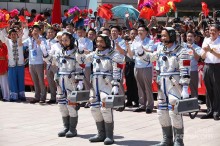
Shenzhou 10 crew
Announcing in early April, that Wang Yaping, a 33 year old Major in the PLA Air Force, was one of the 3-person Shenzhou 10 crew, silence then descended on the identity of the other crew members. Wang was named as the in-flight instructor. She becomes China’s second female and 9th astronaut to have flown. As the in-flight instructor Wang will give lectures to middle and elementary school students from orbit.
Building the suspense the Chinese finally announcing the other two the names of the three person crew yesterday. Along with Wang the Shenzhou 10 crew are: Nie Haisheng (48) Commander of Shenzhou 10, a veteran of Shenzhou 6 in 2005, and a Major General in PLA Air Force, and Zhang Xiaoguang, 47 Assistant Pilot of Shenzhou 10, backup crew of Shenzhou 9 (along with Wang) and a Senior Colonel of PLA Air Force.
This places the Chinese astronaut corps as a modern, relatively, gender balanced operation. Zhang and Nie both hale from the 1996 second astronaut selection. As have all male yuhangyuan to date including Yang Liwei, China’s first astronaut. The first group of astronauts were selected in 1971 in a hopelessly ambitious and quickly abandoned attempt to put astronauts into space in the 1970s. Wang, along with Liu Yang, China’s first female yuhangyuan, comes from China’s 2010 third group of yuhangyuan. The Chinese, at least to the outside world, have not followed the more memorable and colorful NASA lead of allowing astronaut groups to pick their nick-names.
The heavenly palace
With the launch a success, Nie will now chase, rendezvous and dock with an orbital laboratory, Tiangong (a mandarin word meaning “heavenly palace”), which was launched nearly two years ago on September 29, 2011.On November 2, 2011 China successfully docked the unmanned Shenzhou 8 with Tiangong. It remained docked for 14 days and then undocked and repeated the docking maneuver – proof that the first was not a fluke. It then was undocked, leaving Tiangong to its solitary orbit 370km above the earth’s surface.
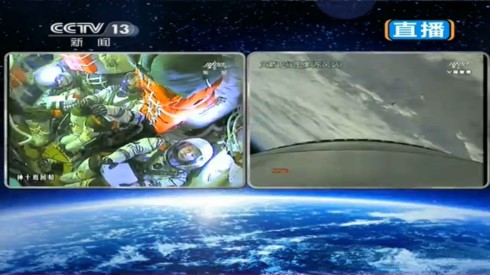
Image of the interior of Shenzhou 10 after launch. China TV demonstrates its new openness and confidence. Image credit CCTV.
On June 18, 2012 a second craft docked with Tiangong. This time it was the crewed Shenzhou 9. The space station was then declared operational. China had joined Russia and the USA in having the capability to become space residents. The three person crew on Tiangong conducted experiments and aclimatised to the prolonged weightlessness for their 10 day mission.
The normal pattern was for two to sleep in Tiangong and one to sleep in Shenzhou. At only 10.4m in length, Shenzhou is smaller than the 1971 Russian Salyut (13.1m) and the 1973 US Skylab (36.1m) space laboratories. Like these other first space laboratories Tiangong is designed with a limited lifespan. The current mission, Shenzhou 10, will be the last to Tiangong 1.
Shenzhou 10
As is the norm now the Shenzhou launch was covered live by the Chinese media. providing pictures, expert commentary and graphics depicting what was going on at the various stages of the launch. Shenzhou 10 is now safely in orbit and will spend the next few days approaching a suitable orbit for docking. The Shenzhou 10 will dock with the orbiting lab module Tiangong 1 several times.
“The three astronauts will stay in orbit for 15 days, including 12 days when they will work inside the coupled complex of the Shenzhou 10 and Tiangong 1,” said Zhou Jianping, head designer of China’s manned space program. It is expected that they will set a Chinese record for time in orbit.
The interesting point is that the mission profile for Shenzhou 10 is opaque. Although it is expected that the craft will be put through it’s docking paces – not something to be dismissed lightly – the scientific and engineering goals of this mission are less obvious that the recent Shenzhou missions.
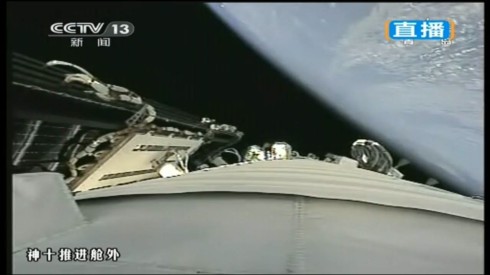
The view from the orbiting Shenzhou 10. Image credit CCTV.
This will be the last Chinese human space mission for quite some time. The next Shenzhou missions are expected to fly to the Tiangong 2 laboratory. This will be an expanded version of Tiangong 1, similar in design to the Russian 1986 Mir space station. It is expected to be able to sustain 20-day visits. It will probably not be launched until around 2015 or possibly later. The gap between the flight of Shenzhou 10 and Shenzhou 11 could ultimately prove to be the longest hiatus in Chinese human spaceflight to date.
Regional implications
With this in mind it will be interesting to see how the Chinese promote this current mission once it is completed. Its success, or otherwise, will not aid any military space activities, nor directly any commercial space activities. It does provide a compelling message, I suggest, to its regional competitors. Human exploration is possibly the most expensive and prestigious space activity. I think we will find China promoting this expedition to its fullest, as it build on its robotic missions to the Moon over the next few years. Fully intending to continue its long march to put humans onto the moon and mars in the next few decades.
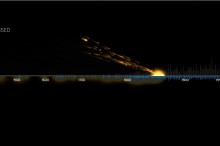
Carlo Zapponi is data visualization designer at Nokia, who has created an amazing animationof the meteorites that have struck the earth. Only 3% of all recorded meteorites were seen falling since 861 AD. 34,513 have been recorded, only 1,042 have been seen falling. Now you can click any of the fallen meteorites at the image below, also you will see the visualization in full screen mode.
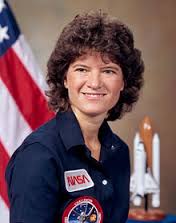
This article is the third in a series of articles in which I will profile every woman astronaut, cosmonaut and taikonaut who has been into space. Last time we looked at the career of Svetlana Savitskaya the second woman in space. Today I’m profiling astronaut Sally Ride, the first American woman in space. (The feature image above is a collection of drawings of women astronauts by artist Phillip J Bond. You can find Phillip’s wonderful series on women astronauts here.)
In 2004 I saw Sally Ride at an Australian Broadcast Corporation (ABC) Radio National Science Special in Canberra. When I first saw her speak, I was surprised how small she appeared on stage. In my mind, Sally Ride was larger than life, an adventurer, explorer, a trailblazer who broke boundaries in physics, astrophysics and space exploration. Of course within a few minutes of her speaking I was completely drawn into her world of science and space exploration where her stature, and gender is irrelevant. (The transcript of the show she shared with astrophysicist Paul Davies, and marine biologist Syliva Earle can be read here).
Sally Ride aboard the Shuttle (Image credit NASA).
Sally Ride was born in Encino, California. She had one sibling, a sister, her mother was a volunteer counselor at a women’s prison, her father was a political science professor. Sally went to Swarthmore College, taking physics courses at UCLA, she then went on to Stanford to earn her Bachelors degree in English and Physics, and her Masters degree and PhD in physics. Sally was an accomplished athlete, and nationally ranked tennis player in her youth.
Sally was one of about 8,000 people who responded to NASA’s call for applicants for the space program. Sally was ‘recruited’ to NASA by actor Nichelle Nicols who played communications officer Lt. Uhura in the original Star Trek television series. NASA had asked Nichols to help them find the first qualified women and minorities to join what was was until then, an all white male astronaut corps. After more than 12 months of testing and training Sally was one of the few selected to join NASA in 1978. Somewhat unsurprisingly at the time, her gender attracted quite a bit of media attention. Although she herself stayed well clear of gender issues Sally was still asked inane questions like ‘Do you weep when things go wrong on the job?’, and ‘Will the flight affect your reproductive organs?’. Sally noted that she felt astronaut training was ‘asexual’, women and men did all the same training, and that in space ‘weightlessness was the great equaliser, you don’t need to be strong in space’.
Sally Ride – Pilot (Image Credit NASA)
When Challenger roared into space on 18 June 1983 Sally Ride became the first American woman, and the youngest astronaut in space. She was preceded by Valentina Tereshkova in 1963 and Svetlana Savitskaya in 1982, both Russian astronauts. During the STS-7 mission the crew deployed two communications satellites and conducted pharmaceutical experiments. Sally was the first woman to use the robot arm in space and the first to use the arm to retrieve a satellite. Sally’s second space flight was in 1984, STS-41G where the crew deployed the Earth Radiation Budget Satellite, and conducted various observations. STS-41G was the first time that two women flew in space together, when Kathryn Sullivan joined Ride on the crew. Upon her return she was then scheduled for STS-61M, however, that mission was cancelled in the wake of the Challenger disaster. She was nominated to head the Operations sub-committee on the Rogers Commission, the presidential commission investigating the challenger accident. Following the investigation Sally went to work in NASA HQ authoring a report ‘NASA Leadership and America’s Future in Space’.
Sally Ride and Muppet (Image courtesy of Wikimedia)
During her career, Sally served as the ground-based capsule communicator (CapCom) for the second and third Space Shuttle flights (STS-2 and STS-3) and helped develop the Space Shuttle’s robot arm. She spent a total of more than 343 hours in space. Sally remarked in an 1984 interview that she felt ‘a lot of pressure’ being the first US woman in space, and that most of the pressure was ‘generated by the media’. She said she felt ‘proud’ to be the first US woman in space, and that the extra pressure made her determined to do things right.
Sally left NASA in 1987 and went to work for Standford University, she then moved to the University of California San Diego (UCSD) as the Professor of Physics. She was also the Director of the California Space Institute, and a vigorous promoter of public outreach for science. In 2001 Sally co-founded her own company, Sally Ride Science, a company that creates entertaining science programs, events, and publications for elementary and middle school students, with a focus on girls. In 2003 she was asked to be a member of the Space Shuttle Columbia Accident Investigation Board, the only person to sit on both the Challenger and Columbia accident boards. Whilst at USCD, Sally led Jet Propulsion Laboratories (JPL) public outreach program for the ISS – EarthKAM and GRAILMoonKAM which encouraged school students to study imagery of the Earth and moon. Sally was also nominated to serve on the 2009 commission that helped shape NASA’s current spaceflight program.
Sally Ride (Image courtesy of NASA)
Sally Ride passed away on 23 July 2012 from pancreatic cancer. A fiercely private person, she did not release any information or details of her 17 month battle with her illness. Her death shocked many people. President Obama said shortly after her death ‘As the first American woman to travel into space, Sally was a national hero and powerful role model. She inspired generations of young girls to reach for the stars and later fought tirelessly to help get them there by advocating for a greater focus on science and math in our schools’. Sally’s legacy of public outreach and work with school students through her company Sally Ride Science will be continued by her partner and co-founder of Sally Ride Science, Tam O’Shaughnessy.
Perhaps the most moving tribute to Sally comes from her friend Nichelle Nichols, ‘Sally Ride — my heart aches right now. Sally was one of my first and biggest achievements. She once thanked me for my recruitment efforts while under contract to NASA, saying “If it hadn’t been for you I might not be here.
In one of the TED-Ed’s lessons worth sharing – astronaut Jerry Carr share his experience on space. As commander of Skylab, he spent over 2000 hours in space, orbiting the Earth over 1000 times. Recounting his life story, Carr remembers the enchanting years he spent at NASA.
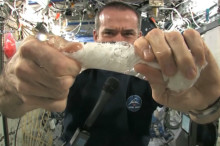
At the top of my list this week would have to be the ISS Commander Chris Hadfield from Canadian Space Agency wringing out a wet towel in zero gravity. If you haven’t watched it yet. Do it now.
The explanation behind what happens is more in depth than “magic”. Cmdr Hadfield is right when he mentions surface tension of water. Though it doesn’t explain the chemistry and physics of what is happening and also why he wasn’t worried about the exposed electronics in the ISS. I have to admit I was worried about droplets of water travelling out and into the wiring because water molecules are attracted to one another due to its molecular structure. I should have realised this being a chemist and all.
What I especially like about Cmdr Hadfield is that he includes people on Earth in his daily routine on the ISS. He replies to people’s tweets. I personally got a kick when he retweeted one of my tweets. Real time communication with an astronaut on the ISS. That’s awesome. He also includes school students allowing them to ask him questions. If you’re on Twitter and he isn’t someone you’re following, go find him at @Cmdr_Hadfield.
One reason why tumours grow is that they suppress the immune system so scientists thought to exploit this hoping that introduced Listeria would concentrate in tumour sites and deliver targeted radiotherapy. They introduced Listeria bacteria dosed with radioisotopes in mice with pancreatic cancer.
The results are really promising. The mice that received this treatment had 90% fewer cancer tumours in other areas of the body than those who had received radiotherapy and saline. The original cancer in the pancreas though was unaffected. It’s early days and it’s a long way from human trials. There is still the need to explain what was observed in this trial and what remains unknown is the effect of radiation on healthy organs.
Pancreatic cancer is the 6th highest cause of death for all cancer types in Australia, and only about 6% of people with this cancer survive 5 years after diagnosis compared to a 5-year survival of 88% for breast cancer, 93% for thyroid cancer and 19% for lung cancer. Currently there are very few treatment options available.
This article is the second in a series of articles in which I will profile every woman astronaut, cosmonaut and taikonaut who has been into space. Last time we looked at the career of Valentina Tereshkova, the first woman in space. Today I’m profiling cosmonaut Svetlana Savitskaya, the second woman in space. (The feature image above is a collection of drawings of women astronauts by artist Phillip J Bond. You can find Phillip’s wonderful series on women astronauts here.)
Svetlana Savitskaya is a record breaking Russian aviator and cosmonaut.
Born in Moscow in 1948, Svetlana was raised in a middle class family. In high school she was a keen parachutist, and in 1970 she won 6th place in FAI (Fédération Aéronautique Internationale) World Aerobic Championship, went on to set 18 international world records in MiG aircraft, and set 3 international records in team parachute jumping. In 1974, Svetlana began a career as a pilot after urging from her father, a Deputy Commander of the Soviet Air Defences and World War II air hero. Her father had recognised her interest in flying and parachuting and was very keen for Svetlana to pursue pilot school. Just two years after finishing pilot school Svetlana went on to become a test pilot.
In the late 1970’s the Soviet Union realised that the US was planning to send women into space within a few years. Svetlana noted that at the time, that although the Russians had the first woman in space (Valentina Tereshkova) they wanted to keep their record intact and beat the Americans once again. So they advertised and recruited a number of women candidates for cosmonaut school. In July 1980, 32 year old Svetlana was chosen for cosmonaut training. She successfully completed the arduous training programs for both the Salyut 7 (Russian Space Station) and Soyuz space craft.
Svetlana Savitskaya
After training, Svetlana was selected as a member of the 3 person crew for the Soyuz T-7 mission. This mission was to fly to the Salyut 7 space station, stay for approximately 7 days to conduct experiments and then return to Earth aboard the Soyuz T-5. The launch of Soyuz T-7 from the Baikonur Cosmodrome at 23:12 hours on 19 August 1982 was flawless. Svetlana, along with Leonid Popov and Alexander Serebrov flew aboard the Soyuz T-7 to dock with the Salyut 7 space station.
After docking with the Salyut 7 space station, Svetlana boarded the vessel only to be greeted by a fellow cosmonaut Valentin Lebedev, who subsequently gave her an apron and told her to ‘start work’. Despite what many cosmonauts thought, Svetlana was there to conduct experiments and throughout the mission she conducted experiments on the cardiovascular system, motion sickness, eye movement as well as an electrophoresis experiment on human cells. After 7 days, 21 hours and 52 minutes Svetlana and her crew returned to earth landing safely just 112 km northeast of Arkalyk. This trip resulted in Svetlana becoming only the 2nd woman in space at that time, and it was also the first human spaceflight by mixed female and male crew. Svetlana’s flight made her a national hero.
Svetlana Savitskaya (Credit Ria Novosti)
On the 17th of July 1984, on the 50th Soyuz spaceflight, Svetlana Savitskaya became the first woman to fly a second space mission when Soyuz T12 launched a mission to conduct maintenance operations on Salyut 7. During the mission Svetlana conducted various experiments and completed repairs to the space station. On 25 July 1984 Svetlana and Dzhanibekov donned their space suits and exited Salyut 7 to perform maintenance on the outside of the space craft. Their tasks involved cutting, welding and soldering tests on the outside of Salyut 7. Their space walk (or Extra Vehicular Activity) lasted 3 hours and 55 minutes. Svetlana had broken one more record, the first woman to conduct a space walk.
The mission ended a few days later after 11 days, 19 hours, 14 minutes and 36 seconds in space. After her last flight Svetlana remained an active cosmonaut and was appointed as Deputy to the Chief Designer of the Energia Project in 1987. Although Svetlana never made another space flight, she remains a symbol of her nation’s pride and achievements. Svetlana retired as a Major from the Russian Air Force and the Cosmonaut Corps in 1993.
Svetlana is now a member of the State Duma representing the Communist Party of the Russian Federation. She also serves as the Deputy Chair of the Committee on Defense.
Svetlana Savitskaya (Credit Ria Novosti)
In a 2009 interview Svetlana, somewhat unsurprisingly, revealed that she battled sexism during her career in the Russian Air Force and within the Cosmonaut Corps. She noted that the ‘Missions were tough,’ and that ‘Even among our space colleagues the men wondered why we needed to weld and said that we might burn each other’s space suits, or the spaceship’s exterior. It’s a great responsibility. My spaceflight shut everyone up!’
Svetlana was twice awarded the Hero of the Soviet Union and has two asteroids named for her (4118 Sveta and 4003 Savitskaya), and her record of 2683 km/h in a MIG-21 in the female category remains unbroken.
Svetlana Savitskaya quote:
“When watching the Earth from over there, one can see the results of human activities, not just a beautiful bluish habitable planet, but because one can see just how habitable it is, with all of its floodlit streets and avenues, and its huge cities. One can see this both at night and in the daytime. And secondly, anyone over there, in orbit, should give, and actually gives, a thought to the fact that they are at an average altitude of 400 kilometres, aboard a space station or a spacecraft that have been manufactured by human mind and human civilization, so one can’t help but feel proud of them. One realizes that this planet is their home. One may even land on water, somewhere in the world Ocean, still the planet is their home. One has a natural psychological wish to return to earth, to their home. When in orbit, one thinks of the whole of the earth, rather than of one’s country, as one’s home.”
What we know of exoplanets has developed at the same time as the technology which we use to discover them. This is, in my opinion, the most exciting thing about the entire field of study. For instance, when we first started spotting planets around alien suns, we found huge gas giants. Hot jupiters, extremely massive and close to their parent stars. For a while, some conjectured that this type of planet may be quite common in the Universe. But since then, we’ve developed more powerful methods of searching the sky and, as it turns out, smaller planets are much more common than huge superjovian worlds. The latest piece in the puzzle comes courtesy of NASA’s Kepler space teescope. Near the end of last month, NASA announced the discovery of the smallest exoplanet ever found around a sun-like star!
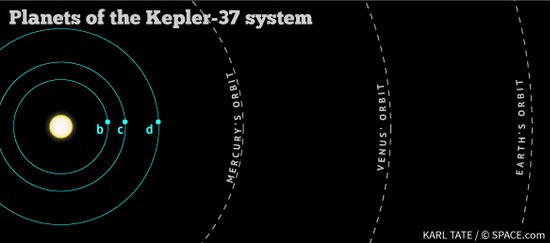
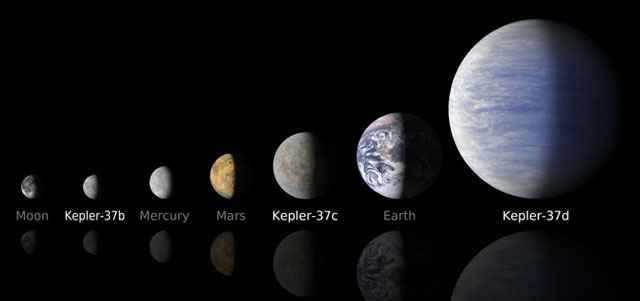
Kepler-37b really is tiny. In fact, the whole Kepler-37 system is tiny – the entire system discovered so far can fit inside the orbit of Mercury! The innermost little world is under 100th the mass of Earth, it’s expected to have a radius of around 3867 km (assuming the same average density as the planets in our own solar system) making it smaller than Earth’s moon. One can only apprehensively wonder if this will spark yet another debate over how large an object has to be before it’s considered a planet. With such a tiny orbit, it also has a year lasting just 13 Earth days. Even though the star Kepler-37 is slightly smaller and cooler than the Sun, it’s still enough to heat the surface of tiny 37b to a roasting 700 Kelvin (nearly 430°C). Needless to say, while we all like stories which talk about potential alien life, this is unlikely to be a home for any lifeforms we might recognise.
Kepler-37b is very definitely the runt of the litter. Its sibling worlds, denoted by the letters c and d, are respectively slightly smaller than Earth and about twice the size of Earth. Of course, these planets are also very close to their parent star. The interesting thing is that we’re discovering more and more small worlds around other stars. More and more exoplanet astronomers are warming to the idea that small rocky planets are likely to be the most common in our galaxy. Our current technology might have trouble spotting them further than a certain distance from their parent stars, but they’re likely to be out there waiting to be found.
Even detecting Kepler-37b was quite a notable feat. It was only possible, in fact, because of a set of rather special circumstances. The star Kepler-37 is particularly quiet, lacking the noisy sunspots and features which cause brightness variation in most stars, making it a particularly clear target. It’s also relatively bright in Kepler’s field of view.
To learn more about this star, and hence get greater accuracy on the measurement of the planets it carries in tow, NASA astronomers used a technique known as asteroseismology. Not dissimilar to the way geologists measure earthquakes, asteroseismology is the study of vibrations within a star, measured by accurately observing pulsations in the star’s surface. All stars are constantly bubbling and boiling, and this causes the whole star to vibrate at a number of resonant frequencies – soundwaves – in exactly the same way a bell vibrates when it rings. By measuring the precise frequencies of those soundwaves, a lot can be determined about the interior of a star. Incidentally, this same technique can be used to effectively “listen” to the Sun.
Interestingly, because Kepler-37 has such an eerily peaceful surface for a star, it was very easy to measure those vibrations, making Kepler-37 the smallest star ever to be studied this way. Normally, only large stars are observed using asteroseismology because the measurements need to be very precise. Conveniently though, the Kepler telescope was built for breathtaking precision.
A tiny planet discovered orbiting a singing star 215 light years away. How poetic!
Long distance weather reports are now a commonality. The report for 2MASSJ22282889-431026 is somewhat unusual. It forecasts wind-driven, planet-sized clouds, with the light varying in time, brightening and dimming about every 90 minutes. The clouds on 2MASSJ22282889-431026 are composed of hot grains of sand, liquid drops of iron, and other exotic compounds. Definitely not the first place to spend a summer holiday.
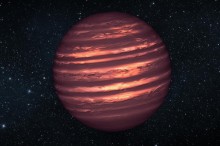
Not that 2MASSJ22282889-431026 (or 2M2228 as it is known in The Astrophysical Journal Letters) will appear on a travel itinerary anytime soon. For 2M2228 is a brown dwarf, 39.1 light years from earth. Brown dwarves form out of condensing gas, as stars do, but lack the mass to fuse hydrogen atoms and produce energy. Instead, these objects, which some call failed stars, are more similar to gas planets, such as Jupiter and Saturn, with their complex, varied atmospheres. Although brown dwarves are cool relative to other stars, they are actually hot by earthly standards. This particular object is about 600 to 700 degrees Celsius.
The atmosphere of 2M2228
Astronomers using NASA’s Spitzer and Hubble space telescopes have probed the stormy atmosphere of this brown dwarf, creating the most detailed “weather map” yet for this class of cool, star-like orbs. “With Hubble and Spitzer, we were able to look at different atmospheric layers of a brown dwarf, similar to the way doctors use medical imaging techniques to study the different tissues in your body,” said Daniel Apai, the principal investigator of the research at the University of Arizona in Tucson.
But more surprising, the team also found the timing of this change in brightness depended on whether they looked using different wavelengths of infrared light.
This artist’s illustration shows the atmosphere of a brown dwarf called 2MASSJ22282889-431026, which was observed simultaneously by NASA’s Spitzer and Hubble space telescopes. The results were unexpected, revealing offset layers of material as indicated in the diagram. For example, the large, bright patch in the outer layer has shifted to the right in the inner layer. The observations indicate this brown dwarf — a ball of gas that “failed” to become a star — is marked by wind-driven, planet-size clouds. The observations were made using different wavelength of light: Hubble sees infrared light from deeper in the object, while Spitzer sees longer-wavelength infrared light from the outermost surface. Both telescopes watched the brown dwarf as it rotated every 1.4 hours, changing in brightness as brighter or darker patches turned into the visible hemisphere. At each observed wavelength, the timing of the changes in brightness was offset, or out of phase, indicating the shifting layers of material. Image credit: NASA/JPL-Caltech.
These variations are the result of different layers or patches of material swirling around the brown dwarf in windy storms as large as Earth itself. Spitzer and Hubble see different atmospheric layers because certain infrared wavelengths are blocked by vapors of water and methane high up, while other infrared wavelengths emerge from much deeper layers.
The new research is a stepping-stone toward a better understanding not only of brown dwarves, but also of the atmospheres of planets beyond our solar system.
The Spitzer Space Telescope consists of a 0.85-meter diameter telescope and three cryogenically-cooled science instruments which perform imaging and spectroscopy in the 3 – 180 micron wavelength range. Since infrared is primarily heat radiation, detectors are most sensitive to infrared light when they are kept extremely cold. Using the latest in large-format detector arrays, Spitzer is able to make observations that are more sensitive than any previous mission. Spitzer’s mission lifetime requirement was 2.5 years, then extended this to 5-years. Spitzer .
Launched on August 25, 2003 Spitzer is now more than 9 years into its mission, and orbits around the sun more than 100-million kilometers behind Earth. It has heated up just a bit – its instruments have warmed up from -271 Celsius to -242 Celsius. This is still way colder than a chunk of ice at 0 Celsius. More importantly, it is still cold enough for some of Spitzer’s infrared detectors to keep on probing the cosmos for at least two more years; the project funding has been extended to 2016.
Spitzer seen against the infrared sky. The band of light is the glowing dust emission from the Milky Way galaxy seen at 100 microns (as seen by the IRAS/COBE missions). Image credit NASA/JPL
Spitzer is the largest infrared telescope ever launched into space. Its highly sensitive instruments allow scientists to peer into cosmic regions that are hidden from optical telescopes, including dusty stellar nurseries, the centres of galaxies, and newly forming planetary systems. Spitzer’s infrared eyes also allows astronomers see cooler objects in space, like brown dwarves, extrasolar planets, giant molecular clouds, and organic molecules that may hold the secret to life on other planets.
Instead of orbiting Earth itself, the observatory trails behind Earth as it orbits the Sun and drifts away from us at about 1/10th of one astronomical unit per year.
This innovative orbit lets nature cool the telescope, allowing the observatory to operate for around 5.5 years using 360 litres of liquid helium coolant. In comparison, Spitzer’s predecessor, the Infrared Astronomical Satellite, used 520 litres of cryogen in only 10 months.
This unique orbital trajectory also keeps the observatory away from much of Earth’s heat, which can reach 250 Kelvin (-23 Celsius) for satellites and spacecraft in more conventional near-Earth orbits.
More scientific duets: the asteroid belt of Vega
Like a gracefully aging rock star Spitzer is reveling in duets. It has also teamed up with the European Space Agency‘s Herschel Space Observatory. Using data from both astronomers have discovered what appears to be a large asteroid belts around the star Vega, the second brightest star in northern night skies.
The data are consistent with the star having an inner, warm belt and outer, cool belt separated by a gap. The discovery of this asteroid belt-like band of debris around Vega makes the star similar to another observed star called Fomalhaut. Again this formation is similar to the asteroid and Kuiper belts in our own solar system.
Astronomers have discovered what appears to be a large asteroid belt around the bright star Vega, as illustrated here at left in brown. The ring of warm, rocky debris was detected using NASA’s Spitzer Space Telescope, and the European Space Agency’s Herschel Space Observatory. In this diagram, the Vega system, which was already known to have a cooler outer belt of comets (orange), is compared to our solar system with its asteroid and Kuiper belts. The relative size of our solar system compared to Vega is illustrated by the small drawing in the middle. On the right, our solar system is scaled up four times. The comparison illustrates that both systems have inner and outer belts with similar proportions. The gap between the inner and outer debris belts in both systems works out to a ratio of about 1-to-10, with the outer belt 10 times farther away from its host star than the inner belt. Astronomers think that the gap in the Vega system may be filled with planets, as is the case in our solar system. Image credit: NASA/JPL-Caltech.
What is maintaining the gap between the warm and cool belts around Vega and Fomalhaut? The results strongly suggest the answer is multiple planets. Our solar system’s asteroid belt, which lies between Mars and Jupiter, is maintained by the gravity of the terrestrial planets and the giant planets, and the outer Kuiper belt is sculpted by the giant planets.
“Our findings (accepted for publication in the Astrophysical Journal) echo recent results showing multiple-planet systems are common beyond our sun,” said Kate Su, an astronomer at the Steward Observatory at the University of Arizona, Tucson.
Vega and Fomalhaut are similar in other ways. Both are about twice the mass of our sun and burn a hotter, bluer color in visible light. Both stars are relatively nearby, at about 25 light-years away. Fomalhaut is thought to be around 400 million years old, but Vega could be closer to its 600 millionth birthday. For comparison our sun is 4,600 million years old. Fomalhaut has a single candidate planet orbiting it, Fomalhaut b, which orbits at the inner edge of its cometary belt.
The Herschel and Spitzer telescopes detected infrared light emitted by warm and cold dust in discrete bands around Vega and Fomalhaut, discovering the new asteroid belt around Vega and confirming the existence of the other belts around both stars. Comets and the collisions of rocky chunks replenish the dust in these bands. The inner belts in these systems cannot be seen in visible light because the glare of their stars outshines them.
It would seem that Spitzer has quite a bit more productive and novel scientific life, including duets, left in it yet.
Astronomy is quite notorious for being full of things we don’t entirely understand. Sometimes it really does feel as if the closer we look at the Universe, the less it makes sense. One thing in particular which seems to constantly evade our understanding is the way in which galaxies work. A lot of very smart people spend a lot of time taking telescope observations and creating computer simulations to try and understand how exactly a galaxy can form and evolve, and every now and again someone will discover something which doesn’t seem to fit with what they were expecting. Occasionally we find something like that which is, at least in cosmic terms, right in our back yard.
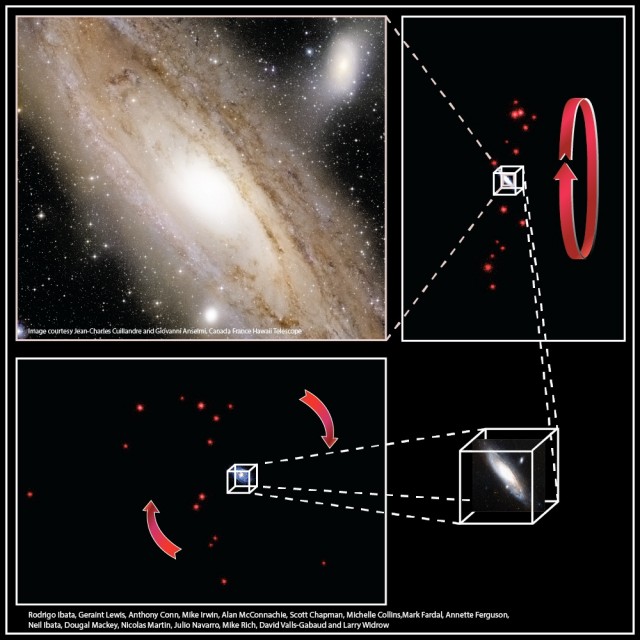
The Andromeda galaxy is practically a twin sister to our own Milky Way. Slightly larger than us but slightly less massive, Andromeda lies around 2.5 million light years away, and between them Andromeda and the Milky Way dominate the local group of galaxies. But Andromeda is not without fanciful tastes – it wears a skirt over a million light years in diameter, made up of dwarf galaxies.
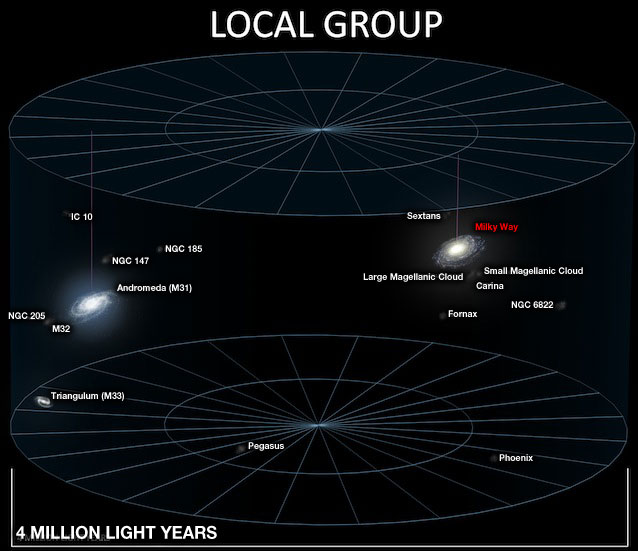
A recent study headed by Rodrigo Ibata at the Strasbourg Astronomical Observatory, France, and Geraint Lewis at the University of Sydney, Australia, found a host of new galaxies in the local group. The image below gives you an idea of the scale involved, but it doesn’t show the full story – There are actually over 54 galaxies in the Local Group. Andromeda is surrounded by a small swarm of 27 dwarf galaxies, and 13 of those dwarf galaxies orbit in the same plane, the same way the planets orbit the Sun. This means that Andromeda is surrounded by a disk-like shape, the largest cohesive structure in the local group. And it’s still very much a mystery as to why it exists.
Even here inside the largest galaxy for millions of light years, space is mostly empty, but the vast expanses of intergalactic space are so devoid of anything that it’s difficult to fully appreciate (to get even more perspective on this, click here and look at the full image!). But even in the face of this terrifying emptiness, galaxies live out their lives. They pull on each other and interract. They form and coalesce. Large galaxies devour smaller ones whole, and every so often, large galaxies smash together and tear each other apart. But none of the theories we have today quite explain Andromeda’s skirt.
Those 13 dwarfs orbit Andromeda once every 5.5 billion years or so, and Ibata, with his team of researchers, has suggested a couple of explanations for the disk. Firstly is that they formed in place as they are, and have been slowly twirling around Andromeda since before the Sun was born. They may have been created during a merger between two ancient galaxies, from a streamer of gas which was spun off. Or possibly, these galaxies are as old as Andromeda itself, forming at the same time amidst all of the dark matter attracted by Andromeda’s huge bulk. This would fit with the fact that those dwarf galaxies are made up of ancient stars, implying that this structure could be truly ancient.
Or perhaps it isn’t a disk at all. Perhaps we’re seeing a slew of galaxies recently pulled into Andromeda’s gravitational grip, and it’s purely by chance that they appear to be arranged into a disk shape. It’s entirely possible, and only further research will show if the disk structure is real or not. Combined with the recently discovered halo of gas surrounding the Milky Way, it seems there may be a lot lurking out there in intergalactic space that we don’t yet understand.
But either way, both of these hypotheses have problems with them. Neither is a perfect fit. In an interview, Nicolas Martin at the Strasbourg Astronomical Observatory explained that the fact that we don’t know why these galaxies are arranged the way they are is what makes this discovery so exciting;
“The presence of this thin, rotating disk of dwarf galaxies around Andromeda suggests a strong connection between the host galaxy Andromeda and its satellites. There is currently no satisfactory scenario that can explain all the properties of the satellites in the disk, but they all require a strong interplay between Andromeda and the satellites themselves.”
Image credits:
Top – Robert Gendler
Middle – Andrew Z. Colvin/Wikimedia Commons
Bottom – Rodrigo Ibata/PAndAS team
Massive objects moving at near light speeds do not occur naturally in the universe as we know it. If we detect such objects it is a reasonable to assume they are artificial artifacts from advanced intelligent life. This according to Garcia-Escartin and Chamorro-Posada, authors of a recent paper, is a low-cost, sure-fire way of searching for intelligent life outside earth.
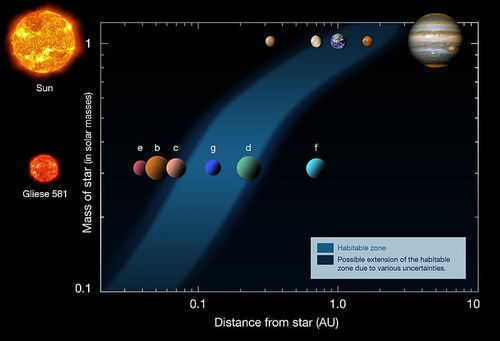
The habitable zone of Gliese 581 compared with our Solar System’s habitable zone. Image credit NASA.
Searching for life beyond earth is a grand and varied enterprise.
For a start we can look for exoplanets that fall inside the habitable zone of a star. A planet found in this zone may fulfill the requirements for life: liquid water, energy, elements and other nutrients, and appropriate physical conditions. Though we have located many exoplanets in recent times they are far from earth – many light years distant. For example one star system, Gliese 581, is 20.3 light years away (192,048,720,000,000 kilometres). With three planets in its habitable zone, we know nothing about conditions on them. The techniques used to find them can tell us nothing about their ecology – if any. Being in a habitable zone does not guarantee life. It is only in recent years that we have realised how inhospitable Venus and Mars are to life – despite being in our habitable zone.
By looking for alien signals or transmissions, as in the SETI programme, we extend our search from ‘possible life’ to intelligent life. For advanced civilisations we look for artificial illumination or interstellar probes.
Let’s face it though, to know we are not alone will require quite good proof for most of us (apart from the misguided minority of UFO believers), and especially for the skeptical scientists.
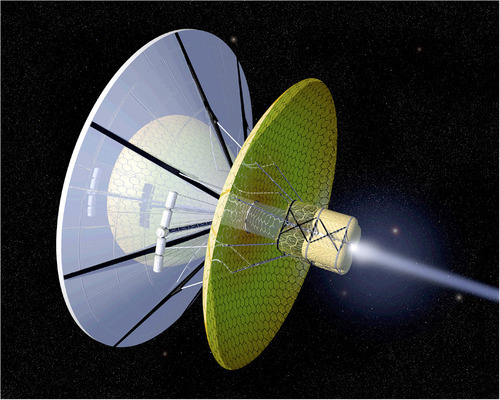
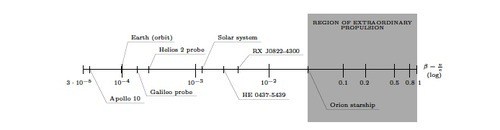
The intriguing proposition of Garcia-Escartin and Chamorro-Posada is based on three ideas. The first is that anything travelling faster than 3.3% of light speed (5,935,890 kilometres per hour) is artificial. All known natural objects travel slower than this speed, as do our current space probes. This speed was chosen as it is the estimated speed of the nuclear propulsion ship proposed by Freeman Dyson in the Orion project. Although the propulsion technology is feasible today the technological and economic hurdle of creating such a craft is way beyond our current means. Although it is certainly not inconceivable to achieve such interstellar travel in the next 100 years.
Scales of speed with respect to the speed of light in vacuum (logarithmic scale). The fastest man-made objects are in the range of velocities from 1/100,000 c to 1/1,000 c. Examples are the fastest manned ship, Apollo 10 on entry, the Galileo probe during its descent into Jupiter and the solar probe Helios 2. For comparison, we have included the average speed of Earth during its orbit around the Sun and the motion of the Solar System with respect to the cosmic microwave background frame. The fastest natural objects, like hypervelocity star HE 0437-5439 and neutron star RX J0822-4300, move in the scale of 1/1,000 c-1/100 c. We define a region of extraordinary propulsion (REP) for speeds which would point to an artificial object. The REP starts at the estimated speed for the nuclear propulsion Orion ship, which could be built with present human technology. Source original paper, Cornell University.
You are possibly thinking about now: “Doesn’t the mass of an object increases massively as its speed approaches light speed?” You would be correct, this consequence of Einstein’s theory of special relativity is demonstrated quite satisfactorily in particle accelerators around the world. To cover this the authors next identify a consequence of relativity theory: relativistic effects amplify the light reflected from a body travelling at near light speed – in some key situations. Allowing for the detection of ‘small’ objects.
This brings in the authors third criteria. Interstellar travel will be from one star system to another. The reflected-light magnifying effect would be greatest for the cases where earth is almost in line with the departure stellar system and the destination stellar system.
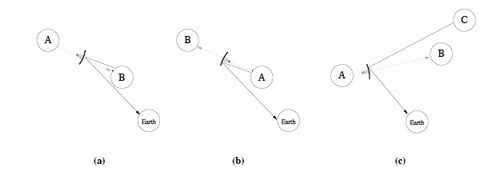
Earth’s position with respect to the ship’s trajectory. (a) Earth receives the light from the destination star reflected from an approaching ship. (b) Earth receives the light from the origin star reflected from an outbound ship. (c) Earth receives the light from a third star, which is reflected from the ship at an angle. Source original paper, Cornell University.
The authors propose to limit the first search to star systems that are reasonably close to each other (no further than 10 light years apart) to maximise the probability of stellar travel opportunities. Considering that Gliese 581, for example, is greater than 20 light years distance from us, I suggest that this criteria is too limiting.
The paper is an interesting, if not compelling, proposition. The authors do calculate what size an artifact would need to be, travelling at their minimum speed (3.3% light speed), to be detected at the distance of one of our closer stellar neighbours. Could such an artifact be detected by the Hubble or James Webb space telescopes, for example? What is the probability of success of such an experiment, compared to say the SETI experiments?
One idea I did find interesting is by focussing on detecting light reflected from ships, we do not need to assume any intention by the interstellar travellers to communicate with us. The ‘signal’ is independent of alien psychology. It is also independent of propulsion technology – we aren’t looking for any ‘signature’ of any particular technology, known or unknown.
It is an interesting paper. I’m not sure they have presented a compelling enough case to convince a funding body – yet.
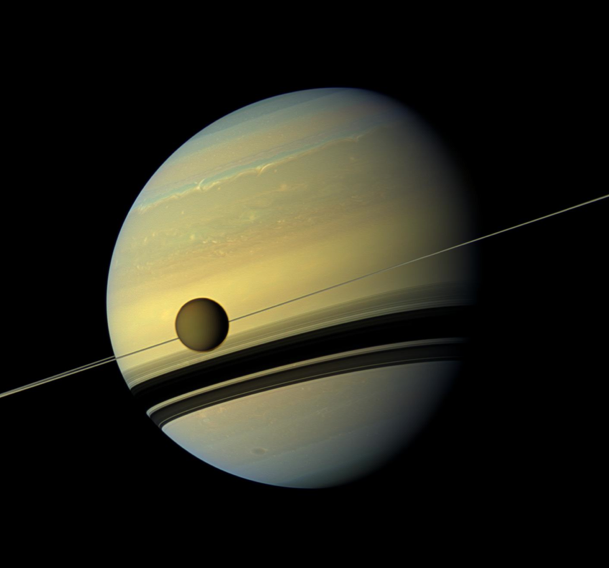
Discovered in 1655 by Dutch astronomer Christiaan Huygens, Titan is one of Saturn’s 62 moons, named for a race of giants in Greek myth who were Saturn’s brothers and sisters. Over 5000 km in diameter, it’s roughly twice the size of our own Moon and is one of the largest moons in our solar system, second only to Jupiter’s Ganymede. It’s even bigger than the planet Mercury, and is covered with an orange haze that shields the secrets of its surface. That alone makes it interesting, but a glimpse into the workings of the planet makes it more intriguing still—astronomers even believe Titan could harbour life.
In the 1980s, the Voyager 1 and 2 spacecraft flew past Titan; in the 2005 Huygens probe parachuted through its atmosphere and landed on the surface; and the Cassini spacecraft still studies Titan from its orbit around Saturn. Their images and measurements have revealed a vibrant alien world beneath the haze—complete with rivers, lakes, and ice volcanoes.
Credit: NASA
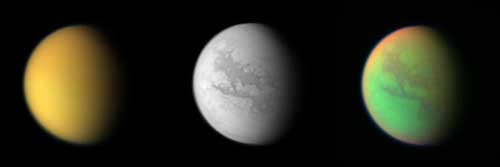
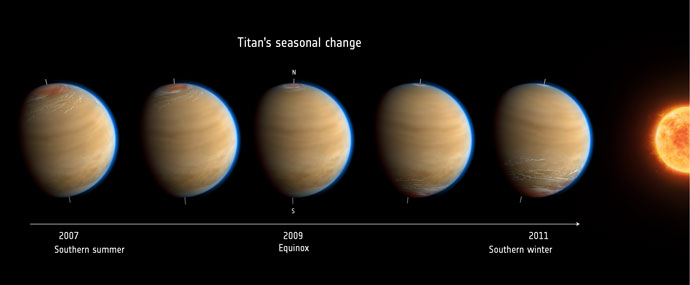
Titan is an incredibly frigid place, with an average temperature of -178 degrees Celsius (-289 Fahrenheit)—too brutally cold for life as we know it, but still of incredible interest to astrobiologists. It’s the only moon known to have an atmosphere—a thick and cloudy one, composed primarily of nitrogen—and it also exhibits weather and changing seasons. The orange haze that shrouds its surface is made up of trace gases such as benzene and hydrogen cyanide, and at the pole closest to the sun, sunlight heats the toxic orange haze and makes it circulate towards the other pole, so the gases concentrating there. Since a year on Titan lasts almost 30 Earth years, each season is 7 years long.
Titan’s seasonal changes. Credit: NASA
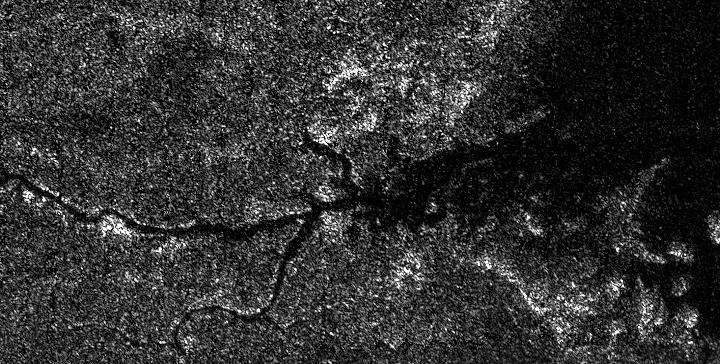
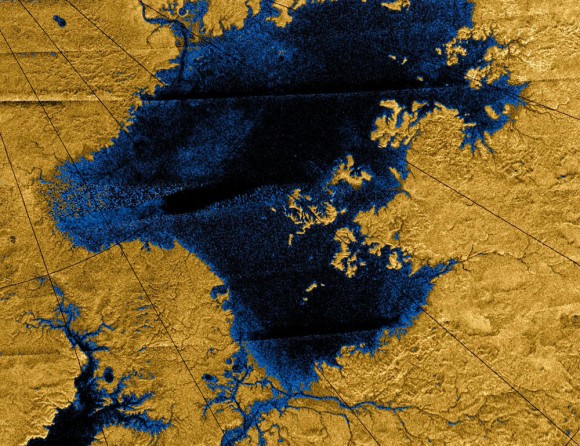
However, unlike Earth, its weather system is methane-based—and aside from Earth, Titan is the only object in the solar system to have permanent bodies of liquid on its surface, including an enormous river system that flows 400km across the moon’s surface to meet a large sea.
River network on Titan. Credit: Cassini
The darkness of the river in the image indicates a smooth surface, which in turn indicates that the river is not a dry bed, but filled with liquid—but this liquid is likely methane or ethane, which are more closely related to gasoline than water. Even though the mechanics seem to be similar, Titan’s weather would be alien to us because the skies fall with methane rain and lakes and oceans pool with liquid methane—but still, this presents possibilities of methane-based life.
Credit: Cassini.
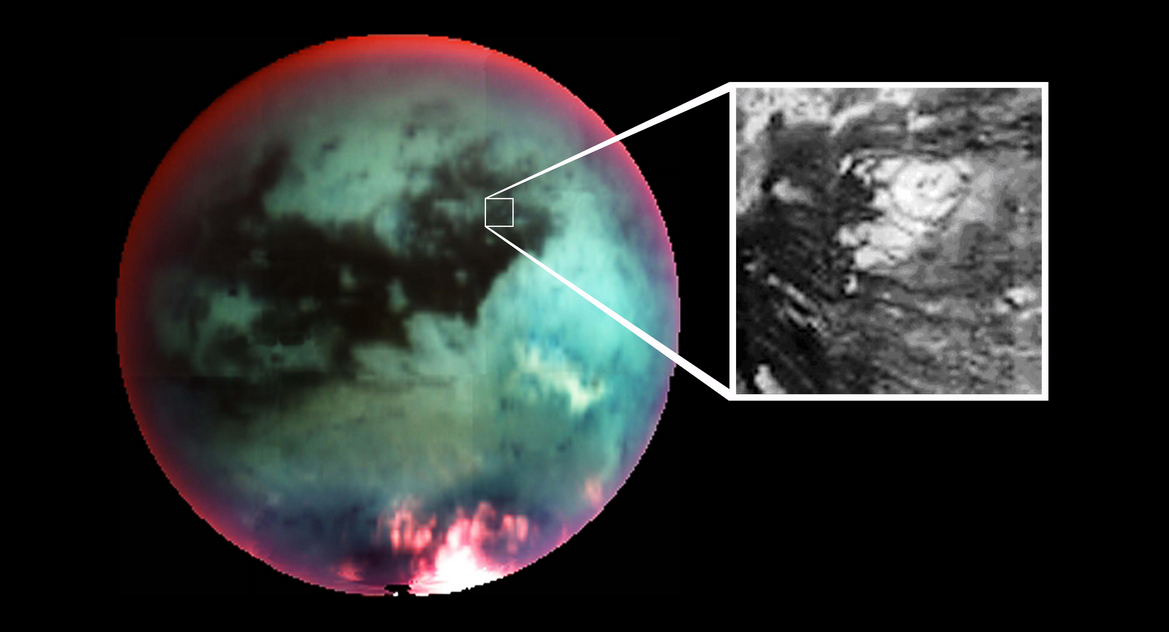
It is also suspected that Titan harbours cyrovolcanoes, which spew water ice and hydrocarbons into the atmosphere instead of lava. Speculations began after NASA’s Cassini spacecraft captured images of a landform on Titan’s surface called Sotra Facula. The images showed three conical features with material flowing from them, their peaks up to 1,500 metres tall, as well as several pits equally as deep. Researchers gravitated towards the idea that these landforms were cyrovolcanoes, as it would help explain a long-standing mystery of Titan’s thick, methane- and nitrogen-filled atmosphere. Calculations show sunlight would have broken the methane down long ago if something hadn’t been replenishing it, and a cyrovolcano is a good candidate—it could erupt methane, dragging it from the planet’s interior into the atmosphere.
Sotra Facula. Credit: APOD.
However, these intriguing surface features could have also been created by weather and meteorite strikes than by volcanic activity, and it is difficult to tell without further data. Researchers believe cyrovolcanoes might be fairly common on the frigid moons of the outer planets—one has been confirmed on another of Saturn’s moons, Enceladus—which is incredibly interesting, because volcanic activity would prove that Titan is an active world, and could increase the likelihood that this huge, distant moon may harbour life. While searing lava destroys life on Earth, ice volcanoes on Titan would provide a way to mix complex chemicals from the surface and the interior. It could bring life forms up to the surface so our instruments have a better chance of detecting them—because fascinatingly, Titan seems to have subsurface oceans.
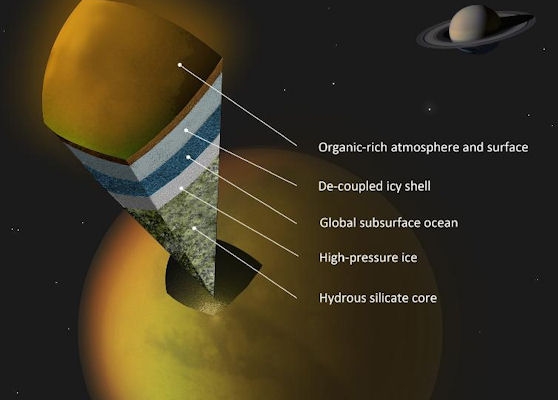
Further data from Cassini indicates that Titan has a layer of liquid water under its icy outer shell. The evidence is tidal—as Titan orbits Saturn, the planet’s powerful gravitational pull stretches and deforms the moon, like pulling and stretching an elastic band. If Titan were solely composed of rock, this stretching would only cause bulges (tides) of about 1 metre, but instead the moon experiences tides of about 10 metres—suggesting that its interior is not entirely solid. This ocean may not be enormous or deep; just a liquid layer between the solid mantle and the external icy shell would be enough to compress and bulge as Cassini has observed. Since Titan’s ice surface is composed mostly water ice, researchers believe its ocean could be liquid water.
However, just the presence of an ocean alone does not indicate life—researchers think that life is more likely to occur when the water comes into contact with rock, and we can’t currently tell if this exists beneath the surface.
Possible scenario for internal structure of Titan. Credit: NASA
Another intriguing phenomenon is the hydrogen gas flows through its atmosphere, and yet there is a lack of the chemical on the planet’s surface—so how did it disappear? One theory suggests that hydrogen-breathing, methane-based life forms consume the gas, similar to how we consume oxygen on Earth.
Liquid water, a possibly active interior, complex chemistry, a thick atmosphere, seasons, weather… All of these factors reflect the environment of life as we know it, so researchers have long thought that Titan is an excellent candidate to harbour life. None of these factors alone are solid evidence for life—they are just conditions necessary for it—but Titan is a fascinating place deserving of further study. Since its nitrogen-rich atmosphere is similar to Earth, just significantly colder, it also demonstrates how atmospheres of cold moons and planets behave, and thus allows us to speculate about how the atmospheres of exoplanets far from their stars might behave.
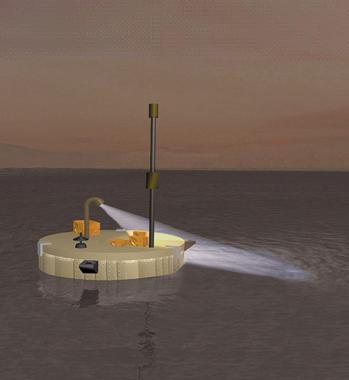
But our questions about Titan will remain unanswered until we obtain sufficient evidence to draw conclusions—but to do this, we need data. Two possible missions have recently been proposed. The first is the Titan Mare Explorer (TiME), which would have sent a floating buoy to land in Titan’s methane sea and measure the chemistry and organic composition, study the sea’s interaction with the atmosphere, and basically perform the first nautical exploration of this extraterrestrial ocean. It also would have observed Titan’s methane cycle to help us compare it to the water cycle on Earth. TiME was proposed to launch in 2016, but unfortunately it lost its funding to a Mars mission.
Artist’s concept for the TiME lander. Credit: NASA/ESA
Another possibility, however, is the Titan Saturn System Mission (TSSM), which is a proposed exploration of Saturn, Titan, and Enceladus—focusing on the complex phenomena the Cassini spacecraft has already noted. It is proposed to launch in 2020 and reach Titan by 2029, and during its 4-year-tenure, it would spend time circumnavigating Titan and studying its astrobiological potential. The mission consists of an orbiter and two Titan exploration probles—one that’s basically a hot air balloon, and another that land on the methane seas. One of the proposals for this second lander is the lake-lander of the discarded TiME mission, which will hopefully be included. TSSM, if it goes ahead, would be the first mission to extensively survey the organic chemistry and climate of the land, sea, and air of another world.
If life is detected on Titan, it would undoubtedly be moving and crucial to us as a species—not only because it’s the first extraterrestrial life we have detected, but also because it would behave differently to the water-based, oxygen-breathing life we’ve developed here. Even if life has not yet developed on Titan, the chemistry for life to form is present, so just give the moon four billion years…and who knows?