
Tag: ISOC

  • New Internet Exchange Point Launched 16 November in Kinshasa, Democratic Republic of the Congo

    New Internet Exchange Point Launched 16 November in Kinshasa, Democratic Republic of the Congo

    [Washington, D.C. and Geneva, Switzerland] — A new Internet Exchange Point (IXP) was launched on 16 November in Kinshasa, Democratic Republic of the Congo (DRC). The Kinshasa IXP (KINIX) was funded through the Internet Society’s Community Grants Programme and managed by the DRC ISP Association (ISPA-DRC), as part of its DRC-IX project, which aims to establish IXPs in Kinshasa, Lubumbashi, and Goma.

    KINIX will serve as a catalyst for innovation and development of Internet services and applications in the DRC, and will support Government efforts to implement E-government services and lower the cost of developing local hosting and application development.  The presence of KINIX will improve local Internet resilience by eliminating the dependence on international connectivity for local Internet services and Internet-based communications.

    DRC is largely dependent on satellite connectivity for its Internet access. As the DRC waits to get connected to the West Africa Cable System, the time to access locally hosted content will be reduced significantly from over 500ms to less than 50ms through KINIX.

    Initially, KINIX will connect six Internet Service Providers (ISPs): AfriNET, Cielux, Cybernet, Global Broadband Solutions, Microcom, and Vodacom.  Twenty-six (26) engineers from these ISPs, including the regulator (ARPTC); Central Bank of Congo; local universities; and the tax, customs and revenue authorities among others have received technical, hands-on training prior to the launch through the Internet Society Africa Interconnection and Traffic Exchange (ITE) programme. The training sponsored by the Internet Society, and in partnership with Netnod and Jaguar Network, will also enable the network providers in the DRC to prepare their networks for interconnection with the rest of the world once the submarine cable connection is activated.

    The Internet Society’s Africa Interconnection and Traffic Exchange programme has been actively supporting the development of IXPs and regional interconnection in the region. The programme aims to have 80% of Internet traffic exchanged in Africa by 2020, keeping local traffic local. This objective has been boosted by the appointment of the Internet Society to implement the African Union’s African Internet Exchange System (AXIS) programme, http://www.internetsociety.org/axis-announcement.
    Source

  • Analysys Mason Study Demonstrates How the Fundamental Sustainability of the Internet Extends to Developing Countries

    Analysys Mason Study Demonstrates How the Fundamental Sustainability of the Internet Extends to Developing Countries

    Analysys Mason’s new study published this week entitled ‘How the Internet continues to sustain growth  and innovation’ reveals how the market forces that have always ensured the sustainability of the Internet in developed countries also extend to developing countries.

    Analysys Mason (www.analysysmason.com) is a global specialist in telecoms, media and technology (TMT). The Internet Society (www.internetsociety.org) commissioned Analysys Mason to study the impact of increased demand for new Internet services and concerns about the sustainability of the ensuing growth.

    The new study shows how, in the past, Internet challenges have been continually met in developed countries, based on a combination of new technology and investment to increase capacity, and changing business models to distribute content. Further, the report shows how investment and innovation are already addressing new demands in developing countries today.

    “Challenges in the past followed the increase in demand from the first commercial web browsers, and the widespread take-up of Internet video. Today, concerns about the sustainability of the Internet in developed countries have arisen from the increased availability of mobile broadband services,

  • Reducing the Digital Divide: Internet Society Supports Establishment of Internet Exchange Points across Africa

    Reducing the Digital Divide: Internet Society Supports Establishment of Internet Exchange Points across Africa

    [Johannesburg, South Africa –23 August 2012] – The Internet Society  announced that it has been selected by the African Union (AU) to conduct community mobilization and technical aspects workshops to support the establishment of Internet Exchange Points (IXPs) in AU Member States as part of the African Internet Exchange System (AXIS) project.  The AXIS project aims at keeping Africa’s Internet traffic local to the continent by providing capacity building and technical assistance to facilitate the establishment of National Internet Exchange Points and Regional Internet Exchange Points in Africa. The project is funded by the Euro-Africa Infrastructure Fund and the Government of Luxembourg.

    The Internet Society is committed to organizing 60 community mobilization and technical aspects workshops in 30 African countries.  To this effect, the Internet Society will also contribute its own resources for the implementation of this component of the AXIS project.
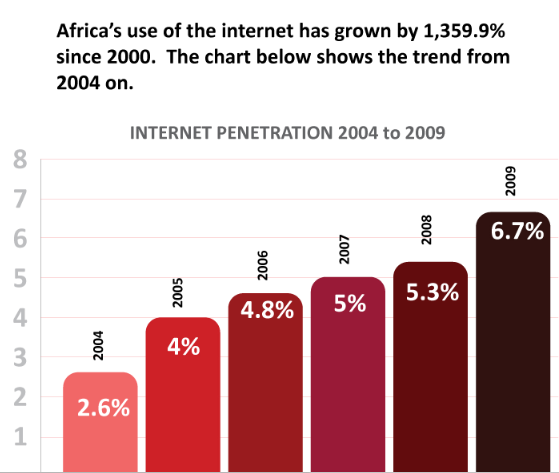
    Africa's use of the internet by Jon Gosier (Flickr)
    Currently, much of Africa’s Internet traffic is routed through Internet exchange points external to the African continent.  As countries establish their own IXPs, Internet traffic will be routed locally, creating a downward pressure on costs and stimulating growth in and distribution of local Internet content.  Through the AXIS project, the interests of the AU and the Internet  Society, working with other African Internet organizations such as AfriNIC, AfNOG and AftLD, will be realized in this collaborative effort to assist in the development of a more locally operated and, hence, more robust and economically accessible pan-African Internet.
    Moctar Yedaly, Head of Information Society Division, African Union Commission, commented, “Africa is paying overseas carriers to exchange ‘local’ (continental) traffic. This is both a costly as well as an inefficient way of handling inter-country exchange of Internet traffic. Independent analysis has shown that Africa pays over US$600 Million to developed countries every year for inter-African traffic exchange that is carried outside the continent. We are therefore pleased that the African Internet Exchange System project will address this challenge by facilitating optimization of Internet traffic to support intra-continental traffic flows in Africa.

  • Internet Society’s African Peering and Interconnection Forum Provides Opportunities for Regional Internet Growth

    Internet Society’s African Peering and Interconnection Forum Provides Opportunities for Regional Internet Growth

    AfPIF-3 Highlights Regional Interconnection – Addressing Africa’s Internet Transit Deficit

    © Internet Society/Shoot the Earth/ Nyani Quarmyne

    [Washington, D.C. and Geneva, Switzerland –13 August 2012] – The third African
    Peering and Interconnection Forum (AfPIF-3), organized by the Internet Society, will
    be held 22-24 August 2012 in Johannesburg, South Africa. A multistakeholder forum,
    AfPIF aims to foster national and cross-border interconnection opportunities where
    key stakeholders, including infrastructure and service providers, Internet Exchange
    Points (IXPs), regulators, and policy makers can share experiences, hear from
    experts, and advance peering and interconnection arrangements.

    According to recent research, nearly all peering and interconnection agreements are
    forged at regional and global peering forums around the world. A unique regional
    forum, AfPIF facilitates discussions on infrastructure challenges, including
    terrestrial capacity issues, national and regional IXP development, local content
    development, and international peering. AfPIF provides a venue for productive
    technical discussions and business relationships that can be forged to augment
    Internet infrastructure and services in Africa.

    Keynotes and panel sessions will cover topics that address Africa’s Internet transit
    deficit, including Peering Negotiations and Strategies for Operators, Peering and
    Transit Economics, Landlocked Countries and Cross-border Regulatory Reality,
    Exploring the Content Business in Africa, and Attracting Global Content via Regional
    IXPs.

    “AfPIF has established itself as a strategic event for conducting business in
    Africa,