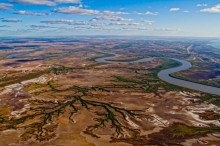
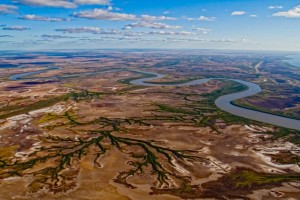
Gulf of Carpentaria showing Flinders River in north Queensland. Department of Natural Resources via www.abc.net.au
We often don’t plan for water in the broader sense when we think of developing communities and towns. The water pipes are underground, sure, and they flow to the water and sewer treatment plant, and we have water whenever we command the faucet to release it. But when you think about it, the water cycle is lost on the ground. The holistic concept of it being a cycle is washed away. Water is seen more as a nuisance, a problem, something to be taken care of rather than a resource. This is the real problem. While water is a need, and a serious one globally for clean water, water is treated more as an expectation, a guarantee of service.
In order to create more sustainable and resilient developments, we need better management and regulation of water resources. Better governance. Water efficiency, water quality, conservation, drought prevention, supply and demand issues, these are topics that local, state and national governments must tackle, and soon. Water is critical to economic development in terms of manufacturing and technology.
Population distribution is skewed as cities and towns dot the coastlines. Over half of the world’s population lives within 200 kilometres (120 miles) of the coast. As we’ve seen increasingly over the past few years, extreme weather events such as cyclones, hurricanes and the resulting floods can cause great devastation to civilisation.
There are design elements that can enhance a community’s relationship with water. Creating driveways and sidewalks out of permeable surfaces rather than bitumen; installing green roofs; rain barrels and gardens to collect water are just a few solutions. Harvesting runoff from buildings (rain barrels) can be used to flush toilets or recycled water for watering lawns and washing. Integrating water into town planning can minimize damage to infrastructure during extreme weather events.
Better water management, which means integrating the water cycle with the urban environment, will produce more sustainable communities in the future. Can you imagine the alternative if we didn’t? A world without water would not last long. The human body can last about 3 days without water. Water and sanitation is a human right, with 3.4 million fighting for their survival each year for clean water. With the global economy’s current fixation on innovation, if we don’t recognize the basic resources needed to allow creativity to flourish, it will all be for nought.
Please check your local conservation office for water resources and other conservation practices you can adopt. These websites will also give you more information and ways to make a difference.
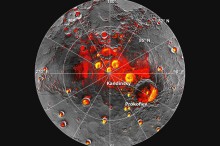
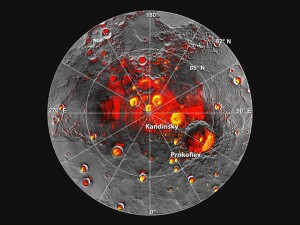
MESSENGER detected the presence of polar ice on Mercury. The spots shown in yellow are craters containing ice. Source: Image Credit: NASA/Johns Hopkins University Applied Physics Laboratory/Carnegie Institution of Washington/National Astronomy and Ionosphere Center, Arecibo Observatory
Water – the source of all life. It’s been found on what we have believed for many moons to be that little hot-tempered planet named Mercury. It seems the celestial body has a shady side, a split personality perhaps; one side ferociously hot, while its polar opposite features some craters of ice. NASA scientists have unequivocally confirmed the presence of water on the planet. Ready for a swim? Ice-skating may be more appropriate.
The Finding
Rarely does consensus on discoveries such as this occur. Three methods, neutron spectrometry, near-infrared reflectance and thermal models from MESSENGER, were used to conclude and confirm the presence of water and organic material on Mercury.
The duality of Mercury is somewhat perplexing; can you imagine living on a planet with a temperature range between -223C and 427C? It is in these shaded, cold regions, those that never see the sun, where the ice lies bare and exposed. However, data from MESSENGER also show that frozen water is found in slightly warmer areas. It lies buried beneath a dark material, an insulator of some sort covering it, and there’s a lot of it. Estimates put the amount of water ice on Mercury between 100 billion and 1 trillion metric tons. That’s enough water to cover an area the size of Washington, D.C., 3.2 kilometers deep.
Where Did the Water Come From?
Much the way Earth came to have water and organic material, it is thought that comet impacts and asteroid strikes created the same organic building blocks of life on Mercury. At last Thursday’s news conference, researchers were bouncing around all sorts of hypotheses on what this discovery could mean for life in other parts of our solar system. Messenger principal investigator Sean Solomon, of Columbia University’s Lamont-Doherty Earth Observatory said “there’s a lot of water out there, as there is a lot of water around other stars, but at substantial distance. “The solar system is “a soggy place ” according to Jim Green, director of NASA’s Planetary Science Division. Green went on to explain his enthusiasm with that statement, indicating “it really bodes well for us to continue on the exploration, following the water and its signs throughout the solar system.” How water was brought to Earth and Mercury, were probably brought to other planets.
With any good find, come more questions…
These observations, while extraordinary, can only heighten our curiosity about Mercury and the rest of the galaxy. Is the dark material in the polar craters on Mercury mainly organic compounds? If so, what sorts of chemical reactions has that organic material undergone? Is this the same material that gave rise to life on our planet? Are there regions on Mercury that have both liquid water and organic compounds? Only by continued exploration of space can we hope to find answers to these questions.
Life as we know it, will probably not be found on Mercury given its ultra-thin atmosphere and proximity to the sun. The discovery of water ice and dark organic material can still inform the hunt for organisms beyond Earth and help scientists piece together the puzzle of how life began on our planet. We still do not fully understand the beginnings of life and the chemical reactions associated with those beginnings on our own planet.
Last week’s discovery of water and organic material on Mercury will indicate we have a lot to learn. Hopefully, it opens up vast areas of research that radiate outward, showing the connections of our segmented universe. How we see view and study other planets has great value for how we analyze and safeguard ours. For instance, what are the implications for planetary warming (climate change)? What can the ice trapped beneath the organic carbon material tell us? The thermostat of astrobiology has just been ratcheted up a notch.
The ADWICE Stakeholder Conference will take place on 2 October 2012 in Brussels, Belgium. The event will offer a platform for dialogue for understanding the vulnerability of drinking water resources, water quality and water abstraction infrastructures to local, national and European decision makers, experts and researchers, water supplier and river basin authorities.
The one-day conference represents a valuable opportunity to share knowledge and experiences and to reflect on what kind of measures may be taken to mitigate or to adapt to it.
The one-day conference will present and discuss the draft results of the literature study conducted by a team led by BIO Intelligent Service, in collaboration with Cranfield University, Water Research Institute (IRSA), National Institute of Hydrology and Water Management (NIHWM) and ICLEI- Europe, for the European Commission (DG ENV). The event will offer a platform to share knowledge and experiences among scientific researchers, local government leaders, national policy-makers and representatives of European institutions and to receive feedback from stakeholder while gathering illustrations and best practices.
The morning session will provide inputs for further work while discussing the existing knowledge. The afternoon will be dedicated to highly interactive specific discussions with invited stakeholders and experts to explore different facets of this important topic in detail.
The conference is free of charge, though early registration is recommended to secure a place.
At just over two tonnes, the second stage of an Atlas V rocket, makes for an unusual ‘kinetic probe’. Nonetheless on October 9, 2009 NASA deliberately impacted a spent Centaur rocket into the lunar south polar crater Cabeus. The target area was a permanently shadowed region within this crater. The impact, not surprisingly, ejected a spectacular plume of debris, dust and vapour.
Science experiment, observe the system, perturb it, and measure what happens
The US scientists had thrown a heavy object at the Moon. They then threw all the instruments possible to monitor the impact. The prize was a decades-long search to directly find water on the Moon.
The impact would have been majestic to watch. Picture those slow motion images of Apollo astronauts on the Moon. Hold that thought and then imagine the impact. An observer could marvel at the slow motion, low gravity, return of the dust and debris cloud to the Moon’s surface. If you could see in the infra-red, the impact flash lasts for 10 seconds. There is a cloud of debris, dust, and vapour rising. At eight seconds the the ejecta cloud is 4.5km in diameter, in the ultra-violet spectrum, the plume is 10km in diameter. At 20 seconds after impact the ejecta cloud was is at its maximum diameter of 8.5km and the plume has reduced to little less than 10km.
The observer would be watching a science experiment on a grand scale.
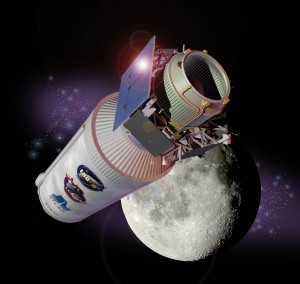
The observer in this experiment was neither you nor I, it was a trailing “shepherding spacecraft”. The Centaur had propelled NASA’s Lunar Reconnaissance Orbiter and Lunar Crater Observation and Sensing Satellite to the Moon. Shortly after launch the Lunar Reconnaissance Orbiter had separated to go on its own mission. Once in lunar orbit the Centaur had vented its remaining fuel. Control was then assumed, for the next four months, by the Lunar Crater Observation and Sensing Satellite as the shepherding satellite. During this next period the shepherding satellite maneuvered the Centaur to allow the Sun to bake-out residual water and volatiles. This was to ensure that no contaminant chemicals were passengers to the lunar impact site. The Centaur’s fuel was a volatile combination of liquid hydrogen and liquid oxygen, both chemicals that were to be scanned for in the impact cloud. The Lunar Crater Observation and Sensing Satellite also calibrated its instruments, then targeted the Centaur to impact with the Moon. Four months of meticulous preparation.
LCROSS spacecraft with Centaur stage, image credit NASA
The Lunar Crater Observation and Sensing Satellite carried nine instruments, including cameras, spectrometers and a radiometer. The spectrometers measured the reflected light at different wavelengths. These enabled the identification of the chemicals present in the ejected cloud.
Near-infrared absorbance attributeble to water vapour and ice, and ultraviolet emissions attributable to hydroxyl radicals (OH-) support the presence of water in the debris. The researchers determined from these observations that there was over 5%, by mass, of water ice in the lunar regolith of the impact site. Certainly this is small by terrestrial soil standards, but more substantial than most earlier estimates.
Over a year after the impact, in the October 22, 2010 issue of the journal Science, the results of this experiment were delivered to the world’s attention. This certainly marked a defining moment for lunar scientists, directly confirming the availability of water on the moon. It was however neither the first nor last word on this.
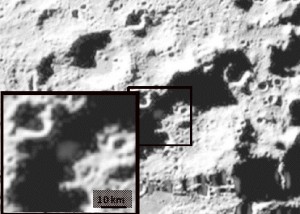
Cabeus crater LCROSS impact site, photo credit NASA
Early attempts
Since the first lunar sample were carried back to earth by Apollo astronauts in the late 1960s, scientists have operated under the presumption that the moon was entirely dry. In total 382kg of lunar material was bought to Earth by the Apollo missions astronauts and a further 0.32kg by the unmanned USSR Lunar missions. New analyses of these rocks with improved analytical techniques have made it possible to perform highly sensitive isotopic measurements on very small lunar grains. These analyses are revealing water in Apollo samples that were once thought to be dry.
Well before these new studies, scientists had been puzzling about why more water was not seen on the moon. It was thought that volatile materials, such as water, could be accumulating at the moon’s permanently shaded polar regions. Here they could be trapped for geological periods of time without significant loss. The in 1998, the orbiting Lunar Prospector spacecraft measured the the abundance of elements on the moon’s surface using neutron spectroscopy. This provided compelling evidence for enhanced hydrogen concentrations, and by inference water, at both of the lunar poles.
In 1999 the Cassini spacecraft flew by the moon on its way to Saturn. It turned its Visual and Infrared Mapping Spectrometer to the moon. By measuring the surface reflectance of light from the moon scientists found absorption attributed to hydroxyl and water on the sunlit surface of the moon. These results were not published until 10 years later, in October 2009. The reason was renewed interest in water on the moon.
On October 22, 2008 Chandrayaan-1 was launched on a lunar mission by the Indian Space Research Organisation. One of its major scientific missions was to look for water on the moon. It had three different instruments ready to make 2008-10 an interesting period for lunar water exploration.
Chandrayaan-1, India’s lunar water finder
The Chandrayaan-1 story is told in detail elsewhere. Here I intend to showcase the marvelous outcome of Chandrayaan-1’s water finding experiments. Perhaps the most exciting of all these was one of the simplest. This was the CHandra’s Altitudinal Composition Explorer (CHACE) on board the Moon Impact Probe.
On November 14 2008 (the birthday of the late Pandit Jawaharlal Nehru, India’s 1st Prime Minister) the Moon Impact Probe became the first Indian built object to reach the surface of the Moon. The probe was a 34kg box-shaped object containing a video image system, radar altimeter, and The CHACE mass spectrometer.
Symbolically the Indian tricolour was painted on three sides of the Moon Impact Probe. This enables India to also lay claim to having the “Indian tricolour placed on the Moon”. Needless to say that “placing” in this case was a hard landing in the Moon’s south polar region near the Shackleton crater, flying over the Malapert mountain en route.
The CHACE mass spectrometer took 650 spectra of the tenuous lunar atmosphere during its 1487 second, 98km, plunge to the lunar surface. Tenuous is right the atmosphere even on the sunlit side is only 7/10,000,000,000th of the Earth’s atmosphere.
The mass spectrometer was tuned to look find water and direct evidence of water it did find. The team leader of the experiment, Dr S M Ahmed, remembers, “We all were jumping when we saw water was literally pouring out of our instrument