Here are some of the top science stories that caught my eye this past week. A smorgasbord of science stories, if you will. Topics include farming in the African desert, the publish or perish dilemma of academia, the wiring patterns of the male and female brains and skilled builder bees. Hope you enjoy.
Peter Higgs, the British physicist who gave his name to the Higgs boson, believes no university would employ him in today’s academic system because he would not be considered “productive” enough.
The research, which involved imaging the brains of nearly 1,000 adolescents, found that male brains had more connections within hemispheres, whereas female brains were more connected between hemispheres. The results, which apply to the population as a whole and not individuals, suggest that male brains may be optimized for motor skills, and female brains may be optimized for combining analytical and intuitive thinking.
For an ongoing collaborative project, New York-based architect John Becker and I have been looking at the possibility of using bees that have been genetically modified to print concrete as architectural printheads.
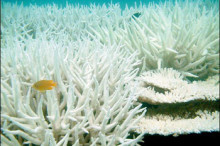
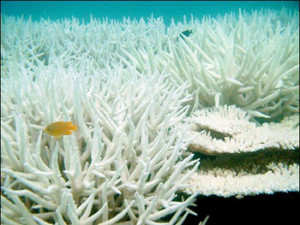
Ocean acidification is a decrease in the pH of the oceans, caused by the uptake of CO2 from the atmosphere. It’s a problem; a real problem. One that marine ecologist Jane Lubchenco, head of the National Oceanic and Atmospheric Administration called global warming’s “equally evil twin.
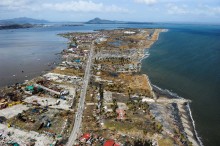
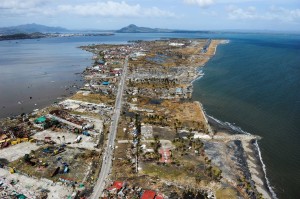
Destruction in the Philippines. Photograph by Bullit Marquez, AP, via National Geographic
Good morning. Or good afternoon, or evening, depending on your time zone. But it’s time for Weekly Science Picks, so let’s take a look at some of the stories making headlines in the world of science this week.
Dr Steve Rintoul, research team leader at Australia’s CSIRO Marine and Atmospheric Research division, said: “A more significant point is that global-average temperature in each of the last three decades has been warmer than any prior decade dating back to 1850, as reported in the recently released IPCC report. It provides compelling evidence that human activities are primarily responsible for the warming over the last 50 years.”
In the light of climate, why the need for action is so dire.
From earthquakes to volcanic eruptions to previous super typhoons, death tolls following cataclysmic events in the Philippines tend to be high. Here are 5 reasons why:
I recall the movie “A Beautiful Mind” when the term schizophrenia comes up. It’s a beautiful movie about the life of John Nash,a mathematician working in differential geometry, game theory and partial differential equations. It depicts the highs and lows of a mental rollercoaster. This next article sheds light on new research, theories, and a little bit of controversy.
We tested the level of paranoia among the general public by asking volunteers to take a virtual reality tube train ride, during which they shared a carriage with a number of computer-generated “avatars”. These avatars were programmed to behave in a strictly neutral fashion, yet over 40% of participants reported that the avatars showed hostility towards them.
Here’s the perfect story to read over breakfast! Pancakes and Maths anyone?
We live in the age of the twisty, twirly, spun-up skyscraper. From the pages of conceptual architectural journals, to the streets of many cities, these eye-boggling wonders look like some of the most futuristic buildings in the world.
Hope you enjoyed this week’s edition. Have a great weekend. And stay thirsty for knowledge.
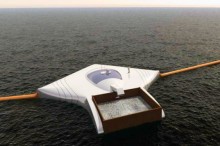
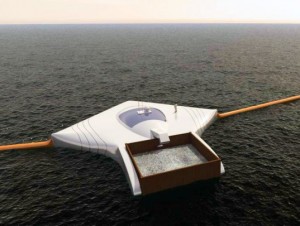
Ocean Cleanup Array by Boyan Slat via inhabitat.com
Plastic. Seems it has extended its reach into the farthest corners of the universe. An earliest post described how plastic has changed our lives, for better…and for worse. ADD link to earlier post. That post largely reflected on the growing problem of plastic in the oceans and the effect on plant and animal life. Now, it seems that plastic threatens our freshwater lakes now too. LINK here.
But wait. It doesn’t stop there. Plastic particles have been found on Saturn’s moon, Titan. The Cassini Probe has detected propene, or propylene on Titan.
It is the first definitive detection of the plastic ingredient on any moon or planet, other than our home world, says the US space agency (Nasa).
What does this mean for the oceans, lakes and rivers? What does it mean for outer space?
With the vast engineering knowledge present around the globe, you’d think we could solve this problem. And we can. We have ambitious engineers. It will take some financing from some courageous and gusty entrepreneurial types. Those aren’t hard to find. It will take people who have an undying passion for the environment and the drive to protect it. We have those. So why can’t we get started on this problem? Any company wanting good PR, this would be an easy ticket to kudos and celebratory high fives.
So realistically, what can be done?
Here’s something that could be a real contender, a real solution to the problem.
Check out Boyan Slat’s idea on this TEDxDelft video. He was just 18 years old at the time. He’s since gone on to found his own non-profit organization, The Ocean Cleanup Foundation. His idea is an ocean cleanup array that could remove 7,250,000 tons of plastic from the world’s oceans.
Sounds easy, right? Not only that, it also sounds possible.
Plastic in the oceans, lakes and rivers on this planet is a problem that must be solved. It must be solved now. And then the problem of plastic from satellites or space junk will then need to solved. Of course, managing plastic, and preventing plastic from escaping into natural environments, is the first step.
There’s always work to do. Ending plastic’s reach could very well be within reach.
Close-up view Giant ants (Paraponera Clavata), appearing at the exhibition “Mille milliards de fourmis” at the Palais de la Decouverte in Paris. (Copyright: Getty Images)
Welcome to this edition of Weekly Science Picks!
Here’s a great little story to get us started about how one scientist found out about his Nobel Prize win this past week. He doesn’t carry a mobile.
Nobel Prize-winning scientist Prof Peter Higgs has revealed he did not know he had won the award until a woman congratulated him in the street.
It’s now the 11th day of the US Government Shutdown. This past week I attempted to go to the Census Bureau website for research on population demographics near a development project I’m working on. No dice. This next story shows the impact that government funding has on science. The implications could be huge.
Imran Khan, chief executive of the British Science Association, said: “The biggest lesson we should take from this week’s Nobel Prizes is that science doesn’t belong to one nation; it’s an international and collaborative human enterprise.
One could spend hours, even days pondering the origins of our solar system. Some devote their life’s work to it. Check out this story about comets and presolar grains.
“Because there is no sign of an impact crater, it has been a mystery as to what kind of celestial event actually could have caused this debris field, but a small, black stone found lying in the middle of the glass area caught our attention,” said study co-author David Block, an astronomer at Wits University in Johannesburg, South Africa.
Balancing the needs of economic development with conservation principles is not easy. Governments do have hard choices to make. Sustainable management of resources, both natural and economic, is not a choice; it should be a top policy priority.
Now conservationists say the rapid clearing of virgin forest is paving the way for environmental catastrophe, turning critically endangered orangutans, tigers and elephants into refugees, and triggering landslides and flash floods.
These next two links speak for themselves. You know that line, “a picture is worth a thousand words”. The power of communication, through both photos and words, assists scientists in developing and proving theories and solving problems of the modern world. Enjoy your weekend. Maybe grab a camera, or your smartphone, and capture some scientific snapshots of your own.
I grew up in a time where the word data seemed to be only used in science classrooms. Now, it’s data this, data that, data here, data there. Consumer technology and social media have shot data out of a cannon. We want to pinpoint the minutiae of every day life down to the smallest factoid so that a story can be told from it. And this is not such a bad thing, but it does make me wonder what the next 50 years will bring. How much more can we manipulate and manufacture data into other ‘life’ forms?
It seems as though modern times are placing a huge expectation upon big data; mainly, that it will solve all of our problems. And while there is this potential to help us make informed decisions, we cannot expect data to tell us what the decisions are that need to be made. Creativity is the first ingredient in the blender.
This creativity emerges again in the processing of the data and figuring out the best means to present the data in a way that paints a story that is easily understandable. Many are not literate in data and this divide is very clear in different populations of students and communities. How we teach data literacy in schools is and will be increasingly important. How kids learn the very act of searching the Internet will be crucial in helping them understand data and how to present that data.
A good example of teaching data literacy comes from within my own family. A 70-year old man wanted to learn how to use the Internet. His sons tried, became frustrated at the process. The sons passed him onto the grandsons, who became frustrated as granddad paused to write down every step so he could get online by himself. One of the sons, a principal at a primary school tried something different. He brought his dad to school and set him down in the computer class with the 8-year-olds. There he learned everything he needed to know – how to get online, how to search. Now he’s planning trips to the Italian Alps, keeping up on the golf scores, staying in touch with his children over email, reading history books online.
The Internet of Everything is expanding. Machines are connected globally. Data has gotten big, really big. Data illiteracy and a lack of computer basics will continue to divide populations. However, with the right instruction, generational gaps can be bridged. Fundamentally how we learn is the same; it’s just the tools that are changing. Big data is changing the world.
Flying virus carrier. Photo credit: Jonathan H. Epstein/ EcoHealth Alliance
Well, it’s a new day in Australia with the election of Tony Abbott. It will be interesting to see what changes may be ahead for environmental laws and science.
But this is Weekly Science Picks and not a political roundup at the moment, so let’s get started on some of the fascinating stories in the world of science this week.
With H.I.V., SARS, and now MERS, a virus catalog seems like a good resource to have for future and potentially deadly epidemics.
In a new study published in the journal mBio, Dr. Anthony and his colleagues have taken an initial step toward such a catalog by exhaustively searching for all the viruses that infect a single species of mammal — a bat known as the Indian Flying Fox. They found 55 viruses, 50 of which are new to science.
If you had hopes of escaping planet Earth and heading to your lunar estate for some peace and quiet…well, you might need to think again.
A new paper in the journal Geophysical Research Letters drives another nail into the coffin of lunar living. It suggests that what was at first taken to be bright, reflective ice in the Shackleton crater is in fact more likely to be white rock.
An intriguing story about land, mining and the afterlife.
To your rear will be 40 graves—old men and women, small children, veterans of conflicts from the Civil War to World War II—surrounded by a white, split-rail fence and a thin ring of trees. Underfoot: approximately four billion dollars’ worth of coal.
To cap off this week’s edition, a story by Australian Science’s own, Danielle Spencer. What an incredible job to engage children in science and guide them on their journeys of exploration and discovery of the world around them! Take a look at Danielle’s latest post about teaching a unit on space to her students.
Now other than being highly entertaining to read, identifying children’s misconceptions is an important part of science teaching. Whilst admittedly some of the above responses may have been guesses, the children were asked to provide their best reason. The responses included here are a sample of the wide variety provided by the children.
As many of you may have heard, Elon Musk – founder of Tesla Motors, PayPal and SpaceX – released his plans for an extraordinary new mode of transportation, the Hyperloop.
Whether they are ‘his’ plans, and if it is a ‘new’ idea, is up for debate. But we’ll leave it there and focus on the idea itself.
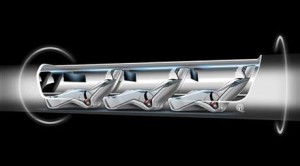
So what is the Hyerloop? Remember those pneumatic tubes that transport capsules stuffed with paperwork in older buildings or drive-thru banks? That’s essentially what it is, a capsule moving through a tube. You would enter this capsule (the claustrophobic might want to find an alternative means of commuting), settle in, and then a force of acceleration would blast you through the tube. The capsules would be pulled down the line by magnetic attraction. Each capsule floats on a cushion of air, like a puck on an air hockey table. To reduce friction, a fan located at the front of the capsule would suck air to the rear in the already nearly air-free tube, creating a turbulence free ride to your destination. The system brings to mind that of Walt Disney’s Tomorrowland.
And will it work? Is it feasible?
Marc Thompson, a professor of electrical engineering at Worcester Polytechnic Institute in Massachusetts told ABC News that the core principles behind the Musk design should work, but travelling in pressurized tubes while encased in a pod went beyond core principles.
Ernst Frankel, an emeritus mechanical engineering professor at MIT (who also designed a tube-based high-speed public transit system in the mid ‘90s linking Boston to New York, and some might say where Elon Musk took inspiration for his idea) said the over 700 MPH speed Musk proposes runs risks. While trains have broken the sound barrier, we still don’t run passenger trains above that speed.
But can it actually be built?
Sure, it could be built, but I’m not sure if any of the barriers or obstacles Musk’s system might encounter were considered in this pie-in-the-sky presentation. First, there are the mountains in the Central Valley of California to get over, or under. Second, there are the land use and zoning laws and property rights to consider when building an elaborate system stretching approximately 381 miles from San Francisco to Los Angeles. Where’s it going to go? Third, Musk mentioned that his Hyperloop system would never crash and would be immune to weather. Never say never. Where a system is operated by humans, there will be likely be human error. And the weather? Perhaps not so much a concern, but what about the seismic activity prevalent in the San Andreas Fault? Furthermore, if the system is underground, how exactly will it be solar-powered? Fourth is the cost. The price tag for the system is between $6 and $10 billion. Unrealistic.
Many big cities and suburbs are facing a transportation breakdown. We eventually get to where we need to go, but often not without congestion, increasing pollution and oftentimes a headache. It’s no wonder engineers, scientists and tinkerers are looking for the next big thing in transportation.
Hopefully, some feasible solutions are just around the corner.
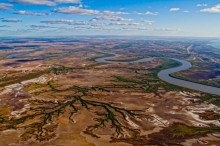
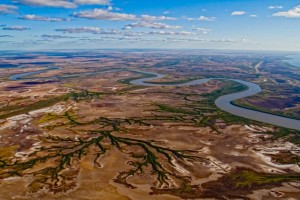
Gulf of Carpentaria showing Flinders River in north Queensland. Department of Natural Resources via www.abc.net.au
We often don’t plan for water in the broader sense when we think of developing communities and towns. The water pipes are underground, sure, and they flow to the water and sewer treatment plant, and we have water whenever we command the faucet to release it. But when you think about it, the water cycle is lost on the ground. The holistic concept of it being a cycle is washed away. Water is seen more as a nuisance, a problem, something to be taken care of rather than a resource. This is the real problem. While water is a need, and a serious one globally for clean water, water is treated more as an expectation, a guarantee of service.
In order to create more sustainable and resilient developments, we need better management and regulation of water resources. Better governance. Water efficiency, water quality, conservation, drought prevention, supply and demand issues, these are topics that local, state and national governments must tackle, and soon. Water is critical to economic development in terms of manufacturing and technology.
Population distribution is skewed as cities and towns dot the coastlines. Over half of the world’s population lives within 200 kilometres (120 miles) of the coast. As we’ve seen increasingly over the past few years, extreme weather events such as cyclones, hurricanes and the resulting floods can cause great devastation to civilisation.
There are design elements that can enhance a community’s relationship with water. Creating driveways and sidewalks out of permeable surfaces rather than bitumen; installing green roofs; rain barrels and gardens to collect water are just a few solutions. Harvesting runoff from buildings (rain barrels) can be used to flush toilets or recycled water for watering lawns and washing. Integrating water into town planning can minimize damage to infrastructure during extreme weather events.
Better water management, which means integrating the water cycle with the urban environment, will produce more sustainable communities in the future. Can you imagine the alternative if we didn’t? A world without water would not last long. The human body can last about 3 days without water. Water and sanitation is a human right, with 3.4 million fighting for their survival each year for clean water. With the global economy’s current fixation on innovation, if we don’t recognize the basic resources needed to allow creativity to flourish, it will all be for nought.
Please check your local conservation office for water resources and other conservation practices you can adopt. These websites will also give you more information and ways to make a difference.
The magenta exoplanet, Illustration courtesy S. Wiessinger, NASA, via BBC
What a week in the world of science! Let’s dive right in!
I’m currently re-reading the Ultimate ‘ Guide by Douglas Adams. This next story got me to thinking of custom designed planet building. What a lovely shade of pink!
In a new study announcing the magenta gas giant, researchers were able to directly image this exoplanet using the Subaru telescope on Hawaii. The color of this blushing body indicates it has less cloud cover than other observed exoplanets, meaning researchers can peer even deeper into its atmosphere to divine its components.
The professor said the meat was made up of tens of billions of lab-grown cells. Asked when lab-grown burgers would reach the market, he said: “I think it will take a while. This is just to show we can do it.”
This next story highlights a growing global problem… teaching and STEM.
The government’s new School Direct scheme is recruiting too few trainee teachers in key subjects, says Oxford Brookes university’s Prof John Howson.
There is a mystery disease attacking the bottlenose dolphin population. It won’t be easy to pinpoint the source, but let’s hope some real progress is made soon.
Federal wildlife officials raised a formal alarm on Thursday over the deaths of scores of bottlenose dolphins in waters off the east coast, saying that a fast-spreading infection could be attacking dolphin populations from New York to Virginia.
Another fish tale… though this one may have leave a bad taste in the mouth with some viewers and readers.
The Discovery Channel, which bills itself as the “#1 nonfiction media company” opened this year’s Shark Week with a fictional “documentary”.
I think this last “story” is a perfect capstone to this edition of Weekly Science Picks. Discovering new planets, investigating unusual mortality events in an animal population, even creating edible meat from stem cells; that’s all real science. And we need teachers to teach the subjects of maths and science to youngsters and to dispel these myths and sensationalism that media companies are hyping with outrageous headlines. It’s not just Discovery; the History Channel and National Geographic have departed from their traditional core programming, presumably to keep pace in the ratings race. And if that’s what viewers want more of, entertainment, well that’s one thing. But science should not be compromised at any cost.
The automobile. If you have one, it is the largest computer you own. When you think about the rate of changes made from the Model T to the present day 4-door family sedan, the evolutionary rate of development has been extraordinary. It’s data and computers and sensors that inform what’s running right with your car, from the fuel consumption to the brakes. And it’s data and technology that continue to make cars more efficient, durable and safer.
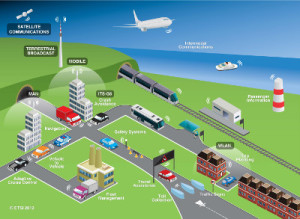
Intelligent Transport Systems
The idea behind Intelligent Transport Systems (ITS) is to increase safety and mobility: allowing you and I to get where we need to quicker and safer. How’s this possible? One component of ITS is IEEE 802.11p, a variant of Wi-Fi, or Dedicated Short-Range Communications (DSRC). This technology is responsible for vehicle-to-vehicle and vehicle-to-infrastructure communications; basically cars can talk to each other and to buildings. An Australian company, Cohda Wireless, is at the forefront of this new frontier.
Cohda is part of a pilot project sponsored by the US Department of Transportation. The $15 million grant equips 3,000 cars with Wi-Fi based transmitters for vehicle-to-vehicle and vehicle-to-infrastructure communications. It works like this: each car is outfitted with a GPS receiver and DSRC radio, which exchanges speed and position data with other vehicles nearby. A computer integrates the vehicle-to-vehicle information with onboard data to determine how drivers respond to warnings, such as lane-change and collision avoidance. Of course, it is ultimately up to the person in the driver’s seat to react in time, and correctly, to avoid an incident.
Other Options
And if it’s incidents we want to avoid, why not just have robotic cars? Perhaps you’ll recall the Google driverless car. With over $200,000 worth of equipment in the vehicle, it’s unlikely these will be parked in family garages any time soon.
The other reason robotic cars may not catch on is for the basic fact that people love to drive. Many of us long for the open road with the wind in our face as we chase down new adventures. For many rural and small towns and suburbia, driving is a way of life. A subway system or light rail facility is either a dream or a nightmare, if it were to happen, for many municipalities.
But if you are in the big city, then public transit systems are in many ways ‘driverless’ – in that when you step on board, you don’t have to worry about the driving.
Given the number of train derailments occurring in the past few weeks (with incidents in the United States, Canada, France, and most recently, Spain), we may want to think about equipping our commuter trains with IEEE 802.11p. If this technology could identify debris on the tracks, or misaligned tracks up ahead, or signals that are not responding to its sensors, or if a train is approaching a curve with too great a speed, it could very well minimize train derailments and incidents; resulting in far fewer fatalities, property damage and disruption to transportation networks. (Note: there is GSM-R, (Global System for Mobile Communications – Railway) technology in operation in Europe, China, Africa and Australia. This technology is a voice and data communications platform reliant on humans to signal a warning.)
After 120 years on the road and over 200 years on the tracks, we still don’t have this commuting problem worked out; and it will likely never be perfect. If we utilise ITS in more projects, both on the road and the rails, we may near that safer, more mobile level of transport we all desire.
Legalising doping in sports leaves no winners at the finsih line. Photo credit: Athletics tracks finish line by Petey21, via Wikimedia Commons
The 100th edition of Le Tour de France came to a close yesterday evening in Paris. It was a spectacular 3 weeks of racing. The battling of teams, riders positioning for stage wins, fans in fancy (and quite often strange) dress, stunning scenery – all made for a memorable tour indeed.
I’ve watched a lot of NBCSN’s Tour de France coverage this year because for one; it’s one of the greatest athletic competitions on this planet, and two; I was curious if this year was going to be any different. Probably as a result of instructions from broadcast corporations, there had been no mention of the American cyclist that ruined himself, Lance Armstrong, by name; just the scandal that rocked cycling. There were a lot of changes to this year’s course – twice up the Alpe d’Huez, the uphill finish on Mont Ventoux, the nighttime finish in Paris on the Champs-Élysées. Changes such as these, along with fresh, young riders such as Nairo Quintana and Andrew Talansky – the future of cycling – will help to lift the tarnish of this truly great, test of sporting endurance.
There is a rampant drug problem in the US sports – baseball, football (not soccer), track and field, cycling. I’m not talking about athletes using and abusing drugs such as cocaine and alcohol; no, this is the pre-meditated plotting to use performance-enhancing drugs to gain an unnatural competitive advantage. Olympic swimming programs in the 1980s were no strangers to steroid cocktails. Wrestling and weightlifting are also sports to have experimented with drugs to push the boundaries.
And to level the playing field there has been a lot of talk lately about legalising doping ‘since everyone is doing it.’ The argument that everyone is doing it is absurd. Granted both the business and science of sport has escalated with huge sums on the line. The money involved with stadium building, superstar contracts and ticket and concession prices is staggering. So too is the amount of funding that goes into exercise physiology equipment for training and recovery and nutrition for these athletes. But to go down the road where athletes shoot up, inhale, drink up, or cycle blood in and out of their body to win in order to beat records and earn more money and endorsements should not be the future of sport.
It’s impossible to know how many are or are not cheating by taking drugs. But there has to be a zero tolerance enforcement policy in place, with much more stringent consequences for those that are caught. Sebastian Coe, the London 2012 chairman, makes an excellent point in this BBC article. Four-year bans would do more harm to an athlete’s career: two-year bans make it too easy for athletes to bounce back. To legalise doping in sport, as this article from The Conversation advocates, would indeed be a tragedy. It would change sport to sport entertainment: two very different things.
Australia is deep in the throes of this debate. You can read about and watch what two Australian sporting icons, Shane Gould and Peter FitzSimons, have to say on the issue of athletes using performance enhancing drugs here. Weigh in and let us know what you think.
In the meantime, let’s hope indeed, that this is one Maillot jaune that will not be compromised.
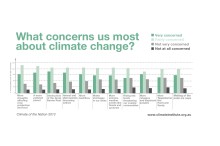
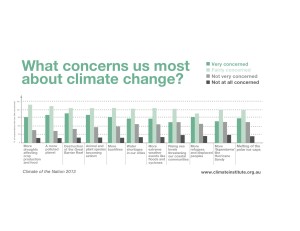
The issues of climate change and carbon pricing have been caught in a purgatorial pinball game over the past 12 months. No wonder there is confusion, doubt and general misunderstanding on climate change among the populace considering the political battle lines drawn between parties in state houses, parliament buildings and capitols worldwide. But a recent study put forth by The Climate Institute, titled Climate of the Nation 2013: Australian attitudes on climate change, seeks to elevate the dialogue. The authors of the report actually talked to people to get their views on climate change. They asked questions, they listened and they documented the responses. Perhaps politicians could add that tactic to their constituent playbook.
Highlights from the report include:
Two-thirds of Australians think that climate change is occurring and almost all of them believe that it is impacting Australia now. People are genuinely worried about the cost impacts of climate change on crop production and food supply, insurance premiums, water shortages and climate refugees.
More people want to give carbon pricing a go than get rid of it. And, more Australians want greater action and leadership than in recent years.
Results from the focus groups and poll behind Climate of the Nation 2013 indicate acceptance that climate change is happening and that humans are contributing to it. Twice as many trust the science than don’t.
Give the report a look; it’s a quick read and the information is presented in a way that connects with people. The authors did a great job because they took a deeper look by diving into demographics – age, gender, and dwelling location to give a realistic snapshot of the population’s views on climate change.
The Australian government says its plan to scrap an unpopular carbon tax will cost A$3.8bn ($3.5bn; £2.3bn).
I wonder whom Kevin Rudd spoke with before deciding to take such action. Did he speak with the people? Could their views have changed over the course of the past year?
The carbon tax, introduced in a somewhat controversial about face on the part of then Prime Minister Julia Gillard in 2012 did leave Australian businesses and families shaking their heads. But Australians place a high importance on the environment and their quality of life. Understanding that Australia is the worst polluter per capita in the developed world is something that most Australians, I think would want to see change. Expecting the worst-polluting firms to pay a tax on each tonne of greenhouse gases they emit is not unreasonable. However, the way the carbon tax policy was structured in Australia by including subsidies was a lose-lose, except of course for the corporations doing the polluting. Based on the information from the survey and work The Climate Institute put forward, perhaps politicians will consider “re-tooling” the carbon tax. The elections are due to take place in September. It will be an interesting to see which party comes out on top and the course of action the government takes on carbon emissions.
The Climate Institute is an independent research organization with offices in Sydney and Melbourne. Their vision is for a “resilient Australia, prospering in a zero-carbon global economy, participating fully and fairly in international climate change solutions.“ That’s a vision the international community can embrace.
Stay tuned for top science stories! Photo credit: Thinkstock, via BBC News
Welcome to this edition of Weekly Science Picks.
What a busy news week – with the markets up, the transportation incidents with planes and trains, major flooding in China…well, there’s been a lot going on. And there were numerous stories of scientific importance reported on as well. So I’ve listed the stories I’ve found significant this week. Topics include climate change, space, physics, public health, girls in education, and dogs watching TV. Yes, dogs watching TV. There’s a little something for everyone. So kick back, with your favorite beverage in hand and soak up some knowledge.
The notion of natural earthquake triggering is not new; in hydrothermal and volcanic areas, tremors can be triggered by large, distant earthquakes. But the new study suggests what is in effect a new category: natural triggering of seismic events primed by human activity.
If you’d like to read the full paper, you can check it out on Science: Injection-Induced Earthquakes by William L. Ellsworth
NASA’s plan to retrieve a tiny asteroid as a steppingstone for astronauts on the way to Mars in the 2030s could be just the exciting project that the space agency needs to garner public support in these severe budgetary times, speakers at a workshop held yesterday in Washington, D.C., said.
Every corner of the country’s energy infrastructure — oil wells, hydroelectric dams, nuclear power plants — will be stressed in coming years by more intense storms, rising seas, higher temperatures and more frequent droughts.
The devices, called optical lattice clocks, lost just one second every 300 million years – making them three times as accurate as current atomic clocks.