 If I let go a hammer on a planet having a positive gravity, I need not see it fall to know that it has, in fact, fallen. – Spock, “Court Martial,” Star Trek, stardate 2948.9.
I recently viewed the film Salmon Fishing in the Yemen. Dr. Jones, (brilliantly played by Ewan McGregor), has been ordered by the Ministry of Fisheries to undertake this farfetched project of introducing salmon into the Yemen River, wholeheartedly, or be out of a job. Dr. Jones reluctantly agrees but continuously ridicules this idea based on his years of research and meticulous study of salmon. He casts doubt every chance he gets that this project will actually work. And what we actually have here is a case of policy dictating science; in the name of a heartfelt, goodwill story meant to assuage the voting public’s uneasiness with the war. (A totally different issue of debate, which I will not touch on here.) It’s not until Dr. Jones meets Sheikh Muhammed, a deeply spiritual man of faith that he begins to open up to another way of thinking, one that defies all his principles of scientific reasoning. And he embraces that this plan just might work, with farmed salmon no less. But what causes the radical reversal of the scientist’s viewpoint from staunch biological reasoning to faith that this project might actually be possible?
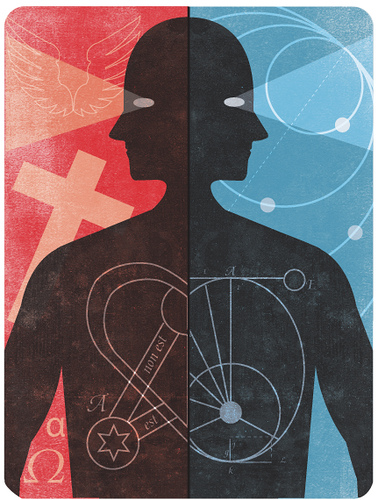
Science and religion have had something of a love-hate relationship, intertwined for centuries and often at direct odds with each other. Popes and bishops issued condemnations and accused some great scientific minds of heresy in the Middle Ages. The work of Galileo, Conrad Gessner and Charles Darwin also come to mind, having caused quite a ruckus of controversy in their day. And well Darwin may always be at odds with some folks.
From my own experience growing up Catholic and pursuing biology and chemistry in college, I found it difficult to compartmentalize science and religion. But there have been and still are a few scientists out there who can separate their scientific beliefs from their religious practice. Copernicus was a Catholic clergyman; Gregor Mendel was an Augustinian friar; and Georges Lemaitre, who first proposed the Big Bang Theory, a Belgian priest. They seemed to have been able to separate their work from their spiritual beliefs. Perhaps they had truly find enlightenment? Or maybe that’s exactly what it is; just a spiritual belief, for right or wrong, that has nothing to do with science.
As with most conflicts, it seems that the bitter clashes between science and religion arose primarily due to a different interpretation over the definition of ‘science’. Secular philosophers considered science in the sense of natural science; while theologians took the view that all science is based on demonstrations – according to the St. Thomas Aquinas viewpoint. The shift toward science becoming the top dog, so to speak, over religion seems to have occurred as Europe and North America experienced greater secularization. The political power and influence of the church relating to scientific research has gradually decreased. According to the Catechism of the Catholic Church: “Methodical research in all branches of knowledge, provided it is carried out in a truly scientific manner and does not override moral laws, can never conflict with the faith, because the things of the world and the things the of the faith derive from the same God. The humble and persevering investigator of the secrets of nature is being led, as it were, by the hand of God in spite of himself, for it is God, the conserver of all things, who made them what they are”. I will leave it up to the reader to ponder that and agree or disagree.
But let’s explore the concept of faith for a moment. The word faith is thought to date back to the early 13th century, around the time of some budding scientific discoveries. Formally, faith is a belief in one or more gods or in the doctrines of religion. Buddhism, Christianity, Judaism, Sikh, Hinduism, Islam – all of these religions have some concept of faith stationed at the root of their core beliefs. Informally, it can mean a trust or belief without proof, a hope. And this is where the criticism starts, over this very definition of faith, and how it can seem at odds with science.
Critics argue that faith is opposed to reason, while advocates argue that faith addresses questions that cannot be settled by evidence. The evolutionary biologist, Richard Dawkins stated, “Faith is the great cop-out, the great excuse to evade the need to think and evaluate evidence. Faith is belief in spite of, even perhaps because of, the lack of evidence.



 So how far away are we from planet Earth morphing into Holodeck 5 and we all have Geordi La Forge glasses? There are several pairs of augmented reality glasses already on the market, many from brands you’ve probably never heard of, but then I’m sure you have heard of
 Whoever thought you could make money in biology, right? Turns out, there is quite a bit of money to be made in this field. And I think we are realizing more than ever the importance of the life sciences and the contribution it offers to society and the economy.
 23 cm of string. 1 tyre iron. 3 broken shards of glass. 18 rolls of fiber insulation. 1 match. 2 cardboard boxes. 4 paperclips. Because you always need a paperclip.
 Skills learned in science have a carryover effect into other areas of life, and ultimately have an impact in their chosen profession – influencing their thought process and how they carry out decisions. Whether kids choose science as a major in university and continue with it through to the job market, even at the earliest levels of schooling, science engages students to become leaders. Why? Because they are inquiring to learn about the environment around them, to find out what makes it tick, and to correct or enhance any “ticks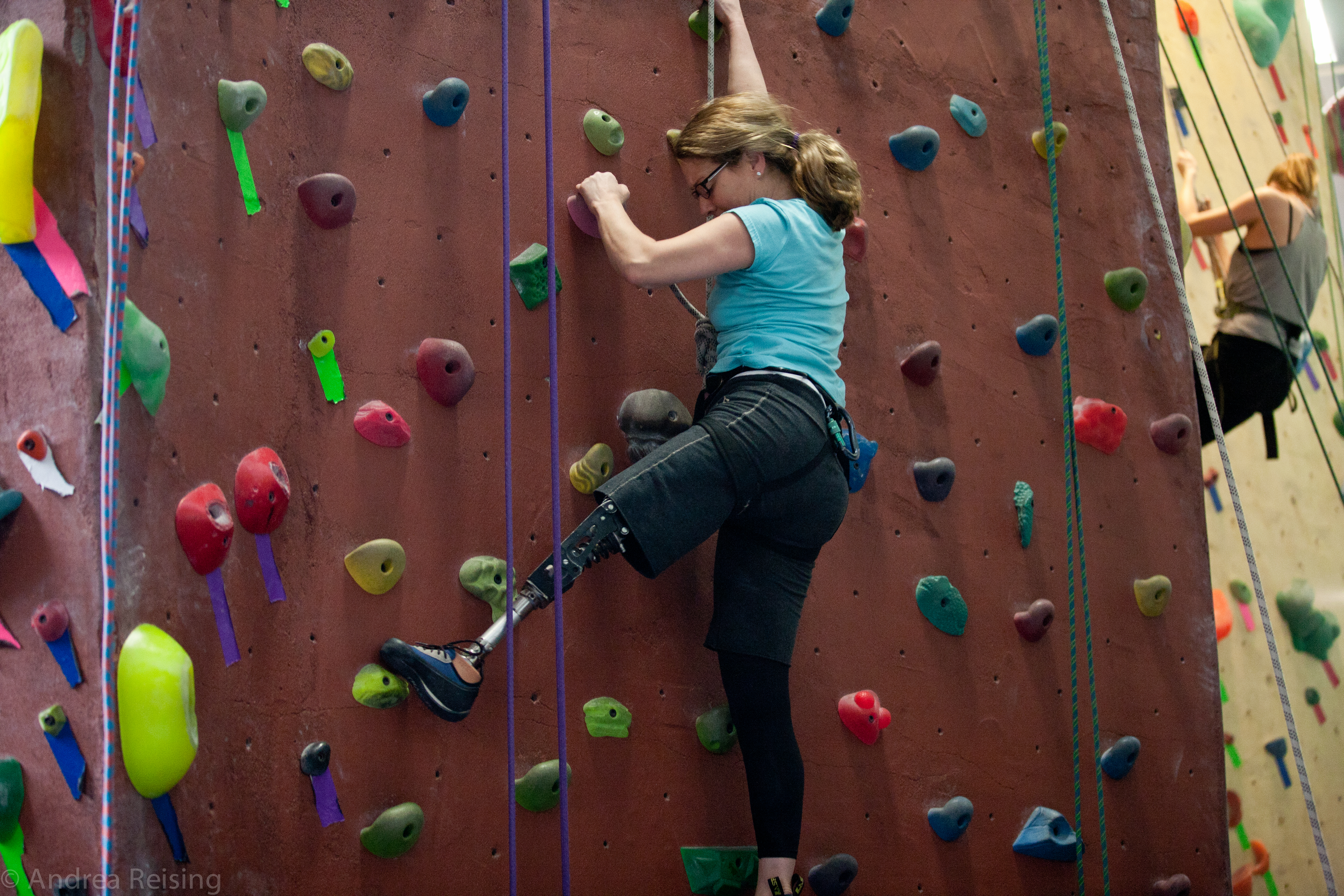




 The 7th Annual MIT Energy Conference held March 16-17 in Boston, MA, was an all-around inspiring event filled with conversations of hot topic scientific research and intense policy discussion. It was impressive, considering this event is entirely planned and executed by the student body, with well over 500 in attendance. From the scientific prowess of the professors working on new energy technologies, the caliber of executives leading the charge on the corporate front, to the undergraduate and graduate students pursuing their dreams to engineer a better tomorrow for society, we are indeed poised to see a radical transformation in both the technology and the policies of the energy sector.
 We hear…but do we comprehend? What connection does our brain make to statements transmitted through our auditory canal such as global warming is increasing at 0.13°C per year? Or there are 495 dead zones covering 95,000 square miles of our world’s oceans as a result of increased runoff from agriculture? We see…but are those images stored in our brain, to recall in decision making when confronted with a particular behavior choice? For instance when the image of a little girl sifting through a rubbish pile looking for a bite to eat burns onto our retinas, do we remember that later when we casually toss out half our dinner plate in a Styrofoam takeout container? How many of us in the developed world actually comprehend that our actions contribute directly to global warming?