
The Internet revolutionised the way we live, learn, communicate and the way we do our business.Today, most of us can’t and won’t imagine our lives without it and we take the existence of the Internet for granted. Younger generations may not be aware of this fact – but us who were born in the 70s and 80s had no other means of communication except letters, telegrams and bulky desk phones when we were teenagers! No Wikipedia, MMO games, email, YouTube videos, social networks, liking, sharing and online courses – just good old books, face to face socialising and playing movies on our VHS player. The Internet has become an ultimate worldwide broadcast “entity
Tag: internet
-
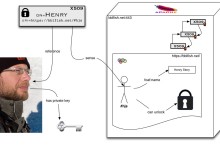
Interview: Henry Story, a Social Web architect and Polymath
Henry Story studied Analytic Philosophy at Kings College London, Computing at Imperial College, worked for AltaVista where he developed the BabelFish machine translation service, worked at Sun Microsystems on Blogging platforms and the development of the Social Web where he developed the decentralised identity and authentication protocol known as WebID, which is under standardisation at the W3C (World Wide Web Consortium). He contributed to the Atom syndication format at the IETF (The Internet Engineering Task Force), to the Linked Data Protocol at the W3C, and is currently writing an Open Source platform for co-operating systems in Scala based on all those standards.
Henry has been giving talks on the philosophy of the Social Web at the Sorbonne University, and various other places. We took a moment to have a conversation with Henry on very interesting topics – from the early years of the World Wide Web, first search engines, Semantic Web, metadata and ontologies, to the current initiatives within the Web Consortium (W3C), WebID Incubator group activities and its impact on the scientific research.
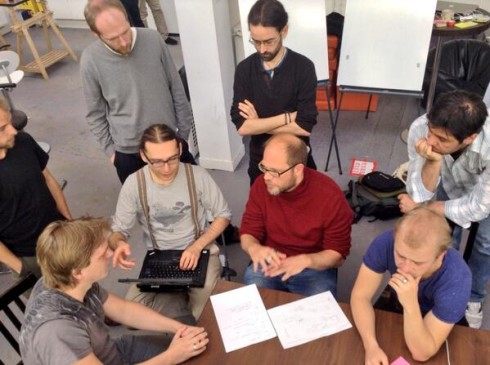
Henry in red at the OuiShare labs workshop in Paris in May 2014. Welcome! Would you, please, tell our readers a little bit more about yourself? Where do you come from, both geographically and philosophically? What is your scientific background, and your professional scope?
Hi, thanks for inviting me over. My background is one that crosses frontiers: both geographic/national ones as well as disciplinary ones. I somehow found myself at the intersection of philosophy, logic, programming, web architecture, standards and social networks development and recently startup creation. Furthermore my work has been more and more about exactly this: how to help people co-operate across such disciplinary boundaries in a global open manner.
To help make sense of this tangle it helps to go back a little bit in time. My father is English and received his PhD in Washington DC, my mother is Austrian and a sculptor, and both lived in France where my father taught until recently political economy at the INSEAD Business school. That explains the geographical/national tangle.
INSEAD is also where I learnt computing on a DEC 2020 around 1980 as I was 13 or so. I wanted to ask the computer how to solve the Rubix cube. Of course I was told that it would not be that easy. I had to learn to communicate with the machine and learn how to ask the question. This lead me to learn the programming language Basic, and soon after that Pascal which was a revelation – no GOTO loops needing rewriting whenever a new line was added to the program – just procedures. So I wondered what could there be that was better. I discovered Lisp which made it easy to conceive of a program that could write itself, and from there the questions of Artificial Intelligence and so of philosophy started to open up.
I could see around 1984 the beginnings of the internet appear as I went to the Centre Mondial in Paris that had Lisp Machines available and connections to 4 different centres around the world.
But at the time computers were changing too quickly – I was stunned when I saw the 1984 Apple Macintosh in a shop window, and how it had left the terminal behind for just a graphical interface – so I decided to learn something which seemed more stable and took maths, physics and English literature for A levels (in the UK) and then later analytic philosophy at Kings College London, which was the philosophy that emerged out on the work by Frege and later Bertrand Russel of mathematical logic. I returned to computers to do a MSc at Imperial College later, where I learnt about Unix, Prolog, Agent Oriented Programming, Functional Programming, and Category Theory. At the time I was wondering how all this would come in useful. How would they tie up together? It turns out that in my work on building a distributed decentralised secure social web what I learnt in philosophy as well as what I learnt at Imperial College are all immensely relevant. Indeed in the last few years I have been giving talks on the philosophy of the Social Web at the Sorbonne, and various other venues that do just that.
At the time I did not know it. At Imperial College we had participated in the early stages of the Web. We were using Sun workstations, publishing web pages, and I even saw the birth of Java, the language that promised to allow one to write code that could run on every computer – a must for distributing programs on the World Wide Web. Its success was assured as it was released with Netscape Navigator in 1995. I learnt it, wrote a little Fractal Applet for my homework, put it on my web page, and flew to San Francisco to the first JavaOne conference. In the UK most job agencies had either not heard of the web, or had no access to it. But in California it was completely different. When I told a student at Berkeley about my Web page he asked me for the URL, had a look at it on the spot and suggested I go to the WestTech conference in San Jose. There were 400 tech companies there looking to employ young people – the biggest equivalent in the UK I had seen was a job fair with 40 companies. As I was about to leave a few days later I received a call from AltaVista the top search engine at the time which had indexed 50 million web pages (!) which was a lot at the time. The web was growing exponentially as every person who wrote a web page linked up to other web pages they found interesting hoping to receive perhaps a link back in return, and so make their page visible on the web. This turned every publisher into a web advocate. I went to the interview and got the job. Finally I was back in the US 28 years after I had left it as a child of 5.
This one is very interesting for those who remember the early days of World Wide Web and the first translation engines. In the 90’s you worked as a senior software engineer for AltaVista on the BabelFish machine translation service. What happened with BabelFish?
Yes, at AltaVista, Louis Monier one of the founders with Mike Burroughs, presented me with the project to adapt the Systran translation engines as a web service. Those translation machines had an old history. In the 1960s they were written in assembly code – the low level code machines understand – and had slowly been ported to C, a low level but more easily portable language which operating systems are written in. But they were not designed to be run on the biggest web service at the time, with potentially 100s of thousands or even millions of users.
As the translations were not always that good I played on this weakness by naming the machine babelfish.altavista.com, in reference to the character from the BBC Comedy Series «The Hitch Hikers Guide to the Galaxy»: a fish that when placed in a person’s ear could feed on brainwave energy and translate every known language in the universe. I pushed out a quick version, and it was immediately very successful. Then I spent a lot of time trying to write a more advanced version in Java, but the compilers at the time produced code that ran much too slowly. Finally around 1999 big speedups arrived making it competitive with C, and it was possible to launch the final version of the servers, and move up to a million or 2 translations a day.
AltaVista’s big advantage initially was Digital Equipment Corporation’s 64 bit machines, that were 10 years ahead of Intel, allowing massive and efficient indexes to be built. AltaVista started by fetching the initial pages of Yahoo a human built directory of interesting web pages, retrieving links to pages, then fetching those, and so on recursively. It would then index all the words it found allowing users to instantaneously find information on the web. Sadly AltaVista never was able to take full account of the links between the pages to help with the ranking. Google worked out how to use the information that each web page author published when he links a web page to another one, thereby voting for it in a sense. Using the collective intelligence of the World Wide Web, Google came to produce more and more relevant results, overtaking AltaVista in 2001 as the largest search destination in the World.
Furthermore AltaVista was constantly undermined by management changes. First it was bought by Compaq (which was later to be bought by HP), then it was sold to CMGI which popped in the dot com bust of 2001, was then bought by Yahoo, and finally Yahoo closed it recently. I left well before in 2000 to join a translation startup, then came back to Europe.
In the end these hand written translators were overrun by Google’s translators tuned by statistical algorithms working on massive amounts of published text available on the web or scanned from books.
Also, you’ve been working on the Semantic Web since 2004 at Sun Microsystems. Semantic Web explorations and practical implementations were so popular, what happened to Semantic Web?
Tim Berners-Lee the inventor of the Web, first spoke of the Semantic Web in 1994 at the first World Wide Web conference, as a way to enable the web to not just be a web of linked human readable pages, but also a web of linked data. As the web was a hyper-text system, so the semantic web could become a hyper-data publication platform allowing people to connect data across organisational and national boundaries.
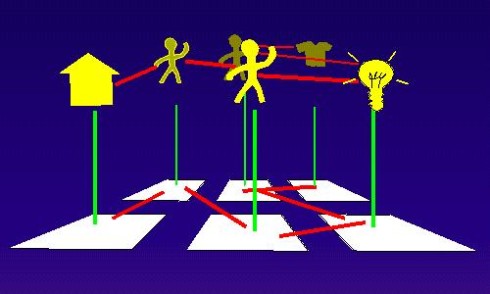
Tim Berners Lee’s www 1994 slide on the semantic web The first RDF standards appeared in the period 1999-2001. Blogging, one of the first applications of RDF, was started at the end of the millennium, and growing at exponential speeds. Around 2004 I had some time for myself and decided to write a blog. I found that James Gosling – the father of Java – had written and Open Source blog editor called BlogEd. I used that, fixed some bugs in it, then adapted it with a local RDF store. As a result he offered me a job at Sun Microsystems which I gladly took.
Sun Microsystems was a great company that had produced in 1981 the first colour graphical work station running Unix, the internet operating system, based on open standards that had emerged from the break up of AT&T. In 2004 Sun was emerging from the dot com bust, and was facing strong competition from Linux, the open source Unix clone developed in a distributed manner by a world wide community of engineers, which powered Google’s servers since the beginning, and was making inroad everywhere. But Sun had produced some of the best technology around, created a huge Unix and Java community. The CEO Jonathan Schwartz in a bold move had decided to move all of Sun’s code Open Source to compete with Linux. He also allowed and even encouraged us to all blog online, so that we could present a human face of what was a research focused engineering company.
What did blogging add to the web? In short it allowed everyone to publish information and let others know through a syndication feed (RSS then Atom a.k.a RFC 4287, which I contributed to) to subscribe to their updates. This allowed increasing distribution of content publication, allowing everyone to get the latest updates from their preferred authors world wide without needing to wait for the search engines to index those pages, a process which could potentially take months to reach updates, as they had to crawl the whole web for content.
Another very interesting application of the semantic web was FOAF – the Friend of a Friend ontology, put together by Dan Brickley and Libby Miller, and that was evolving in a friendly open source manner through open online discussions. FOAF allowed one to publish one’s profile on one’s web server, and link one’s profile to that of one’s friends who also published it on their web server. So just as with blogging and the web, everybody could participate in a distributed social web.
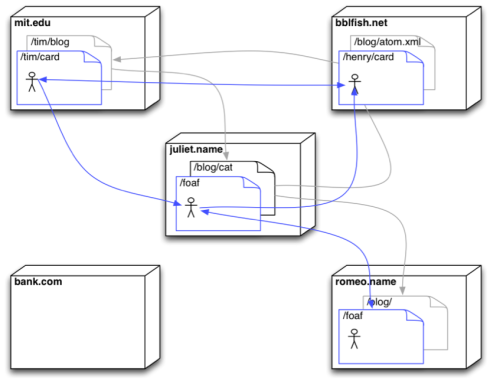
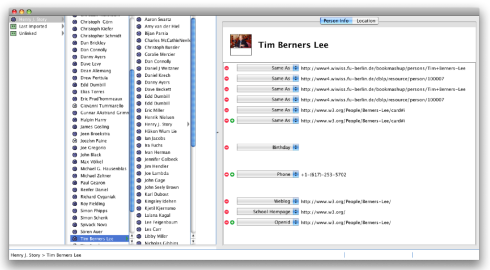
I wrote a distributed Address Book called Beatnik (take a look at this video), which made it easy to see how one could drag a FOAF profile from a web page onto the address book, and it would show you someone’s friends. You could then click on one of the friends to find their name, photo, contact information find out potentially where they currently were on the globe and follow explore their friends. All of this was totally distributed.
But at the time Facebook was starting to grow and people wanted privacy too. So the criticism I received was that this was all and good for publishing open distributed social networks but that one could not publish confidential information. To do that one needed a global identification system, so that one could connect to any web server one had never before gone to, authenticate with a global identifier, and be then given access to the resource if allowed. There was a standard for doing this that was gaining traction called OpenID, but OpenID was very slow requiring 7 http connections and required the user to type a URL in by hand. Having worked on large sites such as AltaVista this seemed to me very inefficient. I wondered if one could reduce those 7 connections down to one, while also removing the need for the user to even type anything. I asked around on the IETF mailing lists and by luck a few people answered, each one with a third of the solution. WebID was born. It allowed us to use TLS the security system used for commercial transactions on the web and built into every browser to enable authentication in one click to any web site securely using public key cryptography.
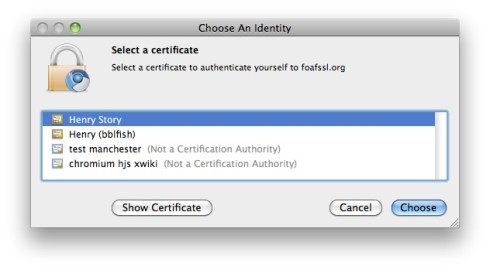
What we found was a beautiful hack to transform a system that was up to then used in a purely centralised manner, into a purely decentralised one. Usually client side certificates require one to have a certificate authority to sign the users information. This is expensive, cumbersome, not very flexible, and on the whole not even as trustworthy as it should be. WebID bypasses the certificate authority, and moves trust to the Social Web of published relations between people.
Would you explain to our readers a bit about the W3C WebID Incubator, for those in the science and technology who may not be familiar with the Incubator? Would you tell us more about your role within W3C WebID Incubator group?
We initially developed the protocol on an open mailing list called foaf-protocols. There we tested the ideas by listening to feedback from implementors from every walk of life. In a few years we had verified that this indeed could work correctly. We found the weaknesses in certain browsers and sent them bug reports. We slowly improved the description of the protocol. But as it became clear that it was workable and that we had nearly a dozen implementations we thought it would be time to go through a more formal process, and create a more formal looking document that would give people confidence in it. There the unofficial mailing list was no longer the correct venue.
Very early on I had sat down next to Tim Berners Lee to show him what we were calling at the time foaf+ssl protocol, and he immediately understood it even suggesting we use the name WebID. Tim had some of his students use it to work on developing a big picture of what this was leading to, which he called Socially Aware Cloud storage. So later when we asked him if we could have a space on the W3C to put together a standard for WebID. He approved completely. Nevertheless there are a lot of standards for identity competing for each other, and so this was a bit of a political mine field, and we settled for a low profile Incubator group status of which I am the chair.
Can you share with us some personal notes regarding the WebID Incubator, any challenges you faced along the way, and the outcome?
The beauty of WebID is its simplicity. So my role as the WebID Incubator group chair has been to try to keep it that way. I think small standards that do one thing well but that are designed to compose with other standards work best.
There was a lot of pressure by some folks who came in later to make things much more complex. Usually when one looks closer at those protocols, that complexity hides some centralising architectural presupposition, a number of security issues, or wishful thinking as to how things may work.
I did make a mistake initially by allowing myself to be argued into making WebID more general than it needed to be. It felt nice: it felt like we could have a standard that would encompass all identity systems. This is an easy mistake to make. It is one thing to design a protocol to make it easy to generalise, but it is another one to make it so general that it is difficult to implement. And initially what is needed is to keep it simple and clear so that implementors can follow a spec to write an implementation that works. Vendors often have an opposite need in that the more complexity they can manage the more they can distinguish themselves (they can tick more boxes on their software features set). This is where the rough consensus and working code mottos of the IETF and the W3C are key. A standard comes from having interoperable implementations written by different organisations that may not even know of each other’s existence. If nobody can implement the full standard, then it is not well specified enough.
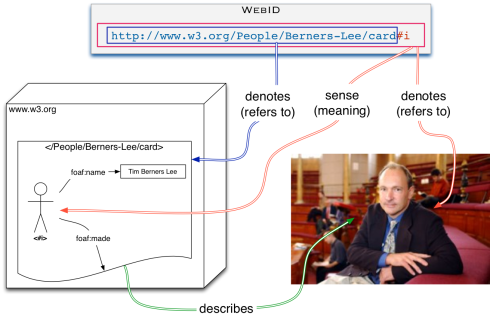
So under the good advice of Tim Berners-Lee a couple of years ago we decided to return back to the roots and create two specs, one that defines what a WebID is independently of authentication, and another that defines the WebID over TLS authentication. This means that we can get WebID to work with potentially other authentication mechanisms such as BrowserID (now called Mozilla Persona) that was a rising star a few years ago, but has run into trouble because it only had the promise of being decentralised sometime in the future, perhaps….
It now ties in very nicely with a number of emerging standards at the W3C such as:
•The Linked Data Protocol: is a standard to turn the web into a read/write web that has been Tim Berners-Lee’s ambition since the beginning. It takes the best of WebDAV and the Atom protocols that came before it, but simplifies them by integrating them in the semantic web. The Linked Data Protocol is being worked on by IBM, Oracle, Fujitsu, and a number of other companies. I represent Apache there, and probably had one of the first implementations of it, which I worked on with Alexandre Bertails of the W3C that was part of a proof of concept that led to the formation of the Working Group.
•Web Access Control: is a simple ontology and a pattern of linking a resource to it so that a client can (if allowed to) work out who has access to a resource and edit (using LDP) the access control rules which are themselves expressed in RDF. Authentication can be done with WebID over TLS, or other methods. This is still just a wiki page but it has a number of implementations.
Finally, what are you currently working on? Where do you see this leading to? How do you see this impacting the scientific research?
We have now the standards to build a platform for distributed creation, edition, and protection of any kind of information resource be it textual, image, video or data on the web, in way to allow the whole world to connect in ways only dreamed of until now. This of course opens up huge spaces of possibilities in every field.
We have built an implementation of this in Scala, a very interesting programming language that compiles to Java byte code or to JavaScript (with Scala-JS), available under an Apache licence on the read-write-web GitHub repository.
Scala is multi-paradigm programming language that mixes Object Oriented and Functional concepts, which in a world where Moore’s law can only continue progressing through parallelization is becoming essential. Consider that Sun’s latest CPU the T5 cpu contains 16 cores for a maximum of 128 threads per processor, for a total of 1024 on an 8 socket system. Old style Object Oriented programming with mutable objects requires complex systems of locks that are prone to dead-locks. Here mathematical programming which is what functional programming is all about is the cure. By working with non mutable data structures (objects) in a functional way that composes – hence the importance of Category Theory which is the study of such composability – one can guarantee that code can be parallelised.
With the advent of LDP+WAC+WEBID we now not only have paralellisation inside one CPU but now across organisations, where our servers potentially have to communicate constantly with 1000s of other servers. Here again the functional nature of Scala makes asynchronous programming vastly more efficient than traditional thread based programming, saving GB of RAM just to process connections on the internet.
With the advent of Scala-JS we can now envisage writing code that works inside the web browser as well as on the server. So we have now come to build a fully distributed agent platform with declarative and inferential semantics (RDF), speech/document acts (LDP) powered by functional programming languages, bringing together all the fields that I had studied twenty years ago at Imperial College in London.
This platform will allow researchers to connect up seamlessly, link up different data sets together, tie articles to the data sets they were based on, link research up with enterprises, banks, governments and individuals in a seamless manner, whilst still always allowing divergence of opinion and subjectivity to remain, and without the very real danger of polical/economic control that centralised networks present.
The big project is now to re-build all the tools that we have to work with this platform, to create easy user interfaces that need to be aware of the subjectivity of information, so as to allow anybody to always ask about any piece of information: where did this come from? Who said it? What was it the logical consequence of? It should be possible to take different points of views on data: skeptical, trusting, etc… to see what kinds of possibilities are entailed by it.
At present we are busy building a platform for co-operating systems using all the above mentioned standards and tools. The platform is open allowing students, researchers or anyone else to join us on the read-write-web project. We are already working with non-profit organisations such as the French Virtual Assembly that are connecting a number of non profit actors in a network based on a concept they call ‘pair to pair’ where pair stands for project actor idea resource.
Thank you Henry for taking your time to talk with me. Thank you for the Interview!
For more information check out a web site of Henry Story, his Academia.edu page, and you can follow his Twitter feed – Bblfish.
Image sources:
discussing how to create a wish list to our #RDF linked profiles #OSLabs14 #OSFest14 pic.twitter.com/JDFU4i6J32
— Joachim Lohkamp (@JoachimLohkamp) May 3, 2014
http://blogs.ch.cam.ac.uk/pmr/2007/05/09/tbl13-if-everybody-did-it-it-would-be-awesome/
http://www.w3.org/2005/Incubator/webid/spec/identity/
-
International Conference on Digital Discrimination and Social Networks Online
Recently, I had a chance to attend and participate at the ICUD International Conference: Digital Discrimination and Social Networks that took place takes on March 13 and 14, 2014 in Barcelona, Spain. The ICUD Project aims to Creatively Unveil hidden forms of Discrimination on the Internet, especially on social network sites such as Facebook, and provide practical tools to combat discrimination online. This project is lead by www.asceps.org, and is co-funded by the European Union’s DG Justice: Fundamental Right and Citizenship programme.
It was a wonderful opportunity and space for interaction, discussion, learning and exchange of ideas and experiences: for social workers, academics, researchers, educators, Internet experts, NGOs, activists, young people and anyone interested in the issues surrounding discrimination on the Internet, especially in regards to social networking sites.
Complex topics like teen usage of Internet tools and social networks, racial discrimination, digital divides, network strategy against discrimination, hate speech, online gaming communities, LGBT issues, presence and representations of women online, youth and identity were discussed during the two-day conference.
Each session, talk, workshop and panel contributed to the ICUD conference and discussion, I’m selecting here few of them, for other details please see the references.
Game Over Hate: Building Better Online Gaming Communities
A project and an initiative Game Over Hate (Germany/Portugal) that was presented during the first day of the conference – had the goal to tackle hate in online gaming environments and to foster inclusive gaming communities.
Participants had a chance to discuss the most profitable branch of the entertainment industry (video games), the massive online communities that exist around it and how everything comes together in a world of hate speech, trolling and rape culture.
In this workshop there was a discussion about the role of the internet as both entertainment and as an alternative to offline socialisation by looking at the impact, size and scope of the new online gaming communities. Through interaction, some stereotypes about games were unmasked. There was an interesting discussion on how players interact online, what types of games they play and what happens when so many people cooperate and compete online.
In an effort to understand this, workshop leaders look into cases from different communities, such as Anita Sarkeesian (FeministFrequency), Phil Fish (FEZ), Carolyn Petit (GameSpot), Zoe Quinn (Depression Quest), and “Fat, Ugly or Slutty
-

Weekly Science Picks
Hello everyone. I hope you’ve all had a good week! It’s a balmy Autumn evening here in the UK where I sit as I write this – and I must say, this week’s science picks include something quite historic…
Anyone with half an eye on the science news recently should know by now that it’s been officially confirmed that NASA’s Voyager 1 probe is has now been confirmed as being in interstellar space. It is no longer within the Sun’s heliosphere and no longer feels the solar wind. To Voyager, the Sun is now simply another star in the sky. Though as Phil Plait points out, being in interstellar space is not technically the same thing as leaving the solar system.
Voyager 1 Reaches Interstellar Space. But Has It Left the Solar System? Wellllll…
However, there’s more to our solar system’s far-flung suburbs than errant electrons and protons. Even out there, over 120 times farther from the Sun than the Earth’s orbit, there are more substantive objects: huge, frozen chunks of ice that are essentially giant comets… It’s like walking outside the front door of your house and saying you’ve left your property. While you’ve left your house, there’s still the yard all around you. You have a ways to go yet.
Citizen Science has been around for a while now, as a fun and interesting way of getting internet users to casually help scientists analyse vast amounts of data. So the latest idea is to use online gaming and social media platforms like Facebook to bolster the effort…
How Facebook and gaming could help scientists battle disease
One example, a smartphone game set for release later this year, is currently called “GeneGame”. Players of the game, developed by Cancer Research UK, will be contributing to the identification of cancer-causing genetic faults from tumour samples. In a crucial difference to the Galaxy Zoo experiment, the scientific research will be a indirect consequence of the gameplay, rather than the explicit focus of the gameplay.
From a long departed craft, to one of the most recent, NASA’s LADEE vehicle is currently en route to the Moon, to study its tenuous atmosphere (and the word “Atmosphere” is used rather loosely here, believe me). But as the probe was launched, there was an unfortunate amphibian casualty. You see, the launch pads at NASA’s Wallops facility are built in rather swampy areas…
Frank the Frog Sacrificed Himself for LADEE Launch
From NASA: “A still camera on a sound trigger captured this intriguing photo of an airborne frog as NASA’s LADEE spacecraft lifts off from Pad 0B at Wallops Flight Facility in Virginia. The photo team confirms the frog is real and was captured in a single frame by one of the remote cameras used to photograph the launch. The condition of the frog, however, is uncertain.
-

Big Data…Big Deal

Data is everywhere. Via CRN. Data is everywhere. It touches and informs every aspect of our lives.
You go to the doctor, and your medical records are electronic on a computer screen before your eyes.
You bank online.
The stock market is all done by computers.
We are living in The Data Age.
I grew up in a time where the word data seemed to be only used in science classrooms. Now, it’s data this, data that, data here, data there. Consumer technology and social media have shot data out of a cannon. We want to pinpoint the minutiae of every day life down to the smallest factoid so that a story can be told from it. And this is not such a bad thing, but it does make me wonder what the next 50 years will bring. How much more can we manipulate and manufacture data into other ‘life’ forms?
It seems as though modern times are placing a huge expectation upon big data; mainly, that it will solve all of our problems. And while there is this potential to help us make informed decisions, we cannot expect data to tell us what the decisions are that need to be made. Creativity is the first ingredient in the blender.
This creativity emerges again in the processing of the data and figuring out the best means to present the data in a way that paints a story that is easily understandable. Many are not literate in data and this divide is very clear in different populations of students and communities. How we teach data literacy in schools is and will be increasingly important. How kids learn the very act of searching the Internet will be crucial in helping them understand data and how to present that data.
A good example of teaching data literacy comes from within my own family. A 70-year old man wanted to learn how to use the Internet. His sons tried, became frustrated at the process. The sons passed him onto the grandsons, who became frustrated as granddad paused to write down every step so he could get online by himself. One of the sons, a principal at a primary school tried something different. He brought his dad to school and set him down in the computer class with the 8-year-olds. There he learned everything he needed to know – how to get online, how to search. Now he’s planning trips to the Italian Alps, keeping up on the golf scores, staying in touch with his children over email, reading history books online.
The Internet of Everything is expanding. Machines are connected globally. Data has gotten big, really big. Data illiteracy and a lack of computer basics will continue to divide populations. However, with the right instruction, generational gaps can be bridged. Fundamentally how we learn is the same; it’s just the tools that are changing. Big data is changing the world.
-
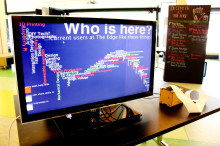
Work, Play & Learn! Using libraries for Social Learning, Impact and Collaboration
The digital information and knowledge paradigm in the 21st century requires skills such as digital literacy, critical thinking, problem solving, skills in communication, and collaboration for overcoming present social and digital inequalities. Those skills go beyond pure technological affordances and they could easily be obtained through collaborative learning practices and social interaction between individuals from different backgrounds and areas of expertise.
Libraries, as environments for social learning and collaboration, present facilitators of education and knowledge. With accelerating dissemination of information in a digital age, libraries emphasise their activities on providing an information commons. In other words, an informal interactive learning place that encourages its visitors to communicate, contribute, participate, and engage with the library. This new dynamic leads towards a collaborative, social construction, and sharing of information and knowledge.
One of the researchers at the Urban Informatics Research Lab at Queensland University of Technology (QUT), interaction designer and interactive technology developer Mark Bilandzic, explores how informal learning environments can support the social side of learning, as well as how smart space technology can be designed to enhance social learning among users? As a part of Bilandzic’s research, he designed a system with the purpose of enhancing awareness of opportunities for social learning and collaboration – called “Gelatine
-

Study on actual and self-reported measures of Facebook use
A cross-post ∞. Thanks to prof. Rey Junco, a faculty associate at the Berkman Center for Internet and Society.
If you are a regular reader of this blog, you likely already know that there is a growing body of research that examines how college students use Facebook and the outcomes of such use. For instance, researchers have examined how Facebook use is related to various aspects of the college student experience including learning, student engagement, multitasking, political activity, life satisfaction, social trust, civic engagement, and political participation, development of identity and peer relationships, and relationship building and maintenance.
All of the previous research has relied on self-reported measures of Facebook use (that is, survey questions). We know from research in other areas of human behavior that there are significant differences between actual and self reported behaviors. One of my favorite examples is a study where researchers found that up to 50% of self-reported non-smoking head and neck cancer patients were indeed smoking as measured by exhaled carbon monoxide levels and levels of a nicotine metabolite in their blood.
As you might imagine, differences between self-reported and actual uses of Facebook could drastically change or even negate findings of how Facebook use is related to the aforementioned outcomes. My latest paper published in Computers in Human Behavior, Comparing actual and self-reported measures of Facebook use examines these differences.
Here is what I did: I paid students to allow me to install a monitor on their computers for one month. I also surveyed them to ask them how much time they spent on Facebook and how many times they logged in to the site. I also monitored/asked about other forms of tech/social media use (like Twitter and email).
Here is what I found: As you can see in the scatterplot below, there was a significant positive correlation between self-reported and actual Facebook use (Pearson’s r = .587, p < .001).

However, and here is the really interesting part, students significantly overestimated the amount of time they spent on Facebook. They reported spending an average of 149 minutes per day on Facebook which was significantly higher than the 26 minutes per day they actually spent on the site (t(41) = 8.068, p < .001).
What is going on? In the paper, I go into much more detail about why there is such a large and significant difference between actual and self-reported Facebook use, as well as why the two are significantly correlated. In brief:
- It could be that self-report questions aren’t specific enough to capture frequency of Facebook usage. Students may interpret a question asking “how much time do you spend on Facebook each day?
- It could be that self-report questions aren’t specific enough to capture frequency of Facebook usage. Students may interpret a question asking “how much time do you spend on Facebook each day?
-

Linux.conf.au 2013: ‘Nerdvana’ in Canberra
During the last week of January, approximately 700 IT professionals and enthusiastic hobbyists descended on Canberra to jointly create an intensive learning experience. Each year the call goes out across the intertubes to gather together open source geeks for Linux Conference Australia. Linux.conf.au, or simply LCA, is one of the largest open source conferences in the southern hemisphere, and one of the most highly-regarded conferences of its kind in the world. I was excited to attend LCA2013, as it was my first LinuxConf, despite being involved to a modest degree in the Linux and open source community for at least the last 15 years.
Most days, the programme commenced with a keynote address by an IT industry luminary who had made a significant contribution to computer technology and open source. At every keynote address, the lower level of ANU’s Llewellyn Hall was packed with delegates, each toting a selection of wifi- or 3G-enabled devices. While I saw a healthy 55Mbps idle capacity on the Internet link provided by conference organisers (ably assisted by the network engineers at AARNET), once the assembled cohort of digital natives hit the link, all of that that capacity was rapidly utilised. 🙂
The conference was opened on the Monday by Bdale Garbee, recently-retired Open Source & Linux Chief Technologiest at Hewlett-Packard, and a long-time contributor to the Debian Linux distribution. (Read Kelly Burnes’ article about Bdale at LCA2013, where you can also watch our video interview.)
On the Tuesday, Radia Perlman enchanted the audience with her talk on the folklore of networking. Radia has been instrumental in developing several key networking protocols that underpin the interconnectedness of computers that we now take for granted. She gave a highly-technical yet accessible talk laced with humour and even nerdy poetry. (You can read my thoughts on Radia at LCA2013, and watch our video interview.)
-

Weekly Science Picks
Last weekend in January brought exciting and interesting events, reports, and readings. Monthly editorial is coming out next week, don’t miss wonderful readings written by Australian Science writers and bloggers. Enjoy in this week science picks, and have a great weekend!
Library services in the digital age – new report by the Pew Internet Research
The internet has already had a major impact on how people find and access information, and now the rising popularity of e-books is helping transform Americans’ reading habits. In this changing landscape, public libraries are trying to adjust their services to these new realities while still serving the needs of patrons who rely on more traditional resources. In a new survey of Americans’ attitudes and expectations for public libraries, the Pew Research Center’s Internet & American Life Project finds that many library patrons are eager to see libraries’ digital services expand, yet also feel that print books remain important in the digital age.
In the past generation, public libraries have reinvented themselves to become technology hubs in order to help their communities access information in all its new forms,
-

Internet Society: Global Internet User Survey Reveals Attitudes, Usage, and Behavior
A worldwide survey of more than 10,000 Internet users in 20 countries conducted by the Internet Society revealed attitudes towards the Internet and user behavior online. The Global Internet User Survey is one of the broadest surveys of Internet user attitudes on key issues facing the Internet. This year’s survey covered areas such as how users manage personal information online, attitudes toward the Internet and human rights, censorship, and the potential for the Internet to address issues such as economic development and education.
“Today’s online users have high expectations for the Internet and its impact on our lives and society, while also expressing concerns over censorship and excessive governmental controls,” said Lynn St. Amour, President and CEO of the Internet Society. “As part of realizing the Internet Society’s vision of an Internet that is for everyone, this survey uniquely focuses on users and their experiences, attitudes, and opinions on how to meet the challenges and opportunities facing the Internet and society in general. We are committed to the Internet’s continued open growth and evolution, not only for those who enjoy the Internet today, but until everyone is able to access and benefit from an open Internet.”
Key Findings
Key findings from this year’s survey cover a broad range of topics.
The Internet and Human Rights:
- Eighty-three percent of respondents agreed or agreed strongly that access to the Internet should be considered a basic human right.
- Eighty-nine percent agreed or agreed strongly that Internet access allows freedom of expression on all subjects, and 86 percent agreed or agreed strongly that freedom of expression should be guaranteed.
- Sixty percent of respondents agreed or agreed strongly that Internet access has contributed significantly to civil action and political awareness in their country.
Internet censorship:
- Thirty percent of users agreed strongly that censorship currently exists on the Internet.
- Sixty-six percent of respondents agreed or agreed strongly that governments in countries with no Internet censorship have a responsibility to keep the Internet free of censorship in countries where the Internet is being censored/controlled/shut down.
- More than 70 percent of users agreed or agreed strongly that more government involvement would make the Internet too controlled or would limit content they can access.
- More than two-thirds agreed or agreed strongly that increased government control would inhibit the growth of the Internet and/or stifle innovation.
Online privacy and identity:
- Even when users know they are sharing personal data with a site or service, most users (80 percent) do not always read privacy policies and a significant fraction (12 percent) of respondents admitted that they never read privacy policies.
- Of users who logged into online services, only half reported that they logged out.
- Nineteen percent of respondents were aware of circumstances in which personal data was used in a way they did not expect. The most commonly reported consequences were: unsolicited communications, stolen personal data, private data becoming public, impersonation, and financial loss.
The Internet and economic and societal issues:
- Nearly two-thirds of respondents agreed or agreed strongly that the Internet would play a significant role in solving global problems, including reducing child mortality (63 percent), improving maternal health (65 percent), eliminating extreme poverty and hunger (61 percent), and preventing the trafficking of women and children (69 percent).
- An even higher percentage of respondents agreed or agreed strongly that the Internet would increase global trade and economic relationships (81 percent), improve the quality of education (80 percent), and improve emergency response during a natural disaster (77 percent).
- A majority of respondents felt strongly that the Internet plays a significant role in making improvements to business, science, and technology in areas such as: expanding the availability of goods and services (66 percent), allowing entrepreneurs to conduct business across all countries (65 percent), and advancing science and technology and creating a technologically recognized workforce (61 percent).
Attitudes towards the Internet:
- Ninety-eight percent of users agreed or strongly agreed the Internet is essential for their access to knowledge and education.
- More than 80 percent agreed or agreed strongly that the Internet plays a positive role for their individual lives as well as society at large.
- Nearly 75 percent of users strongly agreed that access to the Internet allows them to seek any information that interests them.
General Internet usage:
- Internet users nearly universally (96 percent) indicated they accessed the Internet at least once a day.
- More than 90 percent of Internet users surveyed globally indicated they use social media, with a majority (60 percent) using it daily, an increase of 10 percent over 2011.
- Connection speed (73 percent) and reliability (69 percent) ranked slightly above more affordable monthly fees (68 percent) among factors that would increase usage. Other factors included more content in their local language (50 percent) and more online availability of government and/or community services (49 percent)
The Internet Society’s Global Internet User Survey (GIUS) provides reliable information relevant to issues important to the Internet’s future. As an ongoing effort, the survey provides information, informs and supports the activities of the global Internet Society community, and makes the data it collects openly available for all. While other ICT surveys focus on economic, infrastructure, or other Internet use indicators, the GIUS focuses on users, which are the source of innovation that has driven the Internet’s development, evolution, and dramatic growth over the past four decades. The first GIUS in 2011 gathered the responses of 6,088 Internet users in 11 countries.
This year, the GIUS was conducted on behalf of the Internet Society from July to August 2012 by Redshift Research, a leading business market research firm. The survey questionnaire engaged 10,789 Internet users in 20 countries: Argentina, Brazil, Chile, China, France, Germany, India, Indonesia, Italy, Kenya, Peru, Philippines, Poland, Russia, Saudi Arabia, South Africa, South Korea, Spain, UAE, and the United States. Of the respondents, 53 percent were male and 47 percent were female. Results from the survey varied across countries; future reports will provide additional insight into these variations.
The complete questionnaire, full results—including results by country—and more information on survey methodology are available at: http://www.internetsociety.org/survey
-

New Internet Exchange Point Launched 16 November in Kinshasa, Democratic Republic of the Congo
[Washington, D.C. and Geneva, Switzerland] — A new Internet Exchange Point (IXP) was launched on 16 November in Kinshasa, Democratic Republic of the Congo (DRC). The Kinshasa IXP (KINIX) was funded through the Internet Society’s Community Grants Programme and managed by the DRC ISP Association (ISPA-DRC), as part of its DRC-IX project, which aims to establish IXPs in Kinshasa, Lubumbashi, and Goma.
KINIX will serve as a catalyst for innovation and development of Internet services and applications in the DRC, and will support Government efforts to implement E-government services and lower the cost of developing local hosting and application development. The presence of KINIX will improve local Internet resilience by eliminating the dependence on international connectivity for local Internet services and Internet-based communications.
DRC is largely dependent on satellite connectivity for its Internet access. As the DRC waits to get connected to the West Africa Cable System, the time to access locally hosted content will be reduced significantly from over 500ms to less than 50ms through KINIX.
Initially, KINIX will connect six Internet Service Providers (ISPs): AfriNET, Cielux, Cybernet, Global Broadband Solutions, Microcom, and Vodacom. Twenty-six (26) engineers from these ISPs, including the regulator (ARPTC); Central Bank of Congo; local universities; and the tax, customs and revenue authorities among others have received technical, hands-on training prior to the launch through the Internet Society Africa Interconnection and Traffic Exchange (ITE) programme. The training sponsored by the Internet Society, and in partnership with Netnod and Jaguar Network, will also enable the network providers in the DRC to prepare their networks for interconnection with the rest of the world once the submarine cable connection is activated.
The Internet Society’s Africa Interconnection and Traffic Exchange programme has been actively supporting the development of IXPs and regional interconnection in the region. The programme aims to have 80% of Internet traffic exchanged in Africa by 2020, keeping local traffic local. This objective has been boosted by the appointment of the Internet Society to implement the African Union’s African Internet Exchange System (AXIS) programme, http://www.internetsociety.org/axis-announcement.
-
Analysys Mason Study Demonstrates How the Fundamental Sustainability of the Internet Extends to Developing Countries
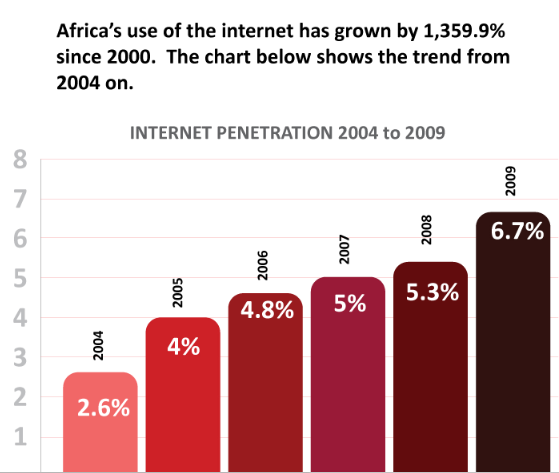
Analysys Mason’s new study published this week entitled ‘How the Internet continues to sustain growth and innovation’ reveals how the market forces that have always ensured the sustainability of the Internet in developed countries also extend to developing countries.
Analysys Mason (www.analysysmason.com) is a global specialist in telecoms, media and technology (TMT). The Internet Society (www.internetsociety.org) commissioned Analysys Mason to study the impact of increased demand for new Internet services and concerns about the sustainability of the ensuing growth.
The new study shows how, in the past, Internet challenges have been continually met in developed countries, based on a combination of new technology and investment to increase capacity, and changing business models to distribute content. Further, the report shows how investment and innovation are already addressing new demands in developing countries today.
“Challenges in the past followed the increase in demand from the first commercial web browsers, and the widespread take-up of Internet video. Today, concerns about the sustainability of the Internet in developed countries have arisen from the increased availability of mobile broadband services,
-
Reducing the Digital Divide: Internet Society Supports Establishment of Internet Exchange Points across Africa
[Johannesburg, South Africa –23 August 2012] – The Internet Society announced that it has been selected by the African Union (AU) to conduct community mobilization and technical aspects workshops to support the establishment of Internet Exchange Points (IXPs) in AU Member States as part of the African Internet Exchange System (AXIS) project. The AXIS project aims at keeping Africa’s Internet traffic local to the continent by providing capacity building and technical assistance to facilitate the establishment of National Internet Exchange Points and Regional Internet Exchange Points in Africa. The project is funded by the Euro-Africa Infrastructure Fund and the Government of Luxembourg.
The Internet Society is committed to organizing 60 community mobilization and technical aspects workshops in 30 African countries. To this effect, the Internet Society will also contribute its own resources for the implementation of this component of the AXIS project.
Africa's use of the internet by Jon Gosier (Flickr) Currently, much of Africa’s Internet traffic is routed through Internet exchange points external to the African continent. As countries establish their own IXPs, Internet traffic will be routed locally, creating a downward pressure on costs and stimulating growth in and distribution of local Internet content. Through the AXIS project, the interests of the AU and the Internet Society, working with other African Internet organizations such as AfriNIC, AfNOG and AftLD, will be realized in this collaborative effort to assist in the development of a more locally operated and, hence, more robust and economically accessible pan-African Internet.Moctar Yedaly, Head of Information Society Division, African Union Commission, commented, “Africa is paying overseas carriers to exchange ‘local’ (continental) traffic. This is both a costly as well as an inefficient way of handling inter-country exchange of Internet traffic. Independent analysis has shown that Africa pays over US$600 Million to developed countries every year for inter-African traffic exchange that is carried outside the continent. We are therefore pleased that the African Internet Exchange System project will address this challenge by facilitating optimization of Internet traffic to support intra-continental traffic flows in Africa.
Internet Society’s African Peering and Interconnection Forum Provides Opportunities for Regional Internet Growth
AfPIF-3 Highlights Regional Interconnection – Addressing Africa’s Internet Transit Deficit
© Internet Society/Shoot the Earth/ Nyani Quarmyne [Washington, D.C. and Geneva, Switzerland –13 August 2012] – The third African
Peering and Interconnection Forum (AfPIF-3), organized by the Internet Society, will
be held 22-24 August 2012 in Johannesburg, South Africa. A multistakeholder forum,
AfPIF aims to foster national and cross-border interconnection opportunities where
key stakeholders, including infrastructure and service providers, Internet Exchange
Points (IXPs), regulators, and policy makers can share experiences, hear from
experts, and advance peering and interconnection arrangements.According to recent research, nearly all peering and interconnection agreements are
forged at regional and global peering forums around the world. A unique regional
forum, AfPIF facilitates discussions on infrastructure challenges, including
terrestrial capacity issues, national and regional IXP development, local content
development, and international peering. AfPIF provides a venue for productive
technical discussions and business relationships that can be forged to augment
Internet infrastructure and services in Africa.Keynotes and panel sessions will cover topics that address Africa’s Internet transit
deficit, including Peering Negotiations and Strategies for Operators, Peering and
Transit Economics, Landlocked Countries and Cross-border Regulatory Reality,
Exploring the Content Business in Africa, and Attracting Global Content via Regional
IXPs.“AfPIF has established itself as a strategic event for conducting business in
Africa,