Tag: internet

  • Radio quiet, please!

    Radio quiet, please!

    Originally conceived over 20 years ago, there’s a project being undertaken by scientists and engineers across the whole world to help us all better understand the mysteries of the galaxy and the very beginnings of the Universe. It’s estimated to be completed by around 2024,costing $1.85 billion AUS (€1.5 billion). Once completed, it’s set to be the most complex and technologically advanced machine ever built by humanity. It will use enough optic fibre to wrap twice around the Earth and will need a computer capable of performing 10^18 operations per second – about three million times the number of stars in our galaxy. It will produce over 980 Exabytes of data every day (equivalent to about 15 million 64GB iPods) and to cope with that, it will need to handle data transfer rates over 10 times as high as the current global internet traffic. No, it isn’t a starship. But it might just be the next best thing.
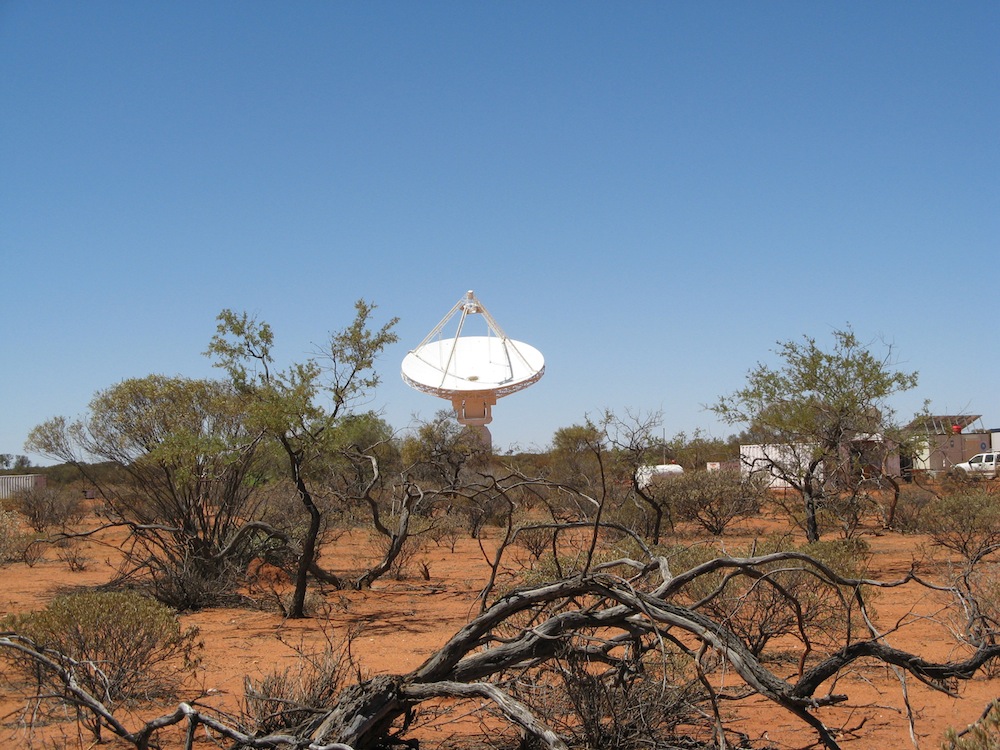
    One of the first components of the SKA, constructed in Western Australia. Credit: Dave DeBoer, CSIRO.

    The Square Kilometre Array (SKA) is one of the most ambitious scientific projects ever devised, and when completed it will comprise a huge number of telescope antennae which will work as one to form a single radio telescope so powerful that it could detect an airport radar on a planet 50 light years away. The sensitivity of any telescope is defined by the area it uses to collect data. With optical telescopes, this is the size of the mirror, and with radio telescopes it’s typically the size of the dish. The SKA gets its name because when fully constructed, all of the detectors and antennae that make it up will have a combined area of one square kilometre, or one million square metres. To put that properly into perspective, the Green Bank Telescope is currently the largest steerable single dish radio telescope, and its area is just under 8000 square metres.

    Being astronomy’s answer to the large hadron collider, the SKA is a staggeringly large international collaboration. I was lucky enough to attend a major meeting regarding the planning of the SKA (the headquarters are to be based here in the UK in Manchester), and the myriad different languages and nationalities represented was impressive to say the least. Over 24 major organisations from countries spanning 5 continents are involved in the project, ranging from universities to industrial engineering companies. New technologies, both software and hardware, are still being developed as a result of this project. Based on the huge data storage and transfer requirements of a machine as complex as the SKA, many of those new technologies are likely to feed straight back into society by offering profound improvements to computing resources like the internet. In fact, as the world’s largest project for sorting and storing data, the SKA is expected to be literally bigger than Google!
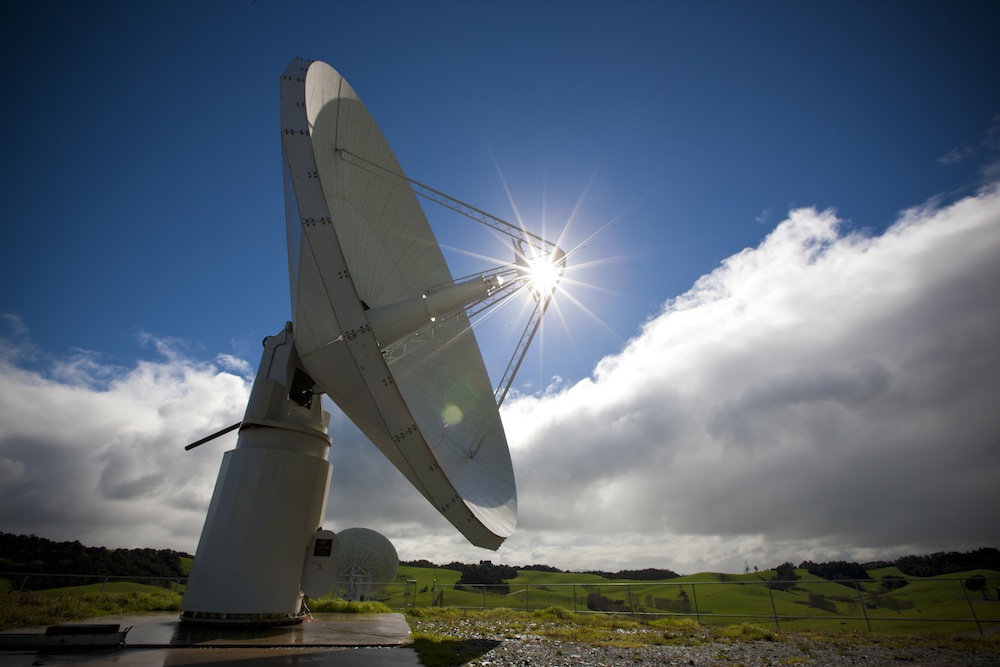
    The Warkworth antenna in New Zealand – an important part of early SKA science. Credit: Alex Wallace.

    The most difficult decision, understandably, has been where precisely to build it. Humanity has an unfortunate tendancy to fill the atmosphere of our planet with noise, bouncing radio waves to and fro and filling the air with radio frequency chatter. A radio telescope array this sensitive needs to be placed somewhere quiet to gain the full benefits, and the most recent decision has been to effectively split the SKA into two components, to be built in Southern Africa and Australia. While this may seem like an odd thing to do, it actually makes perfect sense. The SKA actually has three types of antenna operating at different frequencies. Intended to cover a huge range of radio frequencies (from 70 to 100000 MHz), three types of antenna are needed, because no single technology can actually operate across such a wide range. So the decision was made to build the lowest frequency detectors across Australia, centred at Murchison in outback Western Australia. Murchison is blessed with being one of the few places on our planet which isn’t flooded with FM radio at the low end of the frequency scale. From a radio astronomer’s point of view, it’s the quietest place on Earth.

    This is set to be complemented by the higher frequency steerable dishes which are set to be constructed across Africa. Both South Africa and Australia have put extensive efforts into developing the SKA, and Australian-developed technology is still set to be implemented in the African telescopes. This will mean a huge influx to the African astronomical community and numerous African nations won’t lose out on the economic boost from contributing to such a prestigious project. It’s an ideal situation where everyone wins.

    All in all, it’s an exciting time to be an astronomer. An epic project like this is likely to attract all manner of researchers from across the world to both continents. Just maybe, it could also finally help us to answer the really big questions, like how the galaxy formed, how the Universe began, and whether or not there’s anyone else out there.
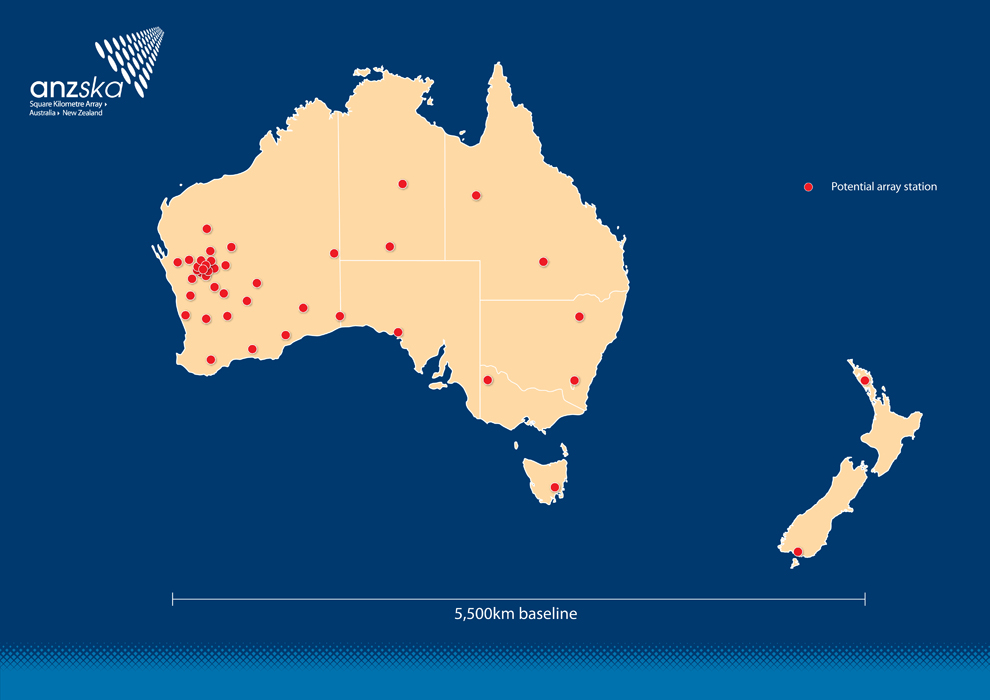

    A map of prospective SKA sites. Credit: anzska
  • Networking the Solar System

    Networking the Solar System

    When the human race inevitably expands off planet Earth, we’ll naturally want to take our internet with us – over the past 15 years or so, the internet really has become an integral part of our lives! In fact, even as you’re reading this, 300 gigawatts of electricity worldwide will have been used to transfer 640 terabytes of information across the internet to 1.5 billion desktop computers and a further billion mobile devices. In the time you’ve taken to read this paragraph, over 200 million e-mails have been sent, 6 million Facebook pages have been loaded, 1.3 million YouTube videos have been watched, and 100,000 people have posted an update to their twitter accounts.

    Astronaut Tracy Caldwell Dyson enjoying a view from the ISS Cupola window.

    Inspite of its sprawling extent on our planet though, the internet’s first step off-world was able to fit inside just 1120 bytes. On January 22, back in 2010, astronaut TJ Creamer made a small but important piece of internet history by being the first human being ever to post to a twitter feed from orbit. Astronauts had been updating twitter feeds while in orbit for some time, but they had previously always relayed their messages via NASA back here on Earth. Since 2010, however, the International Space Station (ISS) has been upgraded to have its own internet connection. Intended for personal use by astronauts and still routed through ground based systems at NASA for security, this is how e-mails, blog posts and twitter updates are sent back home. All the same, even though it might seem a long way away, the ISS is relatively nearby in low Earth orbit.

    Things start to become more complicated when you consider travelling further afield, because whether we like it or not, we can’t cheat special relativity. The speed of light is the fastest any interplanetary communication (or anything, for that matter) can travel. The Moon is still close enough that interaction is possible in almost real time. Sending a message to someone on the Moon would involve a delay of a little under three seconds. Good enough to hold a conversation, but with gamers here on Earth complaining about latencies higher than 600 milliseconds, you’re obviously not going to be able to play Halo or Warcraft against a friend over that kind of distance. Travel as far as Mars and the problem becomes even more pronounced, with delays of anywhere between 3 and 22 minutes, depending on exactly where Mars is in relation to Earth. Minutes turn to hours as you continue to travel outwards (transmissions from Voyager 2 currently take over 13 hours to reach us). All things considered, using an interplanetary internet sounds like a rather good idea for communication over distances like these. While phonecalls to Mars would be essentially impossible, delays between responses to e-mails and tweets are fairly routine. You could quite easily have a twitter conversation with someone over on a neighbouring planet.

    Preparing for the future, NASA and Google teamed up a few years ago to develop a new internet protocol designed to be used in space. Called Disruption-Tolerant Networking (DTN), it’s designed to work a bit differently to the internet we’re all familiar with. While our familiar TCP/IP systems rely on a constant connection to transfer data, this is obviously unfeasible in deep space. While a DTN network would still operate using a series of nodes passing information from machine to machine, the way ground-based networks do, each node needs to hold onto the data being transmitted until it has a confirmation that the message has been safely passed on.

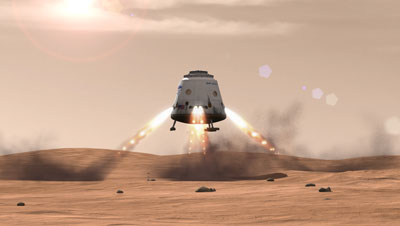
    SpaceX believe it should be possible to send people to Mars within 20 years.

    With a steadily accumulating collection of spacecraft in various parts of the solar system. Google’s Vint Cerf has expressed plans to use these old pieces of hardware, many of which have long since completed their original missions, as nodes in what will become an interplanetary internet. Indeed, spacecraft have already transmitted data amongst themselves en route back to Earth. ESA’s Mars Express probe, for instance, has served as a relay between Earth and vehicles landing on Mars, and is set to do so again when NASA’s Curiosity rover arrives at the red planet later this year. In an interview with networkworld.com last year, Cerf is quoted as  saying “…if they are still functionally operable — they have power, computer, communications — they can become nodes in an interplanetary backbone. So what can happen over time, is that we can literally grow an interplanetary network that can support both man and robotic exploration.” He continued to explain how, while all space missions to date have involved point-to-point communications, future space missions will likely require “a richer communications network.” This also has an added plus that an interplanetary network infrastructure will allow scientists to receive more data from deep space missions than is currently possible.

    With many astronauts already maintaining active twitter feeds from orbit, it has to be said that similar social networks may well play an important role in communications in the future. By the time that role is needed, a network infrastructure will likely be in place for it to operate on. A company like Google, processing petabytes of data and serving hundreds of millions of queries for an index containing billions of websites every day, is certainly qualified to help set up a computer network on interplanetary scales. Maybe in the future when people talk about Google Mars, they might mean it literally!

    Image credits: NASA/Tracy Caldwell Dyson (top), SpaceX (bottom)

  • Measuring Network Performance with M-Lab

    Measuring Network Performance with M-Lab

    Measurement Lab is an open platform for researchers to deploy Internet measurement tools. By enhancing Internet transparency, M-Lab helps sustain a healthy, innovative Internet. What this explanatory video to learn why M-Lab is important to researchers, network engineers and policy makers. M-Lab is a collaborative effort founded in 2009 by Googler Vint Cerf and a number of network researchers and industry partners, including Google.

    M-Lab’s goal is to provide researchers, consumers, policymakers, and anyone else who wants good, intelligible information about the Internet,  with open data about network performance.

    The nuts and bolts of M-Lab start with a widely-distributed server platform maintained and managed by the M-Lab Collaborative. These servers are purpose-built to support broadband measurement, and are consistently deployed to exact specifications. This means that the data they collect is consistent — important when you’re contrasting global network performance. Researchers host open-source, active broadband measurement tools on these servers, and users access these tools, run tests, and get real-time information on their network performance. Each time a user runs a test (about 200,000 times a day), data is collected and put into the public domain. So far, it’s 516 terabytes and growing.


    M-Lab is a head-to-tail solution for high quality, open data. And the best part is that it’s all open. From the testing methodology described in the open source code of the tools, to the server documentation, to the data collected, scientists and others can vet exactly what is being measured, how it’s measured, and what precisely this says about networks and performance. M-Lab’s momentum is generated by working together from a shared source of data to progress the state of networks.

     Source.

  • Occupy the Internet! Why is so viral this expression?

    Occupy the Internet! Why is so viral this expression?

    The animated occupation soldiers are in front of the line and they espect the orders to occupy the internet. This is a real battle, because people took to the streets of internet to show their messages. Many websites are occupied, in fact there is a list with the websites currently being occupied. fffff.at published here a list with such websites and you can use the Occupy Service. You copy and paste a code into any HTML page to your website or to websites you control (or, attention, you can get control of).

    This thing represents the effect of some acts like SOPA, PIPA or ACTA. Occupation movement implies an “army

  • ScienceOnline2012 – The power of the Scientific Community

    ScienceOnline2012 – The power of the Scientific Community


    I want to share some of my personal experiences from the past meetings of the Science online unconference as someone who have participated and attended the conference. I have attended Science Online twice: I have held a session on Open access e-resources in the networked world (2009) and held a workshop – Social Media for the Scientists (2010); interacted, being overwhelmed with positive energy, had wonderful conversations with  scientists, journalists, educators, bloggers, Web developers, and scholars.

    And it all started several years ago, thanks to the initiative and organization of Bora Zivkovic and Anton Zuiker, in Bora’s words:

    “…upon my return from a bloggercon of some kind, I was enthused by the atmosphere at the event and thought to myself how nice it would be to have something similar but with a focus on science. I posted my thoughts on the blog and received many enthusiastic comments and e-mails. But I did not really have a good concept or ideas how to actually make it happen.

    Enter Anton Zuiker. At one of our regular monthly blogger meetups which he organized at the time, Anton took me aside and suggested we work on this project together. It was do-able, he thought, if we did it smart.

    Several months later, the first conference became a reality.

    And people loved it and made sure we understood that this was not going to be a one-time event, but something we’ll have to organize every year. So we did.

  • WWW12 Conference: Transformation of the Social Web

    WWW12 Conference: Transformation of the Social Web

    This year the World Wide Web conference (or WWW12) is taking place in Europe (Lyon, France) . It was first conceived as an idea in 1989 by Tim Berners-Lee at CERN in Geneva while the first conference of the series was held in 1994. Ever since  then World Wide Webn has became an annual event changing location between North America, Europe, and Asia. The official keynote speakers are announced,  and we can expect interesting forum for researchers and practitioners in Web technologies to discuss and exchange positions on current and emergent Web topics.

    The WWW Conference series aims to provide the world a premier forum for discussion and debate about the evolution of the Web, the standardisation of its associated technologies, and the impact of those technologies on society and culture. The conferences bring together researchers, developers, users and commercial ventures – indeed all who are passionate about the Web and what it has to offer;  it is stated as the primary mission of the conference. The series provides an open forum in which all opinions can be presented, subject to a strict process of peer review.

    What is interesting for WWW12 is that this year the specific focus is the most important topics on a global concern in information-communication and web technologies in our society.  The focus is on the social evolution on how web changes our world (World Digital Solidarity), how to reduce digital divide and social inequalities using the web (remember previous discussions of mine on digital divides and what I said). Another is Web Accessibility initiative that aims on “web for all

  • The Future of Internet Search

    The Future of Internet Search

    emotivWhat does the future hold for search engines? Is Google as far as the realm of Internet search will go? According to the Technological Singularity hypothesis, Internet search has not yet reached the apex. A technological singularity occurs when the intellectual capacity of humans has been so greatly augmented by technology that it facilitates a hyperintelligence. Under this hypothesis, Internet search is bound to succumb to knowledge in the next few decades.
    Theoretically, the human capacity for learning and knowledge acquisition is endless. A human could conceivably store and parse more information than Watson, the artificial intelligence computer system developed by IBM. Watson’s 15 terabytes of human knowledge and superfast algorithmic processing power came in handy when it beat the whip-smart champions of the television quiz show Jeopardy! in February, 2011.

    The human processes of learning, teaching and knowledge acquisition have been significantly augmented by the Information Age. While the advances in Internet technology have come a long way from the days of dial-up modems, bulletin board systems and America Online, the search interface paradigm basically remains the same: users need some sort of input device and an Internet connection to access information. Whether it’s a keyboard, touch screen or voice command, humans are dependent on external hardware input devices.

    What if the external interfaces could be eliminated, or at least minimized so that they can no longer be classified as hardware? The current answer to that question lies in the world of brain-computer interfaces, which are commercially available and open to developers. Brain-computer interfaces are wonders of electroencephalography (EEG) technology that allow true wireless, hands-free and voiceless interaction between humans and external devices. The Emotiv EPOC is such a device. While it may sound -and look- like something out of a William Gibson cyberpunk novel, the Emotiv EPOC is able to recognize thought patterns via electrodes and translate them into actions.

    The Emotiv EPOC is mostly used for computer gaming these days, but the day will soon come when brain-computer interfaces can execute a Google search. Think about the SEO and marketing possibilities: custom search results and advertising based on the user’s thoughts, emotions and general state of mind. What is your opinion about neural SEO? What can be accomplished in terms of Internet marketing? Please leave your comments and ideas.

  • Impact of wireless networks on human health

    Impact of wireless networks on human health

    In the modern days wireless technology has become indispensible and is a part of our every-day lives. We have it with remote controls, video cameras, baby monitors and of course mobile phones and wireless internet connections. Despite all its benefits many are concerned about its influence on our health.

    Basics:

    Wireless computer networks have become commonplace in our environment. Wireless hotspots are found in many public areas and, increasingly, in homes and schools. Wireless networks use low-powered radiofrequency (RF) transmitters called access points to communicate with other low-powered transmitters called client cards that are located in users’ laptop computers or other portable equipment. Nearly all of these wireless networks use Wi-Fi technology, although other wireless technologies are coming into use as well.[1]
    Mobile telephony is now commonplace around the world. This wireless technology relies upon an extensive network of fixed antennas, or base stations, relaying information with radiofrequency (RF) signals. Over 1.4 million base stations exist worldwide and the number is increasing significantly with the introduction of third generation technology.

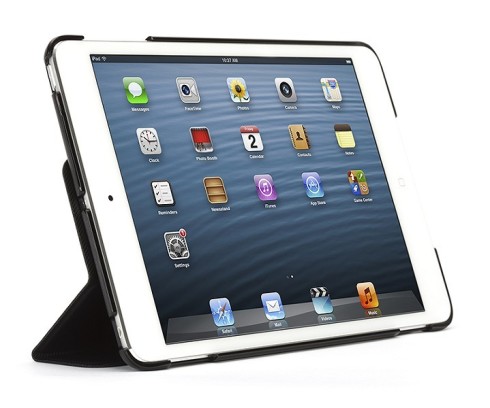
    ipad
    Image source: www.macfixit.com.au

    There has been concern about possible health consequences from exposure to the RF fields produced by wireless technologies. This fact sheet reviews the scientific evidence on the health effects from continuous low-level human exposure to base stations and other local wireless networks.

    Health concerns

    To date, the only health effect from RF fields identified in scientific reviews has been related to an increase in body temperature (> 1 °C) from exposure at very high field intensity found only in certain industrial facilities, such as RF heaters. The levels of RF exposure from base stations and wireless networks are so low that the temperature increases are insignificant and do not affect human health.
    In fact, due to their lower frequency, at similar RF exposure levels, the body absorbs up to five times more of the signal from FM radio and television than from base stations.

    Cancer:

    Scientific evidence on the distribution of cancer in the population can be obtained through carefully planned and executed epidemiological studies. Over the past 15 years, studies examining a potential relationship between RF transmitters and cancer have been published. These studies have not provided evidence that RF exposure from the transmitters increases the risk of cancer.
    Considering the very low exposure levels and research results collected to date, there is no convincing scientific evidence that the weak RF signals from base stations and wireless networks cause adverse health effects.[2]
    Also, the results, which are detailed in the Health Physics paper, show that in all cases the measured Wi-Fi signal levels were very far below international safety limits, specifically, those of the Institute of Electrical and Electronics Engineers and the International Commission on Nonionizing Radiation Protection (ICNIRP 2002). These limits were designed to protect against all known hazards of RF energy. [3]
    The World Health Organization has acknowledged that electromagnetic fields (EMFs) are influencing the environment (but not people), and that some people are worried about possible effects. In response to public concern, the World Health Organization established the International EMF Project in 1996 to assess the scientific evidence of possible health effects of EMF in the frequency range from 0 to 300 GHz. They have stated that although extensive research has been conducted into possible health effects of exposure to many parts of the frequency spectrum, all reviews conducted so far have indicated that exposures are below the limits recommended in the ICNIRP (1998) EMF guidelines, covering the full frequency range from 0–300 GHz, and do not produce any known adverse health effect.[4]

    Conclusion:

    After conducting numerous researches on the subject of impact of wireless networks on human health, the same conclusion was reached: there is no convincing evidence that exposure to RF causes any health problems. However, there are some limitations as to how high a level of frequency people can be exposed to and it should be respected.

    References:

    [1] http://www.hps.org/hpspublications/articles/wirelessnetworks.html
    [2] http://www.who.int/mediacentre/factsheets/fs304/en/index.html
    [3] http://www.hps.org/hpspublications/articles/wirelessnetworks.html
    [4] http://en.wikipedia.org/wiki/Wireless_electronic_devices_and_health