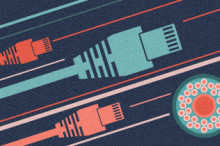
In an increasingly information-oriented world maximising the speed of data transfer and download are crucial to competitiveness in the workplace. Needless to say, not all cables are the same, even though they may feature the same input – e.g. USB or HDMI. The material they are made of will have a major impact on reliability, durability and speed.
Common Cable Types
Different types of telecommunications cables include copper, aluminum, and fibre optic cables. Aluminum and copper are the cheapest type of cable with copper being more durable and flexible than the former. Aluminum is significantly cheaper than copper cable, though copper is faster and has become the standard for telecommunications companies, particularly prior to the gradual switch over to fibre optic cables, and the age of high speed broadband.
Whilst copper and aluminum cable are made by bundling pairs of copper or aluminum strands together before jacketing them, the fibre optic cable is made of glass or plastic fibres through which light is transmitted allowing for even greater speeds of data transmission.
Factors Affecting Speed of Copper Cable
Ethernet cable consists of several twisted pairs of copper wiring, which cancel out the interference. This interference would otherwise produce background noise during telephone or internet communications.
Ethernet cable is divided into categories, which currently run from Cat.4 through to Cat7.a, with categories 8.1 and 8.2 under development. Level1, Level2 and Cat.3 and Cat.4 twisted pair cables run from 0.4 to 20 Mhz, which is relatively slow, and are suitable for telephone calls and slow dial-up connections only. Of these only Cat.3 is commonly used.
The cables most likely to be in use for data communications run from Cat.5 to Cat.6a, with Cat.5e (an enhanced version of the Cat.5 cable) and above used on all new cable installations. Cat.5 is suitable for large scale data transfer over short distances, though Cat.5e is better for high speed Gigabit Ethernet. Whilst both categories have a bandwidth of 100 Mhz, Cat.5e has features designed to deal with ‘crosstalk’, which is the undesirable phenomenon whereby two wires which are paired together interfere with each other’s signals.
Cat.6 performs at up to 250 Mhz and has further features to deal with crosstalk, whilst Cat.6a (or augmented category 6) performs at 500 Mhz. Other factors which affect twisted pair cable categorisations include the length at which a wire can be run between terminals and its durability.
Advantages of Fibre Optic over Copper Cable
While copper is capable of high speed data transfer and is likely to be used for many years to come, making it an ideal choice for your home or office network, fibre optic cable is set to become the standard over time.

Fibre optic cable carries visible light or infrared signals which are bounced across the inside of the cable through a process of ’internal reflection’, at an even frequency, reducing interference and delivering data in an even manner. A fibre optic cable consists of thousands of hair-width glass fibres bundled together.
Although fibre optic cable is in most cases more expensive than copper cable, it is less expensive to maintain and can be installed over greater distances. It also has a higher bandwidth making it a popular choice choice for telecommunications companies. It is more secure, being difficult to ‘tap into’, not least as any resulting interference from a third party would involve an obvious loss of light, causing the system to fail. Additionally, fibre optic is less subject to environmental factors such as changes in temperature and can make contact with water without risk, reducing the need for excessive insulation.
Scientists in New Zealand have recently produced a new fibre optic cable capable of delivering the entire world’s internet traffic down one cable due to their having inserted several cores in each hair-like glass fibre. Whilst such speed has little application in daily or business computing, they do point to the superiority of fibre optic cable in the long run.

 Joanne Manaster is a cell and molecular biology lecturer at the University of Illinois. She currently works as an online course developer and lecturer of science courses for the


 Contact us if you’d like to join our team of science and tech bloggers and authors – please read the


 So how far away are we from planet Earth morphing into Holodeck 5 and we all have Geordi La Forge glasses? There are several pairs of augmented reality glasses already on the market, many from brands you’ve probably never heard of, but then I’m sure you have heard of
 We hear…but do we comprehend? What connection does our brain make to statements transmitted through our auditory canal such as global warming is increasing at 0.13°C per year? Or there are 495 dead zones covering 95,000 square miles of our world’s oceans as a result of increased runoff from agriculture? We see…but are those images stored in our brain, to recall in decision making when confronted with a particular behavior choice? For instance when the image of a little girl sifting through a rubbish pile looking for a bite to eat burns onto our retinas, do we remember that later when we casually toss out half our dinner plate in a Styrofoam takeout container? How many of us in the developed world actually comprehend that our actions contribute directly to global warming?