Hello everyone. I hope you’ve all had a good week! It’s a balmy Autumn evening here in the UK where I sit as I write this – and I must say, this week’s science picks include something quite historic…
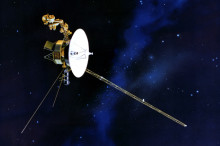
Anyone with half an eye on the science news recently should know by now that it’s been officially confirmed that NASA’s Voyager 1 probe is has now been confirmed as being in interstellar space. It is no longer within the Sun’s heliosphere and no longer feels the solar wind. To Voyager, the Sun is now simply another star in the sky. Though as Phil Plait points out, being in interstellar space is not technically the same thing as leaving the solar system.
However, there’s more to our solar system’s far-flung suburbs than errant electrons and protons. Even out there, over 120 times farther from the Sun than the Earth’s orbit, there are more substantive objects: huge, frozen chunks of ice that are essentially giant comets… It’s like walking outside the front door of your house and saying you’ve left your property. While you’ve left your house, there’s still the yard all around you. You have a ways to go yet.
Citizen Science has been around for a while now, as a fun and interesting way of getting internet users to casually help scientists analyse vast amounts of data. So the latest idea is to use online gaming and social media platforms like Facebook to bolster the effort…
One example, a smartphone game set for release later this year, is currently called “GeneGame”. Players of the game, developed by Cancer Research UK, will be contributing to the identification of cancer-causing genetic faults from tumour samples. In a crucial difference to the Galaxy Zoo experiment, the scientific research will be a indirect consequence of the gameplay, rather than the explicit focus of the gameplay.
From a long departed craft, to one of the most recent, NASA’s LADEE vehicle is currently en route to the Moon, to study its tenuous atmosphere (and the word “Atmosphere” is used rather loosely here, believe me). But as the probe was launched, there was an unfortunate amphibian casualty. You see, the launch pads at NASA’s Wallops facility are built in rather swampy areas…
From NASA: “A still camera on a sound trigger captured this intriguing photo of an airborne frog as NASA’s LADEE spacecraft lifts off from Pad 0B at Wallops Flight Facility in Virginia. The photo team confirms the frog is real and was captured in a single frame by one of the remote cameras used to photograph the launch. The condition of the frog, however, is uncertain.
Computers are everywhere these days. They play us music, tell us when to wake up, remind us that we’re late for an appointment, and provide us with entertainment. Even if we don’t realise it, so ingrained in our lives are computers that the world would be a very different place without them. Computing is also an incredibly fast moving field of technology, and research is finally taking us towards the exciting world of quantum computing!
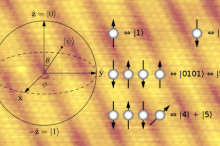
Quantum computers will work using quantum bits, or qubits for short, which are analogous to the digital bits used in computers like the one which you’re using to read this article. Recently, a team of engineers at the University of New South Wales (UNSW) has successfully demonstrated, for the first time ever, how a single atom can be act as a qubit, effectively showing the first step in building an ultra fast quantum computer. And they might just have created the best qubit ever made.
A quantum computer is, simply, a computer which makes use of quantum mechanical phenomena to perform calculations. Well, I say “simply”… Let’s step back a moment. The simplest form of computers involve actual moving objects, and using the positions of those objects to perform calculations. This is essentially how an abacus works, if you’ve ever used one. The earliest computers to be designed, automated this process, using mechanisms. Charles Babbage’s famous, albeit never built, Analytical Engine worked on exactly this basic principle, and if it had been constructed it would have truly been the world’s first computer.
Essentially, the way these old mechanical computers work is to use the positions of their mechanical parts to perform mathematical and logic functions. This is actually the fundamental way in which all computers work. Since the discovery of electricity and the invention of electronics, computers have worked using electric circuits – effectively using the position of electrons instead of the position of actual moving parts. As technology has progressed, computers have become faster, smaller, and more reliable, until the world around us today.
In modern electronics, silicon is king. Silicon-based electronics are the standard used everywhere, though they’re reaching the limit of what they’re capable of. For the next generation of electronics, some people are beginning to advocate new materials, such as graphene, over silicon. But ultimately, others have a higher goal. Proponents of quantum computing believe that in the future, the most vital components of computers will not be electronics at all, but single atoms.
In quantum mechanics, any single particle, from an electron to an atomic nucleus, has a set of properties which can often be changed quite easily. Where past computers used motion of mechanical parts and modern computers use motion of electrons, quantum computers will use changes in the properties of these particles to perform their calculations.
One such quantum property is known as spin (the same property behind magnetism), and this is what the UNSW engineers managed to manipulate. They based their qubit on a single silicon atom and demonstrated how they used changes in the nuclear spin of the nucleus to store and retrieve information. Andrea Morello at UNSW’s School of Electrical Engineering and Telecommunications described how; “We have adapted magnetic resonance technology, commonly known for its application in chemical analysis and MRI scans, to control and read-out the nuclear spin of a single atom in real time.
Well okay, maybe a little more than a minute. Three minutes tops. Well okay, maybe five minutes and throw in an appreciation of watching cartoons and Youtube videos. That’s it.
I was skeptical when I stumbled on Henry Reich’s MinutePhysics Youtube channel one night. How could anyone explain light, The Big Bang or relativity in just minutes and be understood? I decided to watch one in the expectation that I would be sent to sleep. It was well past midnight. In the end, I didn’t go to sleep until after I had watched every MinutePhysics video in existence. I was hooked. It all started with an explanation of what fire is.
I come across people who have not heard of MinutePhysics so here I am telling everyone on the internet. Each of Henry’s videos is well researched and easy to understand. It is firmly on the list of Youtube channels that I have subscribed to.
Henry Reich
Henry creates every MinutePhysics stop motion video himself. He draws, narrates and edits the entire thing. This is because while Henry has a Masters in Physics from the Perimeter Institute for Theoretical Physics he had also pursued filmmaking as a hobby. After the masters was finished, Henry pursued filmmaking more seriously and discovered that Youtube isn’t just about cute cat videos.
“After I finished my masters at the Perimeter Institute for Theoretical Physics, I took some time to work in film/video and ended up working for the youtube channel “Freddiew” where I learned that you could actually make videos intentionally for youtube,” says Henry.
“I’ve also always enjoyed explaining complicated things, so it seemed like it might be fun to try making some videos to explain complicated physics to the public.”
This is what Henry does and he does it well. Nothing seems too small or too big to tackle. He reads every personal message that is sent to him on Youtube and Facebook and does his best to respond. When asked on how he judges a video to be successful, it is not the number of views or whether it has gone viral. The answer Henry gives is humble and reflective.
“I know a video is successful when a middle schooler and the Nobel Laureate who did the research I’m explaining both tell me how much they liked the video.”
Henry doesn’t just make videos on physics found in textbooks and highlights how they do influence our everyday lives whether we think about it or not. He also makes videos on physics discoveries as they happen. One great example of this was when the Higgs Boson discovery was announced. He made a three part video series found its way onto New Scientist, Huffington Post, and NBC.
This is the first video in the Higgs Boson series.
Henry’s enthusiasm for theoretical physics is evident in his videos as he unpacks ideas and concepts for his audience and it is infectious. The videos spawn endless conversation on his Youtube and Facebook pages. After more than a year working on MinutePhysics, Henry has teamed up with other scientists creating MinuteEarth, a Youtube channel bringing together biology, geology, ecology, anthropology, and more.
So if you have a minute, you can learn just about anything.
What exactly is a liquid? It’s a seemingly basic question with an answer which may seem obvious to any of us. But as with so many things in science, it may not be as straightforward as you think. Of course you know what a liquid is, and the answer which may have come to mind as you read this paragraph is most certainly the truth – but it may not be all of it.
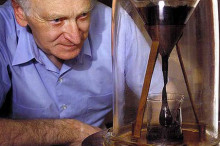
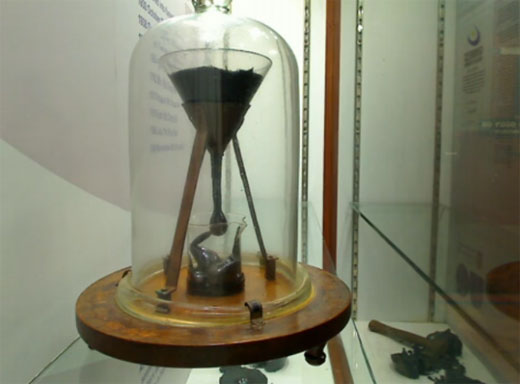
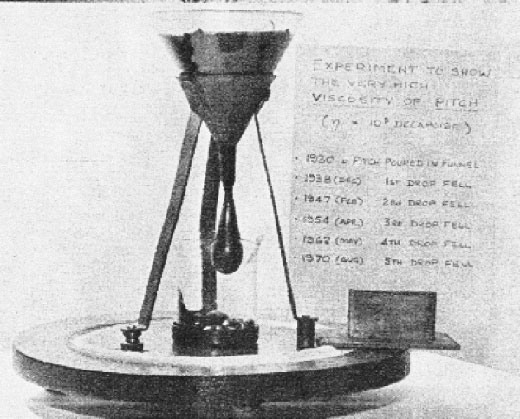
This curious looking setup is the pitch drop experiment. Some people reading this will undoubtedly know of it. Set up at the University of Queensland in 1927 by Professor Thomas Parnell, this experiment may take a few of your ideas about what a liquid actually is and turn them on their heads.
Pitch, you see, is a liquid. But if you were to see some of it up close, you might not think so. To our eyes and senses, it appears to be a solid. It’s a black, waxy looking substance, a derivative of tar which ship builders used to use to waterproof boats. You can think of it more or less like a liquid which moves in slow motion. Extremely slow motion! Pitch is so viscous and flows so slowly that you can quite easily pick up a piece of it and hold it in your hands. You can snap pieces of it off, and if you hit it with a hammer, it will even shatter. But make no mistake – pitch is not a solid.
Perhaps a better word to use here is not liquid, but “fluid.” A fluid is, simply, any substance which is able to flow. Everyday liquids like water are fluids, as are gasses like the air around us. So too are the thicker, more viscous liquids you may encounter, like treacle or tomato ketchup. But pitch is quite possibly the most viscous fluid in the whole world, an average 100 billion times as viscous as water.
Parnell’s pitch drop experiment, presently looked after by Professor John Mainstone, was set up to demonstrate this bizarre fact. In 1927, Parnell heated a sample of pitch and poured it into a sealed glass funnel. He gave the black tarry fluid three full years to “settle” before cutting open the stem of the funnel and leaving it to its own devices, kept in relatively inert conditions under a large glass bell jar. I say relatively inert. This experiment is really more of a demonstration, and how fast the pitch flows depends on the seasons – it moves ever so slightly faster in warm weather, though still never so fast as to be actually noticeable. In the 83 years since, this slow moving tarball is currently forming it’s ninth drop.
In material science terms, pitch is a “viscoelastic polymer”. You may be familiar with some other, similar liquids without realising it. There are, you see, a few materials which very slowly flow over time. The effect is so slow that it takes a significant fraction of your lifespan to notice any motion, but it is there. Certain types of varnish actually have similar, very slowly flowing properties, which can be a concern in the art world. Paintings are often handed down through generations, and anyone wishing to preserve them must be careful not to use varnishes which may slowly flow and spoil the artwork.
On the other hand, there’s a common misconception that glass flows this way. This is absolutely not true. Glass, you see, is not viscoelastic. It’s what’s termed, an “amorphous solid”. Amorphous materials have no order at the atomic level. Many plastics, like the type which makes up the bottles you may buy drinks in, are amorphous this way. If you were to look at a piece of glass on a very, very small scale, you’d find that it’s made up of a web of molecular chains, made from silicon and oxygen atoms. But amorphous solids are not fluid. You can leave a piece of glass alone for centuries, and it will not flow at all.
Actually, glass is quite a generic term, referring to a whole variety of materials. Any material which is rigid and brittle, with a disordered structure, is technically a glass. As well as the glass in windows, many types of plastic, such as polycarbonate and perspex, are technically glasses. Even metals can be made into a glass. If you shave, the razorblade you use is probably made from a glassy metal. Glasses can be pulled and stretched (this is one way in which fibre optics are made), but if you leave them alone, they’ll remain perfectly solid.
Viscoelastic polymers are not like glass. They may have a disordered structure, like a glass, but they behave rather differently, even though you may not realise this at first glance. The word viscoelastic itself, gives away what’s really going on. These materials are both viscous, and elastic. Being elastic, you can stretch them, and they will try to return to their original shape. Leave them alone, and they’ll behave like viscous liquids, and slowly flow. This is because unlike glasses, the molecular chains which make them up aren’t tightly interconnected. Instead, they’re a tangled mess, looking, if I’m honest, not unlike my hair does when I wake up some mornings. Because those chains aren’t joined together, they can slowly slip past each other, which is what gives these materials their fluid properties. Anyone who’s used gloss paint may have noticed how a surface which appears to be smooth will sometimes have visible drops running down it hours later, where the paint flowed before it had time to dry. Unlike pitch, however, most types of paint do eventually dry and harden. Viscoelastic materials, like amorphous materials, are also defined by how they behave at the molecular level – any material can only move as fast as its molecules allow. If you take a highly viscous fluid like pitch and try to move it too quickly, the molecular chains which make it up won’t be able to move fast enough, and it will simply snap. It’s only if you leave it alone for long enough, that you can see it’s fluid behaviour.
This is precisely what Parnell did with the pitch drop experiment all those years ago. To date, it’s already managed to prove his point. The pitch in that funnel, kept at Queensland University, is very definitely flowing just like a liquid. It’s just an excruciatingly slow liquid.
To date, no one has been around to actually witness a drop falling. I’ve no doubt, this must be very frustrating for people like John Mainstone (who actually missed one drop in 1988 because he’d just stepped out to get some coffee). So far, the pitch has dropped just over once a decade.If you’re feeling lucky, you can watch a live webcam feed at the Queensland University website, where three webcams now monitor it at all times. Though I should warn you that it’s possibly even less exciting than watching paint dry. Some are beginning to say that the ninth drop may fall soon. But then, they’ve already been saying that for years…
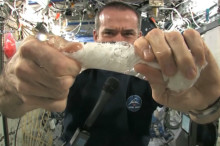
At the top of my list this week would have to be the ISS Commander Chris Hadfield from Canadian Space Agency wringing out a wet towel in zero gravity. If you haven’t watched it yet. Do it now.
The explanation behind what happens is more in depth than “magic”. Cmdr Hadfield is right when he mentions surface tension of water. Though it doesn’t explain the chemistry and physics of what is happening and also why he wasn’t worried about the exposed electronics in the ISS. I have to admit I was worried about droplets of water travelling out and into the wiring because water molecules are attracted to one another due to its molecular structure. I should have realised this being a chemist and all.
What I especially like about Cmdr Hadfield is that he includes people on Earth in his daily routine on the ISS. He replies to people’s tweets. I personally got a kick when he retweeted one of my tweets. Real time communication with an astronaut on the ISS. That’s awesome. He also includes school students allowing them to ask him questions. If you’re on Twitter and he isn’t someone you’re following, go find him at @Cmdr_Hadfield.
One reason why tumours grow is that they suppress the immune system so scientists thought to exploit this hoping that introduced Listeria would concentrate in tumour sites and deliver targeted radiotherapy. They introduced Listeria bacteria dosed with radioisotopes in mice with pancreatic cancer.
The results are really promising. The mice that received this treatment had 90% fewer cancer tumours in other areas of the body than those who had received radiotherapy and saline. The original cancer in the pancreas though was unaffected. It’s early days and it’s a long way from human trials. There is still the need to explain what was observed in this trial and what remains unknown is the effect of radiation on healthy organs.
Pancreatic cancer is the 6th highest cause of death for all cancer types in Australia, and only about 6% of people with this cancer survive 5 years after diagnosis compared to a 5-year survival of 88% for breast cancer, 93% for thyroid cancer and 19% for lung cancer. Currently there are very few treatment options available.
Long distance weather reports are now a commonality. The report for 2MASSJ22282889-431026 is somewhat unusual. It forecasts wind-driven, planet-sized clouds, with the light varying in time, brightening and dimming about every 90 minutes. The clouds on 2MASSJ22282889-431026 are composed of hot grains of sand, liquid drops of iron, and other exotic compounds. Definitely not the first place to spend a summer holiday.
Not that 2MASSJ22282889-431026 (or 2M2228 as it is known in The Astrophysical Journal Letters) will appear on a travel itinerary anytime soon. For 2M2228 is a brown dwarf, 39.1 light years from earth. Brown dwarves form out of condensing gas, as stars do, but lack the mass to fuse hydrogen atoms and produce energy. Instead, these objects, which some call failed stars, are more similar to gas planets, such as Jupiter and Saturn, with their complex, varied atmospheres. Although brown dwarves are cool relative to other stars, they are actually hot by earthly standards. This particular object is about 600 to 700 degrees Celsius.
The atmosphere of 2M2228
Astronomers using NASA’s Spitzer and Hubble space telescopes have probed the stormy atmosphere of this brown dwarf, creating the most detailed “weather map” yet for this class of cool, star-like orbs. “With Hubble and Spitzer, we were able to look at different atmospheric layers of a brown dwarf, similar to the way doctors use medical imaging techniques to study the different tissues in your body,” said Daniel Apai, the principal investigator of the research at the University of Arizona in Tucson.
But more surprising, the team also found the timing of this change in brightness depended on whether they looked using different wavelengths of infrared light.
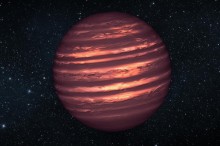
This artist’s illustration shows the atmosphere of a brown dwarf called 2MASSJ22282889-431026, which was observed simultaneously by NASA’s Spitzer and Hubble space telescopes. The results were unexpected, revealing offset layers of material as indicated in the diagram. For example, the large, bright patch in the outer layer has shifted to the right in the inner layer. The observations indicate this brown dwarf — a ball of gas that “failed” to become a star — is marked by wind-driven, planet-size clouds. The observations were made using different wavelength of light: Hubble sees infrared light from deeper in the object, while Spitzer sees longer-wavelength infrared light from the outermost surface. Both telescopes watched the brown dwarf as it rotated every 1.4 hours, changing in brightness as brighter or darker patches turned into the visible hemisphere. At each observed wavelength, the timing of the changes in brightness was offset, or out of phase, indicating the shifting layers of material. Image credit: NASA/JPL-Caltech.
These variations are the result of different layers or patches of material swirling around the brown dwarf in windy storms as large as Earth itself. Spitzer and Hubble see different atmospheric layers because certain infrared wavelengths are blocked by vapors of water and methane high up, while other infrared wavelengths emerge from much deeper layers.
The new research is a stepping-stone toward a better understanding not only of brown dwarves, but also of the atmospheres of planets beyond our solar system.
The Spitzer Space Telescope consists of a 0.85-meter diameter telescope and three cryogenically-cooled science instruments which perform imaging and spectroscopy in the 3 – 180 micron wavelength range. Since infrared is primarily heat radiation, detectors are most sensitive to infrared light when they are kept extremely cold. Using the latest in large-format detector arrays, Spitzer is able to make observations that are more sensitive than any previous mission. Spitzer’s mission lifetime requirement was 2.5 years, then extended this to 5-years. Spitzer .
Launched on August 25, 2003 Spitzer is now more than 9 years into its mission, and orbits around the sun more than 100-million kilometers behind Earth. It has heated up just a bit – its instruments have warmed up from -271 Celsius to -242 Celsius. This is still way colder than a chunk of ice at 0 Celsius. More importantly, it is still cold enough for some of Spitzer’s infrared detectors to keep on probing the cosmos for at least two more years; the project funding has been extended to 2016.
Spitzer seen against the infrared sky. The band of light is the glowing dust emission from the Milky Way galaxy seen at 100 microns (as seen by the IRAS/COBE missions). Image credit NASA/JPL
Spitzer is the largest infrared telescope ever launched into space. Its highly sensitive instruments allow scientists to peer into cosmic regions that are hidden from optical telescopes, including dusty stellar nurseries, the centres of galaxies, and newly forming planetary systems. Spitzer’s infrared eyes also allows astronomers see cooler objects in space, like brown dwarves, extrasolar planets, giant molecular clouds, and organic molecules that may hold the secret to life on other planets.
Instead of orbiting Earth itself, the observatory trails behind Earth as it orbits the Sun and drifts away from us at about 1/10th of one astronomical unit per year.
This innovative orbit lets nature cool the telescope, allowing the observatory to operate for around 5.5 years using 360 litres of liquid helium coolant. In comparison, Spitzer’s predecessor, the Infrared Astronomical Satellite, used 520 litres of cryogen in only 10 months.
This unique orbital trajectory also keeps the observatory away from much of Earth’s heat, which can reach 250 Kelvin (-23 Celsius) for satellites and spacecraft in more conventional near-Earth orbits.
More scientific duets: the asteroid belt of Vega
Like a gracefully aging rock star Spitzer is reveling in duets. It has also teamed up with the European Space Agency‘s Herschel Space Observatory. Using data from both astronomers have discovered what appears to be a large asteroid belts around the star Vega, the second brightest star in northern night skies.
The data are consistent with the star having an inner, warm belt and outer, cool belt separated by a gap. The discovery of this asteroid belt-like band of debris around Vega makes the star similar to another observed star called Fomalhaut. Again this formation is similar to the asteroid and Kuiper belts in our own solar system.
Astronomers have discovered what appears to be a large asteroid belt around the bright star Vega, as illustrated here at left in brown. The ring of warm, rocky debris was detected using NASA’s Spitzer Space Telescope, and the European Space Agency’s Herschel Space Observatory. In this diagram, the Vega system, which was already known to have a cooler outer belt of comets (orange), is compared to our solar system with its asteroid and Kuiper belts. The relative size of our solar system compared to Vega is illustrated by the small drawing in the middle. On the right, our solar system is scaled up four times. The comparison illustrates that both systems have inner and outer belts with similar proportions. The gap between the inner and outer debris belts in both systems works out to a ratio of about 1-to-10, with the outer belt 10 times farther away from its host star than the inner belt. Astronomers think that the gap in the Vega system may be filled with planets, as is the case in our solar system. Image credit: NASA/JPL-Caltech.
What is maintaining the gap between the warm and cool belts around Vega and Fomalhaut? The results strongly suggest the answer is multiple planets. Our solar system’s asteroid belt, which lies between Mars and Jupiter, is maintained by the gravity of the terrestrial planets and the giant planets, and the outer Kuiper belt is sculpted by the giant planets.
“Our findings (accepted for publication in the Astrophysical Journal) echo recent results showing multiple-planet systems are common beyond our sun,” said Kate Su, an astronomer at the Steward Observatory at the University of Arizona, Tucson.
Vega and Fomalhaut are similar in other ways. Both are about twice the mass of our sun and burn a hotter, bluer color in visible light. Both stars are relatively nearby, at about 25 light-years away. Fomalhaut is thought to be around 400 million years old, but Vega could be closer to its 600 millionth birthday. For comparison our sun is 4,600 million years old. Fomalhaut has a single candidate planet orbiting it, Fomalhaut b, which orbits at the inner edge of its cometary belt.
The Herschel and Spitzer telescopes detected infrared light emitted by warm and cold dust in discrete bands around Vega and Fomalhaut, discovering the new asteroid belt around Vega and confirming the existence of the other belts around both stars. Comets and the collisions of rocky chunks replenish the dust in these bands. The inner belts in these systems cannot be seen in visible light because the glare of their stars outshines them.
It would seem that Spitzer has quite a bit more productive and novel scientific life, including duets, left in it yet.
Astronomy is quite notorious for being full of things we don’t entirely understand. Sometimes it really does feel as if the closer we look at the Universe, the less it makes sense. One thing in particular which seems to constantly evade our understanding is the way in which galaxies work. A lot of very smart people spend a lot of time taking telescope observations and creating computer simulations to try and understand how exactly a galaxy can form and evolve, and every now and again someone will discover something which doesn’t seem to fit with what they were expecting. Occasionally we find something like that which is, at least in cosmic terms, right in our back yard.
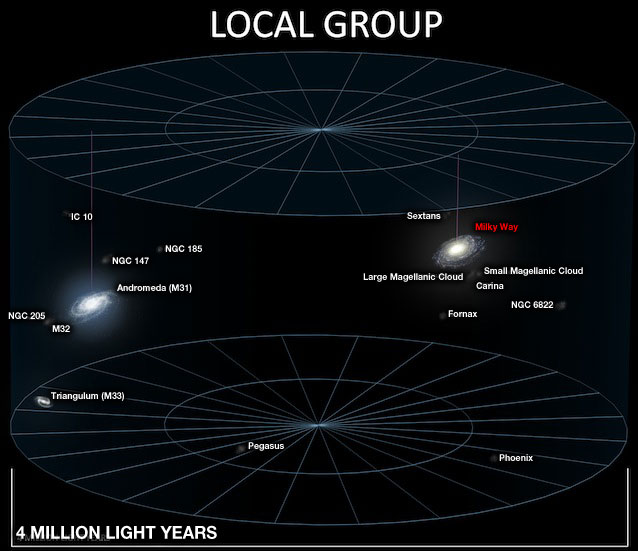
The Andromeda galaxy is practically a twin sister to our own Milky Way. Slightly larger than us but slightly less massive, Andromeda lies around 2.5 million light years away, and between them Andromeda and the Milky Way dominate the local group of galaxies. But Andromeda is not without fanciful tastes – it wears a skirt over a million light years in diameter, made up of dwarf galaxies.
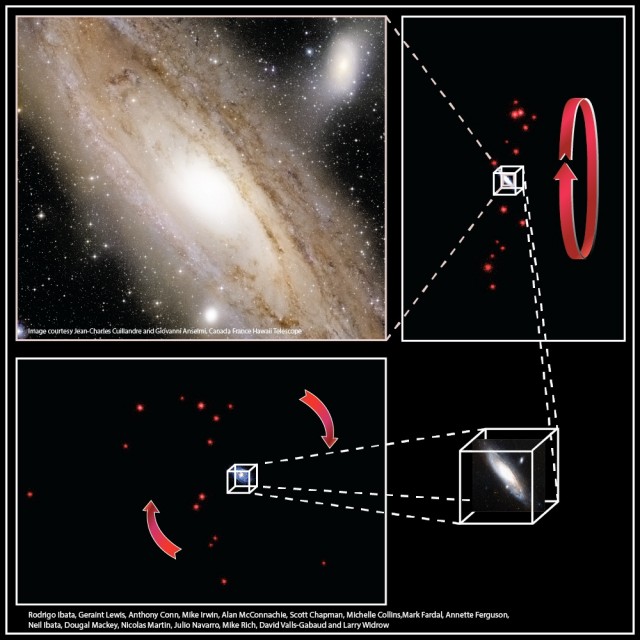
A recent study headed by Rodrigo Ibata at the Strasbourg Astronomical Observatory, France, and Geraint Lewis at the University of Sydney, Australia, found a host of new galaxies in the local group. The image below gives you an idea of the scale involved, but it doesn’t show the full story – There are actually over 54 galaxies in the Local Group. Andromeda is surrounded by a small swarm of 27 dwarf galaxies, and 13 of those dwarf galaxies orbit in the same plane, the same way the planets orbit the Sun. This means that Andromeda is surrounded by a disk-like shape, the largest cohesive structure in the local group. And it’s still very much a mystery as to why it exists.
Even here inside the largest galaxy for millions of light years, space is mostly empty, but the vast expanses of intergalactic space are so devoid of anything that it’s difficult to fully appreciate (to get even more perspective on this, click here and look at the full image!). But even in the face of this terrifying emptiness, galaxies live out their lives. They pull on each other and interract. They form and coalesce. Large galaxies devour smaller ones whole, and every so often, large galaxies smash together and tear each other apart. But none of the theories we have today quite explain Andromeda’s skirt.
Those 13 dwarfs orbit Andromeda once every 5.5 billion years or so, and Ibata, with his team of researchers, has suggested a couple of explanations for the disk. Firstly is that they formed in place as they are, and have been slowly twirling around Andromeda since before the Sun was born. They may have been created during a merger between two ancient galaxies, from a streamer of gas which was spun off. Or possibly, these galaxies are as old as Andromeda itself, forming at the same time amidst all of the dark matter attracted by Andromeda’s huge bulk. This would fit with the fact that those dwarf galaxies are made up of ancient stars, implying that this structure could be truly ancient.
Or perhaps it isn’t a disk at all. Perhaps we’re seeing a slew of galaxies recently pulled into Andromeda’s gravitational grip, and it’s purely by chance that they appear to be arranged into a disk shape. It’s entirely possible, and only further research will show if the disk structure is real or not. Combined with the recently discovered halo of gas surrounding the Milky Way, it seems there may be a lot lurking out there in intergalactic space that we don’t yet understand.
But either way, both of these hypotheses have problems with them. Neither is a perfect fit. In an interview, Nicolas Martin at the Strasbourg Astronomical Observatory explained that the fact that we don’t know why these galaxies are arranged the way they are is what makes this discovery so exciting;
“The presence of this thin, rotating disk of dwarf galaxies around Andromeda suggests a strong connection between the host galaxy Andromeda and its satellites. There is currently no satisfactory scenario that can explain all the properties of the satellites in the disk, but they all require a strong interplay between Andromeda and the satellites themselves.”
Image credits:
Top – Robert Gendler
Middle – Andrew Z. Colvin/Wikimedia Commons
Bottom – Rodrigo Ibata/PAndAS team
Being responsible for picking the week’s most interesting science stories is a fun and fascinating challenge. It pushes to me to look beyond my own interests and explore what others find compelling. So I trust you find my ‘science making news’ selection of interest and delight; explore the quantum, human, off-world and mathematical highs of the week.
On the human scale an international team of scientists has been investigating the antibiotic properties of sweat. More precisely they discovered how a natural antibiotic called dermcidin, produced by our skin when we sweat, is a highly efficient tool to fight tuberculosis germs and other dangerous bugs.
Their results could contribute to the development of new antibiotics that control multi-resistant bacteria.
The benefits of a good nights sleep once again are news. Researchers have shown that the disruption in the body’s circadian rhythm can lead not only to obesity, but can also increase the risk of diabetes and heart disease.
Our study confirms that it is not only what you eat and how much you eat that is important for a healthy lifestyle, but when you eat is also very important.
Disruption of body’s circadian clock increases risk of obesity, diabetes and heart disease. (Credit: Daniel Dubois, Vanderbilt University)
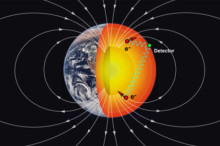
At the quantum scale, the particle physicists are at it again. Not content with discovering the Higgs Boson they are shedding light (pardon the pun) on a possible 5th force in nature. In a breakthrough physicists have established new limits on what scientists call “long-range spin-spin interactions” between atomic particles. These interactions have been proposed by theoretical physicists but have not yet been seen. If a long-range spin-spin force is found, it not only would revolutionize particle physics but might eventually provide geophysicists with a new tool that would allow them to directly study the spin-polarized electrons within Earth.
The most rewarding and surprising thing about this project was realizing that particle physics could actually be used to study the deep Earth.
The latest news from Mars is that curiosity has relayed new images that confirm it has successfully obtained the first sample ever collected from the interior of a rock on another planet.
Many of us have been working toward this day for years. Getting final confirmation of successful drilling is incredibly gratifying. For the sampling team, this is the equivalent of the landing team going crazy after the successful touchdown.
To wrap up with one further piece of geek excitement. On January 25th at 23:30:26 UTC, the largest known prime number, 257,885,161-1, was discovered on Great Internet Mersenne Prime Search (GIMPS) volunteer Curtis Cooper’s computer. The new prime number, 2 multiplied by itself 57,885,161 times, less one, has 17,425,170 digits. With 360,000 CPUs peaking at 150 trillion calculations per second, 17th-year GIMPS is the longest continuously-running global “grassroots supercomputing”project in Internet history.
Until next week’s Australian Science review, go geekily crazy and enjoy your weekend.
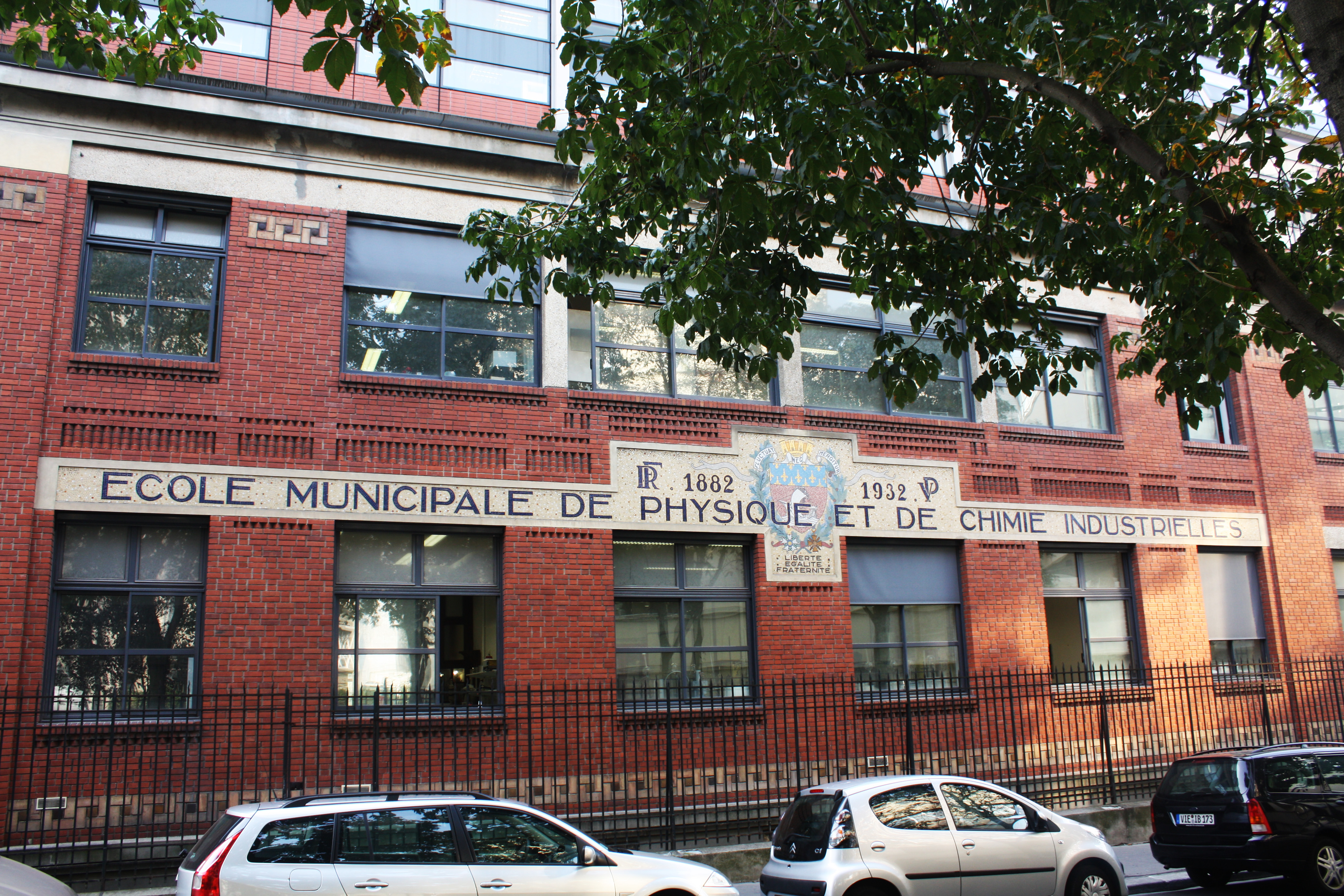
Last week, after I spent a couple of days in Brest, Brittany at a ESF, EU workshop/seminar brainstorming with other internet and scientific researchers on interesting topics related to internet science and innovation, I got myself back to Paris. I visited a French national institute with an international reputation for scientific excellence – ESPCI (École supérieure de physique et de chimie industrielles) and the CNRS department of Physics, Quantum Foundations – a group dedicated to research on quantum effects in materials. Also, I took the opportunity to meet up with two Australian Science writers who reside in Paris: Rayna, and Charles.
ESPCI Paris Tech stands for Physics and Chemistry Higher Educational Institution (a French “Grande École d’ingénieurs”). Founded in 1882, ESPCI is a major institution of higher education – an internationally renowned research center, gathering leading scientific innovatorslike Nobel Prize laureates Pierre and Marie Curie, Paul Langevin, Frédéric Joliot-Curie, Pierre-Gilles de Gennes, and Georges Charpak.
ESPCI ParisTech
At ESPCI, I met with Arjen Dijksman, a physicist and researcher interested in tiny semiconductive nanoparticles, known as “quantum dots
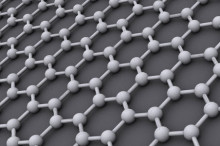
While it may look like little more than molecular chicken wire, graphene really is wonderful stuff. A sheet of carbon atoms naturally forms into a geometrically perfect set of hexagons and, since it was first chemically synthesised in 2004, researchers across the world have been investigating its potential for uses in a wide variety of ways – everything from DNA sequencing to hunting for it in interstellar space!
One of the biggest potentials for graphene, however, is in electronics. As graphite (a naturally occurring mineral), carbon is semiconductive. Due to the way carbon atoms are arranged in this hexagonal pattern, it leaves some electrons free to move across the material in a way not entirely unlike the way the motion of free electrons allows metals to be conductive. However, pure graphite isn’t really very conductive. Pure graphene is a much better conductor, but a single sheet of atoms is quite delicate and difficult to engineer into anything by itself.
The latest development in the story though, is courtesy of the Royal Melbourne Institute of Technology and the Commonwealth Scientific and Industrial Research Organisation (CSIRO), where research has been underway to make high grade electronics with graphene. Their recent success came from a layered material made from graphene and tiny crystals of molybdenum oxide. By using a process called exfoliation, the layers in this material are a mere 11 nm thick, and electrons are able to move freely through it without any scattering from impurities in the material (one of the main limiting factors in any system of electronics). Free from such obstructions, electroncs can flow through this new material at high speeds.
You see, electronics is one of the fastest progressing types of technology in the world today. Moore’s Law is a principle which states that approximately every two years, the number of transistors in electronic circuitry – and therefore the overall speed of computers – doubles every two years. This trend has been continuing for over half a century now; the average mobile phone today probably has more computing power than Apollo 11 did when it travelled to the Moon.
But the growth of electronics is predicted to start slowing down, not because technology will stop progressing, but because we’re expecting to reach the limit of what’s possible with our current silicon-based electronics technology. For electronics to continue improving, new and faster materials are required. Graphene-based technology may well hold the key to the future of electronics. CSIRO’s Serge Zhuiykov, spokesman for the Australian researchers involved in this project, believes it could be, stating, “Quite simply, if electrons can pass through a structure quicker, we can build devices that are smaller and transfer data at much higher speeds.
It was a cloudy day, but we headed down the M1 towards the Gold Coast. Arriving at our destination around 9/9:30AM. Destination: OzBall.
It was about a year ago I had seen video of this amazing, thrilling ride. A weatherman on Sunrise 7 strapped inside a huge plastic ball rolled down a hill. This is called zorbing. Apparently it has been around for decades and can be found in quite a few countries. I knew I must try this on my next trip to Australia. Despite bewildered looks and headshakes from my family, I was going zorbing.
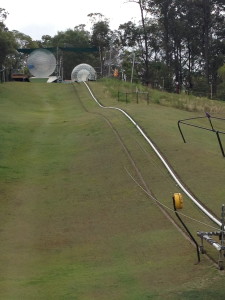
We left the car in the car park and walked through a field to the entrance to OzBall Park. It’s a little off the beaten track. But there it was, a huge grassy hill, the zorb shining in all its glory at the top. Beckoning, if we dare.
OzBall has two zorbs. One is the Hydro Ride where 1-3 riders slosh around in water within the zorb. To me, it’s what being trapped in the washing machine on the delicate cycle would look like. The other is the Harness Ride. The real deal; where you’re strapped to the wall of the zorb facing your fellow zorber, all zany-eyed and excited because you’re a self-described thrill seeker! Little did I know that ride was to exert every known (and unknown) calculable physical force on my body. There was no line or wait for the harness ride. Hmmm.
The Zorb (The Hamster Ball)
You enter the zorb by pulling yourself through a tunnel-like entrance. The zorb is massive – measuring about 3 metres (10 ft) in diameter. Tucked inside is an inner orb about 2 metres (6 ft 7 in). The space between the two orbs creates a shock absorbing, air cushion, connected by hundreds of small nylon strings. The tough, durable plastic is approximately 0.8 millimetres (0.03 in) thick. Shackled securely in my seat by 3 safety mechanisms: the chest harness, lap belt and ankle restraints; I felt completely safe.
The Ride
140 metres (459 ft) is not a long distance. And the speed seemed along the lines of a kid’s carnival ride, reaching up to 30 KPH (19 MPH). I didn’t factor into account the slope of the hill. And it’s not merely an up and down motion, but a side-to-side motion as well. I think you can see where I am going with this. I got way more than the adrenaline rush I bargained for. No projectile vomit or anything of the sort. Just a lot of screaming and wishing for it to be over. It seemed an eternity had passed. The zorb paused. The zorb started moving again. More screaming. The only words I could get out of my mouth were, “Oh, it’s not over yet!” Rolling down the hill, eyes open, eyes shut, trying to stare out the porthole at the grass to fixate my glaze on a constant sight. Finally. The. Zorb. Stopped.
Lawnmower martini. Not sure what that is, but that’s what I felt like. I could hardly speak, but got out of that zorb as fast as possible. Slight dizziness, wobbly, and an insane amount of belching from all the air trapped inside my stomach. The OzBall operators offered us a free hydro ride for being such good sports. I politely declined the invitation.
Why Zorbing?
The point of this story is that it is an incredible opportunity for learning about physics! And how fun science can be when applied to wacky and crazy ideas! I always wanted to go to the theme park on a field trip to ride roller coasters and learn about the forces at work. OK, I really just wanted to ride roller coasters. Man, some science classes were so lucky!
Whether it’s an activity like zorbing, or riding roller coasters, biking, skiing or skateboarding, science is involved. Tools working in tandem with the human body for the benefit of amusement. How far you decide to delve into the science behind each is up to you. I believe that is how to keep science fun and entertaining and keep the kids coming back from more. Education could take a cue from zorbing’s playbook – just let go and roll down the hill.
As for me, I’m glad I tried it; ticked the zorbing experience box. If you saw that episode of Modern Family where Phil does everything in his power to remain a roller coaster fanatic so he can retain that bond with his son, Luke; then you know what I’m talking about. But I’m going to lock this one away and slowly try to rebuild my street cred. (Thank goodness we didn’t opt for the video!)
Warning: Zorbing has been labelled an “adventure sport”, like bungee jumping or skydiving and can be dangerous if the right precautions are not taken. Even riding a roller coaster can sometimes end in tragic results. Deaths from zorbing have occurred, one in Russia just last week. A grassy hill with a catch containment system at the bottom is much different than going down a snowy, rocky mountain. Exercise your best judgement and caution if you are going to attempt zorbing.
The interesting thing about research is that the most interesting results are always the ones which are unexpected. This is particularly true out in the frontiers of physics where, frequently, no one really knows quite what to expect. While news reporters were swift to leap to the conclusion that the Higgs boson had been discovered back in July, the scientists at the CERN press conference were noticeably hesitant to make any such claims outright. Interestingly, it seems that they were wise to do so – in light of the more recent findings, their apprehension has been proven to be well advised. Simply but confusingly, the CERN experiments seem to have yielded two bosons for the price of one.
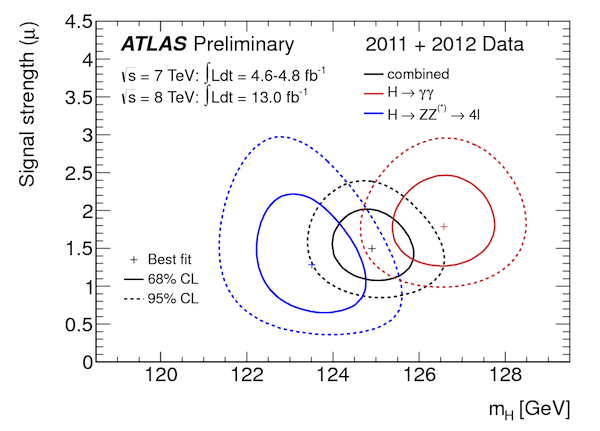
A huge experiment like any of those taking place at the Large Hadron Collider (LHC) collects a lot of data, and believe me when I say that analysing and interpreting the data you can collect from any experiment is not an easy task. A lot of effort needs to be made in order to make sure you understand everything you’re seeing. Back in July, there were a few obvious things which were uncertain. For one, the “Higgs-like particles” observed at CERN appeared to be breaking up and decaying into photons more rapidly than predicted. This was the first clue that something unexpected was going on with the LHC data. However, on closer inspection, the results were so unexpected that there was thought to be a fault with the equipment. Everyone was hoping to find a peak for the Higgs boson, but no one expected there to be two! With one signal detected at 123.5 GeV and a second at 126.6 GeV, there’s a statistically significant difference of 3.1 GeV between the two. While the data have been checked and re-checked throughout November, they appear to be perfectly sound. As far as anyone can tell, these are two genuine detections of two particles.
What exactly this means is very much an open question. Assuming these data are correct, aren’t any existing theories which explain why there would be two Higgs-like signals so close together. Some hypotheses predict multiple Higgs bosons, but none predict them to be so close together. What’s more, these two particles seem to fragment into different products – the 123.5 GeV particle decays into two Z-particles (a different, more familiar variety of boson), while the 126.6 GeV particle decays into photons. So what’s going on?
Physicists are interesting folk, and I’m sure some would be fascinated if this turned out to be something new. Fabiola Gianotti, director of the ATLAS experiment at CERN has appeared noticeably excited before by the prospect of new and unknown physics being discovered. However, the other thing about physicists is that by their nature, they need to be highly skeptical, particularly when it comes to their own work. Adam Falkowski, a Paris-based particle physicist, states what most researchers are probably thinking on his blog Résonaances – that the result is most likely due to a “a systematic problem”. In other words, a problem in the apparatus such as a poorly calibrated detector. To date, there is no explanation from CERN for the unusual data. So is it a glitch, or could there really be two particles being detected here?
Whatever is being seen here, it certainly appears to be at least subtly different to what the theories predict. Even if the second detection turns out to be a fault in the detectors at CERN, the fact that the original detection appeared to decay into photons more readily than it should is still unusual – though as noted by Matt Strassler in his blog, Of Particular Significance, “the excess is still not yet 3 standard deviations. Deviations of this size do come and go. And we don’t have confirmation from CMS. So the situation remains tantalizing but unfortunately not yet very convincing.” Right now, we still need to wait for official confirmation from CERN. Personally, I suspect that isn’t likely to happen until they know more about it themselves. A further announcement is currently scheduled for March 2013.
By now, I think it’s safe to say that if you’re reading this, it means the world didn’t end on Friday. Which is rather a good thing, because a lot of interesting things have been happening recently! Even though I’ve been busy as can be, writing papers and trying to finish off a thesis there have still been a few fascinating little gems to catch my eye in the news this week…
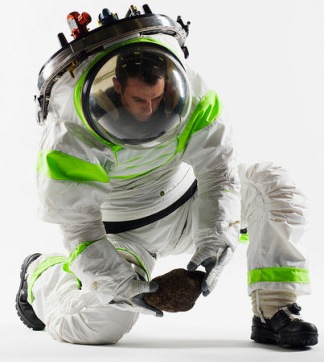
Firstly, NASA have announced a new prototype space suit, with new and improved technology. Intended to be easier to put on, amongst other things, the most exciting part of the news is that these new suits are intended for deep space missions, focussing on safety “during spacewalks and potential surface activities”! Oh, but there’s just one thing which everyone’s noticed…
Nasa’s New Space Suit Looks Exactly Like Buzz Lightyear
Nasa said one of the key differences was that the new suit has a one-piece design, into which the wearer crawls in through a hole in the back, as opposed to the trousers-top-helmet version currently in use on the International Space Station.
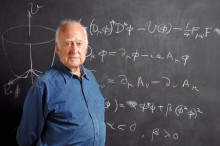
Meanwhile, in Switzerland, physicists have been puzzled by the results they’ve seen from the LHC. While there’s now little doubt that they’ve detected a signature which matches what they’d expect from “a Higgs-like boson”, it seems like there’s more going on than they realised…
Two Higgs Bosons? CERN Scientists Revisit Large Hadron Collider Particle Data
Yesterday researchers at the Atlas experiment finally updated the two-photon results. What they seem to have found is bizarre—so bizarre, in fact, that physicists assume something must be wrong with it. Instead of one clean peak in the data, they have found two.
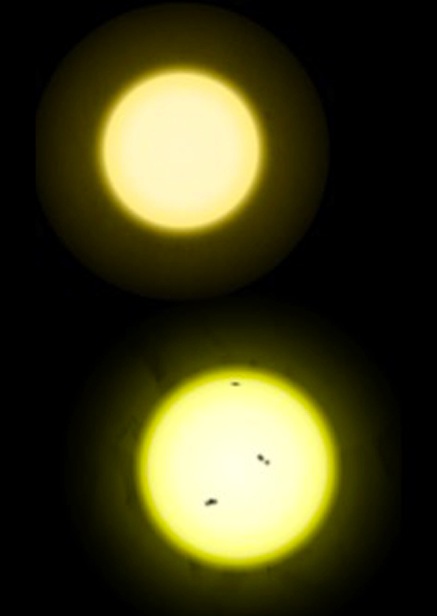
The Sun, is slightly larger and more active than Tau Ceti. Credit: R.J. Hall/Wikimedia Commons
Finally, one star near to Earth which has always garnered much attention from science fiction writers is Tau Ceti – right in our neighbourhood at a mere 12 light years away. For a long time, many have speculated on the potential for life-sustaining worlds around the Sun’s slightly more orange neighbour, and now it looks like there may well be. While we’re still waiting for confirmation, there may be 5 planets around Tau Ceti, and two of those might be candidates for sustaining life!
Nearby Tau Ceti may host two planets suited to life
The highlight of this alien solar system is Tau Ceti e, which has a mass of over four Earths and a year just under half as long as ours. It orbits in the star’s habitable zone, the region where liquid water is thought to exist. “It is in the right place to be interesting,” says [Hugh] Jones.
Short but sweet, that’s all for this week. I hope everyone has a lovely Christmas (or whichever of this season’s holidays and festivals you choose to celebrate). See you next time!
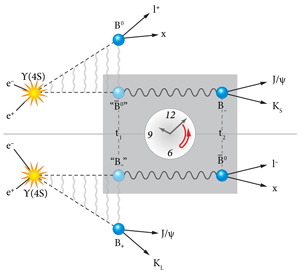
Electron-positron collisions at SLAC produce a Υ(4s) resonance that results in an entangled pair of B mesons. Source: http://physics.aps.org/articles/v5/129
Recall the outrageously cool movie from the 1980s, Back to the Future? Marty McFly and Doc Brown were stretching scientific boundaries, righting the future, all while making sure not to meet their future selves. Fast-forward and time travel may be closer than we think. (Close, relatively speaking of course.)
If you like exceptions to the rule, well, you’re in luck because the Department of Energy’s (DOE) SLAC National Accelerator Laboratory has achieved something quite impressive – the BaBar experiment.
The BaBar experiment investigates the most fundamental questions about the universe by getting back to basics with elementary particles. It’s a global collaboration of physicists delving into the nature of antimatter, the relationship of quarks and leptons and crossing over into areas of physics yet to be explored.
Earlier this week, scientists working on the BaBar project made the first direct observation of a violation to the concept known as time reversal symmetry. Their work was published in Physical Review Letters if you want to journey into the world of B mesons.
How did they do it?
Data from billions of particle collisions, nearly 10 years worth, were poured over and sifted through by researchers on this project. They examined a chain of particle transformations in which B mesons flipped between two different states called B-zero and B-even. This quantum entanglement of B mesons enables information about the first decaying particle to be used to determine the state of its partner at the time of the decay. This allowed the team to find that these transformations happened six times more often in one direction than the other.
Largely by thinking there was something wrong with the picture they were looking at was how missing pieces of the puzzle were filled in, according to the physics coordinator for BaBar, Fabio Anulli of the National Institute for Nuclear Physics in Rome. The BaBar data they had showed evidence of change-parity symmetry violation, so this was a good place to start looking. In fact, just looking at the data in a slightly different way allowed them to the see time violation.
Given the abundance of data the BaBar team had to work with, they were able to measure the T-violation to the 14 sigma level – a high level of statistical significance. Basically meaning there is only 1 chance in 1043 that this effect is not real. Recall the Higgs boson discovery this past summer; that was granted a 5 sigma level. The results demonstrate that the direction of time matters, at least for some elementary particle processes. This provides a strong confirmation that a few subatomic processes like to do things on their own schedule – they have a preferred direction of time, changing into one another much more often in one way, than they change in the other. Time does not run the same forwards as backwards.
The findings – full of futuristic possibilities
What does this mean for the future? This discovery may rock our world in ways we haven’t even conceived of yet. It could have implications for business, for communications, for me getting to Brisbane instantaneously without first stopping for a layover at LAX. We may have perhaps inched closer to that time travelling ease marvelously displayed in Star Trek. Stay tuned.
Discoveries such as this make us think about the beauty of science. The vectors and numbers and B mesons – scientists work that stuff out to provide the beautiful possibilities that are so important to the human race. It may be small now, but we’re definitely on to something bigger. Think how many picture frames we may just be able to tilt to get the answers we seek.