Well, it’s my turn to pick my favourite science news this week on Australian Science. And I must apologise for being slightly late with this. The reason is that I’ve only just got home to Tokyo after spending all week in Taipei for a conference on interstellar dust! As with any good conference, it’s been fun and fascinating but also rather tiring. If anyone’s curious to know more about what went on, the twitter hashtag #lcod2013 is where myself and others were giving internet commentary over the past week.
Also, between talks, twitter is where I heard most of this week’s worldwide science happenings. So here are a few of the things which caught my eye…
Firstly, Katie Mack (a long term inspiration to me) wrote an article for The Research Whisperer on the perils of the academic lifestyle and being a science nomad – and how that affects your personal life. Being still very recently relocated to Japan myself, this strikes something of a chord with me. It’s worth reading for anyone considering a science career themselves. while I personally rather enjoy the nomadic nature of this job, it’s certainly not for everyone. And I have yet to see how I feel about it a couple more years down the line…
As for me, I confess I haven’t figured it out. I have two years left on my contract in Australia and no idea whatsoever which country I’ll end up in next. I’m applying broadly, and there’s no guarantee I’ll have a choice about location if I want to stay on the path toward becoming tenure-track faculty at a major research institution. When it’s not unusual for a single postdoc job to have 300 applicants, and faculty jobs are even more selective, getting even one offer is considered a huge win.
Moving on to life of a different kind, a brand new species has been discovered in the waters off the coast of California. And anyone who’s been reading my articles awhile will know how exciting I find the discovery of new species! This time around, it’s a somewhat scary looking new species of crustacean. Don’t worry though. It only eats copepods.
The frail crustacean, which is only a few millimeters in length, was discovered by scientists from the University of Seville in Spain and the Museum of Natural History in Canada, who had published a taxonomic description of the new species in the journal Zootaxa.
Meanwhile in space… When people talk of space stations and lasers, a lot of us will immediately think of Star Wars. Or whatever other sci fi we might prefer. However, up in orbit around Earth, our own space station is preparing to use lasers for a rather less destructive purpose – to transmit video back to use down here on the ground.
“Optical communications (also referred to as ‘lasercomm’) is an emerging technology wherein data is modulated onto laser beams, which offers the promise of much higher data rates than what is achievable with radio-frequency (RF) transmissions.
I hope everyone’s enjoying a nice weekend! It’s my turn again for the weekly science picks, and this week is the 44th anniversary of the Apollo 11 moon landing. On July 20th 44 years ago, human beings took their first small steps onto the surface of an object in the solar system other than the Earth. While we may not have returned to the Moon since NASA’s Apollo program, it’s important to realise the leaps and bounds which human technology and scientific knowledge have made since then.
And speaking of those leaps and bounds…
Astronomers have managed to determine the colour an exoplanet would appear if were able to see it with our own eyes. Planet HD 189733b, one of the most well studied worlds out there in our galaxy, is a beautiful azure blue planet. But don’t let the similarity to our own planet’s colour fool you. The blue colour of HD 189733b is because it’s a hot jupiter, orbiting scorchingly close to its parent star, and that colour is because the rain on this world is made of glass!
Gamma ray bursts are the most violent and energetic events in the entire universe. Powerful blasts of high energy gamma radiation, bright enough to be seen from literally the very edge of the visible Universe. And yet, we know surprisingly little about them. Of course, we have theories, but every now and again astronomers spot something which those theories don’t fully cover. Such as a couple of years ago, when an international team of astronomers caught a glimpse of the longest lasting gamma ray burst ever seen.
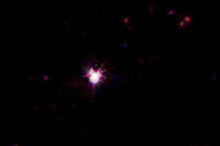
December 9th, 2011. NASA’s Swift telescope detected a sudden spike of gamma rays from somewhere within the constellation of Phoenix, visible in the Southern hemisphere. Gamma ray bursts (GRBs for short) like these are normally subdivided into two types, short bursts and long bursts, which have different causes. Short bursts last for just a couple of seconds, while long bursts can last for several minutes. But this particular burst, dubbed GRB 111209A (pictured above), was very different. One of a unique, rare breed of extra long lived GRBs, and by far the longest ever observed – lasting an unprecedented 7 hours!
Ever since then, astronomers have been picking at the data which were recorded, trying to work out exactly what kind of unusual circumstances would cause such a goliath GRB. One team, a collaboration between Bruce Gendre now at the French National Center for Scientific Research, and David Coward and Eric Howell at the University of Western Australia, managed to get to what may be the bottom of the puzzle. In short, these extra long GRBs are caused by the deaths of the Universe’s most massive stars.
It’s a sobering fact that all stars die. Some burn slowly for billions of years. The very smallest may burn for trillions. But the most massive stars burn out rapidly before dying in titanic explosions which we know as supernovae. It seems that the most massive of the massive, exceptionally rare, die in a unique type of GRB.
So far, only three of these ultra-long GRBs have been found, appearing so bright that some astronomers initially believed that they came from inside our own galaxy. As it happens, this wasn’t the case. Analysing GRB 111209A, Gendre and his colleagues hypothesised the source of it to be an extremely hot, massive star.
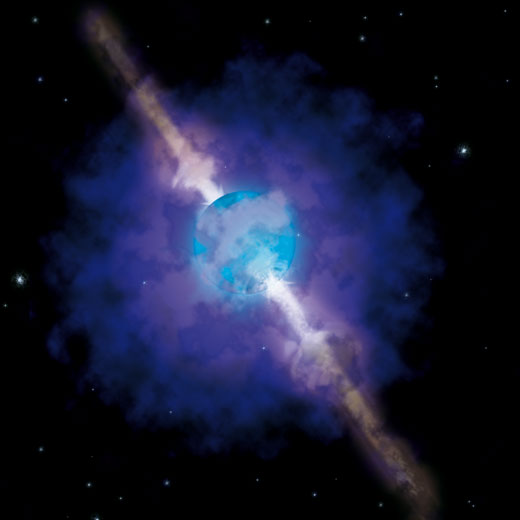
A furiously burning blue supergiant (possibly a hypergiant), hundreds of times the diameter of the Sun. When a star like this dies, its core collapses into a black hole, which then proceeds to start devouring the star from the inside out. As that black hole hungrily eats, its mammoth gravitational forces brutally tearing matter apart at the subatomic level, it generates an immense amount of energy which causes two jets of material to shoot out from its north and south poles. These are blasted outwards out with such ferocity that they actually punch two holes in the doomed star.
Read that again. A star which is hundred of times as massive as the sun, and these jets are powerful enough to blast two holes in it! The amount of energy required to accomplish that is truly difficult to comprehend.
The stars which die in these titanic events still require a specific set of circumstances. These stars are apparently enriched in elements heavier than helium (astronomers refer to these as “metals”, even though chemists would disagree on a few counts). More of these heavier elements cause a star’s stellar wind to increase, causing its rotation speed to slow as it loses material. But faster spinning stars seem to be more likely to cause these long bursts, which led some to wonder if the massive star behind GRB 111209A was also cannibalising another nearby star – a process which could possibly cause its rotation to speed up.
The exact cause is still a matter of puzzles and hypotheses. We won’t know more until we observe more of these ultra-long GRBs, and seeing as we’ve only ever spotted 3 of them, it may remain a puzzle for a while yet. But a tantalising glimpse like this of one of the Universe’s most extreme events gives us a good reason to keep watching and waiting. When we do finally understand, it will almost certainly have been worth waiting for.
A happy Science Sunday to everyone! As usual there’s been a lot happening in the world of science, so lets take a peek of the most interesting picks for the past week!
At the end of this month, NASA will launch IRIS. IRIS will watch the Sun and provide NASA with information on the Sun’s atmosphere and the interface region. This will give scientists a better understanding of how the Sun’s energy powers the solar wind!
NASA Administrator Charles Bolden and Italian Space Agency (ASI) President Enrico Saggese signed a Memorandum of Understanding for cooperation on the European Space Agency (ESA) led BepiColombo mission to Mercury
A new three-dimensional map, aptly called BigBrain is the most detailed ever constructed! Scientists hope it will lead to a more accurate picture of how the brain’s different regions function.
Traditionally astronomers have relied on space telescopes to conduct high-energy y ray astronomy because Earth’s atmosphere is a very efficient shield for y rays. However, in early July at the International Cosmic Ray Conference in Rio de Janeiro, Brazil, indicate that γ-ray astronomers are betting their future on an ambitious ground-based telescope.
Australian researchers say that it’s not bad luck that drives mammals to extinction over geological time, but their failure to keep pace with a deteriorating environment.
Neutron stars are some of the strangest and least understood objects in the entire Universe. Over 1.5 times the mass of our whole solar system, squeezed into an object comparable in size with a city, these curious objects wield titanic gravitational fields and, often, immense magnetic fields. They’re also so incredibly dense that it’s difficult to fully appreciate* And sometimes, for reasons we don’t fully understand, their rotational speed suddenly changes.
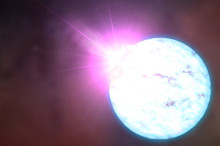
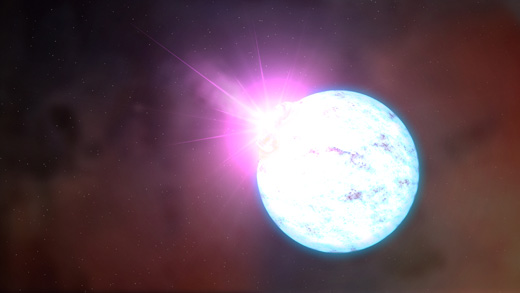
These sudden changes in rotation are known as glitches, and they happen to a particular, rare type of neutron star, known as a magnetar – a neutron star with an exceptionally strong magnetic field, which occasionally undergoes violent outbursts known as starquakes. These starquakes have been known to cause the rotation speed of a neutron star to suddenly increase. But one of these oddities is an oddity among oddities. A magnetar known as 1E 2259+586 was recently observed not to speed up, but to slow down. The reason? No one knows.
The team in charge of this work, led by Victoria Kaspi at McGill University, Montreal, summed up their observation in a press release by saying that it “constitute[s] a new theoretical challenge.” Now, to someone like me, this is very exciting. Specifically because this means that, working with existing theories, they don’t know what’s going on. It’s currently unexplainable. And when this sort of thing happens, it means we’ve discovered something which we didn’t know before.
Any good scientist should be thrilled when they don’t understand something, because this means that there’s something new to understand. In this particular case, the fact that this magnetar seems to have done the opposite of what it should has managed to throw a spanner in the works**.
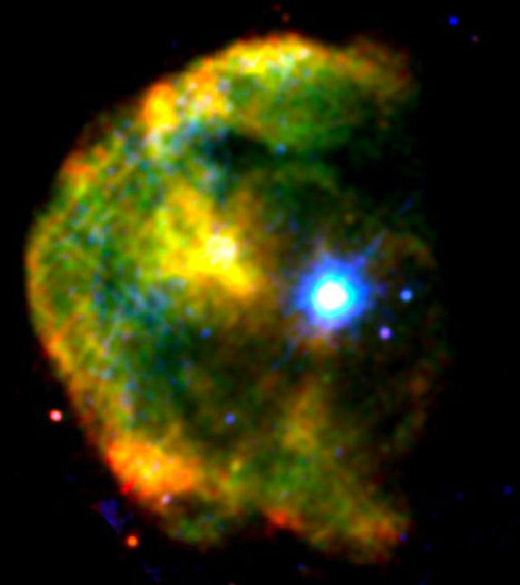
An x-ray image of the neutron star 1E 2259 586 in false colour. Low energy x-rays are shown in red, medium energy in green, and high in blue. Credit: ESA/XMM-Newton/M. Sasaki et al.
“Astronomers have witnessed hundreds of events, called glitches, associated with sudden increases in the spin of neutron stars, but this sudden spin-down caught us off guard,” Kaspi explained. Indeed, the regular type of glitch is, we think, quite well understood.
What precisely might be found beneath the ultra hard crust of a neutron star is a mystery. We might perhaps never be able to directly observe it and find out (neutron stars aren’t fond of guests, and have a tendency to turn anything which lands on them into a large thermonuclear explosion). But what we can deduce is that the interior of a neutron star is a kind of superfluid, composed mostly of neutrons. At the surface of a neutron star, high energy particles are accelerated outwards. This is known as a pulsar wind, and it’s the main mechanism through which neutron stars cool.
As this pulsar wind carries away energy, it gradually grains energy and momentum from the surface of the neutron star. But this causes stress to build up under the surface. After enough stress builds up, the crust ruptures with an almighty crack. This causes the star to emit a huge burst of x-rays. It also allows the crust to catch up with the rotation speed of the interior. Neutron stars slow down when they’re ready to and not a moment sooner.
The neutron star in question, 2259+586, lies around 10,000 light years away in the constellation of Cassiopaeia and rotates once every 7 seconds or so. In the x-ray image shown above, it’s quite obvious in high energy x-rays (coloured blue in the image). The lower energy x-rays show a pulsar wind nebula as those high energy particles streaming away from it crash headlong into the surrounding interstellar medium.
Crust fractures in neutron stars sometimes go by the name of starquakes, and they can be caused by tangled up magnetic field lines too. But it’s this particular mechanism which causes these stars to glitch. 2259+586, however, is going against the grain. Because it’s been observed to do the opposite of what it should, this previously unknown phenomenon has been dubbed an ‘anti-glitch’. What’s more, not content with its abrupt slowdown, 2259+586 is also slowing its speed faster than it was previously observed to (an effect known as “spinning down”).
Sometime in late April, before the anti-glitch was discovered, the Fermi space telescope picked up a powerful x-ray burst. Lasting just 36 milliseconds, the researchers believe that it was this burst which signalled the magnetar’s unprecedented drop in rotational speed. Robert Archibald, the lead author on the paper published on this work, explained, “What is really remarkable about this event is the combination of the magnetar’s abrupt slowdown, the X-ray outburst, and the fact we now observe the star spinning down at a faster rate than before.”
As for why this has happened? Well, now we need to wait for the theoreticians to solve the puzzle. And, at least for some of us, that’s the fun part!
Artist’s impression of a starquake on a magnetar’s surface. Credit: NASA Goddard
* As one tumblr user so wonderfully described it, “an average printed period, if it were as dense as a neutron star, would weigh about as much as a train car FILLED WITH BRICKS.”
Carlo Zapponi is data visualization designer at Nokia, who has created an amazing animationof the meteorites that have struck the earth. Only 3% of all recorded meteorites were seen falling since 861 AD. 34,513 have been recorded, only 1,042 have been seen falling. Now you can click any of the fallen meteorites at the image below, also you will see the visualization in full screen mode.
Greetings one and all, and a very happy science Sunday to you! This week’s generally been quite interesting. We’ve had good news, bad news, a little heated discussion… All the kind of things which keep the science community vibrant and interesting. As for specifically what that news was, well. Please do read on…
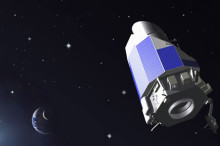
First up this week, sad news. After exemplary service ever since its launch in 2009 and a mission extension last year, the Kepler telescope has finally broken down. Kepler spots transiting exoplanets by staring unblinkingly at the same patch of sky, and in order to do that it needs to keep very still. Sadly, two of its four gyroscopes are out of action, meaning that Kepler may be shutting down for good.
“Frankly, I’m absolutely delighted that we’ve got all this data, that we have been so successful, that we have found so many thousands of planetary candidates,
It’s been rather a turbulent week, all told. There’s been a lot going on in the news, both good and bad. Hopefully, this little handful of science news items will help you finish the last week and begin this next one on a lighthearted note!
NASA’s Kepler mission has found a star system which has not one, but two possibly terrestrial planets in its habitable zone.
Whether either or both of Kepler-62’s optimally positioned planets actually has water is beyond the technical capabilities of the Kepler and other telescopes. Kepler works by detecting the very slight dips in light coming from a star caused by a planet passing by, relative to the telescope’s line of sight.
Sometimes the best way to learn more about nature is to try and recreate it. That happens to be exactly what happened when a group of roboticists were looking at insects…
They found that the moth moved its abdomen in direct response to its shifting visual environment. “If the pattern is rotating up (clockwise), the moth would raise its abdomen up (counterclockwise),” says study co-author Jonathan Dyhr, a University of Washington biologist. “The moth was raising or lowering its abdomen to counteract the movement.”
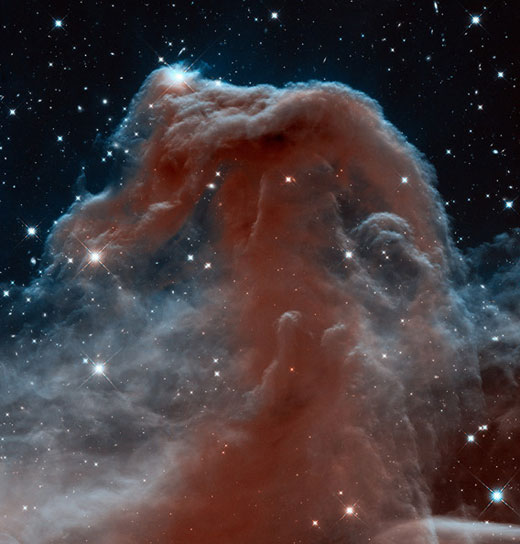
To celebrate the 23rd anniversary of the Hubble Space Telescope’s launch into orbit, NASA have released a brand new and frankly beautiful image of the iconic Horsehead Nebula. Phil Plait explains more…
The Horsehead itself is the site of ongoing star formation. The dense gas and dust inside the nebula is collapsing to form stars, and, at the same time, the edges are being eroded away by the fierce ultraviolet light of Sigma Orionis. The top of the Horsehead is acting a bit like a shield, protecting the material beneath it, which is why it’s taken on that umbrella-like shape. You can see more sculpted pillars of material around the sides, too, like sandbars in a stream.
Ants are fascinating little creatures, and a team of Swiss researchers have been studying the goings on inside a colony of them – by tracking them with barcodes!
Analyzing the color codes, they found that younger ants were more likely to work nursing the young, and older ants were more likely to be foragers. In general, they watched ants transition from nursing to cleaning to foraging as they age, but there’s a lot of individual variation in how quickly these transitions took place.
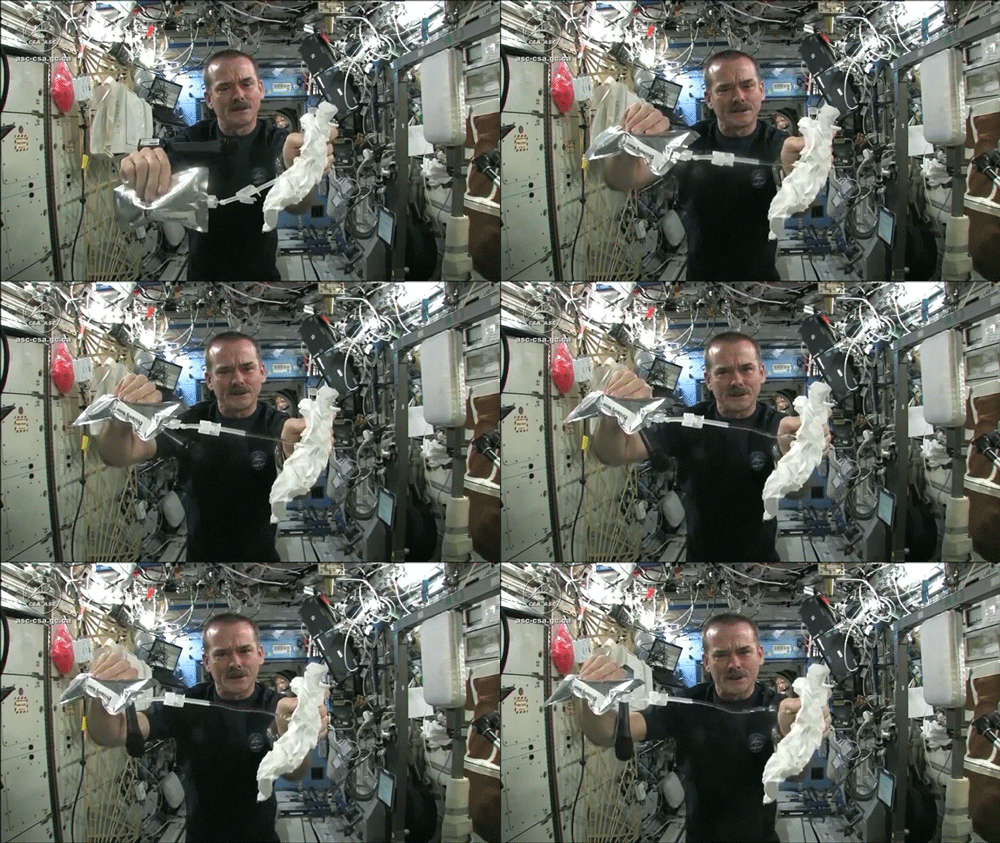
Finally, everyone’s favourite astronaut, Commander Chris Hadfield aboard the ISS answers an interesting question. What happens if you wring out a wet cloth in zero gravity? Click the link to watch the video!
Two Nova Scotia high school students, Kendra Lemke and Meredith Faulkner, submitted this experiment to Canadian Space Agency and got to see astronaut Chris Hadfield actually test it out on the ISS. The results are seriously extraordinary and you need to see them.
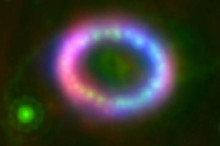
It was a late February night in 1987 when, standing on top of a Chilean mountain range, Ian Shelton saw something which no one had seen for centuries. Looking up in disbelief, he watched a star explode some 160 thousand light years away. Rushing to another observatory to check with someone else, he was initially met with stark disbelief. But there was no doubt. Shelton had seen a supernova explosion with his own eyes.
Named SN 1987A, this was the death of a massive star in the Tarantula nebula. Distant enough to not even be in our own galaxy, but in the Large Magellanic Cloud – one of the Milky Way’s smaller satellite galaxies, the discovery was reported independently by Albert Jones in New Zealand. This began decades of fascinating observations for astronomers, as many began to watch this supernova expand over the years, in real time.
Supernova which are close enough to see with the naked eye are rare beasts. This was, and still is, the only one close enough and visible enough to see properly with modern telescopes, giving us some of the best information we’ve ever had about how an exploding supernova interacts with the dusty interstellar clouds which surround it.
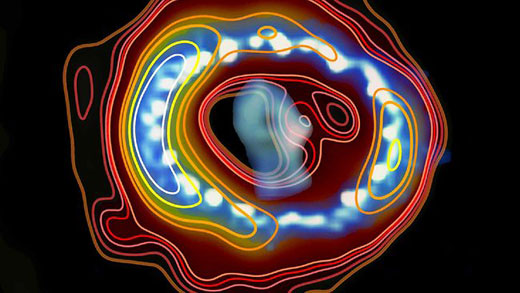
The latest observations of this literally awesome event come courtesy of a team of astronomers working in Australia and Hong Kong, led by Giovanna Zanardo at the International Centre for Radio Astronomy Research (ICRAR). Using CSIRO’s Australia Telescope Compact Array in New South Wales, the researchers have published the highest resolution images of the stellar explosion’s aftermath ever taken.
Portrait of a Dying Star
High resolution images are wonderful in astronomy. The higher the resolution, the more you can learn about what you’re seeing. Zanardo and her colleages compared their observations with other images and data taken at optical and x-ray wavelengths. On doing so, they gained some fresh insight into exactly what happens shortly after a star explodes.
In the centre of the explosion, stellar ground zero, they discovered a pulsar wind nebula. This is a pocket of intensely hot material emitted by a neutron star*, the last remains of the exploding star’s core, proving that SN 1987A did not create a black hole.
Referred to in technical jargon as a “compact source”, a neutron star is a tiny ball of incredibly dense material. With a mass up to over 3 times the mass of the Sun, these bizarre little objects truly are compact. An average neutron star has a radius of just 12 km, which is comparable with the size of Sydney. Yes, you read that correctly. The mass of a star compressed into something with a size similar to a large city.
This discovery actually answers a long standing puzzle about SN 1987 A. Supernovae like SN 1987A are normally expected to form neutron stars, because of the near-unimaginable pressures which occur inside an exploding star. But for several years, despite looking carefully, no astronomers could find any trace of a neutron star amid the stellar debris. But the star which caused this supernova would not have been massive enough to collapse into a black hole, leading theoreticians to try and devise explanations for why there was no neutron star to be seen.
If Zanardo’s team are right, and they have indeed found a pulsar wind nebula inside the shattered remnants of this dead star, then it has to be generated by something. Unless I’m mistaken, this may be some of the most convincing evidence yet for the missing neutron star!
Seeing Clearly in Invisible Light
Discovering all of this, however, was far from easy. Radio images at centimetre wavelengths are difficult to capture with detail. Exceptionally good weather conditions are needed. Zanardo explains, “For this telescope, these [observations] are usually only possible during cooler winter conditions, but even then the humidity and low elevation of the site makes things very challenging.
What we know of exoplanets has developed at the same time as the technology which we use to discover them. This is, in my opinion, the most exciting thing about the entire field of study. For instance, when we first started spotting planets around alien suns, we found huge gas giants. Hot jupiters, extremely massive and close to their parent stars. For a while, some conjectured that this type of planet may be quite common in the Universe. But since then, we’ve developed more powerful methods of searching the sky and, as it turns out, smaller planets are much more common than huge superjovian worlds. The latest piece in the puzzle comes courtesy of NASA’s Kepler space teescope. Near the end of last month, NASA announced the discovery of the smallest exoplanet ever found around a sun-like star!
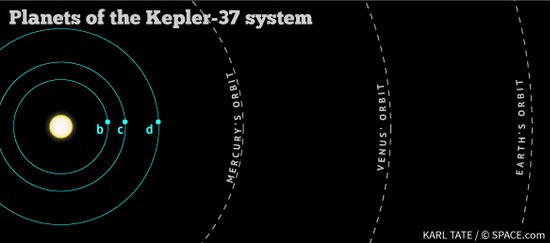
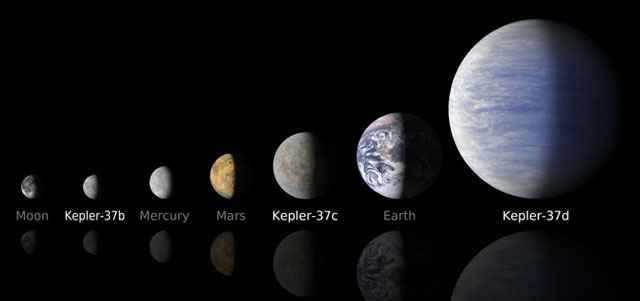
Kepler-37b really is tiny. In fact, the whole Kepler-37 system is tiny – the entire system discovered so far can fit inside the orbit of Mercury! The innermost little world is under 100th the mass of Earth, it’s expected to have a radius of around 3867 km (assuming the same average density as the planets in our own solar system) making it smaller than Earth’s moon. One can only apprehensively wonder if this will spark yet another debate over how large an object has to be before it’s considered a planet. With such a tiny orbit, it also has a year lasting just 13 Earth days. Even though the star Kepler-37 is slightly smaller and cooler than the Sun, it’s still enough to heat the surface of tiny 37b to a roasting 700 Kelvin (nearly 430°C). Needless to say, while we all like stories which talk about potential alien life, this is unlikely to be a home for any lifeforms we might recognise.
Kepler-37b is very definitely the runt of the litter. Its sibling worlds, denoted by the letters c and d, are respectively slightly smaller than Earth and about twice the size of Earth. Of course, these planets are also very close to their parent star. The interesting thing is that we’re discovering more and more small worlds around other stars. More and more exoplanet astronomers are warming to the idea that small rocky planets are likely to be the most common in our galaxy. Our current technology might have trouble spotting them further than a certain distance from their parent stars, but they’re likely to be out there waiting to be found.
Even detecting Kepler-37b was quite a notable feat. It was only possible, in fact, because of a set of rather special circumstances. The star Kepler-37 is particularly quiet, lacking the noisy sunspots and features which cause brightness variation in most stars, making it a particularly clear target. It’s also relatively bright in Kepler’s field of view.
To learn more about this star, and hence get greater accuracy on the measurement of the planets it carries in tow, NASA astronomers used a technique known as asteroseismology. Not dissimilar to the way geologists measure earthquakes, asteroseismology is the study of vibrations within a star, measured by accurately observing pulsations in the star’s surface. All stars are constantly bubbling and boiling, and this causes the whole star to vibrate at a number of resonant frequencies – soundwaves – in exactly the same way a bell vibrates when it rings. By measuring the precise frequencies of those soundwaves, a lot can be determined about the interior of a star. Incidentally, this same technique can be used to effectively “listen” to the Sun.
Interestingly, because Kepler-37 has such an eerily peaceful surface for a star, it was very easy to measure those vibrations, making Kepler-37 the smallest star ever to be studied this way. Normally, only large stars are observed using asteroseismology because the measurements need to be very precise. Conveniently though, the Kepler telescope was built for breathtaking precision.
A tiny planet discovered orbiting a singing star 215 light years away. How poetic!
Astronomy is quite notorious for being full of things we don’t entirely understand. Sometimes it really does feel as if the closer we look at the Universe, the less it makes sense. One thing in particular which seems to constantly evade our understanding is the way in which galaxies work. A lot of very smart people spend a lot of time taking telescope observations and creating computer simulations to try and understand how exactly a galaxy can form and evolve, and every now and again someone will discover something which doesn’t seem to fit with what they were expecting. Occasionally we find something like that which is, at least in cosmic terms, right in our back yard.
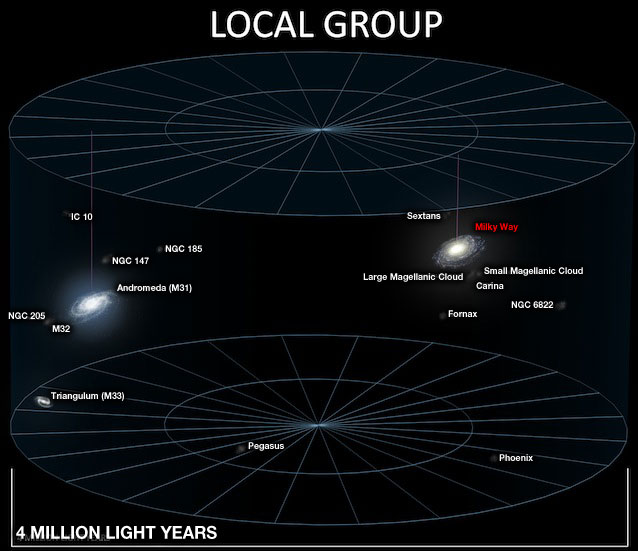
The Andromeda galaxy is practically a twin sister to our own Milky Way. Slightly larger than us but slightly less massive, Andromeda lies around 2.5 million light years away, and between them Andromeda and the Milky Way dominate the local group of galaxies. But Andromeda is not without fanciful tastes – it wears a skirt over a million light years in diameter, made up of dwarf galaxies.
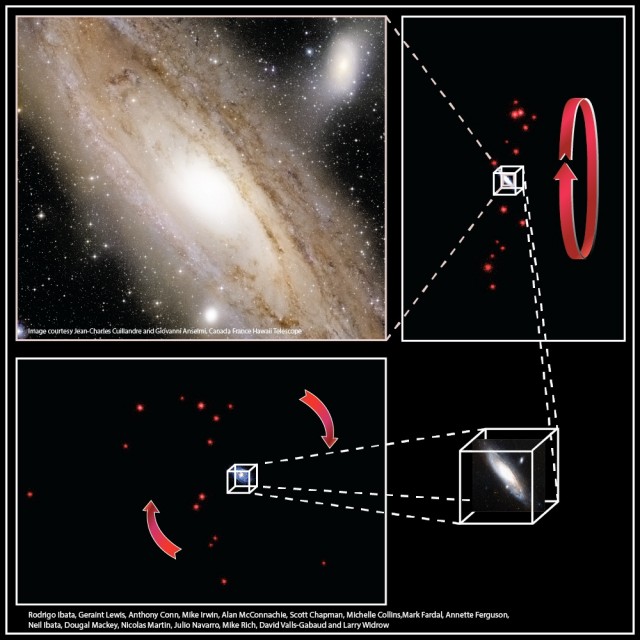
A recent study headed by Rodrigo Ibata at the Strasbourg Astronomical Observatory, France, and Geraint Lewis at the University of Sydney, Australia, found a host of new galaxies in the local group. The image below gives you an idea of the scale involved, but it doesn’t show the full story – There are actually over 54 galaxies in the Local Group. Andromeda is surrounded by a small swarm of 27 dwarf galaxies, and 13 of those dwarf galaxies orbit in the same plane, the same way the planets orbit the Sun. This means that Andromeda is surrounded by a disk-like shape, the largest cohesive structure in the local group. And it’s still very much a mystery as to why it exists.
Even here inside the largest galaxy for millions of light years, space is mostly empty, but the vast expanses of intergalactic space are so devoid of anything that it’s difficult to fully appreciate (to get even more perspective on this, click here and look at the full image!). But even in the face of this terrifying emptiness, galaxies live out their lives. They pull on each other and interract. They form and coalesce. Large galaxies devour smaller ones whole, and every so often, large galaxies smash together and tear each other apart. But none of the theories we have today quite explain Andromeda’s skirt.
Those 13 dwarfs orbit Andromeda once every 5.5 billion years or so, and Ibata, with his team of researchers, has suggested a couple of explanations for the disk. Firstly is that they formed in place as they are, and have been slowly twirling around Andromeda since before the Sun was born. They may have been created during a merger between two ancient galaxies, from a streamer of gas which was spun off. Or possibly, these galaxies are as old as Andromeda itself, forming at the same time amidst all of the dark matter attracted by Andromeda’s huge bulk. This would fit with the fact that those dwarf galaxies are made up of ancient stars, implying that this structure could be truly ancient.
Or perhaps it isn’t a disk at all. Perhaps we’re seeing a slew of galaxies recently pulled into Andromeda’s gravitational grip, and it’s purely by chance that they appear to be arranged into a disk shape. It’s entirely possible, and only further research will show if the disk structure is real or not. Combined with the recently discovered halo of gas surrounding the Milky Way, it seems there may be a lot lurking out there in intergalactic space that we don’t yet understand.
But either way, both of these hypotheses have problems with them. Neither is a perfect fit. In an interview, Nicolas Martin at the Strasbourg Astronomical Observatory explained that the fact that we don’t know why these galaxies are arranged the way they are is what makes this discovery so exciting;
“The presence of this thin, rotating disk of dwarf galaxies around Andromeda suggests a strong connection between the host galaxy Andromeda and its satellites. There is currently no satisfactory scenario that can explain all the properties of the satellites in the disk, but they all require a strong interplay between Andromeda and the satellites themselves.”
Image credits:
Top – Robert Gendler
Middle – Andrew Z. Colvin/Wikimedia Commons
Bottom – Rodrigo Ibata/PAndAS team
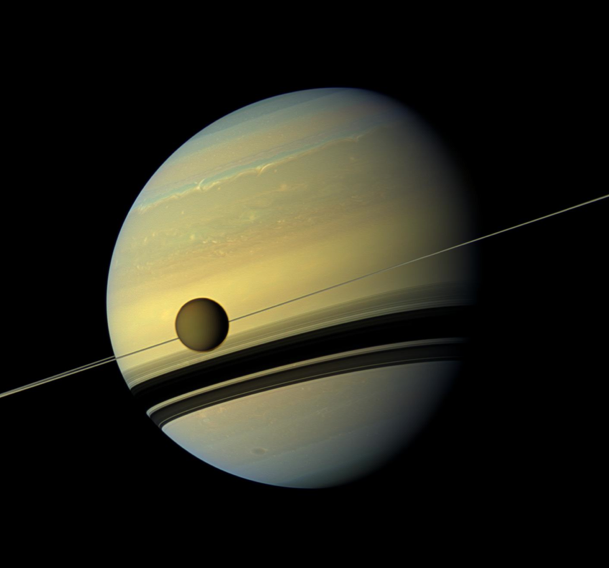
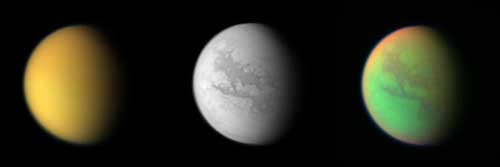
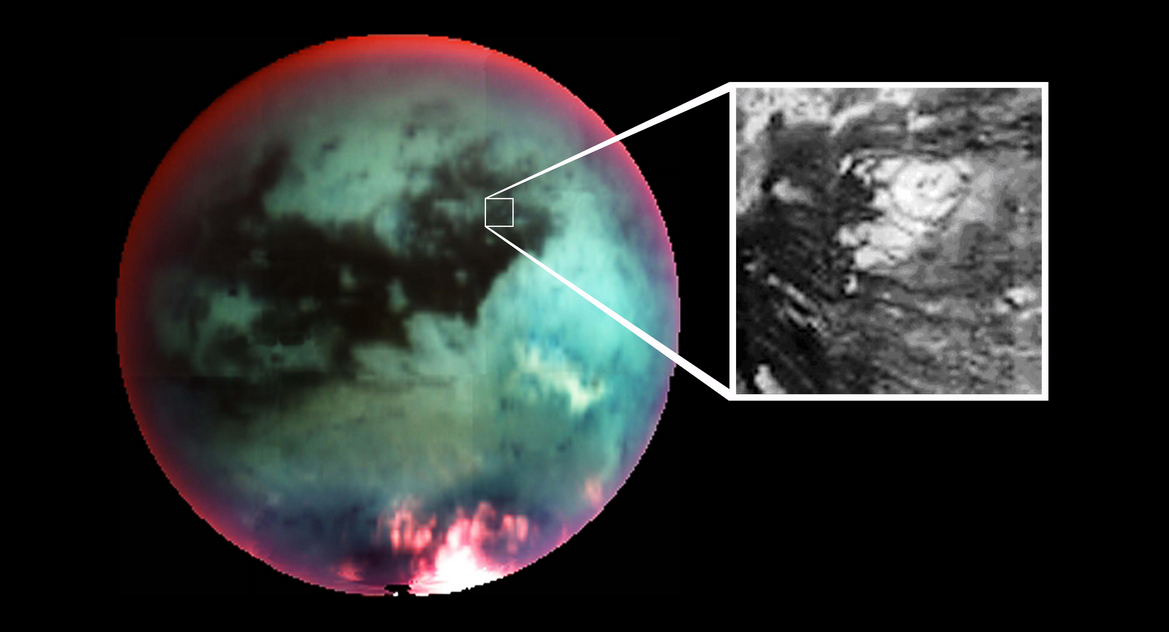
Discovered in 1655 by Dutch astronomer Christiaan Huygens, Titan is one of Saturn’s 62 moons, named for a race of giants in Greek myth who were Saturn’s brothers and sisters. Over 5000 km in diameter, it’s roughly twice the size of our own Moon and is one of the largest moons in our solar system, second only to Jupiter’s Ganymede. It’s even bigger than the planet Mercury, and is covered with an orange haze that shields the secrets of its surface. That alone makes it interesting, but a glimpse into the workings of the planet makes it more intriguing still—astronomers even believe Titan could harbour life.
In the 1980s, the Voyager 1 and 2 spacecraft flew past Titan; in the 2005 Huygens probe parachuted through its atmosphere and landed on the surface; and the Cassini spacecraft still studies Titan from its orbit around Saturn. Their images and measurements have revealed a vibrant alien world beneath the haze—complete with rivers, lakes, and ice volcanoes.
Credit: NASA
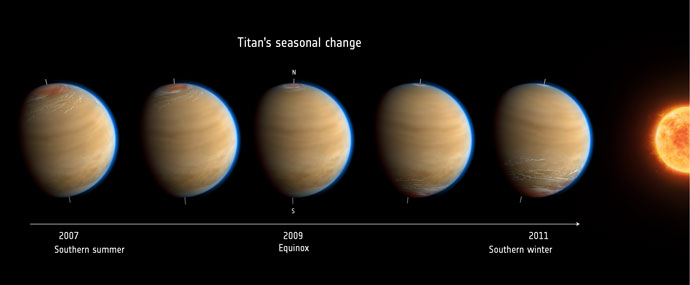
Titan is an incredibly frigid place, with an average temperature of -178 degrees Celsius (-289 Fahrenheit)—too brutally cold for life as we know it, but still of incredible interest to astrobiologists. It’s the only moon known to have an atmosphere—a thick and cloudy one, composed primarily of nitrogen—and it also exhibits weather and changing seasons. The orange haze that shrouds its surface is made up of trace gases such as benzene and hydrogen cyanide, and at the pole closest to the sun, sunlight heats the toxic orange haze and makes it circulate towards the other pole, so the gases concentrating there. Since a year on Titan lasts almost 30 Earth years, each season is 7 years long.
Titan’s seasonal changes. Credit: NASA
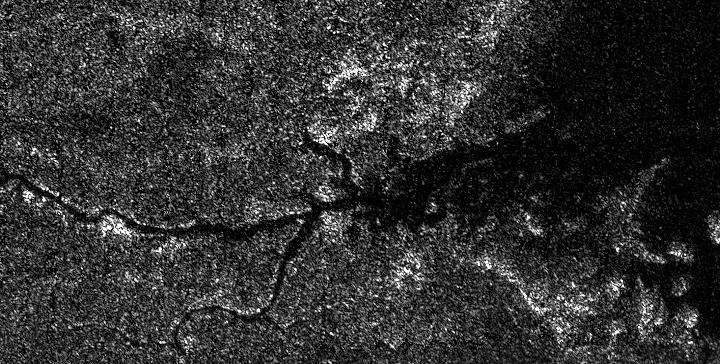
However, unlike Earth, its weather system is methane-based—and aside from Earth, Titan is the only object in the solar system to have permanent bodies of liquid on its surface, including an enormous river system that flows 400km across the moon’s surface to meet a large sea.
River network on Titan. Credit: Cassini
The darkness of the river in the image indicates a smooth surface, which in turn indicates that the river is not a dry bed, but filled with liquid—but this liquid is likely methane or ethane, which are more closely related to gasoline than water. Even though the mechanics seem to be similar, Titan’s weather would be alien to us because the skies fall with methane rain and lakes and oceans pool with liquid methane—but still, this presents possibilities of methane-based life.
Credit: Cassini.
It is also suspected that Titan harbours cyrovolcanoes, which spew water ice and hydrocarbons into the atmosphere instead of lava. Speculations began after NASA’s Cassini spacecraft captured images of a landform on Titan’s surface called Sotra Facula. The images showed three conical features with material flowing from them, their peaks up to 1,500 metres tall, as well as several pits equally as deep. Researchers gravitated towards the idea that these landforms were cyrovolcanoes, as it would help explain a long-standing mystery of Titan’s thick, methane- and nitrogen-filled atmosphere. Calculations show sunlight would have broken the methane down long ago if something hadn’t been replenishing it, and a cyrovolcano is a good candidate—it could erupt methane, dragging it from the planet’s interior into the atmosphere.
Sotra Facula. Credit: APOD.
However, these intriguing surface features could have also been created by weather and meteorite strikes than by volcanic activity, and it is difficult to tell without further data. Researchers believe cyrovolcanoes might be fairly common on the frigid moons of the outer planets—one has been confirmed on another of Saturn’s moons, Enceladus—which is incredibly interesting, because volcanic activity would prove that Titan is an active world, and could increase the likelihood that this huge, distant moon may harbour life. While searing lava destroys life on Earth, ice volcanoes on Titan would provide a way to mix complex chemicals from the surface and the interior. It could bring life forms up to the surface so our instruments have a better chance of detecting them—because fascinatingly, Titan seems to have subsurface oceans.
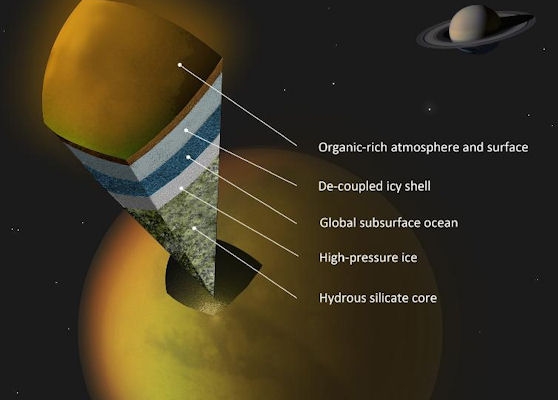
Further data from Cassini indicates that Titan has a layer of liquid water under its icy outer shell. The evidence is tidal—as Titan orbits Saturn, the planet’s powerful gravitational pull stretches and deforms the moon, like pulling and stretching an elastic band. If Titan were solely composed of rock, this stretching would only cause bulges (tides) of about 1 metre, but instead the moon experiences tides of about 10 metres—suggesting that its interior is not entirely solid. This ocean may not be enormous or deep; just a liquid layer between the solid mantle and the external icy shell would be enough to compress and bulge as Cassini has observed. Since Titan’s ice surface is composed mostly water ice, researchers believe its ocean could be liquid water.
However, just the presence of an ocean alone does not indicate life—researchers think that life is more likely to occur when the water comes into contact with rock, and we can’t currently tell if this exists beneath the surface.
Possible scenario for internal structure of Titan. Credit: NASA
Another intriguing phenomenon is the hydrogen gas flows through its atmosphere, and yet there is a lack of the chemical on the planet’s surface—so how did it disappear? One theory suggests that hydrogen-breathing, methane-based life forms consume the gas, similar to how we consume oxygen on Earth.
Liquid water, a possibly active interior, complex chemistry, a thick atmosphere, seasons, weather… All of these factors reflect the environment of life as we know it, so researchers have long thought that Titan is an excellent candidate to harbour life. None of these factors alone are solid evidence for life—they are just conditions necessary for it—but Titan is a fascinating place deserving of further study. Since its nitrogen-rich atmosphere is similar to Earth, just significantly colder, it also demonstrates how atmospheres of cold moons and planets behave, and thus allows us to speculate about how the atmospheres of exoplanets far from their stars might behave.
But our questions about Titan will remain unanswered until we obtain sufficient evidence to draw conclusions—but to do this, we need data. Two possible missions have recently been proposed. The first is the Titan Mare Explorer (TiME), which would have sent a floating buoy to land in Titan’s methane sea and measure the chemistry and organic composition, study the sea’s interaction with the atmosphere, and basically perform the first nautical exploration of this extraterrestrial ocean. It also would have observed Titan’s methane cycle to help us compare it to the water cycle on Earth. TiME was proposed to launch in 2016, but unfortunately it lost its funding to a Mars mission.
Artist’s concept for the TiME lander. Credit: NASA/ESA
Another possibility, however, is the Titan Saturn System Mission (TSSM), which is a proposed exploration of Saturn, Titan, and Enceladus—focusing on the complex phenomena the Cassini spacecraft has already noted. It is proposed to launch in 2020 and reach Titan by 2029, and during its 4-year-tenure, it would spend time circumnavigating Titan and studying its astrobiological potential. The mission consists of an orbiter and two Titan exploration probles—one that’s basically a hot air balloon, and another that land on the methane seas. One of the proposals for this second lander is the lake-lander of the discarded TiME mission, which will hopefully be included. TSSM, if it goes ahead, would be the first mission to extensively survey the organic chemistry and climate of the land, sea, and air of another world.
If life is detected on Titan, it would undoubtedly be moving and crucial to us as a species—not only because it’s the first extraterrestrial life we have detected, but also because it would behave differently to the water-based, oxygen-breathing life we’ve developed here. Even if life has not yet developed on Titan, the chemistry for life to form is present, so just give the moon four billion years…and who knows?
CSIRO telescope takes temperature of Universe Astronomers using a CSIRO radio telescope have taken the Universe’s temperature, and have found that it has cooled down just the way the Big Bang theory predicts.
Using the CSIRO Australia Telescope Compact Array near Narrabri, NSW, an international team from Sweden, France, Germany and Australia has measured how warm the Universe was when it was half its current age.
“This is the most precise measurement ever made of how the Universe has cooled down during its 13.77 billion year history,” said Dr Robert Braun, Chief Scientist at CSIRO Astronomy and Space Science.
“This is the most precise measurement ever made of how the Universe has cooled down during its 13.77 billion year history.”
Dr Robert Braun, Chief Scientist, CSIRO Astronomy and Space Science
Because light takes time to travel, when we look out into space we see the Universe as it was in the past — as it was when light left the galaxies we are looking at. So to look back half-way into the Universe’s history, we need to look half-way across the Universe.
How can we measure a temperature at such a great distance?
The astronomers studied gas in an unnamed galaxy 7.2 billion light-years away [a redshift of 0.89].
The only thing keeping this gas warm is the cosmic background radiation — the glow left over from the Big Bang.
By chance, there is another powerful galaxy, a quasar (called PKS 1830-211), lying behind the unnamed galaxy.
Radio waves from this quasar come through the gas of the foreground galaxy. As they do so, the gas molecules absorb some of the energy of the radio waves. This leaves a distinctive “fingerprint” on the radio waves.
From this “fingerprint” the astronomers calculated the gas’s temperature. They found it to be 5.08 Kelvin (-267.92 degrees Celsius): extremely cold, but still warmer than today’s Universe, which is at 2.73 Kelvin (-270.27 degrees Celsius).
According to the Big Bang theory, the temperature of the cosmic background radiation drops smoothly as the Universe expands. “That’s just what we see in our measurements. The Universe of a few billion years ago was a few degrees warmer than it is now, exactly as the Big Bang Theory predicts,” said research team leader Dr Sebastien Muller of Onsala Space Observatory at Chalmers University of Technology in Sweden.
Publication “A precise and accurate determination of the cosmic microwave background temperature at z=0.89”, by S. Muller et al. Accepted for publication in the journal Astronomy & Astrophysics; online at
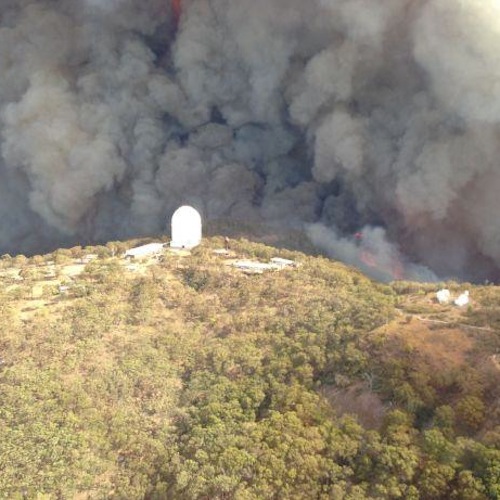
Another week, another collection of weekly science picks! Those of us over here in Northern Europe have been enjoying snowy weather this past few days, with more expected on the way. At the same time, many of us have been keeping a concerned eye on the recent events in Australia – the bush fires being among them.
Among the many areas hit by the fires was Siding Spring Observatory. While some buildings were destroyed and others damaged, all of the telescopes appear to be ok. Details on the entire event from a first hand perspective are given by astronomer Amanda Bauer on her blog, Astropixie.
from all accounts i’ve received, heard, and read, the area surrounding coonabarabran is a “disaster zone,” which is heart-breaking news. fire service crews will be working overnight, taking advantage of milder conditions, to put containment lines around the edges of the fire, hoping to protect coona before the winds change.
Orion, the spacecraft being developed to replace the Space Shuttle and ease the pressure on Russia’s Soyuz craft, has been a troubled undertaking. As with virtually all NASA projects lately, it’s been hampered by repeated budgetary problems. The latest development in the story is that Europe has now formally agreed to assist in developing the Orion craft, with the long term goal of deep space missions, to the Moon and Mars.
The current plan calls for Europe to build the prototype module for 2017 and a number of components that would be needed for the second vehicle in 2021, although a formal go-ahead to complete this additional model is some years off.
Depressingly, there is still an obvious gender gap in science, though it’s at least heartening to know that this is an issue which some are paying serious attention to. Many are going what they can to fix the problem, while others are disappointingly willing to argue that nothing should be done. One article which caught my eye this week was written by an anonymous senior scientist, arguing that we should be taking a more aggressive approach to tackling this problem. I for one, wholeheartedly agree!
Can it be that women are treated less fairly than men? A deceptively simple piece of research led by Jo Handelsman at Yale University has recently suggested that they are… I should point out here that there was no statistically significant difference between the responses from male or female faculty, nor were there differences between levels of faculty, suggesting this is not a hierarchical bias.
Back in space, new plans for the International Space Station involve blowing something up. Nevada-based Bigelow Aerospace have been contracted to develop an inflatable habitat module for the space station, with the intention of using the new SpaceX Dragon craft to send it up into orbit. Private companies are evidently becoming major players in human spaceflight.
Bigelow hopes the tests done in orbit will prove that inflatable capsules are safe and reliable for space tourists and commercial research, an idea almost as old as NASA itself. The space agency began investigating the concept of expandable spacecraft in 1958. Space stations like this would be easier to launch and assemble than those with metal components, so would be cheaper.
On a final note, while many of us tend to consider invertebrate animals as being inferior, there’s evidence that some of them may be more self aware than we give them credit for. While some research has concluded that fish don’t feel pain in any meaningful way, crustaceans like crabs and prawns probably do. It’s probably about time we extended the laws on humane treatment of animals to cover invertebrates too.
A study has revealed that the shore crab, a close relative of the species we use for food, responds to electric shocks and then goes on to avoid them. Previous research has shown that prawns and hermit crabs also react to painful situations.
Whether you’re dealing with fire or ice nearby, stay safe and have a good week!
Image credits:
Top – NSW Rural Fire Service
Bottom – Electron Microscopy Unit, Beltsville Agricultural Research Center, Maryland.
Featured – ESA