Tag: astronomy

  • Weekly Science Picks

    Weekly Science Picks

    By now, I think it’s safe to say that if you’re reading this, it means the world didn’t end on Friday. Which is rather a good thing, because a lot of interesting things have been happening recently! Even though I’ve been busy as can be, writing papers and trying to finish off a thesis there have still been a few fascinating little gems to catch my eye in the news this week…


    Firstly, NASA have announced a new prototype space suit, with new and improved technology. Intended to be easier to put on, amongst other things, the most exciting part of the news is that these new suits are intended for deep space missions, focussing on safety “during spacewalks and potential surface activities”! Oh, but there’s just one thing which everyone’s noticed…

    Nasa’s New Space Suit Looks Exactly Like Buzz Lightyear

    NASA-Z1-suit

    Nasa said one of the key differences was that the new suit has a one-piece design, into which the wearer crawls in through a hole in the back, as opposed to the trousers-top-helmet version currently in use on the International Space Station.


    Meanwhile, in Switzerland, physicists have been puzzled by the results they’ve seen from the LHC. While there’s now little doubt that they’ve detected a signature which matches what they’d expect from “a Higgs-like boson”, it seems like there’s more going on than they realised…

    Two Higgs Bosons? CERN Scientists Revisit Large Hadron Collider Particle Data

    Yesterday researchers at the Atlas experiment finally updated the two-photon results. What they seem to have found is bizarre—so bizarre, in fact, that physicists assume something must be wrong with it. Instead of one clean peak in the data, they have found two.


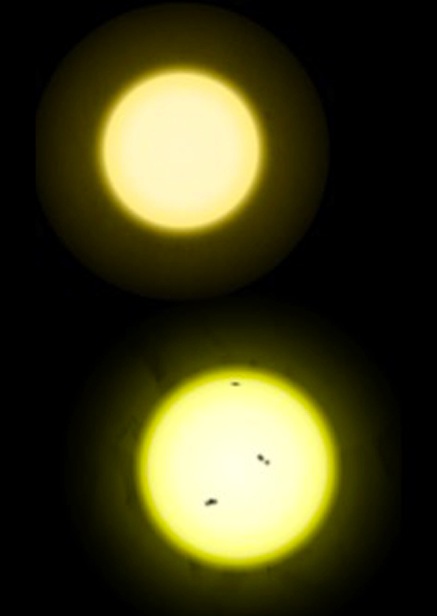
    The Sun, compared to Tau Ceti
    The Sun, is slightly larger and more active than Tau Ceti. Credit: R.J. Hall/Wikimedia Commons

    Finally, one star near to Earth which has always garnered much attention from science fiction writers is Tau Ceti – right in our neighbourhood at a mere 12 light years away. For a long time, many have speculated on the potential for life-sustaining worlds around the Sun’s slightly more orange neighbour, and now it looks like there may well be. While we’re still waiting for confirmation, there may be 5 planets around Tau Ceti, and two of those might be candidates for sustaining life!

    Nearby Tau Ceti may host two planets suited to life

    The highlight of this alien solar system is Tau Ceti e, which has a mass of over four Earths and a year just under half as long as ours. It orbits in the star’s habitable zone, the region where liquid water is thought to exist. “It is in the right place to be interesting,” says [Hugh] Jones.


    Short but sweet, that’s all for this week. I hope everyone has a lovely Christmas (or whichever of this season’s holidays and festivals you choose to celebrate). See you next time!

  • The Case for Neptune

    The Case for Neptune

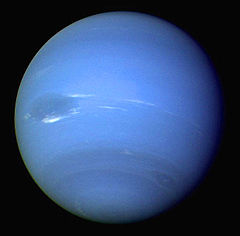
    Take a moment to consider Neptune. The eighth planet in our solar system, the planet farthest from the Sun, and the third most massive planet in our solar system.  Also one of the least visited, and consequently one of the least understood planets in our solar system. Neptune was discovered in 1846.  Forty years later, in 1886, astronomer Sir Robert Ball wrote ‘Besides this brief sketch of the discovery of Neptune, we have little to tell with regard to this distant planet.  With a good telescope and a suitable magnifying power we can indeed see that Neptune has a disc, but no features on that disc can be identified’.

    Unfortunately in the last 126 years not much has changed. Due to its enormous distance from Earth (~ 30 Astronomical Units) Neptune remains little more than a blurry disk in the eyepiece of the most powerful ground based telescopes.  In the past astronomers  studied Neptune by examining the planet as it occulted, or passed in front of the light of another object, usually a star, allowing scientists to calculate its diameter, chemical composition, and temperature.  The opportunity to study the gas giant only improved when Voyager flew by Neptune in 1989, and the Hubble Space Telescope was launched in 1990.

    Voyager 2 launched in 1977, and reached Neptune on the 25th of August 1989 (click here for an impressive animation of the Voyager 2 flyby of Neptune). Although Voyager 2 began imaging the planet from about 35,000,000 million miles out, most of the data we have today is from a 24 hour period, during which Voyager 2 passed 4,500 kilometres above Neptune’s north pole at an eye watering 67,000 km per hour.  During the trip to Neptune Voyager gathered about 5 trillion bits of information or about .5 of a Terabyte of data. That doesn’t sound much now, but back in 1977 the 3 computers on the Voyager spacecraft had a combined memory of 68Kb, so Voyager sent back almost 15 million times more data that could be stored in it’s memory!!

    Scientists were thrilled by the data from Voyager 2 and set to work learning as much as they could about the distant blue planet.  We learnt that Neptune is mostly composed of gas, is likely to have a rocky or metallic core, and that the majority of Netpune’s mass is hydrogen and helium, with traces of water, methane, ammonia, and other compounds.  Thanks to Voyager 2 we learnt an enormous amount about Neptune’s atmosphere, weather systems, magnetic field, moons, and ring system.  But that was over 30 years ago – and we now have more questions than answers.

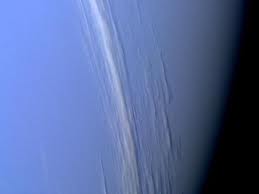
    Images from Voyager 2 showed that the most obvious feature of Neptune is its stunning blue colour, the result of methane in the atmosphere.  Voyager 2 also revealed a more dynamic and turbulent atmosphere than anyone expected.  Neptune’s atmosphere consists of layers of clouds, banded features, and unexpected structures, including what was termed the Great Dark Spot (GDS). Neptune generates the strongest jet streams anywhere in the solar system, reaching speeds of up to 2,400 kms per hour. Voyager detected weak auroras, similar to those on Earth, but because of Neptune’s complex magnetic field, the auroras appear over wide regions of the planet, not just near the planet’s poles.  Despite what we do know, the structure and composition of Neptune’s atmosphere remains poorly understood. What accounts for the relatively high percentage of methane and lack of hydrogen and helium? What is the energy source responsible for powering the incredibly high speed winds and variable storm systems? What happened to the Great Dark Spot (observed by Voyager in 1989, but no where to be seen when Hubble observed the planet in 1994). Why is the temperature of Neptune’s thermosphere, a staggeringly high 750K (4760 degrees celsius)?  How can Neptune be so cold and distant from the Sun, and yet radiate so much energy?

    Thanks to Voyager 2 we know that Neptune’s magnetic field is approximately 25 times stronger than Earths, and that it’s lopsided (like Uranus), at 47to the rotation axis and offset from the planet’s centre.  Although we suspect that Neptune’s magnetic field is generated by currents within Neptune’s icy mantle – we do not fully understand why Neptune’s magnetic field is oriented the way it is, or what processes could generate such an off-kilter magnetic field.

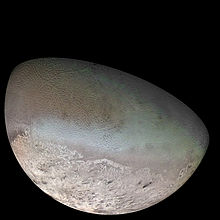
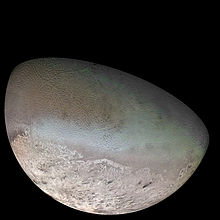
    Voyager 2 image of Triton (Credit Nasa)
    Voyager 2 image of Triton (Credit NASA)

    Before Voyager 2, Neptune was thought to have 2 moons, Triton and Nereid. Voyager 2 discovered 6 new moons, and since Voyager’s visit, astronomers have discovered a further 5 moons.  Most of what we know of Triton, Neptune’s largest satellite, was acquired in a single encounter by the Voyager 2 spacecraft, which imaged about 40% of its surface.  If scientists were surprised by the images from Neptune, they were stunned by the images of Triton.  Triton, is an icy moon with a surface temperature of -235o, the coldest place known in the solar system.  Voyager’s images revealed a geologically active planet, geysers spewing nitrogen gas and dust particles high into the atmosphere, rocky outcrops, canyons, and plains of frozen methane.  Triton has a very thin nitrogen atmosphere with small amounts of methane, above a scarred and cracked surface.  Triton showed no fresh impact craters, an indication of an active planet experiencing periodic resurfacing.  But there’s still a lot to learn. Perhaps the most tantalising questions are about Neptune’s largest moon.  Was Triton formed near Neptune, or is it a captured object from the Kuiper belt?  What is the composition of Triton, and what causes the geologic activity, and has the distribution of the ice geysers changed dramatically since the Voyager flyby?  Will further analysis of Triton tell us more about the solar system, and our place in it?  Is there a sub surface ocean? Could Triton harbour life?

    Earth-based observations during the 1980s suggested that there were a number of partial rings surrounding Neptune, and Voyager 2 discovered a system of equatorial, circular rings.  Although Voyager 2 gave us a good look at Neptune’s rings, the details of their composition is still uncertain, we don’t know how long they’ve been there, or even if they are stable.

    Despite the valuable insights bought to us by the Voyager mission, the Hubble Space Telescope and other studies, clearly there are still a number of questions about Neptune that still need to be answered. Technology has advanced enormously since 1977 and any new mission would be well equipped to examine Neptune, its rings and a number of its moons.  A mission to Neptune would enable us to learn more about our outer solar system, and exploration of Triton may provide our best opportunity to examine the surface and atmosphere of a Kuiper Belt Object in orbit around a planet in our solar system.  In 2003 NASA proposed a Neptune Orbiter/Triton Explorer, however, that mission appears defunct.  Neither NASA nor ESA have any current or future plans for the exploration of Neptune.

    I think that needs to change.

  • Weekly Science Picks

    Weekly Science Picks

    Doesn’t time fly? I don’t know about anyone else, but my week has absolutely flown past. As I take a moment to relax and consider picking a few favourite topics from this week’s news, I realise that perhaps this is because it’s been an exciting week, full of interesting discoveries and unusual events. In fact, I’ve had quite a lot to choose from, but I eventually managed to trim it down to these few articles which particularly caught my eye…


    First and foremost, a planet has been discovered in our neighbouring star system, Alpha Centauri. This is something which I find thrilling for various personal reasons. An interesting discussion of the discovery itself and some of its implications are given by Paul Gilster in the blog Centauri Dreams:

    There was a sense of exhilaration in the air on Tuesday as the buzz around an Alpha Centauri planet built, and when the embargo was lifted, reports of the find filled the social media as the early articles began to appear online. Just how big a deal is Centauri B b? A skeptic could point out that while finding an Earth-mass planet is significant, it must still be confirmed, and in any case, this is an Earth-mass planet that is nothing like a clement, habitable world.


    From a neighbouring star to a neighbouring planet, the Curiosity rover has been finding some very curious shiny objects in the martian soil. Wired Science gives a brief overview of what’s been happening on the red planet:

     NASA’s Curiosity rover took three scoops from a small Martian sand dune and found several bright particles in the soil. Scientists think these are unrelated to the odd bright object that Curiosity saw last week, which turned out to be plastic that fell from the probe, and are probably indigenous Martian mineral flecks.


    Closer to home, this week saw a world record being broken by Austrian skydiver Felix Baumgartner, who leapt from a balloon at an altitude of 39 km. A fantastic achievement and a daredevil stunt! However, could more of an effort have been made to add some depth to the stunt and give us all some more background about it? Science historian Amy Shira Teitel at Vintage Space takes a detailed look at the full background and a few tricks which were missed with respect to communicating the science behind such a stunt:

    In the 1960s, pilots were pushing the envelope of supersonic flight at high altitudes. But this was a dangerous approach. While it’s easy to fly fast in the thin upper atmosphere it’s harder to control an aircraft. With no air for control surfaces to push against, aircraft tend to tumble, and when aircraft tumble pilots tend to eject. Tests with dummies showed that when falling from high altitudes, human bodies tended to get into a flat spin. It would be like rolling down a hill really fast but without the hill, and the G-forces would certainly be fatal.

    Image: AP Photo/Red Bull Stratos, Luke Aikins

    And finally, there was a rather informative little discussion piece by Dave Hone in the blog Lost Worlds. In emphasising some of the difficulties faced in palaeontology, he poses a rhetorical question – did Tyrannosaurus Rex have feathers?

    Note that there is a rather important scientific distinction here, no facts have changed since the 70s, but we have many more facts. And the best interpretation of all of the available data is now a little different to that which we had before. The fossil record is incomplete and we have to extrapolate from the available evidence and apply parsimony the best way we can.


    I hope you’re having a good weekend!

  • The nearest solar system to ours has an Earth-sized planet…

    The nearest solar system to ours has an Earth-sized planet…

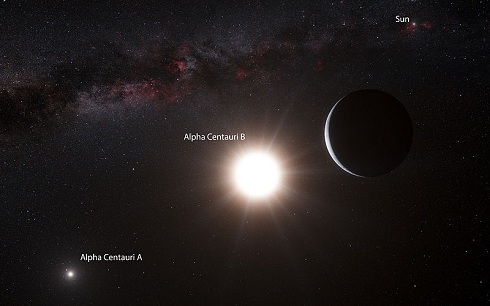
    Already there’s an artist’s impression of the
    newly discovered ‘Alpha Centauri B a’

    Yes—you read right. Alpha Centauri has a planet, and it is roughly the size of Earth. And at just 4.37 light years distance, it is theoretically reachable (with a whole lot of space travel development!) despite the frustrating limitations put on us by Mr Einstein.

    In a paper appearing in the journal Nature today, lead author Xavier Dumusque (Geneva Observatory, Switzerland and Centro de Astrofisica da Universidade do Porto, Portugal) explains how they use the 3.6-metre telescope at the European Space Observatory’s La Silla Observatory in Chile to detect the tiny back-and-forth wobbles to a sun’s position that are caused by the gravitational mass of a planet revolving around it.

    BUT don’t pack your bags yet. This planet is closer to its sun than Mercury is to our Sun. So close in fact that it orbits it in just 3.2 days. So close that its surface temperature is likely to be around 1200 degrees Celsius.

    So not exactly in the much-sought-after ‘Goldilocks zone’—that orbital distance from a sun that would allow liquid water to exist on a planet, making it theoretically hospitable to life—as we know it anyway…

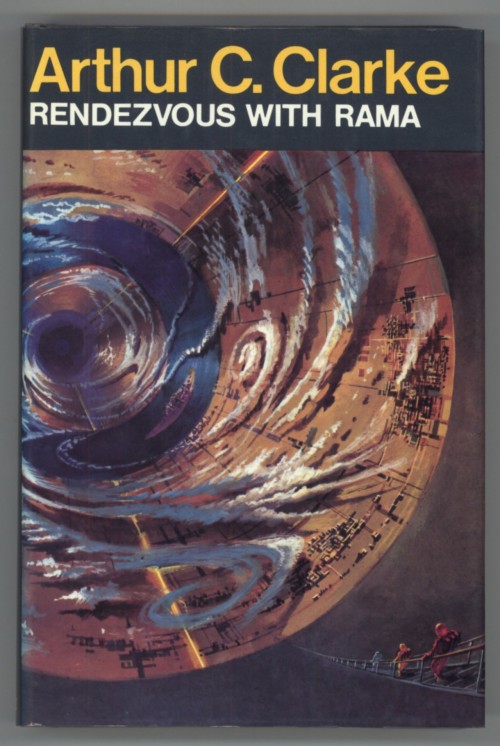
    And besides, while 4.37 light years sounds pretty close—that’s some 56 trillion kilometres—56,000,000,000,000 kilometres. To put that into perspective, Voyager 1 is currently 18,353,400,000 kilometres from Earth, and it was launched in 1977! How’s that in light years? Just 16 hours, 59 minutes and 38 seconds of light-travel time. So we’d probably need something like Arthur C Clarke’s Rama spaceship to make the crossing, because we’d be in there for a very long time…

    Let’s just clarify some details. Alpha Centauri isn’t one star, it’s actually three:

    • Alpha Centauri A (α Cen A)—about 110% the size of our Sun and 152% the luminosity
    • Alpha Centauri B (α Cen B)—about 91% the size of the Sun and half its luminosity
    • Proxima Centauri (α Cen C)—a red dwarf about 1/7 the size of the Sun (just 1.5 times the size of Jupiter) and less than 2% its luminosity

    Alpha Centauri A and B form a binary 4.37 light years from us. The distance they are apart varies between the distance from the Sun to Saturn, and to Pluto. Proxima is gravitationally connected to the binary, but actually slightly closer—4.24 light years away, making it the closest star to our solar system. This system is so close to ours that most of the night sky viewed from any planet there would be recognisable to us, with most constellations virtually unchanged from how they look here.

    Comparative star sizes

    Alpha Centauri is very easy for us to find in the Southern Hemisphere. It’s the fourth-brightest star in our skies at magnitude -0.27, is in the constellation Centauri and is also one of the Pointers to the Southern Cross—the furthest one from Crux. It’s also the brightest of the two pointers and indeed the whole Centauri constellation—hence the alpha in the name. A reasonable amateur telescope or even good binoculars will resolve the binary system, with clear differences between the sizes of the two stars. You need a fair bit better telescope and very good seeing to find Proxima…

    The discovery was made using the HARPS instrument on the ESO telescope—the High Accuracy Radial Velocity Planet Searcher spectograph. Rather than detecting sideways wobbles, HARPS was able to discern variations in the star’s light due to red-shifts and blue-shifts of the forward and away aspects of the star’s wobbles! Considering that the relative velocity this movement is in the order of the speed a baby would crawl, it’s a truly remarkable achievement.

    No doubt others will be looking to verify the finding over coming months. There’s a small (10 to 25%) chance that the planet could be orbiting in an elliptical plane that has it passing in front of α Cen B from our perspective. If so, the other main way that planets are found could be used. This method detects periodic dips in the star’s brightness caused by the planet’s partial eclipse, and is the way the Kepler Space Telescope has been used to find hundreds of other exoplanets.

    Sources:

    http://www.eso.org/public/news/eso1241/

    http://www.nature.com/news/the-exoplanet-next-door-1.11605

    http://bigstory.ap.org/article/earth-sized-planet-found-just-outside-solar-system

    http://www.sciencenews.org/view/generic/id/345756/description/The_alien_next_door

    http://en.wikipedia.org/wiki/Alpha_centauri

  • 2013 looks like being the year of the comet

    2013 looks like being the year of the comet


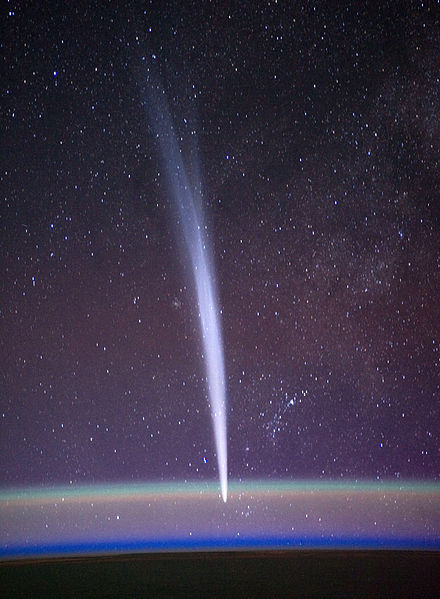
    Comet Lovejoy, taken by astronaut Dan Burbankfrom the ISS

    The astronomy world has been buzzing since it was announced on 24 September – C/2012 S1 is a new comet that could be lighting up our skies like none in living history by November 2013. It’s been named Comet ISON after the telescope research network used to discover it – the International Science Optical Network, using its 16″ telescope in Russia.

    It has since been confirmed, using one of the scopes from the public subscription-based telescope network iTelescope.

    With a trajectory taking it very close to the Sun, people are predicting that it could be bright enough to be visible in daylight, like Venus. Ernesto Guido, Giovanni Sostero & Nick Howes  advised on the blog for the Associazione Fruiulana di Astronomia e Meteorologia that it will pass within 0.012AU of the Sun – with one AU being the distance of Earth from the Sun – at the end of November and about 0.4AU from Earth in early January 2014. That’s about 1.8 million kilometres from the Sun.

    They predict it will become a naked-eye object from early November, and peak in negative magnitudes between 25 November and 3 December, with the brightest a whopping -10.6. Given the visual flop that was the last Haley’s Comet visit, they urge caution with these calculations. But calculations by others appear to confirm that it will likely be very bright.

    (more…)

  • For sale: One world class infrared telescope

    For sale: One world class infrared telescope

    Image © Tom Kerr/A Pacific View

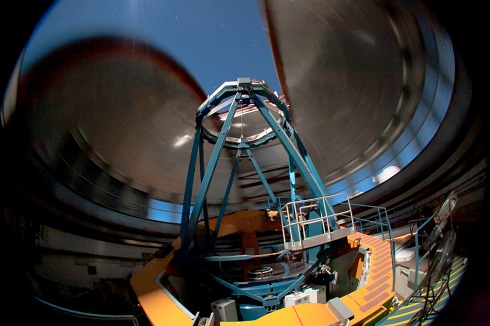
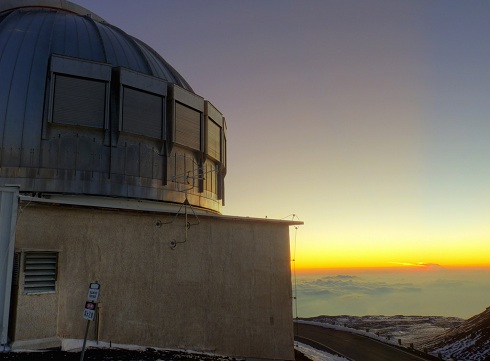
    The world’s largest and most productive dedicated infrared observatory just went on the market in an unprecedented attempt to try and prevent it from being shut down and dismantled. In a bold move, the directors of the United Kingdom InfraRed Telescope (UKIRT), based on Mauna Kea in Hawaii, have just released a prospectus detailing the telescope’s impressive achievements and capabilities in the hopes that they can find sponsorship and save the observatory from certain doom. That may sound melodramatic, but doom genuinely is the most fitting description.

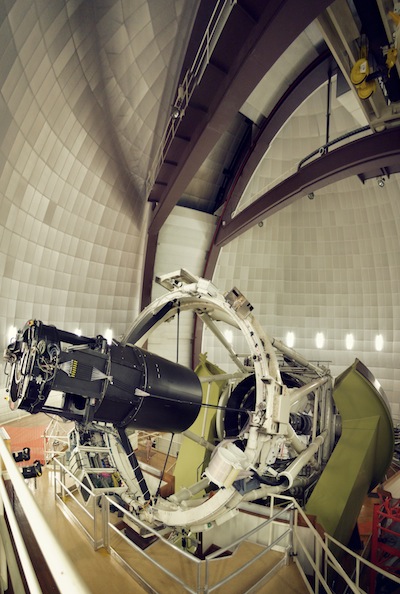
    The Anglo-Australian Telescope, also abandoned by the UK, but still safe in the care of the Australian government. (Image Credit: Ahilan Parameswaran/Wikimedia Commons)

    UKIRT’s death knell has, in fact, already been tolled. At the start of Summer, the UK’s Science and Technology Facilities Council announced that it would be terminating funding and that all telescope operations were to cease by September 2013. The UKIRT board released an official statement explaining their grim disappointment over the decision, and morale has been low for everyone involved with the telescope ever since.

    Unfortunately, since their formation in 2007, the STFC have seemingly been determined to rid the UK of its telescope access. Another casualty was the Anglo-Australian Telescope (AAT). Constructed at Siding Spring Observatory in New South Wales, the AAT was originally built and operated in partnership between Australia and the UK, but since it’s 36th birthday in 2010 it has been owned and funded solely by Australia. The AAT is still the largest optical telescope in Australia and it continues to the crown jewel of the Australian Astronomical Observatory. Sadly, the future for UKIRT looks rather more bleak.

    Should they fail to find funding to continue it’s operation, then in September 2013 UKIRT will have to be dismantled and erased from Mauna Kea. Under the agreement originally made with the Hawaiian government, any telescope no longer in operation must be removed, and the mountain must be returned to its natural state. This once proud telescope will simply be no more – a heartbreaking prospect in the eyes of a great many astronomers worldwide.

    The most tragic part is that UKIRT is actually at its most productive right now. After being the world’s largest dedicated infrared observatory for over three decades, UKIRT is currently boasting a record level of productivity. Being as it’s exceptionally cheap to run and maintain (compared to other world-leading telescopes, it costs little more than pocket change), it’s easily one of the most productive telescopes in the world. And the directors are quite literally offering it to anyone in the world who may have the money to finance it. A dramatic move – no world class telescope has ever been simply offered up for sale on the global market before. Now, all the astronomical community can do is to hope that someone is willing to buy it.

    Whether you happen to be a billionaire playboy philanthropist interested in owning a telescope, or just curious to know more about UKIRT, their prospectus is online for all to see.

    Image © Tom Kerr/A Pacific View
  • My mega grab-bag of astronomy resources for teachers, students, telescope beginners and space fans

    My mega grab-bag of astronomy resources for teachers, students, telescope beginners and space fans

    Whether you are a parent, teacher, student or simply an interested enthusiast, here are a number of interesting sites, podcasts, and social media people for you to draw on as you get going in amateur astronomy.

    Podcasts provide an amazing resource – all free. Most are available via iTunes, the original publishers’ websites, or a raft of other podcast aggregators. There are very good apps to allow you to download podcasts to your smartphone for listening when suitable – Podcruncher is my choice for the iOS platform – brilliant app and service. Just don’t bother trying to use the Apple Podcasts app – it’s a total lemon. Good podcast apps also allow you to increase the playback speed up to double normal (Podcruncher goes in quarter increments) and surprisingly you learn to follow it. In fact, it can get so listening at normal speed is far too slow!

    Many of these links also have Twitter accounts (where noted), so you can keep right up to the minute!

    Astronomy podcasts:

    In Australia there is the wonderful StarStuff, an independent project run by Stuart Gary but sponsored by the ABC, with the 30-minute podcasts at ABC. @abcstarstuff


    Canberra’s Steve Nerlich produces Cheap Astronomy, regular 10-minute shows of varying complexity. @cheapastro

    Overseas, despite a truly ugly website, the fantastic Naked Scientists from UK’s Cambridge University have a stack of brilliant podcasts on general, science, archaeology, earth sciences, oceans, Africa, great kitchen-friendly experiments, and the monthly 60-minute Naked Astronomy, steered by Ben Valsler.

    Tony Darnell works in the Space Telescope Science Institute and as a hobby runs Deep Astronomy, with videos and podcasts generally about 10-minutes.

    There are a stack of NASA video and audio podcasts. Of interest are the space telescope ones for Hubble, Spitzer, Chandra, plus This Week @ NASA, Universe, Earth…where to stop? You’ll be amazed at how much NASA is doing – for an agency that altogether too many people think has shut up shop!

    365 Days of Astronomy is a real mixed bag of 10-minute podcasts – one for every day of the year. And it’s well worth looking back over previous episodes. Following are some specific ones worth checking out.
    Teachers could start with four of the best called ‘Wonders From Class’ by Diane Turnshek from Carnegie Mellon Uni. Over four podcasts and with great passion, she describes how she engages and interests her students with the field of astronomy. Part 1Part 2Part 3, and Part 4. Some others for beginning viewing and then a bit more:
    Common Q&As about telescope use – from RapidEye Observatory
    8 Telescope Tips for Beginners – by Telescope Man
    Buying your first telescope – Telescope Man again
    Have a plan – by Ed Sunder of flinstonestargazing.com
    How to be an armchair astronaut – From Riding With Robots – now there’s a site to spend some time at!
    Armchair astronauts exploring the solar system – by Doug Ellison ofunmannedspaceflight.com @doug_ellison
    Exploring space with your computer – a guide to computer simulation tools by Bruce Irving of JPL
    Moving onto photographing what you see:
    Introduction to astrophotography – by Adam Pender
    Webcam astrophotography – by Alexander Hobson
    Amateur astrophotography for beginners – by Richard Drumm
    Astroimaging under light polluted skies – by Robert Vanderbei
    Expanding further – into spectroscopy:
    Basic spectroscopy for amateurs  and Part 2 – by Mark DeVito and Tom Field

    And if you’d like to go a bit further, you can subscribe to an entire university astronomy course via podcast – all the learning but no horrible assignments or exams! Here’s one in audio format from Ohio State Uni. There are others too, including video. Check iTunes, or iTunesU, the app for which includes study notes and the ability to record your own notes as you go along.

    Observing podcasts:

    The Sydney Observatory posts a monthly podcast summarising the night sky viewing for the month – great for Southern Hemisphere viewers and East Coast Australians in particular. They have the added benefit of a transcript so you can print and highlight the key bits as a night sky viewing plan. @sydneyobs

    NASA’s Jet Propulsion Lab has a short monthly video podcast, plus there’s a stack of related brain food on their site.

    Observing with Webb – another USA podcast by Rod Webb, but many of the sights will be visible here, just in different locations.

    Telescope Man – look for the monthly viewing summaries. No nonsense, best viewing tips, with catalogued numbers if you have a go-to scope, but based on Texas. Plenty of other good beginner podcasts too.

    Non-podcast observing resources:

    The Hayden Planetarium (part of the American Museum of Natural History and headed up by none other than Neil deGrasse Tyson @neiltyson) has a good monthly sky report. You can see a lot of what they discuss, but of course not all. You’ll also find their 3D atlas to the Universe.

    Slooh has several large telescopes around the world and you can view the feeds for free. They have guest speakers during regular events. @slooh

    Heavens Above allows you to register and enter your location, then get schedules of when key objects will pass over your patch of the sky – from GPS satellites to the International Space Station. Find out why the brightness scale goes backwards, planet and comet locations, and more.

    If you just want to focus on passes of manned vehicles like the ISS or Soyuz, then check the RSS subscription for your location at NASA Human Spaceflight.

    Stellarium – a free public domain computer planetarium. Free-standing once installed with no need of web access, so you can switch to red mode and take your notebook computer out with you.

    Celestia – another free planetarium. This one lets you explore off-planet, and even check out various space missions.

    Eyes on the Solar System – NASA’s mission tracking simulator. Go for a ride along with every NASA space mission past and present. A great way to piggy back onto the Mars Curiosity rover and relive her descent to Mars last August!

    Non-podcast astronomy resources:

    NASA’s Breaking News is a good resource, and has a useful RSS feed – check out Google Reader for how to collate key websites simply via RSS feeds, and Feedler Pro is a great app for viewing your Google Reader subscriptions on iThings. @NASA

    NASA also has a comprehensive education section, with specialist information for teachers at different levels, students and a kids club. Too much to list and it seems to grow every time you return. It’s not all about the US either – they have an international Scientist for the Day competition running right now for school students.

    It’s hard to go past Space.com for some of everything you want, and great RSS and Twitter feeds. They have a good shop too – from meteorites to kids’ spacesuits, genuine gone-to-space memorabilia to clothing. I mean, you’ve got to look the part for your classes right? @spacedotcom

    With broadband, giant televisions with network sockets, and a high definition feed from NASA TV, there’s never been a better time for live viewing rocket launches, spacewalks, and more. Keep an eye on the schedule for education shows too. Be warned though, spacewalks are REALLY long and slow-mo. Some younger viewers will have a short attention span for them. But launches…Phroar! Crank up the volume.

    The Square Kilometre Array is the project to build the world’s biggest radio telescope – right here in Australia. And in South Africa. It will be the biggest science project ever in our history. Good video clips explaining the project.

    Bad Astronomy blogger Phil Plait sorts the facts from the nonsense. @BadAstronomer

    Universe Today by Fraser Cain, who also does weekly virtual star parties with Dr Pamela Gay via Google+, YouTube and Cosmoquest. Also does the Astronomy Cast podcast.

    The Space Tweep Society has great articles, photos and videos from spacefans on Twitter who travel the world to attend Tweetups – key space events like launches – and hang out with other fans who use Twitter to share their experiences with their followers. The travels to Russia are brilliantly recounted.

    Registax allows you to stack multiple photos or frames from a video clip to produce a single sharp picture. Free!

    Galaxy Zoo is a citizen science website that allows anyone to help the scientists categorise galaxies as seen by Hubble. There have been a number of people credited on scientific journals for the new wonders they discovered on Galaxy Zoo! And now on a spin-off you might help find exoplanets…

    Tweeps you should follow:

    @NASAKepler – the search for exoplanets
    @SpaceflightNow – space news up to the moment, from Florida
    @Nightskyonline – Australian amateur astronomer, alerts to sights
    @SpaceX – the future of manned missions
    @elonmusk – the boss of SpaceX – a real-life Tony Stark
    @MarsRovers – updates from Opportunity on Mars
    @MarsCuriosity – updates from the Mars Science Laboratory herself
    @matt_heverley – lead Mars Curiosity rover driver
    @marsroverdriver – Scott Maxwell, formerly driving Opportunity, now Curiosity
    @spaceroboticist – Vandi Thomas – there are women driving Curiosity too
    @NASAWebbTelescp – the future of space telescopes, being built now
    @twisst – alerts of ISS passes over your location
    @Aussie_Starman – Mark Rigby, head of the Brisbane Planetarium
    @NASAJuno – Juno is heading to Jupiter
    @carolynporco – the wonderful head of the Cassini mission around Saturn
    @PULSEatParkes – high school students taking over The Dish at Parkes!
    And all the other ones named earlier.
    Apps:

    Lastly, iPhone and iPad apps are simply brilliant for finding out exactly what you are looking at in the sky.
    Star Walk – virtual planetarium, my favourite, $3 – worth every cent!
    Distant Suns – virtual planetarium, free
    SkyOrb – virtual planetarium, free
    Pocket Universe – first off the line with this whole virtual planetarium approach, $2
    3D Sun – know about and watch solar flares before anyone else, free
    Cassini – find out what this probe is doing around Saturn, free
    APOD – astronomy picture of the day – website and iPhone app, free
    Exoplanet – the latest on every exoplanet discovered, free
    NASA – their own app, and simple access to NASA TV – never miss another launch! Free
    Mars Images – what it says on the box, free
    ISS Spotter –  brilliant way to make sure you don’t miss passes of the Space Station – live maps and smart alarms, free
    Mission Clock – don’t miss your dose of roar, $5
    Meteor Counter – help scientists monitor meteor density, free, great activity for families.

    Anyway, that’s enough for now. But rest assured, it is only scratching the surface. There’s a whole world of astronomy resources out there online for you.


  • A long time ago in a galaxy far, far away

    A long time ago in a galaxy far, far away

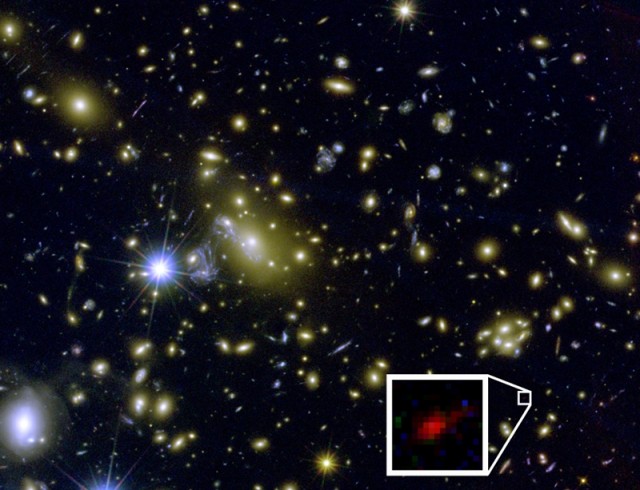
    Feast your eyes on this image…

    Image credit: The CLASH team/Space Telescope Science Institute

    The tiny object in that inset may not look like much. A blurry smudge of red pixels. Not nearly as dramatic as the stunning bouquet of galaxies all around it. But in astronomy, not everything is quite so straightforward. That small red smudge is probably the most exciting thing in this whole image. You see, it too is a galaxy. An unimaginably ancient one.

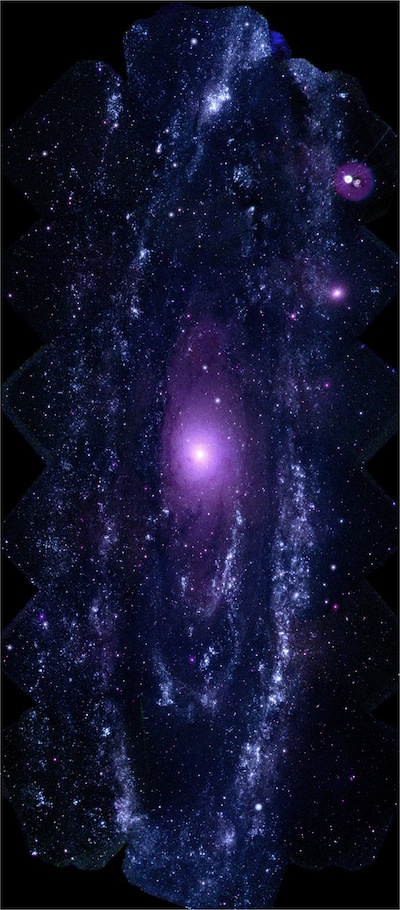
    An ultraviolet image of the nearby Andromeda Galaxy – possibly similar to what we might see of MACS 1149-JD if we could get a more detailed view… Credit: NASA/Swift/Stefan Immler (GSFC) and Erin Grand (UMCP)

    The light that made this unassuming red dot left its source less than 500 million years after the Big Bang and the birth of the Universe. The photons that make up that light have been travelling for over 13.2 billion years. This galaxy was blazing brightly as the oldest known stars in our own galaxy, the Milky Way, were just starting to shine. Back when the gas which would one day become the Sun was still drifting silently amongst stars which are now long dead, and before planet Earth was even a whisper of interstellar dust. Before a massive star forged the iron atoms in your blood, and before a supernova scattered those atoms into space. Before anything we know from the world around us existed, even the stars we see as we look up to the night sky, this galaxy was shining in the dark.

    The Universe was a much smaller place back then. Over the billions of years these photons have been travelling, the Universe itself has expanded with them in the midst of it – stretching them out, redshifting them to longer and longer wavelengths. The light we see here as red was probably ultraviolet once, when it left the galaxy which created it.

    Ancient galaxies like these are difficult to see, purely because they’re so distant. So few photons make it this far that only the most sensitive telescopes can make them out, and even then they need a helping hand. The bloom of galaxies in this image is a massive galaxy cluster called MACS J1149+2223. A collection of galaxies bound together by gravity, clusters like these are some of the largest and most massive objects in the Universe. With that much mass gathered together, gravity starts to do some interesting things, and one of the most interesting is gravitational lensing. Because the gravity of all of those galaxies distorts spacetime, it actually causes the space around the galaxies to act like a titanic lens. A gravitational lens. The ancient red galaxy in this image is only visible because it’s magnified, not only by the Hubble Space Telescope, but by that gravitational lens too.

    It would be naive to assume that this galaxy, dubbed MACS 1149-JD, is special somehow. Instead, it’s most likely to be one of a huge number of primordial galaxies. Except that this one just happened to be in the right place at the right time. A whole population of these ancient galaxies were likely shining brightly at the time, full of hot stars which were driving the reionisation epoch – the time when the Universe went from being an opaque, dark fog, to a clear place where photons could travel long distances. The photons in this image may well have been some of the first photons to have travelled through that ancient and newly transparent Universe.

    The scientific paper is available from Nature – DOI: 10.1038/nature11446

  • Science or fringe science? Removing the ‘giggle factor’ from Near Earth Object impacts

    Science or fringe science? Removing the ‘giggle factor’ from Near Earth Object impacts

    On June 30, 7.17am in a remote, sparsely inhabited area in Siberia, Russia, near the Podkamennaya Tunguska River, occurred an event of enormous devastation. An asteroid or comet estimated to be 40-50 meters in diameter, exploded at low altitude with an energy almost 200 times that of the atom bomb dropped on Hiroshima. Trees where knocked down over an area of two thousand square kilometres, hundreds of reindeer where killed and the seismic shock from the airborne explosion was registered on barometers in England. Eyewitnesses 60km away, reported seeing the northern sky covered with fire, followed by an enormous bang, though thankfully no human deaths were recorded.

    Fallen trees at the Tunguska impact site

    Dan Yeoman from NASA’s Jet Propulsion Laboratory stated in an interview in 2008, “the Tunguska event is of great importance not only because of the devastation caused to a thankfully remote area, but also as it is the only modern era event of this type where we actually have first-hand accounts.

  • Kepler Astronomers Find First Planetary System Around a Binary Star

    Kepler Astronomers Find First Planetary System Around a Binary Star

    NASA’s Kepler mission has found the first multi-planet solar system orbiting a binary star, characterized in large part by University of Texas at Austin astronomers using two telescopes at the university’s McDonald Observatory in West Texas. The finding, which proves that whole planetary systems can form in a disk around a binary star, is published in the August 28 issue of the journal Science.

    “It’s Tatooine, right?” said McDonald Observatory astronomer Michael Endl. “But this was not shown in Star Wars,” he said, referring to the periodic changes in the amount of daylight falling on a planet with two suns. Measurements of the star’s orbits showed that daylight on the planets would vary by a large margin over the 7.4-Earth-day period as the two stars completed their mutual orbits, each moving closer to, then farther from, the planets (which are themselves moving).

    The binary star in question is called Kepler-47. The primary star is about the same mass as the Sun, and its companion is an M-dwarf star one-third its size. The inner planet is three times the size of Earth and orbits the binary star every 49.5 days, while the outer planet is 4.6 times the size of Earth with an orbit of 303.2 days.

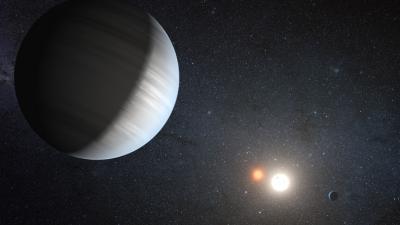
    Artist's concept of the Kepler-47 system.

    The outer planet is the first planet found to orbit a binary star within the “habitable zone,” where liquid water could exist and thus create a home for life. However, the planet’s size (about the same as Uranus) means that it is an icy giant, and not an abode for life. It’s a tantalizing taste of discoveries waiting to be made.

    The combination of observations from the NASA mission and McDonald Observatory allowed astronomers to understand the characteristics of Kepler-47’s two stars and two planets.

    The Kepler mission looks for minute dips in the amount of light coming from a star that might indicate a planet is passing in front of it, an event called a “transit.” The space telescope is also adept at identifying eclipsing binary stars, in which two stars pass in front of each other as they orbit each other. In the case of Kepler-47, they found both stellar eclipses and planet transits in one system.

    So Kepler astronomers Jerome Orosz (lead author on the study) and William Welsh of San Diego State University flagged the Kepler-47 system as worthy of follow up from the ground. They asked the McDonald Observatory Kepler team to work with them.

    Endl studied the binary star with the 9.2-meter Hobby-Eberly Telescope (HET, one of the world’s largest telescopes), as well as the 2.7-meter Harlan J. Smith Telescope at McDonald.

    “The challenging thing is that this is a very faint star,” Endl said, “about 6,000 times dimmer than can be seen with the naked eye.”

    He was taking spectra of the system — looking for characteristics in its light to indicate the motions of the primary star. (The secondary star is too faint to measure.) The McDonald observations enabled astronomers to calculate the mass of the primary star.

    These values, along with the Kepler eclipse and transit timings, were plugged into a model that calculated the relative sizes of all the bodies involved, Endl said.

    The Kepler team at McDonald Observatory also includes Bill Cochran (a co-Investigator of the Kepler mission), research scientist Phillip MacQueen, graduate students Paul Robertson and Eric Brugamyer, and recent graduate Caroline Caldwell.

    “This is the type of research where McDonald Observatory really excels,” Cochran said. “We have excellent scientific instruments on our telescopes, and the queue-scheduled operation of the HET allows us to obtain spectra at the optimal times when they will give us the best information about the stars.”

    Source.

  • Did life’s building blocks crash land?

    Did life’s building blocks crash land?

    In 1969, on September 28, the skies near Murchison, Victoria (not to be confused with Murchison, Western Australia) were illuminated by a dramatic sight. A spectacular fireball blazed its way through Earth’s atmosphere, its outer layers heated to extreme temperatures by its speed. Residents of the town reported seeing the fireball split into three pieces before it faded from view, leaving a trail of smoke in its wake. Seconds later, a tremor was heard as meteorite fragments crashed into the ground, signalling the arrival of what would become one of the most well studied meteorites ever.

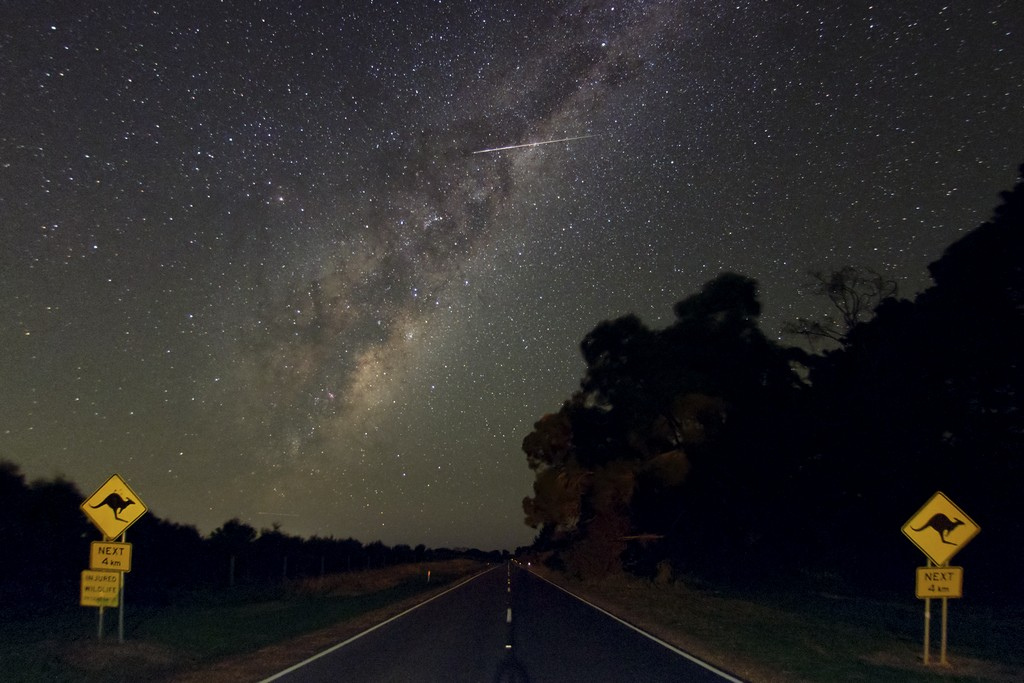
    A meteorite streaks across the Australian night sky, in front of the Milky Way. But just what might it be carrying with it? Image credit: Alex Cherney/terrastro.com

    If you like to watch the sky at night, chances are good that you’ve seen a meteor or two streaking across the night sky, and while many of them burn up in the atmosphere, it’s quite possible that one which you’ve seen might have eventually reached the ground. Meteorites strike Earth a lot more frequently than most people realise. By most estimates, a few hundred tons of meteorite material make it to our planet’s surface every day. Large meteorites like the Murchison meteorite, however, are a lot less common.

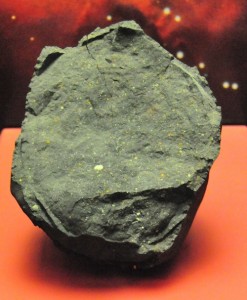
    A fragment of the famous Murchison meteorite. Image credit: Art Bromage, Wikimedia Commons

    While the Murchison meteorite shattered into fragments before it landed (known as an “airburst”), over 100 kg of meteorite have been collected from around Murchison, and scientists have been analysing those fragments ever since. This particular meteorite is a specific type known as a carbonaceous chondrite. These meteorites are fascinating to scientists, because carbonaceous chondrites are chemically very primitive – they’re thought to be very close in composition to the solar nebula from which the Sun and planets condensed 4.5 billion years ago. In other words, the meteorite which crash landed in Murchison 43 years ago was probably older than our entire planet!

    Several things about the Murchison meteorite are very interesting. For one, it shows evidence that it was altered by water. This would have happened a long time ago, wherever this meteorite originally formed, and certainly a long time before it landed on Earth. Secondly, it’s peppered with Calcium-Aluminium-Inclusions (CAIs). These humble crystals are older than the Sun itself. When they formed, the Sun itself was little more than a huge cloud of warm hydrogen gas. Most interestingly to some scientists, however, is the fact that the Murchison meteorite is full of amino acids.

    Uracil, one of the four "nucleobases" used by DNA to encode genetic information, was discovered inside the Murchison meteorite.

    Amino acids are one of the basic building blocks of all living things. The proteins which make up almost everything in your body are made from these small molecules. To date, over 100 amino acids have been found inside the meteorite, including many of those used by life on Earth. Several things about the chemical and isotopic compositions of these molecules suggest that they didn’t come from Earth, but were in this meteorite when it landed. As an example, amino acids have two forms, referred to as left-handed and right-handed. Earth life only uses the left-handed forms, while the acids discovered in this meteorite are a mixture of the two (known to chemists as a racemic mixture). Other Earthly molecules which frequently show up as contaminants were absent from the samples analysed, suggesting that these molecules, the bare essentials of life, are extraterrestrial in origin.

    These amino acids aren’t the only familiar molecules in the Murchison meteorite either. Amongst over 14000 different molecules found inside the meteorite, the chemists who were analysing the meteorite discovered ring-shaped molecules called purines and pyrimidines. These ring molecules are from the same family as the four nucleobases which make up DNA.One of the molecules found was one called uracil, which is actually used by DNA. This same molecule is in every strand of DNA in your body.

    While some still argue over the validity of these studies, if they’re correct then the overall conclusion is a breathtaking one. This space rock is older than the Sun, and it already contained all of the basic ingredients for life to form back when Earth was nothing more than a patch of interstellar dust. We might never know exactly how life started on Earth. Though maybe in the distant past, life’s raw materials crash landed here on Earth in meteorites, just like one meteorite did in Murchison that night 43 years ago.

  • The smoking guns of dying stars

    The smoking guns of dying stars

    VY Canis Majoris, the largest known star in our galaxy, with it's huge smoky clouds of gas and dust being lost into interstellar space. Credit: NASA, ESA, and R. Humphreys (University of Minnesota)

    The ancient Greeks once believed that the heavens were immutable. A vast starry vista, eternally unchanging above our heads. But we now know this to be untrue in the slightest. A lot has changed since then, however, and over the past few hundred years, astronomers have unfurled ever increasing knowledge of the lives of stars. Look out across a starry night sky and you can see stars in all stages of their lives, from brightly burning newborn stars, to ageing giants in their final gasping breaths. As stars near the ends of their lives, they begin to shine a rich red colour as they expand and dramatically increase in size.

    As red giants, these stars are burning the last of their fuel, and as they do so they begin to sputter and gasp. Just as a candle flame does when it starts to burn out, red giant stars flicker – though for these, the largest stars in the universe, those flickers can take thousands of years each. These final bursts of energy are known as thermal pulses, and they mark the star’s final days. During the last couple of million years of its life, a red giant star will lose incredble amounts of material to interstellar space. Even when not caught mid-pulse, these stars lose several times the mass of our planet every year. And the puzzle of exactly how they do so has been recently been unravelled by a team of astronomers led by researchers at the University of Sydney.

    All stars emit a stellar wind – a steady stream of particles being constantly accelerated outwards by the star. Even the Sun emits its own solar wind (with a speed measured at 535 kilometres per second as I write this). The wind from red giant stars is slightly different. As the star loses more mass, stellar material cools and condenses into dust. This dust then catches starlight which is so intense near to the star that it actually pushes that dust outwards. This effect, known as radiation pressure, causes the tiny reflective dust grains to act like minute sails and accelerates them away. Each dust grain is tiny compared to the kind of dust we find on our bookshelves, much more like fine smoke than any dust we’d recognise. Instead of being called stardust, it could easily be called starsmoke!

    “The winds that stream from the upper atmosphere of the red giant stars are responsible for removing massive amounts of matter. The grains that we have discovered here will come as a real shock to the accepted wisdom in the field. They are both much larger and much closer to the stellar surface than anyone expected.” said Barnaby Norris, a PhD student at the University of Sydney, and lead author on the research published earlier this year in Nature.

    This stardust emitted by these smoky smouldering old stars is transparent, not unlike finely powdered glass. The implications of this stardust being detected to close to an ageing star could help us to better understand the processes that occur in stars as they die, and how they manage to lose such prodigous amounts of mass so rapidly. As Norris said, “Hopefully our findings will help to illuminate a key step in the grand cycle as matter is expelled from stars into the galaxy only to seed new generations of stellar and planetary birth.”

    On a final poetic note, all of the chemical elements essential to life are created within stars, before being seeded back into the cosmos when stars die. This means that this condensing stardust contains the fundamental raw materials needed for life to eventually form. As Carl Sagan so often used to muse, we are literally made of stardust.

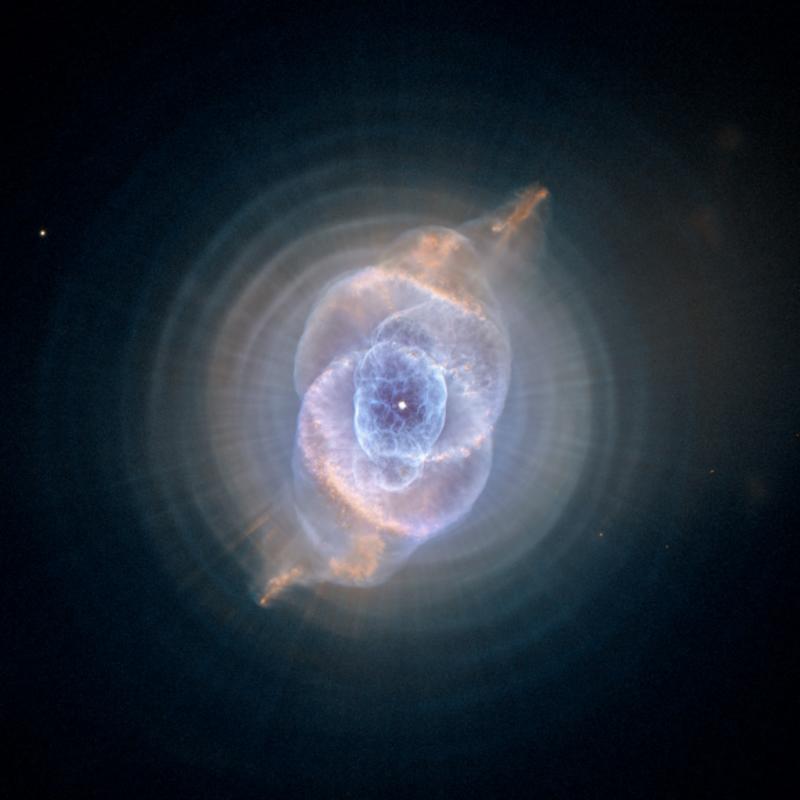
    The Cat's Eye nebula, a star which has now ended its life and is casting its outer layers into the cosmos. The concentric rings show material lost as stellar wind during the star's final thermal pulses.. Credit: ESA, NASA, HEIC and The Hubble Heritage Team (STScI/AURA)
  • Radio quiet, please!

    Radio quiet, please!

    Originally conceived over 20 years ago, there’s a project being undertaken by scientists and engineers across the whole world to help us all better understand the mysteries of the galaxy and the very beginnings of the Universe. It’s estimated to be completed by around 2024,costing $1.85 billion AUS (€1.5 billion). Once completed, it’s set to be the most complex and technologically advanced machine ever built by humanity. It will use enough optic fibre to wrap twice around the Earth and will need a computer capable of performing 10^18 operations per second – about three million times the number of stars in our galaxy. It will produce over 980 Exabytes of data every day (equivalent to about 15 million 64GB iPods) and to cope with that, it will need to handle data transfer rates over 10 times as high as the current global internet traffic. No, it isn’t a starship. But it might just be the next best thing.

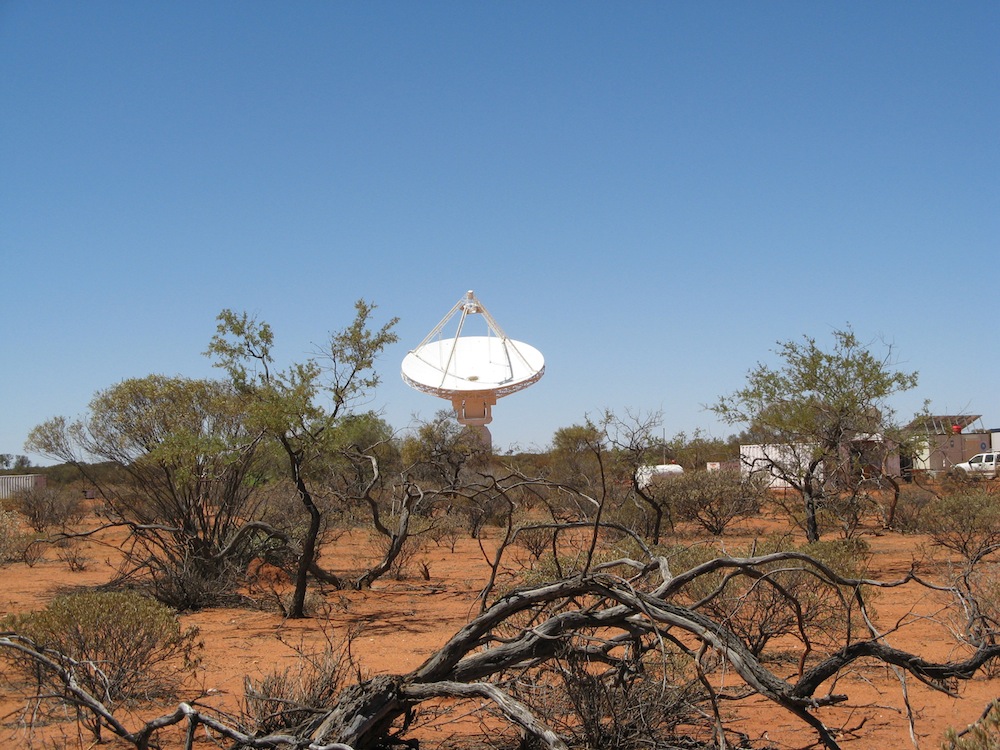
    One of the first components of the SKA, constructed in Western Australia. Credit: Dave DeBoer, CSIRO.

    The Square Kilometre Array (SKA) is one of the most ambitious scientific projects ever devised, and when completed it will comprise a huge number of telescope antennae which will work as one to form a single radio telescope so powerful that it could detect an airport radar on a planet 50 light years away. The sensitivity of any telescope is defined by the area it uses to collect data. With optical telescopes, this is the size of the mirror, and with radio telescopes it’s typically the size of the dish. The SKA gets its name because when fully constructed, all of the detectors and antennae that make it up will have a combined area of one square kilometre, or one million square metres. To put that properly into perspective, the Green Bank Telescope is currently the largest steerable single dish radio telescope, and its area is just under 8000 square metres.

    Being astronomy’s answer to the large hadron collider, the SKA is a staggeringly large international collaboration. I was lucky enough to attend a major meeting regarding the planning of the SKA (the headquarters are to be based here in the UK in Manchester), and the myriad different languages and nationalities represented was impressive to say the least. Over 24 major organisations from countries spanning 5 continents are involved in the project, ranging from universities to industrial engineering companies. New technologies, both software and hardware, are still being developed as a result of this project. Based on the huge data storage and transfer requirements of a machine as complex as the SKA, many of those new technologies are likely to feed straight back into society by offering profound improvements to computing resources like the internet. In fact, as the world’s largest project for sorting and storing data, the SKA is expected to be literally bigger than Google!

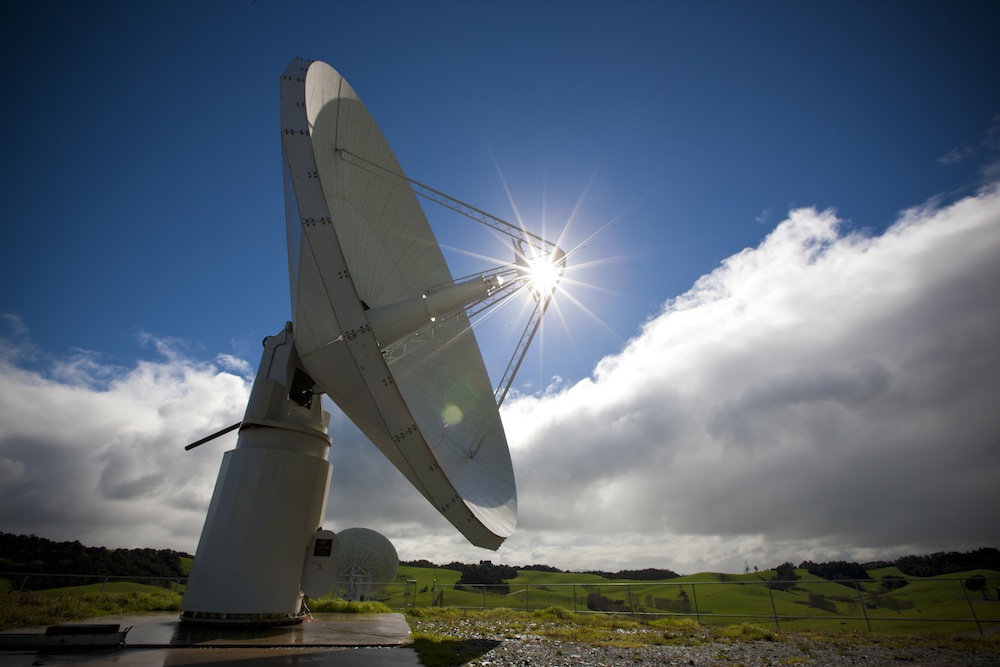
    The Warkworth antenna in New Zealand – an important part of early SKA science. Credit: Alex Wallace.

    The most difficult decision, understandably, has been where precisely to build it. Humanity has an unfortunate tendancy to fill the atmosphere of our planet with noise, bouncing radio waves to and fro and filling the air with radio frequency chatter. A radio telescope array this sensitive needs to be placed somewhere quiet to gain the full benefits, and the most recent decision has been to effectively split the SKA into two components, to be built in Southern Africa and Australia. While this may seem like an odd thing to do, it actually makes perfect sense. The SKA actually has three types of antenna operating at different frequencies. Intended to cover a huge range of radio frequencies (from 70 to 100000 MHz), three types of antenna are needed, because no single technology can actually operate across such a wide range. So the decision was made to build the lowest frequency detectors across Australia, centred at Murchison in outback Western Australia. Murchison is blessed with being one of the few places on our planet which isn’t flooded with FM radio at the low end of the frequency scale. From a radio astronomer’s point of view, it’s the quietest place on Earth.

    This is set to be complemented by the higher frequency steerable dishes which are set to be constructed across Africa. Both South Africa and Australia have put extensive efforts into developing the SKA, and Australian-developed technology is still set to be implemented in the African telescopes. This will mean a huge influx to the African astronomical community and numerous African nations won’t lose out on the economic boost from contributing to such a prestigious project. It’s an ideal situation where everyone wins.

    All in all, it’s an exciting time to be an astronomer. An epic project like this is likely to attract all manner of researchers from across the world to both continents. Just maybe, it could also finally help us to answer the really big questions, like how the galaxy formed, how the Universe began, and whether or not there’s anyone else out there.

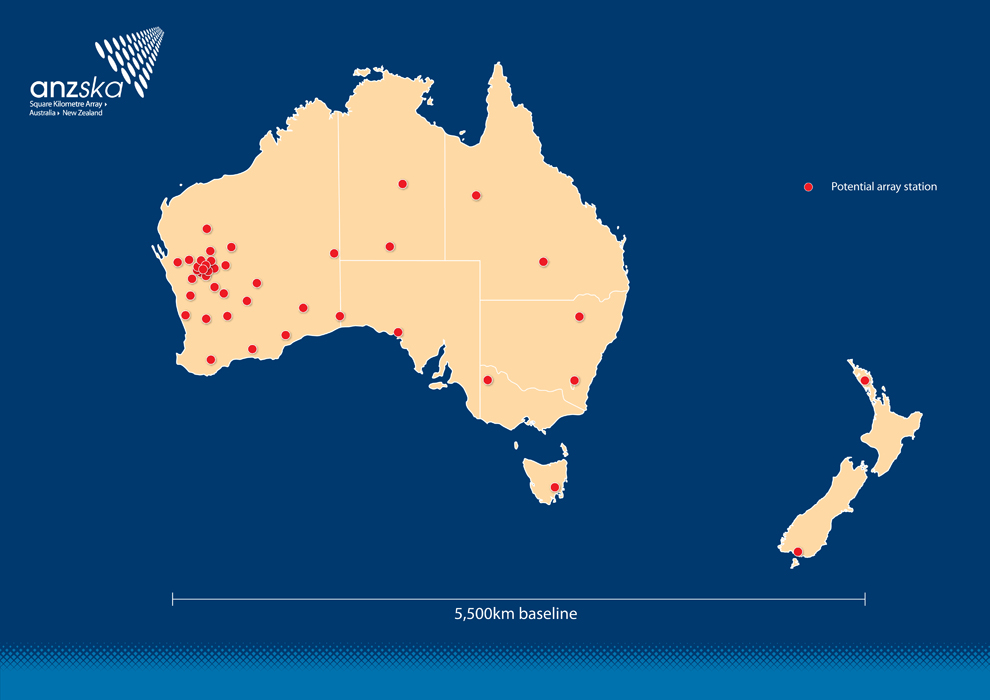
    A map of prospective SKA sites. Credit: anzska