
GM (Genetically Modified) Foods
“Jack! Did you see that potato move?! He’s a GM, that one, he’s sprouted eyes and I bet he’ll grow legs next! He’s gonna round up his buddies and take over the farm!

GM (Genetically Modified) Foods
“Jack! Did you see that potato move?! He’s a GM, that one, he’s sprouted eyes and I bet he’ll grow legs next! He’s gonna round up his buddies and take over the farm!
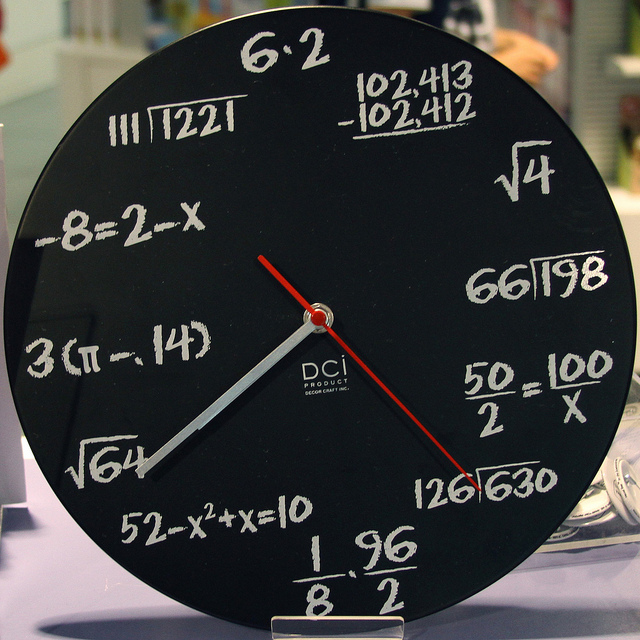
Sigh, my photo caption sums it all up…
But here are the news stories that caught my eye and I hope you find them interesting as well. Maybe reading them will inspire your own work or to dig deeper for answers. In any case, enjoy!
This is one of my favorite topics because it offers up rampant debate on so many topics – society, education, cognition. You’re just going to have to read it for yourself.
This Is Your Brain on the Internet (Maybe) by Kyle Hill
So what is the Internet doing to our thinking? It is hard to say. Current research has a hard time keeping up with the break-neck pace of online culture, and only the more conventional mediums like television and newspapers have been evaluated in any rigorous sense.
Newspapers might be old school, but they do have an online media presence as well these days. This article was published in The Australian this week and concerns Australia’s own CSIRO. Genetically modified crops and foods have been a part of our collective diet for many years, whether or not some want to admit it. And they are here to stay. I am of the opinion that they play an important role in our food security given a number of ever changing variables in our environment. The usual characters are depicted in this piece and it will be interesting to follow this story and hear the response from CSIRO.
Scientists Wary of CSIRO GM Crop by Adam Cresswell
SCIENTISTS from three countries are warning a CSIRO-led push to make Australia the first nation in the world to introduce genetically modified wheat crops could pose a significant health threat to humans and other animals.
If you haven’t heard, NYC Mayor Mike Bloomberg has banned sugary soft drink sales in cups larger than 16 0z. in his efforts to personally tackle the obesity epidemic. I feel some disclaimers are in order: One, this story did appear on www.bloomberg.com, but you could have found it in a variety of online publications; and two, I serve on the Mayor’s Best Practices Partnership to identify strategies to combat childhood obesity. That being said, I find the details of the ban interesting as you can see in the quote below. I personally do not see the need for a a 32 oz. soda, but people who want their sugary fix will do some quick addition, carry more cans or bottles and walk to get more refills. Oh, how long must we wait for data on this?!
NYC Health Panel Backs Bloomberg Ban on Super-Size Sodas by Henry Goldman and Leslie Patton
Restaurants, movie theaters and other outlets have six months to comply or face a $200 fine each time there’s a violation, the health department said. The ban doesn’t apply to convenience stores and groceries that don’t act primarily as purveyors of prepared foods, which are regulated by New York state. The rules do allow consumers to buy as many of the smaller drinks as they want and to get refills.
To continue with the discussion on obesity, this is an interesting read which once again highlights the genetics vs. environment debate.
What’s the Main Cause of Obesity – Our Genes or the Environment? from ScienceDaily with resources from the BMJ (British Medical Journal)
The ongoing obesity epidemic is creating an unprecedented challenge for healthcare systems around the world, but what determines who gets fat?
And one last article that I thought was noteworthy, and a bit on the strange side by the title:
Chemists Develop Nose-Like Array to ‘Smell’ Cancer from ScienceDaily, findings appear in the current issue of the journal ACS Nano
The chemist says, “Smell ‘A’ generates a pattern in the nose, a unique set of activated receptors, and these are different for every smell we encounter. Smell ‘B’ has a different pattern. Your brain will instantly recognize each, even if the only time you ever smelled it was 40 years ago. In the same way, we can tune or teach our nanoparticle array to recognize many healthy tissues, so it can immediately recognize something that’s even a little bit ‘off,’ that is, very subtly different from normal. It’s like a ‘check engine’ light, and assigns a different pattern to each ‘wrong’ tissue. The sensitivity is exquisite, and very powerful.”

Want to broaden your knowledge in ICT topics and meet other people working in this field? Take part in the second EuroNOG meeting on September 10th-11th in Budapest, Hungary.
 EuroNOG – an international meeting of experts responsible for the design, maintenance and development of ICT networks. The first edition was held on the 30th September 2011 in Krakow (Poland). The second edition will be organized on September 10th-11th, 2012 in Budapest (Hungary). Subsequent meetings are going to be held annually in various cities in Europe. Our main goal is to build a platform to exchange experience between the operators, ISPs and companies responsible for network implementation.
National borders are becoming blurred, and increasing international cooperation is a key element of the Internet development. At the same time, due to various technical and economic conditions, in each of the European countries the development of networks diverged in a different way. Therefore it is difficult to compare and easily transfer ready-made solutions from one country to another – just look at the networks in Scandinavian countries compared with countries from Southern Europe– different solutions, architectures and equipment. It is best for us to exchange experience and learn from best practices used by local players on the European market.
What sets us apart from the RIPE, TERENA and other IX meetings?
Certainly, our conference is not academic, we do not want to focus only on the theoretical backgrounds of the IP world. We want to provide the greatest number of good practices and presentations including deployment case studies. Our point of view resembles NANOG, as we are looking at Europe through the prism of a global network, treating each country as a state – strong co-operation but also territorial autonomy. The EuroNOG conference will be a vendor-independent meeting place for experts.
For Australian Science readers the organisers have prepared special discount code “as_10”. People registrating with this code will get 10% discount.
Detailed information: Date: 10-11 September 2012
Location: RamadaPlaza Hotel, Budapest (Hungary)
Registration: http://registration.euronog.eu
Conference website: http://euronog.eu
If you have any questions, please contact: Emilia Staszczak
EuroNOG main organizer mail: emilia.staszczak@euronog.eu
The American Chemistry Council sponsors an initiative “Plastics Make it Possible.
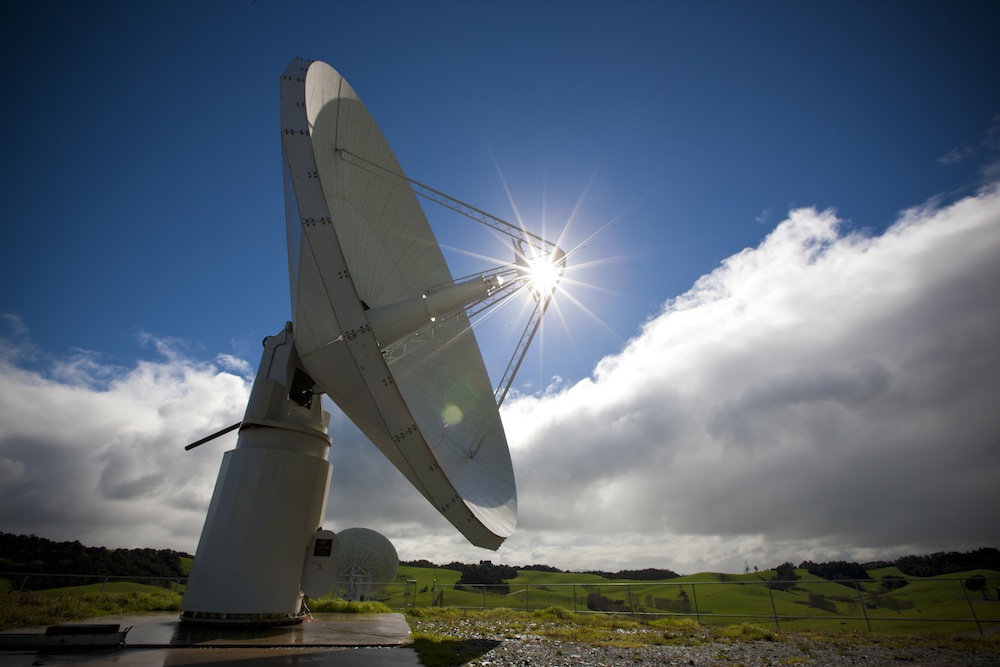
Originally conceived over 20 years ago, there’s a project being undertaken by scientists and engineers across the whole world to help us all better understand the mysteries of the galaxy and the very beginnings of the Universe. It’s estimated to be completed by around 2024,costing $1.85 billion AUS (€1.5 billion). Once completed, it’s set to be the most complex and technologically advanced machine ever built by humanity. It will use enough optic fibre to wrap twice around the Earth and will need a computer capable of performing 10^18 operations per second – about three million times the number of stars in our galaxy. It will produce over 980 Exabytes of data every day (equivalent to about 15 million 64GB iPods) and to cope with that, it will need to handle data transfer rates over 10 times as high as the current global internet traffic. No, it isn’t a starship. But it might just be the next best thing.
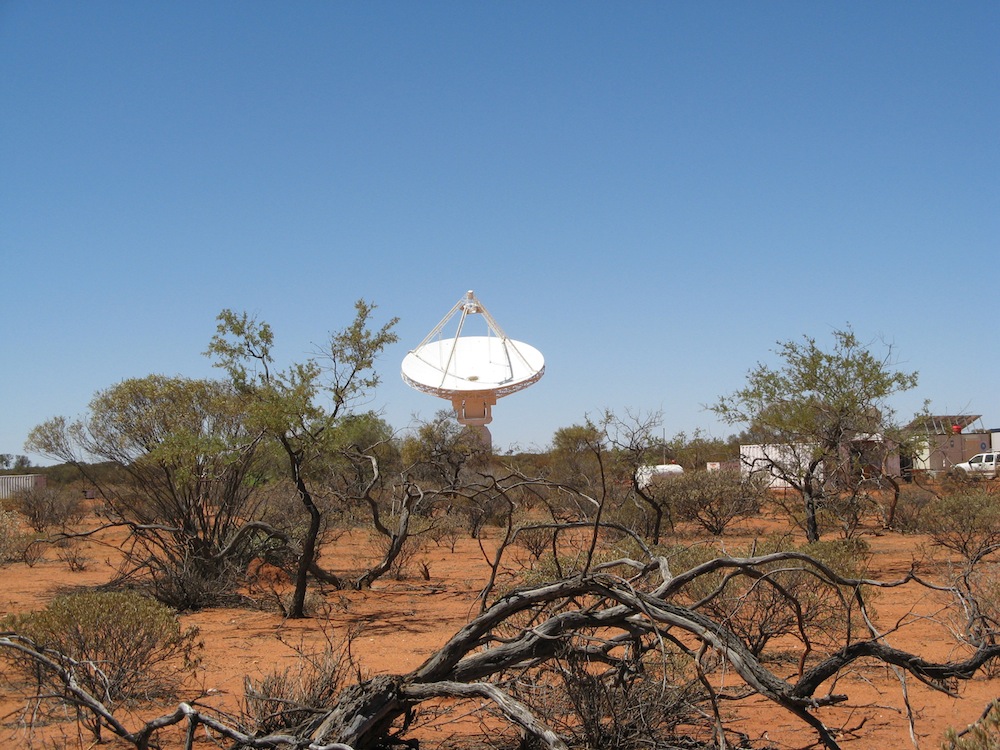
The Square Kilometre Array (SKA) is one of the most ambitious scientific projects ever devised, and when completed it will comprise a huge number of telescope antennae which will work as one to form a single radio telescope so powerful that it could detect an airport radar on a planet 50 light years away. The sensitivity of any telescope is defined by the area it uses to collect data. With optical telescopes, this is the size of the mirror, and with radio telescopes it’s typically the size of the dish. The SKA gets its name because when fully constructed, all of the detectors and antennae that make it up will have a combined area of one square kilometre, or one million square metres. To put that properly into perspective, the Green Bank Telescope is currently the largest steerable single dish radio telescope, and its area is just under 8000 square metres.
Being astronomy’s answer to the large hadron collider, the SKA is a staggeringly large international collaboration. I was lucky enough to attend a major meeting regarding the planning of the SKA (the headquarters are to be based here in the UK in Manchester), and the myriad different languages and nationalities represented was impressive to say the least. Over 24 major organisations from countries spanning 5 continents are involved in the project, ranging from universities to industrial engineering companies. New technologies, both software and hardware, are still being developed as a result of this project. Based on the huge data storage and transfer requirements of a machine as complex as the SKA, many of those new technologies are likely to feed straight back into society by offering profound improvements to computing resources like the internet. In fact, as the world’s largest project for sorting and storing data, the SKA is expected to be literally bigger than Google!
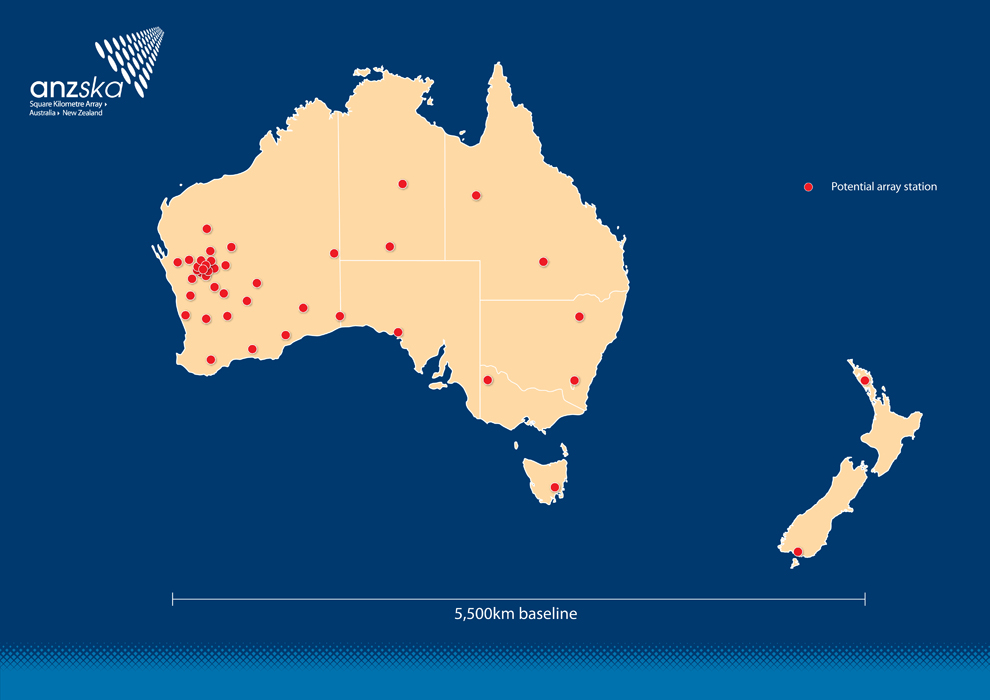
The most difficult decision, understandably, has been where precisely to build it. Humanity has an unfortunate tendancy to fill the atmosphere of our planet with noise, bouncing radio waves to and fro and filling the air with radio frequency chatter. A radio telescope array this sensitive needs to be placed somewhere quiet to gain the full benefits, and the most recent decision has been to effectively split the SKA into two components, to be built in Southern Africa and Australia. While this may seem like an odd thing to do, it actually makes perfect sense. The SKA actually has three types of antenna operating at different frequencies. Intended to cover a huge range of radio frequencies (from 70 to 100000 MHz), three types of antenna are needed, because no single technology can actually operate across such a wide range. So the decision was made to build the lowest frequency detectors across Australia, centred at Murchison in outback Western Australia. Murchison is blessed with being one of the few places on our planet which isn’t flooded with FM radio at the low end of the frequency scale. From a radio astronomer’s point of view, it’s the quietest place on Earth.
This is set to be complemented by the higher frequency steerable dishes which are set to be constructed across Africa. Both South Africa and Australia have put extensive efforts into developing the SKA, and Australian-developed technology is still set to be implemented in the African telescopes. This will mean a huge influx to the African astronomical community and numerous African nations won’t lose out on the economic boost from contributing to such a prestigious project. It’s an ideal situation where everyone wins.
All in all, it’s an exciting time to be an astronomer. An epic project like this is likely to attract all manner of researchers from across the world to both continents. Just maybe, it could also finally help us to answer the really big questions, like how the galaxy formed, how the Universe began, and whether or not there’s anyone else out there.

 So how far away are we from planet Earth morphing into Holodeck 5 and we all have Geordi La Forge glasses? There are several pairs of augmented reality glasses already on the market, many from brands you’ve probably never heard of, but then I’m sure you have heard of Google and their latest project in the foray.
No longer information at your fingertips, oh no, information at your eyelashes. And much more than information, as some researchers and visionaries have conjured up all sorts of ways to use these glasses. From finding directions to a new coffeehouse, online dating, downloading music, answering a phone call, no need for a handheld device.
Some have taken it a step further. Dr. Michio Kaku, Professor of Theoretical Physics at the City University of New York, seems to believe these glasses will forever change the way we interact with the world. He speaks about when you walk into a crowded room, say for a networking event where you are looking to land a new job. Your glasses will steer you who to speak with in that industry. A big red arrow will point them out to you. But in your glasses, their entire biography is laid out before your eyes. Where they went to school, how many brothers and sisters they have, the name of their dog – you have all this information. Likewise, someone wearing these glasses would have all this information about you. What questions will you ask? What would be left to discover about the people you meet at this event? What is their left to converse about? Oh right, work. You can talk about work.
The art of conversation involves the asking of questions. Wouldn’t these reality glasses just negate the need to speak with anyone? Is technology reducing our social ability to communicate with the spoken language? Is it in fact devolving our language? Or are we evolving and becoming more efficient that we no longer require the use of our vocal chords? Getting a bit far out there.
Social media has connected us, we keep “in touch
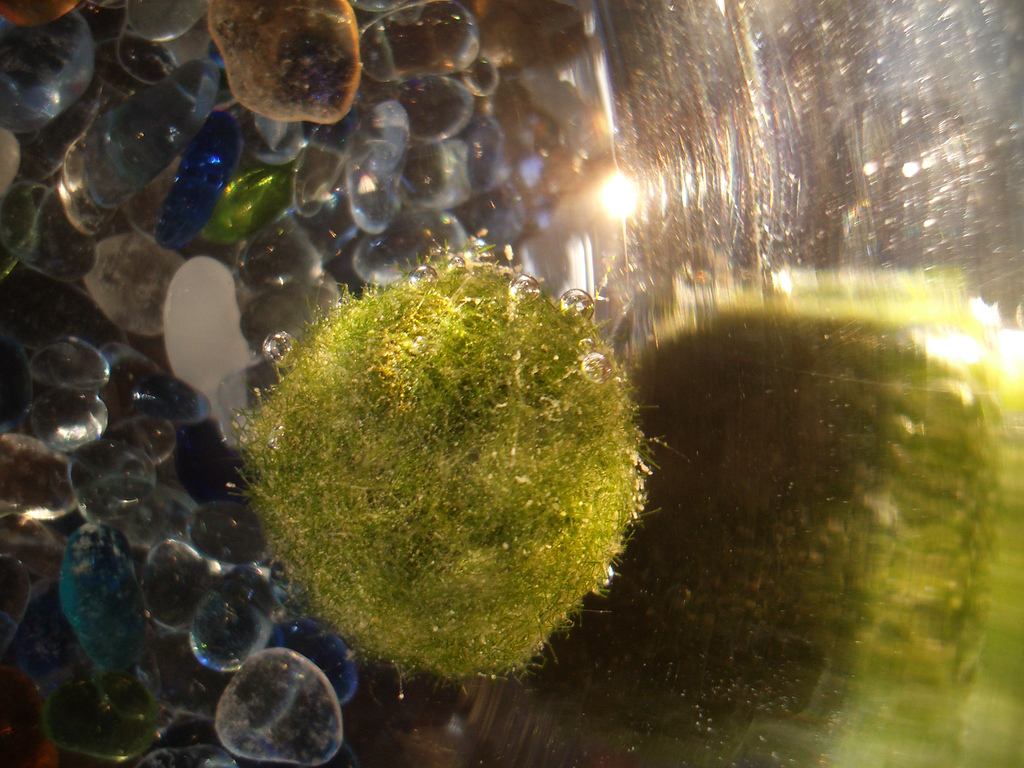
 Whoever thought you could make money in biology, right? Turns out, there is quite a bit of money to be made in this field. And I think we are realizing more than ever the importance of the life sciences and the contribution it offers to society and the economy.
“I think the biggest innovations of the 21st Century will be the intersection of biology and technology. A new era is beginning, just like the digital one was when I was his age.

 23 cm of string. 1 tyre iron. 3 broken shards of glass. 18 rolls of fiber insulation. 1 match. 2 cardboard boxes. 4 paperclips. Because you always need a paperclip.
There was a fantastic TV show that aired in the United States when my brother and I were growing up in the late 1980s…MacGyver. No doubt many of you are aware of it as well as it aired across the globe – Australia, Europe, Taiwan, etc. It was my brother’s favourite show and I think it actually played quite a role in his ability to fix anything. Anything. If my computer breaks down I call him first.
The articles mentioned above, the tire iron, broken glass and paperclips, cardboard boxes, may all sound like rubbish cast aside, items you’d find lying in the gutter on the streets of Manhattan or in a landfill. Should we simply leave these items lie there? Or, should we try to reclaim them? Putting them to some use to help us find a way out of our trash/recycling problem? How do we get to sustainability? Is it a farce? Does sustainability actually exist?
We just had Earth Day. And remember World Water Day was not that long ago. Has the world changed? How many people drastically altered their consumption habits because of some message they read or heard on either of those days? Or were the same cheerleaders leading the chant for the home team that never quite seems to be able to score?
How many people work in offices in the US – around the world? Let me tell you a story about my office. We have black colored trash bins for trash and blue colored bins for recyclables – paper, plastic, aluminum. I dutifully sort the refuse of my consumption day in and day out, as I do at home. Even though I know for a fact that the janitor combines both bins into his large trash can as he makes his way through the offices and workstations collecting those daily discarded items. On Earth Day, all the employees in my 36-story office building received a paper postcard informing us of how we could “redeem
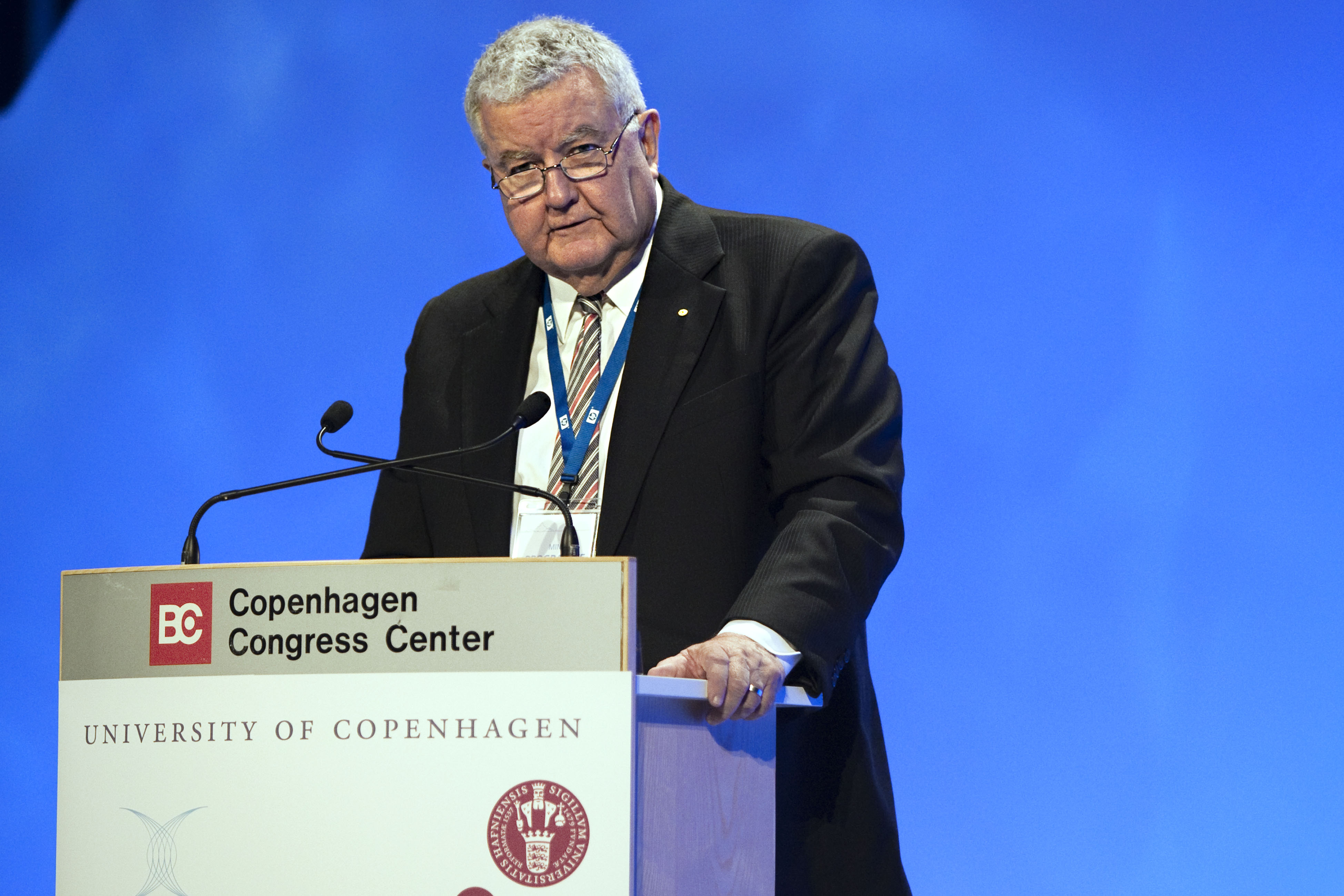
There is no doubt in the mind of Australia’s Chief Scientist, Professor Ian Chubb, the future will be shaped by science technology, engineering and mathematics. Unfortunately, he finds that at present the standing of science, as an expert authority, is being challenged. Furthermore, Ian Chubb finds that the science message is getting lost in the white noise of the mainstream media. I was heartened to hear his positive words about science communication, social media, science and technology education and innovative Australian workplaces.
These were the messages from Ian Chubb at an address he gave as part of NICTA’s Big Picture Seminar series on Wednesday March 28, 2012 at the University of Melbourne.
It was refreshing to see Australia’s Chief Scientist out and about and addressing public forums such as this one. Although judging by the faces, the suits and the overheard conversations at the drinks and nibbles prior to the address, I think this was definitely a speech to the science and technology faithful. That is a pity, his words were worth exposure and considered comment in the mainstream Australian media.
Professor Ian Chubb emphasises Mathematics, Engineering and Science provide the enabling skills and knowledge that underpin every aspect of modern life. They help us understand the natural world and enable us to respond as humans to this world with a constructed view aimed at improving the lot of human kind.
In Australia, as in many economies, we have observed a decline in the number of people choosing a career in these disciplines. Not only that, the STEM subjects (Science Technology Engineering and Mathematics), as he called them, are taken for granted or simply ignored. Although it is obvious without at least an appreciation of these subjects, a modern citizen is hampered in their ability to critically evaluate and make informed decisions about the issues that are shaping their future. Among his many roles as Australia’s Chief Scientist, Professor Ian Chubb has been charged with examining this decline and offering strategies to address it.
Professor Ian Chubb is eminently suited to this task. He was appointed to the position of Chief Scientist on 19 April 2011 and commenced the role on 23 May 2011. Prior to his appointment as Chief Scientist, Professor Ian Chubb was Vice-Chancellor of the Australian National University. Professor Chubb’s research focused on the neurosciences. Although he jokingly said on the night he would prefer not to be quizzed, on science specifics, by such an informed audience. He has co-authored some 70 full papers and co-edited one book all related to his research. In 1999 Professor Chubb was made an Officer of the Order of Australia (AO) for “service to the development of higher education policy and its implementation at state, national and international levels, as an administrator in the tertiary education sector, and to research particularly in the field of neuroscience