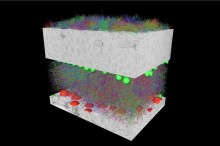
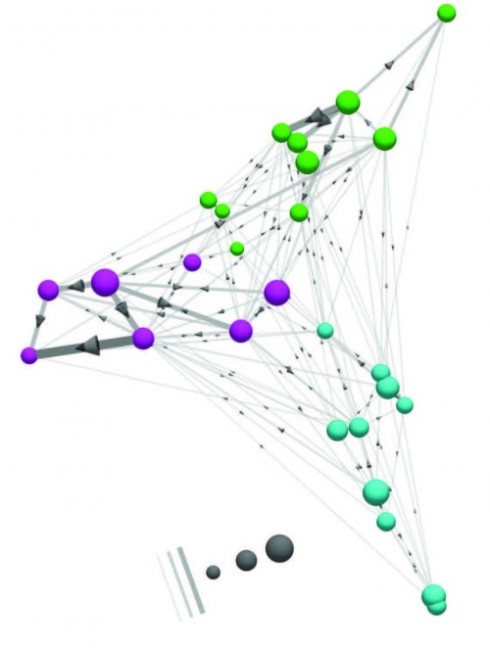
Connectomics as a 3D graph. Cell types with stronger connections are positioned closer to each other, using an algorithm. Three spatially segregated groups are observed that closely match the pathways identified through clustering (colouring of spheres). The dominant direction of signal flow is oriented into the page.
The human brain has 100 billion neurons, connected to each other in networks that allow us to interpret the world around us, plan for the future, and control our actions and movements. Mapping those networks, creating a wiring diagram of the brain could help scientists learn how we each become our unique selves. Understanding the brain and all its connections is Connectomics – a word soon to become as familiar as ‘genetics’.
In three papers appearing in Nature, scientists report their first step toward this goal: Firstly using a combination of human and artificial intelligence, they have mapped all the wiring among 950 neurons within a tiny patch of the mouse retina. While a second group look at a classic problem of neural computation – the detection of visual motion – in the eye of a fruitfly.
The eye of the mouse
The retina is technically part of the brain, as it is composed of neurons that process visual information. Neurons come in many types, and the retina is estimated to contain 50 to 100 types, but they’ve never been exhaustively characterised. Their connections are even less well known. Neurons in the retina are classified into five classes: photoreceptors, horizontal cells, bipolar cells, amacrine cells and ganglion cells. Within each class are many types, classified by shape and by the connections they make with other neurons.
In this study, the research team focused on a section of the retina known as the inner plexiform layer, which is one of several layers sandwiched between the photoreceptors, which receive visual input, and the ganglion cells, which relay visual information to the brain via the optic nerve. The neurons of the inner plexiform layer help to process visual information as it passes from the surface of the eye to the optic nerve.
By mapping all of the neurons in a 117-micrometre-by-80-micrometre patch of tissue, researchers were able to classify most of the neurons they found, based on their patterns of wiring. They also identified a new type of retinal cell that had not been seen before. To map all of the connections in this small patch of retina, the researchers first took electron micrographs of the targeted section generating high-resolution three-dimensional images of biological samples.
Concrete and cement. Words synonymous with solidity and well, staidness. Cement is probably the most ubiquitous building material of the late 20th century – yet it may provide some very 21st century surprises. Researchers at the University of Alicante have developed a cement material incorporating carbon nanofibres in its composition, turning cement into an excellent conductor of electricity. Similarly scientists from the USA, Japan, Finland and Germany have unraveled the formula for transforming liquid cement into liquid metal – opening up its use in the profitable consumer electronics marketplace for thin films, protective coatings, and computer chips.
The warmer side of concrete
Concrete is a composite material composed of coarse granular material (the aggregate or filler) embedded in a hard matrix of material (the cement or binder) that sets and hardens independently, filling the space among the aggregate particles and gluing them together. Concrete made from such mixtures was first used in Mesopotamia in the third millennium B.C. and later in Egypt. It was further improved by the Ancient Macedonians and three centuries later on a large scale by Roman engineers. They used both natural pozzolans (such as pumice) and artificial pozzolans (ground brick or pottery) in these concretes. Many excellent examples of structures made from these concretes are still standing, notably the huge dome of the Pantheon in Rome and the massive Baths of Caracalla. The vast system of Roman aqueducts also made extensive use of hydraulic cement.
Conventional concrete is a poor conductor of electricity. To obtain a cement-like compound that is effective as a heating element, it then should have a low resistivity. This has been achieved by the addition of conductive materials such as carbon fibres, for example. This new technology, developed and patented by the University of Alicante Civil Engineering Department’s Research Group in Multifunctional Concrete Conductors, allows, among other functions, the material to heat up due to the passage of current.
The technology allows buildings’ premises to heat or prevents the formation of ice on infrastructure, such as highways, railways, roads, airstrips and other elements. In this way, a new conductive compound with much more interesting properties is achieved since it keeps the structural properties of concrete and does not compromise the durability of the structures themselves. This new product has a great versatility, since any existing structure or surface can be coated with it, keeping thermal control in it by applying continuous electric current. At present, the research group has developed trials to test the technology in plasters with carbonaceous materials. These tests have given very satisfactory results, obtaining optimal properties of heating the material with minimum energy consumption.
21st century metallic-glass cement
A team of scientists from the USA, Japan, Finland and Germany have made a metallic-glass cement. This new material has lots of applications, including as thin-film resistors used in liquid-crystal displays – basically the flat panel computer monitor that you are probably reading this from at the moment. The team have demonstrated how make and understand the cement-to-metal transformation, which has positive attributes including better resistance to corrosion than traditional metal, less brittleness than traditional glass, conductivity, low energy loss in magnetic fields, and fluidity for ease of processing and molding. Previously, only metals have been able to transition to a metallic-glass form. Cement does this by a process called electron trapping, a phenomena only previously seen in ammonia solutions. Understanding how cement joined this exclusive club opens the possibility of turning other solid normally insulating materials into room-temperature semiconductors.
This phenomenon of trapping electrons and turning liquid cement into liquid metal was found recently, but not explained in detail until now. Now that the conditions needed to create trapped electrons in materials are known, other materials can be developed and tested to find out if we can make them conduct electricity in this way. The results were reported in the journal the Proceeding of the National Academy of Sciences in the article “Network topology for the formation of solvated electrons in binary CaO-Al2O3 composition glasses.”
The team of scientists studied mayenite, a component of alumina cement made of calcium and aluminum oxides. They melted it at temperatures of 2,000 degrees Celsius using an aerodynamic levitator with carbon dioxide laser beam heating. The material was processed in different atmospheres to control the way that oxygen bonds in the resulting glass. The levitator keeps the hot liquid from touching any container surfaces and forming crystals. This let the liquid cool into glassy state that can trap electrons in the way needed for electronic conduction.
The scientists discovered that the conductivity was created when the free electrons were “trapped” in the cage-like structures that form in the glass. The trapped of electrons provided a mechanism for conductivity similar to the mechanism that occurs in metals. To uncover the details of this process, scientists combined several experimental techniques and analyzed them using a supercomputer.
These developments are sure to provide an impetus for a new look at old building material.
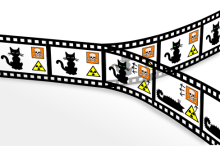
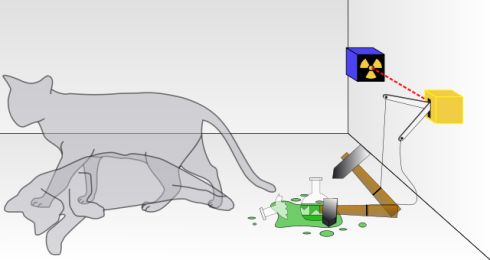
Diagram of Schrödinger’s cat theory. Image credit: Dhatfield
Since Erwin Schrödinger’s famous 1935 cat thought experiment, physicists around the world have tried to create large scale systems to test how the rules of quantum mechanics apply to everyday objects. Scientists have only managed to recreate quantum effects on much smaller scales, resulting in a nagging possibility that quantum mechanics, by itself, is not sufficient to describe reality.
Researchers Alex Lvovsky and Christoph Simon from the University of Calgary recently made a significant step forward in this direction by creating a large system that displays quantum behaviour, publishing their results in Nature Physics.
Understanding Schrödinger’s cat
Quantum mechanics is without doubt one of the most successful physics theories to date. Without it the world we live in would be remarkably different: driving and shaping our modern world making possible everything from computers, mobile phones, nuclear weapons, solar cells and our everyday appliances. At the same time it presents us with conundrums that are at the far end of reason; challenging even the greatest minds to comprehend.
In contrast to our everyday experience, quantum physics allows for particles to be in two states at the same time — so-called quantum superpositions. A radioactive nucleus, for example, can simultaneously be in a decayed and non-decayed state.
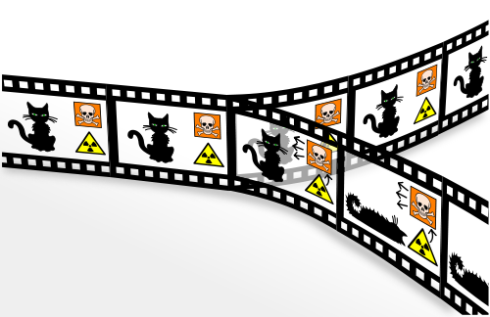
Schrödinger’s Cat; visualization of the separation of the universe due to two superposed and entangled quantum mechanical states. (image credit: Christian Schirm)
Applying these quantum rules to large objects leads to paradoxical and even bizarre consequences. To emphasize this, Erwin Schrödinger, one of the founding fathers of quantum physics, proposed in 1935 a thought experiment involving a cat that could be killed by a mechanism triggered by the decay of a single atomic nucleus. If the nucleus is in a superposition of decayed and non-decayed states, and if quantum physics applies to large objects, the belief is that the cat will be simultaneously dead and alive.
Schrödinger’s thought experiment involves a (macroscopic) cat whose quantum state becomes entangled with that of a (microscopic) decaying nucleus. While quantum systems with properties akin to ‘Schrödinger’s cat’ have been achieved at a micro level, the application of this principle to everyday macro objects has proved to be difficult to demonstrate. The experimental creation of such micro-macro entanglement is what these authors successfully achieved.
Photons help to illuminate the paradox
The breakthrough achieved by Calgary quantum physicists is that they were able to contrive a quantum state of light that consists of a hundred million photons and can even be seen by the naked eye. In their state, the “dead” and “alive” components of the “cat” correspond to quantum states that differ by tens of thousands of photons.
While the findings are promising, study co-author Simon admits that many questions remain unanswered.
“We are still very far from being able to do this with a real cat,” he says. “But this result suggests there is ample opportunity for progress in that direction.”
Seeing quantum effects requires extremely precise measurements. In order to see the quantum nature of this state, one has to be able to count the number of photons in it perfectly. This becomes more and more difficult as the total number of photons is increased. Distinguishing one photon from two photons is within reach of current technology, but distinguishing a million photons from a million plus one is not.
Decoherence: the emergence of the classical world from the quantum
Why don’t we see quantum effects in everyday life? The current explanation is that it is to do with decoherence.
Physicists see quantum systems as fragile. When a photon interacts with its environment, even just a tiny bit, the superposition is destroyed. This interaction, could be as a result of measurement or an observation, or just a random interaction. Superposition is a fundamental principle of quantum physics that says that systems can exist in all their possible states simultaneously. But when measured, only the result of one of the states is given.
This effect is known as decoherence and it has been studied intensively over the last few decades. The idea of decoherence as a thought experiment was raised by Erwin Schrödinger, in his famous cat paradox. Unfortunately for non-physicists decoherence only provides an explanation for the observance of wave function collapse, as the quantum nature of the system “leaks” into the environment. It does not tell us where the line is, if one does exist, between the quantum and everyday worlds.
Although Schrodinger’s thought experiment was originally intended to convey the absurdity of applying quantum mechanics to macroscopic objects, this experiment and related ones suggest that it may apply on all scales.
If you are interested in the history and foundation of quantum mechanics then I highly recommend Quantum: Einstein, Bohr and the great debate about the nature of reality, by Manjit Kumar (2009), and The Age of Entanglement: when quantum physics was reborn, by Louisa Gilder (2008). Both are well-researched and captivating brilliant accounts of science science and scientists.
Imagine, Lake Vostok is covered by more than 3,700 metres of Antarctic ice. Devoid of sunlight, it lies far below sea level in a depression that formed 60 million years ago, when the continental plates shifted and cracked. Few nutrients are available. Yet scientist, led by Scott Rogers, a Bowling Green State University professor of biological sciences, have found a surprising variety of life forms living and reproducing in this extreme environment. A paper published June 26 in PLOS ONE details the thousands of species they identified through DNA and RNA sequencing.
What lies sealed beneath the glacial ice?
Antarctica, 35 million years ago, had a temperate climate and was inhabited by a diverse plants and animals. About 34 million years ago, a huge drop in temperature occurred and ice covered the lake, when it was probably still connected to the Southern Ocean. This lowered the sea level by about 100 metres, which could have cut off Lake Vostok from the ocean. The ice cover was intermittent until a second big plunge in temperature took place 14 million years ago, and sea level dropped even farther.
As the ice crept across the lake, it plunged the lake into total darkness and isolated it from the atmosphere, and led to increasing pressure in the lake from the weight of the glacier. While many species probably disappeared from the lake, as indicated by Rogers’ results, some seem to have survived.
Rogers and his colleagues examined core sections from the ice above Lake Vostok that were extracted in 1998. At the time, no one had reached the actual lake, a feat that was achieved only last year. But the drilling had gone deep enough to reach a layer of ice at the bottom of the sheet that formed as lake water froze onto the bottom of the glacier where it meets the lake. The team sampled cores from two areas of the lake, the southern main basin and near an embayment on the southwestern end of the lake. The embayment appears to contain much of the biological activity in the lake.
By sequencing the DNA and RNA from the ice samples, the team identified thousands of bacteria, including some that are commonly found in the digestive systems of fish, crustaceans and annelid worms, in addition to fungi and two species of archaea, or single-celled organisms that tend to live in extreme environments. Other species they identified are associated with habitats of lake or ocean sediments. Psychrophiles, or organisms that live in extreme cold, were found, along with heat-loving thermophiles, which suggests the presence of hydrothermal vents deep in the lake. Rogers said the presence of marine and freshwater species supports the hypothesis that the lake once was connected to the ocean, and that the freshwater was deposited in the lake by the overriding glacier.
These results, however, are not without controversy.
Other claims and other lakes
Long before he began using these techniques to study the ice, Rogers and his team had developed a method to ensure purity. Sections of core ice were immersed in a sodium hypochlorite (bleach) solution, then rinsed three times with sterile water, removing an outer layer. Under strict sterile conditions, the remaining core ice was then melted, filtered and refrozen.
Sergey Bulat has doubts about the results, despite the careful sample preparation. Bulat, a Lake Vostok expert at the Petersburg Nuclear Physics Institute in Gatchina, Russia, is quoted as saying, “that it is very probably that the samples are heavily contaminated with tissue and microbes from the outside world.”
Bulat and Rogers have both studied Vostok ice samples taken in the 1990s by a consortium of Russian, French and US Antarctic researchers. In the past, the pair pondered a close collaboration. But their scientific relationship broke over enduring disagreement about the level of contamination of samples.
In March, Bulat himself faced criticism over an unknown species of bacterium his team had discovered in a Lake Vostok ice core drilled last year. Sceptics said that this finding was due to contamination from drilling fluid.
The two researchers’ claims are probably the first in what will no doubt be an interesting period of discovery in Lake Vostok and other Antarctic lakes. The first samples of water from Lake Vostok itself, collected in early 2013 are currently being analysed. The Russian team has said that it hopes to have results within the next year. Bacteria, of known species, have been recovered from the smaller Antarctic Lakes, Whillans and Vida. Lake Vida has been sealed off for around 2,800 years. Ice cores drilled in 2005 and 2010 have recently revealed life, but at about one-tenth of the abundance usually found in freshwater lakes in moderate climate zones. Similarly in Lake Whillans the bacteria levels were roughly one-tenth the abundance of microbes in the oceans.
These results are glimpses into the the sub-glacial world of Antarctica. Glimpses that may change how we not only view this continent but also providing clues to how extra terrestrial life may exist on icy moons such as Jupiter’s Europa and Saturn’s Enceladus.
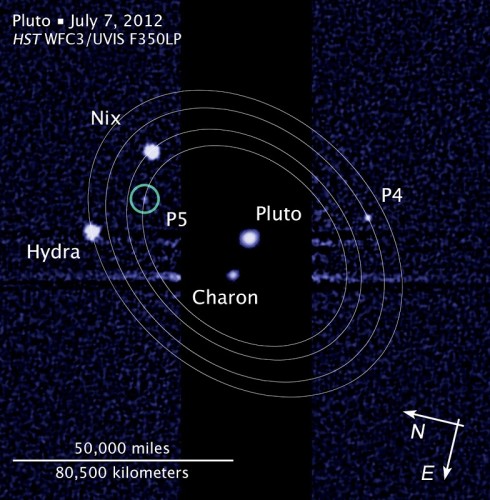
This image, taken by the NASA/ESA Hubble Space Telescope, shows five moons orbiting Pluto, the distant, icy dwarf planet (ESA/Hubble/AFP/Showalter)
The dwarf planet, Pluto, can still generate plenty of public interest – if the naming of its two recently discovered moons is anything to go by. After their discovery, the leader of the research team, Mark Showalter, called for a public vote to suggest names for the two objects. The on-line contest, aptly named ‘Pluto Rocks!‘, concluded with Vulcan as the outright favorite, after a William Shatner led push by Star Trek fans. The names Cerberus and Styx ranking second and third respectively. The International Astronomical Union (IAU) has announced that the names Kerberos and Styx have officially been recognised for these fourth and fifth moons of Pluto. A decision that is probably correct, even if it proves not to be the most popular.
The moons of Pluto
The new moons were discovered in 2011 and 2012, during observations of the Pluto system made with the NASA/ESA Hubble Space Telescope. Their discovery increasing the number of known Pluto moons to five. Kerberos lies between the orbits of Nix and Hydra, two bigger moons discovered by Hubble in 2005, and Styx lies between Charon, the innermost and biggest moon, and Nix. Both have circular orbits assumed to be in the plane of the other satellites in the system. Kerberos has an estimated diameter of 13 to 34 kilometres, and Styx is thought to be irregular in shape and is 10 to 25 kilometres across.
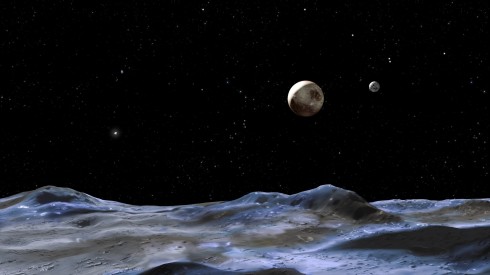
Artist illustration of Pluto (centre) from one of its small moons. The largest moon Charon is on the right. Credit: NASA, ESA and G. Bacon (STScI)
The recent discoveries of the two small moons orbiting Pluto raise interesting new questions about how the dwarf planet formed. We now know that a total of four outer moons circle around a central “double-planet” comprising Pluto and its large, nearby moon Charon.
No home for Spock
The International Astronomical Union (IAU) is the arbiter of the naming process of celestial bodies, and is advised and supported by astronomers active in different fields. On discovery, astronomical objects receive unambiguous and official catalogue designations. When common names are assigned, the IAU rules ensure that the names work across different languages and cultures in order to support collaborative worldwide research and avoid confusion.
To be consistent with the names of the other Pluto satellites, the names had to be picked from classical European mythology, in particular with reference to the underworld — the realm where the souls of the deceased go in the afterlife. Showalter submitted Vulcan and Cerberus to the IAU where the Working Group for Planetary System Nomenclature (WGPSN) and the Committee on Small Body Nomenclature (WGSBN) discussed the names for approval.
After a final deliberation, the IAU Working Group and Committee agreed to change Cerberus to Kerberos — the Greek spelling of the word, to avoid confusion with an asteroid called 1865 Cerberus. According to mythology, Cerberus was a many-headed dog that guarded the entrance to the underworld. In keeping with the underworld theme the third most popular name was chosen — Styx, the name of the goddess who ruled over the underworld river, also called the Styx.
The IAU decided against the name Vulcan for a number of reasons: Vulcan had already been used for a hypothetical planet between Mercury and the Sun (although this planet was found not to exist), the term “vulcanoid
Trouble in Mind (Jenni Ogden, Scribe, $32.95, ISBN 9781922070562, July 2013)
I do not think I would be alone in fearing ‘losing my mind’. Even the common expression, “are you out of your mind?” gives solid form to what may seem a merely philosophical train of thought. At any given time most people will declare confidently that “I am in my ‘right mind’ and point to themselves as that ‘I’. The quandary is the ‘I’ of age eight is different to the ‘I’ of forty-eight; despite the continuity of of ‘I’ joining these two for example. Our mind then is one of those puzzling concepts at once both familiar and ephemeral. To lose ones mind, though, even partially, through trauma, disease, or disorder we would all agree is to lose some quintessential part of us. Trouble In Mind is a collection of real stories about people who have suffered just that – losing part of their minds.
The stories are from patients that the neuropsychologist author, Jenni Ogden, has worked with over her career in New Zealand, the USA, and Australia. Ten of the 15 patients portrayed in this book featured in Ogden’s 2005 textbook Fractured Minds. Trouble in Mind is neither text, nor assessment, nor treatment book. There are other books on the market that describe patients with a variety of neurological conditions. Many written by clinicians such as Ogden. Most I find fall short because the clinician writer is excited by the condition and fails to connect the human to that condition. In other examples non-clinicians often focus complete cures, without any reference to the many that underwent similar treatments – without success.
Ogden’s stories succinctly and clearly explain the medical conditions and engagingly present the human side of each in an empathetic and nuanced style. Whether talking about patients with car-crash brain trauma, rugby-induced concussion or suffering from Parkinson’s disease Ogden covers the personal, social and family elements with clarity that is often missing in clinical based non-fiction written by clinicians. In this respect Ogden writes with feeling like that of psychologist Oliver Sacks at his best.
These are stories that will have a resonance with most in our society. Three in particular I will mention as way of illustration of the breadth covered. Michael was a 24-year old motorcycle maniac. After a horrific accident, he left the critical care unit with a virtually ignored head injury; the surgeons had grappled with keeping him alive and the extensive orthopedic surgeries and specialist care. neither he nor his doctors realised that he was cortically blind. This resolved itself after two years – leaving him with object agnosia – the inability to recognise what he was seeing. Ogden then describes he many years work with Michael, his trials, tribulations and treatments to living 24 years later is a life with a most interesting disability. Amongst this we also get Ogden’s motivation – her clinician’s ‘delight’ in being asked to work with such an unusual case. Yes her delight, her excitement; those real human emotions not hidden behind neutral, banal psychology speak.
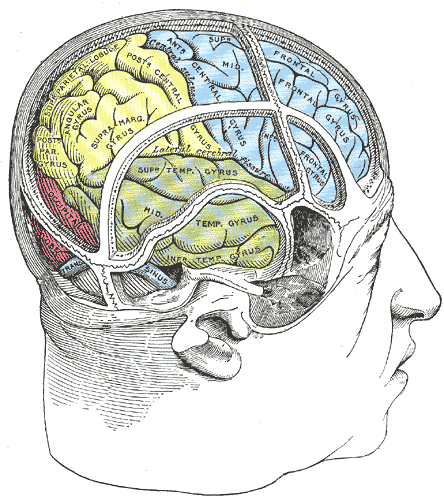
Hemispherical neglect. Wikimedia commons.
In another chapter Ogden looks at the bizarre neuropsychological disorder of hemineglect – ignoring visual stimuli in the side of space opposite to the side of their brain that is damaged. In this case though the patient is a chirpy 50 year-old female, Janet. The chapter is fascinating and the description of janet’s sessions with Ogden are sometimes, well, hilarious. But this is real-life not Hollywood. Janet’s hemineglect is caused by a brain tumor. Janet dies, four long and difficult years following her diagnosis. Ogden doesn’t just end the chapter, she humanely discusses the impact on Janet’s husband and close family and friends of her treatment and death. She also assesses the effectiveness of the treatments, looking at other cases, from her own and others’ casebooks.
The final chapter is aptly called “The Long Goodbye: coming to terms with Alzheimer’s disease.” This chapter follows Sophie’s diagnosis and cognitive decline from Alzheimer’s disease. I learnt a lot about the disease from reading this chapter. I equally learnt how it would be to watch a person who “was once active, independent, intelligent, humorous and loving gradually lose her mind”.
This collection of stories is eminently readable. I recommend it to readers with either; a specific, perhaps personal, topic of interest or those more generally who are curious and interested in how our minds work, particularly when they go awry due to damage to that squishy grey organ inside our skull.
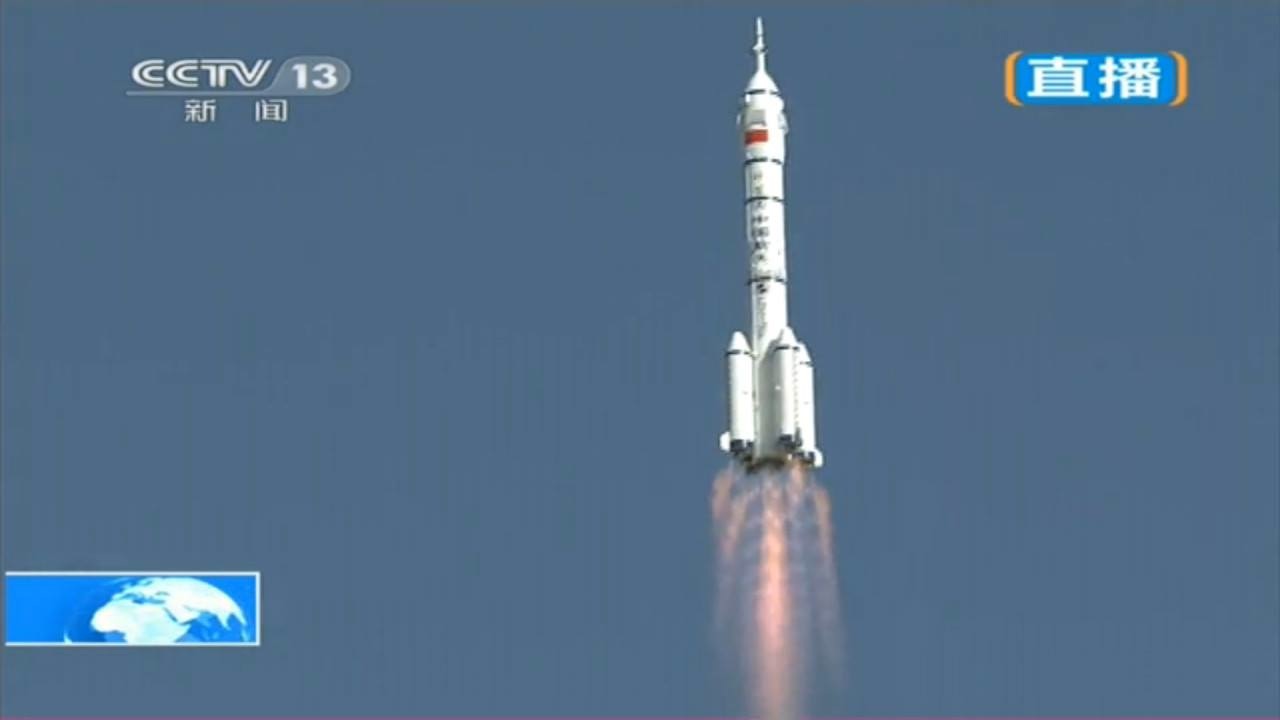
The Long March 2F rocket, Shenzhou 10, seconds after its launch. Photo credit CCTV.
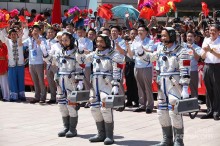
The colorful and polished launch of Shenzhou 10 confirms that China has come of age as a spacefaring nation. At 19:40 AEST on Tuesday June 11 (17:40 local time) three ‘yuhangyuan’, Chinese astronauts, embarked on China’s sixth crewed space mission. This second mission to Tiangong 1, the Chinese space station, is a credible step in mastering the art and engineering of space exploration. It was also a public relations success.
Shenzhou 10 crew
Announcing in early April, that Wang Yaping, a 33 year old Major in the PLA Air Force, was one of the 3-person Shenzhou 10 crew, silence then descended on the identity of the other crew members. Wang was named as the in-flight instructor. She becomes China’s second female and 9th astronaut to have flown. As the in-flight instructor Wang will give lectures to middle and elementary school students from orbit.
Building the suspense the Chinese finally announcing the other two the names of the three person crew yesterday. Along with Wang the Shenzhou 10 crew are: Nie Haisheng (48) Commander of Shenzhou 10, a veteran of Shenzhou 6 in 2005, and a Major General in PLA Air Force, and Zhang Xiaoguang, 47 Assistant Pilot of Shenzhou 10, backup crew of Shenzhou 9 (along with Wang) and a Senior Colonel of PLA Air Force.
This places the Chinese astronaut corps as a modern, relatively, gender balanced operation. Zhang and Nie both hale from the 1996 second astronaut selection. As have all male yuhangyuan to date including Yang Liwei, China’s first astronaut. The first group of astronauts were selected in 1971 in a hopelessly ambitious and quickly abandoned attempt to put astronauts into space in the 1970s. Wang, along with Liu Yang, China’s first female yuhangyuan, comes from China’s 2010 third group of yuhangyuan. The Chinese, at least to the outside world, have not followed the more memorable and colorful NASA lead of allowing astronaut groups to pick their nick-names.
The heavenly palace
With the launch a success, Nie will now chase, rendezvous and dock with an orbital laboratory, Tiangong (a mandarin word meaning “heavenly palace”), which was launched nearly two years ago on September 29, 2011.On November 2, 2011 China successfully docked the unmanned Shenzhou 8 with Tiangong. It remained docked for 14 days and then undocked and repeated the docking maneuver – proof that the first was not a fluke. It then was undocked, leaving Tiangong to its solitary orbit 370km above the earth’s surface.
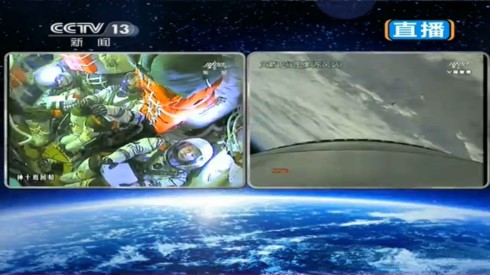
Image of the interior of Shenzhou 10 after launch. China TV demonstrates its new openness and confidence. Image credit CCTV.
On June 18, 2012 a second craft docked with Tiangong. This time it was the crewed Shenzhou 9. The space station was then declared operational. China had joined Russia and the USA in having the capability to become space residents. The three person crew on Tiangong conducted experiments and aclimatised to the prolonged weightlessness for their 10 day mission.
The normal pattern was for two to sleep in Tiangong and one to sleep in Shenzhou. At only 10.4m in length, Shenzhou is smaller than the 1971 Russian Salyut (13.1m) and the 1973 US Skylab (36.1m) space laboratories. Like these other first space laboratories Tiangong is designed with a limited lifespan. The current mission, Shenzhou 10, will be the last to Tiangong 1.
Shenzhou 10
As is the norm now the Shenzhou launch was covered live by the Chinese media. providing pictures, expert commentary and graphics depicting what was going on at the various stages of the launch. Shenzhou 10 is now safely in orbit and will spend the next few days approaching a suitable orbit for docking. The Shenzhou 10 will dock with the orbiting lab module Tiangong 1 several times.
“The three astronauts will stay in orbit for 15 days, including 12 days when they will work inside the coupled complex of the Shenzhou 10 and Tiangong 1,” said Zhou Jianping, head designer of China’s manned space program. It is expected that they will set a Chinese record for time in orbit.
The interesting point is that the mission profile for Shenzhou 10 is opaque. Although it is expected that the craft will be put through it’s docking paces – not something to be dismissed lightly – the scientific and engineering goals of this mission are less obvious that the recent Shenzhou missions.
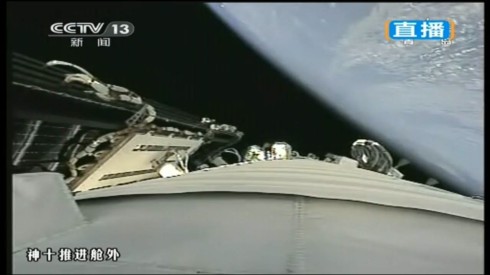
The view from the orbiting Shenzhou 10. Image credit CCTV.
This will be the last Chinese human space mission for quite some time. The next Shenzhou missions are expected to fly to the Tiangong 2 laboratory. This will be an expanded version of Tiangong 1, similar in design to the Russian 1986 Mir space station. It is expected to be able to sustain 20-day visits. It will probably not be launched until around 2015 or possibly later. The gap between the flight of Shenzhou 10 and Shenzhou 11 could ultimately prove to be the longest hiatus in Chinese human spaceflight to date.
Regional implications
With this in mind it will be interesting to see how the Chinese promote this current mission once it is completed. Its success, or otherwise, will not aid any military space activities, nor directly any commercial space activities. It does provide a compelling message, I suggest, to its regional competitors. Human exploration is possibly the most expensive and prestigious space activity. I think we will find China promoting this expedition to its fullest, as it build on its robotic missions to the Moon over the next few years. Fully intending to continue its long march to put humans onto the moon and mars in the next few decades.
Laughing rats, name-calling wild parrots, archer-fish with a sense of humour, and educated ants; the naturalist Charles Darwin would have loved this book. The philosopher Rene Descartes would equally have found it deeply troubling. Both with good reason.
In Descartes’ dualist philosophy the mind and body are two separate entities. There is the material body and the immaterial mind or soul. The latter linking humans to the mind of God, making us, in his philosophy, different to animals. Descartes famously reasoned animals are composed only of material substances and therefore have no capacity to reason. More importantly for how we see animals, Descartes wrote that a human person, such as you or I, is something distinct from that person’s body. Therefore an animal, being material only, could in this way of thinking, never have a mind – never have a concept of “I”.
This stance was extended by the behaviorist paradigms of the mid 20th century associated with the psychologist B F Skinner.
Darwin on the other hand thought differently. He was a natural philosopher who got up out of his armchair and voyaged the world, most notably aboard the Beagle. Darwin attributed emotions to many animals and even argued that earthworms are cognitive beings. In his classic The Descent of Man he argued, most persuasively, that we and the other animals differ in our mental powers by degree, not in kind.
Today the discussion is no different, researchers still debate not only advanced claims of intelligence in animals but also how to test whether their abilities reflect human-like cognition.
This brings me to what I liked so much about this book.
Each chapter focuses on an animal in a particular observational or experimental setting. Virginia Morell introduces us to the scientist and the animals, explaining the studies, the results and some of the trials and triumphs along the way to building an understanding of what the scientists find. The animal and settings we may already have a prejudice about; captive dolphins, elephant memories, chimpanzees and language, dogs and humans, are very carefully presented to ensure that the most compelling results are well presented. The more novel animals, ants and fish for example, are also carefully presented, their novelty makes for an easier presentation. For example I had no preconceived ideas regarding the ability of ants to teach – with no mental hurdle of my to overcome – that chapter was very illuminating. The examples and researchers chosen for these chapters succinctly illustrate what we have learnt about the emotions and intelligence of these animals.
Yes I did say chosen. It does not pretend, nor claim to be, encyclopaedic, academic nor ‘balanced’ presentation of the entire field. This is a lively, non-fiction tour of the cutting edge of animal cognitive science. Virginia Morell translates the scientific jargon of the field into words that all can engage with.
Each chapter is a separate story, reflecting that some of the chapters were adapted from previously published articles from 2008 to 2012. These are neatly book-ended with chapter that frame these quite succinctly. This I think is a strength of the book. Each chapter, each story, is self-contained that you can read it, look at the references and ponder what the researchers and Virginia are conveying to you. Not only do you get an appreciation of the scientific significance of the various studies – you get that rare glimpse into the scientific process and personality that is often missed in science communication writing.
For example, consider the archer-fish and neuroscientist Stefan Schuster. I learnt that Stefan has spent more than forty years investigating how fish think and make decisions. I learnt that the idea of seeing life from the mind of a fish was something that grabbed him as a child. Stefan’s story is more than just his careful experimentation on fish behaviour. Along the way he has made key discoveries about the sophisticated mental abilities of the archer-fish. The archer-fish is well-named for it is the sharpshooter of the piscine world.
In the chapter discussing his work I learnt that Schuster owes his success to curiosity, fun and serendipity – as well as careful experimentation. Schuster and his students had discovered that archer-fish learnt how to shoot at difficult and novel targets by watching another skilled fish perform the task. That means they had taken the viewpoint of the other fish. Did they copy or imitate? Let the philosophers debate the definitions. What the archerfish do involves cognition. Although we don’t understand the relationship between cognition and sentience, scientists know that one informs the other.
Each chapter is replete with great stories, good science and probing philosophy. Morell displays her ability to write engagingly for a general audience, while presenting the science at a suitably intriguing level. If you view animals the same after reading this book – then give it a second read – it will be worth it.
I’ll leave the last words to the late Douglas Adams:
Man had always assumed that he was more intelligent than dolphins because he had achieved so much – the wheel, New York, wars and so on – while all the dolphins had ever done was muck about in the water having a good time. But conversely, the dolphins had always believed that they were far more intelligent than man – for precisely the same reasons.
Nobel prizewinner Samuel Ting, early Thursday morning (March 4, 2:00 AEDT), announced the first results from the Alpha Magnetic Spectrometer (AMS) search for dark matter. The findings, published in Physical Review Letters, provide the most compelling direct evidence to date for the existence of this mysterious matter.
In short, the AMS results have shown an excess of antimatter particles within a certain energy range. The measurements represent 18 months of data from the US$1.5 billion instrument.
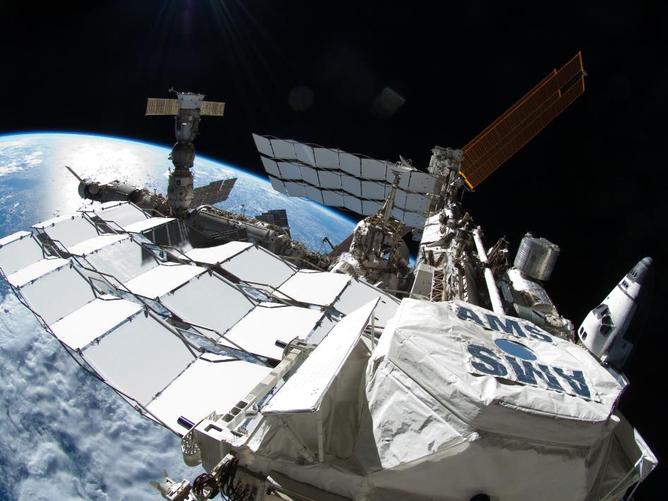
The AMS experiment is a collaboration of 56 institutions, across 16 countries, run by the European Organisation for Nuclear Research (CERN). The AMS is a giant magnet and cosmic-ray detector complex fixed to the outside of the International Space Station (ISS).
Dark matter matters
The visible matter in the universe, such as you, me, the stars and planets, adds up to less than 5% of the universe. The other 95% is dark, either dark matter or dark energy. Dark matter can be observed indirectly through its interaction with visible matter but has yet to be directly detected.
Cosmic rays are charged high-energy particles that permeate space. The AMS is designed to study them before they have a chance to interact with Earth’s atmosphere.
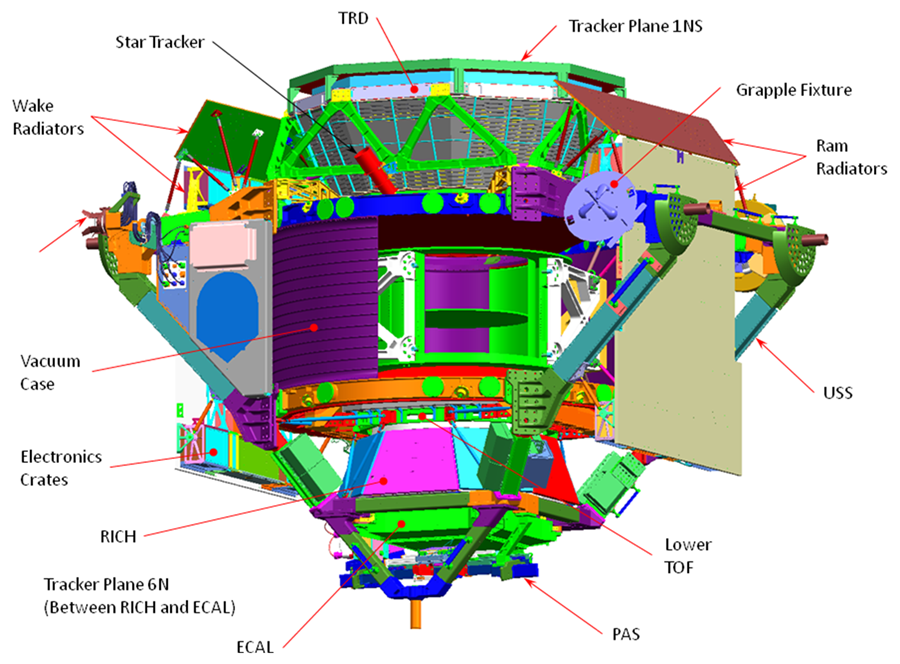
Magnet bends in opposite directions charged particles/antiparticles. Transition Radiation Detector (TRD) identifies electrons and positrons among other cosmic-rays. Time-of-Flight System (ToF) warns the sub-detectors of incoming cosmic-rays. Silicon Tracker (Tracker) detects the particle charge sign, separating matter from antimatter. Ring-Imaging Cherenkov Detector (RICH) measures with high precision the velocity of cosmic-rays. Electromagnetic Calorimeter (ECAL) measures energy of incoming electrons, positrons and γ-rays. Anti-Coincidence Counter (ACC) rejects cosmic rays traversing the magnet walls. Tracker Alignment System (TAS) checks the Tracker alignment stability. Star Tracker and GPS defines the position and orientation of the AMS-02 experiment. Electronics transform the signals detected by the various particle detectors into digital information to be analyzed by computers. Diagram credit AMS Collaboration.
An excess of antimatter within the cosmic rays has been observed in two recent experiments – and these were labelled as “tantalising hints
Long distance weather reports are now a commonality. The report for 2MASSJ22282889-431026 is somewhat unusual. It forecasts wind-driven, planet-sized clouds, with the light varying in time, brightening and dimming about every 90 minutes. The clouds on 2MASSJ22282889-431026 are composed of hot grains of sand, liquid drops of iron, and other exotic compounds. Definitely not the first place to spend a summer holiday.
Not that 2MASSJ22282889-431026 (or 2M2228 as it is known in The Astrophysical Journal Letters) will appear on a travel itinerary anytime soon. For 2M2228 is a brown dwarf, 39.1 light years from earth. Brown dwarves form out of condensing gas, as stars do, but lack the mass to fuse hydrogen atoms and produce energy. Instead, these objects, which some call failed stars, are more similar to gas planets, such as Jupiter and Saturn, with their complex, varied atmospheres. Although brown dwarves are cool relative to other stars, they are actually hot by earthly standards. This particular object is about 600 to 700 degrees Celsius.
The atmosphere of 2M2228
Astronomers using NASA’s Spitzer and Hubble space telescopes have probed the stormy atmosphere of this brown dwarf, creating the most detailed “weather map” yet for this class of cool, star-like orbs. “With Hubble and Spitzer, we were able to look at different atmospheric layers of a brown dwarf, similar to the way doctors use medical imaging techniques to study the different tissues in your body,” said Daniel Apai, the principal investigator of the research at the University of Arizona in Tucson.
But more surprising, the team also found the timing of this change in brightness depended on whether they looked using different wavelengths of infrared light.
This artist’s illustration shows the atmosphere of a brown dwarf called 2MASSJ22282889-431026, which was observed simultaneously by NASA’s Spitzer and Hubble space telescopes. The results were unexpected, revealing offset layers of material as indicated in the diagram. For example, the large, bright patch in the outer layer has shifted to the right in the inner layer. The observations indicate this brown dwarf — a ball of gas that “failed” to become a star — is marked by wind-driven, planet-size clouds. The observations were made using different wavelength of light: Hubble sees infrared light from deeper in the object, while Spitzer sees longer-wavelength infrared light from the outermost surface. Both telescopes watched the brown dwarf as it rotated every 1.4 hours, changing in brightness as brighter or darker patches turned into the visible hemisphere. At each observed wavelength, the timing of the changes in brightness was offset, or out of phase, indicating the shifting layers of material. Image credit: NASA/JPL-Caltech.
These variations are the result of different layers or patches of material swirling around the brown dwarf in windy storms as large as Earth itself. Spitzer and Hubble see different atmospheric layers because certain infrared wavelengths are blocked by vapors of water and methane high up, while other infrared wavelengths emerge from much deeper layers.
The new research is a stepping-stone toward a better understanding not only of brown dwarves, but also of the atmospheres of planets beyond our solar system.
The Spitzer Space Telescope consists of a 0.85-meter diameter telescope and three cryogenically-cooled science instruments which perform imaging and spectroscopy in the 3 – 180 micron wavelength range. Since infrared is primarily heat radiation, detectors are most sensitive to infrared light when they are kept extremely cold. Using the latest in large-format detector arrays, Spitzer is able to make observations that are more sensitive than any previous mission. Spitzer’s mission lifetime requirement was 2.5 years, then extended this to 5-years. Spitzer .
Launched on August 25, 2003 Spitzer is now more than 9 years into its mission, and orbits around the sun more than 100-million kilometers behind Earth. It has heated up just a bit – its instruments have warmed up from -271 Celsius to -242 Celsius. This is still way colder than a chunk of ice at 0 Celsius. More importantly, it is still cold enough for some of Spitzer’s infrared detectors to keep on probing the cosmos for at least two more years; the project funding has been extended to 2016.
Spitzer seen against the infrared sky. The band of light is the glowing dust emission from the Milky Way galaxy seen at 100 microns (as seen by the IRAS/COBE missions). Image credit NASA/JPL
Spitzer is the largest infrared telescope ever launched into space. Its highly sensitive instruments allow scientists to peer into cosmic regions that are hidden from optical telescopes, including dusty stellar nurseries, the centres of galaxies, and newly forming planetary systems. Spitzer’s infrared eyes also allows astronomers see cooler objects in space, like brown dwarves, extrasolar planets, giant molecular clouds, and organic molecules that may hold the secret to life on other planets.
Instead of orbiting Earth itself, the observatory trails behind Earth as it orbits the Sun and drifts away from us at about 1/10th of one astronomical unit per year.
This innovative orbit lets nature cool the telescope, allowing the observatory to operate for around 5.5 years using 360 litres of liquid helium coolant. In comparison, Spitzer’s predecessor, the Infrared Astronomical Satellite, used 520 litres of cryogen in only 10 months.
This unique orbital trajectory also keeps the observatory away from much of Earth’s heat, which can reach 250 Kelvin (-23 Celsius) for satellites and spacecraft in more conventional near-Earth orbits.
More scientific duets: the asteroid belt of Vega
Like a gracefully aging rock star Spitzer is reveling in duets. It has also teamed up with the European Space Agency‘s Herschel Space Observatory. Using data from both astronomers have discovered what appears to be a large asteroid belts around the star Vega, the second brightest star in northern night skies.
The data are consistent with the star having an inner, warm belt and outer, cool belt separated by a gap. The discovery of this asteroid belt-like band of debris around Vega makes the star similar to another observed star called Fomalhaut. Again this formation is similar to the asteroid and Kuiper belts in our own solar system.
Astronomers have discovered what appears to be a large asteroid belt around the bright star Vega, as illustrated here at left in brown. The ring of warm, rocky debris was detected using NASA’s Spitzer Space Telescope, and the European Space Agency’s Herschel Space Observatory. In this diagram, the Vega system, which was already known to have a cooler outer belt of comets (orange), is compared to our solar system with its asteroid and Kuiper belts. The relative size of our solar system compared to Vega is illustrated by the small drawing in the middle. On the right, our solar system is scaled up four times. The comparison illustrates that both systems have inner and outer belts with similar proportions. The gap between the inner and outer debris belts in both systems works out to a ratio of about 1-to-10, with the outer belt 10 times farther away from its host star than the inner belt. Astronomers think that the gap in the Vega system may be filled with planets, as is the case in our solar system. Image credit: NASA/JPL-Caltech.
What is maintaining the gap between the warm and cool belts around Vega and Fomalhaut? The results strongly suggest the answer is multiple planets. Our solar system’s asteroid belt, which lies between Mars and Jupiter, is maintained by the gravity of the terrestrial planets and the giant planets, and the outer Kuiper belt is sculpted by the giant planets.
“Our findings (accepted for publication in the Astrophysical Journal) echo recent results showing multiple-planet systems are common beyond our sun,” said Kate Su, an astronomer at the Steward Observatory at the University of Arizona, Tucson.
Vega and Fomalhaut are similar in other ways. Both are about twice the mass of our sun and burn a hotter, bluer color in visible light. Both stars are relatively nearby, at about 25 light-years away. Fomalhaut is thought to be around 400 million years old, but Vega could be closer to its 600 millionth birthday. For comparison our sun is 4,600 million years old. Fomalhaut has a single candidate planet orbiting it, Fomalhaut b, which orbits at the inner edge of its cometary belt.
The Herschel and Spitzer telescopes detected infrared light emitted by warm and cold dust in discrete bands around Vega and Fomalhaut, discovering the new asteroid belt around Vega and confirming the existence of the other belts around both stars. Comets and the collisions of rocky chunks replenish the dust in these bands. The inner belts in these systems cannot be seen in visible light because the glare of their stars outshines them.
It would seem that Spitzer has quite a bit more productive and novel scientific life, including duets, left in it yet.
Being responsible for picking the week’s most interesting science stories is a fun and fascinating challenge. It pushes to me to look beyond my own interests and explore what others find compelling. So I trust you find my ‘science making news’ selection of interest and delight; explore the quantum, human, off-world and mathematical highs of the week.
On the human scale an international team of scientists has been investigating the antibiotic properties of sweat. More precisely they discovered how a natural antibiotic called dermcidin, produced by our skin when we sweat, is a highly efficient tool to fight tuberculosis germs and other dangerous bugs.
Their results could contribute to the development of new antibiotics that control multi-resistant bacteria.
The benefits of a good nights sleep once again are news. Researchers have shown that the disruption in the body’s circadian rhythm can lead not only to obesity, but can also increase the risk of diabetes and heart disease.
Our study confirms that it is not only what you eat and how much you eat that is important for a healthy lifestyle, but when you eat is also very important.
Disruption of body’s circadian clock increases risk of obesity, diabetes and heart disease. (Credit: Daniel Dubois, Vanderbilt University)
At the quantum scale, the particle physicists are at it again. Not content with discovering the Higgs Boson they are shedding light (pardon the pun) on a possible 5th force in nature. In a breakthrough physicists have established new limits on what scientists call “long-range spin-spin interactions” between atomic particles. These interactions have been proposed by theoretical physicists but have not yet been seen. If a long-range spin-spin force is found, it not only would revolutionize particle physics but might eventually provide geophysicists with a new tool that would allow them to directly study the spin-polarized electrons within Earth.
The most rewarding and surprising thing about this project was realizing that particle physics could actually be used to study the deep Earth.
The latest news from Mars is that curiosity has relayed new images that confirm it has successfully obtained the first sample ever collected from the interior of a rock on another planet.
Many of us have been working toward this day for years. Getting final confirmation of successful drilling is incredibly gratifying. For the sampling team, this is the equivalent of the landing team going crazy after the successful touchdown.
To wrap up with one further piece of geek excitement. On January 25th at 23:30:26 UTC, the largest known prime number, 257,885,161-1, was discovered on Great Internet Mersenne Prime Search (GIMPS) volunteer Curtis Cooper’s computer. The new prime number, 2 multiplied by itself 57,885,161 times, less one, has 17,425,170 digits. With 360,000 CPUs peaking at 150 trillion calculations per second, 17th-year GIMPS is the longest continuously-running global “grassroots supercomputing”project in Internet history.
Until next week’s Australian Science review, go geekily crazy and enjoy your weekend.
Massive objects moving at near light speeds do not occur naturally in the universe as we know it. If we detect such objects it is a reasonable to assume they are artificial artifacts from advanced intelligent life. This according to Garcia-Escartin and Chamorro-Posada, authors of a recent paper, is a low-cost, sure-fire way of searching for intelligent life outside earth.
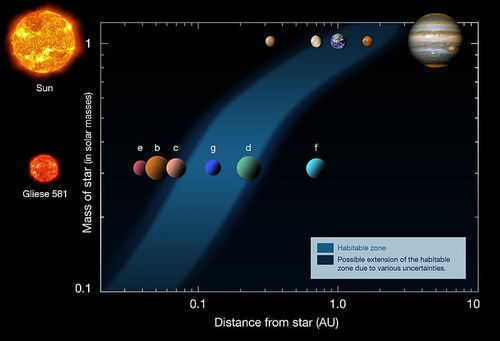
The habitable zone of Gliese 581 compared with our Solar System’s habitable zone. Image credit NASA.
Searching for life beyond earth is a grand and varied enterprise.
For a start we can look for exoplanets that fall inside the habitable zone of a star. A planet found in this zone may fulfill the requirements for life: liquid water, energy, elements and other nutrients, and appropriate physical conditions. Though we have located many exoplanets in recent times they are far from earth – many light years distant. For example one star system, Gliese 581, is 20.3 light years away (192,048,720,000,000 kilometres). With three planets in its habitable zone, we know nothing about conditions on them. The techniques used to find them can tell us nothing about their ecology – if any. Being in a habitable zone does not guarantee life. It is only in recent years that we have realised how inhospitable Venus and Mars are to life – despite being in our habitable zone.
By looking for alien signals or transmissions, as in the SETI programme, we extend our search from ‘possible life’ to intelligent life. For advanced civilisations we look for artificial illumination or interstellar probes.
Let’s face it though, to know we are not alone will require quite good proof for most of us (apart from the misguided minority of UFO believers), and especially for the skeptical scientists.
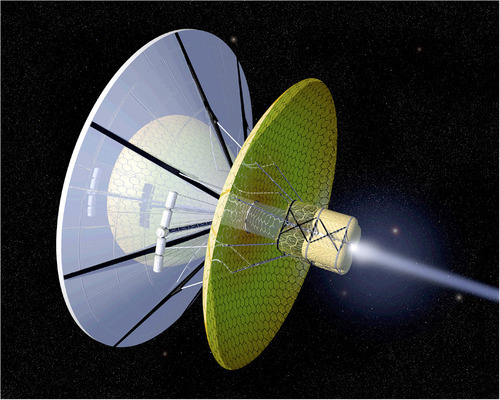
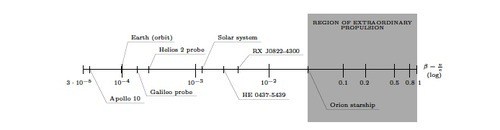
The intriguing proposition of Garcia-Escartin and Chamorro-Posada is based on three ideas. The first is that anything travelling faster than 3.3% of light speed (5,935,890 kilometres per hour) is artificial. All known natural objects travel slower than this speed, as do our current space probes. This speed was chosen as it is the estimated speed of the nuclear propulsion ship proposed by Freeman Dyson in the Orion project. Although the propulsion technology is feasible today the technological and economic hurdle of creating such a craft is way beyond our current means. Although it is certainly not inconceivable to achieve such interstellar travel in the next 100 years.
Scales of speed with respect to the speed of light in vacuum (logarithmic scale). The fastest man-made objects are in the range of velocities from 1/100,000 c to 1/1,000 c. Examples are the fastest manned ship, Apollo 10 on entry, the Galileo probe during its descent into Jupiter and the solar probe Helios 2. For comparison, we have included the average speed of Earth during its orbit around the Sun and the motion of the Solar System with respect to the cosmic microwave background frame. The fastest natural objects, like hypervelocity star HE 0437-5439 and neutron star RX J0822-4300, move in the scale of 1/1,000 c-1/100 c. We define a region of extraordinary propulsion (REP) for speeds which would point to an artificial object. The REP starts at the estimated speed for the nuclear propulsion Orion ship, which could be built with present human technology. Source original paper, Cornell University.
You are possibly thinking about now: “Doesn’t the mass of an object increases massively as its speed approaches light speed?” You would be correct, this consequence of Einstein’s theory of special relativity is demonstrated quite satisfactorily in particle accelerators around the world. To cover this the authors next identify a consequence of relativity theory: relativistic effects amplify the light reflected from a body travelling at near light speed – in some key situations. Allowing for the detection of ‘small’ objects.
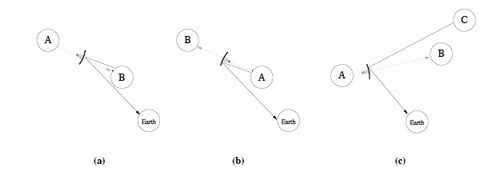
This brings in the authors third criteria. Interstellar travel will be from one star system to another. The reflected-light magnifying effect would be greatest for the cases where earth is almost in line with the departure stellar system and the destination stellar system.
Earth’s position with respect to the ship’s trajectory. (a) Earth receives the light from the destination star reflected from an approaching ship. (b) Earth receives the light from the origin star reflected from an outbound ship. (c) Earth receives the light from a third star, which is reflected from the ship at an angle. Source original paper, Cornell University.
The authors propose to limit the first search to star systems that are reasonably close to each other (no further than 10 light years apart) to maximise the probability of stellar travel opportunities. Considering that Gliese 581, for example, is greater than 20 light years distance from us, I suggest that this criteria is too limiting.
The paper is an interesting, if not compelling, proposition. The authors do calculate what size an artifact would need to be, travelling at their minimum speed (3.3% light speed), to be detected at the distance of one of our closer stellar neighbours. Could such an artifact be detected by the Hubble or James Webb space telescopes, for example? What is the probability of success of such an experiment, compared to say the SETI experiments?
One idea I did find interesting is by focussing on detecting light reflected from ships, we do not need to assume any intention by the interstellar travellers to communicate with us. The ‘signal’ is independent of alien psychology. It is also independent of propulsion technology – we aren’t looking for any ‘signature’ of any particular technology, known or unknown.
It is an interesting paper. I’m not sure they have presented a compelling enough case to convince a funding body – yet.
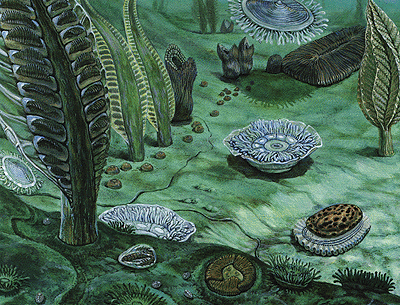
The Ediacara Hills, north of the city of Adelaide in South Australia are a tumbling mass of ancient rocks. Sunbaked now, 580 million years ago they were a sea alive with soft-bodied organisms. These organisms varied greatly: from millimetres to metres in size; from “blob-like” to intricate in complexity; and from sturdy and resistant to a jelly-soft rigidity. They are all prosaically named the Ediacaran biota. A mundane name for what are the earliest known multicellular organisms on Earth.
Turning over rocks and finding fossils
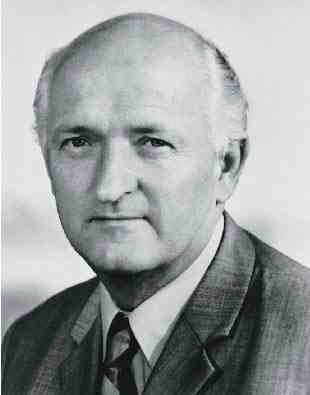
In 1946, an Australian mining geologist named Reginald Sprigg was inspecting abandoned mines the Ediacara Hills. These hills take their name from the aboriginal Idiyakra, “water is present”. Serendipitously, while eating his lunch, Sprigg found fossilized imprints of soft-bodied organisms on the undersides of slabs of quartzite and sandstone. Most were round, disc-shaped forms that Sprigg dubbed “medusoids” from their seeming similarity to jellyfish. Others, however, resembled worms, arthropods, or even stranger things; quilted mattresses and mud-filled bags.
Reginald Sprigg. Photo credit: Wiki commons.
Sprigg thought that these fossils were ancient and dating from the Cambrian era (541-485 million years ago). He submitted a paper to the journal Nature, but it was refused. Sprigg travelled to London and presented his findings to the 1948 International Geological Congress, but failed to excite either interest or belief.
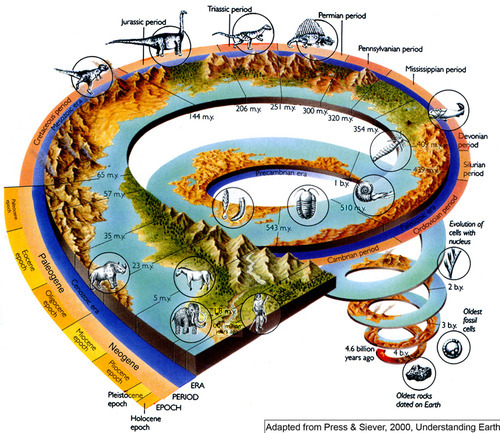
A time-coil of the Earth’s ages from formation to the present age. Adapted from Press and Siever (2000) Understanding the Earth.
These were not the first Precambrian soft-bodied fossils to be found and described — scattered reports of them had appeared in the scientific literature as far back as the mid-nineteenth century.
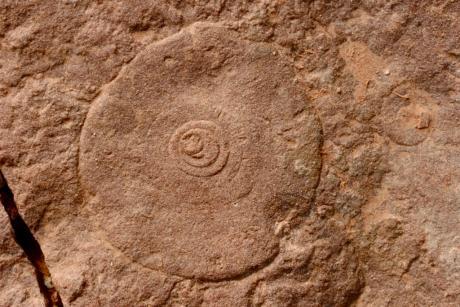
The first Ediacaran fossils discovered were the disc-shaped Aspidella terranovica in 1868. Their discoverer, Scottish geological surveyor Alexander Murray, found them to lay below the the Cambrian strata that were then thought to contain the very first signs of life. It took a further four years for anybody to dare propose they could be fossils. Elkanah Billings‘ 1872 proposal was dismissed by his peers on account of their simple form. They were instead declared gas escape structures, inorganic concretions, or even tricks played by a malicious God to promote unbelief.
Aspidella. Image source Wikipedia.
This one-sided debate soon fell into obscurity as no similar structures elsewhere in the world were then known. In 1933, Georg Gürich discovered specimens in Namibia. They were assigned to the Cambrian Period by the firm belief that life originated in the Cambrian, and no link to Aspidella was made.
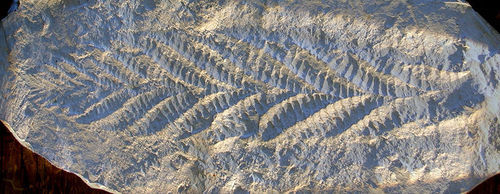
It was not until the 1957 British discovery of the frond-shaped fossil Charnia in England’s Charnwood Forest that the pre-Cambrian was seriously considered as containing life. Due to the detailed geological mapping of the British Geological Survey there was no doubt that these fossils sat in Precambrian rocks.
The iconic Ediacaran Charnia. Image source Wikipedia.
University of Adelaide palæontologist Martin Glaessner finally, in 1959, made the connection between this and the earlier finds. With a combination of improved dating of existing specimens and an injection of vigour into the search many more fossils were recognised.
The naming the “Ediacaran” period
Due to this punctuated discovery a plethora of different names existed for this pre-Cambrian period and its biota. In 1960 the French name “Ediacarien” was added to the competing terms “Sinian” and “Vendian” for late-Precambrian rocks, and these names were also applied to the life-forms. “Ediacaran” and “Ediacarian” were subsequently applied to the epoch or period of geological time and its corresponding rocks. In March 2004, the International Union of Geological Sciences ended the inconsistency by formally naming the terminal period of the Neoproterozoic after the Australian locality.
The rise of the soft-bodied Ediacaran
It took almost 4 billion years from the formation of the Earth for the Ediacaran organisms to first appear, 655 million years ago. Fossils of single-cell organisms are reported from an age 3,460 million years ago. The first uncontroversial evidence for life though is found 2,700 million years ago. Cells with nuclei certainly existed by 1,200 million years ago.
The reason why it took so long for forms with an Ediacaran grade of organisation to appear is uncertain. A primary size-limiting factor is the amount of atmospheric oxygen. With the low oxygen levels in the early Earth, as low as 0.1% of today’s levels, organisms had to be simple. The oxygen cannot reach the centre of a complex organism quickly enough to supply its metabolic demand. So without sufficient oxygen life could only be very simple.
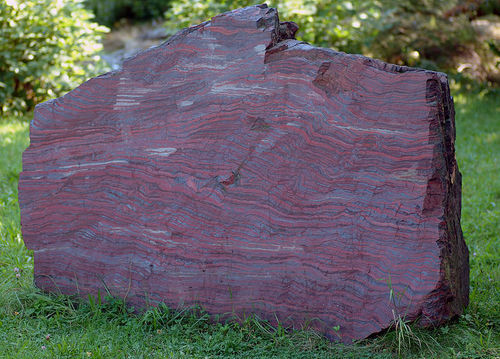
On the early Earth, reactive elements such as iron and uranium existed in a reduced form, which would react with any free oxygen produced by photosynthesising organisms. Oxygen would not be able to build up in the atmosphere until all the iron had rusted and other reactive elements had also been oxidised.
Periods of intense cold have also been suggested as a barrier to the evolution of multicellular life. The period preceeding the Ediacaran is known as the Cryogenian. The greatest ice ages known to have occurred on Earth, possibly covering the entire planet, occurred during this period. These ‘snowball earth‘ events are still the subject of much scientific controversy, whether these glaciations were truly global or merely localised events. The diversity of life in modern Antarctica has also sparked disagreement over whether cold temperatures increase or decrease the rate of evolution.
Antarctica snow dome. Image source Wikipedia.
Oxygen, is still seen as key to enable cells to cluster and differentiate. It seems to have accumulated in two pulses; the rise of small, sessile (stationary) organisms seems to correlate with an early oxygenation event, with larger and mobile organisms appearing around the second pulse of oxygenation – the rise of the Endiacaran.
Life, but not exactly as we know it
The advantages of multicellularity include increased size and specialisation, physical protection and conditions for the development of complex behaviour. Unfortunately the soft-bodied physiology of the organisms have meant that fossil remains make their nature speculative and seem quite alien.
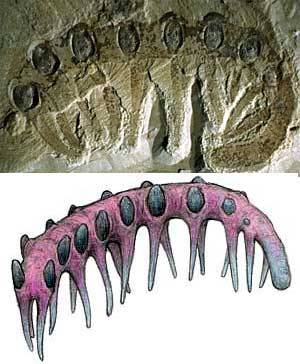
Microdictyon, fossil and artists impression. Image source Wikipedia.
While some can be likened to modern jellyfish, corals and lichens, many others remain more enigmatic. For example the Charnia are lacking any mouth, gut, reproductive organs, or indeed any evidence of internal anatomy, their lifestyle was somewhat peculiar by modern standards; the most widely accepted hypothesis holds that they sucked nutrients out of the surrounding seawater by osmosis.
The demise of the Ediacaran
The Cambrian period is marked by the appearance of organisms who evolved the ability to precipitate minerals used for skeletons and hard shells. Organisms which are more easily preserved as fossils than soft-bodied ones. This “Cambrian Explosion
There is a dominant theme in the life of Nikola Tesla. His undoubted genius. Tesla pioneered, if not invented; AC motors, AC power generation and transmission, high voltage generation (Tesla coil), wireless transmission of power and information, radio controlled boats, cold discharge fluorescent lighting, and the ‘death-ray’.
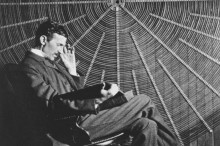
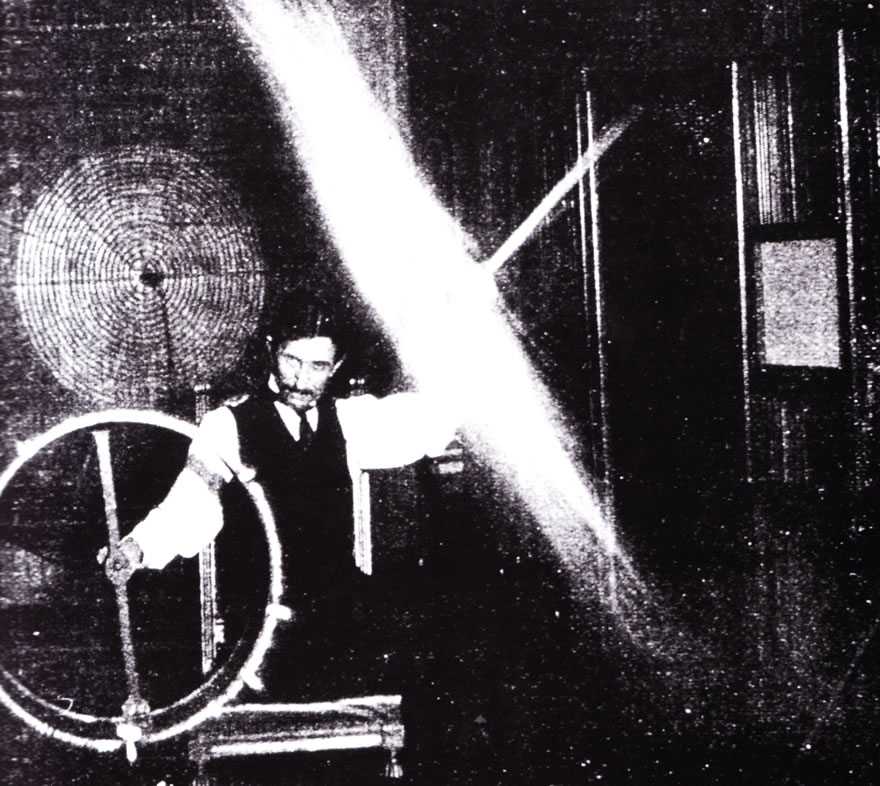
Tesla at his Houston street laboratory in 1898, sending 500,000 volts through his body to light a wireless fluorescent light. Image source Wiki commons.
It also meant that he was ahead of his time, in many cases unable or disdainful to translate what to him was now obvious to those of lesser vision or ability. This resulted in tempestuous clashes with entrepreneurial inventors in three major technologies, technologies that defined this as the ‘Age of Electricity’. Tesla’s was no ordinary progression in life and its colorful and quirky story continues to determine his eccentric place in history – from near invisibility to cult figure.
Two books: many stories
My prompt for this writing this essay was my recent reading of two books on Tesla’s life. His autobiography; My Inventions and other writings, first published serially in 1919 when he was 63, is a technicolour, frenetic meditation on his major discoveries and innovations. It is autobiographical, mixing his life stories with his inventions, the narrative leaping around in time and place as Tesla seemed to in real life. Worth reading to obtain some of the character of Nikola Tesla – even if coloured by his own deliberate self mythologizing.
The second book Wizard: the life and times of Nikola Tesla (by Marc Seifer) captures much of the excitement of this early age of electricity. This book is a chronology of Tesla’s life, informative in its research and illuminating with its vignettes drawn from contemporary memoirs. At the same time its chronological presentation provides a misleading sequential perception of his life.
Seifer also lacks the engineering or science competence to describe in simple terms the genius of Tesla’s inventions. An essential for a biography of someone whose whole life revolved around his work. In the concluding chapters Seifer’s writing starts to take on the ludicrous credulity of the conspiracy theorist – which is a pity the rest of the book is clear of this nonsense.
In defense of Seifer I think it would be challenge for any biographer to tell the whole Tesla story. Tesla was completely consumed by his ideas and inventions, eschewing most intimate contact – to the extreme of apparently being celibate his whole life. To make credible his fantastic life is a challenge. Furthermore, a modern reader, it most cases will struggle in comprehending the archaic technical descriptions and ideas.
The dawn of the Electric Age
This was an age when electricity and magnetism had only recently been linked by the arcane mathematics of James Clerk Maxwell and electricity was still thought to propagate by vibrations of an aether. Tesla was one of the few people alive who understood the physics of what we now call electromagnetism, and could also translate this into tangible inventions.
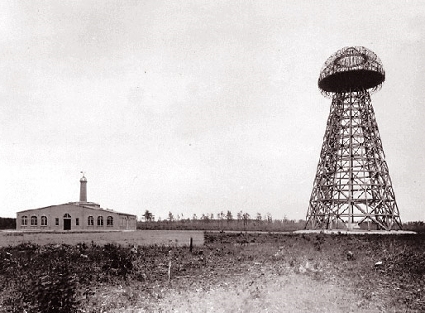
Wardenclyffe, circa 1903. Source Wiki commons.
Tesla’s name is associated with the invention of the rotating magnetic field and the ability of such a field to produce an electric current. By 1882 Tesla had invented and patented the AC polyphase motor – giving the ability to transfer electrical energy into mechanical energy. The reverse of this creates a turbine that converts mechanical energy, from say a waterfall, into electrical energy.
Tesla’s move, in 1884, from Europe to the USA was to develop his own inventions and contribute to Edison’s commercial interests. This collaboration parted ways over what became the AC-DC power war. Edison’s commercial interests were firmly focused on his incandescent lamps and the use of DC power (direct current; such as we get from a battery). Tesla had correctly intuited from first principles that alternating current (AC power as we now operate our homes and industries on), as different to DC power, could be transported by wires over great distances with minimal power loss.
Ultimately Tesla was proved both scientifically and commercially correct. It was his turbine designs that Westinghouse used in the first major hydroelectric power station in the world – the 1894 powering of Buffalo by the might of Niagara falls.
This was a tumultuous period of commercial expansion. The ability to power industry by electricity rather than steam was arguably a bigger leap than from manual to steam power – certainly in commercial terms. The ensuing law-suits and counter-suits over patent precedence in motors, generation and transmission, roiled across the US and Europe, making and breaking reputations and fortunes. These actions bringing Edison General Electric to its knees and forcing it to join with others to become General Electric.
Westinghouse prevailed, at the same time neglecting to pay Tesla royalties that he deserved – despite he not bothering to ensure he had written agreements. This disdain for the corporate conventions of the time cost Tesla both wealth and reputation. He moved onto other new ideas whilst others claimed his inventions in the law and popular press.
Father of the wireless
This was repeated in the next huge modernisation trend – the invention of the wireless transmission of information. By 1893 Tesla was demonstrating the transmission of electric power by wireless means most notably at the Chicago World fair. He delighted in amazing audiences with fantastic high-voltage discharge displays, passing millions of volts through his body and remote lighting of fluorescent tubes by radio frequency.
Already in 1891 he had discussed his “wireless telegraphy” and demonstrated the technology required in 1892. It was 1894 before Guglielmo Marconi would begin his teenage tinkering in the wireless field. So why do we remember the name of Marconi as synonymous with radio? Why did he share the 1909 Nobel Prize with Karl Braun rather than with Tesla?
It would appear from historical evidence that Tesla, in his own mind, had already proved it – and moved on. Whereas the entrepreneur in Marconi, much like Edison, was tenacious in development of his inventions. Tesla at this time had formed a company with the financier Pierpont Morgan to commercialise his wireless technologies. Morgan knew their was a fortune in wireless telegraphy and fluorescent lighting; provided they were developed sufficiently to present to investors as near commercial realities.
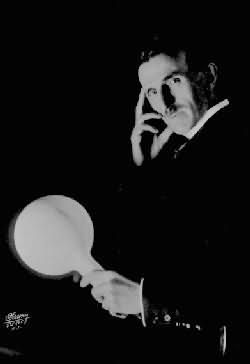
Nikola Tesla illuminated by one of his wireless powered cold arc lamps. Source Wiki commons.
To this end Morgan had tasked him with demonstrating the fluorescent light technologies and maturing their manufacture and demonstrating his wireless by covering off-shore yacht races. The latter would have been a tangible demonstration for both the rich and the Navy. Tesla did neither. he scorned the triviality of the public demonstration – despite his very public earlier electric demonstrations. This left the field of wireless telegraphy (radio) for Marconi and other to develop. instead Tesla squandered the Morgan money on his other big dream – providing wireless transmission of electric power by radio.
Radio power, transmission and weapons
Tesla’s greatest dream was sure to be one not funded by the likes of Morgan. He envisaged a world where power and information were transmitted world-wide – for free. To this end he he used the money from Morgan to plan and start building a gigantic transmission tower, Wardenclyffe, in 1902. His philanthropic ideals and profligate spending meant that by 1906 his funding from Morgan had dried up, and his dream never realised. The tower was destroyed in 1917 by US Government orders to ensure that it was not used by enemies of the state.
In developing this idea he correctly understood the physics of wireless transmission both through the atmosphere and the ground. Laying down the principles that would guide the subsequent invention of both AM and FM radio.
A combination of creditors, stock market upheavals, World War 1 and the stock market collapse of 1930 ensured that Tesla could never raise the money required to bring about this revolutionary idea. A idea revolutionary even by the social standards and upheavals of the time.
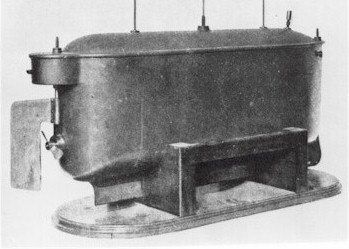
Tesla’s radio controlled boat. Source Wiki Commons
At the same time Tesla was a continuing fountain of new ideas. Perhaps given the turbulent times these included the world’s first radio controlled boat in 1898 which he continually and unsuccessfully tried to interest the US Navy in, improvements on dirigibles, a helicopter plane called a flivver and at the age of 78 a ‘death-ray’.
This latter ‘invention’ was never built nor even prototyped but harked back to experiments of Tesla in the 1890’s that were only a small step away from the invention of the laser. The ideas were sufficiently developed though to serve as mental prototypes for particle-beam weapons and strategic defense shields loved by science fiction writers and some politicians.
Modern nonsense
Apart from the tangible technological legacies left by Tesla’s prodigious genius there are also quixotically hare-brained modern legacies. These Tesla, if he were alive today, would scoff at. None more so than the Tesla “free-energy-generator”
This modern scam is based on the misrepresentation of Tesla’s laudable Wardenclyffe dream and his idea that you could use his generator as a receiver of the, at the time, newly discovered cosmic rays. The radio sophistication and development of radar during and subsequent to WW11 demonstrate the impracticality of large transmitters and receivers of radio power at the levels envisaged by Tesla. We now use networks of smaller powered repeaters (many of these satellites) to ensure uninterrupted radio/telephone/television coverage on a world-wide basis. As for cosmic rays, they are energetic, however of such low density (thankfully for life) that collecting sufficient power from them is impracticable.
That scams based on Tesla exist in this modern age is testament not to conspiracy theories as maintained by these swindlers. Rather it is testimony to Tesla being truly ahead of his time – a time of tumultuous technological growth, which he partially created without ever seeming to inhabit.
A complete biography of Nikola Tesla is still to be written. I believe it will require a writer who understands the science and engineering of Tesla’s age and who has the artistry to weave the many threads of his life into the dynamic, parallel genius of his life – teetering on the precipice of chaos – that was Nikola Tesla.