At least 441 new species of animals and plants have been discovered over a four year period in the vast, underexplored rainforest of the Amazon, including a monkey that purrs like a cat.
Extremophiles are microbes that have adapted to extreme environments, such as Utah’s Great Salt Lake. But new microorganisms can be found in everyday places, and scientists are showing school kids how to discover and name their own new species.
The ozone hole that forms each year in the stratosphere over Antarctica was slightly smaller in 2013 than average in recent decades, according to NASA satellite data.
ESA’s volunteers recently finished their third and last session lying in bed in the interest of spaceflight and science. They can return to their normal lives after spending their last 21 days in bed with their feet up – once their bodies have recuperated from the experience.
It appears NASA satellites have not accurately estimated the important life-giving microscopic phytoplankton population that lives in the Southern Ocean and Antarctica.
Could life really exist on other planets? The most positive scientific answer we can offer is: well, maybe, but we do not yet have enough evidence for or against.
A new nano material with applications that could include reducing condensation in airplane cabins and enabling certain medical tests without the need for high tech laboratories has been developed by researchers at the University of Sydney.
Ten years ago the Spitzer Space Telescope was launched about a Delta II rocket from Canaveral, Florida. Spitzer is an infrared telescope and is the fourth of the NASA’s four Great Observatories in space, Hubble, Chandra, Compton and Spitzer.
The most precise clocks in the world have been built in the US. Two clocks made from ytterbium (serioulsy I’ve not heard of this element before!) and could be used for technological advancements beyond timekeeping, such as navigation systems, magnetic fields and temperature. Apparently the clocks’ ticking rate varies less than two parts in one quintillion, or 10 times better than any other atomic clock. Sounds great! But does it stop me being late for work?
The Lunar Atmosphere and Dust Environment Explorer (LADEE) is a robotic mission that will orbit the moon to gather detailed information about the structure and composition of the thin lunar atmosphere and determine whether dust is being lofted into the lunar sky. LADEE will help us better understand the moon, and other objects including asteroids and other planetary moons.
A new study by the Institute of Social, Behavioural and Economic Research at the University of California, Santa Barbara has found that chopping wood to clear land and feed the family produces more testosterone in men than competitive activities like sport.
Bacteria can directly trigger the nerves that sense pain, suggesting that the body’s own immune reaction is not always to blame for the extra tenderness of an infected wound.
This article is one of a series of articles in which I will profile every woman astronaut, cosmonaut and taikonaut who has been into space. Last time we looked at the career of Sally Ride. Today I’m profiling astronaut Judith Resnik. (The feature image above is a collection of drawings of women astronauts by artist Phillip J Bond. You can find Phillip’s wonderful series on women astronauts here.)
When the space shuttle Challenger was due to launch in the middle of the night (Australian time) on the 28th of January of 1986 – I was in the middle of a standard teenage baby sitting gig. The kids must have been 6 or 7 years old and we were all very excited by the upcoming launch, but disappointed by the late hour. As I tucked the kids into bed I agreed to wake them up during the night so we could watch the launch. We didn’t get up during the night, I don’t remember why – maybe I didn’t set the alarm, maybe I decided not to wake them, maybe I just forgot. When I woke in the morning and turned on the TV, the images of the Challenger exploding a minute into launch were so horrifying they still affect me today.
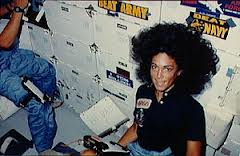
Judith Resnik (NASA image)
Judith Resnik broke many records during her short life. She was the only person in her high school graduating year to score a perfect college entrance score, she was the second American woman in space (2 missions/145hours), the first Jewish woman in space, and she was, sadly, a member of the first shuttle crew to perish during a mission.
Judith was born in 1949 in Akron, Ohio to Jewish parents who had emigrated from the Ukraine. She had a younger brother, Charles. When a student at Firestone High School, Judith excelled in mathematics and played classical piano. She went on to graduate from Carnegie Mellon University with a B.S. in electrical engineering, and then received her PhD in electrical engineering from the University of Maryland. Judith married fellow student Michael Oldak in 1970; although the subsequently divorced in 1974 they remained close friends. Michael even travelled to Kennedy Space Centre to watch Judith’s first mission launch.
Judith in space (NASA image)
After graduation from Carnegie Mellon Judith worked as a design engineer on various NASA projects contracted through her employer, the RCA Corporation. She also worked with the US National Institute of Health as a biomedical engineer, and as a systems engineer with Xerox Corporation during her PhD. When Judith heard that NASA was looking for female astronauts she sought advice from her faculty advisor and mentor Angel Jordan, who encouraged her to apply. In an interview with the Carnegie Mellon newspaper Jordan said, ‘she was an amazing person’, and he still feels responsible for her loss, ‘I pushed her to excel, and I live with that memory every day’.
Judith Resnick, like Sally Ride, was recruited into the astronaut program by actress Nichelle Nichols (Lieutenant Uhura on Star Trek) who worked as a recruiter for NASA from the mid 1970’s until the mid 1980’s. NASA selected Judith as an astronaut candidate in January of 1978. She completed the year-long training and evaluation period in August 1979. Judith’s first mission was as mission specialist on the maiden voyage of Discovery on 30 August 1984 (STS41-D). She worked on a number of projects in support of Orbiter development, including experiment software, the Remote Manipulator System (RMS), and training techniques.
During the mission the crew of STS41-D activated the OAST-1 solar cell wing experiment, deployed three satellites, and completed a number of experiments. STS 41-D completed 96 orbits of the Earth before landing at Edwards Air Force Base, California, on September 5, 1984. Judith’s first space mission caused plenty of publicity for NASA , during her mission Judith showed a playful sense of humour, doing extensive periods of aerobatics, and holding a sign reading ‘Hi Dad’ up to the camera. According to her ex-husband, Judith ‘had a great sense of humor and was always willing to try anything’. She made waves during her first mission with images of her long flowing locks of hair, viewers were used to seeing the mundane cropped hair styles of men during missions. Resnik didn’t like to be pigeonholed as a woman astronaut or a Jewish astronaut, she considered herself ‘just another astronaut, period.’
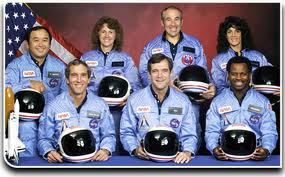
STS51-L Crew (NASA image)
Judith’s second mission was also as mission specialist, aboard Challenger (STS51-L), which was launched from the Kennedy Space Center, Florida, at 11:38 on January 28, 1986. Challenger crew included the commander, Mr. F.R. Scobee, the pilot, Commander M.J. Smith (USN), fellow mission specialists, Dr. R.E. McNair, and Lieutenant Colonel E.S. Onizuka (USAF), as well as two civilian payload specialists, Mr. G.B. Jarvis and Mrs. S. C. McAuliffe (NASA Teacher in Space). During the mission crew were expected to deploy tracking and data relay satellites, carry out the first flight of the Shuttle-Pointed Tool for Astronomy (SPARTAN-203), deploy the Halley’s Comet Experiment in order to observe Halley’s Comet and complete a number of lessons as part of the Teacher in Space Project.
The STS 51-L crew died on January 28, 1986 when Challenger exploded shortly after launch.
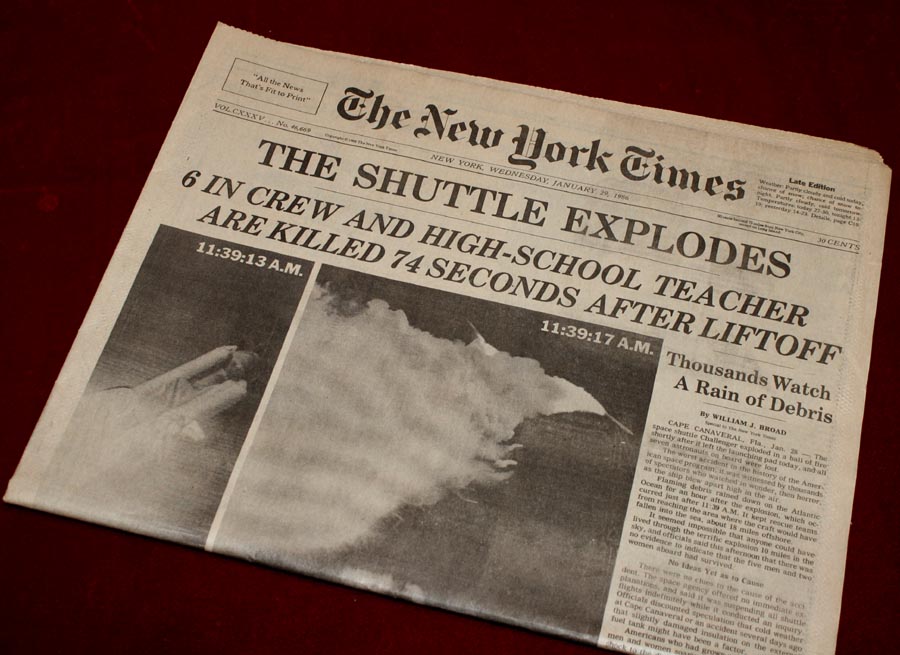
The facts of the Challenger disaster are well known. Challenger blasted off from Kennedy Space Centre (KSC) at 11:38 hours on 28 January 1986. 73 seconds after lift off, during the ascent phase, Challenger experienced a catastrophic structural failure resulting in the loss of the crew and vehicle.
How news of the Challenger disaster broke
Naturally, after such a catastrophic incident there was a Presidential review, the resulting Rogers Commission findings are publicly available.
Judith has been honoured many times, including lunar crater ‘Resnik’, a dormitory at Carnegie Mellon, the main engineering hall at University of Maryland all named in her honour. A memorial to Resnik and the crew of Space Shuttle Challenger has been dedicated in Seabrook, Texas where Resnik once lived, the IEEE (Institute of Electrical and Electronics Engineers) ‘Judith Resnik Award’ for space engineering is also named in her honor, and a memorial to Judith resides at the base of Hammerschlag Hall, at Carnegie Mellon University. Members of Tau Beta Pi, the National Engineering Honor Society, help maintain the monument.
‘The future is not free: the story of all human progress is one of a struggle against all odds. We learned again that this America, which Abraham Lincoln called the last, best hope of man on Earth, was built on heroism and noble sacrifice, It was built by men and women like our seven star voyagers, who answered a call beyond duty, who gave more than was expected or required and who gave it little thought of worldly reward.’
On Friday night I was lucky enough to be able to attend National Science Week’s Event ‘Memes, blogs and videos: how social media has transformed the way we communicate science‘ in Canberra. The event was a panel discussion between some of the most prominent and influential social media science communicators around the globe. The panel included:
Phil Plait – (AKA @BadAstronomer) an astronomer, writer and popular science blogger, Elise Andrew – Creator of I Fucking Love Science on Facebook; Henry Reich – Creator of MinutePhysics and MinuteEarth YouTube channels; Mitchell Moffit & Gregory Brown – Creators of AsapSCIENCE YouTube channel; Destin Sandlin – Creater of SmarterEveryDay YouTube channel; and Chris Cassella – Managing Director of Science Alert.
It really was a stellar ‘cast’ who have a combined social media reach of well over 100 million people per week. So what did these ‘giants’ of social media have to say about science communication? Well they said a lot, so I can only cover the highlights here. For a start – they all agreed – anyone can be a ‘science communicator’. You don’t have to be a scientist, or journalist or writer to be an effective science communicator, you just need to have a passion for science, and the time and ability to pass that information onto others. So what do the panel members think makes their science communication successful, and what can they suggest to someone interested in science communication?
Let’s start with Phil Plait, astronomer, author and science blogger who thinks that ‘all science is entertaining’! Phil selects topics for his blog based on what he’s excited by, not so much on what he thinks others want to see. Phil explained that his philosophy is that if he’s excited about it, other people will be excited about it. He recognises that people are often interested in the scary stuff, so he wrote ‘Death from the Skies’, where he talks about all the stuff that could kill us; blackholes, magnetic flares, supernovas, and killer asteroids. He recommends putting your own spin on a topic, if every one else is talking about it, you need differentiate yourself from everyone else.
Phil Plait (Image courtesy of www.badastronomer.com)
In contrast to Phil, Elise Andrews, creator of the enormously popular I Fucking Love Science Facebook page, really didn’t start off with an idea of ‘doing’ social media. Elise manages a page with 6.4 million followers on her own, and admits that the task takes up all of her time. Elise’s tip is to use the Facebook scheduling function, which helps dramatically with maintaining content in a global 24 hour information cycle. She stressed that the viral nature of social media means that it’s one of the few ways we have to get the message of science and science communication in front of people who wouldn’t normally seek out science-related material. When asked about the contentious name of her page, Elise responded ‘the name of your page is important, you need a name you can’t not look at!’
Minute Physics creator Henry Reich has a background in physics, so that’s why he focuses on physics – he understands it and he wants others to understand it. Henry believes that traditional teaching of physics/science is classical and boring to most people, which is a shame, because right now current physics is focused on really cool stuff like the big bang, string theory, quantum theory, etc. When deciding on a topic Henry tries to focus on the cool stuff, he then tries to explain it in a way that is simple and fun – but remains true to the science. Minute Physics videos are restricted to a minute or two – that makes Henry focus on what is important and condenses the message – there’s no room for extraneous material or ‘fluff’, and that keeps the attention of the viewer.
A clip from Minute Physics: Albert Einstein, The size and existence of atoms (Source: Minute Physics)
AsapSCIENCE creators Mitchell and Gregory, who also have a YouTube channel agree that the traditional way of teaching science can be seen as boring and dry. They believe the message in traditional classroom learning is ‘goal focused’ rather than focusing on the details of the science. So when they pick a topic, they ask a question like ‘Why do we age?’ rather than starting with detailed descriptions of cell division and DNA replication, etc.. This makes the message more relatable, rather than what often happens in a classroom setting with it being very dry and overwhelming. Incorporating entertainment is a vital part of effectively communicating the message – it helps to overcome the reputation of science as being dry and boring, and overly serious.
The third member of the panel that has his own YouTube channel is Destin Sandlin, creator of Smarter Every Day. Although Destin has an engineering background – B.Sc. in Mechanical Engineering, M.Sc. in Aeronautical Engineering – he takes the approach that he’s just an average guy who is trying to figure something out that he doesn’t know. This allows him to take his viewers on a journey from unknowing to discovery to knowing. In crafting his videos he looks for the “Aha!” moment – the point at which you go from not-knowing to knowing how something works or what caused it to happen. Destin’s videos are progressive – each one starts off with simple concepts, gets progressively harder, until it spikes with a serious point, before it reaches its conclusion. He believes that each video needs to cater for all levels of viewer and should have something interesting for everyone.
Lastly, Science Alert Managing Director Chris Cassella, says that Science Alert started as a website promoting Australian science, since Australian scientific accomplishments are under-represented in the media and community awareness. Chris started to use Facebook to drive traffic to the website, although things didn’t quite work out that way. The Facebook page didn’t drive much traffic to the website, but there was fantastic engagement on Facebook – he then realised that Facebook itself was a better delivery medium. He recommends that sites mix up the serious science content with humorous memes, jokes, etc which breaks up the stream and helps keep people engaged.
During the Q&A session at the end of the panel, an audience member asked the panel for their advice to scientists on what they can do to help assist science popularisers to get the message out about new research. The immediate and very strong message from all panelists was, “publish your results in open access journals!” So often, they would love to link to new research, but linking to a paywalled paper or article creates a deluge of complaints from their audience – so they can’t do it.
So there’s a lot of information to take away from this group of committed science enthusiasts and communicators, but here’s a few tips:
– Be passionate about the science you love, whether it’s biology, physics, astronomy or chemistry – if you’re passionate about it, your enthusiasm will be passed on to your listeners/viewers.
– The advent of social media and platforms like Facebook, Twitter and YouTube means that you no longer need to have a lot of money or resources to be an effective science communicator, you can start with a laptop and internet connection and you’re on your way.
– You don’t need top notch equipment, ‘Hollywood’ style special effects or eye-wateringly expensive graphics to produce your own YouTube videos.
– Make sure you get your science facts right, but if you make a mistake, correct it, be transparent about it, and move on.
If you’d like to see more of the panelists check out these links for further tour dates during National Science Week: Phil Plait, IFLS Live, and National Science Week.
We’ve known for some time that electrons in the heart of the Van Allen Radiation Belts are accelerated to almost the speed of light. But until now we didn’t know why…..
This sounds like the plot of about a half a dozen sci-fi movies… but researchers have attempted to implant false memories in mice and the results are very interesting!
Picking up extremely weak signals from exploring spacecraft, such as Gaia and BepiColombo requires cooling a detector to within a few degrees of absolute zero. Recently ESA upgraded 3 of their deep space tracking antennas with the new technology.
Doctors have known for a while that patients with diabetes who undergo gastric bypass surgery often don’t require insulin shots after surgery. They assumed it was the result of weight loss and change of diet, as it turns out that’s not the full picture…
Images snapped by the Hubble Space Telescope suggest that gold may have been generated by a violent neutron star collision that also yielded lead, platinum, uranium and other heavy elements.
Federal wildlife officials plan to dispatch armed bird specialists into forests of the Pacific Northwest starting this fall to shoot one species of owl to protect another that is threatened with extinction.
A happy Science Sunday to everyone! As usual there’s been a lot happening in the world of science, so lets take a peek of the most interesting picks for the past week!
At the end of this month, NASA will launch IRIS. IRIS will watch the Sun and provide NASA with information on the Sun’s atmosphere and the interface region. This will give scientists a better understanding of how the Sun’s energy powers the solar wind!
NASA Administrator Charles Bolden and Italian Space Agency (ASI) President Enrico Saggese signed a Memorandum of Understanding for cooperation on the European Space Agency (ESA) led BepiColombo mission to Mercury
A new three-dimensional map, aptly called BigBrain is the most detailed ever constructed! Scientists hope it will lead to a more accurate picture of how the brain’s different regions function.
Traditionally astronomers have relied on space telescopes to conduct high-energy y ray astronomy because Earth’s atmosphere is a very efficient shield for y rays. However, in early July at the International Cosmic Ray Conference in Rio de Janeiro, Brazil, indicate that γ-ray astronomers are betting their future on an ambitious ground-based telescope.
Australian researchers say that it’s not bad luck that drives mammals to extinction over geological time, but their failure to keep pace with a deteriorating environment.
A happy Science Sunday to everyone! As usual there’s been a lot happening in the world of science, so lets take a peek of the best picks for the past week!
If you’re into astronomy, a planetary conjunction is something to celebrate! This week is one for the observers. Just after dusk for the next few days you can see the unusual and stunning alignment of Jupiter, Venus and Mercury.
‘Three planets Jupiter, Venus and Mercury — can be now be seen in the western sky at dusk, weather permitting, in a rare and beautiful gathering that changes from night to night. Astronomers call a meeting of objects in the night sky a conjunction, but this planet parade is better described as a “Grand Conjunction.”
Also in the news this week. Cockroaches. Yes. Cockroaches. Apparently they’re cutting back on the sugary stuff, for good reason.
Sugar-free diets aren’t just making headlines in the human world. Cockroaches have joined the anti-sugar trend. Research published in the US journal ‘Science’ today shows cockroaches will eat anything, except sugar. The researchers show that cockroaches have learned to detect and avoid a certain kind of glucose that is commonly used in commercial traps.
Citizen scientists solved a decades-old puzzle by assisting astronomers to make the most accurate distance measurements yet for an important star system.
The new research, reported in the in the journal Science found the distance to the binary system SS Cygni in the constellation Cygnus the Swan, is 372 light-years. That’s far closer than previous measurements of 520 light-years made by the Hubble Space Telescope, according to the study’s lead author Dr James Miller-Jones of Curtin University and the International Centre for Radio Astronomy Research.
This article took me by surprise. I know we can tell a lot from looking at skeletons, and fossilised teeth but how long a mother breastfed for?
The debate on how long to breastfeed now has a Neanderthal spin with analysis of a fossilised tooth suggesting primitive mothers breastfed exclusively for just seven months. The claim is based on an analysis of barium concentration in different layers of tooth enamel, which also reveals the Neanderthal child was completely weaned at 1.2 years.
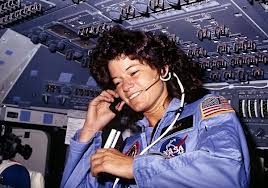
This article is the third in a series of articles in which I will profile every woman astronaut, cosmonaut and taikonaut who has been into space. Last time we looked at the career of Svetlana Savitskaya the second woman in space. Today I’m profiling astronaut Sally Ride, the first American woman in space. (The feature image above is a collection of drawings of women astronauts by artist Phillip J Bond. You can find Phillip’s wonderful series on women astronauts here.)
In 2004 I saw Sally Ride at an Australian Broadcast Corporation (ABC) Radio National Science Special in Canberra. When I first saw her speak, I was surprised how small she appeared on stage. In my mind, Sally Ride was larger than life, an adventurer, explorer, a trailblazer who broke boundaries in physics, astrophysics and space exploration. Of course within a few minutes of her speaking I was completely drawn into her world of science and space exploration where her stature, and gender is irrelevant. (The transcript of the show she shared with astrophysicist Paul Davies, and marine biologist Syliva Earle can be read here).
Sally Ride aboard the Shuttle (Image credit NASA).
Sally Ride was born in Encino, California. She had one sibling, a sister, her mother was a volunteer counselor at a women’s prison, her father was a political science professor. Sally went to Swarthmore College, taking physics courses at UCLA, she then went on to Stanford to earn her Bachelors degree in English and Physics, and her Masters degree and PhD in physics. Sally was an accomplished athlete, and nationally ranked tennis player in her youth.
Sally was one of about 8,000 people who responded to NASA’s call for applicants for the space program. Sally was ‘recruited’ to NASA by actor Nichelle Nicols who played communications officer Lt. Uhura in the original Star Trek television series. NASA had asked Nichols to help them find the first qualified women and minorities to join what was was until then, an all white male astronaut corps. After more than 12 months of testing and training Sally was one of the few selected to join NASA in 1978. Somewhat unsurprisingly at the time, her gender attracted quite a bit of media attention. Although she herself stayed well clear of gender issues Sally was still asked inane questions like ‘Do you weep when things go wrong on the job?’, and ‘Will the flight affect your reproductive organs?’. Sally noted that she felt astronaut training was ‘asexual’, women and men did all the same training, and that in space ‘weightlessness was the great equaliser, you don’t need to be strong in space’.
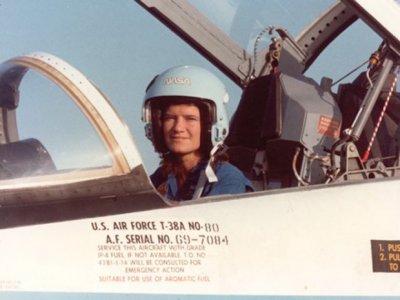
Sally Ride – Pilot (Image Credit NASA)
When Challenger roared into space on 18 June 1983 Sally Ride became the first American woman, and the youngest astronaut in space. She was preceded by Valentina Tereshkova in 1963 and Svetlana Savitskaya in 1982, both Russian astronauts. During the STS-7 mission the crew deployed two communications satellites and conducted pharmaceutical experiments. Sally was the first woman to use the robot arm in space and the first to use the arm to retrieve a satellite. Sally’s second space flight was in 1984, STS-41G where the crew deployed the Earth Radiation Budget Satellite, and conducted various observations. STS-41G was the first time that two women flew in space together, when Kathryn Sullivan joined Ride on the crew. Upon her return she was then scheduled for STS-61M, however, that mission was cancelled in the wake of the Challenger disaster. She was nominated to head the Operations sub-committee on the Rogers Commission, the presidential commission investigating the challenger accident. Following the investigation Sally went to work in NASA HQ authoring a report ‘NASA Leadership and America’s Future in Space’.
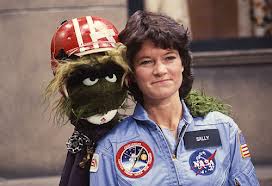
Sally Ride and Muppet (Image courtesy of Wikimedia)
During her career, Sally served as the ground-based capsule communicator (CapCom) for the second and third Space Shuttle flights (STS-2 and STS-3) and helped develop the Space Shuttle’s robot arm. She spent a total of more than 343 hours in space. Sally remarked in an 1984 interview that she felt ‘a lot of pressure’ being the first US woman in space, and that most of the pressure was ‘generated by the media’. She said she felt ‘proud’ to be the first US woman in space, and that the extra pressure made her determined to do things right.
Sally left NASA in 1987 and went to work for Standford University, she then moved to the University of California San Diego (UCSD) as the Professor of Physics. She was also the Director of the California Space Institute, and a vigorous promoter of public outreach for science. In 2001 Sally co-founded her own company, Sally Ride Science, a company that creates entertaining science programs, events, and publications for elementary and middle school students, with a focus on girls. In 2003 she was asked to be a member of the Space Shuttle Columbia Accident Investigation Board, the only person to sit on both the Challenger and Columbia accident boards. Whilst at USCD, Sally led Jet Propulsion Laboratories (JPL) public outreach program for the ISS – EarthKAM and GRAILMoonKAM which encouraged school students to study imagery of the Earth and moon. Sally was also nominated to serve on the 2009 commission that helped shape NASA’s current spaceflight program.
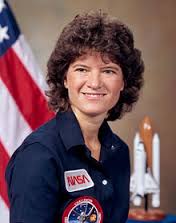
Sally Ride (Image courtesy of NASA)
Sally Ride passed away on 23 July 2012 from pancreatic cancer. A fiercely private person, she did not release any information or details of her 17 month battle with her illness. Her death shocked many people. President Obama said shortly after her death ‘As the first American woman to travel into space, Sally was a national hero and powerful role model. She inspired generations of young girls to reach for the stars and later fought tirelessly to help get them there by advocating for a greater focus on science and math in our schools’. Sally’s legacy of public outreach and work with school students through her company Sally Ride Science will be continued by her partner and co-founder of Sally Ride Science, Tam O’Shaughnessy.
Perhaps the most moving tribute to Sally comes from her friend Nichelle Nichols, ‘Sally Ride — my heart aches right now. Sally was one of my first and biggest achievements. She once thanked me for my recruitment efforts while under contract to NASA, saying “If it hadn’t been for you I might not be here.
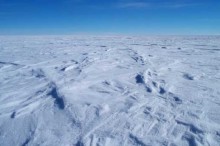
When Russian geographer and Antarctic explorer Andrey Kapitsa travelled to Vostok Station in 1959 he was looking for evidence of a subglacial lake that was first proposed by Russian scientist Peter Kropotkin at the end of the 19th century. Whilst Kropotkin was not able to specify the location of subglacial lakes, he theorised that masses of fresh water could be trapped far below the Antarctic ice sheets. He believed that the massive pressure of thousands of meters of solid ice would mean that temperatures at the bottom of the ice sheet would be high enough to create isolated water lakes.
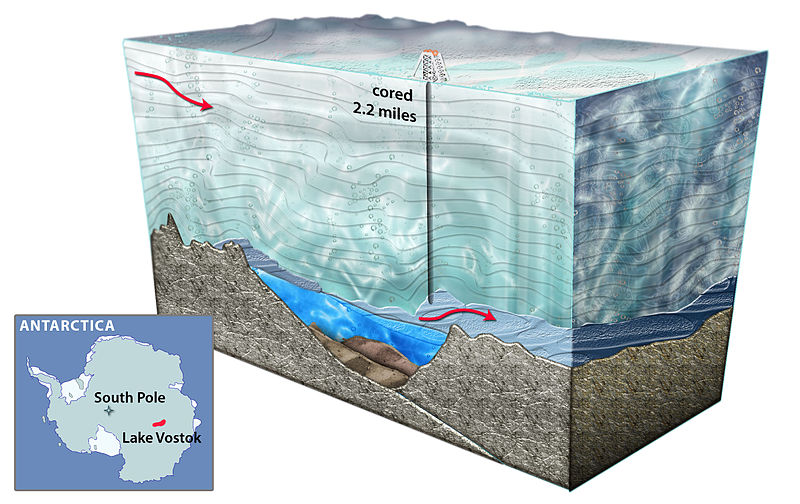
Lake Vostok (Image courtesy of the National Science Foundation)
During expeditions to the region around Vostok Station in 1959 and 1964 Kapitsa took numerous seismic readings of the thickness of the Antarctic ice sheet. When Kapitsa analysed his measurements he was able to confirm that he had found a subglacial lake – just as Kropotkin predicted.
It wasn’t until the 1970s that further tests were conducted on Lake Vostok. British scientists performed numerous tests including airborne ice-penetrating radar surveys over the site. Results confirmed the presence of a liquid, freshwater lake far below the icy surface. In the 1980s and 1990s subsequent studies confirmed the details of the lake and revealed that it was the largest of 140 known Antarctic subglacial lakes (about 400 subglacial lakes exist worldwide). Measurements showed that the lake was more than 250km long, 50 km wide, about 400m deep, and was submerged more than 4km under the surface. In 2005 it was discovered that Lake Vostok had a number of islands, and that it’s likely that Lake Vostok is connected to other Antarctic subglacial lakes by a series of subglacial rivers. Unfortunately, scientists are still unsure how water might travel between the lakes, however it appears that the water in Lake Vostok may have been trapped under the ice for 15 – 25 million years. Lake Vostok is interesting to astronomers and astrobiologists, who theorise that if life exists somewhere in the cold murky depths of the lake, then perhaps it could also survive in the cold icy moons of our outer solar system.
Since 1989 there have been various efforts to drill down into the lake to obtain samples to test for microbes. However, drilling Lake Vostok has proven to be a very difficult exercise due to the remote location, freezing temperatures (the coldest recorded temperatures on Earth were recorded at Lake Vostok at -89 degrees Celsius), and long dark winters that reduce drilling times. Samples were taken from an ice core that reached within 100m of the lake in 1998, 2011 and 2012 but these results were inconclusive.
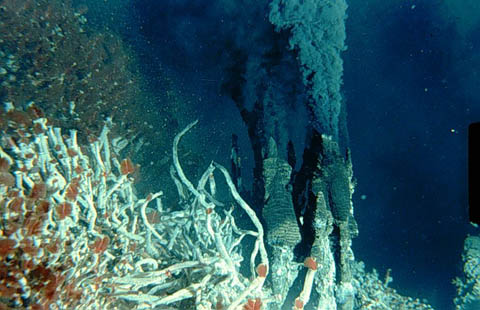
Black Smoker Hydrothermal Vent (Image Courtesy University of Victoria)
Recently researchers announced that they had penetrated the ‘surface’ of Lake Vostok and had analysed samples taken from the drill head in the borehole. Results indicated a type of bacteria that was ‘unknown’ – a result that initially excited scientists. However, the next day, it was announced that the bacteria in the sample was found to use kerosene as an energy source. This was problematic for the team, as they use significant amounts of kerosene and freon at the site to stabilise the borehole (54 tonnes over the last few years). This result pointed to a likely contamination of the sample. Researchers advised they would be conducting further tests in order to collect ‘clean’ samples.
So – why are we so interested in Lake Vostok?
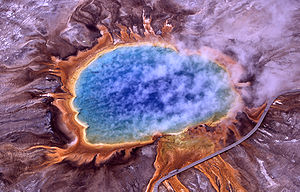
Until the mid 1980s we had a very narrow idea of where life could survive on our planet. We essentially applied the ‘Goldilocks’ theory; in order to foster ‘life’ the environment had to be not too hot, not too cold, must have water, sunlight etc… In the 1980s and 1990s, scientists discovered that microbial life has an amazing ability to survive in what we would consider extreme environments, niches that are blisteringly hot, dry, acidic, or even extremely cold. The discovery of these microbes, known as extremophiles has shown us that the boundaries of where life can exist, and even thrive are far wider than previously imagined. The image above shows a ‘black smoker’ hydrothermal vent – deep in the ocean spewing out water anywhere from 60 – 400 degrees Celsius. Typically these objects are surrounded by life forms, including Thermophiles, microbes that thrive in extremely hot temperatures. Until these deep sea hydrothermal vents were discovered in the early 1980’s we had no idea that life could survive, let alone thrive in such an inhospitable environment without sunlight and under such enormous pressure. The Grand Prismatic Spring in Yellowstone National Park in the U.S. is also home to various types of thermophiles, which thrive in the Grand Prismatic hot spring, despite it’s average 70 degree Celsius temperature.
Grand Prismatic Spring – Yellowstone National Park (Image courtesy of Wikimedia)
By looking at sites such as Lake Vostok we hope that we will discover something that will confirm our understanding of the boundaries for life or perhaps give us new information! We hope to find a new type of bacteria, similar perhaps to the psychrophile, or cryophile, extremophiles that can grow and reproduce in temperatures as low as -15 degrees Celsius. These organisms are currently found on Earth in small pockets of briny water surrounded by sea ice, alpine and arctic soils, deep ocean waters, glaciers and snowfields.
Although the Russians have been working on Lake Vostok for some time, they aren’t the only ones taking a good look at sub glacial lakes. Researchers from Britain and the U.S. are also working on Antarctic sites. The Americans have drilled more than 800m to reach Lake Whillans, whilst British researchers have stalled testing on Lake Ellsworth while they test new hot-water drilling methods.
If we find microbes surviving in the waters of Lake Vostok, or another subglacial lake that has been subject to enormous pressure, freezing conditions, lack of sunlight – that suggests that life could exist on one of the icy moons of the solar system. With the knowledge gained from sites like Lake Vostok we can plan missions to the icy moons in search of life. Research has shown that subsurface oceans may exist on a number of solar system moons including Enceladus (Saturn), Titan (Saturn), Europa (Jupiter), and Triton (Neptune). Each of these moons may have an environment capable of harbouring life.
It just may not be life as we know it.
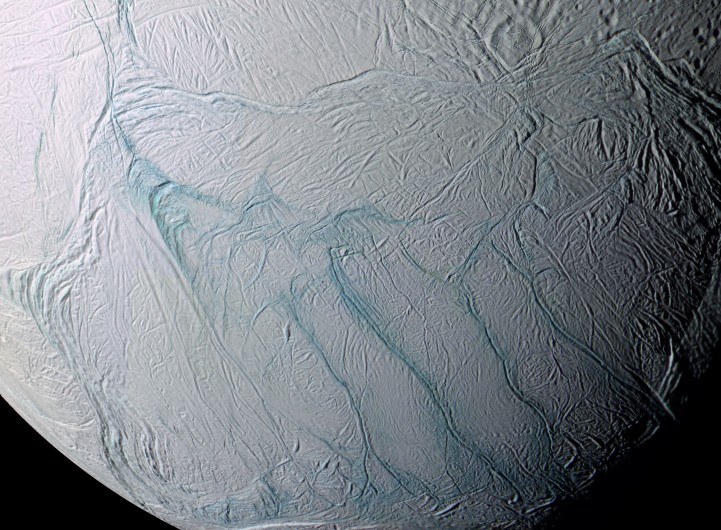
Enceladus and it’s ‘tiger stripes’ – an area near the south pole of the moon that may cover a sub surface ocean (Image courtesy of NASA)
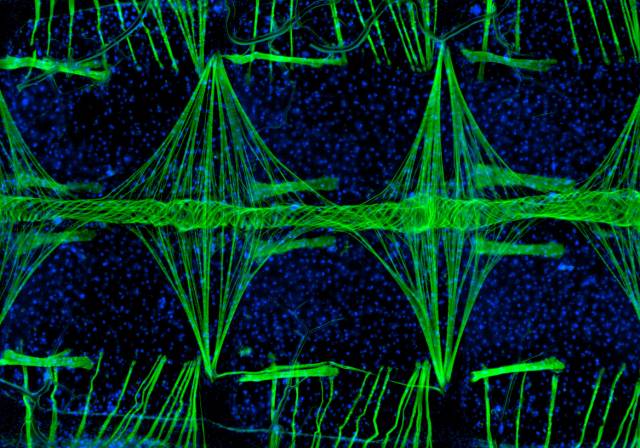
Frankly I’ve not given much thought to the heartbeat of mosquitoes. I’m usually much more worried that mine will continue will continue to beat for many more years to come. But Charles Ebikeme’s article covering the research done by Dr Julian Hillyer and his team at Vanderbilt University, Nashville, Tennesee, is fascinating.
“A mosquito’s heart is very different — without veins or arteries, it pumps a clear liquid called hemolymph. The hemolymph flows from the heart into the abdominal cavity and eventually cycles back through the heart. The heart runs along the insects body as an unbranched tube, no thicker than three tenths of a millimeter. Helical twists of muscle fibres support the central tube. Their sequential contractions makes the heart in a wave-like peristaltic action. A peristaltic action that has the ability to run in both directions.”
As an insect that carries various diseases that wreaks havoc on the human population, mosquitoes are a significant concern for health authorities. Hillyer’s research is just one more step in understanding the pest and developing effective control strategies.
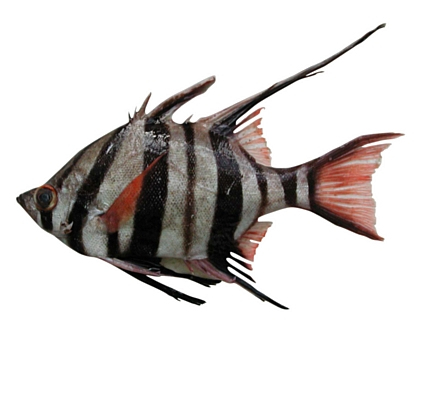
Millions of Australians are recreational fishers, there’s a large commercial seafood and aquaculture industry, and plenty of us who like to eat fish!! So who wouldn’t be interested in an online mapping tool that allows us to check out where our favourite marine fish are hiding?
“With FishMap you can find out what fish occur at any location or depth in the waters of Australia’s continental shelf and slope. You can also create species lists for any region that include photographs and illustrations, distribution maps and current scientific and common names.”
FishMap is a pretty cool tool – and you’d be surprised how much time you can spend looking at fish….
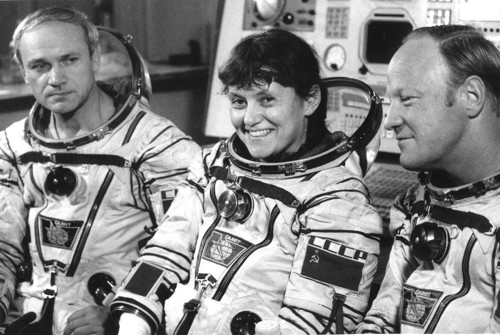
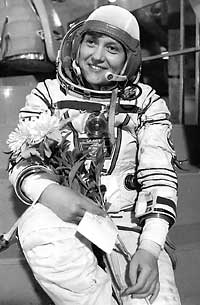
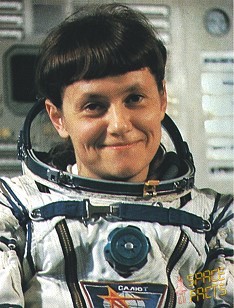
This article is the second in a series of articles in which I will profile every woman astronaut, cosmonaut and taikonaut who has been into space. Last time we looked at the career of Valentina Tereshkova, the first woman in space. Today I’m profiling cosmonaut Svetlana Savitskaya, the second woman in space. (The feature image above is a collection of drawings of women astronauts by artist Phillip J Bond. You can find Phillip’s wonderful series on women astronauts here.)
Svetlana Savitskaya is a record breaking Russian aviator and cosmonaut.
Born in Moscow in 1948, Svetlana was raised in a middle class family. In high school she was a keen parachutist, and in 1970 she won 6th place in FAI (Fédération Aéronautique Internationale) World Aerobic Championship, went on to set 18 international world records in MiG aircraft, and set 3 international records in team parachute jumping. In 1974, Svetlana began a career as a pilot after urging from her father, a Deputy Commander of the Soviet Air Defences and World War II air hero. Her father had recognised her interest in flying and parachuting and was very keen for Svetlana to pursue pilot school. Just two years after finishing pilot school Svetlana went on to become a test pilot.
In the late 1970’s the Soviet Union realised that the US was planning to send women into space within a few years. Svetlana noted that at the time, that although the Russians had the first woman in space (Valentina Tereshkova) they wanted to keep their record intact and beat the Americans once again. So they advertised and recruited a number of women candidates for cosmonaut school. In July 1980, 32 year old Svetlana was chosen for cosmonaut training. She successfully completed the arduous training programs for both the Salyut 7 (Russian Space Station) and Soyuz space craft.
Svetlana Savitskaya
After training, Svetlana was selected as a member of the 3 person crew for the Soyuz T-7 mission. This mission was to fly to the Salyut 7 space station, stay for approximately 7 days to conduct experiments and then return to Earth aboard the Soyuz T-5. The launch of Soyuz T-7 from the Baikonur Cosmodrome at 23:12 hours on 19 August 1982 was flawless. Svetlana, along with Leonid Popov and Alexander Serebrov flew aboard the Soyuz T-7 to dock with the Salyut 7 space station.
After docking with the Salyut 7 space station, Svetlana boarded the vessel only to be greeted by a fellow cosmonaut Valentin Lebedev, who subsequently gave her an apron and told her to ‘start work’. Despite what many cosmonauts thought, Svetlana was there to conduct experiments and throughout the mission she conducted experiments on the cardiovascular system, motion sickness, eye movement as well as an electrophoresis experiment on human cells. After 7 days, 21 hours and 52 minutes Svetlana and her crew returned to earth landing safely just 112 km northeast of Arkalyk. This trip resulted in Svetlana becoming only the 2nd woman in space at that time, and it was also the first human spaceflight by mixed female and male crew. Svetlana’s flight made her a national hero.
Svetlana Savitskaya (Credit Ria Novosti)
On the 17th of July 1984, on the 50th Soyuz spaceflight, Svetlana Savitskaya became the first woman to fly a second space mission when Soyuz T12 launched a mission to conduct maintenance operations on Salyut 7. During the mission Svetlana conducted various experiments and completed repairs to the space station. On 25 July 1984 Svetlana and Dzhanibekov donned their space suits and exited Salyut 7 to perform maintenance on the outside of the space craft. Their tasks involved cutting, welding and soldering tests on the outside of Salyut 7. Their space walk (or Extra Vehicular Activity) lasted 3 hours and 55 minutes. Svetlana had broken one more record, the first woman to conduct a space walk.
The mission ended a few days later after 11 days, 19 hours, 14 minutes and 36 seconds in space. After her last flight Svetlana remained an active cosmonaut and was appointed as Deputy to the Chief Designer of the Energia Project in 1987. Although Svetlana never made another space flight, she remains a symbol of her nation’s pride and achievements. Svetlana retired as a Major from the Russian Air Force and the Cosmonaut Corps in 1993.
Svetlana is now a member of the State Duma representing the Communist Party of the Russian Federation. She also serves as the Deputy Chair of the Committee on Defense.
Svetlana Savitskaya (Credit Ria Novosti)
In a 2009 interview Svetlana, somewhat unsurprisingly, revealed that she battled sexism during her career in the Russian Air Force and within the Cosmonaut Corps. She noted that the ‘Missions were tough,’ and that ‘Even among our space colleagues the men wondered why we needed to weld and said that we might burn each other’s space suits, or the spaceship’s exterior. It’s a great responsibility. My spaceflight shut everyone up!’
Svetlana was twice awarded the Hero of the Soviet Union and has two asteroids named for her (4118 Sveta and 4003 Savitskaya), and her record of 2683 km/h in a MIG-21 in the female category remains unbroken.
Svetlana Savitskaya quote:
“When watching the Earth from over there, one can see the results of human activities, not just a beautiful bluish habitable planet, but because one can see just how habitable it is, with all of its floodlit streets and avenues, and its huge cities. One can see this both at night and in the daytime. And secondly, anyone over there, in orbit, should give, and actually gives, a thought to the fact that they are at an average altitude of 400 kilometres, aboard a space station or a spacecraft that have been manufactured by human mind and human civilization, so one can’t help but feel proud of them. One realizes that this planet is their home. One may even land on water, somewhere in the world Ocean, still the planet is their home. One has a natural psychological wish to return to earth, to their home. When in orbit, one thinks of the whole of the earth, rather than of one’s country, as one’s home.”
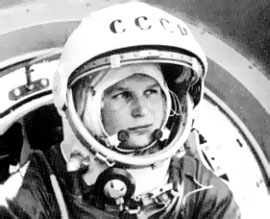
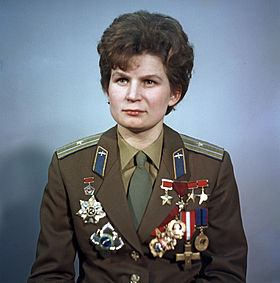
This article is the first in a series of articles in which I will profile every woman astronaut, cosmonaut and taikonaut who has been into space. The last time I checked 58 women have travelled into space, by the end of this year there may be a few more! We’re going to start this series at the beginning – with Russian cosmonaut Valentina Tereshkova, the first woman in space. (The feature image above is a collection of drawings of women astronauts by artist Phillip J Bond. You can find Phillip’s wonderful series on women astronauts here.)
Valentina Tereshkova
Born in 1937, Tereshkova was a textile worker from Maslennikovo, a small village in the far west of Russia. Tereshkova never yearned to go into space, she left school early to support her family, but continued her education by correspondence. Tereshkova worked in the local textile mill, and earned certification as a cotton spinning technology expert. She went on to become the secretary of the local Komsomol (Young Communist League). Tereshkova’s passion was parachuting. She was introduced to the sport of parachuting by a friend and was so taken by the sport she soon began parachuting regularly and set up the Textile Mill Workers Parachute Club.
In 1962 when the Soviet Air Force advertised for 50 cosmonauts to join the new space program, it included 5 positions for women. At the time Nikita Khrushchev thought that the U.S. was considering sending women from the Mercury Program into space. This spurred the Russians on to select a number of women for their own space program, with the aim of getting them into space before the US.
Valentina Tereshkova (Photo Credit NASA)
The requirement to be a cosmonaut did not include any piloting skills, but they did require all applicants to be experienced parachutists, under 170cm tall, under 70kg in weight, under 30 years of age, be fit and be ‘ideologically pure’. Tereshkova met all the criteria. In addition, she was the daughter of a local war hero who had been declared MIA (presumed dead) during the Russian/Finnish war.
Tereshkova was one of 50 out of a pool of 400 applicants that were accepted for further testing. Eventually 5 women passed the assessment test to become a cosmonaut. Over a period of 15 months the 5 women undertook all the same training that the men did, including weightless flights, isolation tests, centrifuge tests, rocket theory, spacecraft engineering, 120 parachute jumps and pilot training in jet fighters. In a 2005 interview Tereshkova recalled that the training was strict and that they were ‘locked inside the classroom to study theory all day long’. As Tereshkova was a civilian she was inducted into the Soviet Air Force as a Lieutenant so that she could become a member of the cosmonaut corps.
Valentina Tereshkova (Image Credit Wikimedia)
Tereshkova was originally intended to launch first in Vostok 5, and another female cosmonaut, Valentina Leonidovna Ponomaryova was to pilot Vostok 6. However, a few months before launch, the flight plan was altered so that Tereshkova would pilot Vostok 6 and Valery Bykovsky would pilot Vostok 5. In an interview Tereshkova was asked if the other members were jealous that she got to fly. She responded ‘The other women were upset – but our friendship is still alive’. She recalled that when she was driven off towards Vosktok 6 for the launch that her back up Irina Solovyova remained in the bus, fully clothed in her space suit, prepared for launch should Tereshkova not be ready or able to launch.
At 1430 hours on 16 June 1963, 26 year old Russian Cosmonaut Valentina Tereshkova blasted into space aboard Vostok 6, becoming the first woman in space. Tereshkova’s mission was to orbit the earth for 24 hours and to conduct a number of tests on herself to collect data on the female body’s reaction to spaceflight. Soon after launch when she settled into orbit Tereshkova realised that the spacecraft was moving away from Earth, rather than heading towards it. She quickly reported the error to ground control, which then provided a new landing algorithm. However, this meant that her mission was extended to 2 days 22 hours and 50 minutes. Because of this, Tereshkova spent more time in orbit than all the U.S. Mercury astronauts combined. At the time there was no mention made of the potentially fatal miscalculation. This information was only released in the 1990s.
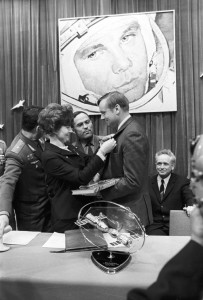
Valentina Tereshkova, presenting a badge to U.S. astronaut Neil Armstrong in memory of his visit to the Gagarin Cosmonaut Training Center in Star City. Photo Credit RIA Novosti
Although it’s often reported that Tereshkova got severe space sickness during her flight, in fact she found that it was actually the space food provided that made her ill. However, this had no impact on her performance of her duties during the mission.
Tereshkova orbited the earth 48 times and landed as planned, with only a minor bruise to her nose from impact with her helmet during landing. In November of 1963 Valentina married cosmonaut Andrian Nikolayev On June 8, 1964, she gave birth to their daughter Elena Andrianovna Nikolaeva-Tereshkova, who is now a doctor and was the first person to have both a mother and father who had travelled into space. Tereshkova and Nikolayev divorced in 1982.
After her flight, Tereshkova studied at the Zhukovsky Air Force Academy and graduated as a cosmonaut engineer. She went on to be a test pilot and instructor. In 1977 she earned a doctorate in engineering. She went on to become a prominent member of the Communist Party of the Soviet Union, President of the Soviet Women’s Committee and prominent supporter of women’s rights. Tereshkova is considered a heroine in post-Soviet Russia.
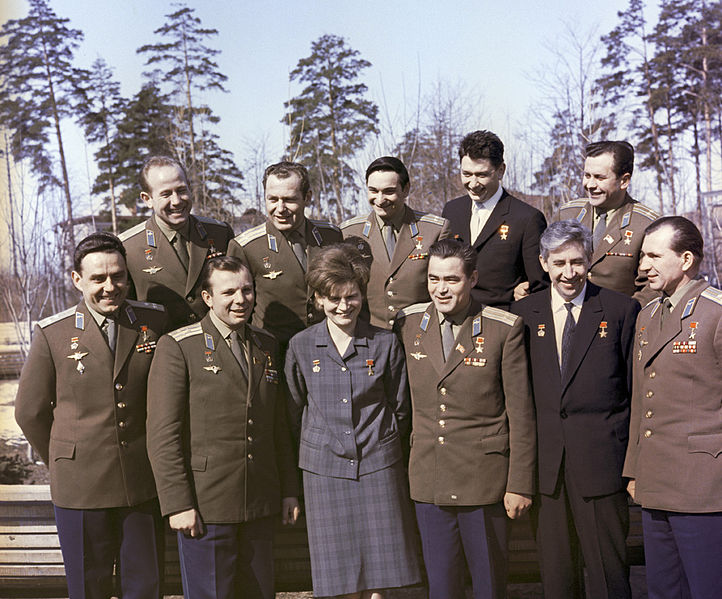
Soviet cosmonauts (front row, from left): Vladimir Komarov, Yuri Gagarin, Valentina Tereshkova, Andrian Nikolayev, Konstantin Feoktistov, Pavel Belyaev, second row: Alexei Leonov, German Titov, Valery Bykovsky, Boris Yegorov, and Pavel Popovich. Photo Credit RIA Novosti
Tereshkova and her fellow female cosmonauts were not considered by some to be a part of the cosmonaut corps, and were not considered for flight assignments on an equal basis with the ‘regular’ male cosmonauts. Unfortunately, during this period space flights manned by women were considered for propaganda purposes. There was fierce competition from the men for a flight position, and placing a woman on the flight would mean that she would be taking the place of a man. An all female Voskhod flight was considered, but eventually cancelled. There is some suggestion that male cosmonauts objected to the women in the corps as a distraction. None of the other four women in Tereshkova’s early group flew, and in October 1969 the pioneering female cosmonaut group was dissolved. Even though there were numerous plans for further flights by women, it was a further 19 years before the second woman Svetlana Savitskaya, flew into space.
Valentina was the recipient of many honours and awards including:
The Hero of the Soviet Union
Order of Lenin
Order of the October Revolution
Order of Merit for the Fatherland
Order of Friendship
Russian Federation State Prize
United Nations Gold Medal of Peace
Simba International Women’s Movement Award
Honorary Doctorate from University of Edinburgh
Named a crater on the moon ‘Tereshkova Crater’
Eduard Rhein Ring of Honor
Asteroid 1671 named Chaika (Her callsign for Vostok 6 ‘Seagull’)
Joliot-Curie Gold Medal
Tereshkova is now 75 years old, living quietly and enjoying life with her grandchildren. She remains the only woman in history to have made a solo space flight.
It seems like another day goes by and there’s another discovery of more exoplanets! On January 7, just one week into 2013, astronomers from the Kepler Mission Space Observatory announced the discovery of the latest exoplanet, the creatively named KOI-172.02. At this stage it appears that KOI-172.02 is an Earth-like planet candidate orbiting a star similar to our own sun. It almost seems like old news when scientists announce the discovery of a planet orbiting another star in our galaxy!
As at January 15, 2013 a total of 859 such planets have been identified (details can be found here). These are certainly exciting times for astronomers, but just how do astronomers search for exoplanets?
There are a number of methods used to detect exoplanets including astrometry, the transit method, radial velocity, gravitational microlensing, pulsar timing, eclipsing binaries, circumstellar disks and coronagraphy. Each method of observation has its pros and cons, is used in different circumstances, and produces different results. I will give an overview of each technique:
Astrometry is a technique that requires astronomers to precisely measure a star’s position in the sky, and then make more observations of the stars movement over time. If the star has an orbiting planet or planets, then the gravitational influence of the objects will cause the star to move in a tiny circular or elliptical orbit around the common centre of mass. Finding Earth-mass planets by astrometry requires extreme (sub-microarcsecond or 1 millionth of an arcsecond!!) precision. As the motion of the star is so small, this method has not yet been very productive in detecting exoplanets. However it’s expected that astrometric accuracy from ground-based telescopes will improve and become more useful.
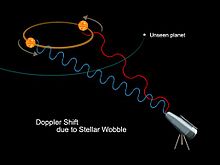
Doppler Shift (Image courtesy of NASA)
One method that is very productive is the Radial Velocity method. This method requires the measurement of the velocity of a star’s centre of mass. Variations in the star’s radial velocity can be deduced from displacements in the star’s spectral lines due to the Doppler effect. If the motion of the star is towards the observer, then the received wavelengths are shorter than those emitted by the source, and longer if the motion is away from the observer. This is similar to the Doppler effect we observe in sound waves when a fire-engine passes us and the pitch of its siren changes! The Anglo-Australian Planet Search was a long-term program that searched for giant planets around more than 240 nearby solar type stars and as of 2010, discovered more than 30 exoplanets using the Doppler method. This method has been by far the most productive method of discovering exoplanets.
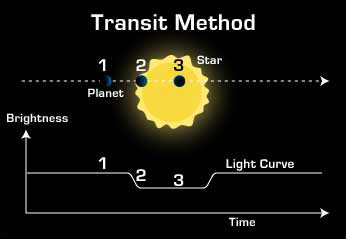
Another popular and effecitve method of detecting exoplanets is the Transit Method which measures the faint dip in brightness of a star when a planet transits the star (passes in front of it as observed from earth). As an exoplanet transits in front of its parent star, the observed brightness of the star drops by a very small amount. This method has emerged as one of the prevailing techniques to search for exoplanets. The amount by which the star dims depends on its size and on the size of the planet. A local example of this phenomenon was the transit of Venus across the face of the Sun in June 2004 and July 2012. The transit method is the second most productive method of detection, though confirmation from another method is usually considered necessary as dips in apparent brightness can arise from events other than a planetary transit. The Kepler Observatory uses the transit method and as of January 2013 it has discovered 2740 candidate exoplanets.
Transit Method (Image courtesy of NASA)
One of the more exciting, yet complex methods is Gravitational Microlensing. This method is used when the gravitational field of a star (close to us) acts like a lens and magnifies the light of a distant background star. When the alignment is exact you might think that the background star would be hidden from view, however the gravitational field of the foreground star bends the light of the background star towards us. This method has the advantage of being very sensitive to planets at large angular separations/distances from the parent stars. This makes gravitational microlensing one method well suited to finding low-mass planets. One major disadvantage is that the event can’t be repeated, as the alignment is unlikely to occur again. Also the planets tend to be very distant, so the other methods are unable to confirm the observations.
A pulsar is a fast-spinning neutron star that emits radio waves at very regular intervals as it rotates. We can use the Pulsar Timing method to discover exoplanets. Slight changes in the timing of its observed radio pulses can be used to track changes in the pulsar’s motion caused by the presence of planets. The presence of a planet orbiting a star affects the timing of the regular signals emitted by the star itself. This phenomenon can be used to detect planets around a pulsar. This method is very sensitive and is capable of detecting planets of a very small mass. In 1992, Wolszczan and Frail used this method to discover the first exoplanet around the pulsar PSR 1257+12. Unfortunately pulsars are pretty rare, so this method is not going to produce a large number of exoplanet discoveries. Also, it’s unlikely that life could survive on planets orbiting pulsars since high-energy radiation there is intense.
When a double star (binary) system is aligned such that the stars pass in front of each other in their orbit, the system is called an eclipsing binary star system. Astronomers can use the Eclipsing Binaries method to discover exoplanets. If a planet has a large orbit that carries it around both members of an eclipsing double star system, then the planet can be detected through small variations in the timing of the stars’ eclipses of each other.
Disks of dust surround many stars, and this dust can be detected because it absorbs ordinary starlight and re-emits it as infrared radiation. The Circumstellar Dust Disks method detects features in dust disks that may suggest the presence of planets. Dust is generated by collisions of small objects, including comets and/or asteroids, and radiation pressure from stars will push the dust particles out into stellar space. Therefore any detection of dust around a star indicates the possibility of recent collisions and other objects.
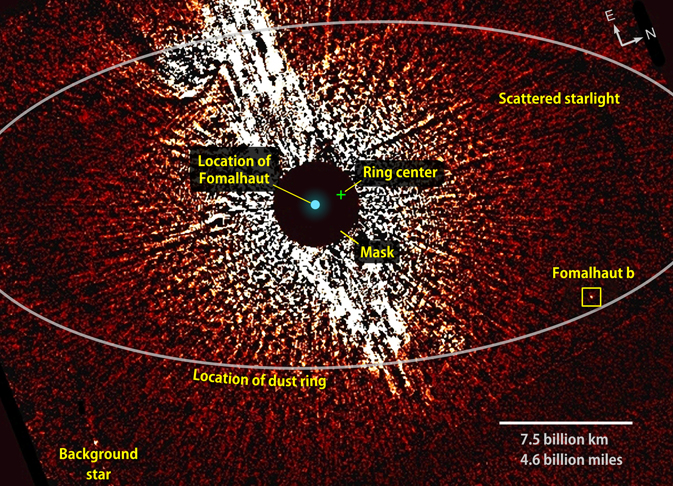
Lastly, a Coronagraph is an object when attached to a telescope, blocks out the direct light from a star so that nearby objects, which otherwise would be hidden in the star’s bright glare, can be observed. In the past coronagraphs have been developed to view the corona of the Sun, but new versions of similar instruments are being used to find extrasolar planets around nearby stars. Coronagraphs can be attached to either ground or space based telescopes. While stellar and solar coronagraphs are similar in concept, they are quite different in design. This is so that observations can be made of exoplanets which are much more distant than our own sun. A stellar coronagraph concept is currently being studied to fly on the Terrestrial Planet Finder mission. On ground-based telescopes, a stellar coronagraph can be combined with adaptive optics to search for planets around nearby stars.
Coronographic Mask showing Dust Disk (Image Courtesy of NASA)
Astronomers at the Harvard Smithsonian Centre for Astrophysics have recently estimated that as many as 17 billion earth sized planets exist in the Milky Way Galaxy alone! Yes, Billion! So I think that we’ll continue to hear about exciting new exoplanet discoveries all the way through 2013 and well beyond. By the way – if you’re really into exoplanets and consider yourself a ‘citizen scientist’ you can help discover new exoplanets! Planet Hunters is an organisation that encourages ordinary folks with no scientific training at all to help find planets from data provided by the Kepler Observatory! If you’re the first person to identify an exoplanet using their data, you’ll be included paper describing the discovery.