Category: Events

  • Call for Participation: EuroNOG – an international meeting

    Call for Participation: EuroNOG – an international meeting

    Want to broaden your knowledge in ICT topics and meet other people working in this field? Take part in the second EuroNOG meeting on September 10th-11th in Budapest, Hungary.
    EuroNOG – an international meeting of experts responsible for the design, maintenance and development of ICT networks. The first edition was held on the 30th September 2011 in Krakow (Poland). The second edition will be organized on September 10th-11th, 2012 in Budapest (Hungary). Subsequent meetings are going to be held annually in various cities in Europe. Our main goal is to build a platform to exchange experience between the operators, ISPs and companies responsible for network implementation.

    National borders are becoming blurred, and increasing international cooperation is a key element of the Internet development. At the same time, due to various technical and economic conditions, in each of the European countries the development of networks diverged in a different way. Therefore it is difficult to compare and easily transfer ready-made solutions from one country to another – just look at the networks in Scandinavian countries compared with countries from Southern Europe– different solutions, architectures and equipment. It is best for us to exchange experience and learn from best practices used by local players on the European market.

    What sets us apart from the RIPE, TERENA and other IX meetings?

    Certainly, our conference is not academic, we do not want to focus only on the theoretical backgrounds of the IP world. We want to provide the greatest number of good practices and presentations including deployment case studies. Our point of view resembles NANOG, as we are looking at Europe through the prism of a global network, treating each country as a state – strong co-operation but also territorial autonomy. The EuroNOG conference will be a vendor-independent meeting place for experts.

    For Australian Science readers the organisers have prepared special discount code “as_10”. People registrating with this code will get 10% discount.

    Detailed information: Date: 10-11 September 2012

    Location: RamadaPlaza Hotel, Budapest (Hungary)

    Registration: http://registration.euronog.eu

    Conference website: http://euronog.eu

    If you have any questions, please contact: Emilia Staszczak

    EuroNOG main organizer mail: emilia.staszczak@euronog.eu
     

  • The Higgs boson does exist: New particle observed at 125 GeV

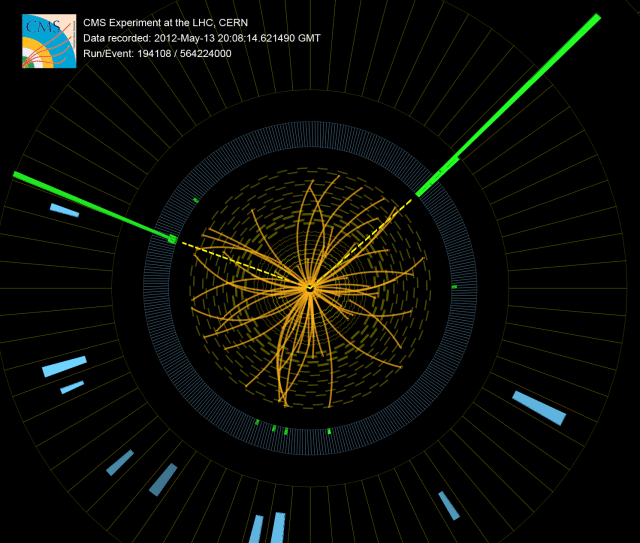
    The Higgs boson does exist: New particle observed at 125 GeV

    Australian researchers helped design and build parts of the ATLAS detector and helped analyse the results.

    Researchers using two huge detectors at the Large Hadron Collider announced the results of their searches at a joint scientific seminar in Geneva and Melbourne, where the International Conference on High Energy Physics is being held.

    In a joint seminar today at CERN and the “ICHEP 2012

  • The EMBO Meeting 2012 – Call for Participation

    The EMBO Meeting 2012 – Call for Participation

    EARLY REGISTRATION & ABSTRACT SUBMISSION: 12 JUNE 2012
    ON-LINE REGISTRATION: 4 SEPTEMBER 2012

    UPDATE: Late abstract deadline 12 August 14:00 CEST (Berlin)

    SUBMIT ABSTRACT | REGISTER


    http://www.the-embo-meeting.org/

    This annual conference attracts 1,500 scientists working in the life sciences. Featuring an impressive line-up of more than 120 world-class scientific speakers, including: Paul Nurse, Linda Partridge, Kari Alitalo, Steven Henikoff and Rob Singer. The programme includes three plenary lecture sessions devoted to genomics, RNA and oxygen sensing, vasculogenesis and disease. 20 concurrent sessions juxtapose classical fields of research with those exploring new frontiers in molecular biology. Daily meet the speaker lunches, giving access to leading researchers, and poster sessions extend the scientific programme.

    Latest News:

    Brisbane Times:

    Scientists closer to elixir of youth

    A FUTURE where Australians can pop a pill and significantly delay the effects of ageing – from hair loss to the onset of dementia – may be only about a decade away, one of the world’s leading evolutionary biologists predicts.

    Professor Dame Linda Partridge, who heads research teams at University College London and is the founding director of the Max Planck Institute for Biology of Ageing in Cologne, has been selected to give the prestigious Graeme Clark Oration in Melbourne next month.

    She predicts that at some point in the next 10 years drugs will be available that could keep us healthy in body and mind long into old age.

    More: http://www.brisbanetimes.com.au/act-news/scientists-closer-to-elixir-of-youth-20120616-20h6o.html

    Latest Videos:


  • EduWiki 2012: Wikipedia as an educational resource, now and in the future

    EduWiki 2012: Wikipedia as an educational resource, now and in the future

    What do Dictator novelImplicit self-esteem and Nuclear energy policy in the United States have in common? Each of these Wikipedia articles has been improved by university students in exchange for course credit.

    Wikipedia educational assignments – where improving the free online encyclopaedia is integral to the course – already happen in many universities in the USA, Canada and other countries. In the UK, lecturers in the universities of Hull, Southampton, Portsmouth and Imperial College, London have been experimenting with Wikipedia assignments.

    It seems that everybody gains from this sort of assignment. The students get a real experience of publication, and are motivated to find reliable sources, write neutrally, avoid plagiarism and seek feedback from Wikipedia’s internal review processes. Wikipedia, and its enormous global audience, get improved articles in academic subjects. The lecturers get help in creating a distinctive and demanding educational experience.

    To avoid the potential pitfalls, these courses need planning and coordination beforehand between the lecturers and the Wikipedia contributors. Ambassadors – experienced Wikipedians – assist the courses online or in person. The Wikimedia education portal has tips, case studies and supporting materials.

    These projects treat Wikipedia as a set of educational processes, not as a static, fixed resource.

    The saying about sausages and legislation is that people who enjoy them shouldn’t watch them being made. With anything that claims to be knowledge, the opposite is true. Learners need to see the process behind it: whether the idea just popped into someone’s head, or survived rigourous testing against alternative explanations; whether it was published directly or went through some sort of review. On Wikipedia, the writing, editing and review processes are all open and on public view. By exploring and taking part in these processes, learners have a chance to develop high-level skills of research and collaboration.

    At school level, there are opportunities not only to teach many subjects using Wikipedia’s freely reusable text, images and other media but also to teach a critical understanding of Wikipedia itself. Those of us who write Wikipedia don’t want readers to treat the site as a final authority: we want them to view it critically, as a medium with weaknesses and strengths, just as newspapers, books or television should be read critically.

    What would be ideal now is if educators and other staff from universities and schools could get together in a room with Wikimedia contributors, discussing the educational projects we’re each working on and the opportunities for the future. That’s exactly why Wikimedia UK and the University of Leicester are hosting a one-and-a-half-day EduWiki conference on the 5th and 6th of September.

    There will be speakers from the USA, Canada and Germany as well as the UK, talking about educational activities that use Wikipedia or other wiki projects.

    The EduWiki conference takes place on 5 and 6 September at the University of Leicester. More about this – on the Source page.

  • ScienceOnline 2013 – be a part of the program, and participate!

    ScienceOnline 2013 – be a part of the program, and participate!

    ScienceOnline2013 conference will take place Jan. 31-Feb. 2 in the McKimmon Conference Center on the campus of N.C. State University in Raleigh, North Carolina.
    For those not familiar with ScienceOnline conferences, ScienceOnline started in 2007 as a one-day conference with 135 people who wanted to explore the world of science blogging. Today, ScienceOnline has grown into an international and interconnected network of thousands of individuals, local groups and regional affiliations, and signature annual events that delve into all the ways that science is done, shared, communicated and supported through the Web and tools of social media.

    In short, ScienceOnline is a global community – a community built through our online connections and face-to-face conversations.
    Those connections and conversations have been in full splendor online with the hashtag #scio13.
    Note that the scio13 planning wiki, where you can add suggestions for discussion sessions, workshops and demonstrations, will close July 1 at 12 noon E.D.T. Bora and the program committee will then begin to build the program for the conference.
  • Bike Brisbane: Brisbane winners announcement

    Bike Brisbane: Brisbane winners announcement

    On Thursday, the Lord Mayor announced the winners of the hack::Brisbane competition at a presentation in New Farm Park. The winners of the hack::Brisbane competition are: (more…)

  • The transit of Venus 2012 as seen from Cairns (Australia)

    The transit of Venus 2012 as seen from Cairns (Australia)

    Credits: GLORIA Project (www.gloria-project.eu)

    Transit of Venus as seen from the Cupola Module, by NASA_JSC_Photo
  • The Olympics Mass Effect

    The Olympics Mass Effect

    59 Days to go.

    Simply put, for those that care about the London Olympics — the excitement is mounting. With 26 sports across 44 venues, 10,500 athletes and millions of spectators, it’s going to be a busy summer. From Box-hill to Coventry, and all across London the preparations are almost over and it’s almost time for the curtains to go up. Behind the scenes  a workforce of around 200,000 people are being amassed — comprising of around 6,000 paid full-time and temporary employees, up to 70,000 volunteers and around 100,000 contractors. A small army. Add to this another small army of reporters and media that will cover the games from every angle. The American broadcaster NBC will be sending a team of around 2,800 to London. The BBC will deliver a record 2,500 hours of live action from the games, including 26 channels dedicated to each sport. An Olympic staff (in more ways than one) that actually outnumbers Team GB itself by a considerable margin.

    As Londoners, nonplussed about it all, make a quiet exit for a few weeks, the city and those unlucky enough to be caught in it, are going to be overrun with tourists, sightseers, and everyone else.

    The amount of column inches dedicated to the Olympics, as you would expect, is significant. From the tried-and-tested stories of athletes battling against the odds to make it to London this summer. To the truly bizarre ones of the UK’s Ministry of Defence telling residents high-velocity rockets will be fitted to apartment blocks close to the Olympic Park. With round the clock surveillance, and even snipers.

    Evidently, in the run-up to the games, tensions and expectations for worse-case-scenarios are high. The threat and danger of anything sparking a problem is clearly in the forefront of the organiser’s minds. With millions of extra people added to the melting pot it’s not just an extra strain on public services. It goes beyond that — the Olympics should come with a health warning.

    Well, in fact, it does. A doctor at the Centers for Disease Control and Prevention (CDC) has told US travellers to make sure they are vaccinated against measles if they travel to London for the Olympics in July.

    “Disease knows no borders. We are concerned about Americans coming back from the Olympics this summer and unknowingly infecting others,

  • Call for Participation – PLNOG 2012 conference

    Call for Participation – PLNOG 2012 conference

    This year in Krakow, a real Polish Golden Autumn will accompany the next meeting of all operators, deployment companies, content providers and network administrators at the 9th edition of the PLNOG conference. In response to the expectations and suggestions of attendees of previous editions, lectures again will be divided into four independent paths with an even greater number of foreign speakers and a big emphasis on the educational level. In addition, there will be panels, unique workshops, peering session and lots of attractions.

    PLNOG Conference is a unique conference dedicated to issues of maintaining and developing of ICT networks. This is an incredible opportunity to exchange experiences, broaden knowledge, attempt to solve common problems in networking industry and to meet fantastic people with similar interests. The participation of many outstanding professionals, two days of exciting lectures and fun during the evening event make the PLNOG conference a truly unique.

    In addition, in September, EuroNOG Meeting will be held – the international meeting of experts responsible for the construction, maintenance and development of ICT networks, which is an extension of the initiative PLNOG to the European market. Subsequent meetings will be held each year in various cities in Europe. Our main goal is to build a platform to exchange experience between the operators, ISPs and companies responsible for deployment.

    More about  PLNOG, and the Call For Papers can be found at: http://plnog.pl/spotkanie-8-pazdziernik/call-for-papers/

    Photo source

  • Google Science Fair 2012:  Everyone has a question. What’s yours?

    Google Science Fair 2012: Everyone has a question. What’s yours?


    On January 11th  2012, Google has launched the second annual international online Science Fair, a a unique opportunity for young people to engage with the scientific community at large. This competition encourages students  to be curious, ask questions, get engaged with their peers, and perform science experiments to answer those questions.  The organisers believe that science fairs help students to explore their vision and curiosity through science. It allows any student with an Internet connection and a Google account (more…)

  • Science Online 2012 – wrapping up the unconference

    Science Online 2012 – wrapping up the unconference

    The Science Online 2012 (un)conference on science and the Web is over. It gathered many bloggers, scientists, scholars, journalists world wide, actively engaging, interacting, writing, and communicating on science, social media, technology, art.  The conference offered numerous sessions throughout three days (January 19-21, 2012) on different topics ranging from Cybersecurity and Digital rights,  Dealing with Scientific Data to  Semantic Web, WikipediaTeaching Science Journalism in the Era of Social Media, Digital Preservation and Science Online. There were practical sessions on podcasts, creating eBooks, on art and science, and  Making Beautiful Maps.

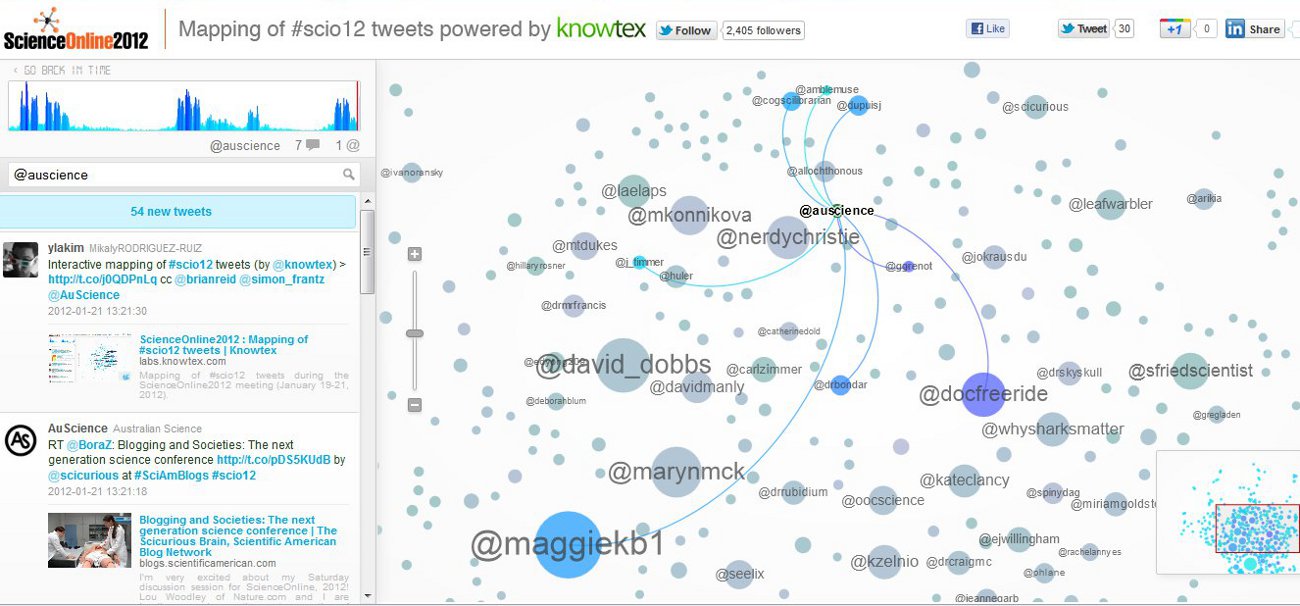
    We talked about the conference and the power of the scientific community earlier last week, and we have been live tweeting during the event, virtually, on our Twitter feed – Australian Science. You can check out the tweets with the hashtag  #scio12. There is a wonderful archive of scio12 tweets : 27,000+ total tweets from 12/26/ to 01/23.  Also, check out the beautiful visualisation of #scio12 tweets, an interactive map.

    There has been lot of interactions during the sessions and off sessions with the colleagues who were there, sharing impressions of the meeting and in between events as well as the reactions and blog posts on the conference. This is the list of all blog posts and articles about the conference, and media coverage.

    And Bora already announced ScienceOnline2013 planning wiki – Program Suggestions that already started to fill in with program sessions proposals.

    Selected interesting sources, videos and music mash-ups:

    #SciAmBlogs – the post-#scio12 blues

    Science Online 2012 #scio12 Photo/music mash-up

    Science Online 2012: Communicating with Images  (video)

    Science Online Youtube channel with #scio12 videos