Tag: International Space Station

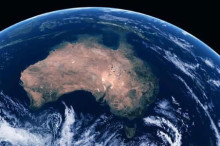
  • Australia from orbit

    Australia from orbit

    From December 19th last year, Chris Hadfield has been living aboard the International Space Station (ISS) in orbit roughly 400 km above planet Earth. Seeing 15 sunrises every day as the station tracks its way above our planet, the ISS, to quote Hadfield himself, “weighs 500 tonnes and is the size of 5 NHL hockey rinks, with living quarters for 6 people.”

    One of the many things which Hadfield has been doing is to keep the tradition set by previous astronauts of taking fantastic photographs of our planet from above. In a Reddit AMA session a couple of months ago, he mentioned that Australia “looks the coolest” from orbit, being fond of the textures and colours of the Australian Outback. So here, for your visual pleasure, are some of the most beautiful pictures of Australia taken from high, high above by Chris Hadfield. Enjoy!
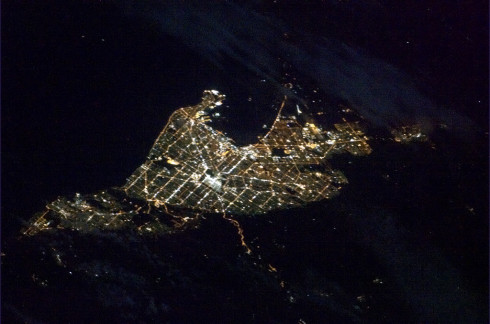
    Adelaide by night

    Adelaide by night, glittering like a jewel.
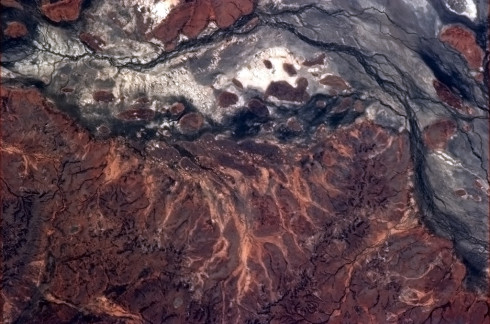
     

    Outback from Orbit

    “The Outback is full of scary faces, staring up in forbidding horror.”
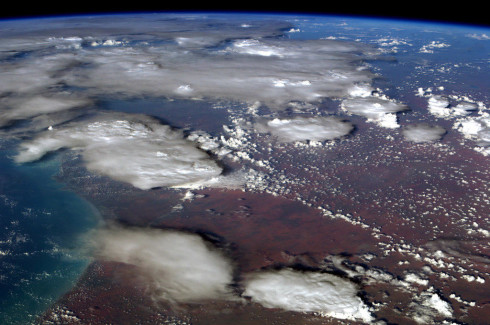
     

    Smoke clouds from the bush fires

    Smoke clouds from the bush fires, as seen from above.
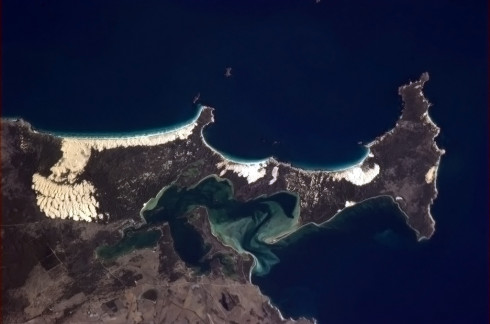
     

    Coffin Bay

    Coffin Bay national park.


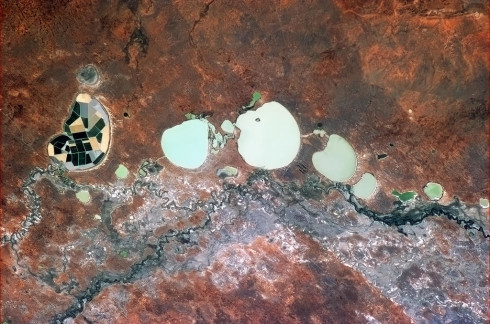
    Dry Lake Beds

    Dry lakes in the Outback, including one which is being used for farming. Quite ingenious.
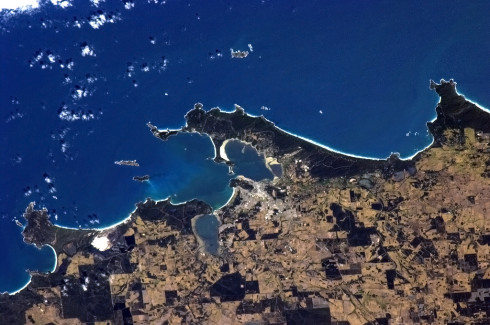
     

    King George's Sound

    King George’s Sound. Hadfield notes that “Charles Darwin got off the Beagle and hosted a dance here in February, 1836.”
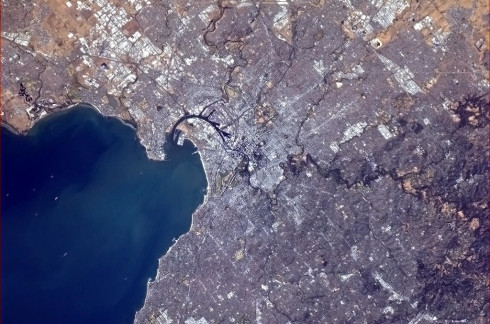
     

    Melbourne

    Melbourne harbour.


    Dry Lake in the Outback

    Beautiful smeared colours of a dry lake bed.
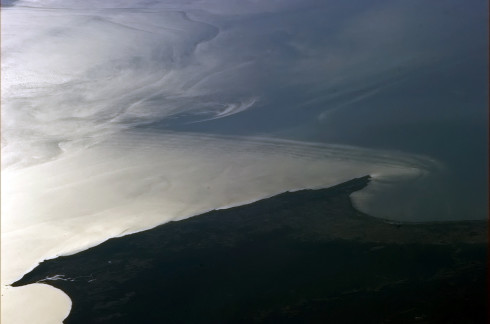
     

    Off the coast of Perth

    The ocean off the coast of Perth. Evening sunlight catches the waves and ocean currents, making them visible.
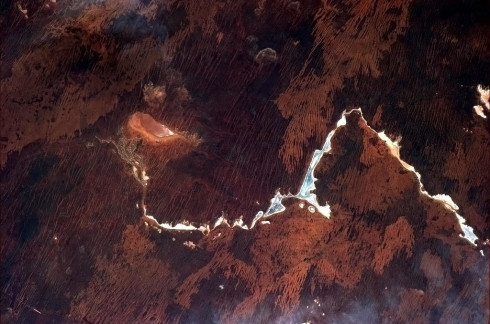
     

    Outback from Orbit

    Jagged lines of the Outback.


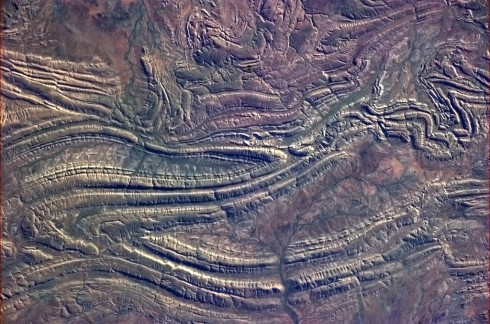
    Outback rock patterns

    Folded rock formations created by tectonic activity in the Outback. Caught by the morning sunlight, they really stand out.
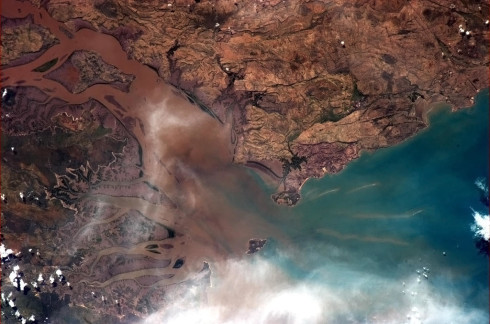
     

    River Delta

    A river delta, showing a host of gorgeous colours.
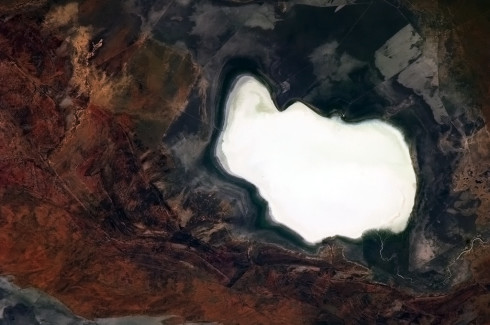
     

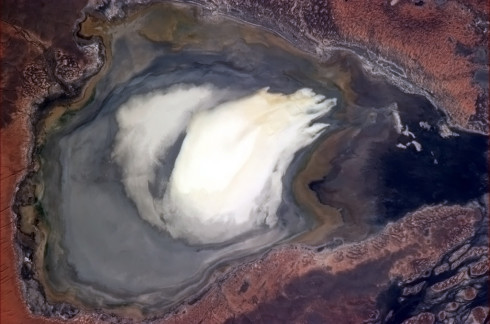
    Dry Lake in the Outback

    A big dry lake somewhere in the Outback.
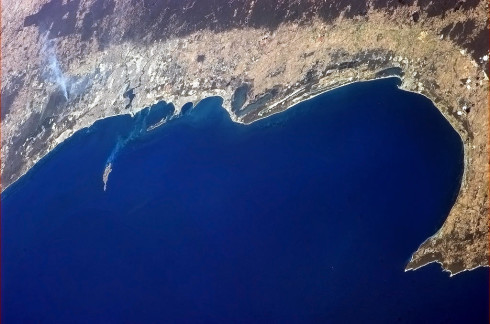
     

    Perth from Orbit

    Beautiful blue seas off the Perth coast.
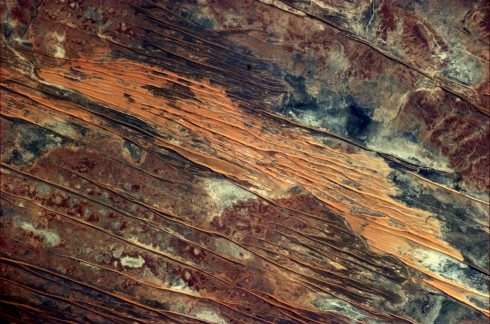
     

    Outback from Orbit

    “A lot of the Australian Outback looks like somebody spilled something on it.”
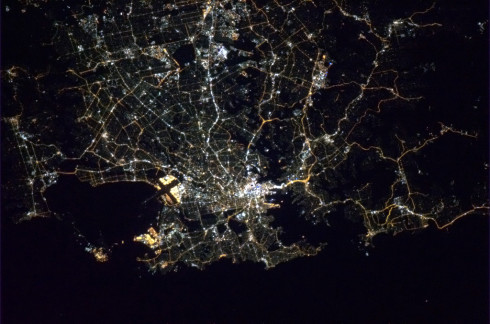
     

    Sydney by night

    The city lights of Sydney.


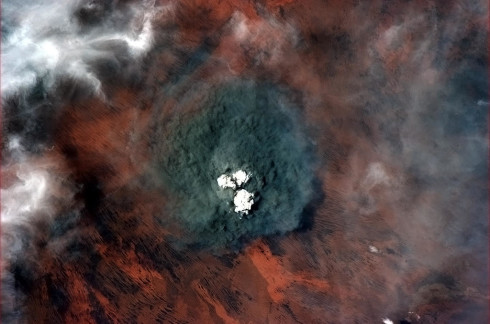
    Ominous smoke cloud

    An ominous looking smoke cloud in Western Australia.
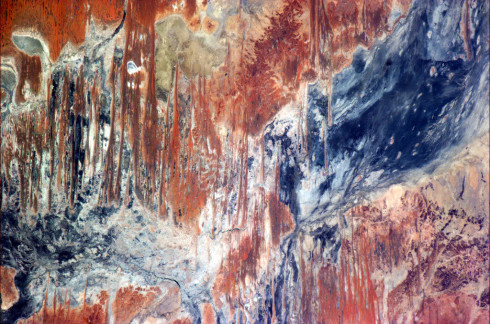
     

    Outback from Orbit

    A shot of the Outback looking very much like a Jackson Pollock painting.
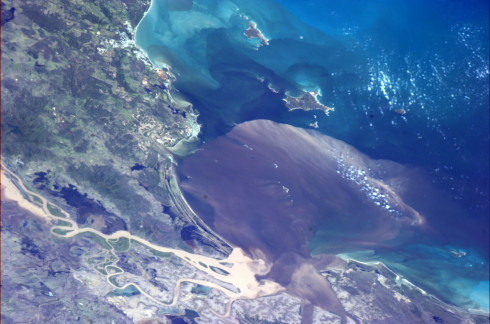
     

    Floodwaters at Rockhampton

    Floodwaters pouring into the Coral Sea near Rockhampton. You can see all the murky brown silt from the river as it disperses into the tides.
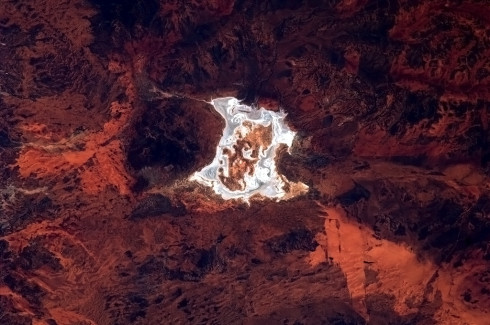
     

    Outback from Orbit

    “A splash of dry salt white on seared red in Australia’s agonizingly beautiful Outback.”


    All images: NASA/Chris Hadfield
  • Weekly Science Picks

    Weekly Science Picks

    It’s been rather a turbulent week, all told. There’s been a lot going on in the news, both good and bad. Hopefully, this little handful of science news items will help you finish the last week and begin this next one on a lighthearted note!


    NASA’s Kepler mission has found a star system which has not one, but two possibly terrestrial planets in its habitable zone.

    Kepler-62: A Star System With Two Earths?

    Whether either or both of Kepler-62’s optimally positioned planets actually has water is beyond the technical capabilities of the Kepler and other telescopes. Kepler works by detecting the very slight dips in light coming from a star caused by a planet passing by, relative to the telescope’s line of sight.


    Sometimes the best way to learn more about nature is to try and recreate it. That happens to be exactly what happened when a group of roboticists were looking at insects…

    Roboticists discover the secret of insect flight, and it’s not wings

    They found that the moth moved its abdomen in direct response to its shifting visual environment. “If the pattern is rotating up (clockwise), the moth would raise its abdomen up (counterclockwise),” says study co-author Jonathan Dyhr, a University of Washington biologist. “The moth was raising or lowering its abdomen to counteract the movement.”

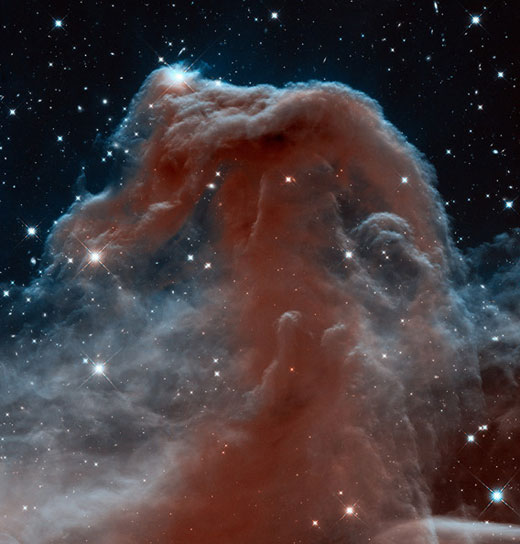
    The Horsehead Nebula

    To celebrate the 23rd anniversary of the Hubble Space Telescope’s launch into orbit, NASA have released a brand new and frankly beautiful image of the iconic Horsehead Nebula. Phil Plait explains more…

    Hubble’s Knight to Remember

    The Horsehead itself is the site of ongoing star formation. The dense gas and dust inside the nebula is collapsing to form stars, and, at the same time, the edges are being eroded away by the fierce ultraviolet light of Sigma Orionis. The top of the Horsehead is acting a bit like a shield, protecting the material beneath it, which is why it’s taken on that umbrella-like shape. You can see more sculpted pillars of material around the sides, too, like sandbars in a stream.


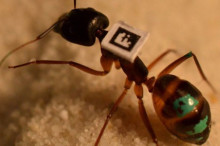
    Ants are fascinating little creatures, and a team of Swiss researchers have been studying the goings on inside a colony of them – by tracking them with barcodes!

    Barcodes let scientists track every ant in a colony

    Analyzing the color codes, they found that younger ants were more likely to work nursing the young, and older ants were more likely to be foragers. In general, they watched ants transition from nursing to cleaning to foraging as they age, but there’s a lot of individual variation in how quickly these transitions took place.

    Chris Hadfield. Being awesome from orbit.

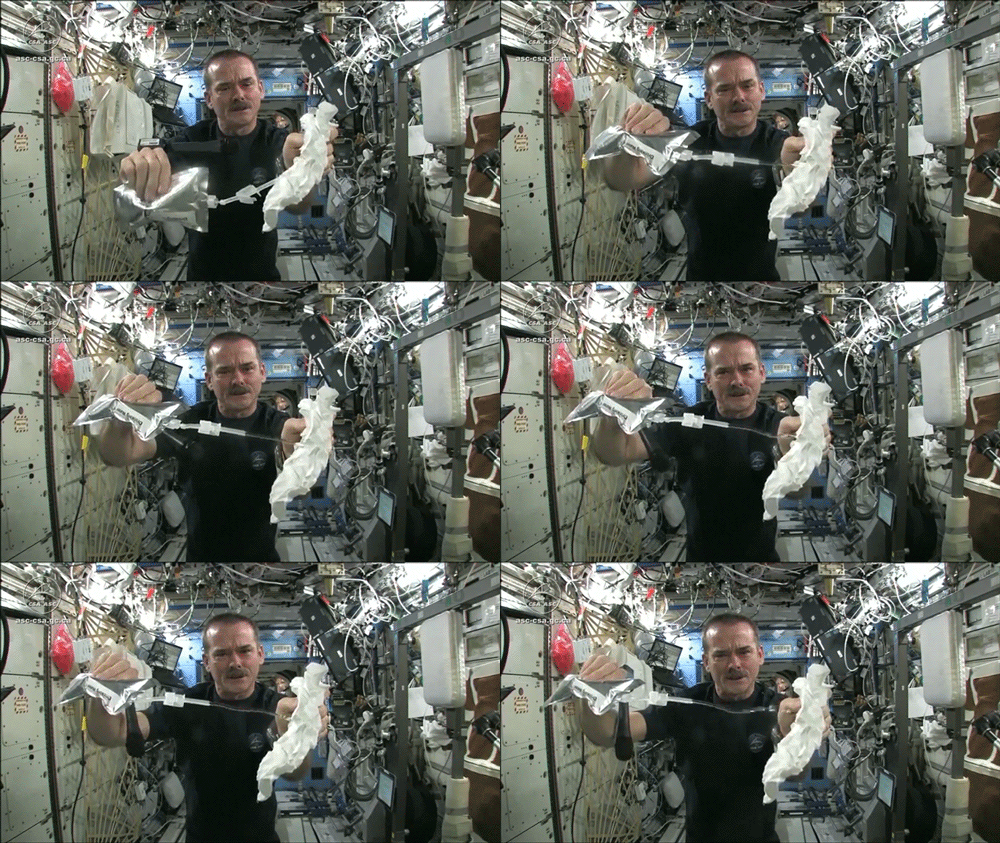
    Finally, everyone’s favourite astronaut, Commander Chris Hadfield aboard the ISS answers an interesting question. What happens if you wring out a wet cloth in zero gravity? Click the link to watch the video!

    What happens when you wring out a washcloth in space?

    Two Nova Scotia high school students, Kendra Lemke and Meredith Faulkner, submitted this experiment to Canadian Space Agency and got to see astronaut Chris Hadfield actually test it out on the ISS. The results are seriously extraordinary and you need to see them.

  • New light on dark matter: space station magnet attracts praise

    New light on dark matter: space station magnet attracts praise

    qqtyppyd-1365030919
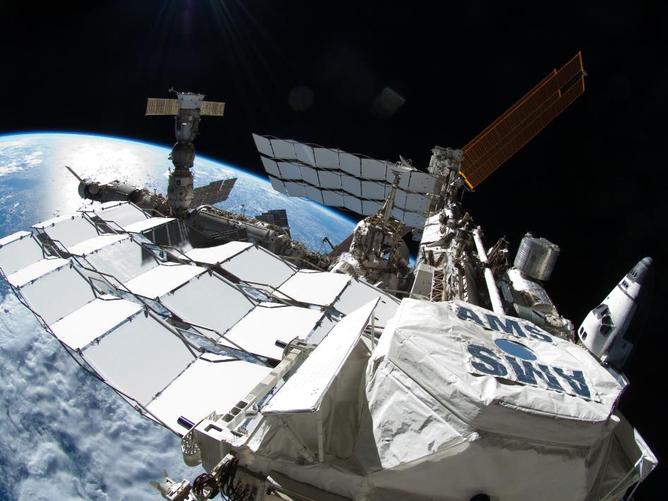
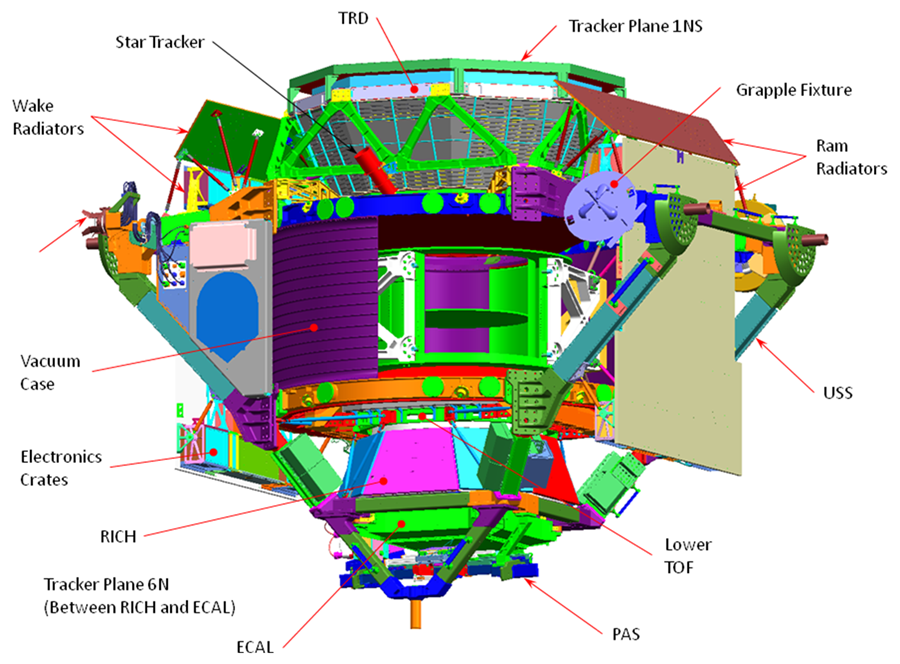
    The AMS aboard the ISS. Photo credit NASA.

    Nobel prizewinner Samuel Ting, early Thursday morning (March 4, 2:00 AEDT), announced the first results from the Alpha Magnetic Spectrometer (AMS) search for dark matter. The findings, published in Physical Review Letters, provide the most compelling direct evidence to date for the existence of this mysterious matter.

    In short, the AMS results have shown an excess of antimatter particles within a certain energy range. The measurements represent 18 months of data from the US$1.5 billion instrument.

    The AMS experiment is a collaboration of 56 institutions, across 16 countries, run by the European Organisation for Nuclear Research (CERN). The AMS is a giant magnet and cosmic-ray detector complex fixed to the outside of the International Space Station (ISS).

    Dark matter matters

    The visible matter in the universe, such as you, me, the stars and planets, adds up to less than 5% of the universe. The other 95% is dark, either dark matter or dark energy. Dark matter can be observed indirectly through its interaction with visible matter but has yet to be directly detected.

    Cosmic rays are charged high-energy particles that permeate space. The AMS is designed to study them before they have a chance to interact with Earth’s atmosphere.

    ams_rivelatori
    Magnet bends in opposite directions charged particles/antiparticles. Transition Radiation Detector (TRD) identifies electrons and positrons among other cosmic-rays. Time-of-Flight System (ToF) warns the sub-detectors of incoming cosmic-rays. Silicon Tracker (Tracker) detects the particle charge sign, separating matter from antimatter. Ring-Imaging Cherenkov Detector (RICH) measures with high precision the velocity of cosmic-rays. Electromagnetic Calorimeter (ECAL) measures energy of incoming electrons, positrons and γ-rays. Anti-Coincidence Counter (ACC) rejects cosmic rays traversing the magnet walls. Tracker Alignment System (TAS) checks the Tracker alignment stability. Star Tracker and GPS defines the position and orientation of the AMS-02 experiment. Electronics transform the signals detected by the various particle detectors into digital information to be analyzed by computers. Diagram credit AMS Collaboration.

    An excess of antimatter within the cosmic rays has been observed in two recent experiments – and these were labelled as “tantalising hints

  • Here be Dragons

    Here be Dragons

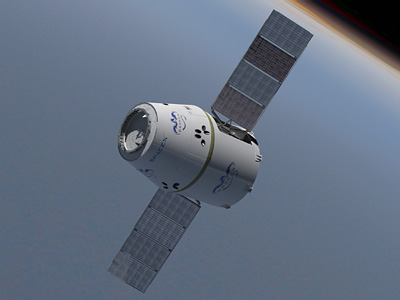
    On May 11, a Dragon will mate with the International Space station.  Rather than some mythical creature, this Dragon is of human artifice.  The Dragon’s rendezvous and berthing with the International Space Station presages a new chapter in human exploration of space.

    The significance of this event is Dragon is a reusable spacecraft, developed, and built by the American company Space Exploration Technologies, SpaceX, as it is more commonly known.  Established in 2002, SpaceX has developed a new family of launch and cargo and crew capsules from the ground up.

    The commercial race to space

    NASA has now “set it sights on exploring once again beyond low earth orbit.