Tag: research

  • Internet Society: Global Internet User Survey Reveals Attitudes, Usage, and Behavior

    Internet Society: Global Internet User Survey Reveals Attitudes, Usage, and Behavior

    A worldwide survey of more than 10,000 Internet users in 20 countries conducted by the Internet Society revealed attitudes towards the Internet and user behavior online. The Global Internet User Survey is one of the broadest surveys of Internet user attitudes on key issues facing the Internet. This year’s survey covered areas such as how users manage personal information online, attitudes toward the Internet and human rights, censorship, and the potential for the Internet to address issues such as economic development and education.

    “Today’s online users have high expectations for the Internet and its impact on our lives and society, while also expressing concerns over censorship and excessive governmental controls,” said Lynn St. Amour, President and CEO of the Internet Society. “As part of realizing the Internet Society’s vision of an Internet that is for everyone, this survey uniquely focuses on users and their experiences, attitudes, and opinions on how to meet the challenges and opportunities facing the Internet and society in general. We are committed to the Internet’s continued open growth and evolution, not only for those who enjoy the Internet today, but until everyone is able to access and benefit from an open Internet.”

    Key Findings

    Key findings from this year’s survey cover a broad range of topics.

    The Internet and Human Rights:

    • Eighty-three percent of respondents agreed or agreed strongly that access to the Internet should be considered a basic human right.
    • Eighty-nine percent agreed or agreed strongly that Internet access allows freedom of expression on all subjects, and 86 percent agreed or agreed strongly that freedom of expression should be guaranteed.
    • Sixty percent of respondents agreed or agreed strongly that Internet access has contributed significantly to civil action and political awareness in their country.

    Internet censorship:

    • Thirty percent of users agreed strongly that censorship currently exists on the Internet.
    • Sixty-six percent of respondents agreed or agreed strongly that governments in countries with no Internet censorship have a responsibility to keep the Internet free of censorship in countries where the Internet is being censored/controlled/shut down.
    • More than 70 percent of users agreed or agreed strongly that more government involvement would make the Internet too controlled or would limit content they can access.
    • More than two-thirds agreed or agreed strongly that increased government control would inhibit the growth of the Internet and/or stifle innovation.

    Online privacy and identity:

    • Even when users know they are sharing personal data with a site or service, most users (80 percent) do not always read privacy policies and a significant fraction (12 percent) of respondents admitted that they never read privacy policies.
    • Of users who logged into online services, only half reported that they logged out.
    • Nineteen percent of respondents were aware of circumstances in which personal data was used in a way they did not expect. The most commonly reported consequences were: unsolicited communications, stolen personal data, private data becoming public, impersonation, and financial loss.

    The Internet and economic and societal issues:

    • Nearly two-thirds of respondents agreed or agreed strongly that the Internet would play a significant role in solving global problems, including reducing child mortality (63 percent), improving maternal health (65 percent), eliminating extreme poverty and hunger (61 percent), and preventing the trafficking of women and children (69 percent).
    • An even higher percentage of respondents agreed or agreed strongly that the Internet would increase global trade and economic relationships (81 percent), improve the quality of education (80 percent), and improve emergency response during a natural disaster (77 percent).
    • A majority of respondents felt strongly that the Internet plays a significant role in making improvements to business, science, and technology in areas such as: expanding the availability of goods and services (66 percent), allowing entrepreneurs to conduct business across all countries (65 percent), and advancing science and technology and creating a technologically recognized workforce (61 percent).

    Attitudes towards the Internet:

    • Ninety-eight percent of users agreed or strongly agreed the Internet is essential for their access to knowledge and education.
    • More than 80 percent agreed or agreed strongly that the Internet plays a positive role for their individual lives as well as society at large.
    • Nearly 75 percent of users strongly agreed that access to the Internet allows them to seek any information that interests them.

    General Internet usage:

    • Internet users nearly universally (96 percent) indicated they accessed the Internet at least once a day.
    • More than 90 percent of Internet users surveyed globally indicated they use social media, with a majority (60 percent) using it daily, an increase of 10 percent over 2011.
    • Connection speed (73 percent) and reliability (69 percent) ranked slightly above more affordable monthly fees (68 percent) among factors that would increase usage. Other factors included more content in their local language (50 percent) and more online availability of government and/or community services (49 percent)

    The Internet Society’s Global Internet User Survey (GIUS) provides reliable information relevant to issues important to the Internet’s future. As an ongoing effort, the survey provides information, informs and supports the activities of the global Internet Society community, and makes the data it collects openly available for all. While other ICT surveys focus on economic, infrastructure, or other Internet use indicators, the GIUS focuses on users, which are the source of innovation that has driven the Internet’s development, evolution, and dramatic growth over the past four decades. The first GIUS in 2011 gathered the responses of 6,088 Internet users in 11 countries.

    This year, the GIUS was conducted on behalf of the Internet Society from July to August 2012 by Redshift Research, a leading business market research firm. The survey questionnaire engaged 10,789 Internet users in 20 countries: Argentina, Brazil, Chile, China, France, Germany, India, Indonesia, Italy, Kenya, Peru, Philippines, Poland, Russia, Saudi Arabia, South Africa, South Korea, Spain, UAE, and the United States. Of the respondents, 53 percent were male and 47 percent were female. Results from the survey varied across countries; future reports will provide additional insight into these variations.

    The complete questionnaire, full results—including results by country—and more information on survey methodology are available at: http://www.internetsociety.org/survey
    Press release – source. 

    Image source.

  • A long time ago in a galaxy far, far away

    A long time ago in a galaxy far, far away

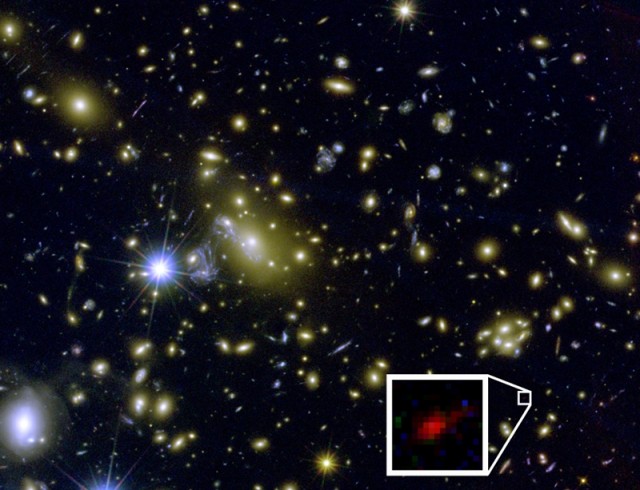
    Feast your eyes on this image…

    Image credit: The CLASH team/Space Telescope Science Institute

    The tiny object in that inset may not look like much. A blurry smudge of red pixels. Not nearly as dramatic as the stunning bouquet of galaxies all around it. But in astronomy, not everything is quite so straightforward. That small red smudge is probably the most exciting thing in this whole image. You see, it too is a galaxy. An unimaginably ancient one.

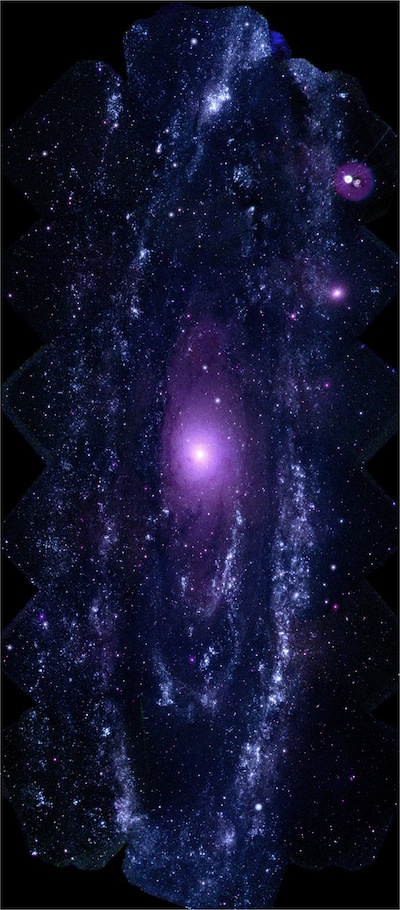
    An ultraviolet image of the nearby Andromeda Galaxy – possibly similar to what we might see of MACS 1149-JD if we could get a more detailed view… Credit: NASA/Swift/Stefan Immler (GSFC) and Erin Grand (UMCP)

    The light that made this unassuming red dot left its source less than 500 million years after the Big Bang and the birth of the Universe. The photons that make up that light have been travelling for over 13.2 billion years. This galaxy was blazing brightly as the oldest known stars in our own galaxy, the Milky Way, were just starting to shine. Back when the gas which would one day become the Sun was still drifting silently amongst stars which are now long dead, and before planet Earth was even a whisper of interstellar dust. Before a massive star forged the iron atoms in your blood, and before a supernova scattered those atoms into space. Before anything we know from the world around us existed, even the stars we see as we look up to the night sky, this galaxy was shining in the dark.

    The Universe was a much smaller place back then. Over the billions of years these photons have been travelling, the Universe itself has expanded with them in the midst of it – stretching them out, redshifting them to longer and longer wavelengths. The light we see here as red was probably ultraviolet once, when it left the galaxy which created it.

    Ancient galaxies like these are difficult to see, purely because they’re so distant. So few photons make it this far that only the most sensitive telescopes can make them out, and even then they need a helping hand. The bloom of galaxies in this image is a massive galaxy cluster called MACS J1149+2223. A collection of galaxies bound together by gravity, clusters like these are some of the largest and most massive objects in the Universe. With that much mass gathered together, gravity starts to do some interesting things, and one of the most interesting is gravitational lensing. Because the gravity of all of those galaxies distorts spacetime, it actually causes the space around the galaxies to act like a titanic lens. A gravitational lens. The ancient red galaxy in this image is only visible because it’s magnified, not only by the Hubble Space Telescope, but by that gravitational lens too.

    It would be naive to assume that this galaxy, dubbed MACS 1149-JD, is special somehow. Instead, it’s most likely to be one of a huge number of primordial galaxies. Except that this one just happened to be in the right place at the right time. A whole population of these ancient galaxies were likely shining brightly at the time, full of hot stars which were driving the reionisation epoch – the time when the Universe went from being an opaque, dark fog, to a clear place where photons could travel long distances. The photons in this image may well have been some of the first photons to have travelled through that ancient and newly transparent Universe.

    The scientific paper is available from Nature – DOI: 10.1038/nature11446

  • Music Underlies the Ability to Acquire Language, Theorists Propose

    Music Underlies the Ability to Acquire Language, Theorists Propose

    Contrary to the prevailing theories that music and language are cognitively separate or that music is a byproduct of language, theorists at Rice University’s Shepherd School of Music and the University of Maryland, College Park (UMCP) advocate that music underlies the ability to acquire language.

    “Spoken language is a special type of music,” said Anthony Brandt, co-author of a theory paper published online this month in the journal Frontiers in Cognitive Auditory Neuroscience. “Language is typically viewed as fundamental to human intelligence, and music is often treated as being dependent on or derived from language. But from a developmental perspective, we argue that music comes first and language arises from music.”


    Brandt, associate professor of composition and theory at the Shepherd School, co-authored the paper with Shepherd School graduate student Molly Gebrian and L. Robert Slevc, UMCP assistant professor of psychology and director of the Language and Music Cognition Lab.

    “Infants listen first to sounds of language and only later to its meaning,” Brandt said. He noted that newborns’ extensive abilities in different aspects of speech perception depend on the discrimination of the sounds of language — “the most musical aspects of speech.”

    The paper cites various studies that show what the newborn brain is capable of, such as the ability to distinguish the phonemes, or basic distinctive units of speech sound, and such attributes as pitch, rhythm and timbre.

    The authors define music as “creative play with sound.” They said the term “music” implies an attention to the acoustic features of sound irrespective of any referential function. As adults, people focus primarily on the meaning of speech. But babies begin by hearing language as “an intentional and often repetitive vocal performance,” Brandt said. “They listen to it not only for its emotional content but also for its rhythmic and phonemic patterns and consistencies. The meaning of words comes later.”

    Brandt and his co-authors challenge the prevailing view that music cognition matures more slowly than language cognition and is more difficult. “We show that music and language develop along similar time lines,” he said.

    Infants initially don’t distinguish well between their native language and all the languages of the world, Brandt said. Throughout the first year of life, they gradually hone in on their native language. Similarly, infants initially don’t distinguish well between their native musical traditions and those of other cultures; they start to hone in on their own musical culture at the same time that they hone in on their native language, he said.

    The paper explores many connections between listening to speech and music. For example, recognizing the sound of different consonants requires rapid processing in the temporal lobe of the brain. Similarly, recognizing the timbre of different instruments requires temporal processing at the same speed — a feature of musical hearing that has often been overlooked, Brandt said.

    “You can’t distinguish between a piano and a trumpet if you can’t process what you’re hearing at the same speed that you listen for the difference between ‘ba’ and ‘da,’” he said. “In this and many other ways, listening to music and speech overlap.” The authors argue that from a musical perspective, speech is a concert of phonemes and syllables.

    “While music and language may be cognitively and neurally distinct in adults, we suggest that language is simply a subset of music from a child’s view,” Brandt said. “We conclude that music merits a central place in our understanding of human development.”

    Brandt said more research on this topic might lead to a better understanding of why music therapy is helpful for people with reading and speech disorders. People with dyslexia often have problems with the performance of musical rhythm. “A lot of people with language deficits also have musical deficits,” Brandt said.

    More research could also shed light on rehabilitation for people who have suffered a stroke. “Music helps them reacquire language, because that may be how they acquired language in the first place,” Brandt said.

    The research was supported by Rice’s Office of the Vice Provost for Interdisciplinary Initiatives, the Ken Kennedy Institute for Information Technology and the Shepherd School of Music.

    Source.

    Image source.

  • Horticultural Tourism as a form of Sustainable Tourism

    Horticultural Tourism as a form of Sustainable Tourism

    Hedgework, source: http://www.flickr.com/photos/mithril/4382135401/in/photostream/

    Tourism industry has a significant effect on the Australian economy. The tourism industry was accounted for 2.5% of Australia’s GDP at a rate of $35 billion to the national economy in the financial year of 2010/2011.This is comparable with $94.8 million contribution of tourism a day to the Australian economy. (Australian Bureau of statistic. “Tourism Satelite account 2010-2011: Key Figures

  • The smoking guns of dying stars

    The smoking guns of dying stars

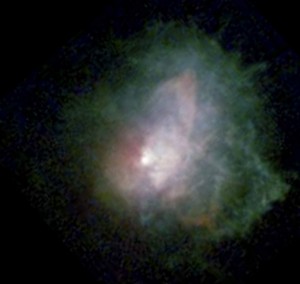
    VY Canis Majoris, the largest known star in our galaxy, with it's huge smoky clouds of gas and dust being lost into interstellar space. Credit: NASA, ESA, and R. Humphreys (University of Minnesota)

    The ancient Greeks once believed that the heavens were immutable. A vast starry vista, eternally unchanging above our heads. But we now know this to be untrue in the slightest. A lot has changed since then, however, and over the past few hundred years, astronomers have unfurled ever increasing knowledge of the lives of stars. Look out across a starry night sky and you can see stars in all stages of their lives, from brightly burning newborn stars, to ageing giants in their final gasping breaths. As stars near the ends of their lives, they begin to shine a rich red colour as they expand and dramatically increase in size.

    As red giants, these stars are burning the last of their fuel, and as they do so they begin to sputter and gasp. Just as a candle flame does when it starts to burn out, red giant stars flicker – though for these, the largest stars in the universe, those flickers can take thousands of years each. These final bursts of energy are known as thermal pulses, and they mark the star’s final days. During the last couple of million years of its life, a red giant star will lose incredble amounts of material to interstellar space. Even when not caught mid-pulse, these stars lose several times the mass of our planet every year. And the puzzle of exactly how they do so has been recently been unravelled by a team of astronomers led by researchers at the University of Sydney.

    All stars emit a stellar wind – a steady stream of particles being constantly accelerated outwards by the star. Even the Sun emits its own solar wind (with a speed measured at 535 kilometres per second as I write this). The wind from red giant stars is slightly different. As the star loses more mass, stellar material cools and condenses into dust. This dust then catches starlight which is so intense near to the star that it actually pushes that dust outwards. This effect, known as radiation pressure, causes the tiny reflective dust grains to act like minute sails and accelerates them away. Each dust grain is tiny compared to the kind of dust we find on our bookshelves, much more like fine smoke than any dust we’d recognise. Instead of being called stardust, it could easily be called starsmoke!

    “The winds that stream from the upper atmosphere of the red giant stars are responsible for removing massive amounts of matter. The grains that we have discovered here will come as a real shock to the accepted wisdom in the field. They are both much larger and much closer to the stellar surface than anyone expected.” said Barnaby Norris, a PhD student at the University of Sydney, and lead author on the research published earlier this year in Nature.

    This stardust emitted by these smoky smouldering old stars is transparent, not unlike finely powdered glass. The implications of this stardust being detected to close to an ageing star could help us to better understand the processes that occur in stars as they die, and how they manage to lose such prodigous amounts of mass so rapidly. As Norris said, “Hopefully our findings will help to illuminate a key step in the grand cycle as matter is expelled from stars into the galaxy only to seed new generations of stellar and planetary birth.”

    On a final poetic note, all of the chemical elements essential to life are created within stars, before being seeded back into the cosmos when stars die. This means that this condensing stardust contains the fundamental raw materials needed for life to eventually form. As Carl Sagan so often used to muse, we are literally made of stardust.

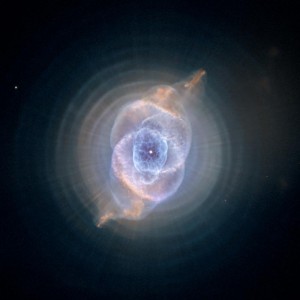
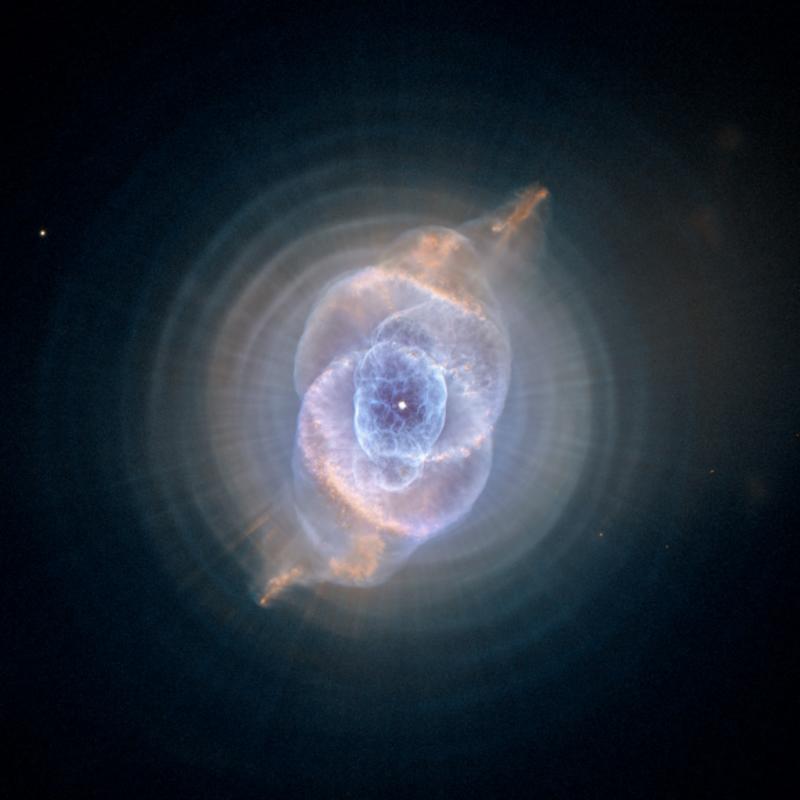
    The Cat's Eye nebula, a star which has now ended its life and is casting its outer layers into the cosmos. The concentric rings show material lost as stellar wind during the star's final thermal pulses.. Credit: ESA, NASA, HEIC and The Hubble Heritage Team (STScI/AURA)
  • Radio quiet, please!

    Radio quiet, please!

    Originally conceived over 20 years ago, there’s a project being undertaken by scientists and engineers across the whole world to help us all better understand the mysteries of the galaxy and the very beginnings of the Universe. It’s estimated to be completed by around 2024,costing $1.85 billion AUS (€1.5 billion). Once completed, it’s set to be the most complex and technologically advanced machine ever built by humanity. It will use enough optic fibre to wrap twice around the Earth and will need a computer capable of performing 10^18 operations per second – about three million times the number of stars in our galaxy. It will produce over 980 Exabytes of data every day (equivalent to about 15 million 64GB iPods) and to cope with that, it will need to handle data transfer rates over 10 times as high as the current global internet traffic. No, it isn’t a starship. But it might just be the next best thing.

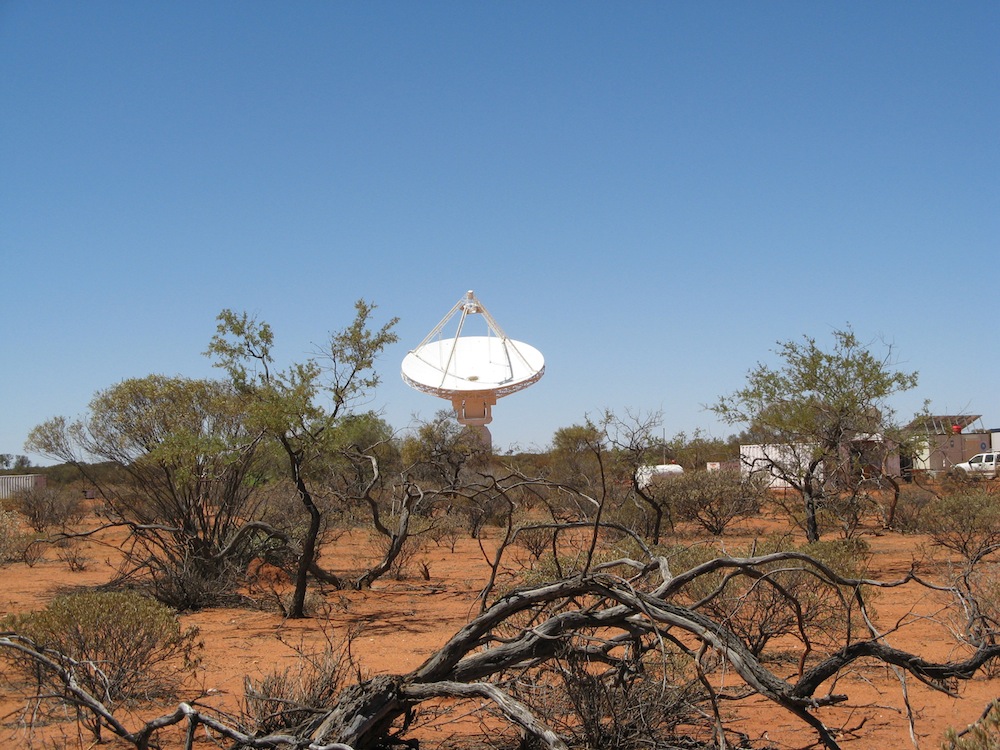
    One of the first components of the SKA, constructed in Western Australia. Credit: Dave DeBoer, CSIRO.

    The Square Kilometre Array (SKA) is one of the most ambitious scientific projects ever devised, and when completed it will comprise a huge number of telescope antennae which will work as one to form a single radio telescope so powerful that it could detect an airport radar on a planet 50 light years away. The sensitivity of any telescope is defined by the area it uses to collect data. With optical telescopes, this is the size of the mirror, and with radio telescopes it’s typically the size of the dish. The SKA gets its name because when fully constructed, all of the detectors and antennae that make it up will have a combined area of one square kilometre, or one million square metres. To put that properly into perspective, the Green Bank Telescope is currently the largest steerable single dish radio telescope, and its area is just under 8000 square metres.

    Being astronomy’s answer to the large hadron collider, the SKA is a staggeringly large international collaboration. I was lucky enough to attend a major meeting regarding the planning of the SKA (the headquarters are to be based here in the UK in Manchester), and the myriad different languages and nationalities represented was impressive to say the least. Over 24 major organisations from countries spanning 5 continents are involved in the project, ranging from universities to industrial engineering companies. New technologies, both software and hardware, are still being developed as a result of this project. Based on the huge data storage and transfer requirements of a machine as complex as the SKA, many of those new technologies are likely to feed straight back into society by offering profound improvements to computing resources like the internet. In fact, as the world’s largest project for sorting and storing data, the SKA is expected to be literally bigger than Google!

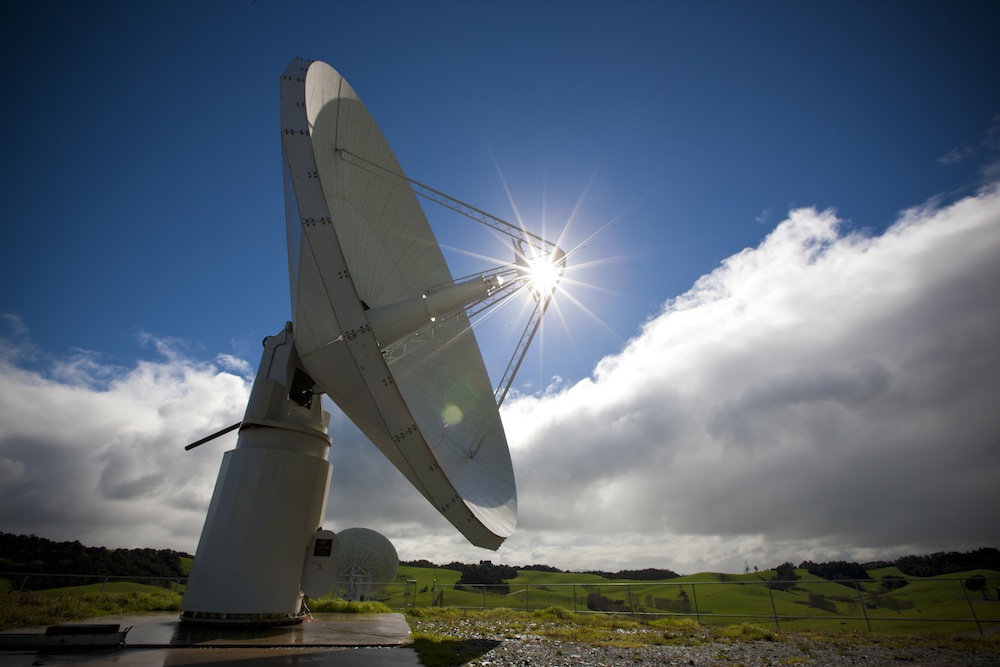
    The Warkworth antenna in New Zealand – an important part of early SKA science. Credit: Alex Wallace.

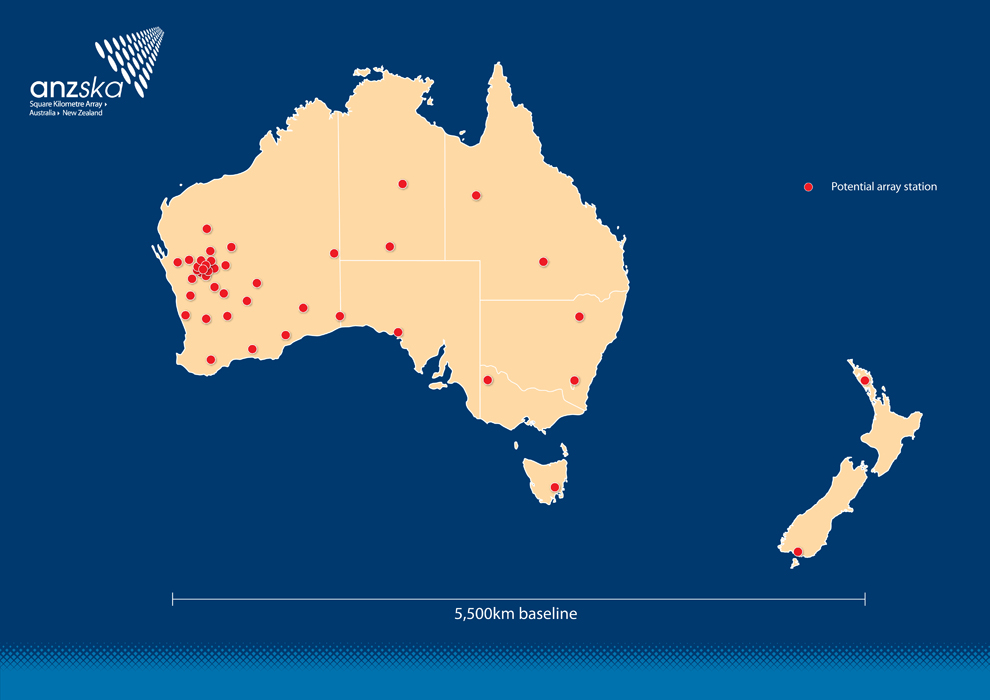
    The most difficult decision, understandably, has been where precisely to build it. Humanity has an unfortunate tendancy to fill the atmosphere of our planet with noise, bouncing radio waves to and fro and filling the air with radio frequency chatter. A radio telescope array this sensitive needs to be placed somewhere quiet to gain the full benefits, and the most recent decision has been to effectively split the SKA into two components, to be built in Southern Africa and Australia. While this may seem like an odd thing to do, it actually makes perfect sense. The SKA actually has three types of antenna operating at different frequencies. Intended to cover a huge range of radio frequencies (from 70 to 100000 MHz), three types of antenna are needed, because no single technology can actually operate across such a wide range. So the decision was made to build the lowest frequency detectors across Australia, centred at Murchison in outback Western Australia. Murchison is blessed with being one of the few places on our planet which isn’t flooded with FM radio at the low end of the frequency scale. From a radio astronomer’s point of view, it’s the quietest place on Earth.

    This is set to be complemented by the higher frequency steerable dishes which are set to be constructed across Africa. Both South Africa and Australia have put extensive efforts into developing the SKA, and Australian-developed technology is still set to be implemented in the African telescopes. This will mean a huge influx to the African astronomical community and numerous African nations won’t lose out on the economic boost from contributing to such a prestigious project. It’s an ideal situation where everyone wins.

    All in all, it’s an exciting time to be an astronomer. An epic project like this is likely to attract all manner of researchers from across the world to both continents. Just maybe, it could also finally help us to answer the really big questions, like how the galaxy formed, how the Universe began, and whether or not there’s anyone else out there.

    A map of prospective SKA sites. Credit: anzska
  • Victoria’s Leading Postgraduate Health and Medical Researchers Recognised

    Victoria’s Leading Postgraduate Health and Medical Researchers Recognised

    Premier Ted Baillieu and Minister for Health David Davis today announced that Dr Stefan Gehrig has been awarded the prestigious Premier‟s Award for Health and Medical Research for 2012. The Premier‟s Award for Health and Medical Research recognises and honours the achievements of Victoria‟s early career health and medical researchers.


    Mr Baillieu said Dr Gehrig won the award from a highly competitive field of young Victorian researchers for his far-reaching investigation into Duchenne muscular dystrophy (DMD).

    “Dr Gehrig discovered that increasing levels of a specific protein in muscles has the potential to treat DMD – a severe and progressive muscle wasting disease,

  • Measuring Network Performance with M-Lab

    Measuring Network Performance with M-Lab

    Measurement Lab is an open platform for researchers to deploy Internet measurement tools. By enhancing Internet transparency, M-Lab helps sustain a healthy, innovative Internet. What this explanatory video to learn why M-Lab is important to researchers, network engineers and policy makers. M-Lab is a collaborative effort founded in 2009 by Googler Vint Cerf and a number of network researchers and industry partners, including Google.

    M-Lab’s goal is to provide researchers, consumers, policymakers, and anyone else who wants good, intelligible information about the Internet,  with open data about network performance.

    The nuts and bolts of M-Lab start with a widely-distributed server platform maintained and managed by the M-Lab Collaborative. These servers are purpose-built to support broadband measurement, and are consistently deployed to exact specifications. This means that the data they collect is consistent — important when you’re contrasting global network performance. Researchers host open-source, active broadband measurement tools on these servers, and users access these tools, run tests, and get real-time information on their network performance. Each time a user runs a test (about 200,000 times a day), data is collected and put into the public domain. So far, it’s 516 terabytes and growing.


    M-Lab is a head-to-tail solution for high quality, open data. And the best part is that it’s all open. From the testing methodology described in the open source code of the tools, to the server documentation, to the data collected, scientists and others can vet exactly what is being measured, how it’s measured, and what precisely this says about networks and performance. M-Lab’s momentum is generated by working together from a shared source of data to progress the state of networks.

     Source.

  • Science and Faith

    Science and Faith

    If I let go a hammer on a planet having a positive gravity, I need not see it fall to know that it has, in fact, fallen. – Spock, “Court Martial,” Star Trek, stardate 2948.9.
    I recently viewed the film Salmon Fishing in the Yemen. Dr. Jones, (brilliantly played by Ewan McGregor), has been ordered by the Ministry of Fisheries to undertake this farfetched project of introducing salmon into the Yemen River, wholeheartedly, or be out of a job. Dr. Jones reluctantly agrees but continuously ridicules this idea based on his years of research and meticulous study of salmon. He casts doubt every chance he gets that this project will actually work. And what we actually have here is a case of policy dictating science; in the name of a heartfelt, goodwill story meant to assuage the voting public’s uneasiness with the war. (A totally different issue of debate, which I will not touch on here.) It’s not until Dr. Jones meets Sheikh Muhammed, a deeply spiritual man of faith that he begins to open up to another way of thinking, one that defies all his principles of scientific reasoning. And he embraces that this plan just might work, with farmed salmon no less. But what causes the radical reversal of the scientist’s viewpoint from staunch biological reasoning to faith that this project might actually be possible?

    Science and religion have had something of a love-hate relationship, intertwined for centuries and often at direct odds with each other. Popes and bishops issued condemnations and accused some great scientific minds of heresy in the Middle Ages. The work of Galileo, Conrad Gessner and Charles Darwin also come to mind, having caused quite a ruckus of controversy in their day. And well Darwin may always be at odds with some folks.

    From my own experience growing up Catholic and pursuing biology and chemistry in college, I found it difficult to compartmentalize science and religion. But there have been and still are a few scientists out there who can separate their scientific beliefs from their religious practice. Copernicus was a Catholic clergyman; Gregor Mendel was an Augustinian friar; and Georges Lemaitre, who first proposed the Big Bang Theory, a Belgian priest. They seemed to have been able to separate their work from their spiritual beliefs. Perhaps they had truly find enlightenment? Or maybe that’s exactly what it is; just a spiritual belief, for right or wrong, that has nothing to do with science.

    As with most conflicts, it seems that the bitter clashes between science and religion arose primarily due to a different interpretation over the definition of ‘science’. Secular philosophers considered science in the sense of natural science; while theologians took the view that all science is based on demonstrations – according to the St. Thomas Aquinas viewpoint. The shift toward science becoming the top dog, so to speak, over religion seems to have occurred as Europe and North America experienced greater secularization. The political power and influence of the church relating to scientific research has gradually decreased. According to the Catechism of the Catholic Church: “Methodical research in all branches of knowledge, provided it is carried out in a truly scientific manner and does not override moral laws, can never conflict with the faith, because the things of the world and the things the of the faith derive from the same God. The humble and persevering investigator of the secrets of nature is being led, as it were, by the hand of God in spite of himself, for it is God, the conserver of all things, who made them what they are”. I will leave it up to the reader to ponder that and agree or disagree.

    But let’s explore the concept of faith for a moment. The word faith is thought to date back to the early 13th century, around the time of some budding scientific discoveries. Formally, faith is a belief in one or more gods or in the doctrines of religion. Buddhism, Christianity, Judaism, Sikh, Hinduism, Islam – all of these religions have some concept of faith stationed at the root of their core beliefs. Informally, it can mean a trust or belief without proof, a hope. And this is where the criticism starts, over this very definition of faith, and how it can seem at odds with science.

    Critics argue that faith is opposed to reason, while advocates argue that faith addresses questions that cannot be settled by evidence. The evolutionary biologist, Richard Dawkins stated, “Faith is the great cop-out, the great excuse to evade the need to think and evaluate evidence. Faith is belief in spite of, even perhaps because of, the lack of evidence.

  • Google Gets an Upgrade

    Google Gets an Upgrade

    According to Google’s Grzegorz Czajkowski, many of the things people are involved in can be represented in the form of graph, including professional activities and personal relationships. The company was the first to use advanced graph analysis methods like PageRank to get more from the Web.

    Using graphs in a dynamic environment like the society brings a new angle to computational power and scalability. Google applies the Bulk Synchronous Parallel Model in its scalable graph analysis by using a framework known as Pregel. Pregel simplifies the calculation of PageRank and scales clusters autonomously without requiring programmers to intervene manually. As a result, the software engineers have more time to concentrate on the algorithm itself.

    The Basics of PageRank

    PageRank uses the random suffer model that assumes that Web surfers use a linear method when following links until their interests stop or they stop browsing. All the clicks away from the source documents reduce the PageRank. Of course, the actual process is more complex, with the typical value of PageRank dampening being 0.15.

    The entire Web can be treated like a graph, where all the pages and index-able files are regarded as ‘vertices’ and the links as ‘edges.’
    The vertices are usually initialised with starting values that, interestingly, make no major influence on the end-result. Pregel runs
    through a series of super-steps after initialisation by updating values and sending messages to other vertices.

    Related Frameworks and Methodologies

    According to Bill Slawski of SEO by the Sea, there’s more behind Pregel and Google, which uses other techniques like FlumeJava and Dremel. The company uses Pregel because it is ‘expressive’ and easy to program.
    Software engineers have designed their own frameworks and toolkits, especially when dealing with multi-step graph operations.

    Characteristics and Benefits of Dremel

    Nested data

    Interactive speed

    Trillion-record, multi-terabyte datasets

    Columnar processing and storage

    Aggregation tree architecture

    Spam analysis

    Analysing crawled Web documents

    In situ data access

    Crash reporting for Google Products

    OCR results from Google Books

    Tracking the install of Android Market apps

    Resource monitoring for work run in Google’s data centres

    Debugging map tiles on Google Maps

    FlumeJava

    Google users started using FlumeJava in May 2009. It is simpler than MapReduce and can control executor and optimizer if necessary. Hundreds of people use pipelines with processing capacities ranging from gigabytes to petabytes every month.
    Google employs interchangeable tools and systems that multiple groups can use.


    References:

    http://arxiv.org/abs/1201.2261
    http://arxiv.org/ftp/arxiv/papers/1201/1201.2261.pdf
    http://arxiv.org/a/petrovic_d_1