As 2012 draws to a close and the new year begins, now is a good time to wrap things up and recapitulate the year just passed. It’s been an exciting year with plenty of interesting happenings in science, technology, and education. Despite the fact that we aren’t especially keen on top 10 lists (because all of our authors are fantastic and inspirational), here are a few of the highlights from the past year. We hope you enjoy them!
The news that CERN had detected a signature matching the much sought after Higgs boson was the biggest news this year in physics. While physicists at the LHC still aren’t 100% certain what they’ve found, one thing is for certain – they’ve definitely discovered something never before seen, and it definitely seems to match what’s expected for the Higgs boson. Now it’s up to the theorists to work out if this will confirm existing theories, or if it will require brand new physics to be devised to explain it!
“It’s a bit like spotting a familiar face from afar,
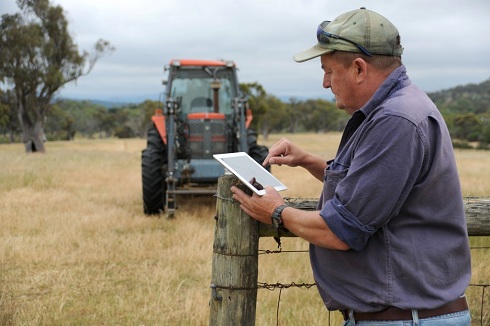
Australia’s national soil databases can now be accessed in real time online through a new iPad app called SoilMapp.
The new app provides open access to the best and most up-to-date information for soil at any location in the country within a matter of seconds.
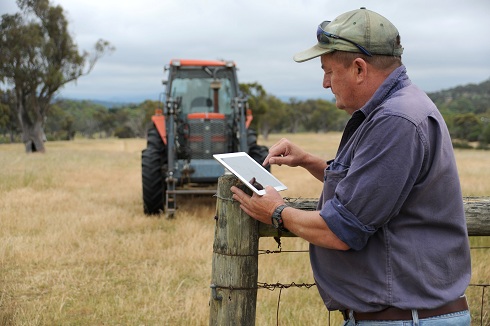
The SoilMapp for iPad will allow farmers and others to access real time information about their soils from in the field.
Information such as soil depth, acidity, salinity, soil carbon, soil water holding capacity and other attributes will help land managers, farmers and rural advisors make on-the-spot, decisions about how to more effectively manage their land.
This mobile device technology will deliver detailed scientific information on soils directly into the hands of farmers, rural consultants, agronomists, and potentially other soil enthusiasts like real estate agents, hobby farmers and keen bushwalkers.
The app has been developed by the Australian Collaborative Land Evaluation Program (ACLEP) and CSIRO, with funding from the Grains Research and Development Corporation (GRDC), because understanding soils is essential for sustaining healthy, natural environments and productive agricultural landscapes.
CSIRO’s Mike Grundy said soils are one of the most important building blocks of our agricultural and ecological systems and are a precious natural asset.
“They sustain food production, biodiversity, water quality and play a key role in human health. Understanding the characteristics of soil allows us to ensure we make decisions about its management to ensure maximum productivity and maintain or improve its health for today and future generations,” Mr Grundy said.
SoilMapp is the first app developed by CSIRO and it is being launched at the Joint Australian and New Zealand Soil Science Conference in Hobart on Tuesday, in time for World Soil Day on Wednesday. The app taps into soil information from the Australian Soil Resource Information System (ASRIS) and APSoil, the database behind the farming systems model, the Agricultural Production Systems SIMulator (APSIM), which is used worldwide.
Both these databases are stocked with contributions from thousands of individuals and organisations including the Australian Government Department of Agriculture, Fisheries and Forestry (DAFF), state and territory agencies responsible for land resource assessment, Geoscience Australia, and soil research and industry groups. The databases contain information about approximately 85,000 samples from nearly 15,000 locations, some dating back to the 1950s.
“There’s a lot of information about Australian soils stored in these two databases and the beautiful thing about SoilMapp is that it provides a user friendly mechanism for accessing that information in real time, on location,” Mr Grundy said.
“Although that information is already available through the web, it is now of far more use to famers or consultants working out on the land because it can be at your fingertips in the field, and at no cost. Importantly, as our soil agencies improve their data collections, SoilMapp will provide access to later releases,” he said.
Senior Agronomist Steve Richmond from Kerin Landmark Rural said the app will be a welcome addition to his decision making toolkit when speaking with growers.
“By understanding the soil’s characterisation, water holding capacity and amount of organic carbon, we can make calculations about how much nitrogen to use on certain crops. This could lead to improvements in fertiliser use efficiency as well helping prevent soil acidification from the overuse of nitrogen. That provides a productivity benefit as well as environmental and economic benefits,” Mr Richmond said.
“Farmers are the custodians of vast tracts of Australia, and the decisions they make daily will impact on the short and long term future of this country’s ability to feed itself, meet growing global demands and to sustain its natural beauty. The more informed we can be when making these decisions, the greater benefit we can deliver for both productivity and environmental health. It’s a win-win,” he said.
While SoilMapp for iPad currently accesses Australian information, other users may soon be able to get the benefit of this technology, with CSIRO exploring the possibility of working with partners in New Zealand, Indonesia and the Pacific Island countries to widen the scope of SoilMapp.
SoilMapp was developed by CSIRO through the Australian Collaborative Land Evaluation Program (ACLEP) and the Grains Research and Development Corporation (GRDC) project Doing it better, doing it smarter — managing soil water in Australian agriculture.
SoilMapp for iPad will be available from the App Store soon.
Media are invited to attend the Joint Australian and New Zealand Soil Science Conference on Monday and Tuesday to use SoilMapp and speak with the researchers that developed it.
Angela Saini, in her book Geek Nation: how Indian science is taking over the world, wants to convince us that Indian science is taking over the world. Now any well read student of the physical and mathematical sciences will be able to provide you with notable scientific contributions. Even the Indian constitution abjures: “It shall be the duty of every citizen of India to develop the scientific temper”. Does “Indian science” exist, and if so what makes it special?
First, pause and contemplate the following statistics. India is the world’s largest democracy: with a population over 1.23 billion (more than 1 in 6 of the world’s 7.14 billion total population are Indian). India has 415 living languages, with 22 having more that 1 million native speakers – 41% of the population speak Standard Hindi – India’s official language. Some states have their own language as the sole language; Maharashtra (capital Mumbai) has 72 million native Marathi speakers. There are 28 Indian states, the smallest Arunachal Pradesh has 1.3 million people, while the largest, the Hindi speaking Uttar Pradesh, has 199.6 million people, and includes the growing cities of of Lucknow and Kanpur. India is also birthplace to four of the world’s major religions, of which Hinduism has 80.5% of the Indian population as followers. India has a large Muslim following at 13.4% of its population, the third largest Muslim population in the world. Despite so many languages the 2010 adult literacy is 63%, with 8% internet users and a staggering 61 mobile phones per 100 of population. With an improved 88% having satisfactory water facilities only 31% of the population has satisfactory sanitation facilities.
These statistics underlie what a competent revelation Saini’s book is. The diversity of topics is to be applauded. Saini has a breezy, almost whimsical style in introducing topics and providing Indian settings for an perspective of each topic.
In particular I liked her mature handling of two hot-button topics: nuclear power and genetically modified foods. To many in the developed world energy and food security are lifestyle discussions – in India they are of life-and-death importance for many millions of the population, both now and the future.
Saini manages a well-reasoned discussion of the energy option for India – looking in detail at one important option. A visit to the Bhabha Atomic Research Centre provides a first hand glimpse of India’s nuclear aspirations, and reasoning behind it. The ensuing discussion on the indigenous development of thorium based nuclear technologies was both fascinating and compelling. From an economic point of view this development would seem to be a necessity if India is to manage its growth and not burn coal and become a major polluter such as the USA or China. They see this as a crucial intermediate step to a solar energy future. My caution is that India is yet to sign either nuclear ratification or nuclear weapons non-proliferation treaties, a point the author fails to mention.
Similarly a trip around the markets provides a great introduction into genetically modifies crops. India is by both legislation and custom a country of small rural-family run farms. These rural communities are poor and very much at the mercy of the elements. Saini presents a reasoned and sensitive discussion on the development of genetically modified crops (such as a long-life banana) that are relevant to ordinary Indians. There is a greater acceptance of these crops amongst the rural farmers than you first might imagine – provided they are cheap and preferably developed in India.
In addition Saini provides a fascinating look at the development of tuberculosis drugs, the use of electronic documents to speed up the notoriously slow bureaucratic and legal systems of India, as well as electronics and information systems companies. We are taken to the Vikram Sarabhai Space Centre to get a first-hand update on the Indian space program and aspirations. Saini comments, “There’s something unimaginably ambitious about the speed and scale of India’s space programme, as if it’s no longer content fulfilling its early goals of sending up satellites so ordinary people could have colour television and cheaper mobile phone connections. Now it seems India has something else to prove.” With a successful first moon-shot India has established itself as a space power – only lacking a manned mission.
In amongst all of this excellent investigation and examination there was one discordant section. “The mindreading machine” discusses a the use of an Indian lie-detector test based on brain wave measurements. The test has been used as legal evidence in cases, including one of murder, in Indian courts. Saini voices disquiet at this ‘science’ yet at no stage does she state the obvious – that this is not science. There are no theories supporting its claims, no peer review nor double-blind tests to give any credence to the claims. I expect that a science writer would point this out, explicitly; Saini doesn’t.
Including this item in the book highlights a very fascinating aspect of what Saini sees as quintessential Indian science. Indian science nurtures the nutty, allowing questions to be asked and curiosity to be followed before they are shouted down by a conservative mainstream view of what is appropriate science. Interesting scientific and technological achievements aside this for me, is the book’s the defining point – India is having an impact far beyond the scientific statistics and measures. Saini’s book is a welcome and worthwhile look at the the idiosyncrasies and successes of the scientific and technological side of India. I’m not convinced it will take over the world, it will certainly influence and impact the direction of science and technology – that will be interesting to participate in.
Doesn’t time fly? I don’t know about anyone else, but my week has absolutely flown past. As I take a moment to relax and consider picking a few favourite topics from this week’s news, I realise that perhaps this is because it’s been an exciting week, full of interesting discoveries and unusual events. In fact, I’ve had quite a lot to choose from, but I eventually managed to trim it down to these few articles which particularly caught my eye…
First and foremost, a planet has been discovered in our neighbouring star system, Alpha Centauri. This is something which I find thrilling for various personal reasons. An interesting discussion of the discovery itself and some of its implications are given by Paul Gilster in the blog Centauri Dreams:
There was a sense of exhilaration in the air on Tuesday as the buzz around an Alpha Centauri planet built, and when the embargo was lifted, reports of the find filled the social media as the early articles began to appear online. Just how big a deal is Centauri B b? A skeptic could point out that while finding an Earth-mass planet is significant, it must still be confirmed, and in any case, this is an Earth-mass planet that is nothing like a clement, habitable world.
From a neighbouring star to a neighbouring planet, the Curiosity rover has been finding some very curious shiny objects in the martian soil. Wired Science gives a brief overview of what’s been happening on the red planet:
NASA’s Curiosity rover took three scoops from a small Martian sand dune and found several bright particles in the soil. Scientists think these are unrelated to the odd bright object that Curiosity saw last week, which turned out to be plastic that fell from the probe, and are probably indigenous Martian mineral flecks.
Closer to home, this week saw a world record being broken by Austrian skydiver Felix Baumgartner, who leapt from a balloon at an altitude of 39 km. A fantastic achievement and a daredevil stunt! However, could more of an effort have been made to add some depth to the stunt and give us all some more background about it? Science historian Amy Shira Teitel at Vintage Space takes a detailed look at the full background and a few tricks which were missed with respect to communicating the science behind such a stunt:
In the 1960s, pilots were pushing the envelope of supersonic flight at high altitudes. But this was a dangerous approach. While it’s easy to fly fast in the thin upper atmosphere it’s harder to control an aircraft. With no air for control surfaces to push against, aircraft tend to tumble, and when aircraft tumble pilots tend to eject. Tests with dummies showed that when falling from high altitudes, human bodies tended to get into a flat spin. It would be like rolling down a hill really fast but without the hill, and the G-forces would certainly be fatal.
Image: AP Photo/Red Bull Stratos, Luke Aikins
And finally, there was a rather informative little discussion piece by Dave Hone in the blog Lost Worlds. In emphasising some of the difficulties faced in palaeontology, he poses a rhetorical question – did Tyrannosaurus Rex have feathers?
Note that there is a rather important scientific distinction here, no facts have changed since the 70s, but we have many more facts. And the best interpretation of all of the available data is now a little different to that which we had before. The fossil record is incomplete and we have to extrapolate from the available evidence and apply parsimony the best way we can.
When the human race inevitably expands off planet Earth, we’ll naturally want to take our internet with us – over the past 15 years or so, the internet really has become an integral part of our lives! In fact, even as you’re reading this, 300 gigawatts of electricity worldwide will have been used to transfer 640 terabytes of information across the internet to 1.5 billion desktop computers and a further billion mobile devices. In the time you’ve taken to read this paragraph, over 200 million e-mails have been sent, 6 million Facebook pages have been loaded, 1.3 million YouTube videos have been watched, and 100,000 people have posted an update to their twitter accounts.
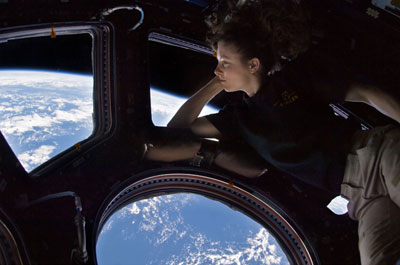
Astronaut Tracy Caldwell Dyson enjoying a view from the ISS Cupola window.
Inspite of its sprawling extent on our planet though, the internet’s first step off-world was able to fit inside just 1120 bytes. On January 22, back in 2010, astronaut TJ Creamer made a small but important piece of internet history by being the first human being ever to post to a twitter feed from orbit. Astronauts had been updating twitter feeds while in orbit for some time, but they had previously always relayed their messages via NASA back here on Earth. Since 2010, however, the International Space Station (ISS) has been upgraded to have its own internet connection. Intended for personal use by astronauts and still routed through ground based systems at NASA for security, this is how e-mails, blog posts and twitter updates are sent back home. All the same, even though it might seem a long way away, the ISS is relatively nearby in low Earth orbit.
Things start to become more complicated when you consider travelling further afield, because whether we like it or not, we can’t cheat special relativity. The speed of light is the fastest any interplanetary communication (or anything, for that matter) can travel. The Moon is still close enough that interaction is possible in almost real time. Sending a message to someone on the Moon would involve a delay of a little under three seconds. Good enough to hold a conversation, but with gamers here on Earth complaining about latencies higher than 600 milliseconds, you’re obviously not going to be able to play Halo or Warcraft against a friend over that kind of distance. Travel as far as Mars and the problem becomes even more pronounced, with delays of anywhere between 3 and 22 minutes, depending on exactly where Mars is in relation to Earth. Minutes turn to hours as you continue to travel outwards (transmissions from Voyager 2 currently take over 13 hours to reach us). All things considered, using an interplanetary internet sounds like a rather good idea for communication over distances like these. While phonecalls to Mars would be essentially impossible, delays between responses to e-mails and tweets are fairly routine. You could quite easily have a twitter conversation with someone over on a neighbouring planet.
Preparing for the future, NASA and Google teamed up a few years ago to develop a new internet protocol designed to be used in space. Called Disruption-Tolerant Networking (DTN), it’s designed to work a bit differently to the internet we’re all familiar with. While our familiar TCP/IP systems rely on a constant connection to transfer data, this is obviously unfeasible in deep space. While a DTN network would still operate using a series of nodes passing information from machine to machine, the way ground-based networks do, each node needs to hold onto the data being transmitted until it has a confirmation that the message has been safely passed on.
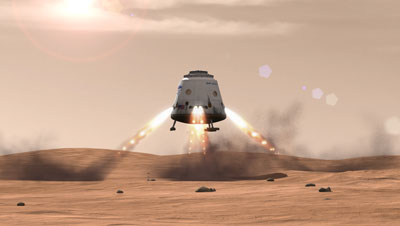
SpaceX believe it should be possible to send people to Mars within 20 years.
With a steadily accumulating collection of spacecraft in various parts of the solar system. Google’s Vint Cerf has expressed plans to use these old pieces of hardware, many of which have long since completed their original missions, as nodes in what will become an interplanetary internet. Indeed, spacecraft have already transmitted data amongst themselves en route back to Earth. ESA’s Mars Express probe, for instance, has served as a relay between Earth and vehicles landing on Mars, and is set to do so again when NASA’s Curiosity rover arrives at the red planet later this year. In an interview with networkworld.com last year, Cerf is quoted as saying “…if they are still functionally operable — they have power, computer, communications — they can become nodes in an interplanetary backbone. So what can happen over time, is that we can literally grow an interplanetary network that can support both man and robotic exploration.” He continued to explain how, while all space missions to date have involved point-to-point communications, future space missions will likely require “a richer communications network.” This also has an added plus that an interplanetary network infrastructure will allow scientists to receive more data from deep space missions than is currently possible.
With many astronauts already maintaining active twitter feeds from orbit, it has to be said that similar social networks may well play an important role in communications in the future. By the time that role is needed, a network infrastructure will likely be in place for it to operate on. A company like Google, processing petabytes of data and serving hundreds of millions of queries for an index containing billions of websites every day, is certainly qualified to help set up a computer network on interplanetary scales. Maybe in the future when people talk about Google Mars, they might mean it literally!
This week we have seen beautiful Venus transiting directly between the Earth and the Sun, which brought plenty of the media attention, and yesterday one of the greatest science fiction writers Ray Bradburydied during Venus transit. He was best known for his dystopian novel Fahrenheit 451 and for the science fiction stories collection The Martian Chronicles. Both the Earth and Mars lost one of their most famous citizens.
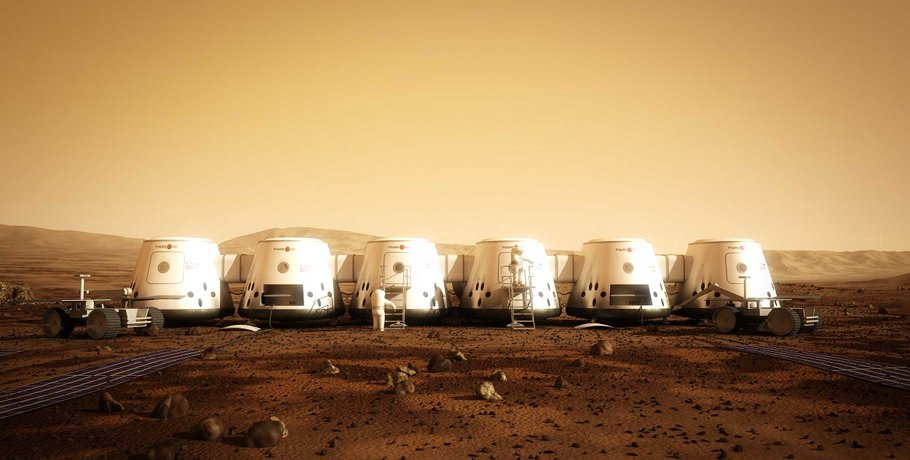
Speaking of Venus, Mars, science fiction and non-fiction, I want to share something with you that a colleague of mine drew the attention to, the other day. It is a private space start up from the Netherlands called the Mars One project, whose goal is to send four volunteer astronauts on a one-way journey to Mars. Take a look at the promotional video to get the sense of this endeavor.
The idea of the privately financed Dutch company is to establish the first human colony on Mars by 2023. ‘’A habitable settlement will be waiting for the settlers when they land. The settlement will support them while they live and work on Mars the rest of their lives.
There is no doubt in the mind of Australia’s Chief Scientist, Professor Ian Chubb, the future will be shaped by science technology, engineering and mathematics. Unfortunately, he finds that at present the standing of science, as an expert authority, is being challenged. Furthermore, Ian Chubb finds that the science message is getting lost in the white noise of the mainstream media. I was heartened to hear his positive words about science communication, social media, science and technology education and innovative Australian workplaces.
It was refreshing to see Australia’s Chief Scientist out and about and addressing public forums such as this one. Although judging by the faces, the suits and the overheard conversations at the drinks and nibbles prior to the address, I think this was definitely a speech to the science and technology faithful. That is a pity, his words were worth exposure and considered comment in the mainstream Australian media.
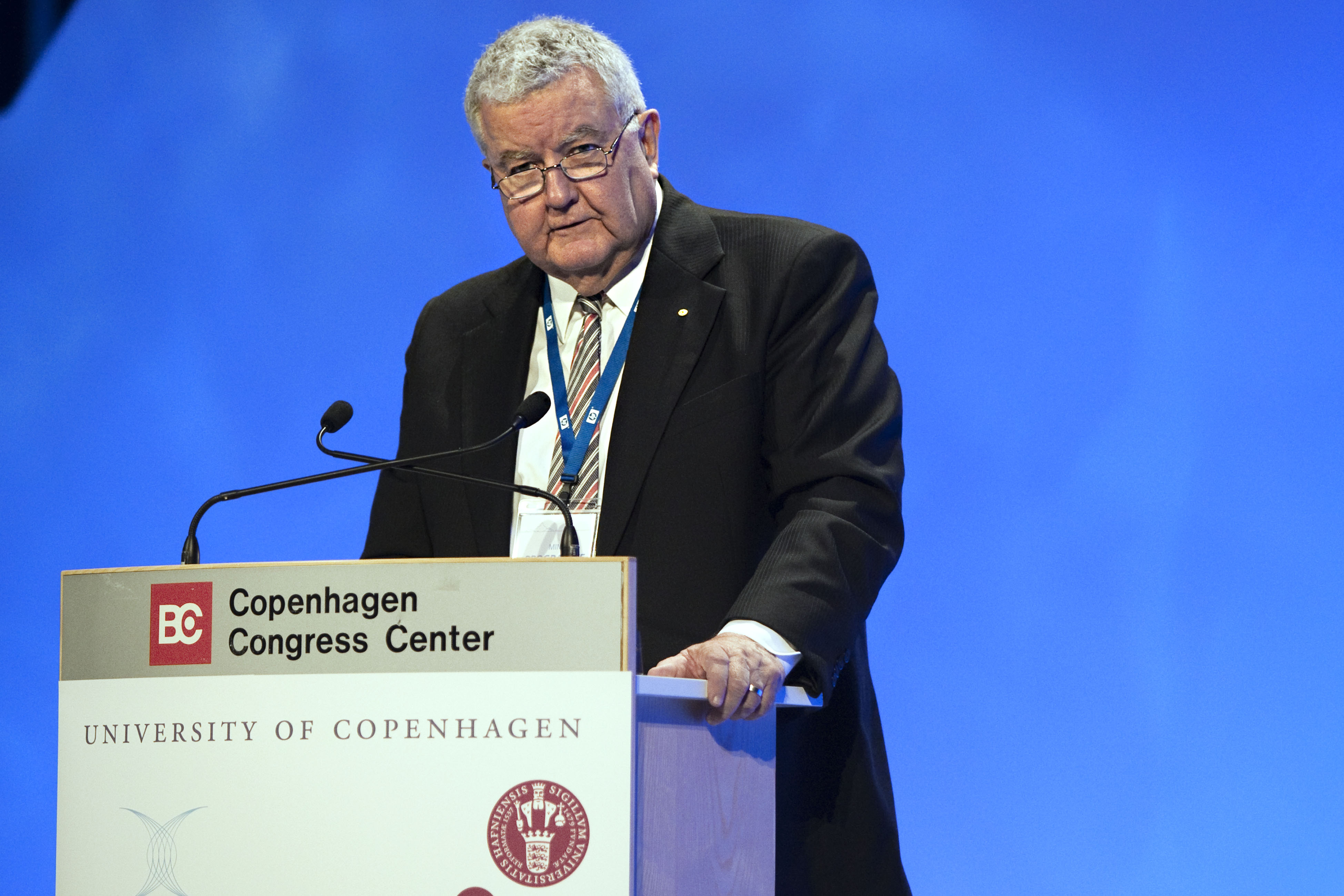
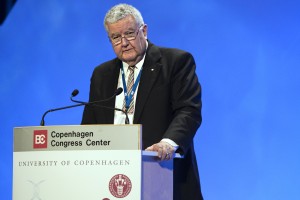
Prof. Ian Chubb at the Climate congress, Copenhagen 2009, March 10-12. Opening session.
Professor Ian Chubb emphasises Mathematics, Engineering and Science provide the enabling skills and knowledge that underpin every aspect of modern life. They help us understand the natural world and enable us to respond as humans to this world with a constructed view aimed at improving the lot of human kind.
In Australia, as in many economies, we have observed a decline in the number of people choosing a career in these disciplines. Not only that, the STEM subjects (Science Technology Engineering and Mathematics), as he called them, are taken for granted or simply ignored. Although it is obvious without at least an appreciation of these subjects, a modern citizen is hampered in their ability to critically evaluate and make informed decisions about the issues that are shaping their future. Among his many roles as Australia’s Chief Scientist, Professor Ian Chubb has been charged with examining this decline and offering strategies to address it.
Professor Ian Chubb is eminently suited to this task. He was appointed to the position of Chief Scientist on 19 April 2011 and commenced the role on 23 May 2011. Prior to his appointment as Chief Scientist, Professor Ian Chubb was Vice-Chancellor of the Australian National University. Professor Chubb’s research focused on the neurosciences. Although he jokingly said on the night he would prefer not to be quizzed, on science specifics, by such an informed audience. He has co-authored some 70 full papers and co-edited one book all related to his research. In 1999 Professor Chubb was made an Officer of the Order of Australia (AO) for “service to the development of higher education policy and its implementation at state, national and international levels, as an administrator in the tertiary education sector, and to research particularly in the field of neuroscience
The endless cycle of idea and action,
Endless invention, endless experiment,
Brings knowledge of motion, but not stillness;
Knowledge of speech, but not of silence;
Knowledge of words, and ignorance of the Word.
…
Where is the Life we have lost in living?
Where is the wisdom we have lost in knowledge?
Where is the knowledge we have lost in information?
– T. S. Elliot
We uncouple technologies, such as computing and road building, from our deepest human values. The questions asked by T. S. Elliot become irrelevant as we refuse to acknowledge the human context.
Students at universities become mainly focused on “practical knowledge” that leads to high paid jobs. The values by which we guide our technological development and application become afterthoughts. We must wonder if technology now controls human life more than humans control technology.
Information technology is valued above wisdom. There is no “wisdom technology”. It’s easier to understand information technology then wisdom. A high school student can quickly grasp computer programming, but it takes almost an entire lifetime to mature to wisdom. People who think of themselves as wise because they have read some books are dangerous. Wisdom is lived, not mastered as procedures and facts that can be scored on an exam sheet.
Data and information are the “atomic” components of knowledge. These components don’t make a lot of sense by themselves. Water is composed of molecules, which are in turn composed of atoms of hydrogen and oxygen. We could say that molecules are like information and atoms (a level further down) are like data. But such an understanding does not allow us to understand the “wetness” of water. Wetness is an emergent phenomenon that is experienced by sentient human beings. When we look at a friend, we just don’t see atoms and molecules, we see a friend.
Meaning is the real food of human life. Our real task is to arrange education, family, society, moral training, technology and economic arrangements in way that allows meaningful human life to unfold for as many people as possible. Clearly, we have remarkable technologies. But do we have enough meaning?
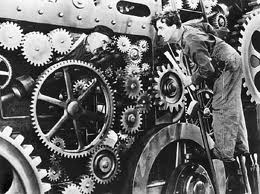
_________________ Image: Charlie Chaplin, ‘Modern Times’, classic silent movie, 1936. Worth locating a copy for viewing.


 Doesn’t time fly? I don’t know about anyone else, but my week has absolutely flown past. As I take a moment to relax and consider picking a few favourite topics from this week’s news, I realise that perhaps this is because it’s been an exciting week, full of interesting discoveries and unusual events. In fact, I’ve had quite a lot to choose from, but I eventually managed to trim it down to these few articles which particularly caught my eye…