Tourism industry has a significant effect on the Australian economy. The tourism industry was accounted for 2.5% of Australia’s GDP at a rate of $35 billion to the national economy in the financial year of 2010/2011.This is comparable with $94.8 million contribution of tourism a day to the Australian economy. (Australian Bureau of statistic. “Tourism Satelite account 2010-2011: Key Figures
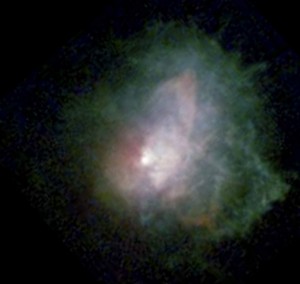
VY Canis Majoris, the largest known star in our galaxy, with it's huge smoky clouds of gas and dust being lost into interstellar space. Credit: NASA, ESA, and R. Humphreys (University of Minnesota)
The ancient Greeks once believed that the heavens were immutable. A vast starry vista, eternally unchanging above our heads. But we now know this to be untrue in the slightest. A lot has changed since then, however, and over the past few hundred years, astronomers have unfurled ever increasing knowledge of the lives of stars. Look out across a starry night sky and you can see stars in all stages of their lives, from brightly burning newborn stars, to ageing giants in their final gasping breaths. As stars near the ends of their lives, they begin to shine a rich red colour as they expand and dramatically increase in size.
As red giants, these stars are burning the last of their fuel, and as they do so they begin to sputter and gasp. Just as a candle flame does when it starts to burn out, red giant stars flicker – though for these, the largest stars in the universe, those flickers can take thousands of years each. These final bursts of energy are known as thermal pulses, and they mark the star’s final days. During the last couple of million years of its life, a red giant star will lose incredble amounts of material to interstellar space. Even when not caught mid-pulse, these stars lose several times the mass of our planet every year. And the puzzle of exactly how they do so has been recently been unravelled by a team of astronomers led by researchers at the University of Sydney.
All stars emit a stellar wind – a steady stream of particles being constantly accelerated outwards by the star. Even the Sun emits its own solar wind (with a speed measured at 535 kilometres per second as I write this). The wind from red giant stars is slightly different. As the star loses more mass, stellar material cools and condenses into dust. This dust then catches starlight which is so intense near to the star that it actually pushes that dust outwards. This effect, known as radiation pressure, causes the tiny reflective dust grains to act like minute sails and accelerates them away. Each dust grain is tiny compared to the kind of dust we find on our bookshelves, much more like fine smoke than any dust we’d recognise. Instead of being called stardust, it could easily be called starsmoke!
“The winds that stream from the upper atmosphere of the red giant stars are responsible for removing massive amounts of matter. The grains that we have discovered here will come as a real shock to the accepted wisdom in the field. They are both much larger and much closer to the stellar surface than anyone expected.” said Barnaby Norris, a PhD student at the University of Sydney, and lead author on the research published earlier this year in Nature.
This stardust emitted by these smoky smouldering old stars is transparent, not unlike finely powdered glass. The implications of this stardust being detected to close to an ageing star could help us to better understand the processes that occur in stars as they die, and how they manage to lose such prodigous amounts of mass so rapidly. As Norris said, “Hopefully our findings will help to illuminate a key step in the grand cycle as matter is expelled from stars into the galaxy only to seed new generations of stellar and planetary birth.”
On a final poetic note, all of the chemical elements essential to life are created within stars, before being seeded back into the cosmos when stars die. This means that this condensing stardust contains the fundamental raw materials needed for life to eventually form. As Carl Sagan so often used to muse, we are literally made of stardust.
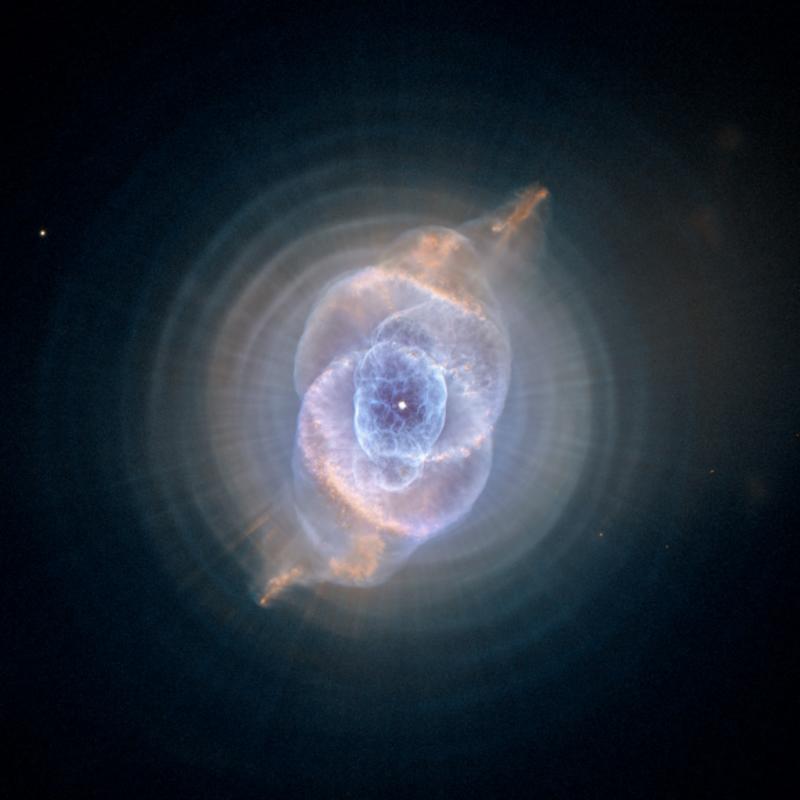
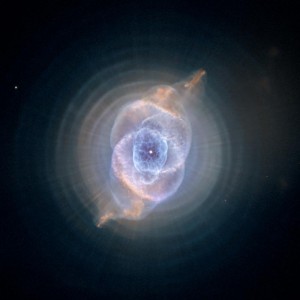
The Cat's Eye nebula, a star which has now ended its life and is casting its outer layers into the cosmos. The concentric rings show material lost as stellar wind during the star's final thermal pulses.. Credit: ESA, NASA, HEIC and The Hubble Heritage Team (STScI/AURA)
Originally conceived over 20 years ago, there’s a project being undertaken by scientists and engineers across the whole world to help us all better understand the mysteries of the galaxy and the very beginnings of the Universe. It’s estimated to be completed by around 2024,costing $1.85 billion AUS (€1.5 billion). Once completed, it’s set to be the most complex and technologically advanced machine ever built by humanity. It will use enough optic fibre to wrap twice around the Earth and will need a computer capable of performing 10^18 operations per second – about three million times the number of stars in our galaxy. It will produce over 980 Exabytes of data every day (equivalent to about 15 million 64GB iPods) and to cope with that, it will need to handle data transfer rates over 10 times as high as the current global internet traffic. No, it isn’t a starship. But it might just be the next best thing.
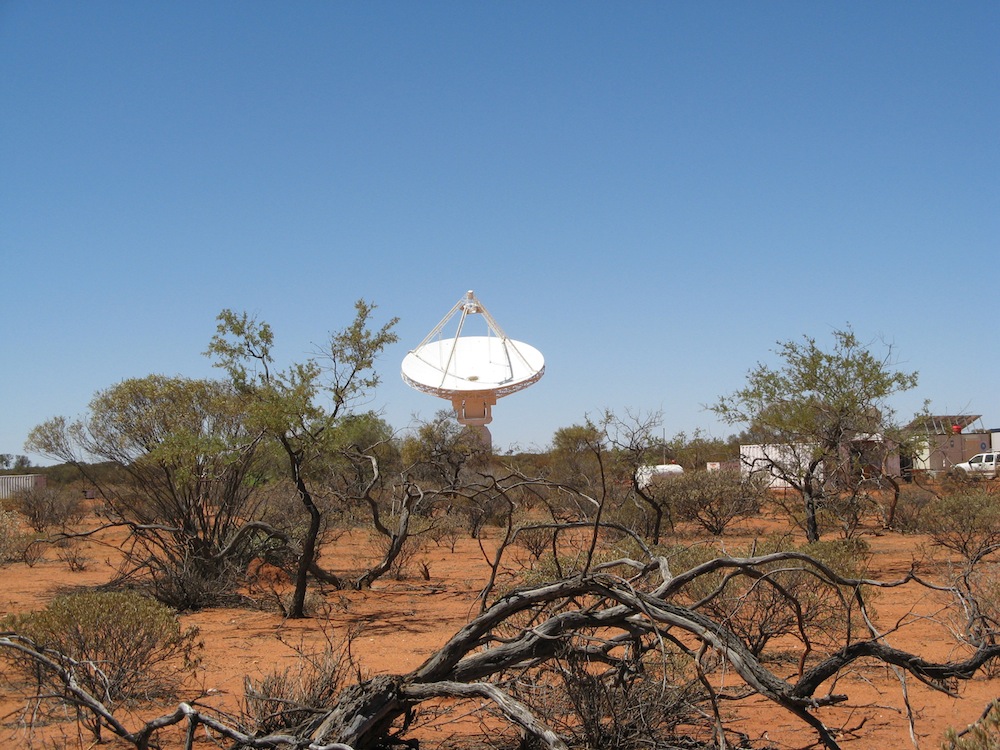
One of the first components of the SKA, constructed in Western Australia. Credit: Dave DeBoer, CSIRO.
The Square Kilometre Array (SKA) is one of the most ambitious scientific projects ever devised, and when completed it will comprise a huge number of telescope antennae which will work as one to form a single radio telescope so powerful that it could detect an airport radar on a planet 50 light years away. The sensitivity of any telescope is defined by the area it uses to collect data. With optical telescopes, this is the size of the mirror, and with radio telescopes it’s typically the size of the dish. The SKA gets its name because when fully constructed, all of the detectors and antennae that make it up will have a combined area of one square kilometre, or one million square metres. To put that properly into perspective, the Green Bank Telescope is currently the largest steerable single dish radio telescope, and its area is just under 8000 square metres.
Being astronomy’s answer to the large hadron collider, the SKA is a staggeringly large international collaboration. I was lucky enough to attend a major meeting regarding the planning of the SKA (the headquarters are to be based here in the UK in Manchester), and the myriad different languages and nationalities represented was impressive to say the least. Over 24 major organisations from countries spanning 5 continents are involved in the project, ranging from universities to industrial engineering companies. New technologies, both software and hardware, are still being developed as a result of this project. Based on the huge data storage and transfer requirements of a machine as complex as the SKA, many of those new technologies are likely to feed straight back into society by offering profound improvements to computing resources like the internet. In fact, as the world’s largest project for sorting and storing data, the SKA is expected to be literally bigger than Google!
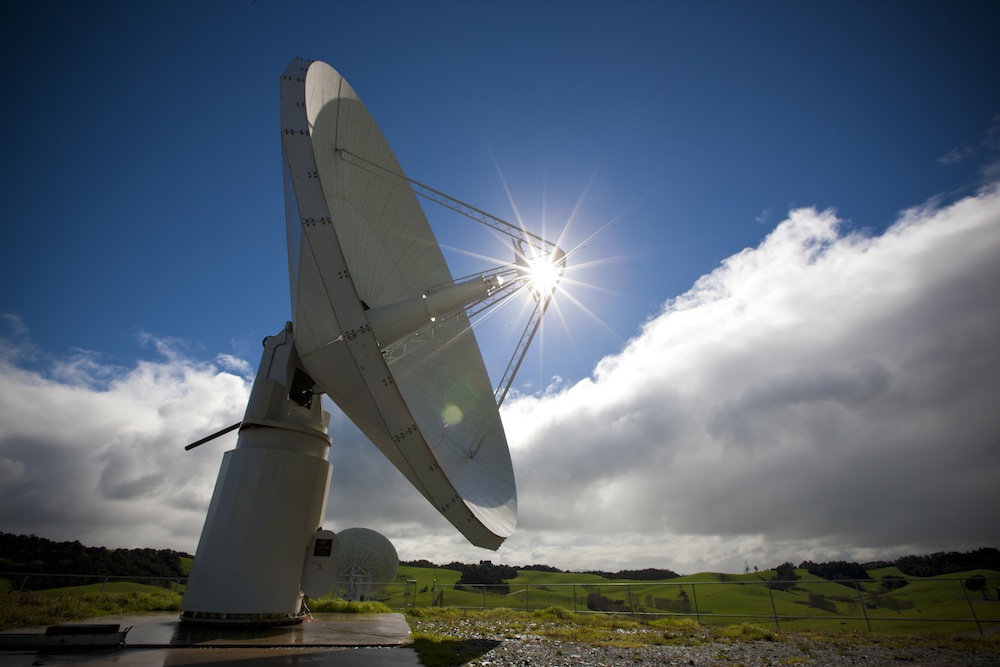
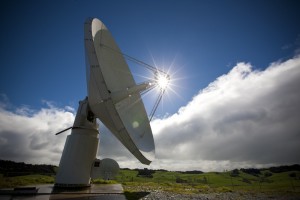
The Warkworth antenna in New Zealand – an important part of early SKA science. Credit: Alex Wallace.
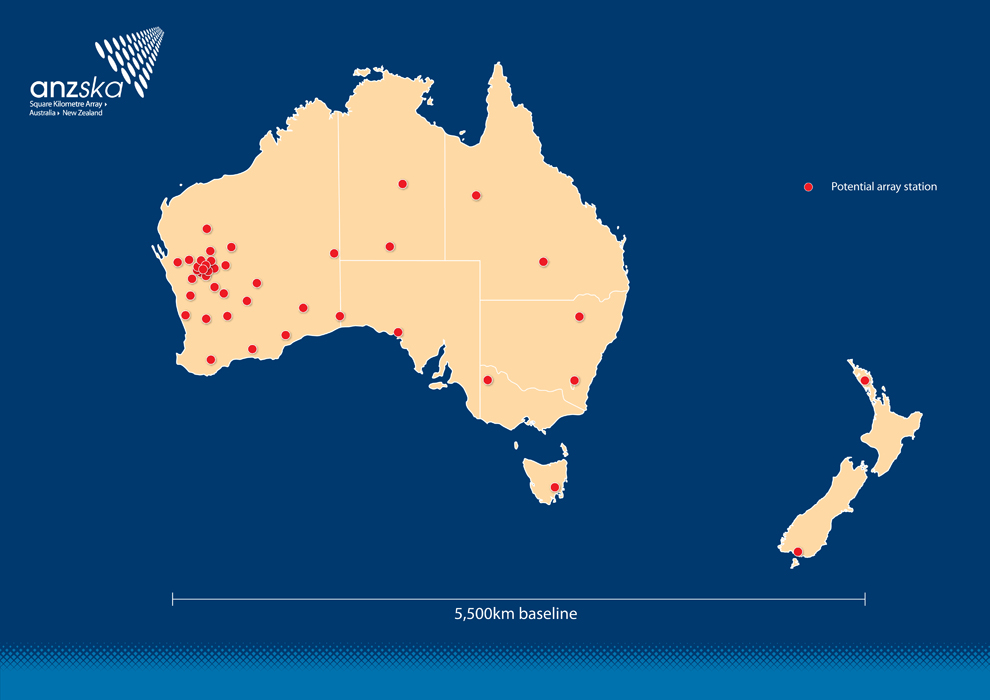
The most difficult decision, understandably, has been where precisely to build it. Humanity has an unfortunate tendancy to fill the atmosphere of our planet with noise, bouncing radio waves to and fro and filling the air with radio frequency chatter. A radio telescope array this sensitive needs to be placed somewhere quiet to gain the full benefits, and the most recent decision has been to effectively split the SKA into two components, to be built in Southern Africa and Australia. While this may seem like an odd thing to do, it actually makes perfect sense. The SKA actually has three types of antenna operating at different frequencies. Intended to cover a huge range of radio frequencies (from 70 to 100000 MHz), three types of antenna are needed, because no single technology can actually operate across such a wide range. So the decision was made to build the lowest frequency detectors across Australia, centred at Murchison in outback Western Australia. Murchison is blessed with being one of the few places on our planet which isn’t flooded with FM radio at the low end of the frequency scale. From a radio astronomer’s point of view, it’s the quietest place on Earth.
This is set to be complemented by the higher frequency steerable dishes which are set to be constructed across Africa. Both South Africa and Australia have put extensive efforts into developing the SKA, and Australian-developed technology is still set to be implemented in the African telescopes. This will mean a huge influx to the African astronomical community and numerous African nations won’t lose out on the economic boost from contributing to such a prestigious project. It’s an ideal situation where everyone wins.
All in all, it’s an exciting time to be an astronomer. An epic project like this is likely to attract all manner of researchers from across the world to both continents. Just maybe, it could also finally help us to answer the really big questions, like how the galaxy formed, how the Universe began, and whether or not there’s anyone else out there.
It’s official. As was the subject of a press conference here in Europe this morning, the LHC has discovered a new particle. Is it the much talked about Higgs boson? Evidently it’s far too early to say with certainty. But whatever it is, it’s a brand new subatomic particle, it’s consistent with a Higgs boson signature, and it’s enough to make CERN physicists quite excited.Whatever it may turn out to be, it’s brand new and never seen before.
This is physics at its most fundamental. The standard model of particle physics is probably our best depiction of how the universe operates at subatomic scales, but our picture is incomplete. A jigsaw puzzle with missing pieces which must still be searched for. One of those pieces is a piece so basic that for a long time it was simply overlooked. Why do objects have mass at all? The existence of the Higgs boson in the Standard Model seeks to address that question. It posits that all the universe is filled with a so-called Higgs Field. Any particles, protons or neutrons for instance, passing through that field will interract with it, and it will interract via Higgs bosons. Any particle which exists in this field will effectively be surrounded by a cluster of these Higgs bosons. The more bosons, the stronger the interraction, and the more massive that particle will be.
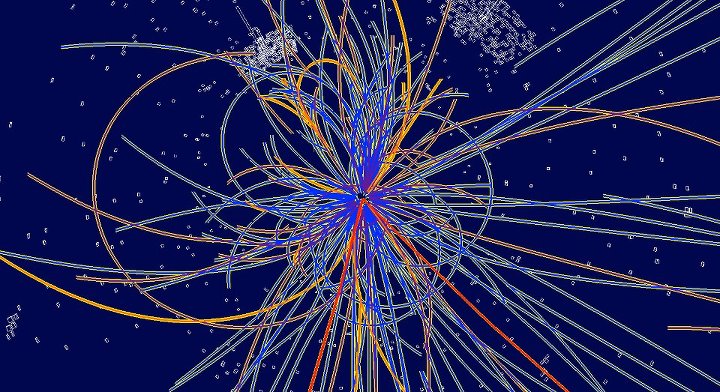
Simulation of Higgs Boson decay.
But exactly what it is that’s been discovered is still being analysed. Amid a press conference full of journalists asking pointed questions about “the Higgs boson”, scientists were noticeably hesitant to outright say that this is what they’ve discovered. And for good reason too, because science doesn’t work like that, no matter how many people might want to run through the streets naked shouting ‘Eureka’. In all of this, only one thing is certain – a new particle has been discovered with a mass of approximately 126 giga electron volts (126 GeV), with a statistical significance of 4.9 standard deviations (4.9 σ).
Peter Higgs himself, declined to make any comment twice during the conference, simply stating that it would not be appropriate to answer detailed questions at this stage. The other members of the panel too, agree that it’s very difficult to say anything definitively right now and that “Higgs-like” would be a better description of what they’ve found. It’s compatible with a Higgs boson detection, but the “uncertainties are still large”. While definitely being “consistent with a Higgs boson”, interestingly it’s noted that they cannot say if this is the Higgs boson (i.e. the one required by the Standard Model), rather at this stage it may be a Higgs boson. Scientifically speaking, it’s far better to only make statements on what’s known to be true, rather than to make brash announcements which may prove to be incorrect a few months later.
Whatever happens after the months of data analysis which are due to follow is that we’re set to unravel a lot more about the fundamentals of the universe. This discovery is on the very edge of human understanding. It may help to refine our knowledge of the Standard Model of particle physics, or it may hint that this particular Higgs boson is not a part of the standard model – a prospect which ATLAS experiment director Fabiola Gianotti seemed visibly quite excited by.
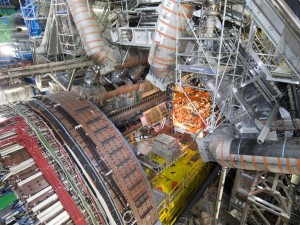
The ATLAS instrument, a detector in the LHC.
Rolf Heuer stressed the fact that the most exciting thing here is the fact that they have a discovery of something brand new, perhaps suggesting that we shouldn’t get too caught up in our expectations and simply enjoy the excitement of there being something never before seen in physics in the process of being analysed. Moreover, this could be the very first fundamental scalar particle, and the first gauge boson which actually has any mass. If it does turn out to be a Higgs boson, then this holds the additional thrill that this particle has a relationship to the state of the universe itself, embodying the substance to all other particles which exist.
In the meantime, as the LHC prepares to power down for a couple of years of maintenance, this discovery will certainly stoke the fires of curiosity in thousands of scientists worldwide. The data are still being picked apart too, for things which are completely unknown. Perhaps even more brand new physics is still waiting to be found. It’s an exciting time in physics right now!
A recent news published online by The Wall Street journalabout the Indian Council of Agriculture Research (ICAR) offer of germplasm from its massive seed gene bank at National Bureau of Plant Genetic Resources (NBPGR) to multinational corporations (MNCs) in exchange for expertise and a share of the profits made me to put forth before you about the topic ‘Free and Open Source Agriculture’ which is proposed and discussed by Janet E. Hope (2004), Susan H. Bragdon(2005), Daniel D. Holman(2007) Keith Aoki (2009) and others. It is strange that the ICAR which is an the apex body of the world’s largest National Agricultural Research System (NARS) coordinating, many institutes involved in basic and strategic research, education and extension, is still looking at MNCs for next generation genetic technologies and the for the want of the same, it is going to share/sell its genetic materials. No doubt agriculture in India and elsewhere in the world is facing challenges from the changing climatic conditions, threats from biotic and abiotic factors. India is rich in biodiversity and with the use of agricultural biotechnology, it is now possible to develop new crop varieties that are tolerant to adverse climatic and poor soil conditions, pests, diseases, insects, weeds etc. and build agriculture and food security. The MNCs with their huge investments have taken proprietary rights on most of the rapid scientific and technological advancement tools and products. Now they are looking at harness the public plant genetic resources for the creation of new generation of crops with the use of advanced molecular biology tools.
As per the Convention on Biological Diversity (CBD) 1992, plant varieties are national sovereign resources and with sui generis system of protection in India under the Protection of Plant Varieties & Farmers’ Rights Act, 2001(PVFRP), the plant breeders and farmers have been given rights for conservation, improvement and re-use. Now the question arises once the MNCs takes the role of plant breeders and claim their rights on the improved traditional varieties with the help of biotechnological tools, does the farmers have any right to use the same improved material for his own use? or would they be left with no choice other than to buy the planting material at the cost specified by the MNCs?
As per the PPVFR, the farmers would have the right to claim for rewards from Gene Fund if genes from their local varieties are used for the production of improved material for commercial purpose, they don’t have any right to participate in decision making on matters related to the conservation and sustainable use of plant genetic resources for food and agriculture as suggested in the International Treaty on Plant Genetic Resources for Food and Agriculture (ITPGR) in Article 9.2. However it seems that in man of the decisions on sharing/selling the country’s germplasm, there is no seeking of prior consent from the farmers/communities from whose locations, the germplasm might have been collected.
Under the IPR regime, the free progress of science and innovation is hampering and the fruits are not reaching to the public while, the exchange of knowledge and tools should be a way of life in agricultural research. Hence, I would like to put forth the concept of ‘Open Source‘ in Agriculture and Biotechnology which is proposed/discussed since quite sometime when the Free and Open Source Software (FOSS) and GNU movements had become global movements. In contrary to the proprietary software which gives only license to work, FOSS gives source code and a bundle of rights to the user to use, reverse engineer, learn, share and improve it. We are seeing now many FOSS products which are built by the community and are very good. These products are licensed as ‘Copyleft‘ or ‘Share Alike‘ of creative commons and or GNU Public License which requires that the copies or adaptations of the work to be released under the same or similar license as that of original.
This concept of FOSS initiative in agriculture has not taken up as a policy by the public funded research institutes. Though the germplasm is being received and sent (shared) by material transfer agreements (MTAs), many of the breeders are not exploring the concept of ‘Share Alike‘. When the crop improvement is being taken up by both public and private, the MTAs should have the licensing terms which asks the agencies to share their improved materials in the similar terms to the public for further use and development without seeking any royalties for the further improvement and use. Recently, there are reports that there is a charge against the Bt Brinjal’s developers in India for violation of the Biological Diversity Act, 2002 and allegations that they had accessed Indian varieties of brinjal for the development of genetically modified ‘Bt Brinjal’ without prior permission from the National Biodiversity Authority (NBA). These issues could be avoided when the materials are freely available to everyone to use and also for re-use.
Though there is a provision for ‘Compulsory License‘ under PPVFR for undertaking production, distribution, and sale of the seed or other propagating material on the grounds that the reasonable requirements of the public for seeds or other propagating material of the variety have not been satisfied or that the seed or other propagating material of the variety is not available to the public at a reasonable price, there is no provision for the use of the material for further improvement.
The FOSS movement had not built in one day but its a continuous building movement. And if this initiative to happen in agriculture, it would be a great thing. However, for that it needs greater advocacy and to be built by the convinced breeders/farmers. Centre for Sustainable Agriculture from Hyderabad in India which is working for sustainable agriculture is now exploring the concept called ‘Open Source Seeds‘. In the world, the BiOS Initiative of Cambia (BiOS – Biological Innovation for an Open Society) is the one which is based on the GNU/FOSS model and is sharing enabling technologies with large community of innovators under ‘Protected Commons‘. The BiOS licenses when employed for MTAs, would enable the public to access to the technologies freely and there would not be any prevention of the same by appropriation of IPR rights by private players.
Premier Ted Baillieu and Minister for Health David Davis today announced that Dr Stefan Gehrig has been awarded the prestigious Premier‟s Award for Health and Medical Research for 2012. The Premier‟s Award for Health and Medical Research recognises and honours the achievements of Victoria‟s early career health and medical researchers.
Mr Baillieu said Dr Gehrig won the award from a highly competitive field of young Victorian researchers for his far-reaching investigation into Duchenne muscular dystrophy (DMD).
“Dr Gehrig discovered that increasing levels of a specific protein in muscles has the potential to treat DMD – a severe and progressive muscle wasting disease,
Whoever thought you could make money in biology, right? Turns out, there is quite a bit of money to be made in this field. And I think we are realizing more than ever the importance of the life sciences and the contribution it offers to society and the economy.
“I think the biggest innovations of the 21st Century will be the intersection of biology and technology. A new era is beginning, just like the digital one was when I was his age.


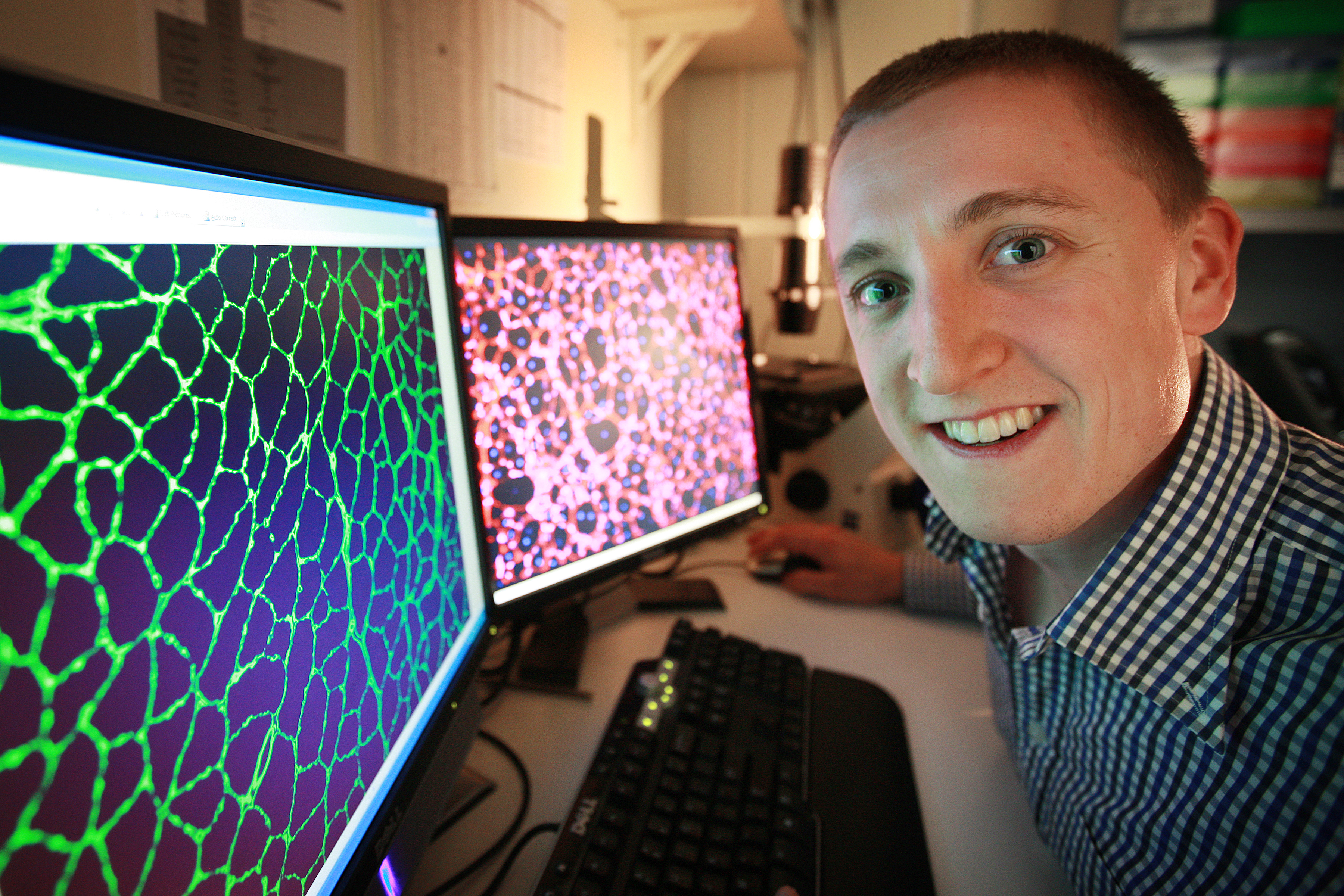
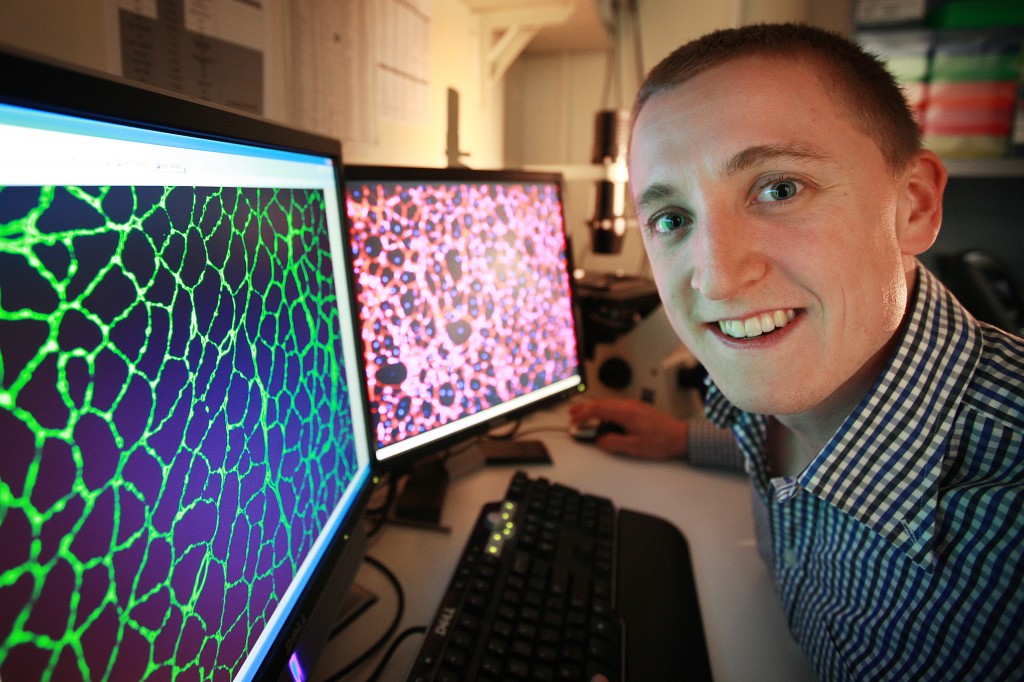 Premier Ted Baillieu and Minister for Health David Davis today announced that Dr Stefan Gehrig has been awarded the prestigious Premier‟s Award for Health and Medical Research for 2012. The Premier‟s Award for Health and Medical Research recognises and honours the achievements of Victoria‟s early career health and medical researchers.
 Whoever thought you could make money in biology, right? Turns out, there is quite a bit of money to be made in this field. And I think we are realizing more than ever the importance of the life sciences and the contribution it offers to society and the economy.