Author: Kelly Burnes

  • Weekly Science Picks

    Weekly Science Picks

    datatunnelI’ve just returned from a fantastic holiday in Australia (sad I had to leave). The great thing about travel is that it opens your mind and exposes your senses – elevates it to a higher level of thinking, thinking that is clear and uninterrupted. The not so great thing about travelling to far away places is the resulting jet lag…that can lead to not so clear and uninterrupted bouts of thinking at 3AM. What follows is a hodgepodge of the collection of science stories I encountered over the past week.


    This first article opens up a much-needed debate on the policy of biodiversity and species preservation. Whether it is rhinos, right whales, snow leopards, I think it’s time we had a conversation on how present day society moves forward with species interaction.

    Rhino poaching in South Africa reaches record levels by Matt McGrath

    “Rhinos are being illegally killed, their horns hacked off and the animals left to bleed to death,” says Traffic’s director of advocacy Sabri Zain, “all for the frivolous use of their horns as a hangover cure.”


    While in Brisbane, I had the great pleasure to meet with the director of Australian Science, Dan Petrovic. We had an hour-long conversation about artificial intelligence. I’m not sure how much interaction I want with my search engine in the future, but the beauty of his story is in the intricate details and the possibilities that may soon be reality. This story technically wasn’t from last week, but that is when I read it. So if you haven’t given it a read, sit yourself down with a cup of coffee or tea and do so. We would love to host a Google+ hangout and get some reader feedback on this topic.

    Conversations with Google by Dan Petrovic

    This article explores the future of human-computer interaction and proposes how search engines will learn and interact with their users in the future.


    I love science. How did I not know about io9? No idea. But thank goodness I have added it to my weekly reading list. (Thanks Dan!) This next story is about humour more than anything. And in science, a sense of humour is an important character trait to have. The U.S. may not be building a Death Star, but kudos to them for the response and taking the opportunity to highlight STEM. My nieces in Ohio are hard at work on building the Lego Death Star they received from Santa. So in a way, the U.S. is getting a Death Star and two aspiring scientists. Maybe thousands!

    The White House will not build a Death Star, tells us in hilariously geeky fashion by Lauren Davis

    If you do pursue a career in a science, technology, engineering or math-related field, the Force will be with us! Remember, the Death Star’s power to destroy a planet, or even a whole star system, is insignificant next to the power of the Force. –  Response from Paul Shawcross, Chief of the Science and Space Branch at the White House Office of Management and Budget


    Apparently Shell experienced an incident with its Arctic drilling on New Year’s Eve, with no catastrophic consequences. Arctic drilling seems like a horror movie. You’re sitting on the couch watching TV, the music is loudening, suspense is growing, you know something bad is about to happen at any second…

    An energy analyst from the Brookings Institution mentions in the article that oil and gas companies don’t have a choice when it comes to Arctic exploration and drilling. In order to remain competitive, they have to go up there.

    In Kulluk’s Wake, Deeper Debate Roils on Arctic Drilling by Traci Watson

    Fortunately for the energy industry, the Arctic has become more hospitable to drilling just as other locations have become more hostile. The Arctic sea ice melted away to a record low in 2012, according to the U.S. National Oceanic and Atmospheric Administration, spelling easier access for drill ships, though melting ice also brings new problems.

    Fortunate. Back to the drawing board. So many plans and policies, so little time.

    As always, stay thirsty for knowledge.

  • Chemtrails – Conspiracy Theory?

    Chemtrails – Conspiracy Theory?

    Qantas Airbus A380
    Contrail or Chemtrail?

    We all know what contrails are: those long thin artificial clouds that form behind aircraft, most often as a result of the water vapour in the exhaust of the aircraft’s engines. But have you heard of chemtrails?

    I first learned of chemtrails after our editor asked if I would be interested in writing a story on it. At the time, I thought it would be a simple story.

    But it’s been over a month since I watched the video, “What in the World are They Spraying? I didn’t realize the amount of research or the length of the list of questions that would emerge. Here, I’ll comment on the video (it’s about 1 hour 35 minutes long), pose some of the questions I had, and offer some analysis.

    Michael J. Murphy is a filmmaker and political activist who wrote, directed and produced the film. The concern seems to be compassionately targeted on public health. That scientists and geoengineers are trying to solve the global warming crisis by geoengineering appears to be unacceptable to Mr. Murphy and his collaborators. Geoengineering is the deliberate intention to moderate global warming by intervening with Earth’s climate system. An example is cloud engineering. Cloud engineering research is underway at the University of Washington as a potential tool to ease climate change, but at this point is only at the initial stages.

    The film tries to touch on some aspects of science and targets aluminium as the cause for an increased alkalinity of soil in California that is damaging plant life and threatens the water supply for hikers visiting Mt. Shasta. This aluminium that falls as pellets from the sky is also thought to be the cause for softening the bark of coconuts trees in Hawaii and why farmers there cannot grow their own taro and papaya. Farmers on the compound in the film claim they want GMO seeds so they can grow their own food naturally. Interesting turn of events and thought patterns, wouldn’t you say?

    I could go into more detail about the effects of aluminium, but I will refrain. If you are keen to learn more about the public health effects, click here.

    The so-called climate engineers are painted as scientists who have crossed over to the dark side. They know the harm these chemicals can cause but must be willing to go ahead with these spraying flights, even if it means harming their own families. Or are they somehow excluded and protected from the aluminium that rains down with coats and hats that offer some sort of super power protection? It was mentioned in the film that they are forming sales, implementation and funding strategies. I’m still not sure who “they” are. They are mentioned over and over and over again as the culprits, the party responsible for poisoning the people and food on our planet. Follow the money, the filmmakers and those appearing in the movie say repeatedly. There is a whole evil empire, beginning to build, that will take over the world. And the evil empire evidently begins with Monsanto.

    The multinational agricultural and biotech company Monsanto is mentioned as a curve ball to distract from the topic at hand and perhaps gain more followers. In the film, it is stated that an aluminium resistant gene had been developed at Cornell University and was patented in September 2009. A search of the United States Patent and Trademark Office website reveals no such patent matching #7582809.

    The filmmakers bring in advocate and conspiracist G. Edward Griffin to join this chemtrail crusade. He talks about how chemtrails don’t dissipate; that a permanent grid hangs over cities like Los Angeles. A bit more confirmation on this is needed for my liking – for instance a time-lapse camera set up throughout the daylight hours, for an entire 7-day period, to see exactly how many airplanes are passing through, creating these everlasting contrails containing chemicals that rain down on us. And the camera should be able to zoom in on the plane, or perhaps a set of binoculars could be used to see the N-Number on the aircraft. Flight plans have to be registered by pilots at airports, so surely with some investigation and tracking down records, we could find out whom these they people are and begin to interrogate them as to why poisoning the planet for profit or using this method to combat global climate change seems like a good idea.

    The first International Chemtrail Symposium took place on May 29, 2010. When you plug this into Google, a myriad of conspiracy type results show up; one is listed under “Godlike Productions”. In the film, we are given a glimpse of this symposium. The phrase, “What God had originally made” is used. Any time God vs. science rears its head in a conversation, it is no longer a logical debate; it is one rooted on emotion and one’s philosophical beliefs.

    Another anecdote that leans this chemtrail film toward the conspiracy theory side is when they invite activist Jeremy Rothe-Kuschel to go to Washington, D.C., to try to persuade elected officials in the U.S. House and Senate to investigate this fleece that has been cast over the American people. Representative after representative shut them down. Ambushing politicians with pamphlets and a video camera does not seem to be the best method for getting one’s case heard. Senator Dianne Feinstein of California humours this crew a bit by taking their information. I’ve yet to see her office actually follow up on the issue of chemtrails by displaying information on their website, holding a public meeting, or introducing a bill for a hearing to the Committee on Science and Technology.

    Over and over there are references that scream sensationalism tactics. Presenting one side of the story as this film does, makes it a bit difficult to really ascertain what the perceived harm is and if chemtrails are really a ploy by governments the globe over to decrease the human race. If it is true, than we should start tracking the whereabouts of aluminium and barium in relation to scheduled flight plans and requesting that our elected officials work with our national scientific organizations to find the answers, while looking for real solutions to climate change that works for the populations and the planet.

  • Weekly Science Picks

    Weekly Science Picks

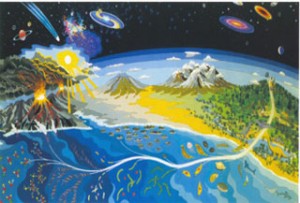
    Cosmic Evolution Connectedness
    Cosmic Evolution Connectedness

    It’s that time again! Time for Weekly Science Picks! Let’s dive in.

    This is interesting. This could really make things interesting. You just need to read this article on climate change and emissions that appeared in The Australian. It opens up a whole can of worms for debate, which I may tackle later, so feel free to leave a comment. I’d love to hear some thoughts on this.

    Doha sets up $3bn hit for taxpayers as climate deal fails to deliver on emissions targets by David Crowe

    “We can’t be allowed to free ride off the suffering of others,” he said yesterday. – John Connor, chief executive, Climate Institute


    This is one of those stories that gets you excited and makes you wish you were part of that research team on assignment. I am anxiously awaiting the results. Earlier this week, drilling began at Lake Ellsworth in Antarctica. This project is testing the environments of where life is possible and has implications for future space exploration and discovery.

    Drilling begins at lake hidden beneath Antarctic by David Shukman

    “Exploring for life in such an extreme environment – in pitch-black conditions under high pressure beneath the ice-sheet – could open up possibilities for life on other worlds such as Jupiter’s moon Europa.” – Professor Martin Siegert, chief scientist


    There’s so much focus and emphasis on space these days, that we forget about that big blue thing that covers 71% of our planet and is in need of some major TLC…ah, the ocean! The Argo data program started in the late 1990s and has since been put to use in weather and climate models. It’s also playing a major role in ocean forecasting, such as responding to environmental emergencies, helping the shipping industry and promoting safety at sea.

    Ocean science robot revolution hits symbolic millionth milestone by CSIRO

    “The world’s deep ocean environment is as hostile as that in space, but because it holds so many clues to our climate future exploring it with the Argo observing network is a real turning point for science. – Dr Susan Wijffels, Argo co-Chair and CSIRO Wealth from Oceans Flagship scientist


    And tying it all back to the source of what’s important, the kiddos. This last pick comes from one of our very own Australian Science authors, Danielle Spencer. Here Danielle examines the importance of play-based learning in the science classroom.

    We’re Just Playing, Science by Stealth by Danielle Spencer

    Play-based learning is highly sanctioned in early year’s curriculum, but why do we need to stop? Ask any child who doesn’t like science and it’s about too much writing, too much theory, too much bookwork. Maybe, we just should let them play some more.


    Stay thirsty for knowledge, my friends. Stay thirsty.

  • Come on in, the Water is…Frozen

    Come on in, the Water is…Frozen

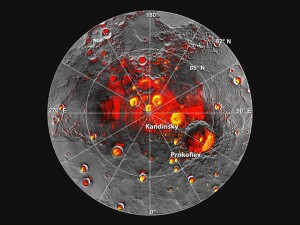
    MESSENGER detected the presence of polar ice on Mercury. The spots shown in yellow are craters containing ice. Source: Image Credit: NASA/Johns Hopkins University Applied Physics Laboratory/Carnegie Institution of Washington/National Astronomy and Ionosphere Center, Arecibo Observatory

    Water – the source of all life. It’s been found on what we have believed for many moons to be that little hot-tempered planet named Mercury. It seems the celestial body has a shady side, a split personality perhaps; one side ferociously hot, while its polar opposite features some craters of ice. NASA scientists have unequivocally confirmed the presence of water on the planet. Ready for a swim? Ice-skating may be more appropriate.

    The Finding

    Rarely does consensus on discoveries such as this occur. Three methods, neutron spectrometry, near-infrared reflectance and thermal models from MESSENGER, were used to conclude and confirm the presence of water and organic material on Mercury.

    The duality of Mercury is somewhat perplexing; can you imagine living on a planet with a temperature range between -223C and 427C? It is in these shaded, cold regions, those that never see the sun, where the ice lies bare and exposed. However, data from MESSENGER also show that frozen water is found in slightly warmer areas. It lies buried beneath a dark material, an insulator of some sort covering it, and there’s a lot of it. Estimates put the amount of water ice on Mercury between 100 billion and 1 trillion metric tons. That’s enough water to cover an area the size of Washington, D.C., 3.2 kilometers deep.

    Where Did the Water Come From?

    Much the way Earth came to have water and organic material, it is thought that comet impacts and asteroid strikes created the same organic building blocks of life on Mercury. At last Thursday’s news conference, researchers were bouncing around all sorts of hypotheses on what this discovery could mean for life in other parts of our solar system. Messenger principal investigator Sean Solomon, of Columbia University’s Lamont-Doherty Earth Observatory said “there’s a lot of water out there, as there is a lot of water around other stars, but at substantial distance. “The solar system is “a soggy place ” according to Jim Green, director of NASA’s Planetary Science Division. Green went on to explain his enthusiasm with that statement, indicating “it really bodes well for us to continue on the exploration, following the water and its signs throughout the solar system.” How water was brought to Earth and Mercury, were probably brought to other planets.

    With any good find, come more questions…

    These observations, while extraordinary, can only heighten our curiosity about Mercury and the rest of the galaxy. Is the dark material in the polar craters on Mercury mainly organic compounds? If so, what sorts of chemical reactions has that organic material undergone? Is this the same material that gave rise to life on our planet? Are there regions on Mercury that have both liquid water and organic compounds? Only by continued exploration of space can we hope to find answers to these questions.

    Life as we know it, will probably not be found on Mercury given its ultra-thin atmosphere and proximity to the sun. The discovery of water ice and dark organic material can still inform the hunt for organisms beyond Earth and help scientists piece together the puzzle of how life began on our planet. We still do not fully understand the beginnings of life and the chemical reactions associated with those beginnings on our own planet.

    Last week’s discovery of water and organic material on Mercury will indicate we have a lot to learn. Hopefully, it opens up vast areas of research that radiate outward, showing the connections of our segmented universe. How we see view and study other planets has great value for how we analyze and safeguard ours. For instance, what are the implications for planetary warming (climate change)? What can the ice trapped beneath the organic carbon material tell us? The thermostat of astrobiology has just been ratcheted up a notch.

  • Citizen Science

    Citizen Science

    Monarch butterfly (Danaus plexippus), Source: Wikipedia Commons

    Citizen Scientists

    An interesting report released last week from the UK Environmental Observation Framework reveals the benefit of citizen scientists to governmental environmental organisations. The Nerc Centre for Ecology and Hydrology and the Natural History Museum in London, reviewed 234 projects – ranging from small surveys to large-scale programmes. The results found the involvement of volunteers offers “high value to research, policy and practice”.

    Given the increasing number of complex scientific problems facing our communities, states and countries; coupled with the ever dwindling supply of cash on hand to fund research projects, it behooves governments to dial into this untapped source of volunteer environmental monitors and data collection specialists. People enjoy going to their local botanical gardens, taking the kids and grandkids to learn about the natural world surrounding them. A large majority of the population love their parks for taking walks and having picnics and for exercise. They want to see these lands, with the flora and fauna contained within them protected. People volunteer for things they believe in and causes they want to see sustained. That is the movement around science and the environment and why the citizen scientist movement is growing.

    Scientists should be working with their governmental departments, or university outreach extension centers, to coordinate community science volunteer days. Measuring leaf litter in a forest, or tree ring growth, or monitoring a stream for the presence of certain harmful bacteria or toxic chemicals, or tallying the number of a threatened bird species are a few such projects that could be undertaken by community members. Scientists and their research teams and graduate assistants could customize their research projects with a component where they served as project managers working with the community to accomplish a piece of the data collection puzzle.

    The Value – Minuses and Pluses 

    Of course, not every project will be appropriate for citizen scientists and a fair amount of training may have to be done, given the nature of the project. And the report touches on the fact that although the quality of the data collected by citizen scientists could be excellent, it may not be fully recognized by all researchers or policymakers. This seems to be an area that would require some policy work in setting up standards to ensure the legitimacy and recognition of such projects undertaken with contributions from citizen scientists. That minus shouldn’t be so hard to turn into a plus. Volunteer-collected data possesses a bevy of potential benefits. The use of smartphones continues to increase among consumers and with that comes development technologies in the form of apps that could play an easier role in data collection. A scientist could quite easily dispatch his volunteer army with marching orders to perform observations of the monarch butterfly (Danaus plexippus) over a 5-acre area of the park and have his/her data collection completed within a month’s time. And of course, the benefit that every bureaucrat or department chair loves to hear: it’s a cost-effective way to collect environmental data and could help meet the demands of increasing governmental reporting and compliance requirements.

    Getting Started

    I think it’s up to each and every one of us to identify the actions we can take that will help continue to make our environment habitable. And becoming involved in a citizen scientist program seems like an ideal way to start to make a difference in your community. Whether you are a scientist or a volunteer, the guide, produced alongside the report by the UK Environmental Observation Framework, is a great place to begin identifying and mapping out strategies for a collaborative citizen science project.

  • Turn Back Time

    Turn Back Time

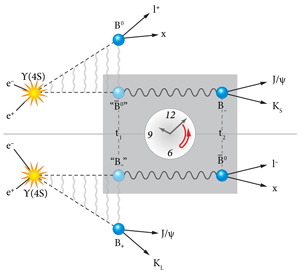
    Electron-positron collisions at SLAC produce a Υ(4s) resonance that results in an entangled pair of B mesons. Source: http://physics.aps.org/articles/v5/129

    Recall the outrageously cool movie from the 1980s, Back to the Future? Marty McFly and Doc Brown were stretching scientific boundaries, righting the future, all while making sure not to meet their future selves. Fast-forward and time travel may be closer than we think. (Close, relatively speaking of course.)

    If you like exceptions to the rule, well, you’re in luck because the Department of Energy’s (DOE) SLAC National Accelerator Laboratory has achieved something quite impressive – the BaBar experiment.

    The BaBar experiment investigates the most fundamental questions about the universe by getting back to basics with elementary particles. It’s a global collaboration of physicists delving into the nature of antimatter, the relationship of quarks and leptons and crossing over into areas of physics yet to be explored.

    Earlier this week, scientists working on the BaBar project made the first direct observation of a violation to the concept known as time reversal symmetry. Their work was published in Physical Review Letters if you want to journey into the world of  B mesons.

    How did they do it?

    Data from billions of particle collisions, nearly 10 years worth, were poured over and sifted through by researchers on this project. They examined a chain of particle transformations in which B mesons flipped between two different states called B-zero and B-even. This quantum entanglement of B mesons enables information about the first decaying particle to be used to determine the state of its partner at the time of the decay. This allowed the team to find that these transformations happened six times more often in one direction than the other.

    Largely by thinking there was something wrong with the picture they were looking at was how missing pieces of the puzzle were filled in, according to the physics coordinator for BaBar, Fabio Anulli of the National Institute for Nuclear Physics in Rome. The BaBar data they had showed evidence of change-parity symmetry violation, so this was a good place to start looking. In fact, just looking at the data in a slightly different way allowed them to the see time violation.

    Given the abundance of data the BaBar team had to work with, they were able to measure the T-violation to the 14 sigma level – a high level of statistical significance. Basically meaning there is only 1 chance in 1043 that this effect is not real. Recall the Higgs boson discovery this past summer; that was granted a 5 sigma level. The results demonstrate that the direction of time matters, at least for some elementary particle processes. This provides a strong confirmation that a few subatomic processes like to do things on their own schedule – they have a preferred direction of time, changing into one another much more often in one way, than they change in the other. Time does not run the same forwards as backwards.

    The findings – full of futuristic possibilities

    What does this mean for the future? This discovery may rock our world in ways we haven’t even conceived of yet. It could have implications for business, for communications, for me getting to Brisbane instantaneously without first stopping for a layover at LAX. We may have perhaps inched closer to that time travelling ease marvelously displayed in Star Trek. Stay tuned.

    Discoveries such as this make us think about the beauty of science. The vectors and numbers and B mesons – scientists work that stuff out to provide the beautiful possibilities that are so important to the human race. It may be small now, but we’re definitely on to something bigger. Think how many picture frames we may just be able to tilt to get the answers we seek.


  • The Science Surrounding James Bond

    The Science Surrounding James Bond

    James Bond in Skyfall. Original source: The Guardian. Photograph: Francois Duhamel

    Bond. Double Bond.

    That was a quip a lab partner of mine cracked during a sophomore chemistry class and I have not forgotten since. And it is a perfect lead in for this week’s post as I take you through the past and into a closer look with – The Science Surrounding James Bond.

    This year marks the 50th Anniversary of Ian Fleming’s classic James Bond series. And Friday, 9 November 2012, the 23rd installment of the series, Skyfall, hit theatres in the United States. And I wouldn’t have missed it for the world.

    I became a James Bond fan early on, around age 5, thanks to my Dad. Perhaps, not the most appropriate film choice for a 5-year-old per se, but that’s water under the bridge. What captivated my attention so? The action-packed chases, the sports cars (Aston Martin DB5, yes, please), the explosions, the science behind it all!

    The Quartermaster – Q

    The Quartermaster, known affectionately by the moniker ‘Q’ is head of the fictional research and development division of the British Secret Service. Q – always the scene stealer, in my opinion, whether portrayed by John Cleese, Desmond Llewellyn, Peter Burton, and now the youngest gadget genius, Ben Whishaw – keeps the spy business humming along. Where would 007 be without Q who created so many of those gadgets allowing his to escape safely and serve country and Queen? Q in fact answers this question in License to Kill.

    “If it hadn’t been for Q Branch, you’d have been dead long ago” – Q to Bond

    Yes, where would James Bond be without science and technology?

    I could not possibly list all of the gadgets and technology featured in the James Bond films. Well, I could, but for space’s sake I’ll refrain. I’ll just highlight some of the more clever mechanics and mind-blowing inventions, some of which still have relevance today. Perhaps. This may be a list of mundane ordinary household items or personal effects, that are anything but, and all very much deadly. I’ll also include the movie reference for homework, just in case you’d like to check it out for yourself.

    Handgun with palm recognition – Skyfall

    Bioemetric Fingerprint Scanner – Diamonds Are Forever

    Radioactive Lint – On Her Majesty’s Secret Service  (Fun fact – George Lazenby who played Bond in this film is Australian)

    Perfume Flamethrower – The Spy Who Loved Me

    Montblanc fountain pen – Octopussy

    Mini Submarine – For Your Eyes Only

    SNOOPER – A View to a Kill

    Philips Keychain – The Living Daylights 

    Miniature Binoculars – The Living Daylights 

    Dentonite Toothpaste – Licence to Kill

    Surfboard – Die Another Day

    Kids, there is a lot of chemistry, physics and hi-stakes math going on these films, so pay attention. Many of these inventions and gadgets helped keep humankind safe from terrorism and evil in the films. I’d hate to be a Debbie Downer and mention the downside, such as the loss of life, and destruction to the environment that sometimes results from Bond’s escapades, but there is a price to pay for freedom. All the more reason to study the sciences with the aim to improve the societal good of the world!

    The Old and the New

    The tales of Bond have allowed audiences to see the world; those that maybe haven’t had the luxury to travel so much. For a kid growing up on a farm in the Midwest, those movies opened my eyes to different lands and cultures and set my mind racing with possibilities. Possibilities of what I wanted to do in the field of science.

    I really don’t want to give anything away for those that have yet to see the film (IT’S SUPERB!), but Skyfall especially displays that melding of the classic Bond with the futuristic Bond. Bond has actually found immortality – the writers, producers and actors have found ways to continually reincarnate and refresh this character for future audiences. Here’s to another 50 years of shaken martinis, fine tailoring, fast sports cars, death-defying stunts, witty one-liners and keeping the world safe from terrorism at all levels. Cheers.

  • Weekly Science Picks

    Weekly Science Picks

    It seems the rate of everything has increased exponentially. A very bold, vague, yet intriguing statement, you might say.

    During the course of the past 2 weeks, Hurricane Sandy devastated the East Coast of America, followed closely by a nor’easter. So my science picks for this week center on the themes of natural disasters, planning, global warming and Space, and the rate of which we have to increase our thinking and innovation in order to get ahead of these issues, before they become serious problems.

    So let’s get started.

    I was out of town when Hurricane Sandy struck. My neighborhood in Brooklyn was pretty much untouched. While I heard reports from friends not having power, and subways and airports being closed, it wasn’t until watching the hurricane relief telethon that I realized the magnitude of destruction. And I chose the following article by our very own Charles Ebikeme because it is important to remember that Haiti has yet to recover from several rounds of natural disasters. The U.S. will rebuild. Considering a large portion of the Haitian population still remains housed in tents from the earthquake, will they be able to rebuild? Before the next natural disaster strikes?

    Sandy’s aftermath by Charles Ebikeme

    While most of the focus of western media centred on the damage Sandy caused in America, especially this close to a Presidential election; there were few news outlets that reported what had passed in the Caribbean — outside the death tolls and damaged infrastructure. Indeed, as it is becoming more and more apparent, it is always the blogosphere that provides an adequate source of information. Hurricane Sandy’s progression was followed by bloggers on the ground, giving another side of the story we don’t often get to see.

    But it is in Haiti, a country that has yet to recover from tropical storm Isaac that hit in August of this year, as well as the earthquake of 2010, that felt the worst of Sandy’s wrath. 1.8 million people in Haiti are affected by the storm, according to the United Nations relief agency.

    This next story appears in the current issue of Scientific American and drives home the point why immediate action on climate change, energy and planning (community planning) is necessary to attempt to prevent incidences such as Sandy, or at least lessen the amount of destruction as much as possible. Obama won re-election this week. And while there is no shortage of issues to tackle, the President needs to implement an energy policy for this country. And it’s called global warming, so I hope the world can come together within the next four years and knock out a sound plan.

    Global Warming: Faster Than Expected? by John Carey

    The potential for faster feedbacks has turned some scientists into vocal Cassandras. Those experts are saying that even if nations do suddenly get serious about reducing greenhouse gas emissions enough to stay under the 450-ppm limit, which seems increasingly unlikely, that could be too little, too late. Unless the world slashes CO2 levels back to 350 ppm, “we will have started a process that is out of humanity’s control,

  • The Continuing Saga of the Genetically Modified Plant

    The Continuing Saga of the Genetically Modified Plant

    Mutant Fruits, Photo Source: Wikipedia

    GM (Genetically Modified) Foods

    “Jack! Did you see that potato move?! He’s a GM, that one, he’s sprouted eyes and I bet he’ll grow legs next! He’s gonna round up his buddies and take over the farm!

  • Payload

    Payload

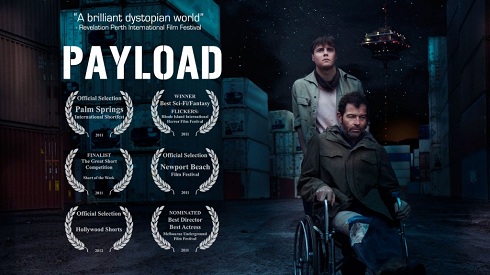
    Source: http://www.payloadfilm.com/about/

    Science Fiction

    This may not be the usual topic for a blog post normally displayed on Australian Science, but when our editor Danica mentioned she saw this great Aussie short and asked if one of us writers wanted to do a narrative, I jumped at it. The next 17:55 of my lunch break left me in awe.

    A movie doesn’t have to be a full length feature to have an impact or drive home a message. And Payload really packs a punch. There were so many messages; messages of a society that travelled down a drainpipe. Clarke’s Town is a place that would have just about every council of the United Nations mired in details and confusion and working round the clock. The issues raised in this fictional setting being human trafficking, prostitution, the sale of human organs or body parts, smuggling, security, poverty, gender, food, clothing, education… corruption is everywhere. You get a sense of normalcy among the Carter clan, but that normalcy is faced against the outside operations of a world that does not make sense,which is far bigger than the Carters. Sacrifice is the only way for survival.

    Clarke’s Town is a functioning spaceport, which is a character in and of itself in this story. This spaceport, this crawler, is painted as an escape to freedom and perhaps to normalcy – from dystopia to utopia. Is that why the mother never came back? Is Davinia “Dave” Carter now saved from what one can only suspect was to be a dreadful and despairing existence? Simon Carter may have been doing what he had to do, but he is Davinia’s hero. The main characters – Simon, Adam Carter (the father) and Kate Henshaw – each went through a visible transformation, almost a metamorphosis of sorts. They took what little there was of a moral high ground when it came to the reasoning of right and wrong (no matter how wrong). With Davinia, as she says goodbye to Simon at the spaceport, she leaves you with the thought that her transformation, her payload, is yet to come. I find it rather apropos the meaning of the name Davinia/David is “beloved”.

    I’m having a hard recalling when exactly was the last time a movie moved me as much as this little motion picture has. From the setting, to the haunting yet soothing tones of the music, it makes you think what society, our world, would be like without some of the resources we take for granted every day. More so, I think it makes you think about some of the countries, or communities, in this world just struggling to gain access to basic resources.

    Writer and director Stuart Willis mentioned extending Payload into a feature – set 10 years later when Earth is being evacuated. Will answers be given to the questions raised in the short? My synapses are already firing up hypothetical synopses. If there were a motion picture category for the Nobel Prize, I would say award it to Mr. Willis straight away.

    Watch the movie.

  • Weekly Science Picks

    Weekly Science Picks

    Chemical Structures, Photo credit: www.southtexascollege.edu

    This past week was made notable by the Nobel Prizes awarded. So much great research being done, it can make your head spin. Chinese literature took center stage, and for peace…the European Union… Be sure to catch up on all the action here.

    Just some of the stories that grabbed me, motivated me and infuriated me are listed below. I think they’re worth a read; let us know what you think.

    Ocean acidification is one of the topics I think people hear or read the headline and move on, not giving it a second thought. Or maybe that;s just my opinion. I think we all need to take a hard look at the amount of CO2 humans are pumping into the air. And think about how our own individual actions, in our neighborhoods, whether we live near an ocean or not, affect marine life and what the consequences of these impacts might mean.

    Ocean Acidification by Liz O’Connell

    Will ocean acidification spell a watery grave for vital parts of marine ecosystems? Marine ecologist Jane Lubchenco, head of the National Oceanic and Atmospheric Administration, named ocean acidification global warming’s “equally evil twin.”

    Again, I may be on my Public Service Announcement soap box here, but biodiversity doesn’t receive the attention it deserves either. The section that caught my attention most was the section in the article describing ‘We have the science: policy is the next step’. I believe this concept is something that we, as communicators of science, need to be vigilant in spreading.

    Explainer: what is biodiversity and why does it matter? by Steve Morton, Andy Sheppard, and Mark Lonsdale

    To halt the decline in biodiversity across the continent, we must translate accumulated knowledge on biodiversity into government policy. This can be done through programs and on-the-ground management. Tough decisions need to be made about where to invest, what to manage, and which approach to take.

    Climate change. Carbon capture and storage (or sequestration) is a huge topic as the world looks for ways to reduce CO2 levels, keeping greenhouse gases in check and prevent global temperatures from rising 2°C. Speaking of we have the science: policy is the next step… significant work needs to be made on this front.

    Carbon capture: 130 plants need ‘to avoid dangerous climate change’ by Adam Vaughan

    More than a hundred carbon capture and storage projects (CCS) musst be built to avoid dangerous global warming, an international CCS  group said this week, as fears were raised over whether UK projects would benefit from an EU fund for 12 demonstration plants.


    A.D.H.D. This is something we need to look at as a nation, and I’m so very curious what the experiences of other countries surrounding this issue are. We have to fix the environment. What kind of policy do we want where we dope kids up to get though to complete an education? You have to read this article to understand what I am referring to. In some instances, medication may be warranted, but I feel this doctor may be going beyond his Hippocratic Oath; especially when he doesn’t know the harm he may be doing.

    It is a constant argument and debate here in the U.S. about academic performance and teacher effectiveness. We like band-aids and pills to fix problems. Who thinks this is a good idea? I don’t believe this is good for the patient without A.D.H.D. or good for society.

    Attention Disorder or Not, Pills to Help in School by Alan Schwarz

    “I don’t have a whole of choice,” said Dr. Anderson, a pediatrician for many poor families in Cherokee County, north of Atlanta. “We’ve decided as a society that it’s too expensive to modify the kid’s environment. So we have to modify the kid.”

  • Got Science? Australian Science on Display at Mitchelton State School

    Got Science? Australian Science on Display at Mitchelton State School

    A young scientist on the brink of discovery during National Science Week

    In my last post, I talked about the role of imagination in science and early childhood education and the U.S. efforts on encouraging students to pursue careers focused on STEM (Science, Technology, Education and Mathematics). I also mentioned that I would be featuring a primary school in Brisbane, Australia to gain an understanding of their science curriculum. If Australia was worried about their place in the global rankings of science and math test scores and working to get kids interested in science at an early age, they only need look at the example being set by Mitchelton State School. It starts with passionate and committed teachers.

    SC@M

    The Science Club at Mitchelton (SC@M) came about as an initiative of teacher Ms. Danielle Spencer. After completing an Education Queensland scholarship-funded Graduate Certificate in Primary Science, she wanted to start a club at Mitchelton dedicated to promoting students’ interest and involvement in science, and particularly to encourage girls to participate. With the support of Principal Roger Sheehan, Ms. Spencer worked collaboratively with Ms. Katie McIntyre, Head of Curriculum, and the two educators laid out the objectives for the new science club:

    1)      Promote science and a love of scientific enquiry within Mitchelton State School.

    2)      To provide opportunities and facilities that support scientific interest.

    3)      To liaise with external groups with similar objectives and aims.

    4)      To encourage girls interest in science.

    To join SC@M, students were asked to submit an application containing a series of questions about their views on science, why they wanted to join and what they wanted to do in the science club. For some of the questions they were asked whether they agreed with a statement and why or why not. For example, ‘Science has too much math in it’ and ‘Men are better at science jobs than women’. I find it fascinating the children were questioned about their views on the gender imbalances in science. This area is a personal research interest for Ms. Spencer. Once the application portion was complete, students agreed to commit, with the support and consent of their parents, to attend each week for one lunch break and participate fully (and safely) in all activities.

    Each term would be dedicated to a different area of scientific knowledge including physics, biology, chemistry and earth science driven by the children’s interests. To ensure that student activities are developmentally appropriate for the students, Mitchelton established SC@M to focus on Years 4 to 7. However, they are finding the younger kids want to join the science club too; so discussions are underway to assess the feasibility of adding a second period to the week allowing them to participate in activities geared toward their age and comprehension level. Less than two months old, I’m not sure the school was prepared for the level of enthusiasm displayed by the students to participate in SC@M once National Science Week came around and more children applied for the club. Thirty-nine children are now participating in the science club, and if numbers keep increasing they may have to initiate a cut off and place children on a waiting list.

    National Science Week

    National Science Week started 15 years ago, but this was Mitchelton’s first year participating in the nationwide event (August 11-19th) and to really shine the spotlight on it, they organised a Science Expo at the school to run for the whole week. The event included hands-on activities allowing the students to investigate the properties of slime, rocks and sound; exploring world‘s not seen by the naked eye with microscopes; and discovering natural events such as tornadoes in a bottle and exploding volcanoes. The entire school took part in the Science Expo with a poster design contest, a competition to name the school’s new skeleton, and a scientist dress-up day. The kids listened to a brief presentation from one of the SC@M coordinators and then were free to explore and interact with the exhibits for 45 minutes. Many of the children were having so much fun they did not want to leave when their time was up.

    Mitchelton opened up the Science Expo to the public for two afternoons so parents and members of the community could engage in scientific exploration with their children and others. Here the SC@M members chaired the different science stations and provided their expertise and scientific rationale to the public. In addition, the school invited members of the high school community to share the experience by presenting a Science Show to the students and hosted a representative of the Young Scientists Association. On the final day of Science Week, a group of visiting scientists presented science demonstrations at a school-wide event. These activities involving the high school students and the visiting scientists clearly demonstrate Mitchelton’s holistic thinking on identifying and building the scaffolding necessary to show students that a pathway to continue their pursuit of science does exist.

    The science club is the highlight of my week, just love it! – Danielle Spencer, Teacher at Mitchelton State School

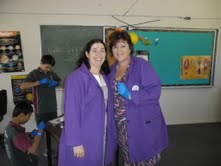
    Teachers' commitment to science: Ms. Katie McIntyre (left) and Ms. Danielle Spencer

    Australia Places National Emphasis on Early Childhood and Science

    I wanted to know if the same emphasis on early childhood instruction is placed on teachers, kids and schools in Australia, as in the U.S. Ms. McIntyre stated, “There is certainly a huge emphasis placed on early childhood development, and in more recent times, Queensland education has focused on increasing students participation in a pre-prep program similar to other states.” This has resulted in the establishment of a large number of independently run pre-prep centres housed in primary schools. She went on to say teachers are finding that the Australian Curriculum is expecting more of students at a younger age and they are adapting their teaching practice to this requirement. While the prep curriculum remains play-based, there is a growing emphasis on explicit instruction in literacy and numeracy. This is similar to what is happening with the early childhood curriculum in the U.S., though I will have to leave my compare/contrast analysis for another posting and get back to science.

    Both Ms. Spencer and Ms. McIntyre agree the Australian Curriculum endorses and provides a hands-on approach to engage children in science and develop that passion for it. Ms. McIntyre indicated that in addition to exposing children to science, it’s also essential “to develop the attributes of curiosity that are necessary to the investigations around science.” One way Mitchelton incorporates this active learning involves activities from CSIRO – The Commonwealth Scientific and Industrial Research Organisation. Ms. Spencer has used numerous activities from CSIRO, (e.g. The Helix and Scientriffic magazines) in her classroom and feels CSIRO provides a valuable resource for science teachers in Australia. She appreciates that the activities are enquiry-based and directly linked to the different strands of the Australian Curriculum. Having that link between CSIRO and the national curriculum is vital. I believe this level of collaboration demonstrates a complete feedback loop where the local level works with the state and national levels to influence and advance the science curriculum and grow the interest and passion for careers in science.

    It’s inspiring to hear and see the students at Mitchelton wanting to be involved and, in fact, demanding more science in their school day. In addition to joining SC@M, several students who displayed an increased aptitude for scientific enquiry were encouraged to enter national science competitions such as the 60Second Science Video Competition (organised by Brendan O’Brien and sponsored by the Department of Education and Early Childhood Development in Melbourne, Victoria), and the NATA Young Scientist of the Year Award. At this writing, I am pleased to report that Mitchelton swept the primary school award category for the entire state of Queensland. The winners and notable mentions are:

    1st Place: Xanthe Czerniawski

    Runner-Up: Jessamy Bryant, Jacob Schofield & Hunter Griffiths

    Highly Commended: Amelia Czerniawski

    Highly Commended: Amelia & Claudia Czerniawski

    Well done, kids!

    How Australia Must Inspire its Young Scientists 

    The Australian Curriculum has identified science and math as two of the core priorities to prepare students for further study in science and technology careers, though Ms. Spencer worries the problem Australia faces “is the declining involvement in math and science carers.” She states this is particularly notable with girls and has been the basis for numerous national studies and strategic reports. Both Ms. McIntyre and Ms. Spencer feel that the primary school setting could use more resources and funding as they are limited to the types of scientific experiments they can instruct children in. We all understand budgets are tight, but earlier exposure to quality science activities could raise the interest level of children, providing long-term benefits. Where do you put the money for the greatest return on long-term investment?

    The other investment that must be made is in teachers. Teachers who continue their professional development, who pass their love of learning for exploration and discovery in the pursuit of science, (and any discipline, really) is how kids will continue on with careers in science and technology. It’s not a guarantee of course, but teachers are that spark to the kindling that starts the fire of learning in students. It’s up to the students to carry the torch. It would be interesting to follow up later and see how many of this inaugural group of SC@M members are working to cure diseases, attempting to solve our energy problems and tackling our food security issues. Or maybe they go on to design buildings, work in government to protect our natural resources with laws and regulations, or use their social media gadgets to communicate the stories of science to others. But we’ll have to wait a few years for that. In the meantime, let’s hope their curiosity in learning continues and prepares them well for the avenues they choose to travel. They have a head start at Mitchelton.

    Special thanks to Mitchelton State School staff – Roger Sheehan, Danielle Spencer, and Katie McIntyre – for their gracious participation in the Q&A and photos for this article and the commitment they demonstrate in providing an enriched, quality education for the children in the community they serve.


  • Weekly Science Picks

    Weekly Science Picks

    So much science, so little time… – Photo credit, Leo Reynolds

    Sigh, my photo caption sums it all up…

    But here are the news stories that caught my eye and I hope you find them interesting as well. Maybe reading them will inspire your own work or to dig deeper for answers. In any case, enjoy!


    This is one of my favorite topics because it offers up rampant debate on so many topics – society, education, cognition. You’re just going to have to read it for yourself.

    This Is Your Brain on the Internet (Maybe) by Kyle Hill

    So what is the Internet doing to our thinking? It is hard to say. Current research has a hard time keeping up with the break-neck pace of online culture, and only the more conventional mediums like television and newspapers have been evaluated in any rigorous sense.


    Newspapers might be old school, but they do have an online media presence as well these days. This article was published in The Australian this week and concerns Australia’s own CSIRO. Genetically modified crops and foods have been a part of our collective diet for many years, whether or not some want to admit it. And they are here to stay. I am of the opinion that they play an important role in our food security given a number of ever changing variables in our environment. The usual characters are depicted in this piece and it will be interesting to follow this story and hear the response from CSIRO.

    Scientists Wary of CSIRO GM Crop by Adam Cresswell

    SCIENTISTS from three countries are warning a CSIRO-led push to make Australia the first nation in the world to introduce genetically modified wheat crops could pose a significant health threat to humans and other animals.


    If you haven’t heard, NYC Mayor Mike Bloomberg has banned sugary soft drink sales in cups larger than 16 0z. in his efforts to personally tackle the obesity epidemic. I feel some disclaimers are in order: One, this story did appear on www.bloomberg.com, but you could have found it in a variety of online publications; and two, I serve on the Mayor’s Best Practices Partnership to identify strategies to combat childhood obesity. That being said, I find the details of the ban interesting as you can see in the quote below. I personally do not see the need for a a 32 oz. soda, but people who want their sugary fix will do some quick addition, carry more cans or bottles and walk to get more refills. Oh, how long must we wait for data on this?!

    NYC Health Panel Backs Bloomberg Ban on Super-Size Sodas by Henry Goldman and Leslie Patton

    Restaurants, movie theaters and other outlets have six months to comply or face a $200 fine each time there’s a violation, the health department said. The ban doesn’t apply to convenience stores and groceries that don’t act primarily as purveyors of prepared foods, which are regulated by New York state. The rules do allow consumers to buy as many of the smaller drinks as they want and to get refills.


    To continue with the discussion on obesity, this is an interesting read which once again highlights the genetics vs. environment debate.

    What’s the Main Cause of Obesity – Our Genes or the Environment? from ScienceDaily with resources from the BMJ (British Medical Journal)

    The ongoing obesity epidemic is creating an unprecedented challenge for healthcare systems around the world, but what determines who gets fat?


    And one last article that I thought was noteworthy, and a bit on the strange side by the title:

    Chemists Develop Nose-Like Array to ‘Smell’ Cancer from ScienceDaily, findings appear in the current issue of the journal ACS Nano

    The chemist says, “Smell ‘A’ generates a pattern in the nose, a unique set of activated receptors, and these are different for every smell we encounter. Smell ‘B’ has a different pattern. Your brain will instantly recognize each, even if the only time you ever smelled it was 40 years ago. In the same way, we can tune or teach our nanoparticle array to recognize many healthy tissues, so it can immediately recognize something that’s even a little bit ‘off,’ that is, very subtly different from normal. It’s like a ‘check engine’ light, and assigns a different pattern to each ‘wrong’ tissue. The sensitivity is exquisite, and very powerful.”

  • Lighting the Imagination in Science

    Lighting the Imagination in Science

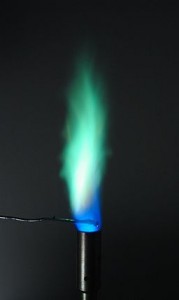
    Gas flame used for flame test of copper sulphate. Photo Credit: Søren Wedel Nielsen

    Imagination in Science

    In my policy work in early childhood education, I get to travel and observe a few child care centers in the NYC area every year as part of our Excellence in Teaching Awards. Well, I should say I did, until the funding for this awards program was cut. Minor point.

    In those visits last year, some really stellar (read well-funded) classrooms had water tables, sand boxes, aquariums, terrariums, birds, blocks, paints; tools to inspire and ignite the creativity of young minds as they explore and try to make sense of the world around them. Imagination is the most vivid and active during the early years. It must be cultivated and continued in practice.

    Let’s think about the role of imagination in science. The process of imagination is on display everywhere in an early childhood classroom. But by the time they reach middle school, students seem to burn out and tire of science. Tired of memorizing facts and figures they see no point in bothering to retain because they will never use that information again. They see no purpose for being able to regurgitate that Cu is the symbol for the chemical element of copper; that 454 grams equals 1 pound; that kinetic energy is defined as the work needed to accelerate a body of a given mass from rest to its stated velocity. All of this information could be looked up if it were required in the future. Where is the imagination? What is driving the curiosity?

    The United States is losing a great majority of future scientists as a result of its education system and the way it teaches science. It’s alarming when you hear the statistics: American students ranked 21st out of 30 in science, and 25th out of 30 in math compared to other students in developed countries (2006 PISA comparison). Or on the 2009 NAEP math test 4th graders showed absolutely no improvement in scores, while 8th graders showed modest progress at best. That’s why this emphasis on STEM – Science, Technology, Engineering and Mathematics – is so crucial. If we are to “stem” this brain drain of our youth, we must begin to see and teach science in a new light.

    Why We Should Care

    Science and math form the basis of our society. Who envisioned and built streets to make transportation easier, or built homes for improved shelter? That couldn’t have been done with basic principles and understanding of either science or math.

    Think about who designed your Starbucks cup containing your triple soy latte this morning.* Or the person who envisioned the design of the clothes you are wearing and the manufacturing process that went into producing the items that fit your style. Or the energy and transportation logistics required to get those Levi’s into the stores for you to purchase.

    Whether kids are interested in studying particle physics, fashion design, or aeronautical engineering in terms of a future career, doesn’t much matter. Society requires this mix of disciplines to function. And the teaching and promotion of science and technology, and the process we use in the curriculum to increase students’ interest and learning, is how we begin to turn this tide.

    We need to show the applications of science to connect with children. Give them the means to see the direction of their studies laid out in front of them so that they can understand the relevant connections between classroom content and career pathways, thus providing learning opportunities for students.

    I think we are not seeing the forest for the trees; we are more focused on getting to the endpoint – maintaining a competitive status, being a global leader, creating more jobs – than we are focused on how we get there along the way. Perhaps that is the missing component; something we should be sharing with children as we try and teach them about protons, electrons and neutrons. That if they can understand these concepts, understand the relationships, they may be better able to think about the application of these concepts into nuclear medicine and how it might lead to a career as in the field of molecular medicine, or they may apply this knowledge to working on nuclear-powered submarines.

    We start our kids in gymnastics, karate, soccer (football) and rugby when young; why isn’t the same emphasis placed on science education in schools? Science is fun! But I’m wired differently and a bit of a nerd, so you may differ with my opinion (but you probably do not, since you are reading Australian Science). Kids don’t just like winning at sports, they like winning. There’s more to competition than just winning, of course: learning what went right, what went wrong, how to improve, working with others, pulling your own weight, being a leader – these are things important to competition, whether it is athletics or academics. And a healthy balance of the two is important.

    Young muscle memory needs to be exercised early and often for excellence to take hold. But conditioning a young mind is different from pushing a young mind. Beginning down the path with the mindset that your young child is going to win the Nobel Prize in physics and anything less is unacceptable, probably isn’t ideal. But if parents and schools can start exposing kids to science at an earlier age – simple building blocks, water tables, modeling clay, activities requiring counting and measuring, nature trips. I’m talking things that are age appropriate of course, those activities that give kids a chance to explore on their own terms the world around them. Encouragement, support, resources – that’s how you grow a future scientist, that’s how you improve a nation, a society. Without science, what chance do we have as a species for survival?

    In the U.S., much time and resources are spent on “teaching to the test”. Meaning, teachers are prepping their students for standardized tests. Not munch learning is taking place as little information is retained that way. Would it be better to have a two-week “camp