Author: Markus

  • Mysterious Mars

    Mysterious Mars

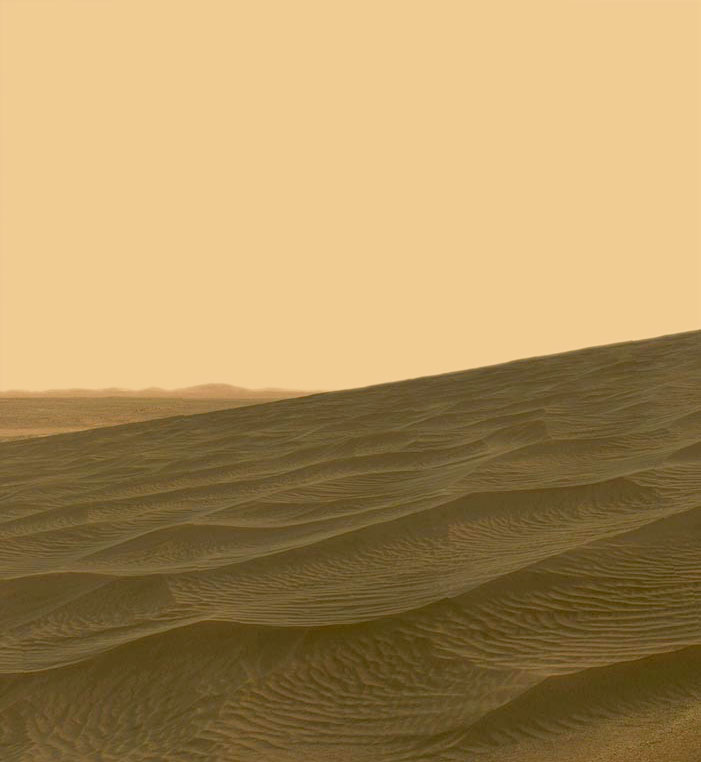
    Mars is full of secrets and mysteries. The classic definition of a desert world, our planet’s arid sibling is a parched wilderness of dunes and planetwide dust storms. With a thin carbon dioxide atmosphere and only 38% the gravitational pull of Earth, there are a lot of puzzles about this cold and frosty little planet, and a lot of scientists who are longing to solve them.
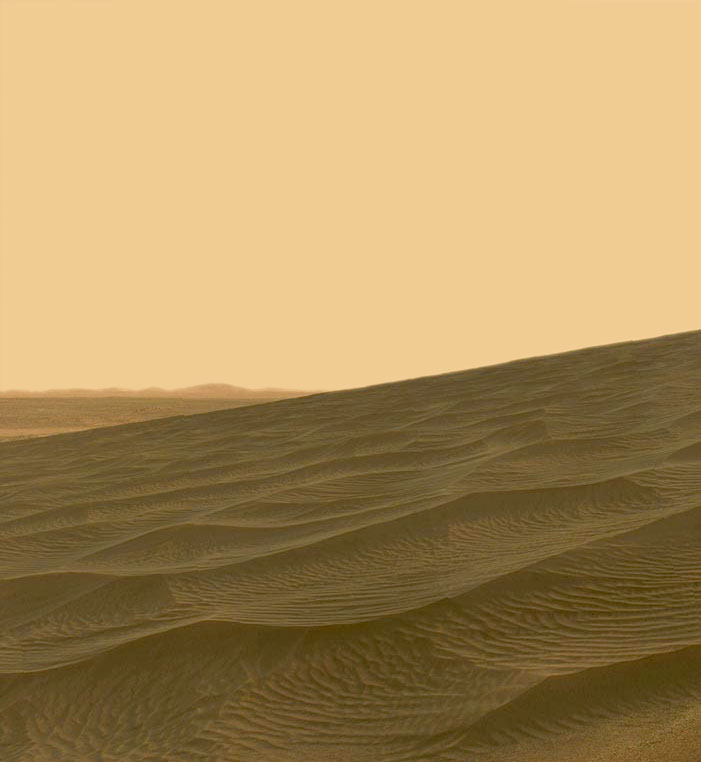
    El Dorado, Gusev Crater. Mars is a world of dust and dunes…

    By now, anyone keeping up with the news is bound to have heard that NASA’s Curiosity rover made a flawless descent through the atmosphere of Mars and is now busy eyeing up its new home in the Gale Crater. As was discussed previously here on Australian Science, a big question still on everyone’s mind is the same one which David Bowie sang about back in 1971. Is there life on Mars? However, it seems that NASA’s plans are not to answer this question directly. John Grotzinger, project scientist for the Curiosity mission, is quoted as saying; “Curiosity is not a life detection mission. We’re not actually looking for life; we don’t have the ability to detect life if it was there.” Instead, the main objective of Curiosity is to look for signs of life.

    The trouble is that looking for life directly is a difficult task. Back here on Earth, new discoveries are still being made frequently, with life being found in environments and habitats where no one was expecting. There’s a lot which we still don’t fully understand about life here on our own world. When we’re talking about another planet, it’s safe to say that all bets are off. As a result, Curiosity’s goal is to look for the various elements and chemical compounds which life might use – or might have used once upon a time when the planet may have been more hospitable. The focus has shifted from the search for life on Mars right now, to life which may once have lived there.
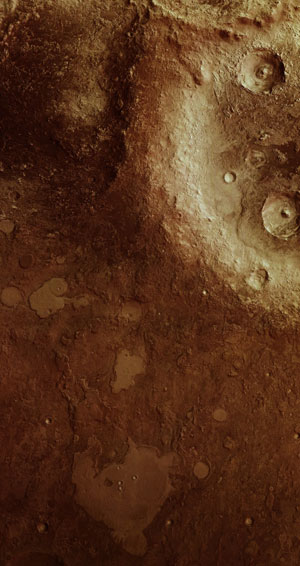
    Arabia Terra – one of the three locations on Mars where methane plumes have been spotted.

    One point which is worth remembering right now, however, is that there’s one big unsolved mystery about Mars. A gaseous mystery. Large quantities of methane have been detected in the martian atmosphere, which gives rise to a real puzzle. Methane is destroyed by sunlight, and with the thin atmosphere found on Mars, any methane should be rapidly broken apart by solar ultraviolet. The only possible conclusion is that the methane seen on Mars is being replenished somehow. There are only really two possibilities for how this might happen.

    One scenario sees the martian methane caused by a geological process called serpentinisation. This is where a type of mineral known as olivine (more familiar to us as the gemstone peridot) chemically reacts with water and carbon dioxide. The reaction creates methane and a green mineral called serpentine (commonly found in certain parts of Western Australia and Tasmania), and releases methane gas. If this is the process which is occurring, it would mean that not only is there a suitable amount of water somewhere under the surface of Mars, but there must also be geological activity for that water to continue being brought into contact with further olivine to react with. This would suggest that there are things which we don’t know about current geological processes on Mars.

    The other possibility, more radically, is that this methane is being produced by life. Here on Earth, bacteria known as methanogens are responsible for most of the methane present in Earth’s atmosphere. In fact, on Earth, methane is so regularly produced by living organisms that it can used as an indicator of biological activity.

    When three distinct plumes of methane were discovered on Mars in 2009, it was noted that there was an equal probability of either of those two scenarios being the source of the methane – and that both would be huge revelations in our understanding of our neighbouring world. So maybe the Curiosity rover isn’t set up to hunt for life, and maybe it won’t be directly looking for it. But I, for one, do hope it finds some clues about the origin of the mysterious martian methane. Just as any scientist should, I love a good mystery!
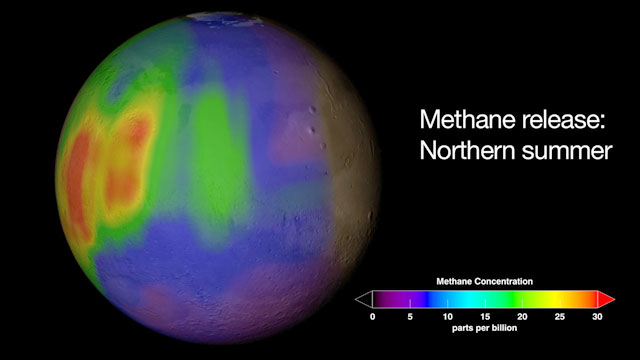
    The three methane plumes seen on Mars at South-East Syrtis Major, Nili Fossae and Arabia Terra.

    Image credits:
    Top – NASA JPL/Cornell
    Middle – ESA/DLR/FU Berlin (G. Neukum)
    Bottom – NASA
  • Did life’s building blocks crash land?

    Did life’s building blocks crash land?

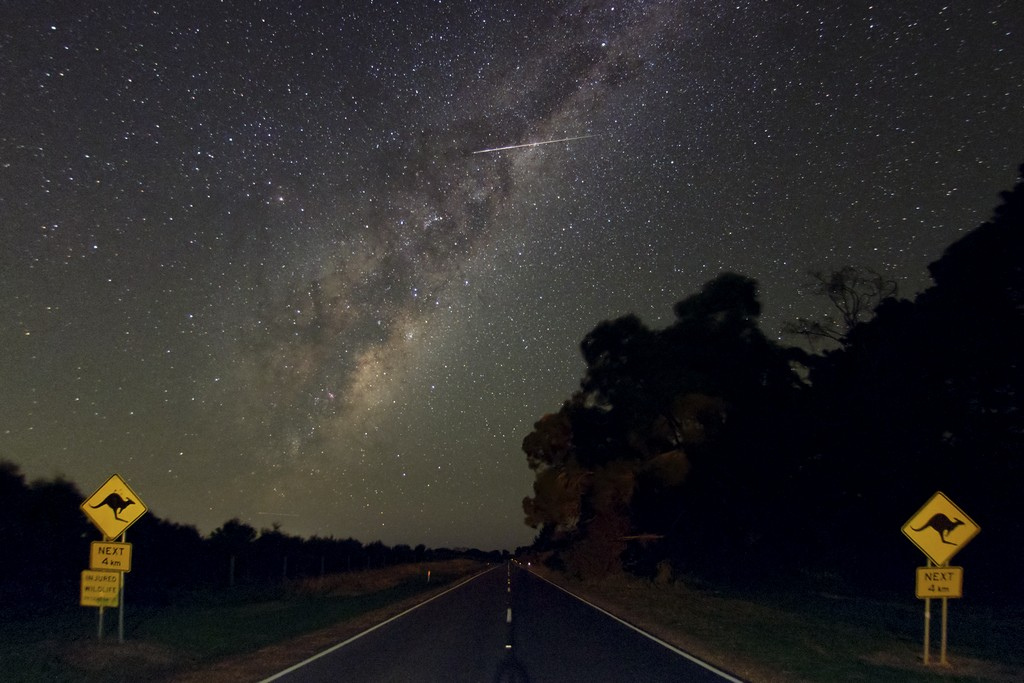
    In 1969, on September 28, the skies near Murchison, Victoria (not to be confused with Murchison, Western Australia) were illuminated by a dramatic sight. A spectacular fireball blazed its way through Earth’s atmosphere, its outer layers heated to extreme temperatures by its speed. Residents of the town reported seeing the fireball split into three pieces before it faded from view, leaving a trail of smoke in its wake. Seconds later, a tremor was heard as meteorite fragments crashed into the ground, signalling the arrival of what would become one of the most well studied meteorites ever.

    A meteorite streaks across the Australian night sky, in front of the Milky Way. But just what might it be carrying with it? Image credit: Alex Cherney/terrastro.com

    If you like to watch the sky at night, chances are good that you’ve seen a meteor or two streaking across the night sky, and while many of them burn up in the atmosphere, it’s quite possible that one which you’ve seen might have eventually reached the ground. Meteorites strike Earth a lot more frequently than most people realise. By most estimates, a few hundred tons of meteorite material make it to our planet’s surface every day. Large meteorites like the Murchison meteorite, however, are a lot less common.

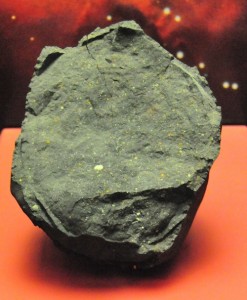
    A fragment of the famous Murchison meteorite. Image credit: Art Bromage, Wikimedia Commons

    While the Murchison meteorite shattered into fragments before it landed (known as an “airburst”), over 100 kg of meteorite have been collected from around Murchison, and scientists have been analysing those fragments ever since. This particular meteorite is a specific type known as a carbonaceous chondrite. These meteorites are fascinating to scientists, because carbonaceous chondrites are chemically very primitive – they’re thought to be very close in composition to the solar nebula from which the Sun and planets condensed 4.5 billion years ago. In other words, the meteorite which crash landed in Murchison 43 years ago was probably older than our entire planet!

    Several things about the Murchison meteorite are very interesting. For one, it shows evidence that it was altered by water. This would have happened a long time ago, wherever this meteorite originally formed, and certainly a long time before it landed on Earth. Secondly, it’s peppered with Calcium-Aluminium-Inclusions (CAIs). These humble crystals are older than the Sun itself. When they formed, the Sun itself was little more than a huge cloud of warm hydrogen gas. Most interestingly to some scientists, however, is the fact that the Murchison meteorite is full of amino acids.

    Uracil, one of the four "nucleobases" used by DNA to encode genetic information, was discovered inside the Murchison meteorite.

    Amino acids are one of the basic building blocks of all living things. The proteins which make up almost everything in your body are made from these small molecules. To date, over 100 amino acids have been found inside the meteorite, including many of those used by life on Earth. Several things about the chemical and isotopic compositions of these molecules suggest that they didn’t come from Earth, but were in this meteorite when it landed. As an example, amino acids have two forms, referred to as left-handed and right-handed. Earth life only uses the left-handed forms, while the acids discovered in this meteorite are a mixture of the two (known to chemists as a racemic mixture). Other Earthly molecules which frequently show up as contaminants were absent from the samples analysed, suggesting that these molecules, the bare essentials of life, are extraterrestrial in origin.

    These amino acids aren’t the only familiar molecules in the Murchison meteorite either. Amongst over 14000 different molecules found inside the meteorite, the chemists who were analysing the meteorite discovered ring-shaped molecules called purines and pyrimidines. These ring molecules are from the same family as the four nucleobases which make up DNA.One of the molecules found was one called uracil, which is actually used by DNA. This same molecule is in every strand of DNA in your body.

    While some still argue over the validity of these studies, if they’re correct then the overall conclusion is a breathtaking one. This space rock is older than the Sun, and it already contained all of the basic ingredients for life to form back when Earth was nothing more than a patch of interstellar dust. We might never know exactly how life started on Earth. Though maybe in the distant past, life’s raw materials crash landed here on Earth in meteorites, just like one meteorite did in Murchison that night 43 years ago.

  • The smoking guns of dying stars

    The smoking guns of dying stars

    VY Canis Majoris, the largest known star in our galaxy, with it's huge smoky clouds of gas and dust being lost into interstellar space. Credit: NASA, ESA, and R. Humphreys (University of Minnesota)

    The ancient Greeks once believed that the heavens were immutable. A vast starry vista, eternally unchanging above our heads. But we now know this to be untrue in the slightest. A lot has changed since then, however, and over the past few hundred years, astronomers have unfurled ever increasing knowledge of the lives of stars. Look out across a starry night sky and you can see stars in all stages of their lives, from brightly burning newborn stars, to ageing giants in their final gasping breaths. As stars near the ends of their lives, they begin to shine a rich red colour as they expand and dramatically increase in size.

    As red giants, these stars are burning the last of their fuel, and as they do so they begin to sputter and gasp. Just as a candle flame does when it starts to burn out, red giant stars flicker – though for these, the largest stars in the universe, those flickers can take thousands of years each. These final bursts of energy are known as thermal pulses, and they mark the star’s final days. During the last couple of million years of its life, a red giant star will lose incredble amounts of material to interstellar space. Even when not caught mid-pulse, these stars lose several times the mass of our planet every year. And the puzzle of exactly how they do so has been recently been unravelled by a team of astronomers led by researchers at the University of Sydney.

    All stars emit a stellar wind – a steady stream of particles being constantly accelerated outwards by the star. Even the Sun emits its own solar wind (with a speed measured at 535 kilometres per second as I write this). The wind from red giant stars is slightly different. As the star loses more mass, stellar material cools and condenses into dust. This dust then catches starlight which is so intense near to the star that it actually pushes that dust outwards. This effect, known as radiation pressure, causes the tiny reflective dust grains to act like minute sails and accelerates them away. Each dust grain is tiny compared to the kind of dust we find on our bookshelves, much more like fine smoke than any dust we’d recognise. Instead of being called stardust, it could easily be called starsmoke!

    “The winds that stream from the upper atmosphere of the red giant stars are responsible for removing massive amounts of matter. The grains that we have discovered here will come as a real shock to the accepted wisdom in the field. They are both much larger and much closer to the stellar surface than anyone expected.” said Barnaby Norris, a PhD student at the University of Sydney, and lead author on the research published earlier this year in Nature.

    This stardust emitted by these smoky smouldering old stars is transparent, not unlike finely powdered glass. The implications of this stardust being detected to close to an ageing star could help us to better understand the processes that occur in stars as they die, and how they manage to lose such prodigous amounts of mass so rapidly. As Norris said, “Hopefully our findings will help to illuminate a key step in the grand cycle as matter is expelled from stars into the galaxy only to seed new generations of stellar and planetary birth.”

    On a final poetic note, all of the chemical elements essential to life are created within stars, before being seeded back into the cosmos when stars die. This means that this condensing stardust contains the fundamental raw materials needed for life to eventually form. As Carl Sagan so often used to muse, we are literally made of stardust.

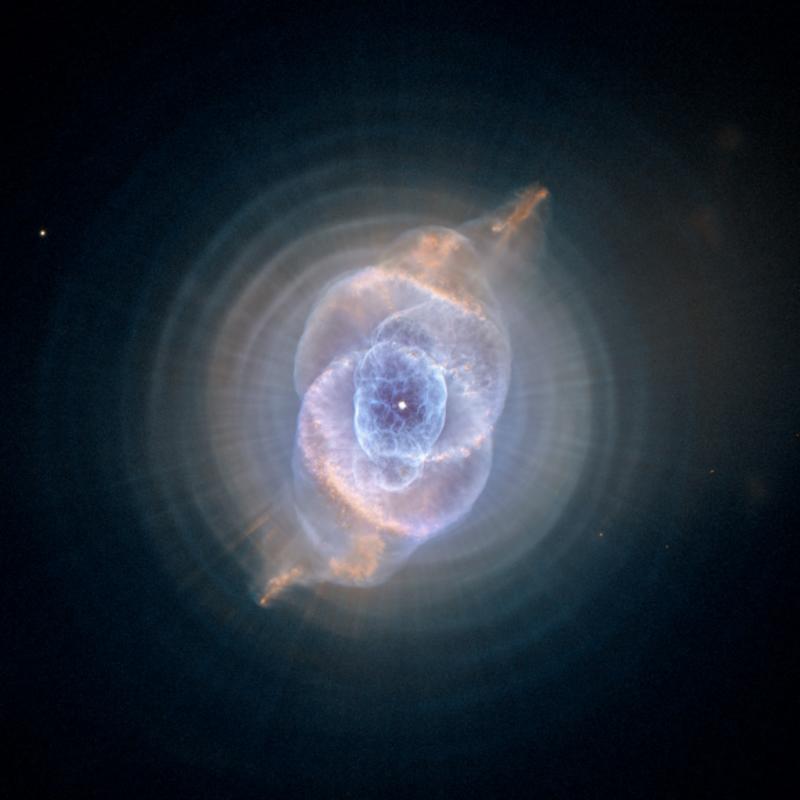
    The Cat's Eye nebula, a star which has now ended its life and is casting its outer layers into the cosmos. The concentric rings show material lost as stellar wind during the star's final thermal pulses.. Credit: ESA, NASA, HEIC and The Hubble Heritage Team (STScI/AURA)
  • Radio quiet, please!

    Radio quiet, please!

    Originally conceived over 20 years ago, there’s a project being undertaken by scientists and engineers across the whole world to help us all better understand the mysteries of the galaxy and the very beginnings of the Universe. It’s estimated to be completed by around 2024,costing $1.85 billion AUS (€1.5 billion). Once completed, it’s set to be the most complex and technologically advanced machine ever built by humanity. It will use enough optic fibre to wrap twice around the Earth and will need a computer capable of performing 10^18 operations per second – about three million times the number of stars in our galaxy. It will produce over 980 Exabytes of data every day (equivalent to about 15 million 64GB iPods) and to cope with that, it will need to handle data transfer rates over 10 times as high as the current global internet traffic. No, it isn’t a starship. But it might just be the next best thing.

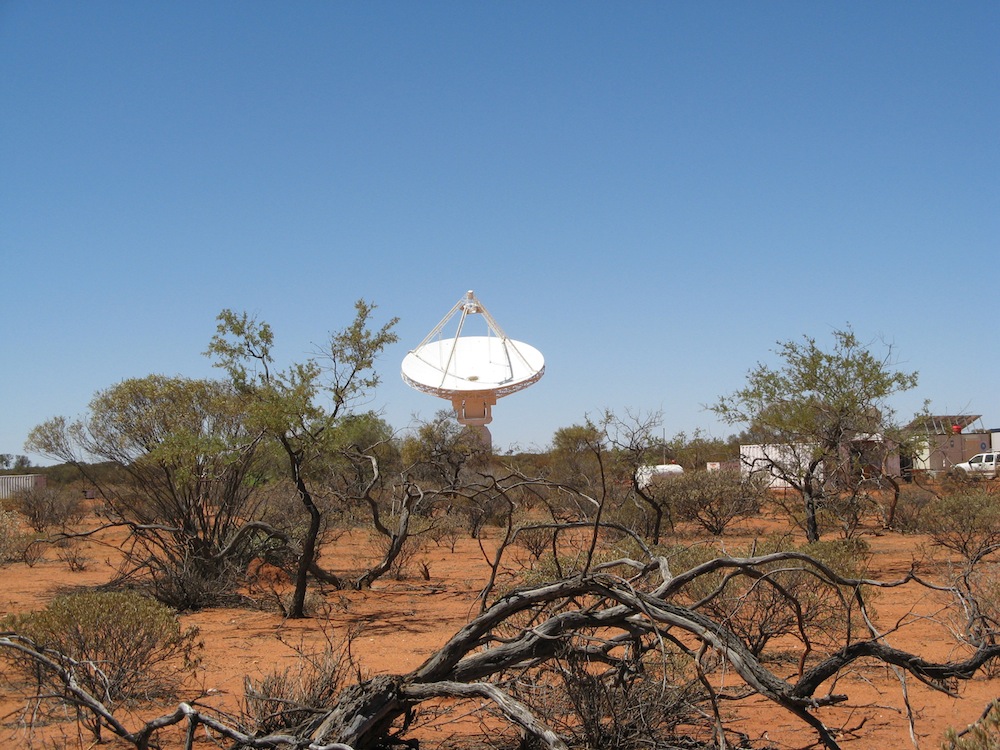
    One of the first components of the SKA, constructed in Western Australia. Credit: Dave DeBoer, CSIRO.

    The Square Kilometre Array (SKA) is one of the most ambitious scientific projects ever devised, and when completed it will comprise a huge number of telescope antennae which will work as one to form a single radio telescope so powerful that it could detect an airport radar on a planet 50 light years away. The sensitivity of any telescope is defined by the area it uses to collect data. With optical telescopes, this is the size of the mirror, and with radio telescopes it’s typically the size of the dish. The SKA gets its name because when fully constructed, all of the detectors and antennae that make it up will have a combined area of one square kilometre, or one million square metres. To put that properly into perspective, the Green Bank Telescope is currently the largest steerable single dish radio telescope, and its area is just under 8000 square metres.

    Being astronomy’s answer to the large hadron collider, the SKA is a staggeringly large international collaboration. I was lucky enough to attend a major meeting regarding the planning of the SKA (the headquarters are to be based here in the UK in Manchester), and the myriad different languages and nationalities represented was impressive to say the least. Over 24 major organisations from countries spanning 5 continents are involved in the project, ranging from universities to industrial engineering companies. New technologies, both software and hardware, are still being developed as a result of this project. Based on the huge data storage and transfer requirements of a machine as complex as the SKA, many of those new technologies are likely to feed straight back into society by offering profound improvements to computing resources like the internet. In fact, as the world’s largest project for sorting and storing data, the SKA is expected to be literally bigger than Google!

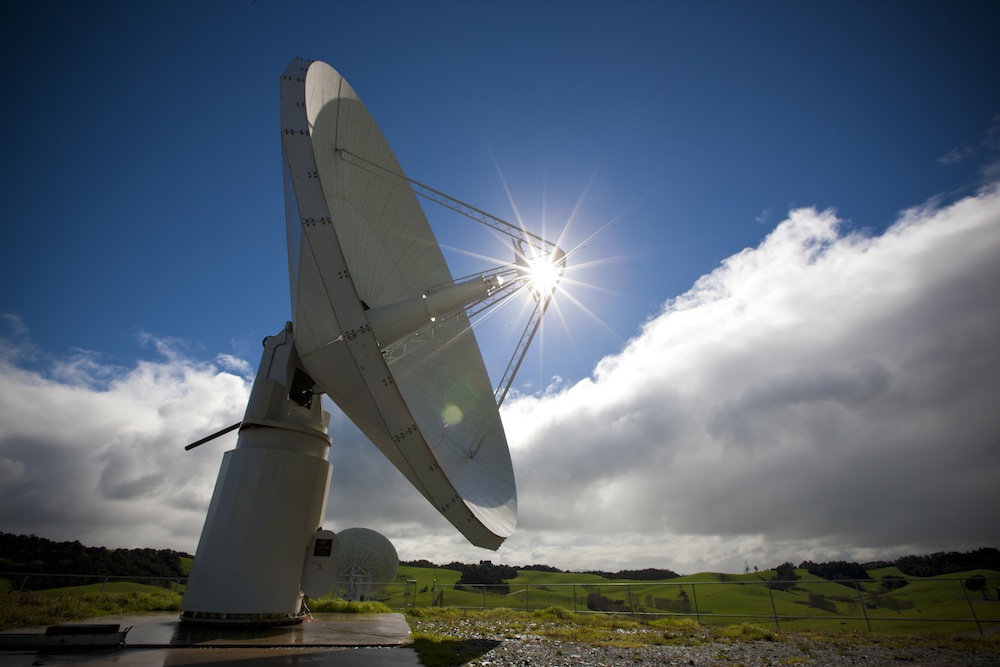
    The Warkworth antenna in New Zealand – an important part of early SKA science. Credit: Alex Wallace.

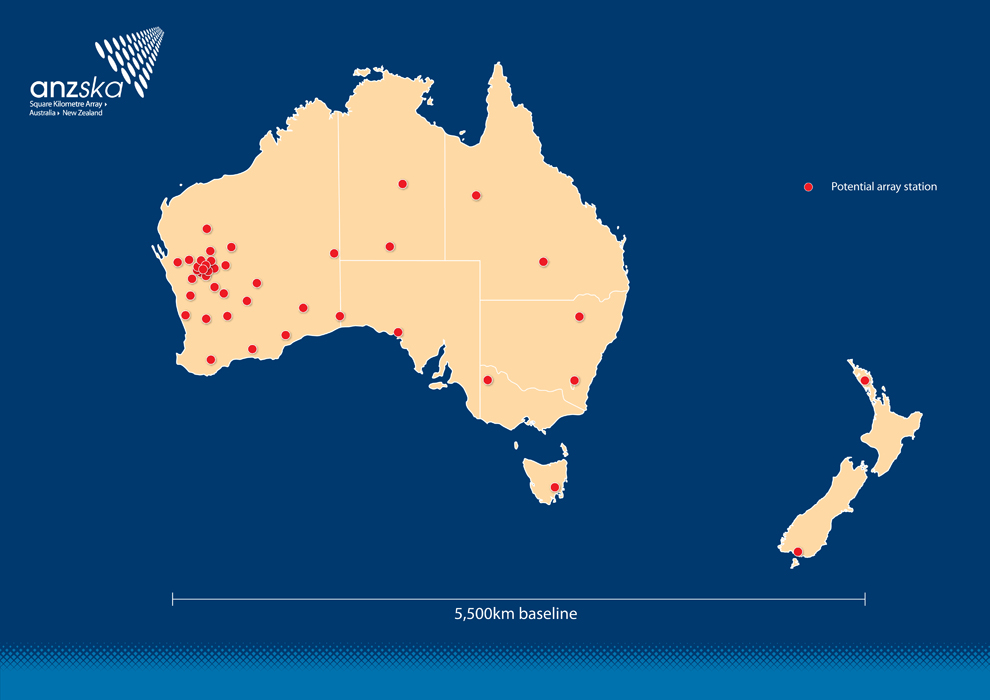
    The most difficult decision, understandably, has been where precisely to build it. Humanity has an unfortunate tendancy to fill the atmosphere of our planet with noise, bouncing radio waves to and fro and filling the air with radio frequency chatter. A radio telescope array this sensitive needs to be placed somewhere quiet to gain the full benefits, and the most recent decision has been to effectively split the SKA into two components, to be built in Southern Africa and Australia. While this may seem like an odd thing to do, it actually makes perfect sense. The SKA actually has three types of antenna operating at different frequencies. Intended to cover a huge range of radio frequencies (from 70 to 100000 MHz), three types of antenna are needed, because no single technology can actually operate across such a wide range. So the decision was made to build the lowest frequency detectors across Australia, centred at Murchison in outback Western Australia. Murchison is blessed with being one of the few places on our planet which isn’t flooded with FM radio at the low end of the frequency scale. From a radio astronomer’s point of view, it’s the quietest place on Earth.

    This is set to be complemented by the higher frequency steerable dishes which are set to be constructed across Africa. Both South Africa and Australia have put extensive efforts into developing the SKA, and Australian-developed technology is still set to be implemented in the African telescopes. This will mean a huge influx to the African astronomical community and numerous African nations won’t lose out on the economic boost from contributing to such a prestigious project. It’s an ideal situation where everyone wins.

    All in all, it’s an exciting time to be an astronomer. An epic project like this is likely to attract all manner of researchers from across the world to both continents. Just maybe, it could also finally help us to answer the really big questions, like how the galaxy formed, how the Universe began, and whether or not there’s anyone else out there.

    A map of prospective SKA sites. Credit: anzska
  • A brand new boson?

    A brand new boson?

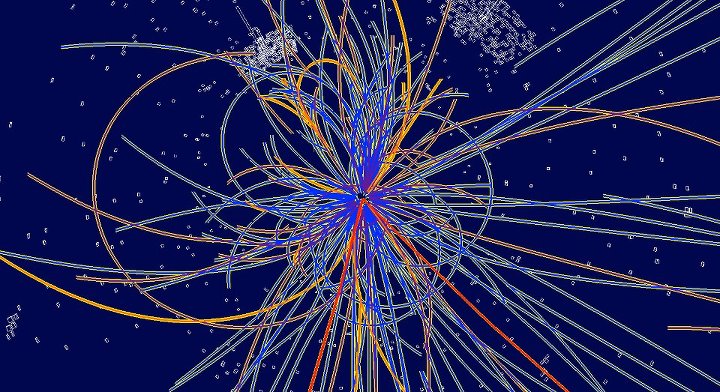
    It’s official. As was the subject of a press conference here in Europe this morning, the LHC has discovered a new particle. Is it the much talked about Higgs boson? Evidently it’s far too early to say with certainty. But whatever it is, it’s a brand new subatomic particle, it’s consistent with a Higgs boson signature, and it’s enough to make CERN physicists quite excited.Whatever it may turn out to be, it’s brand new and never seen before.

    This is physics at its most fundamental. The standard model of particle physics is probably our best depiction of how the universe operates at subatomic scales, but our picture is incomplete. A jigsaw puzzle with missing pieces which must still be searched for. One of those pieces is a piece so basic that for a long time it was simply overlooked. Why do objects have mass at all? The existence of the Higgs boson in the Standard Model seeks to address that question. It posits that all the universe is filled with a so-called Higgs Field. Any particles, protons or neutrons for instance, passing through that field will interract with it, and it will interract via Higgs bosons. Any particle which exists in this field will effectively be surrounded by a cluster of these Higgs bosons. The more bosons, the stronger the interraction, and the more massive that particle will be.

    Simulation of Higgs Boson decay.

    But exactly what it is that’s been discovered is still being analysed. Amid a press conference full of journalists asking pointed questions about “the Higgs boson”, scientists were noticeably hesitant to outright say that this is what they’ve discovered. And for good reason too, because science doesn’t work like that, no matter how many people might want to run through the streets naked shouting ‘Eureka’. In all of this, only one thing is certain – a new particle has been discovered with a mass of approximately 126 giga electron volts (126 GeV), with a statistical significance of 4.9 standard deviations (4.9 σ).

    Peter Higgs himself, declined to make any comment twice during the conference, simply stating that it would not be appropriate to answer detailed questions at this stage. The other members of the panel too, agree that it’s very difficult to say anything definitively right now and that “Higgs-like” would be a better description of what they’ve found. It’s compatible with a Higgs boson detection, but the “uncertainties are still large”. While definitely being “consistent with a Higgs boson”, interestingly it’s noted that they cannot say if this is the Higgs boson (i.e. the one required by the Standard Model), rather at this stage it may be a Higgs boson. Scientifically speaking, it’s far better to only make statements on what’s known to be true, rather than to make brash announcements which may prove to be incorrect a few months later.

    Whatever happens after the months of data analysis which are due to follow is that we’re set to unravel a lot more about the fundamentals of the universe. This discovery is on the very edge of human understanding. It may help to refine our knowledge of the Standard Model of particle physics, or it may hint that this particular Higgs boson is not a part of the standard model – a prospect which ATLAS experiment director Fabiola Gianotti seemed visibly quite excited by.

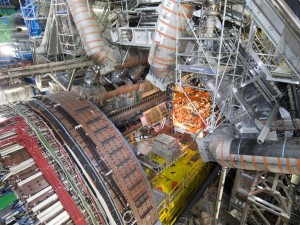
    The ATLAS instrument, a detector in the LHC.

    Rolf Heuer stressed the fact that the most exciting thing here is the fact that they have a discovery of something brand new, perhaps suggesting that we shouldn’t get too caught up in our expectations and simply enjoy the excitement of there being something never before seen in physics in the process of being analysed. Moreover, this could be the very first fundamental scalar particle, and the first gauge boson which actually has any mass. If it does turn out to be a Higgs boson, then this holds the additional thrill that this particle has a relationship to the state of the universe itself, embodying the substance to all other particles which exist.

    In the meantime, as the LHC prepares to power down for a couple of years of maintenance, this discovery will certainly stoke the fires of curiosity in thousands of scientists worldwide. The data are still being picked apart too, for things which are completely unknown. Perhaps even more brand new physics is still waiting to be found. It’s an exciting time in physics right now!

  • Networking the Solar System

    Networking the Solar System

    When the human race inevitably expands off planet Earth, we’ll naturally want to take our internet with us – over the past 15 years or so, the internet really has become an integral part of our lives! In fact, even as you’re reading this, 300 gigawatts of electricity worldwide will have been used to transfer 640 terabytes of information across the internet to 1.5 billion desktop computers and a further billion mobile devices. In the time you’ve taken to read this paragraph, over 200 million e-mails have been sent, 6 million Facebook pages have been loaded, 1.3 million YouTube videos have been watched, and 100,000 people have posted an update to their twitter accounts.

    Astronaut Tracy Caldwell Dyson enjoying a view from the ISS Cupola window.

    Inspite of its sprawling extent on our planet though, the internet’s first step off-world was able to fit inside just 1120 bytes. On January 22, back in 2010, astronaut TJ Creamer made a small but important piece of internet history by being the first human being ever to post to a twitter feed from orbit. Astronauts had been updating twitter feeds while in orbit for some time, but they had previously always relayed their messages via NASA back here on Earth. Since 2010, however, the International Space Station (ISS) has been upgraded to have its own internet connection. Intended for personal use by astronauts and still routed through ground based systems at NASA for security, this is how e-mails, blog posts and twitter updates are sent back home. All the same, even though it might seem a long way away, the ISS is relatively nearby in low Earth orbit.

    Things start to become more complicated when you consider travelling further afield, because whether we like it or not, we can’t cheat special relativity. The speed of light is the fastest any interplanetary communication (or anything, for that matter) can travel. The Moon is still close enough that interaction is possible in almost real time. Sending a message to someone on the Moon would involve a delay of a little under three seconds. Good enough to hold a conversation, but with gamers here on Earth complaining about latencies higher than 600 milliseconds, you’re obviously not going to be able to play Halo or Warcraft against a friend over that kind of distance. Travel as far as Mars and the problem becomes even more pronounced, with delays of anywhere between 3 and 22 minutes, depending on exactly where Mars is in relation to Earth. Minutes turn to hours as you continue to travel outwards (transmissions from Voyager 2 currently take over 13 hours to reach us). All things considered, using an interplanetary internet sounds like a rather good idea for communication over distances like these. While phonecalls to Mars would be essentially impossible, delays between responses to e-mails and tweets are fairly routine. You could quite easily have a twitter conversation with someone over on a neighbouring planet.

    Preparing for the future, NASA and Google teamed up a few years ago to develop a new internet protocol designed to be used in space. Called Disruption-Tolerant Networking (DTN), it’s designed to work a bit differently to the internet we’re all familiar with. While our familiar TCP/IP systems rely on a constant connection to transfer data, this is obviously unfeasible in deep space. While a DTN network would still operate using a series of nodes passing information from machine to machine, the way ground-based networks do, each node needs to hold onto the data being transmitted until it has a confirmation that the message has been safely passed on.

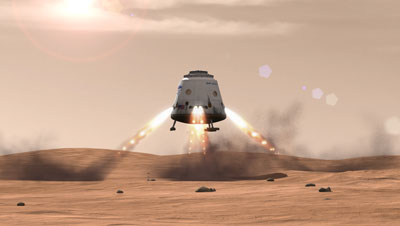
    SpaceX believe it should be possible to send people to Mars within 20 years.

    With a steadily accumulating collection of spacecraft in various parts of the solar system. Google’s Vint Cerf has expressed plans to use these old pieces of hardware, many of which have long since completed their original missions, as nodes in what will become an interplanetary internet. Indeed, spacecraft have already transmitted data amongst themselves en route back to Earth. ESA’s Mars Express probe, for instance, has served as a relay between Earth and vehicles landing on Mars, and is set to do so again when NASA’s Curiosity rover arrives at the red planet later this year. In an interview with networkworld.com last year, Cerf is quoted as  saying “…if they are still functionally operable — they have power, computer, communications — they can become nodes in an interplanetary backbone. So what can happen over time, is that we can literally grow an interplanetary network that can support both man and robotic exploration.” He continued to explain how, while all space missions to date have involved point-to-point communications, future space missions will likely require “a richer communications network.” This also has an added plus that an interplanetary network infrastructure will allow scientists to receive more data from deep space missions than is currently possible.

    With many astronauts already maintaining active twitter feeds from orbit, it has to be said that similar social networks may well play an important role in communications in the future. By the time that role is needed, a network infrastructure will likely be in place for it to operate on. A company like Google, processing petabytes of data and serving hundreds of millions of queries for an index containing billions of websites every day, is certainly qualified to help set up a computer network on interplanetary scales. Maybe in the future when people talk about Google Mars, they might mean it literally!

    Image credits: NASA/Tracy Caldwell Dyson (top), SpaceX (bottom)