Author: Markus

  • Quantum computing: Australian researchers store data on a single atom!

    Quantum computing: Australian researchers store data on a single atom!

    Computers are everywhere these days. They play us music, tell us when to wake up, remind us that we’re late for an appointment, and provide us with entertainment. Even if we don’t realise it, so ingrained in our lives are computers that the world would be a very different place without them. Computing is also an incredibly fast moving field of technology, and research is finally taking us towards the exciting world of quantum computing!

    Quantum computers will work using quantum bits, or qubits for short, which are analogous to the digital bits used in computers like the one which you’re using to read this article. Recently, a team of engineers at the University of New South Wales (UNSW) has successfully demonstrated, for the first time ever, how a single atom can be act as a qubit, effectively showing the first step in building an ultra fast quantum computer. And they might just have created the best qubit ever made.

    A quantum computer is, simply, a computer which makes use of quantum mechanical phenomena to perform calculations. Well, I say “simply”… Let’s step back a moment. The simplest form of computers involve actual moving objects, and using the positions of those objects to perform calculations. This is essentially how an abacus works, if you’ve ever used one. The earliest computers to be designed, automated this process, using mechanisms. Charles Babbage’s famous, albeit never built, Analytical Engine worked on exactly this basic principle, and if it had been constructed it would have truly been the world’s first computer.

    Essentially, the way these old mechanical computers work is to use the positions of their mechanical parts to perform mathematical and logic functions. This is actually the fundamental way in which all computers work. Since the discovery of electricity and the invention of electronics, computers have worked using electric circuits – effectively using the position of electrons instead of the position of actual moving parts. As technology has progressed, computers have become faster, smaller, and more reliable, until the world around us today.

    In modern electronics, silicon is king. Silicon-based electronics are the standard used everywhere, though they’re reaching the limit of what they’re capable of. For the next generation of electronics, some people are beginning to advocate new materials, such as graphene, over silicon. But ultimately, others have a higher goal. Proponents of quantum computing believe that in the future, the most vital components of computers will not be electronics at all, but single atoms.

    In quantum mechanics, any single particle, from an electron to an atomic nucleus, has a set of properties which can often be changed quite easily. Where past computers used motion of mechanical parts and modern computers use motion of electrons, quantum computers will use changes in the properties of these particles to perform their calculations.

    One such quantum property is known as spin (the same property behind magnetism), and this is what the UNSW engineers managed to manipulate. They based their qubit on a single silicon atom and demonstrated how they used changes in the nuclear spin of the nucleus to store and retrieve information. Andrea Morello at UNSW’s School of Electrical Engineering and Telecommunications described how; “We have adapted magnetic resonance technology, commonly known for its application in chemical analysis and MRI scans, to control and read-out the nuclear spin of a single atom in real time.

  • Mosquito-borne diseases: Fighting fire with fire

    Mosquito-borne diseases: Fighting fire with fire

    I have a decidedly “live and let live” approach to life. There are no animals in this world which I harbour any malicious feelings towards, regardless of how many of those animals would think nothing of poisoning, eating, maiming, or otherwise killing me (it’s a tough world out there). No animals, with one exception. I absolutely detest mosquitos – and not irrationally so.

    You see, you might not realise it, but mosquitos are actually the most dangerous animal in the world. Yes, seriously. They may not look like much, but every year, mosquitos will spread diseases to 700 million people. That’s 10% of the human population on this planet. Many of the diseases spread by mosquitos are potentially fatal, and mosquitos are responsible for over 2 million deaths every year. Needless to say, some way of curbing the spread of mosquito-borne disease would be a huge success in combating illness worldwide.

    Interestingly, an unusual but potentially effective method has been devised by Ary Hoffmann and Michale Turelli at the University of Melbourne. I say unusual, because their method of preventing mosquitos from spreading disease is to actually infect the mosquitos with a disease of their own.

    When mosquitos are infected with a type of bacteria called wolbachia, it renders them unable to spread viruses such as dengue fever. Dengue is a particularly nasty disease spread by mosquitos, for which no real treatments or vaccines are available. Around 40,000 people die every year from dengue, with around 2,400 cases reported over the past few years in Northern Australia.

    Wolbachia bacteria are actually surprisingly common, existing naturally in around 70% of all insects. The particular strain used in this study was discovered by Hoffmann in 1988, in Australian fruit flies. Nature, it seems, is full of serendipities. In 2011, studies showed a great success. Mosquitos infected with wolbachia cannot spread the dengue virus!

    However, there was still a problem to address. Wolbachia also affected the mosquitos eggs, preventing them from hatching. While this may seem, at first, like a good thing in that it may cull the mosquito population, the problem lies in the fact that if the infected mosquitos all die off, the remaining insects will still be quite able to spread disease.

    The solution, perhaps even more counterintuitively, involves giving the mosquitos resistance to insecticide. At first glance, this idea may seem unappealing, but it isn’t without merit. In fact it’s quite ingenious. Areas which are particularly prone to mosquito-borne infections tend to use insecticides as a way to control the mosquito populations and curb disease. In these regions, the non-infected mosquitos would be killed off by insecticide, so that the population of mosquitos would adapt. The end result would be a population of mosquitos which cannot spread the dengue virus.

    Similarly, the insecticide resistance gene would not be able to be passed to any non-infected mosquitos. A female mosquito would pass on both the gene and the bacteria to her eggs, while any non-infected female mating with an infected male would lead to eggs which will never hatch (due to cytoplasmic incompatibility). The end result would be that the only offspring from this population of infected mosquitos would also be infected, and therefore would be unable to spread viral infections to humans.

    As well as dengue, the method is promising as a way of preventing other mosquito-borne illnesses, such as yellow fever, and perhaps eventually even malaria. The latest strain of bacteria which Hoffmann and Turelli are working with, named wMelPop, is a strong blocker of dengue and other viruses. Perhaps this method could eventually help to eradicate mosquito-borne diseases altogether.

    the meantime, I’m noticing that typing up this article is having the psychosomatic effect of making me feel rather itchy. I’m going to take this as a sign that I should stop writing about mosquitos now. And perhaps take a shower…

    Image: A Tasmanian mosquito feeding on human blood. Credit: J. J. Harrison/Wikimedia Commons

  • The World’s Slowest Experiment

    The World’s Slowest Experiment

    What exactly is a liquid? It’s a seemingly basic question with an answer which may seem obvious to any of us. But as with so many things in science, it may not be as straightforward as you think. Of course you know what a liquid is, and the answer which may have come to mind as you read this paragraph is most certainly the truth – but it may not be all of it.

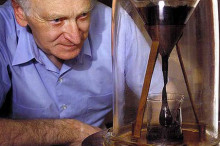
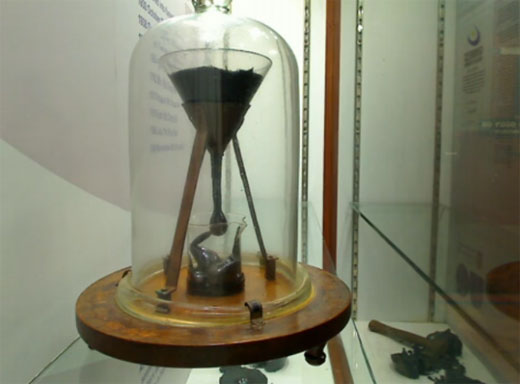
    This curious looking setup is the pitch drop experiment. Some people reading this will undoubtedly know of it. Set up at the University of Queensland in 1927 by Professor Thomas Parnell, this experiment may take a few of your ideas about what a liquid actually is and turn them on their heads.

    Good things come to those who wait...?

    Pitch, you see, is a liquid. But if you were to see some of it up close, you might not think so. To our eyes and senses, it appears to be a solid. It’s a black, waxy looking substance, a derivative of tar which ship builders used to use to waterproof boats. You can think of it more or less like a liquid which moves in slow motion. Extremely slow motion! Pitch is so viscous and flows so slowly that you can quite easily pick up a piece of it and hold it in your hands. You can snap pieces of it off, and if you hit it with a hammer, it will even shatter. But make no mistake – pitch is not a solid.

    Perhaps a better word to use here is not liquid, but “fluid.” A fluid is, simply, any substance which is able to flow. Everyday liquids like water are fluids, as are gasses like the air around us. So too are the thicker, more viscous liquids you may encounter, like treacle or tomato ketchup. But pitch is quite possibly the most viscous fluid in the whole world, an average 100 billion times as viscous as water.

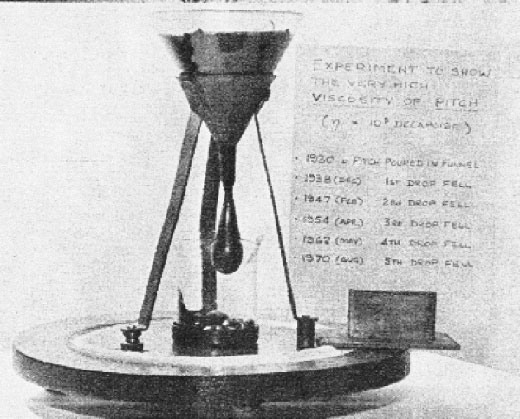
    Parnell’s pitch drop experiment, presently looked after by Professor John Mainstone, was set up to demonstrate this bizarre fact. In 1927, Parnell heated a sample of pitch and poured it into a sealed glass funnel. He gave the black tarry fluid three full years to “settle” before cutting open the stem of the funnel and leaving it to its own devices, kept in relatively inert conditions under a large glass bell jar. I say relatively inert. This experiment is really more of a demonstration, and how fast the pitch flows depends on the seasons – it moves ever so slightly faster in warm weather, though still never so fast as to be actually noticeable. In the 83 years since, this slow moving tarball is currently forming it’s ninth drop.

    In material science terms, pitch is a “viscoelastic polymer”. You may be familiar with some other, similar liquids without realising it. There are, you see, a few materials which very slowly flow over time. The effect is so slow that it takes a significant fraction of your lifespan to notice any motion, but it is there. Certain types of varnish actually have similar, very slowly flowing properties, which can be a concern in the art world. Paintings are often handed down through generations, and anyone wishing to preserve them must be careful not to use varnishes which may slowly flow and spoil the artwork.

    On the other hand, there’s a common misconception that glass flows this way. This is absolutely not true. Glass, you see, is not viscoelastic. It’s what’s termed, an “amorphous solid”. Amorphous materials have no order at the atomic level. Many plastics, like the type which makes up the bottles you may buy drinks in, are amorphous this way. If you were to look at a piece of glass on a very, very small scale, you’d find that it’s made up of a web of molecular chains, made from silicon and oxygen atoms. But amorphous solids are not fluid. You can leave a piece of glass alone for centuries, and it will not flow at all.

    Actually, glass is quite a generic term, referring to a whole variety of materials. Any material which is rigid and brittle, with a disordered structure, is technically a glass. As well as the glass in windows, many types of plastic, such as polycarbonate and perspex, are technically glasses. Even metals can be made into a glass. If you shave, the razorblade you use is probably made from a glassy metal. Glasses can be pulled and stretched (this is one way in which fibre optics are made), but if you leave them alone, they’ll remain perfectly solid.

    Viscoelastic polymers are not like glass. They may have a disordered structure, like a glass, but they behave rather differently, even though you may not realise this at first glance. The word viscoelastic itself, gives away what’s really going on. These materials are both viscous, and elastic. Being elastic, you can stretch them, and they will try to return to their original shape. Leave them alone, and they’ll behave like viscous liquids, and slowly flow. This is because unlike glasses, the molecular chains which make them up aren’t tightly interconnected. Instead, they’re a tangled mess, looking, if I’m honest, not unlike my hair does when I wake up some mornings. Because those chains aren’t joined together, they can slowly slip past each other, which is what gives these materials their fluid properties. Anyone who’s used gloss paint may have noticed how a surface which appears to be smooth will sometimes have visible drops running down it hours later, where the paint flowed before it had time to dry. Unlike pitch, however, most types of paint do eventually dry and harden. Viscoelastic materials, like amorphous materials, are also defined by how they behave at the molecular level – any material can only move  as fast as its molecules allow. If you take a highly viscous fluid like pitch and try to move it too quickly, the molecular chains which make it up won’t be able to move fast enough, and it will simply snap. It’s only if you leave it alone for long enough, that you can see it’s fluid behaviour.

    This is precisely what Parnell did with the pitch drop experiment all those years ago. To date, it’s already managed to prove his point. The pitch in that funnel, kept at Queensland University, is very definitely flowing just like a liquid. It’s just an excruciatingly slow liquid.

    To date, no one has been around to actually witness a drop falling. I’ve no doubt, this must be very frustrating for people like John Mainstone (who actually missed one drop in 1988 because he’d just stepped out to get some coffee). So far, the pitch has dropped just over once a decade.If you’re feeling lucky, you can watch a live webcam feed at the Queensland University website, where three webcams now monitor it at all times. Though I should warn you that it’s possibly even less exciting than watching paint dry. Some are beginning to say that the ninth drop may fall soon. But then, they’ve already been saying that for years…

    It's not often you find vintage photographs of experiments which are still running!

  • Australia from orbit

    Australia from orbit

    From December 19th last year, Chris Hadfield has been living aboard the International Space Station (ISS) in orbit roughly 400 km above planet Earth. Seeing 15 sunrises every day as the station tracks its way above our planet, the ISS, to quote Hadfield himself, “weighs 500 tonnes and is the size of 5 NHL hockey rinks, with living quarters for 6 people.”

    One of the many things which Hadfield has been doing is to keep the tradition set by previous astronauts of taking fantastic photographs of our planet from above. In a Reddit AMA session a couple of months ago, he mentioned that Australia “looks the coolest” from orbit, being fond of the textures and colours of the Australian Outback. So here, for your visual pleasure, are some of the most beautiful pictures of Australia taken from high, high above by Chris Hadfield. Enjoy!

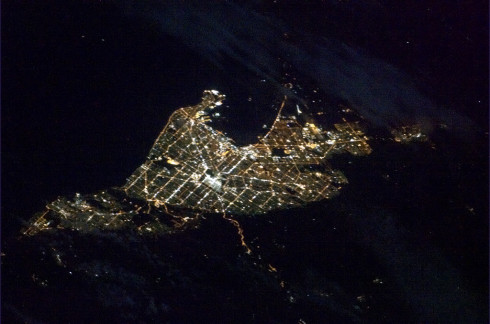
    Adelaide by night

    Adelaide by night, glittering like a jewel.


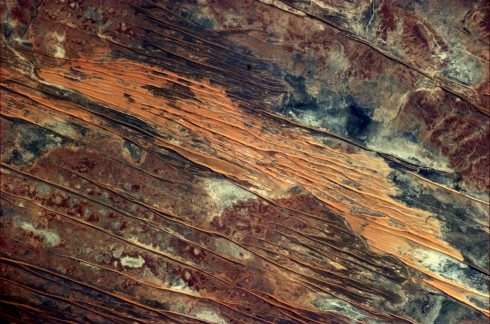
    Outback from Orbit

    “The Outback is full of scary faces, staring up in forbidding horror.”


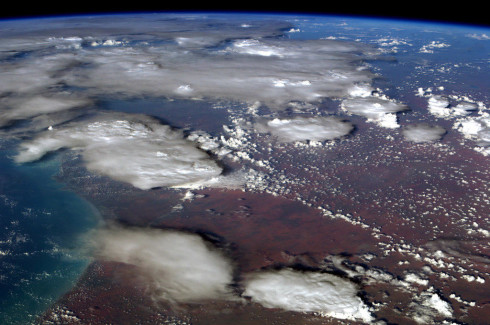
    Smoke clouds from the bush fires

    Smoke clouds from the bush fires, as seen from above.


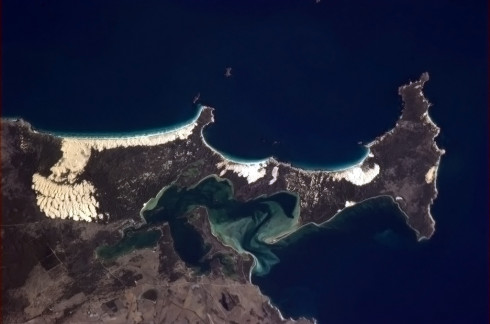
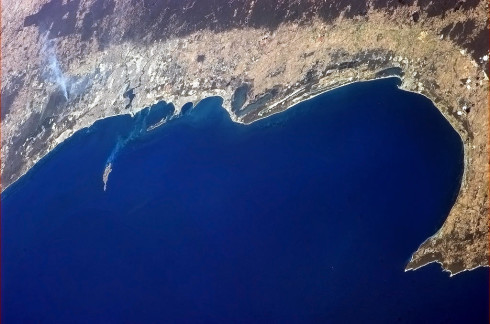
    Coffin Bay

    Coffin Bay national park.


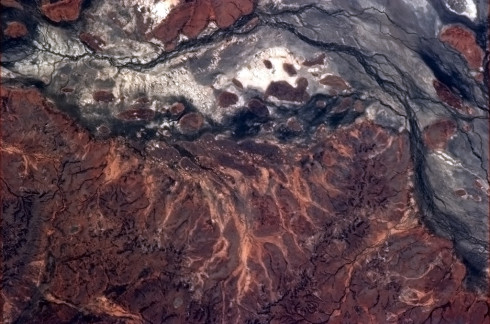
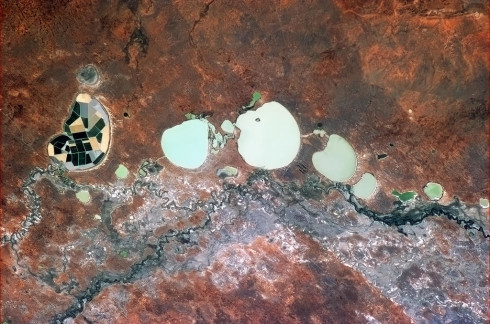
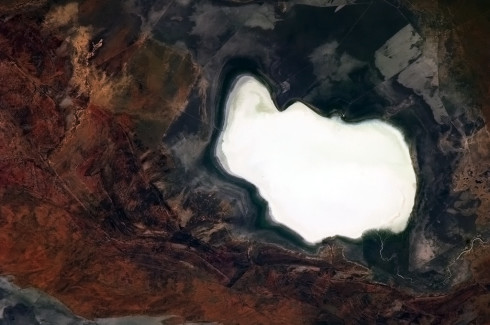
    Dry Lake Beds

    Dry lakes in the Outback, including one which is being used for farming. Quite ingenious.


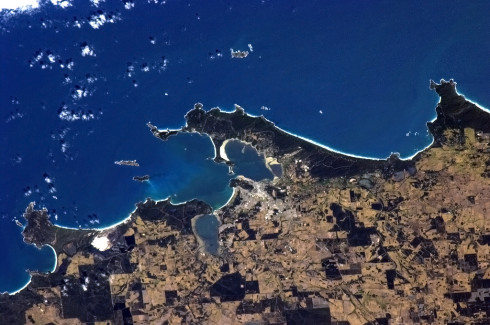
    King George's Sound

    King George’s Sound. Hadfield notes that “Charles Darwin got off the Beagle and hosted a dance here in February, 1836.”


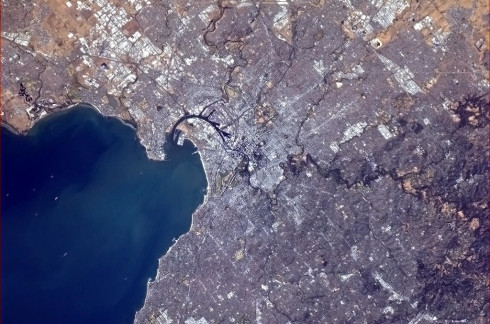
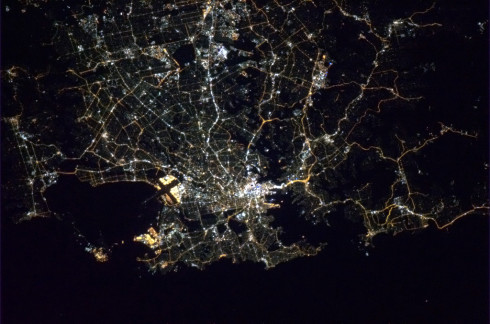
    Melbourne

    Melbourne harbour.


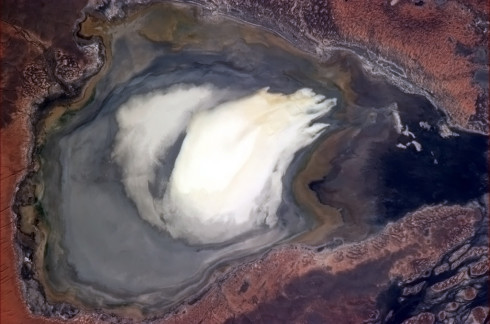
    Dry Lake in the Outback

    Beautiful smeared colours of a dry lake bed.


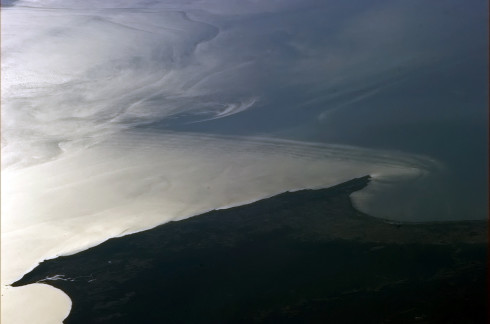
    Off the coast of Perth

    The ocean off the coast of Perth. Evening sunlight catches the waves and ocean currents, making them visible.


    Outback from Orbit

    Jagged lines of the Outback.


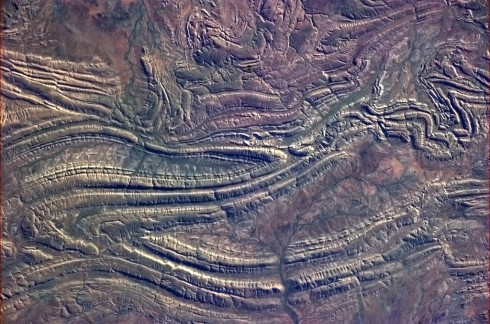
    Outback rock patterns

    Folded rock formations created by tectonic activity in the Outback. Caught by the morning sunlight, they really stand out.


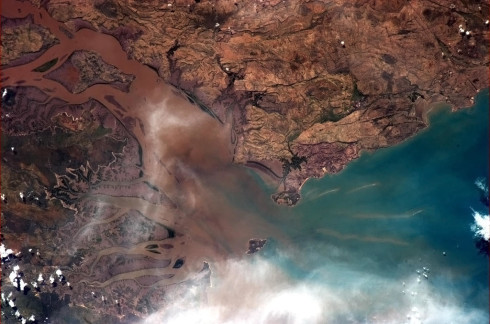
    River Delta

    A river delta, showing a host of gorgeous colours.


    Dry Lake in the Outback

    A big dry lake somewhere in the Outback.


    Perth from Orbit

    Beautiful blue seas off the Perth coast.


    Outback from Orbit

    “A lot of the Australian Outback looks like somebody spilled something on it.”


    Sydney by night

    The city lights of Sydney.


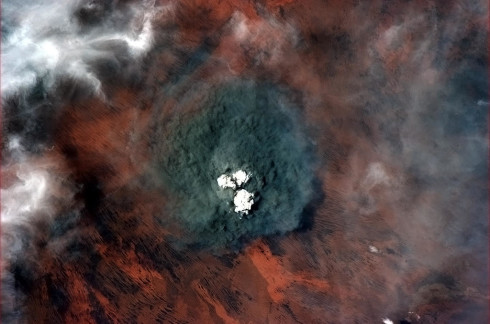
    Ominous smoke cloud

    An ominous looking smoke cloud in Western Australia.


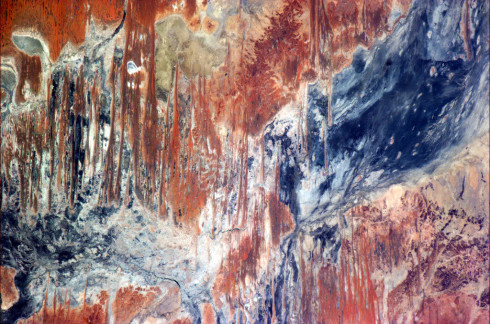
    Outback from Orbit

    A shot of the Outback looking very much like a Jackson Pollock painting.


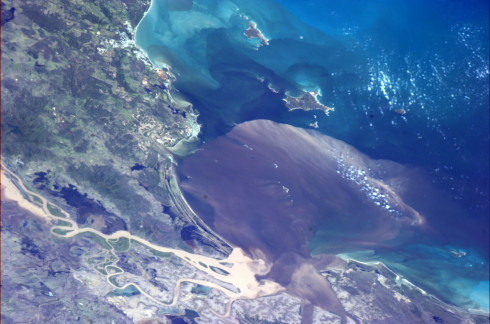
    Floodwaters at Rockhampton

    Floodwaters pouring into the Coral Sea near Rockhampton. You can see all the murky brown silt from the river as it disperses into the tides.


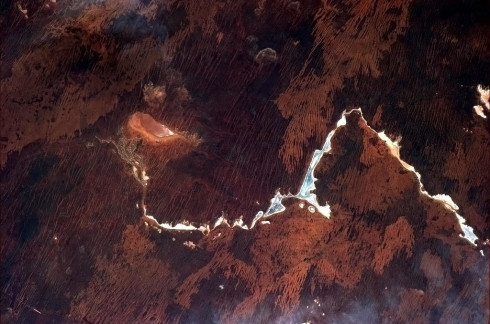
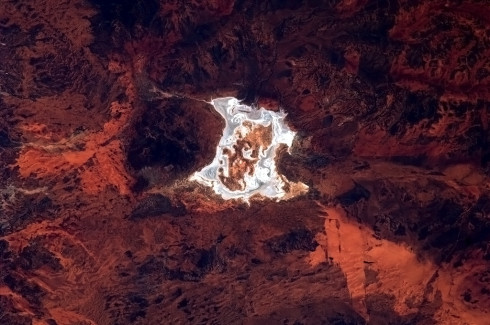
    Outback from Orbit

    “A splash of dry salt white on seared red in Australia’s agonizingly beautiful Outback.”


    All images: NASA/Chris Hadfield

  • Weekly Science Picks

    Weekly Science Picks

    It’s been rather a turbulent week, all told. There’s been a lot going on in the news, both good and bad. Hopefully, this little handful of science news items will help you finish the last week and begin this next one on a lighthearted note!


    NASA’s Kepler mission has found a star system which has not one, but two possibly terrestrial planets in its habitable zone.

    Kepler-62: A Star System With Two Earths?

    Whether either or both of Kepler-62’s optimally positioned planets actually has water is beyond the technical capabilities of the Kepler and other telescopes. Kepler works by detecting the very slight dips in light coming from a star caused by a planet passing by, relative to the telescope’s line of sight.


    Sometimes the best way to learn more about nature is to try and recreate it. That happens to be exactly what happened when a group of roboticists were looking at insects…

    Roboticists discover the secret of insect flight, and it’s not wings

    They found that the moth moved its abdomen in direct response to its shifting visual environment. “If the pattern is rotating up (clockwise), the moth would raise its abdomen up (counterclockwise),” says study co-author Jonathan Dyhr, a University of Washington biologist. “The moth was raising or lowering its abdomen to counteract the movement.”

    The Horsehead Nebula

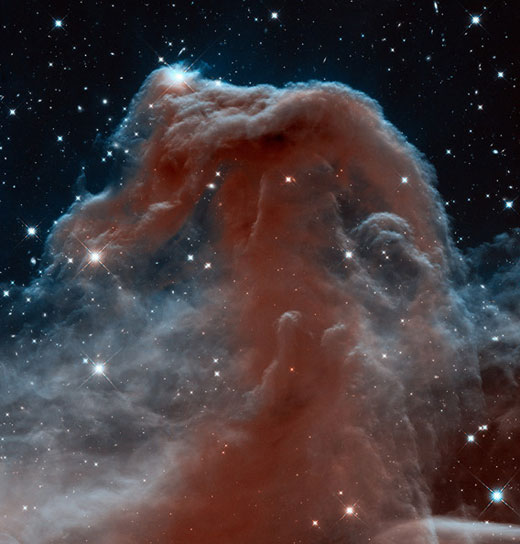
    To celebrate the 23rd anniversary of the Hubble Space Telescope’s launch into orbit, NASA have released a brand new and frankly beautiful image of the iconic Horsehead Nebula. Phil Plait explains more…

    Hubble’s Knight to Remember

    The Horsehead itself is the site of ongoing star formation. The dense gas and dust inside the nebula is collapsing to form stars, and, at the same time, the edges are being eroded away by the fierce ultraviolet light of Sigma Orionis. The top of the Horsehead is acting a bit like a shield, protecting the material beneath it, which is why it’s taken on that umbrella-like shape. You can see more sculpted pillars of material around the sides, too, like sandbars in a stream.


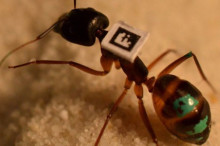
    Ants are fascinating little creatures, and a team of Swiss researchers have been studying the goings on inside a colony of them – by tracking them with barcodes!

    Barcodes let scientists track every ant in a colony

    Analyzing the color codes, they found that younger ants were more likely to work nursing the young, and older ants were more likely to be foragers. In general, they watched ants transition from nursing to cleaning to foraging as they age, but there’s a lot of individual variation in how quickly these transitions took place.

    Chris Hadfield. Being awesome from orbit.

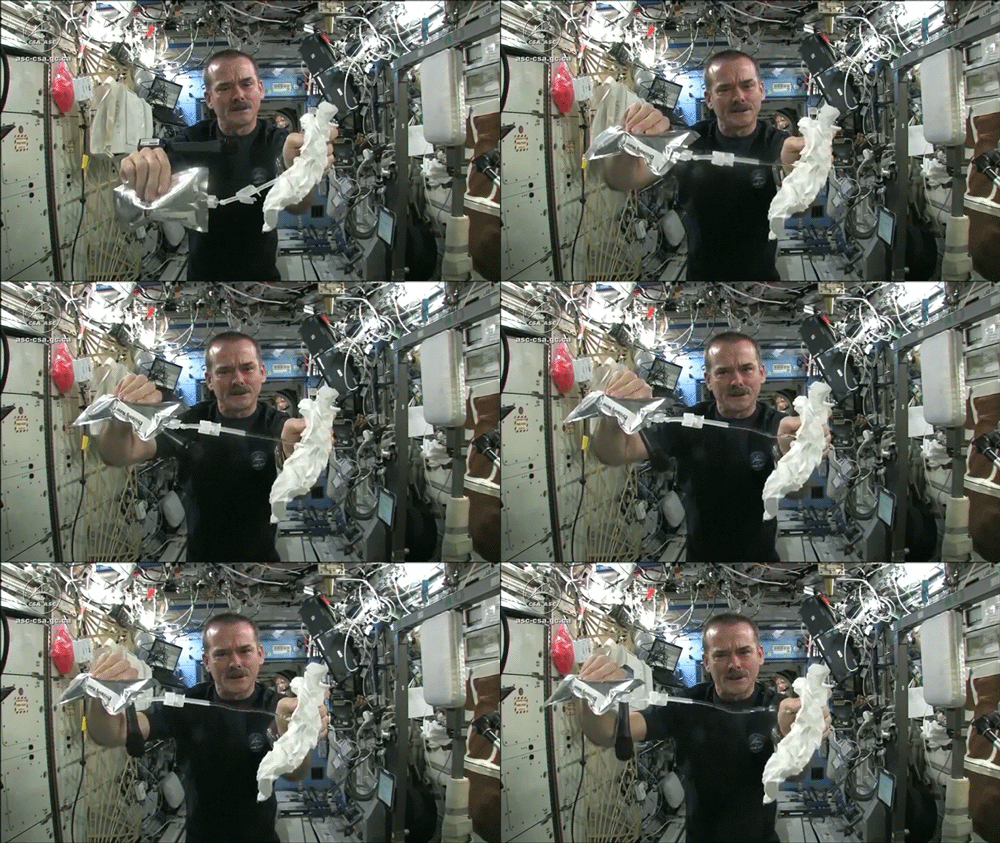
    Finally, everyone’s favourite astronaut, Commander Chris Hadfield aboard the ISS answers an interesting question. What happens if you wring out a wet cloth in zero gravity? Click the link to watch the video!

    What happens when you wring out a washcloth in space?

    Two Nova Scotia high school students, Kendra Lemke and Meredith Faulkner, submitted this experiment to Canadian Space Agency and got to see astronaut Chris Hadfield actually test it out on the ISS. The results are seriously extraordinary and you need to see them.

  • The Schoolchild who Discovered a New Jellyfish Species

    The Schoolchild who Discovered a New Jellyfish Species

    The thing I love the most about scientific discovery is that anyone can do it. Literally anyone could, tomorrow, turn over a stone or look at a seemingly empty spot in the night sky and find something which no human being has ever seen before. Or, perhaps more importantly, something which no one has full appreciated before.

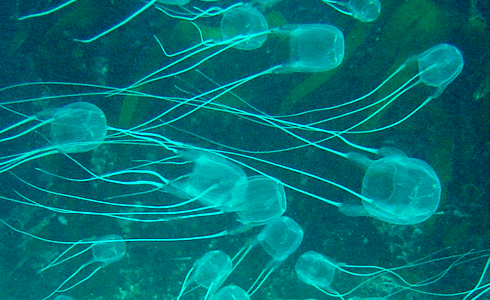
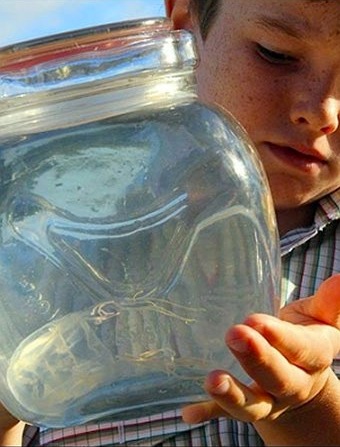
    And that’s exactly what happened to nine-year-old Saxon Thomas from Paradise Point in Queensland, Australia. While fishing in a canal in his backyard, Saxon found a jellyfish which he recognised as a box jellyfish. This was surprising at first, because no box jellies had previously been found in these waters. With a little help from his father, he carefully collected the fragile animal into a jar and sent it to Merrick Ekins, a marine expert at the Queensland Museum, to be identified.

    But Ekins couldn’t identify it. It’s now been confirmed to actually be a new species, previously unknown to marine biologists. This has caused some consternation among locals who may now be thinking twice about swimming off the nearby coast. A few box jellyfish species are notorious for having extremely painful, and in some cases potentially fatal, stings.

    Mercifully, this species is not the box jellyfish, otherwise known as chironex fleckeri, known for its lethal stings. This was the first species which Ekins checked, because if c. fleckeri was found around the coast of Queensland, it would be a big problem for local swimmers. Reassuringly, while the new jellyfish is a related species, it’s definitely not the same one.

    Unfortunately though, for now at least, no one’s quite sure whether this new species is dangerous or not. Lacking the resources to investigate it further, local marine biologists explain that they won’t know how severe the stings this jelly can give are until someone is stung by one. Needless to say, no one’s particularly keen to find out voluntarily. While it’s very definitely capable of giving you a sting – this is, after all, how jellyfish catch their prey – it’s probably not life threatening. That said, Ekins cautions that there’s simply no way of knowing this for sure. Swimmers would be well advised to steer clear of them in any case.

    Dangerous or otherwise, a new species is always an exciting find for biologists. Lisa Gershwin, director of Australian Marine Stinger Advisory services, shares in the excitement, while wondering what the new jellyfish species should be named. “I haven’t met Saxon yet but my intention is to one of these days when I meet him ask him what he would like it to be named,” she said, in keeping with the tradition that new species are named by whoever discovers it.

    However, while this privilege is normally taken by the first scientist to describe the species, Gershwin thinks that Saxon Thomas should have the honour of naming the jellyfish he discovered. She explains, “I wanna give him the choice to name it because I think it’s such a wonderful thing that here’s these kids out playing with nature and going ‘hey wait, that’s different – what’s that?’ – and now we know. What a fabulous find.”

    Fabulous indeed. And a reminder that it’s impossible to know when and where discoveries like this will be made next – or who might be there to make them!

    Saxon Thomas with his jellyfish

    Images:
    Top – Box jellyfish – Peter Southwood/Wikimedia Commons
    Bottom – Saxon Thomas with the jellyfish he found – via ABC Gold Coast


  • A Supernova Post-Mortem in Radio Waves

    A Supernova Post-Mortem in Radio Waves

    It was a late February night in 1987 when, standing on top of a Chilean mountain range, Ian Shelton saw something which no one had seen for centuries. Looking up in disbelief, he watched a star explode some 160 thousand light years away. Rushing to another observatory to check with someone else, he was initially met with stark disbelief. But there was no doubt. Shelton had seen a supernova explosion with his own eyes.

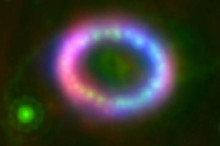
    Named SN 1987A, this was the death of a massive star in the Tarantula nebula. Distant enough to not even be in our own galaxy, but in the Large Magellanic Cloud – one of the Milky Way’s smaller satellite galaxies, the discovery was reported independently by Albert Jones in New Zealand. This began decades of fascinating observations for astronomers, as many began to watch this supernova expand over the years, in real time.

    Supernova which are close enough to see with the naked eye are rare beasts. This was, and still is, the only one close enough and visible enough to see properly with modern telescopes, giving us some of the best information we’ve ever had about how an exploding supernova interacts with the dusty interstellar clouds which surround it.

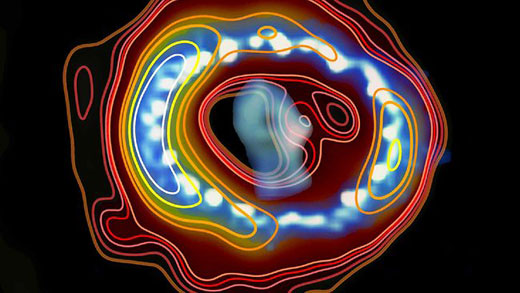
    The latest observations of this literally awesome event come courtesy of a team of astronomers working in Australia and Hong Kong, led by Giovanna Zanardo at the International Centre for Radio Astronomy Research (ICRAR). Using CSIRO’s Australia Telescope Compact Array in New South Wales, the researchers have published the highest resolution images of the stellar explosion’s aftermath ever taken.


    Portrait of a Dying Star

    SN 1987A contour lines


    High resolution images are wonderful in astronomy. The higher the resolution, the more you can learn about what you’re seeing. Zanardo and her colleages compared their observations with other images and data taken at optical and x-ray wavelengths. On doing so, they gained some fresh insight into exactly what happens shortly after a star explodes.

    In the centre of the explosion, stellar ground zero, they discovered a pulsar wind nebula. This is a pocket of intensely hot material emitted by a neutron star*, the last remains of the exploding star’s core, proving that SN 1987A did not create a black hole.

    Referred to in technical jargon as a “compact source”, a neutron star is a tiny ball of incredibly dense material. With a mass up to over 3 times the mass of the Sun, these bizarre little objects truly are compact. An average neutron star has a radius of just 12 km, which is comparable with the size of Sydney. Yes, you read that correctly. The mass of a star compressed into something with a size similar to a large city.

    This discovery actually answers a long standing puzzle about SN 1987 A. Supernovae like SN 1987A are normally expected to form neutron stars, because of the near-unimaginable pressures which occur inside an exploding star. But for several years, despite looking carefully, no astronomers could find any trace of a neutron star amid the stellar debris. But the star which caused this supernova would not have been massive enough to collapse into a black hole, leading theoreticians to try and devise explanations for why there was no neutron star to be seen.

    If Zanardo’s team are right, and they have indeed found a pulsar wind nebula inside the shattered remnants of this dead star, then it has to be generated by something. Unless I’m mistaken, this may be some of the most convincing evidence yet for the missing neutron star!


    Seeing Clearly in Invisible Light

    Discovering all of this, however, was far from easy. Radio images at centimetre wavelengths are difficult to capture with detail. Exceptionally good weather conditions are needed. Zanardo explains, “For this telescope, these [observations] are usually only possible during cooler winter conditions, but even then the humidity and low elevation of the site makes things very challenging.

  • Weekly Science Picks

    Weekly Science Picks

    Ahhh, the end of the week again. It seems that every time it’s my turn to give the weekly science picks, it’s been an interesting week in science. This leads me to believe that every week is an interesting week in science! Amongst other things, this week was the birthday of Albert Einstein – March the 14th. Which, to those who use American date formats, might also be known as Pi Day. But enough irrational trivia. Here are the things which caught my eye this week…

    Probably the biggest news this week was the fact that those lovely people at CERN have officially confirmed that the particle which they announced last summer is indeed the much acclaimed Higgs boson!

    Physicists Say They Have Found a Higgs Boson

    “To me it is clear that we are dealing with a Higgs boson, though we still have a long way to go to know what kind of Higgs boson it is,” said Joe Incandela, a physicist who heads one of the two main teams at CERN, each involving about 3,000 scientists.


    Meanwhile, Colossal shows some rather impressive trickery with water, sine waves, and a video camera set to the right frame rate. I can’t really do justice to this one with words. Just… have a look.

    This is What Happens When You Run Water Through a 24Hz Sine Wave

    What!? How is this even possible? Because science, my friends. Brusspup’s latest video explores what happens when a stream of water is exposed to an audio speaker producing a loud 24hz sine wave. If I understand correctly the camera frame rate has been adjusted to the match the vibration of the air (so, 24fps) thus creating … magic zigzagging water. Or something.

    Wibbly wobbly water!


    On a more serious note, good news in the medical world! A device has been created which can enable human livers available for transplant to survive outside the body for a whole day – something utterly without precedent. Something like this is most certainly going to save lives!

    Donor livers kept alive outside the body for 24 hours

    Donated livers can survive for at least a day outside the body thanks to a new device which keeps the organ ticking over as if it hadn’t been removed. The machine is likely to more than double the availability of livers for transplant.


    A lot further from home, this week saw a science meeting to celebrate the 20th anniversary of the Keck observatory on Mauna Kea, Hawaii. Among all the lovely new science presented at the meeting, UC Berkeley’s Geoff Marcy announced new findings which suggest than a whopping 23% of Sun-like stars have at least one Earth-sized planet in orbit around them. Pretty amazing…

    Quarter of Sun-Like Stars Host Earth-Size Worlds

    “I’ll say that again, because that number really surprised me: 23 percent of sun-like stars have a nearly-Earth-sized planet orbiting in tight orbits within 0.25 AU of the host stars,

  • It’s a small world after all

    It’s a small world after all

    What we know of exoplanets has developed at the same time as the technology which we use to discover them. This is, in my opinion, the most exciting thing about the entire field of study. For instance, when we first started spotting planets around alien suns, we found huge gas giants. Hot jupiters, extremely massive and close to their parent stars. For a while, some conjectured that this type of planet may be quite common in the Universe. But since then, we’ve developed more powerful methods of searching the sky and, as it turns out, smaller planets are much more common than huge superjovian worlds. The latest piece in the puzzle comes courtesy of NASA’s Kepler space teescope. Near the end of last month, NASA announced the discovery of the smallest exoplanet ever found around a sun-like star!

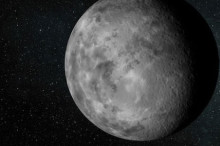
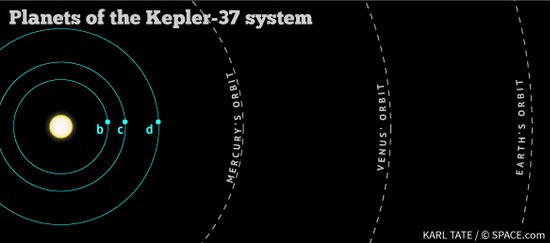
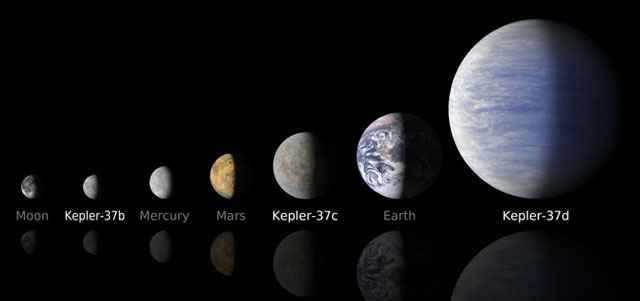
    Kepler-37b really is tiny. In fact, the whole Kepler-37 system is tiny – the entire system discovered so far can fit inside the orbit of Mercury! The innermost little world is under 100th the mass of Earth, it’s expected to have a radius of around 3867 km (assuming the same average density as the planets in our own solar system) making it smaller than Earth’s moon. One can only apprehensively wonder if this will spark yet another debate over how large an object has to be before it’s considered a planet. With such a tiny orbit, it also has a year lasting just 13 Earth days. Even though the star Kepler-37 is slightly smaller and cooler than the Sun, it’s still enough to heat the surface of tiny 37b to a roasting 700 Kelvin (nearly 430°C). Needless to say, while we all like stories which talk about potential alien life, this is unlikely to be a home for any lifeforms we might recognise.

    Tiny star system!

    Kepler-37b is very definitely the runt of the litter. Its sibling worlds, denoted by the letters c and d, are respectively slightly smaller than Earth and about twice the size of Earth. Of course, these planets are also very close to their parent star. The interesting thing is that we’re discovering more and more small worlds around other stars. More and more exoplanet astronomers are warming to the idea that small rocky planets are likely to be the most common in our galaxy. Our current technology might have trouble spotting them further than a certain distance from their parent stars, but they’re likely to be out there waiting to be found.

    The planets of Kepler-37

    Even detecting Kepler-37b was quite a notable feat. It was only possible, in fact, because of a set of rather special circumstances. The star Kepler-37 is particularly quiet, lacking the noisy sunspots and features which cause brightness variation in most stars, making it a particularly clear target. It’s also relatively bright in Kepler’s field of view.

    To learn more about this star, and hence get greater accuracy on the measurement of the planets it carries in tow, NASA astronomers used a technique known as asteroseismology. Not dissimilar to the way geologists measure earthquakes, asteroseismology is the study of vibrations within a star, measured by accurately observing pulsations in the star’s surface. All stars are constantly bubbling and boiling, and this causes the whole star to vibrate at a number of resonant frequencies – soundwaves – in exactly the same way a bell vibrates when it rings. By measuring the precise frequencies of those soundwaves, a lot can be determined about the interior of a star. Incidentally, this same technique can be used to effectively “listen” to the Sun.

    Interestingly, because Kepler-37 has such an eerily peaceful surface for a star, it was very easy to measure those vibrations, making Kepler-37 the smallest star ever to be studied this way. Normally, only large stars are observed using asteroseismology because the measurements need to be very precise. Conveniently though, the Kepler telescope was built for breathtaking precision.

    A tiny planet discovered orbiting a singing star 215 light years away. How poetic!

    Image credits:
    Top – NASA/Ames/JPL-Caltech
    Middle – Karl Tate/ © space.com
    Bottom – NASA/Ames/JPL-Caltech

  • Asteroids, extinctions, and biodiversity: Wiping the slate clean for new life to flourish

    Asteroids, extinctions, and biodiversity: Wiping the slate clean for new life to flourish

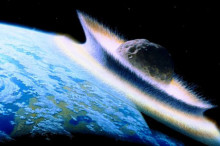
    The recent meteor strike in Russia has been a rather sobering reminder that Earth has been regularly battered during its history, by space rocks. Actually, the amount of meteoritic material constantly landing on Earth is startling – on average, over 100 tons every day which we don’t even notice. Now, most of that is in the form of tiny rock fragments and dust; with most being small enough to be vapourised as they burn up in Earth’s atmosphere, relatively few meteorites ever end up on the ground. The part which may make us uneasy, however,  is the fact that occasionally something larger crosses Earth’s path. Something much larger.

    We already know with some degree of certainty that a gigantic asteroid impact may have played a role in wiping the dinosaurs off the face of our world, and we also know it’s not the only such large impact in Earth’s history. Now there’s evidence of another huge impact – and this one was in Australia!

    With a diameter spanning around 200 km in South Australia’s East Warbuton basin, an ancient impact site has been uncovered. Created by an asteroid which was probably between 10-20 km in diamater, affecting an area of terrain of around 30,000 km, this impact zone is the third largest currently known. When this particular asteroid struck Earth some 360 million years ago, its effects would have been profound and global.

    Andrew Glikson, a visiting fellow at the Australian National University, first started investigating the area after hearing about structural abnormalities in the rocks there. He spent time in a crystallography lab, studying the orientation of crystals in rocks collected from the site, and found that the most likely cause for what he was seeing was the result of the rocks being subjected to a huge shock. Given the extent and area of the shocked rocks, the most likely explanation is a giant extraterrestrial impact.
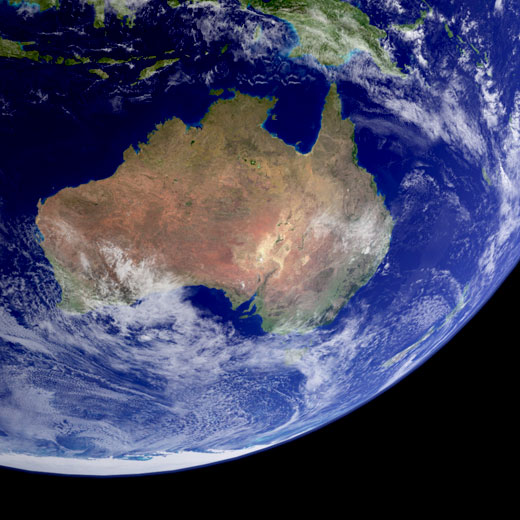
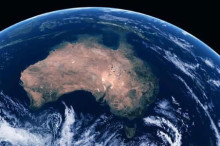
    Earth looks so peaceful from orbit...

    The most well known giant impact, known as the Chicxulub Impact Event, occurred about 66 million years ago causing the Cretaceous-Tertiary extinction event, and quite probably being the final nail in the coffin of the dinosaurs. This newly discovered Australian impact site, however, is much older. In fact, when this asteroid struck Earth, it was around 100 million years before any dinosaurs had even evolved. In fact, it would have likely been during the Carboniferous Period in Earth’s geologic history. Interestingly enough, there was a minor extinction event during the Carboniferous. A minor extinction caused by a change in Earth’s climate.

    Glikson went on to explain that this impact was likely one of part of a cluster which caused a number of impacts around that time. This cluster of impacts was very likely behind an extinction event. Simply, a huge impact like the one discovered in the middle of Australia would cause devastation. The effects locally would be severe, splattering molten rock into the air which would then rain back down to the ground hundreds of kilometres away, and a blast wave of superheated air would cause widespread forest fires near the impact zone – particularly in the oxygen rich atmosphere of Earth’s Carboniferous forests.

    The global repercussions of such an impact, however, would be much worse. A huge amount of dust would be thrown up into Earth’s atmosphere, choking out the sunlight. This would cause Earth’s surface to cool, and the reduced light would make plants die off. A big enough impact – or a series of them – would throw enough dust into the skies that this could happen on a global scale. With the food chain cut off at the plants which are its source, a mass extinction would follow as animals would have trouble finding food to survive on.

    These events are mercifully rare. A giant impact may happen on Earth once every ten million years or so. Interestingly enough though, researchers in a different study have found evidence that extinction events on planet Earth may actually be beneficial to biodiversity.

    Kale Sniderman, part of a group of researchers working at the University of Melbourne and the University of Tasmania, focussed on an event much more recent than the East Warburton impact. Instead, he and the others looked at the last ice age, around one million years ago and together they constructed a hypothesis that extinction events may be even more important for biodiversity than rapid evolution. While their work concerns species which went extinct during ice ages as opposed to impact events, a suitably large meteor strike may be a factor in what causes an ice age to begin.

    The traditional view of most biologists is that some areas have greater biodiversity due to evolution in those places progressing more rapidly. Evolution has always been the only thing emphasised in biodiversity studies, but Sniderman and his colleagues have taken the first step in overturning this picture.
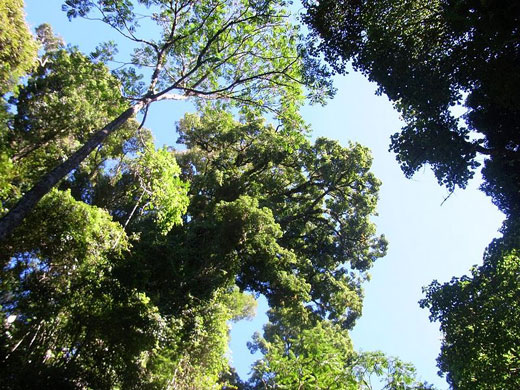
    League Scrub

    Their work looked at regions in South Africa and Australia – notable as two of the most diverse areas on planet Earth. South Western Australia is known among botanists for having a huge variety of plants, particularly tough leaved shrubs and trees. The very tip of the South African cape is even more diverse, populated by very similar types of plant. For a long time, biologists have theorised that the diversty in these rather similar areas was down to the dry, arid summer conditions and the nutrient poor soils in these areas. The exact connection, however, has never been entirely apparent.

    As it happens, the status may not be quite so quo here. Studying fossils from an ancient lake in South Eastern Australia, it was found that plant life in Australia tended to die off as the continent has gradually become drier – a process taking millions of years. In particular, during the last ice age, a huge amount of rainforest plants died off. This allowed other hardier plants to fill the space they’d left and plant diversity expanded as they did so – creating what was described by University of Tasmania’s Greg Jordan as “a remarkable number of tough-leaved, shrubby plants.” Thinking about this process logically, it seems to make perfect sense. In any place on Earth where there’s a vacant ecological niche, life will typically evolve to try and fill that niche. Where an extinction occurs, a huge niche will suddenly become empty. This would prompt a veritable explosion of new life forms to fill in the gap.

    This study not only gives new insight into how extinction events can affect diversity of life forms, but also has implications for current and future climate change, and how species may be able to cope with it. As I mentioned previously when talking about the Great Barrier Reef, Australian wildlife is already suffering from climate change. However, at least for plant life on land, there’s a good chance that the species most easily affected by rapid environmental changes may have already died off during the last ice age.

    To loop this discussion back to the beginning, if an extinction due to an ice age could help to boost biodiversity, logically an extinction due to an asteroid impact event could do the same. To my knowledge, there are no studies in this context concerning what happened to biodiversity after the Chicxulub impact event (though I’ll admit that I may be wrong on this), but it would be very interesting to see what such studies might find. Similarly, it would be interesting to know if any such flourishes of biodiversity occurred after the newly discovered East Warbuton impact too. It could be that only certain types of extinction event can boost diversity of life on a planet. That said, if the same thing can occur after an asteroid impact then it may have implications reaching beyond Earth.

    If a giant impact event could serve to actually boost life on a planetary scale, then it may imply that once life has taken hold on a planet, it’s more robust than we’ve been giving it credit for. The implications for astrobiologists and the search for life elsewhere in the galaxy are quite clear.

    To end on an aside, a large enough asteroid strike even on Earth today would cause widespread fires kilometres away from the impact site. Back in the Carboniferous Period, around the time when the East Warbuton impact occurred, the situation would have been much more dramatic; the oxygen content of Earth’s atmosphere was up to 15% higher then, than it is today. In such a combustible atmosphere, where fires could have been started by a simple lightning strike, a large asteroid impact could cause a widespread inferno. However, South Africa (one of the places considered in the biodiversity study) is home to a number of species which have evolved specifically to survive fires. In particular, the highly diverse Fynbos region is known for a number of plants for which fire is actually an integral part of their lifecycle. Some seeds belonging to protea species simply don’t germinate unless they’re exposed to the intense heat of a wildfire. Provided they could gather sufficient amounts of sunlight under the darkened skies, plants like these may be able to rapidly repopulate an area after an impact event.

    Life on Earth, evidently, has resilience which can still surprise us.

    nature

    Image credits:
    Top – Artists impression of a large scale impact event – Don Davis/NASA
    Upper Middle – Australia seen from orbit – NASA
    Lower Middle – League Scrub sub tropical rainforest, near Bowraville NSW, Australia – Peter Woodard/Wikimedia Commons
    Bottom – Garden – https://croatia-real.estate
  • Andromeda and the 13 Dwarfs

    Andromeda and the 13 Dwarfs

    Astronomy is quite notorious for being full of things we don’t entirely understand. Sometimes it really does feel as if the closer we look at the Universe, the less it makes sense. One thing in particular which seems to constantly evade our understanding is the way in which galaxies work. A lot of very smart people spend a lot of time taking telescope observations and creating computer simulations to try and understand how exactly a galaxy can form and evolve, and every now and again someone will discover something which doesn’t seem to fit with what they were expecting. Occasionally we find something like that which is, at least in cosmic terms, right in our back yard.

    The Andromeda galaxy  is practically a twin sister to our own Milky Way. Slightly larger than us but slightly less massive, Andromeda lies around 2.5 million light years away, and between them Andromeda and the Milky Way dominate the local group of galaxies. But Andromeda is not without fanciful tastes – it wears a skirt over a million light years in diameter, made up of dwarf galaxies.
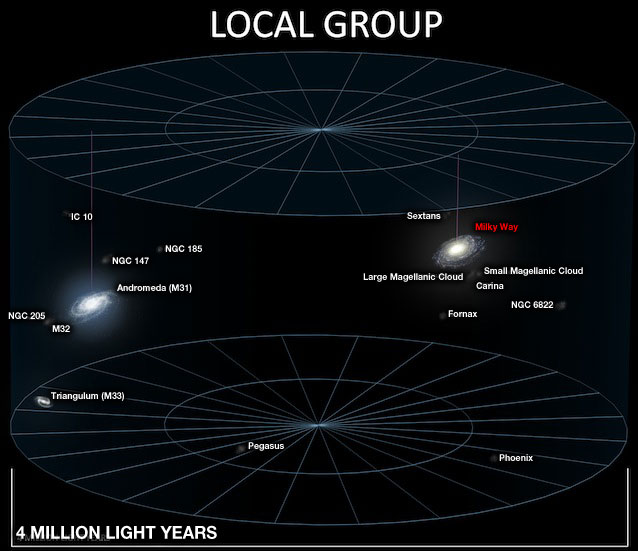
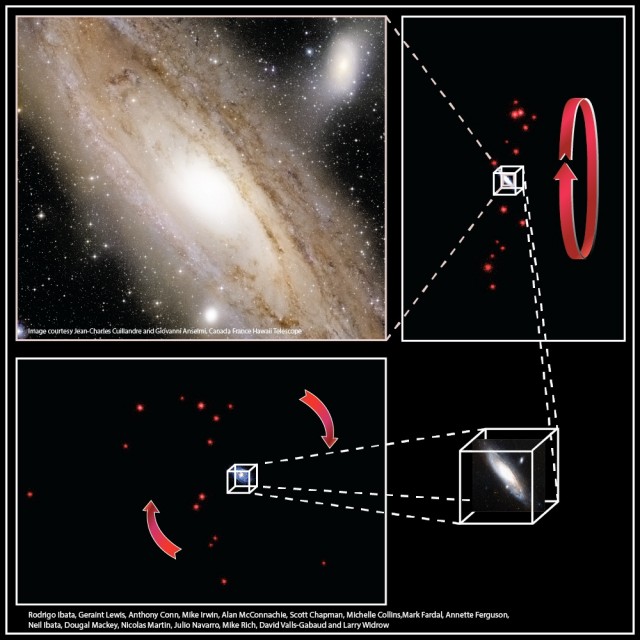
    A recent study headed by Rodrigo Ibata at the Strasbourg Astronomical Observatory, France, and Geraint Lewis at the University of Sydney, Australia, found a host of new galaxies in the local group. The image below gives you an idea of the scale involved, but it doesn’t show the full story – There are actually over 54 galaxies in the Local Group. Andromeda is surrounded by a small swarm of 27 dwarf galaxies, and 13 of those dwarf galaxies orbit in the same plane, the same way the planets orbit the Sun. This means that Andromeda is surrounded by a disk-like shape, the largest cohesive structure in the local group. And it’s still very much a mystery as to why it exists.

    The Local Group

    Even here inside the largest galaxy for millions of light years, space is mostly empty, but the vast expanses of intergalactic space are so devoid of anything that it’s difficult to fully appreciate (to get even more perspective on this, click here and look at the full image!). But even in the face of this terrifying emptiness, galaxies live out their lives. They pull on each other and interract. They form and coalesce. Large galaxies devour smaller ones whole, and every so often, large galaxies smash together and tear each other apart. But none of the theories we have today quite explain Andromeda’s skirt.
    Those 13 dwarfs orbit Andromeda once every 5.5 billion years or so, and Ibata, with his team of researchers, has suggested a couple of explanations for the disk. Firstly is that they formed in place as they are, and have been slowly twirling around Andromeda since before the Sun was born. They may have been created during a merger between two ancient galaxies, from a streamer of gas which was spun off. Or possibly, these galaxies are as old as Andromeda itself, forming at the same time amidst all of the dark matter attracted by Andromeda’s huge bulk. This would fit with the fact that those dwarf galaxies are made up of ancient stars, implying that this structure could be truly ancient.

    Or perhaps it isn’t a disk at all. Perhaps we’re seeing a slew of galaxies recently pulled into Andromeda’s gravitational grip, and it’s purely by chance that they appear to be arranged into a disk shape. It’s entirely possible, and only further research will show if the disk structure is real or not. Combined with the recently discovered halo of gas surrounding the Milky Way, it seems there may be a lot lurking out there in intergalactic space that we don’t yet understand.

    But either way, both of these hypotheses have problems with them. Neither is a perfect fit. In an interview, Nicolas Martin at the Strasbourg Astronomical Observatory explained that the fact that we don’t know why these galaxies are arranged the way they are is what makes this discovery so exciting;

    “The presence of this thin, rotating disk of dwarf galaxies around Andromeda suggests a strong connection between the host galaxy Andromeda and its satellites. There is currently no satisfactory scenario that can explain all the properties of the satellites in the disk, but they all require a strong interplay between Andromeda and the satellites themselves.”

    Andromeda's skirt

    Image credits:
    Top – Robert Gendler
    Middle – Andrew Z. Colvin/Wikimedia Commons
    Bottom – Rodrigo Ibata/PAndAS team

  • Weekly Science Picks

    Weekly Science Picks

    Ah, the end of the week. Time to relax, unwind, and look over the most interesting things to happen this past week in science. While I may be biased, being an astronomer, the most exciting things to happen recently have all been about space!

    The biggest news of the week was an asteroid passing so close to Earth that it came closer than many communication satellites. Coincidentally, shortly before this, a large meteor fell over Russia.

    Asteroid misses Earth by 17,000 miles after meteor strikes Russia

    In a rather uncomfortable coincidence, a measure of the type of damage that can result from such rocks from space was demonstrated earlier on Friday when a meteor streaked across the sky and exploded over central Russia, raining fireballs over a vast area and causing a shockwave that smashed windows, damaged buildings and injured 1,200 people.


    Rather more distantly, Pluto’s family seems to keep growing. Everyone’s favourite planet has now had a family of 5 moons discovered around it, and the public are being asked to help name them!

    Help Name Pluto’s Newest Moons!

    According to the New Horizons research team, after the discovery of P4 in June 2011 it was decided to wait to see if any more moons were discovered in order to choose names that fit together as a pair…


    One of the big events of the science communication community online so far this year was the ScienceOnline2013 conference. Kelly Oakes gives a nice rundown at Scientific American.

    What I learned at ScienceOnline2013: Performance, feedback, revision #scio13

    What I took away from that afternoon was the idea that, most of the time, if you want to make something, you probably can. Don’t worry about finding the perfect tool, or the perfect idea. Try something and see if it works.


    And to end on a lighter note, here’s mathemusician Vi Hart explaining space time using a music box. Have a good week!

  • Rare echidna species not so extinct after all?

    Rare echidna species not so extinct after all?

    Speaking as a European, Australia has something of a reputation for having some rather unusual wildlife. Easily the most unusual are the small handful of monotreme species – the echidnas, and the duck-billed platypus. The only species of egg-laying mammals in the world today, these little creatures may once have been quite widespread. Now, however, they’re only found in Australia and New Guinea. One species in particular, the long-beaked echidna, is critically endangered. It was believed to have been extinct in Australia for over 30,000 years (and only found in New Guinea), since the last ice age. It was believed, that is, until recently. And the evidence for this rediscovery came from a rather surprising source.

    100 years ago, biologists worked a lot differently to the way they do today. Back then, it was common practice to travel to remote places and collect specimens – by way of hunting animals, shooting them, and getting a taxidermist to stuff them. While this bloodthirsty pokemon attitude may seem ghastly to our modern sensibilities, it was once simply the way things were done, and many such specimens are still on display in museums. Though it should be added that such specimen collecting is widely outlawed today.

    Nonetheless, one such specimen was found in London’s Natural History Museum. The creature had been “collected” in Australia in 1901, scientifically described, and had subsequently been stored and forgotten about entirely. I have to wonder what those researchers may have done if they’d realised the true significance of this unassuming little creature.

    The fascinating thing is really that this little preserved creature is the keystone for the entire study. Just one single specimen. However, it was very well documented and most certainly came from Australia. Its discovery was quite serendipitous too, when zoologist Kristofer Helgen from the Smithsonian Institution, Washington, was paying a visit to the London Natural History Museum.

    From the description it was tagged with, this echidna had been found on Mount Anderson, in sparsely populated Northwest Australia. Following up the find, researchers decided to investigate further. In West Kimberley, they spoke to some aboriginal communities where people recounted stories of how their parents used to hunt echidnas which were much larger than the others. Using photographs, they identified those large echidnas as the same long-beaked echidna species still found in New Guinea.

    So the big question is, are long-beaked echidnas still found in Australia today? This discovery does give us some more information about how adaptable these spiny little animals are; long-beaked echidnas can evidently survive in both arid Australian scrub land and lush New Guinea rainforests. Until a living animal is found, it’s impossible to make any definite statements. And finding them is no easy task. They’re nocturnal creatures, and the known populations of them in New Guinea are difficult to find. All the same, conservationists can be hopeful that long-beaked echidnas may not be extinct in Australia just yet.

  • Could the next generation of electronics be made with graphene?

    Could the next generation of electronics be made with graphene?

    While it may look like little more than molecular chicken wire, graphene really is wonderful stuff. A sheet of carbon atoms naturally forms into a geometrically perfect set of hexagons and, since it was first chemically synthesised in 2004, researchers across the world have been investigating its potential for uses in a wide variety of ways – everything from DNA sequencing to hunting for it in interstellar space!

    One of the biggest potentials for graphene, however, is in electronics. As graphite (a naturally occurring mineral), carbon is semiconductive. Due to the way carbon atoms are arranged in this hexagonal pattern, it leaves some electrons free to move across the material in a way not entirely unlike the way the motion of free electrons allows metals to be conductive. However, pure graphite isn’t really very conductive. Pure graphene is a much better conductor, but a single sheet of atoms is quite delicate and difficult to engineer into anything by itself.

    The latest development in the story though, is courtesy of the Royal Melbourne Institute of Technology and the Commonwealth Scientific and Industrial Research Organisation (CSIRO), where research has been underway to make high grade electronics with graphene. Their recent success came from a layered material made from graphene and tiny crystals of molybdenum oxide. By using a process called exfoliation, the layers in this material are a mere 11 nm thick, and electrons are able to move freely through it without any scattering from impurities in the material (one of the main limiting factors in any system of electronics). Free from such obstructions, electroncs can flow through this new material at high speeds.

    You see, electronics is one of the fastest progressing types of technology in the world today. Moore’s Law is a principle which states that approximately every two years, the number of transistors in electronic circuitry – and therefore the overall speed of computers – doubles every two years. This trend has been continuing for over half a century now; the average mobile phone today probably has more computing power than Apollo 11 did when it travelled to the Moon.

    But the growth of electronics is predicted to start slowing down, not because technology will stop progressing, but because we’re expecting to reach the limit of what’s possible with our current silicon-based electronics technology. For electronics to continue improving, new and faster materials are required. Graphene-based technology may well hold the key to the future of electronics. CSIRO’s Serge Zhuiykov, spokesman for the Australian researchers involved in this project, believes it could be, stating, “Quite simply, if electrons can pass through a structure quicker, we can build devices that are smaller and transfer data at much higher speeds.