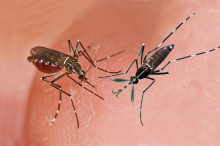
Sometime during that glorious decade known as the 1980s, a shipment landed in Houston, Texas. A shipment carrying more than its cargo. The point of origin was Japan. The shipment was used tires. The payload was Asian tiger mosquitoes.
Within years of landing in Texas the tiger mosquito, Aedes albopictus, rapidly displaced resident populations of Aedes aegypti mosquito. Both are important disease vectors. The native being considered the primary vector of breakbone fever — or dengue. And the Asian tiger mosquito recently emerging as the most important transmitter of chikungunya virus and yellow fever. By September 1986, the range of the Asian tiger mosquito had extended as far north as Utah. The demise of the native Aedes aegypti had already begun — representing not a transient ecological phenomenon, but the beginning of permanent colonisation, and resulting in rapid declines and extinctions of the native mosquito species.
Aedes aegypti originated in Africa and was introduced to the Americas between the 15th and 18th centuries, during the height of the slave trade and most likely on ships transporting slaves. They quickly established across the south eastern part of the US. Then what followed was a demise in the face of stiff competition and after centuries of habitation in America. An inadvertent metaphor for the “Post-America
Comments
2 responses to “Invasion of the Asian tiger mosquito”
[…] Invasion of the Asian tiger mosquito by Charles Ebikeme […]
[…] There is a scientific term that causes fear and alarm to those that study biodiversity. More fear and alarm than the term climate change. Biotic homogenisation — introducing a new exotic species to an area that was, until now, without admixture. Worldwide there is an increase in introduced exotic species and the potential of these species to become invasive have their impact. […]