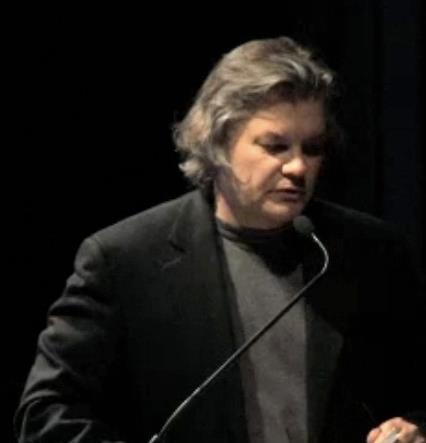
Art world is in direct contact today with science and technology. But, net-art is in difficulty since web 2.o explosion and this thing represent a new artist situs. I discussed about the curent artist situs, about cybism and viractualism with Joseph Nechvatal.
Joseph Nechvatal is a post-conceptual art digital artist and art theoretician who creates computer-assisted paintings and computer animations, often using custom-created computer viruses. Since 1986, Joseph Nechvatal has worked with ubiquitous electronic visual information, computers and computer-robotics. In 2002, he extended that artistic research into the field of viral artificial life through his collaboration with the programmer Stéphane Sikora. Books: Towards an Immersive Intelligence: Essays on the Work of Art in the Age of Computer Technology and Virtual Reality (1993-2006), published by Edgewise Press in 2009, Immersion Into Noise, Open Humanities Press/ 2011.
Rares Iordache: What is the current artist situs in digital culture? The idea becomes a machine that makes the art, says Sol LeWitt. After some good years net-art seems to enter in obscurity. I have to say that web 2.0 introduce the relative in scheme, and user became (v)user. Everything is relative to clicking, to be online. What is the current trend in art world?
Joseph Nechvatal: Cybism is a new sensibility emerging in art respecting the integration of certain aspects of science, technology and consciousness – a consciousness struggling to attend to the prevailing current spirit of our age. This cybistic zeitgeist I identify as being precisely a quality-of-life desire in which everything, everywhere, all at once is connected in a rhizomatic web of communication. Therefore, cybism is no longer content with the regurgitation of standardized repertoires. Rather I detect in art a fertile attraction towards the abstractions of advanced scientific discovery – discovery now stripped of its fundamentally reductive logical methodology. Moreover, cybism can be used to characterize a certain group of researchers and their understanding of where cultural space is developing today. Cybists reflect on system dynamics with a hybrid blending (cybridization) of the computational supplied virtual with the analog. Digitization is a key metaphor for the cybists only in the sense that it is the fundamental translating system today.
*
RI: I said recently that we live in a viral culture, were information spreads very fast and we are all affected by technology. The mechanism is similar to virus spreading, even rizhomatic. You connect your theory, viractualism, with this technological stage. In a recent essay you talk about viractualism in webbed digital age and viral viractualism.
JN: My concept of viractuality-and viractualism-emerged out of the research I conducted in virtual reality at the Centre for Advanced Inquiry in the Interactive Arts, in the U.K.. It begins with the realization that every new technology disrupts previous rhythms of consciousness. I believe that the viractual realm is now the authentic domain of art in the information age. This concept is central to my work as an artist. The basis of the viractual conception is that virtual producing computer technology has become a significant means for making and understanding contemporary art and that this brings us as artists to a place where we find the emerging of the computed (the virtual) with the uncomputed corporeal (the actual). This merger-which tends to contradict some dominant techno clichés of our time-is what I call the ‘viractual’. The blending of computational virtual space with ordinary viewable space indicates the subsequent emergence of a new topological cognitive-vision of connection between the computed virtual and the uncomputed corporeal world.
*
RI: In your book, Immersion into Noise, you theorize the immersive noise consciousness, as a ontological unification stage of consciousness. It seems to be a phenomenological operation, which is based on self-re-programmablity. Everything is put on the brackets, and after that is re-composed at another level. What is immersive art-of-noise role in this ecuation?
JN: Immersion Into Noise is intended as a conceptual handbook useful for the development of a personal-political-visionary art of noise. On a planet that is increasingly technologically linked and globally mediated, how might noises break and re-connect in distinctive and productive ways within practices located in the world of art and thought? That is the question I explore in Immersion Into Noise.
*
RI: Can we talk about noise as a relevant element to re-symbolize, to stabilze the instability of an existent body/mint rupture?
JN: The method used in Immersion Into Noise reflects on the insights noise suggests to the traditional western history of unified being (which indeed engenders extraordinarily deep conflicts). This entailed a review of past and present approaches towards ontology and an analysis of a variety of artistic maneuvers. I thus outlined an integrative noise philosophy by tracing the visual noise impetus through its various expressions so as to examine the immersive noise philosophy from all possible sides. Of principal interest was the discussion of subject/object cognition.
*
Interview published in Net-Art 2.II
Towards an Immersive Intelligence: Essays on the Work of Art in the Age of Computer Technology and Virtual Reality (1993-2006) was published by Edgewise Press in 2009.
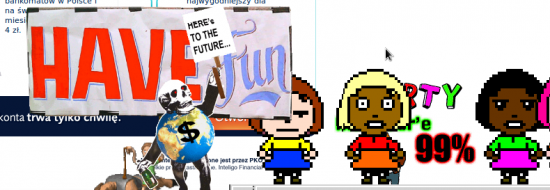
 The animated occupation soldiers are in front of the line and they espect the orders to occupy the internet. This is a real battle, because people took to the streets of internet to show their messages. Many websites are occupied, in fact there is a list with the websites currently being occupied. fffff.at published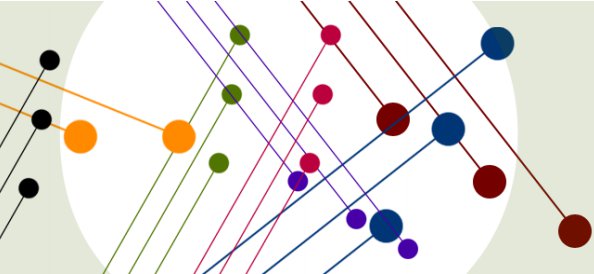
 According to Google’s Grzegorz Czajkowski, many of the things people are involved in can be represented in the form of graph, including professional activities and personal relationships. The company was the first to use advanced graph analysis methods like PageRank to get more from the Web.