Last week marked the 40th anniversary of the Landsat satellite program (http://landsat.gsfc.nasa.gov/) —now the longest-running continuous acquisition of satellite images of the Earth’s surface. The entire Landsat7 imagery archives are publicly accessible through Google Earth Engine (http://goo.gl/fjTZL), with a new and improved featured gallery, which includes zoomable time-lapse videos and a beautiful new interface: http://earthengine.google.org/#intro!
Google Earth Engine enables scientists to use our extensive computing infrastructure—the Google cloud—to analyze an unprecedented amount of satellite imagery and data. The new gallery includes what may be the largest video frame ever created. At 1.78 terapixels, if you tried to view all at once, it would take 18 football fields’ worth of computer screens laid side-by-side.
Google Earth Engine technology has already been used to compute the forested areas of Mexico (http://earthengine.google.org/#intro/MexicoTreeCover), identify deforestation in the Amazon (Monitoring Forests From the Ground to the Cloud) and map roadless areas of the world (http://earthengine.google.org/#intro/Roadless1km).
We look forward to seeing the full potential of the Landsat archives revealed, as Google Earth Engine and other tools enable non-professionals to explore this valuable trove of data.
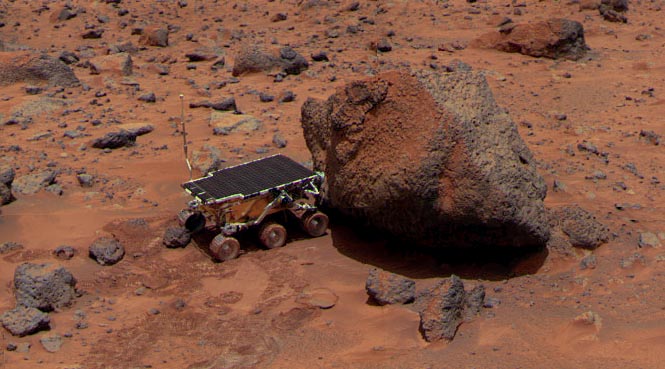
The NASA rover Curiosity is expected to be landing on Mars at 3:31 am August 6, 2012 (AEST). It’s mission, lasting one Martian-year (98 Earth weeks), is of scientific significance and perhaps even of human significance. Curiosity will be fulfilling the prospecting stage of a step-by-step program of exploration, reconnaissance, prospecting and mining evidence for a definitive answer to the question “Has life existed on Mars?
Do you wish to become a Martizen, a citizen of Mars, anytime in the near future? If you are serious about this then Dutchman, Bas Lansdorp is your man.
Bas Lansdorp is a person with an audacious ambition. Through his company, Mars One, he plans to establish the first human settlement on Mars by April 2023. In addition to this he intends that a new team of four settlers will join the Martian settlement every two years. By 2033 there will be over twenty people living, working, and they believe, flourishing on Mars, their new home.
If the Mars one publicity is believable, and on this point there is no real reason to doubt it, organizing a manned mission to Mars has been Bas Lansdorp’s dream for many years. Bas has been working on Mars One with partner Arno Wielders since January 2011. During 2011 they had confidential discussions with possible equipment suppliers to ensure that there was reality in their idea. In May 2012 they announced their vision to the world.
Like any large entrepreneurial venture their success will predicated on the skill, experience and credibility of the venture and the people involved. To be credible they will need to be convincing in, at least, these four aspects of the venture; technological; financial; psychological; and finally ethical. They will need to be convincing in a way that engages and excites both investors and participants.
It is rocket science
Getting to Mars is not trivial, if it were, well I expect there would be more than the spectacular array of NASAsuper, and superannuated rovers there currently is on Mars. Mars One have developed and made integral to their model a simple theme to get to and live on Mars: buy already developed technology from existing component manufacturers.
Take the Falcon Heavy lifter from SpaceX, to boost the components into low earth orbit. Combine a SpaceX Dragon capsule as the landing stage, add a transit living module from Thales Alenia Space and attach to two propellant stages which are a variant of the SpaceX Falcon 9 upper stage rockets and you have the vehicle to get from low earth orbit to orbit around Mars via a Hohmann transfer trajectory.
The seven-month trip to mars will be Spartan, similar to, but more cramped, than current conditions experienced on the International Space Station. This is where rigorous training will first pay off:
“Showering won’t be an option; instead they will have to make do with wet wipes like the International Space Station astronauts. Tinned food only, constant noise from the ventilators and equipment and a regimented routine of three hours of exercise a day to keep up muscle mass all add to their trials. If they are hit by a solar storm they will have to take refuge in the shelter area of the rocket, which provides the best protection, for as long as several days.”
When the first 4 settlers land on Mars in April 2023 they will arrive at an established site. They will be picked up from their SpaceX Dragon capsule and taxied to the settlement by two robotic Mars rovers designed and built by MDA Space Missions. To get to this point is an ambitious and tight timeline.
2013
Settler selection begins. Replica of Mars settlement is built on an Earth desert to help the settlers prepare and train, and for a realistic environment in which to test the equipment. The settler selection and the preparations in the simulated Mars base will be broadcast on television and online for the public to view.
2014
Preparation for the supplies mission. Production of the first Mars communication satellites.
2016
January launch of the supplies mission, landing in October, includes the first habitat module (modified Dragon capsule) and 2500kg of supplies.
2018
First robotic rover lands (again in a modified Dragon capsule) to enable the pick of the specific settlement site.
2021
A total of 2 robot rovers, 2 living units, 2 life support units and 2 supply units are now all present at the Mars settlement site.
2022
All H2O, O2, and atmosphere production will be ready before a go-ahead to launch the settlers.
2023
First 4 settlers arrive at the Mars settlement.
2025
Second group of 4 settlers arrive, to be no doubt enthusiastically greeted by the pioneering first four.
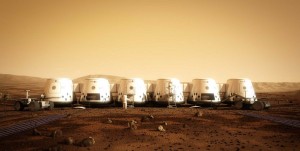
Once arrived there will be work for the settlers to connect up the various habitats. However once complete they will have substantial living space, 50m²+ each, equipped with showers, flushing toilets and kitchens. The living units are a Dragon capsule with an inflatable living section supplied by ILC Dover, who have supplied NASA with space suits and landing bags for the previous Mars rovers Opportunity and Spirit. The inflatable living sections are to be covered in Martian regolith to provide adequate radiation shielding.
Mars One
When moving around on the Mars surface the settlers will be wearing Mars suits, similar to the suits worn by the Apollo astronauts on the Moon. These suits will be made by Paragon Space Developments, the same company who provide NASA with ‘extra-vehicular’ suits, for when astronauts work in space outside the International Space Station.
By focussing on proven existing technologies Mars One are certainly presenting a reliable low cost technology solution. It is also deceptively simple. Let us remind ourselves this is a first, these conditions will be new.
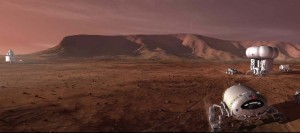
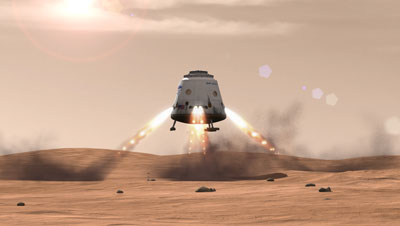
For example the first step to settlement, safely landing the settlers on Mars, is unproven at present. NASA has described the process of entering the Red Planet’s atmosphere and slowing down to land as “six minutes of terror.” Computer graphics of Mars landings, in full colour and exquisite detail do not provide the simple fact that landing payloads that are large enough to bring humans and sustain their survival on the Red Planet is still beyond our capability. Currently NASA expects to have testable solutions to this some time in 2014.
Similarly we could look at the Mars suits and pose, repairs? replacements? These will be an absolute necessity for survival, however you won’t be able to buy a replacement online or wander down to high street shops to get an upgraded model or new one for a growing Martizen child.
Competent and knowledgeable engineers and specialists, as well as countless armchair experts, will no doubt be picking apart the technology of the Mars One mission, as I have just briefly done. There is no doubt that each step of the timetable above has a myriad of ‘first-time’ problems that will require solutions, some of which can be inferred some which will only become apparent as the experience proceeds. I hope that all involved have read Gregory Benson’s 1999 novel, The Martian Race, a gripping primer to life on Mars.
Show me the money
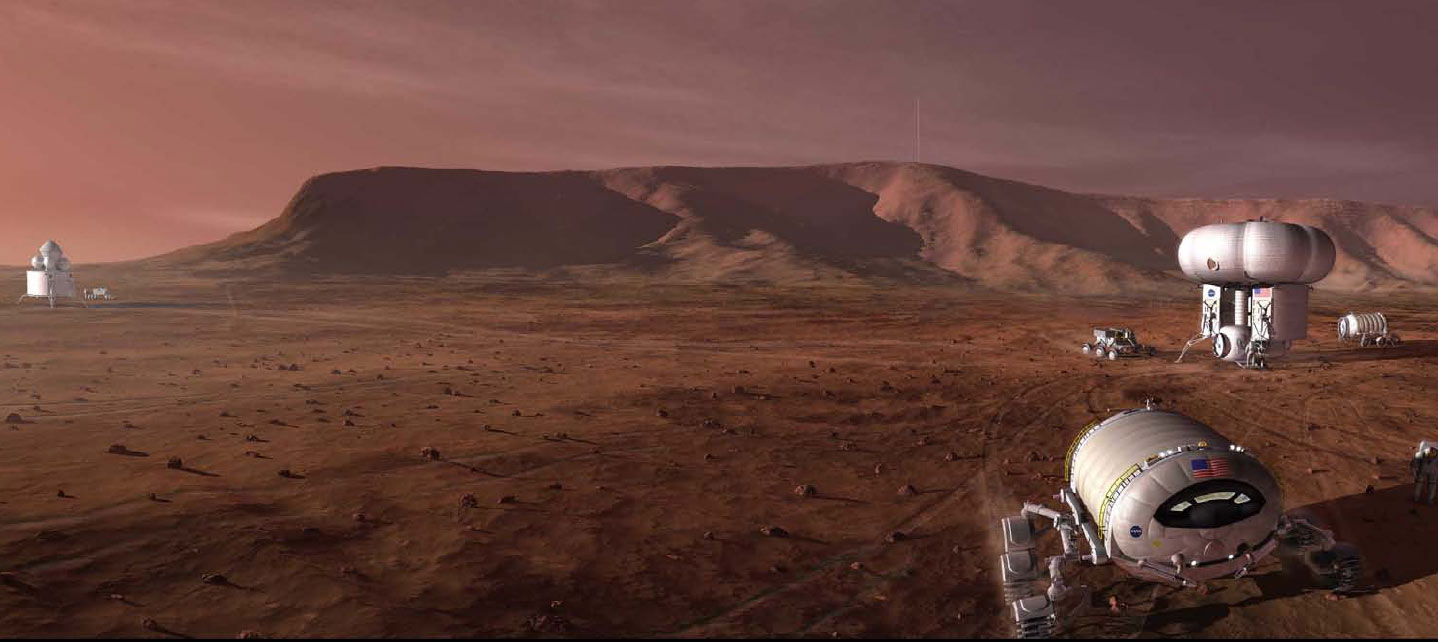
Mars manned mission. Image credit: NASA
Getting to Mars is not cheap. Since the late 1940s there have been many proposals for manned exploration and settlements on mars. A commonality is that they are all pitched 10-20 years in the future and large sums of money are mentioned. To put this into today’s context on August 6 (EDT), 2012 NASA’s Mars rover, Curiosity, will land on Mars. This mission will place an 899kg six-wheeled, un-manned science laboratory on Mars; for the approximate mission cost of US$2.5B. It is expected that a 2030s NASA mission to Mars will be of the order of US$20B. Mars One says it will cost them US$6B to put the first four settlers on Mars.
In many ways focusing on the mission cost is a furphy. NASA mission budgets come from USA public purses and there is always great argument in the US Senate about the value of such publically funded scientific enterprise. In the US this argument is always balanced by the technology and enterprise that this brings to US companies and the economy. Mars One have no such public funding in mind. They intend to buy the above technologies based on price and quality, not through political or national preferences.
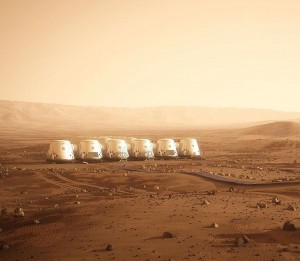
Colonisation of Mars 2023, Mars One. Image Credit: Ariukux
The ability to fund such a mission will depend on what value it returns for investors. Here is the Mars One point of difference; funding will be via sponsorship and as the World’s largest media event. If I were a settler having ILC Dover and Paragon Space Development would be more reassuring than IKEA on my Living and Life Support Modules. As for the thought of a 7 months trip to Mars eating McDonalds pre-prepared ‘meals’ that would be unpalatable. Choose the sponsors wisely Mars One.
There are no stated scientific or economic goals. Instead they see it this way:
“A manned mission to Mars is one of the most exciting, inspiring and ambitious adventures that mankind can take on. We see this as a journey that belongs to us all, and it is for this reason that we will make every step one that we take together. This will also be our way to finance the mission: the mission to Mars will be the biggest media event ever! The entire world will be able to watch and help with decisions as the teams of settlers are selected, follow their extensive training and preparation for the mission and of course observe their settling on Mars once arrived. The emigrated astronauts will share their experiences with us as they build their new home, conduct experiments, and explore Mars. The mission itself will provide us with invaluable scientific and social knowledge that will be accessible to everyone, not just an elite select few.”
To assist in making this worldwide media frenzy Mars One has enlisted Paul Römer as an ambassador. An established expert on grasping the attention of a global public, he was the co-creator of the worldwide phenomenon “Big Brother” – the television program that revolutionized reality television.
The 24/7 Martizen lab-rat
More than the tangibles of this venture, I believe it will be the intangible elements that make this a standout human endeavour. Especially the ethics and psychology of the Martizen being media fodder 24/7. A previous article has already questioned the ethics of such, admitedly voluntary, surveillance.
The psychology of such surveillance is fascinating and worrying. Even the most extroverted of people have private lives. Only the totally naive display ‘real’ faces through the public media. Media such as facebook display a mixture unconscious representations, as well as carefully and foolishly contrived facets of our lives. In many cases events are morphed and selectively recorded on media such as facebook and twitter. It is one thing to post to your facebook friends, it is quite a different thing to know that all that you do will be on display for a public you do not know.
It is hopefully obvious that the narcissist, wastrel, celebrity personalities that populated the many versions of Big Brother are not what will make a great four-person team on Mars. I also am happy to be labelled an ‘elitist’ and state that public participation via stringent selection processes, such as voting-off someone you don’t like, will be a disaster for a serious mission.
I am unsure how history’s first off-world conception, birth and death will go as media events. I can appreciate the lure for marketers of such landmark voyeuristic events, I am at the same time unsure how the participants of such private events will feel.
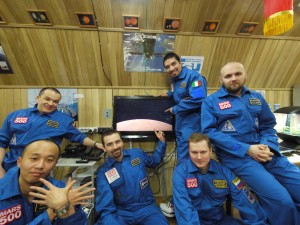
Mars500 crew. Photo credit ESA
There is psychologically a world of difference between the isolation that would be experienced in genuine remote exploration, think Antarctica, to the pseudo-isolation of contrived event that has a definite endpoint, think Big Brother and Survivor. The Marsonauts of Mars500 ended with smiling faces after their 17 month long isolation experiment. The European Space Agency’s Directorate of Human Spaceflight has a long tradition of conducting research on the physiological and psychological aspects of spaceflight. In light of this, ESA undertook the Mars500 cooperative project with the Russian Institute for Biomedical Problems (IBMP) in Moscow, in 2010-11. This all male crew experiment is instructive, and illuminating for Mars One, however no matter how ‘isolated’ Moscow may feel, like the people in the Big Brother household, they could if they chose leave at any stage.
Despite this a key science project during Mars500 was to determine the implications of personal values held by individual crew-members for compatibility within the group as a whole or otherwise, and for individual coping strategies and adaptation during long lasting confinement. On a human exploration mission to Mars, the psychological resilience of the crew will play a critical role for the maintenance of health and performance and hence the success of the mission. One factor impacting on psychological resilience is the personal values of crew members defining their motivational goals and attitudes. Crew member selection is for real, not a game where if a poor choice is made they leave the set or you re-boot the computer.
It’s a one-way trip
That is one clear distinction this is a one-way journey. Since returning astronauts from the surface of Mars is one of the most difficult, and expensive, parts of a Mars mission, the idea of a one-way trip to Mars has been proposed several times. The notion of settlers, rather than expedition astronauts changes the technology and psychology of the mission.
A one-way trip scenario has been proposed seriously a number of times since 1998. Including a 2004 proposal by Paul Davies. Another organisation, Mars to Stay, proposed that astronauts sent to Mars for the first time should stay there indefinitely, both to reduce mission cost and to ensure permanent settlement of Mars. Among many notable Mars to Stay advocates, former Apollo astronaut Buzz Aldrin is a particularly outspoken promoter who has suggested in numerous forums “Forget the Moon, Let’s Head to Mars!”
During a 2009 public hearing of the U.S. Human Space Flight Plans Committee at which Robert Zubrin presented a summary of the arguments in book The Case for Mars, dozens of placards reading “Mars Direct Cowards Return to the Moon” were placed throughout the Carnegie Institute.The passionate uproar among space exploration advocates – both favourable and critical – is an indication of the interest in Mars exploration.
I find the Mars to Stay idea appealing and compelling for both economic and safety reasons. More emphatically, I find it a representation of the spirit of human exploration and discovery. Also personally it is a fulfilment of the ultimate mandate by which manned space programs (US, European, Russian, Chinese, Indian, Japanese etc.) are sold, at least philosophically and long-term, as a step to colonizing other worlds. I hope that Mars One either credibly fulfils this trust or propels alternative programs that deliver human settlement on Mars via a well-defined (i.e. non-suicidal) exploration program.
When the human race inevitably expands off planet Earth, we’ll naturally want to take our internet with us – over the past 15 years or so, the internet really has become an integral part of our lives! In fact, even as you’re reading this, 300 gigawatts of electricity worldwide will have been used to transfer 640 terabytes of information across the internet to 1.5 billion desktop computers and a further billion mobile devices. In the time you’ve taken to read this paragraph, over 200 million e-mails have been sent, 6 million Facebook pages have been loaded, 1.3 million YouTube videos have been watched, and 100,000 people have posted an update to their twitter accounts.
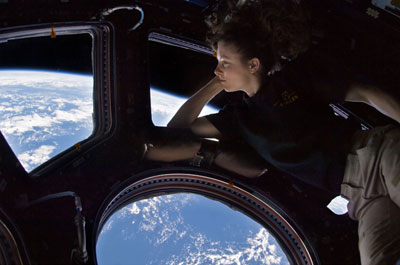
Astronaut Tracy Caldwell Dyson enjoying a view from the ISS Cupola window.
Inspite of its sprawling extent on our planet though, the internet’s first step off-world was able to fit inside just 1120 bytes. On January 22, back in 2010, astronaut TJ Creamer made a small but important piece of internet history by being the first human being ever to post to a twitter feed from orbit. Astronauts had been updating twitter feeds while in orbit for some time, but they had previously always relayed their messages via NASA back here on Earth. Since 2010, however, the International Space Station (ISS) has been upgraded to have its own internet connection. Intended for personal use by astronauts and still routed through ground based systems at NASA for security, this is how e-mails, blog posts and twitter updates are sent back home. All the same, even though it might seem a long way away, the ISS is relatively nearby in low Earth orbit.
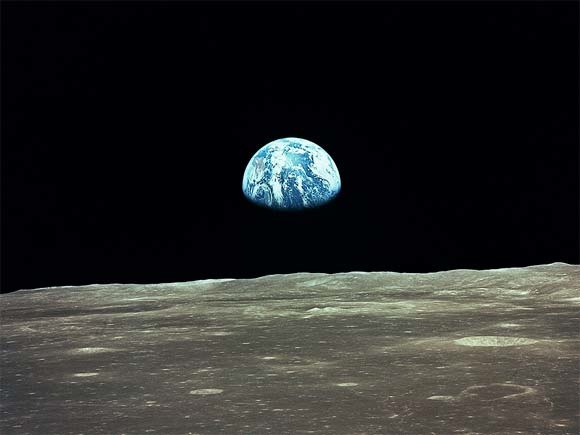
Things start to become more complicated when you consider travelling further afield, because whether we like it or not, we can’t cheat special relativity. The speed of light is the fastest any interplanetary communication (or anything, for that matter) can travel. The Moon is still close enough that interaction is possible in almost real time. Sending a message to someone on the Moon would involve a delay of a little under three seconds. Good enough to hold a conversation, but with gamers here on Earth complaining about latencies higher than 600 milliseconds, you’re obviously not going to be able to play Halo or Warcraft against a friend over that kind of distance. Travel as far as Mars and the problem becomes even more pronounced, with delays of anywhere between 3 and 22 minutes, depending on exactly where Mars is in relation to Earth. Minutes turn to hours as you continue to travel outwards (transmissions from Voyager 2 currently take over 13 hours to reach us). All things considered, using an interplanetary internet sounds like a rather good idea for communication over distances like these. While phonecalls to Mars would be essentially impossible, delays between responses to e-mails and tweets are fairly routine. You could quite easily have a twitter conversation with someone over on a neighbouring planet.
Preparing for the future, NASA and Google teamed up a few years ago to develop a new internet protocol designed to be used in space. Called Disruption-Tolerant Networking (DTN), it’s designed to work a bit differently to the internet we’re all familiar with. While our familiar TCP/IP systems rely on a constant connection to transfer data, this is obviously unfeasible in deep space. While a DTN network would still operate using a series of nodes passing information from machine to machine, the way ground-based networks do, each node needs to hold onto the data being transmitted until it has a confirmation that the message has been safely passed on.
SpaceX believe it should be possible to send people to Mars within 20 years.
With a steadily accumulating collection of spacecraft in various parts of the solar system. Google’s Vint Cerf has expressed plans to use these old pieces of hardware, many of which have long since completed their original missions, as nodes in what will become an interplanetary internet. Indeed, spacecraft have already transmitted data amongst themselves en route back to Earth. ESA’s Mars Express probe, for instance, has served as a relay between Earth and vehicles landing on Mars, and is set to do so again when NASA’s Curiosity rover arrives at the red planet later this year. In an interview with networkworld.com last year, Cerf is quoted as saying “…if they are still functionally operable — they have power, computer, communications — they can become nodes in an interplanetary backbone. So what can happen over time, is that we can literally grow an interplanetary network that can support both man and robotic exploration.” He continued to explain how, while all space missions to date have involved point-to-point communications, future space missions will likely require “a richer communications network.” This also has an added plus that an interplanetary network infrastructure will allow scientists to receive more data from deep space missions than is currently possible.
With many astronauts already maintaining active twitter feeds from orbit, it has to be said that similar social networks may well play an important role in communications in the future. By the time that role is needed, a network infrastructure will likely be in place for it to operate on. A company like Google, processing petabytes of data and serving hundreds of millions of queries for an index containing billions of websites every day, is certainly qualified to help set up a computer network on interplanetary scales. Maybe in the future when people talk about Google Mars, they might mean it literally!
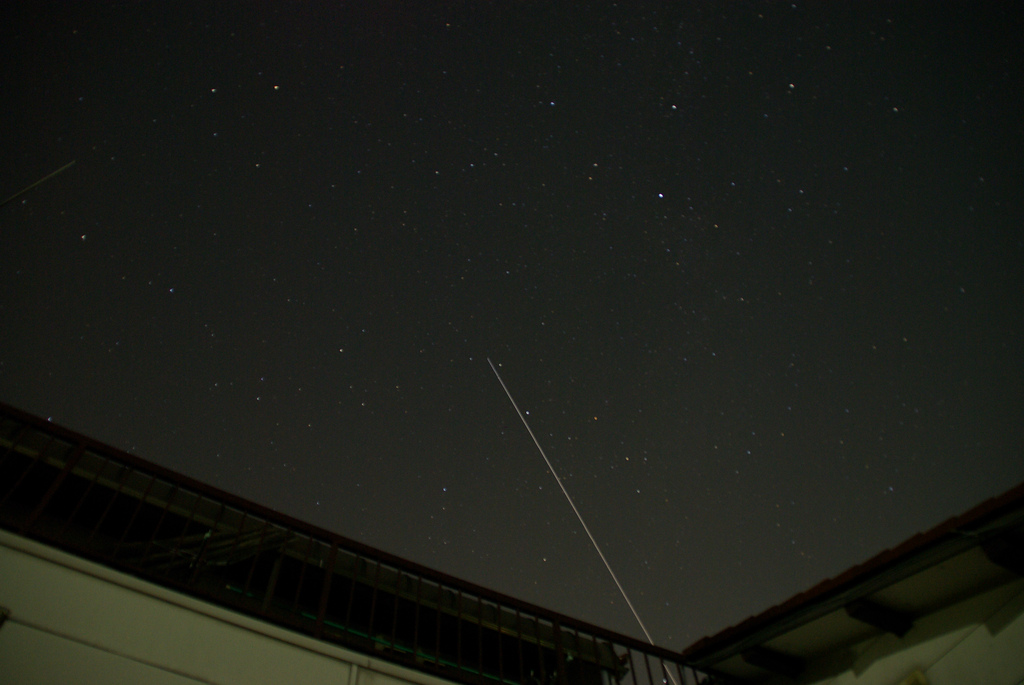
Today SpaceX#Dragon is proceeding toward rendezvous with #ISS. The International Space Station mission management team completed a thorough review of the progress of the SpaceX Dragon spacecraft and at 9:38 p.m. EDT unanimously authorized the International Space Station and Dragon flight control teams to proceed toward rendezvous and berthing about 11:20 a.m. Friday.
The SpaceX mission management team reported all spacecraft systems are ready for the final stages of rendezvous and completion of the final COTS demonstration objectives, and space station managers reported the orbiting outpost is ready for the commercial spacecraft’s arrival.
Dragon has nearly completed its fly-around of the station, crossing behind the station and beginning its final approach. NASA TV coverage will begin at 2 a.m. Source.
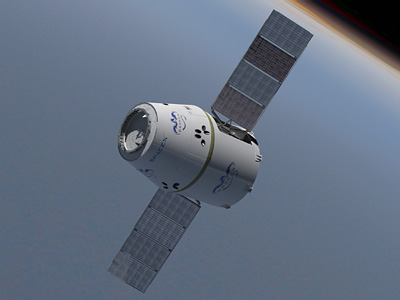
On May 11, a Dragon will mate with the International Space station. Rather than some mythical creature, this Dragon is of human artifice. The Dragon’s rendezvous and berthing with the International Space Station presages a new chapter in human exploration of space.
The significance of this event is Dragon is a reusable spacecraft, developed, and built by the American company Space Exploration Technologies, SpaceX, as it is more commonly known. Established in 2002, SpaceX has developed a new family of launch and cargo and crew capsules from the ground up.
The commercial race to space
NASA has now “set it sights on exploring once again beyond low earth orbit.
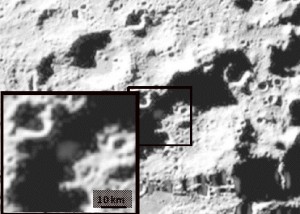
At just over two tonnes, the second stage of an Atlas V rocket, makes for an unusual ‘kinetic probe’. Nonetheless on October 9, 2009 NASA deliberately impacted a spent Centaur rocket into the lunar south polar crater Cabeus. The target area was a permanently shadowed region within this crater. The impact, not surprisingly, ejected a spectacular plume of debris, dust and vapour.
Science experiment, observe the system, perturb it, and measure what happens
The US scientists had thrown a heavy object at the Moon. They then threw all the instruments possible to monitor the impact. The prize was a decades-long search to directly find water on the Moon.
The impact would have been majestic to watch. Picture those slow motion images of Apollo astronauts on the Moon. Hold that thought and then imagine the impact. An observer could marvel at the slow motion, low gravity, return of the dust and debris cloud to the Moon’s surface. If you could see in the infra-red, the impact flash lasts for 10 seconds. There is a cloud of debris, dust, and vapour rising. At eight seconds the the ejecta cloud is 4.5km in diameter, in the ultra-violet spectrum, the plume is 10km in diameter. At 20 seconds after impact the ejecta cloud was is at its maximum diameter of 8.5km and the plume has reduced to little less than 10km.
The observer would be watching a science experiment on a grand scale.
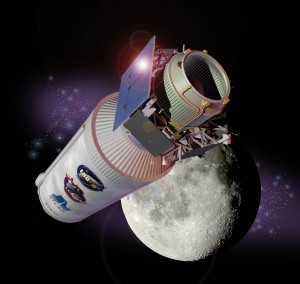
The observer in this experiment was neither you nor I, it was a trailing “shepherding spacecraft”. The Centaur had propelled NASA’s Lunar Reconnaissance Orbiter and Lunar Crater Observation and Sensing Satellite to the Moon. Shortly after launch the Lunar Reconnaissance Orbiter had separated to go on its own mission. Once in lunar orbit the Centaur had vented its remaining fuel. Control was then assumed, for the next four months, by the Lunar Crater Observation and Sensing Satellite as the shepherding satellite. During this next period the shepherding satellite maneuvered the Centaur to allow the Sun to bake-out residual water and volatiles. This was to ensure that no contaminant chemicals were passengers to the lunar impact site. The Centaur’s fuel was a volatile combination of liquid hydrogen and liquid oxygen, both chemicals that were to be scanned for in the impact cloud. The Lunar Crater Observation and Sensing Satellite also calibrated its instruments, then targeted the Centaur to impact with the Moon. Four months of meticulous preparation.
LCROSS spacecraft with Centaur stage, image credit NASA
The Lunar Crater Observation and Sensing Satellite carried nine instruments, including cameras, spectrometers and a radiometer. The spectrometers measured the reflected light at different wavelengths. These enabled the identification of the chemicals present in the ejected cloud.
Near-infrared absorbance attributeble to water vapour and ice, and ultraviolet emissions attributable to hydroxyl radicals (OH-) support the presence of water in the debris. The researchers determined from these observations that there was over 5%, by mass, of water ice in the lunar regolith of the impact site. Certainly this is small by terrestrial soil standards, but more substantial than most earlier estimates.
Over a year after the impact, in the October 22, 2010 issue of the journal Science, the results of this experiment were delivered to the world’s attention. This certainly marked a defining moment for lunar scientists, directly confirming the availability of water on the moon. It was however neither the first nor last word on this.
Cabeus crater LCROSS impact site, photo credit NASA
Early attempts
Since the first lunar sample were carried back to earth by Apollo astronauts in the late 1960s, scientists have operated under the presumption that the moon was entirely dry. In total 382kg of lunar material was bought to Earth by the Apollo missions astronauts and a further 0.32kg by the unmanned USSR Lunar missions. New analyses of these rocks with improved analytical techniques have made it possible to perform highly sensitive isotopic measurements on very small lunar grains. These analyses are revealing water in Apollo samples that were once thought to be dry.
Well before these new studies, scientists had been puzzling about why more water was not seen on the moon. It was thought that volatile materials, such as water, could be accumulating at the moon’s permanently shaded polar regions. Here they could be trapped for geological periods of time without significant loss. The in 1998, the orbiting Lunar Prospector spacecraft measured the the abundance of elements on the moon’s surface using neutron spectroscopy. This provided compelling evidence for enhanced hydrogen concentrations, and by inference water, at both of the lunar poles.
In 1999 the Cassini spacecraft flew by the moon on its way to Saturn. It turned its Visual and Infrared Mapping Spectrometer to the moon. By measuring the surface reflectance of light from the moon scientists found absorption attributed to hydroxyl and water on the sunlit surface of the moon. These results were not published until 10 years later, in October 2009. The reason was renewed interest in water on the moon.
On October 22, 2008 Chandrayaan-1 was launched on a lunar mission by the Indian Space Research Organisation. One of its major scientific missions was to look for water on the moon. It had three different instruments ready to make 2008-10 an interesting period for lunar water exploration.
Chandrayaan-1, India’s lunar water finder
The Chandrayaan-1 story is told in detail elsewhere. Here I intend to showcase the marvelous outcome of Chandrayaan-1’s water finding experiments. Perhaps the most exciting of all these was one of the simplest. This was the CHandra’s Altitudinal Composition Explorer (CHACE) on board the Moon Impact Probe.
On November 14 2008 (the birthday of the late Pandit Jawaharlal Nehru, India’s 1st Prime Minister) the Moon Impact Probe became the first Indian built object to reach the surface of the Moon. The probe was a 34kg box-shaped object containing a video image system, radar altimeter, and The CHACE mass spectrometer.
Symbolically the Indian tricolour was painted on three sides of the Moon Impact Probe. This enables India to also lay claim to having the “Indian tricolour placed on the Moon”. Needless to say that “placing” in this case was a hard landing in the Moon’s south polar region near the Shackleton crater, flying over the Malapert mountain en route.
The CHACE mass spectrometer took 650 spectra of the tenuous lunar atmosphere during its 1487 second, 98km, plunge to the lunar surface. Tenuous is right the atmosphere even on the sunlit side is only 7/10,000,000,000th of the Earth’s atmosphere.
The mass spectrometer was tuned to look find water and direct evidence of water it did find. The team leader of the experiment, Dr S M Ahmed, remembers, “We all were jumping when we saw water was literally pouring out of our instrument
This image of Earth’s city lights was created with data from the Defense Meteorological Satellite Program (DMSP) Operational Linescan System (OLS). Originally designed to view clouds by moonlight, the OLS is also used to map the locations of permanent lights on the Earth’s surface.
The brightest areas of the Earth are the most urbanized, but not necessarily the most populated. (Compare western Europe with China and India.) Cities tend to grow along coastlines and transportation networks. Even without the underlying map, the outlines of many continents would still be visible. The United States interstate highway system appears as a lattice connecting the brighter dots of city centers. In Russia, the Trans-Siberian railroad is a thin line stretching from Moscow through the center of Asia to Vladivostok. The Nile River, from the Aswan Dam to the Mediterranean Sea, is another bright thread through an otherwise dark region.
Even more than 100 years after the invention of the electric light, some regions remain thinly populated and unlit. Antarctica is entirely dark. The interior jungles of Africa and South America are mostly dark, but lights are beginning to appear there. Deserts in Africa, Arabia, Australia, Mongolia, and the United States are poorly lit as well (except along the coast), along with the boreal forests of Canada and Russia, and the great mountains of the Himalaya.
Credit: Data courtesy Marc Imhoff of NASA GSFC and Christopher Elvidge of NOAA NGDC. Image by Craig Mayhew and Robert Simmon, NASA GSFC. http://www.nasa.gov/
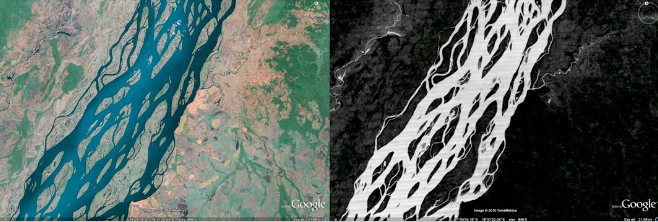
 Google Earth Engine technology has already been used to compute the forested areas of Mexico (http://earthengine.google.org/#intro/MexicoTreeCover), identify deforestation in the Amazon (Monitoring Forests From the Ground to the Cloud) and map roadless areas of the world (http://earthengine.google.org/#intro/Roadless1km).