Tag: NASA

  • A flawless launch for the world’s first commercial space mission

    A flawless launch for the world’s first commercial space mission

    Photo: Ben Cooper http://www.launchphotography.com/SpX-1.html

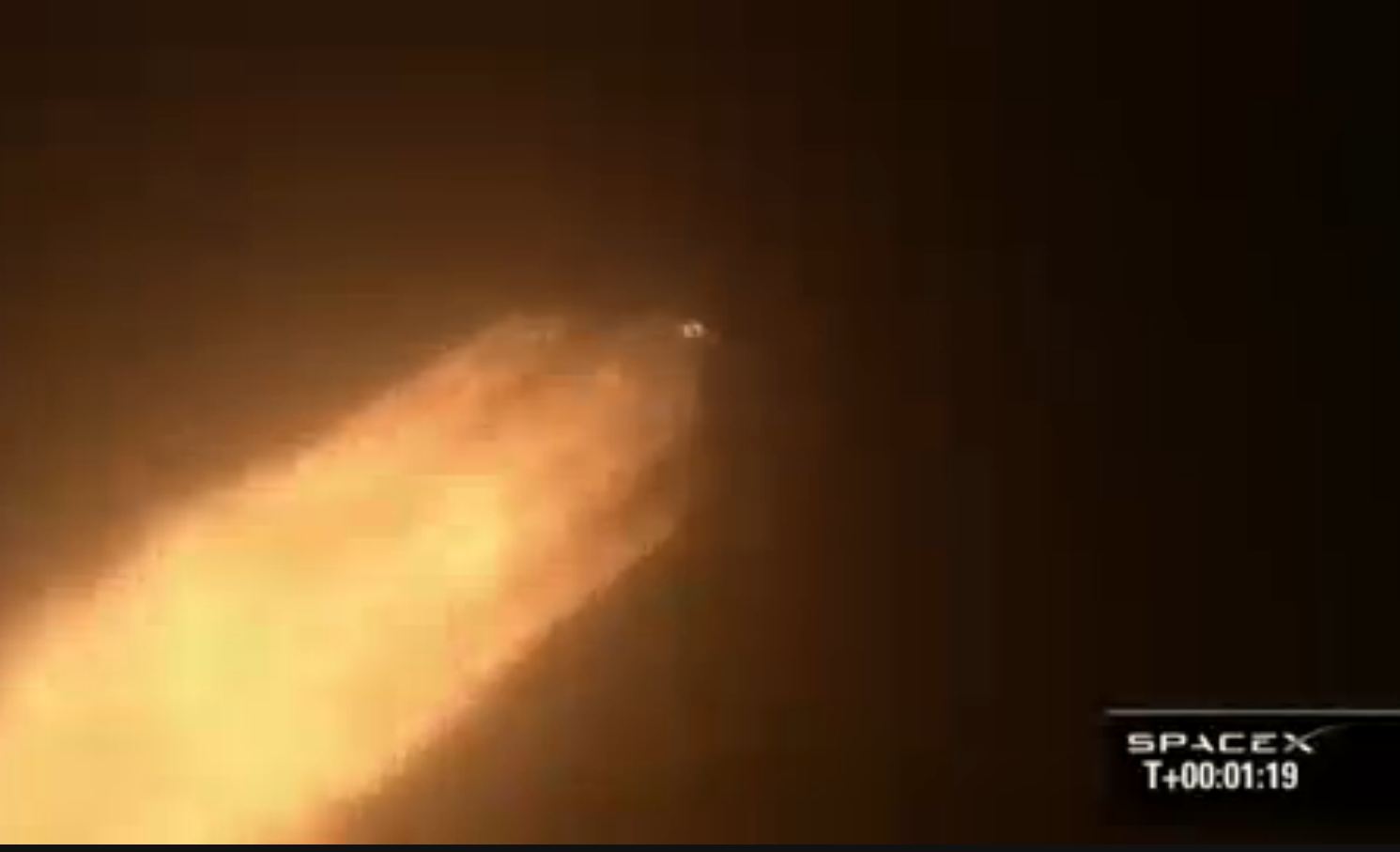
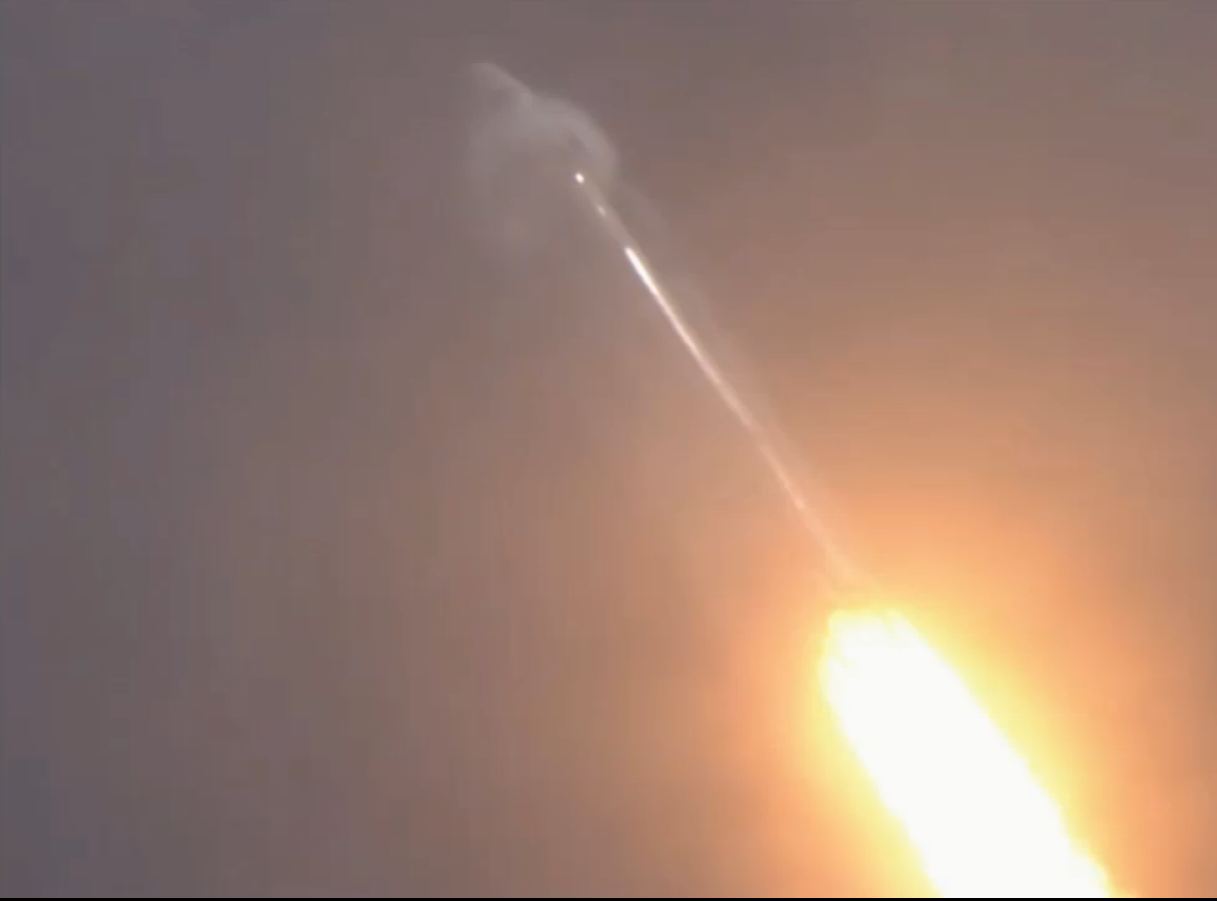
    Elon Musk’s commercial space travel venture SpaceX has ticked off another global first – the first commercial space flight. Watch a replay of the launch first stage:


    The SpaceX Falcon 9 rocket roared off the launch pad at 11:35am Canberra time, boosting the robotic Dragon capsule into a three-day chase of the International Space Station, carrying a NASA-commissioned resupply cargo. The media kit includes the full cargo manifest – 905 kilograms each way.

    What it doesn’t mention is that the cargo includes a freezer with vanilla and chocolate ice cream for the crew! Special treat.

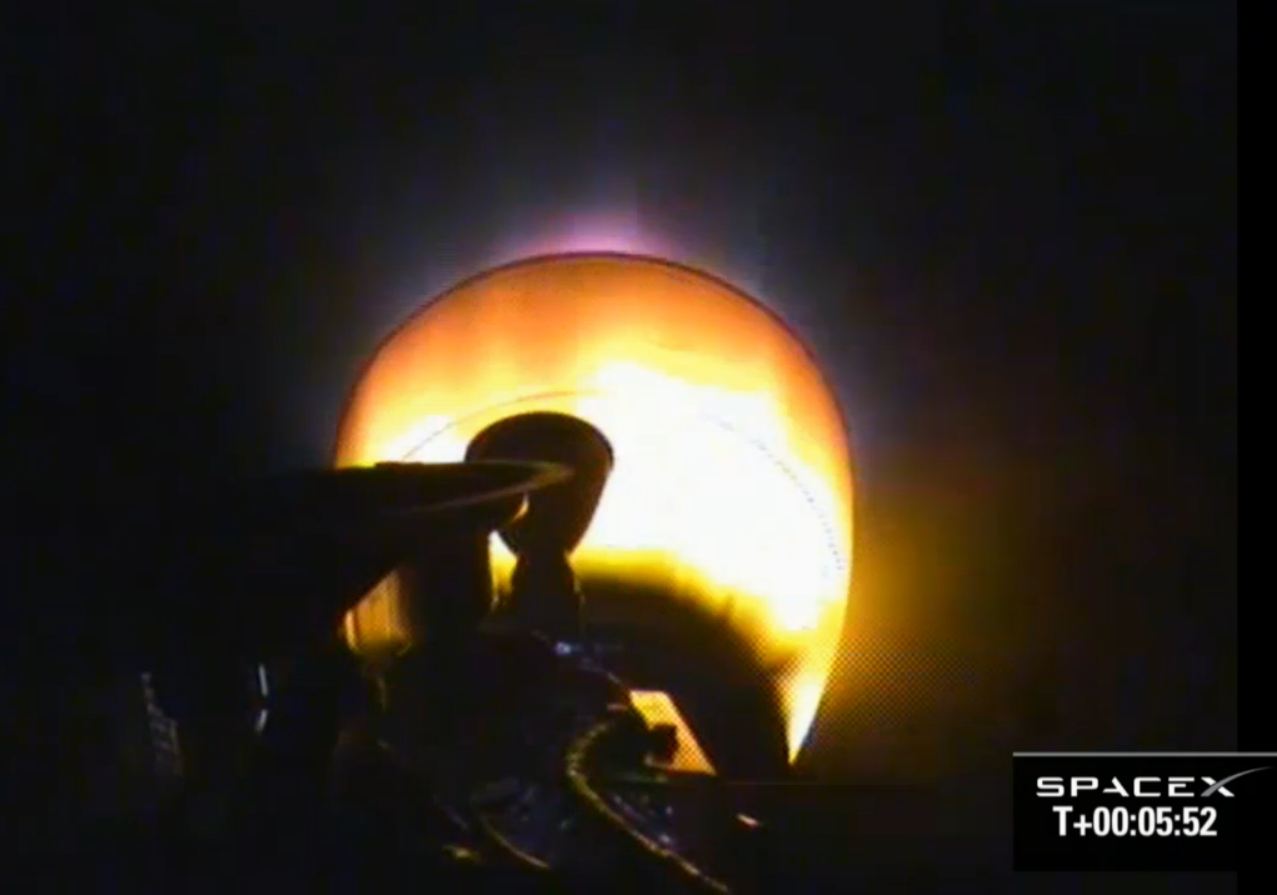
    SpaceX are switched on with their broadcasts too – they had multiple onboard cameras giving some amazing perspectives, such as this one of the second stage rocket glowing white hot.

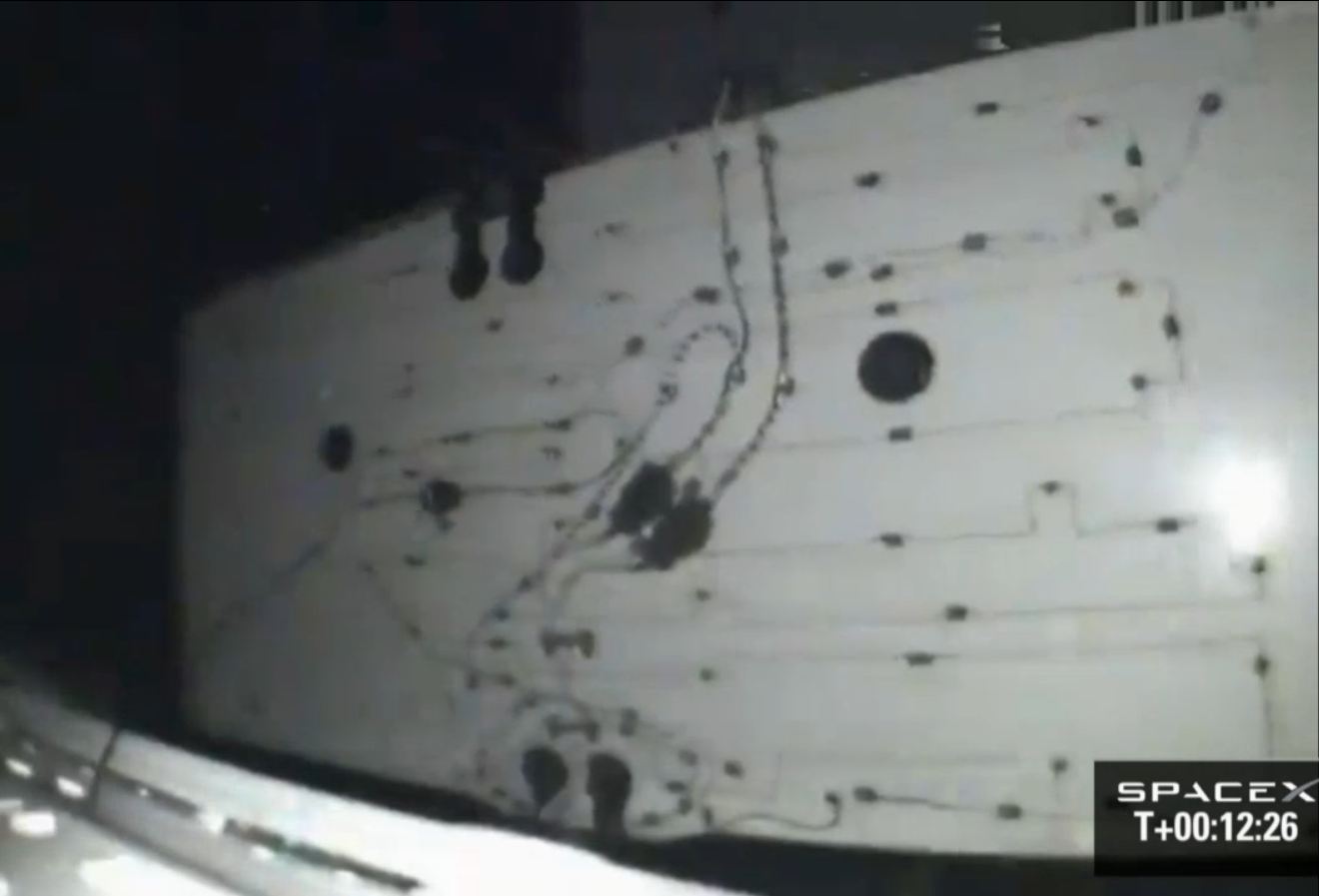
    This one shows the solar array deployment – unfolding surprisingly quickly.

    During the broadcast, SpaceX confirmed the stories behind the naming of their craft: the Falcon 9 is named after Han Solo’s Millenium Falcon on Star Wars, and the 9 is for the nine Merlin rocket engines that power it. This screengrab shows the Falcon breaking the sound barrier.

    The capsule itself is named Dragon, after the old show Puff the Magic Dragon, following criticism back in 2002 of SpaceX’s goals. This screengrab shows Dragon docked to the ISS.


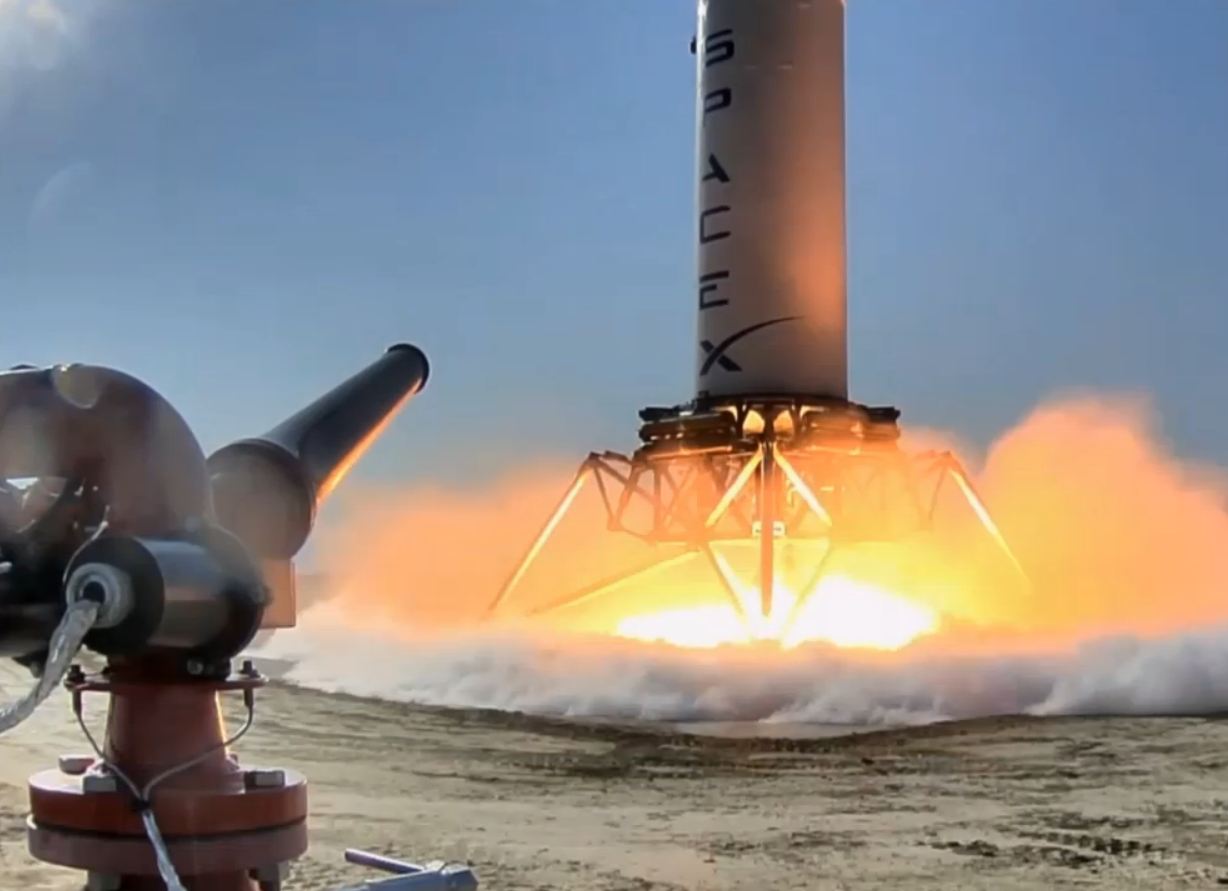
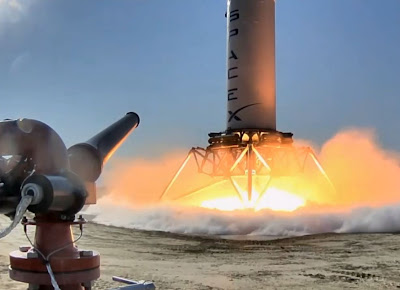
    Recently, SpaceX also tested their “grasshopper” configuration – a set of legs on the base of the first stage. The goal here is to retain some fuel in the booster and return the whole thing back to a gentle landing for reuse.

    This shows the shock absorbers on the grasshopper legs. It was only a short hop a few metres off the ground, but it’s a start.

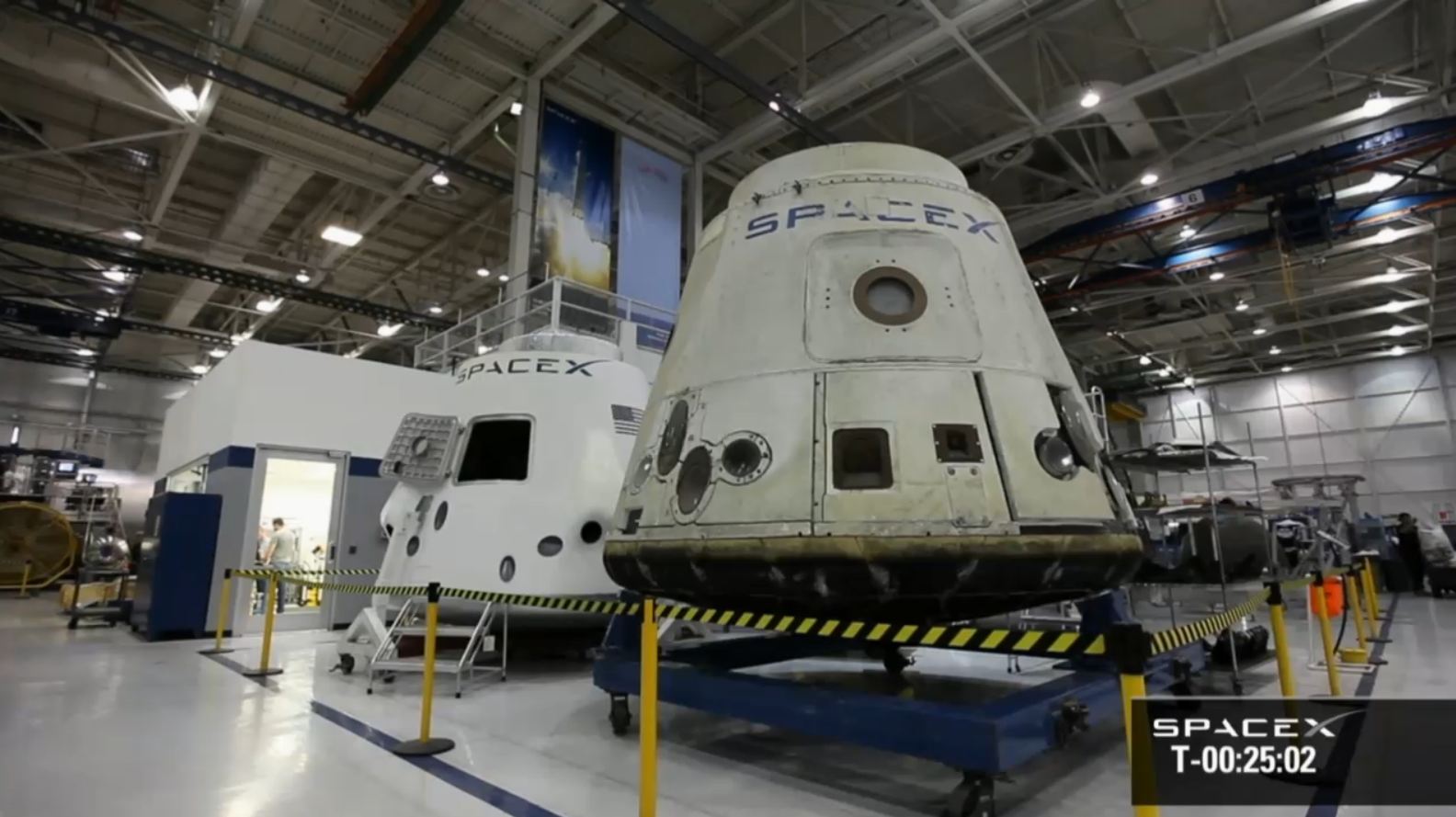
    And what about this as a workplace?

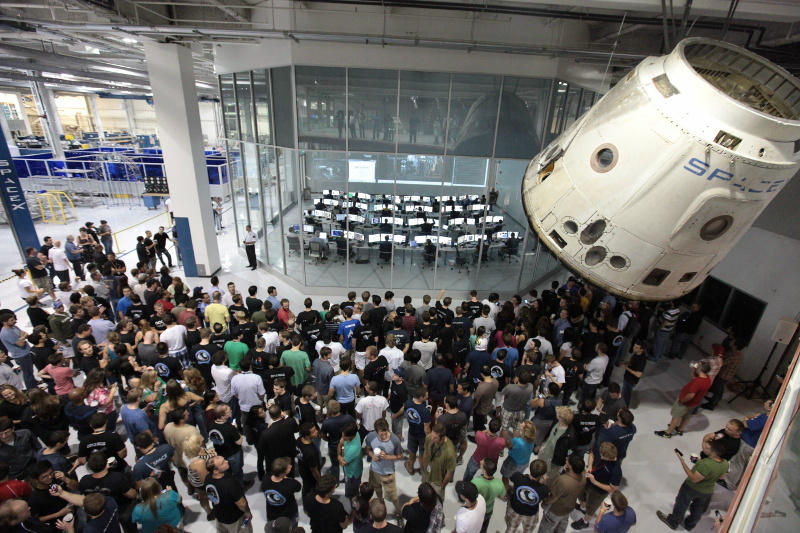
    Finally, here’s the launch control room in SpaceX HQ. NASA it is not!

    The Dragon capsule looks very cylindrical there – just a wide angle lens distortion.

  • My mega grab-bag of astronomy resources for teachers, students, telescope beginners and space fans

    My mega grab-bag of astronomy resources for teachers, students, telescope beginners and space fans

    Whether you are a parent, teacher, student or simply an interested enthusiast, here are a number of interesting sites, podcasts, and social media people for you to draw on as you get going in amateur astronomy.

    Podcasts provide an amazing resource – all free. Most are available via iTunes, the original publishers’ websites, or a raft of other podcast aggregators. There are very good apps to allow you to download podcasts to your smartphone for listening when suitable – Podcruncher is my choice for the iOS platform – brilliant app and service. Just don’t bother trying to use the Apple Podcasts app – it’s a total lemon. Good podcast apps also allow you to increase the playback speed up to double normal (Podcruncher goes in quarter increments) and surprisingly you learn to follow it. In fact, it can get so listening at normal speed is far too slow!

    Many of these links also have Twitter accounts (where noted), so you can keep right up to the minute!

    Astronomy podcasts:

    In Australia there is the wonderful StarStuff, an independent project run by Stuart Gary but sponsored by the ABC, with the 30-minute podcasts at ABC. @abcstarstuff


    Canberra’s Steve Nerlich produces Cheap Astronomy, regular 10-minute shows of varying complexity. @cheapastro

    Overseas, despite a truly ugly website, the fantastic Naked Scientists from UK’s Cambridge University have a stack of brilliant podcasts on general, science, archaeology, earth sciences, oceans, Africa, great kitchen-friendly experiments, and the monthly 60-minute Naked Astronomy, steered by Ben Valsler.

    Tony Darnell works in the Space Telescope Science Institute and as a hobby runs Deep Astronomy, with videos and podcasts generally about 10-minutes.

    There are a stack of NASA video and audio podcasts. Of interest are the space telescope ones for Hubble, Spitzer, Chandra, plus This Week @ NASA, Universe, Earth…where to stop? You’ll be amazed at how much NASA is doing – for an agency that altogether too many people think has shut up shop!

    365 Days of Astronomy is a real mixed bag of 10-minute podcasts – one for every day of the year. And it’s well worth looking back over previous episodes. Following are some specific ones worth checking out.
    Teachers could start with four of the best called ‘Wonders From Class’ by Diane Turnshek from Carnegie Mellon Uni. Over four podcasts and with great passion, she describes how she engages and interests her students with the field of astronomy. Part 1Part 2Part 3, and Part 4. Some others for beginning viewing and then a bit more:
    Common Q&As about telescope use – from RapidEye Observatory
    8 Telescope Tips for Beginners – by Telescope Man
    Buying your first telescope – Telescope Man again
    Have a plan – by Ed Sunder of flinstonestargazing.com
    How to be an armchair astronaut – From Riding With Robots – now there’s a site to spend some time at!
    Armchair astronauts exploring the solar system – by Doug Ellison ofunmannedspaceflight.com @doug_ellison
    Exploring space with your computer – a guide to computer simulation tools by Bruce Irving of JPL
    Moving onto photographing what you see:
    Introduction to astrophotography – by Adam Pender
    Webcam astrophotography – by Alexander Hobson
    Amateur astrophotography for beginners – by Richard Drumm
    Astroimaging under light polluted skies – by Robert Vanderbei
    Expanding further – into spectroscopy:
    Basic spectroscopy for amateurs  and Part 2 – by Mark DeVito and Tom Field

    And if you’d like to go a bit further, you can subscribe to an entire university astronomy course via podcast – all the learning but no horrible assignments or exams! Here’s one in audio format from Ohio State Uni. There are others too, including video. Check iTunes, or iTunesU, the app for which includes study notes and the ability to record your own notes as you go along.

    Observing podcasts:

    The Sydney Observatory posts a monthly podcast summarising the night sky viewing for the month – great for Southern Hemisphere viewers and East Coast Australians in particular. They have the added benefit of a transcript so you can print and highlight the key bits as a night sky viewing plan. @sydneyobs

    NASA’s Jet Propulsion Lab has a short monthly video podcast, plus there’s a stack of related brain food on their site.

    Observing with Webb – another USA podcast by Rod Webb, but many of the sights will be visible here, just in different locations.

    Telescope Man – look for the monthly viewing summaries. No nonsense, best viewing tips, with catalogued numbers if you have a go-to scope, but based on Texas. Plenty of other good beginner podcasts too.

    Non-podcast observing resources:

    The Hayden Planetarium (part of the American Museum of Natural History and headed up by none other than Neil deGrasse Tyson @neiltyson) has a good monthly sky report. You can see a lot of what they discuss, but of course not all. You’ll also find their 3D atlas to the Universe.

    Slooh has several large telescopes around the world and you can view the feeds for free. They have guest speakers during regular events. @slooh

    Heavens Above allows you to register and enter your location, then get schedules of when key objects will pass over your patch of the sky – from GPS satellites to the International Space Station. Find out why the brightness scale goes backwards, planet and comet locations, and more.

    If you just want to focus on passes of manned vehicles like the ISS or Soyuz, then check the RSS subscription for your location at NASA Human Spaceflight.

    Stellarium – a free public domain computer planetarium. Free-standing once installed with no need of web access, so you can switch to red mode and take your notebook computer out with you.

    Celestia – another free planetarium. This one lets you explore off-planet, and even check out various space missions.

    Eyes on the Solar System – NASA’s mission tracking simulator. Go for a ride along with every NASA space mission past and present. A great way to piggy back onto the Mars Curiosity rover and relive her descent to Mars last August!

    Non-podcast astronomy resources:

    NASA’s Breaking News is a good resource, and has a useful RSS feed – check out Google Reader for how to collate key websites simply via RSS feeds, and Feedler Pro is a great app for viewing your Google Reader subscriptions on iThings. @NASA

    NASA also has a comprehensive education section, with specialist information for teachers at different levels, students and a kids club. Too much to list and it seems to grow every time you return. It’s not all about the US either – they have an international Scientist for the Day competition running right now for school students.

    It’s hard to go past Space.com for some of everything you want, and great RSS and Twitter feeds. They have a good shop too – from meteorites to kids’ spacesuits, genuine gone-to-space memorabilia to clothing. I mean, you’ve got to look the part for your classes right? @spacedotcom

    With broadband, giant televisions with network sockets, and a high definition feed from NASA TV, there’s never been a better time for live viewing rocket launches, spacewalks, and more. Keep an eye on the schedule for education shows too. Be warned though, spacewalks are REALLY long and slow-mo. Some younger viewers will have a short attention span for them. But launches…Phroar! Crank up the volume.

    The Square Kilometre Array is the project to build the world’s biggest radio telescope – right here in Australia. And in South Africa. It will be the biggest science project ever in our history. Good video clips explaining the project.

    Bad Astronomy blogger Phil Plait sorts the facts from the nonsense. @BadAstronomer

    Universe Today by Fraser Cain, who also does weekly virtual star parties with Dr Pamela Gay via Google+, YouTube and Cosmoquest. Also does the Astronomy Cast podcast.

    The Space Tweep Society has great articles, photos and videos from spacefans on Twitter who travel the world to attend Tweetups – key space events like launches – and hang out with other fans who use Twitter to share their experiences with their followers. The travels to Russia are brilliantly recounted.

    Registax allows you to stack multiple photos or frames from a video clip to produce a single sharp picture. Free!

    Galaxy Zoo is a citizen science website that allows anyone to help the scientists categorise galaxies as seen by Hubble. There have been a number of people credited on scientific journals for the new wonders they discovered on Galaxy Zoo! And now on a spin-off you might help find exoplanets…

    Tweeps you should follow:

    @NASAKepler – the search for exoplanets
    @SpaceflightNow – space news up to the moment, from Florida
    @Nightskyonline – Australian amateur astronomer, alerts to sights
    @SpaceX – the future of manned missions
    @elonmusk – the boss of SpaceX – a real-life Tony Stark
    @MarsRovers – updates from Opportunity on Mars
    @MarsCuriosity – updates from the Mars Science Laboratory herself
    @matt_heverley – lead Mars Curiosity rover driver
    @marsroverdriver – Scott Maxwell, formerly driving Opportunity, now Curiosity
    @spaceroboticist – Vandi Thomas – there are women driving Curiosity too
    @NASAWebbTelescp – the future of space telescopes, being built now
    @twisst – alerts of ISS passes over your location
    @Aussie_Starman – Mark Rigby, head of the Brisbane Planetarium
    @NASAJuno – Juno is heading to Jupiter
    @carolynporco – the wonderful head of the Cassini mission around Saturn
    @PULSEatParkes – high school students taking over The Dish at Parkes!
    And all the other ones named earlier.
    Apps:

    Lastly, iPhone and iPad apps are simply brilliant for finding out exactly what you are looking at in the sky.
    Star Walk – virtual planetarium, my favourite, $3 – worth every cent!
    Distant Suns – virtual planetarium, free
    SkyOrb – virtual planetarium, free
    Pocket Universe – first off the line with this whole virtual planetarium approach, $2
    3D Sun – know about and watch solar flares before anyone else, free
    Cassini – find out what this probe is doing around Saturn, free
    APOD – astronomy picture of the day – website and iPhone app, free
    Exoplanet – the latest on every exoplanet discovered, free
    NASA – their own app, and simple access to NASA TV – never miss another launch! Free
    Mars Images – what it says on the box, free
    ISS Spotter –  brilliant way to make sure you don’t miss passes of the Space Station – live maps and smart alarms, free
    Mission Clock – don’t miss your dose of roar, $5
    Meteor Counter – help scientists monitor meteor density, free, great activity for families.

    Anyway, that’s enough for now. But rest assured, it is only scratching the surface. There’s a whole world of astronomy resources out there online for you.
  • Weekly Science Picks

    Weekly Science Picks

    It’s been an interesting week for science news, and I’ve been lucky enough to be asked to give this week’s science picks! This made me spend a little while sipping contemplatively on a cup of vanilla iced coffee and wondering where to even start…

    The articles I’ve selected are, of course, slanted towards my own (rather geeky) interests, but all the same I hope you find them all as fascinating as I did!


    First up, the news that Star Trek style warp drives may actually be possible, at least in theory, made me exclaim “Oh wow!” out loud. Fortunately, people who spend any time with me are generally used to me talking to myself while staring at a computer screen…

    Warp Drive May be More Feasible than Thought

    “Everything within space is restricted by the speed of light. But the really cool thing is space-time, the fabric of space, is not limited by the speed of light.”
    – Richard Obousy, president of Icarus Interstellar


    Artists impression of Mimivirus, the first giant virus to be discovered. Image Credit: InvaderXan/Wikimedia Commons

    From the vastness of space to life under the microscope, biologists have been debating for years whether or not viruses qualify as a form of life. The latest evidence is that they may indeed be a life form in their own right, and an old one at that!

    Giant Viruses are Ancient Living Organisms

    They found that many of the most ancient protein folds in living organisms were present in the giant viruses, which “offers more evidence that viruses are embedded in the fabric of life,” Caetano-Anollés said.


    Heritage Daily had a fascinating article about the archaeology of the future, and what precisely our distant descendents may one day think of us and the way we lived…

    The Archaeology of the Future

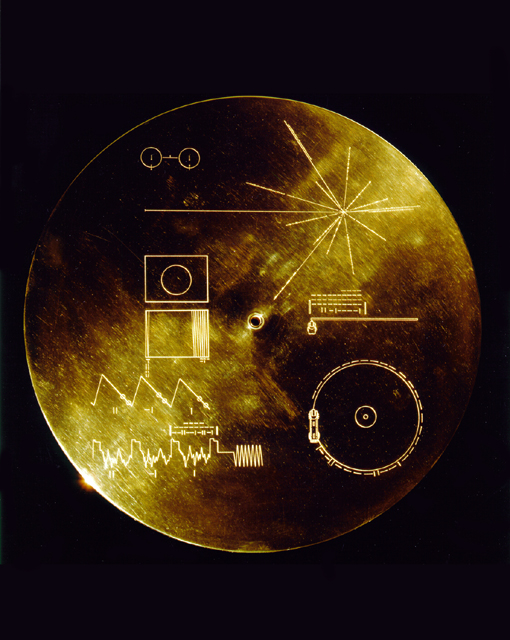
    The point is that most of what survives will not be determined by conscious decisions on our part. This may not be for want of trying, as shown by the current popularity of time capsules. The most impressive of these must be the KEO satellite, due to be launched in 2014 and to return to Earth 50,000 years later.


    And speaking of what we know of the past, it’s been shown again and again that our primitive relatives, the neanderthals, were likely not the brainless savages they’re often depicted to be. Evidence suggests that neanderthals liked to collect bird feathers as ornaments.

    Neanderthals Used Feathers as ‘Personal Ornaments’

    “I think this is the tip of the iceberg,” said Prof Finlayson: “It is showing that Neanderthals simply expressed themselves in media other than cave walls. The last bastion of defence in favour of our superiority was cognition.” Neanderthals, he said, may have been “different”, but “their processes of thinking were obviously very similar”.


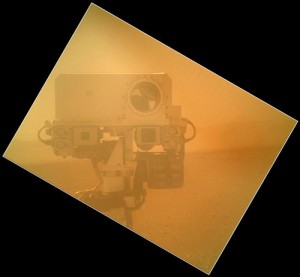
    Curiosity self-portrait. Image Credit: NASA/JPL-Caltech/Malin Space Science Systems

    As the Curiosity rover settles into its new home in Gale Crater on our neighbouring planet, one small worry is growing in the backs of the minds of certain NASA scientists. Could a blunder on the part of some engineers lead to Curiosity contaminating the surface of Mars with Earth life?

    Drill Bits on Rover Could Contaminate Mars

    John D. Rummel, a professor of biology at East Carolina University, said, partly in jest: “It will be a sad day for NASA if they do detect ice or water. That’s because the Curiosity project will most likely be told, ‘Gee, that’s nice. Now turn around.’ “


    And finally, planet hunters are scouring the sky for exoplanets. Astrobiologists are hoping to soon be able to look into the atmospheres of those planets in search of life signs, in the form of certain molecules created by living organisms. But could they be fooled by those molecules coming from somewhere else?

    Meteors Might Add Methane to Exoplanet Atmospheres

    One key gas astrobiologists looking for extraterrestrial life would concentrate on would be oxygen […] Another possibility would be methane, a colorless, odorless, flammable organic gas that microbes on Earth produce. Seeing both together in an exoplanet’s atmosphere might be an especially significant sign of life, since they would both ordinarily remove each other from the atmosphere without something like life to constantly replenish them.


    Have a good weekend!

  • Science or fringe science? Removing the ‘giggle factor’ from Near Earth Object impacts

    Science or fringe science? Removing the ‘giggle factor’ from Near Earth Object impacts

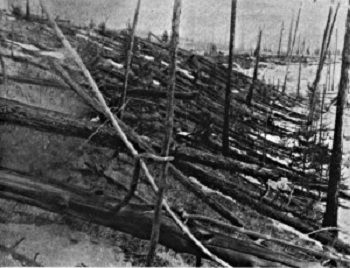
    On June 30, 7.17am in a remote, sparsely inhabited area in Siberia, Russia, near the Podkamennaya Tunguska River, occurred an event of enormous devastation. An asteroid or comet estimated to be 40-50 meters in diameter, exploded at low altitude with an energy almost 200 times that of the atom bomb dropped on Hiroshima. Trees where knocked down over an area of two thousand square kilometres, hundreds of reindeer where killed and the seismic shock from the airborne explosion was registered on barometers in England. Eyewitnesses 60km away, reported seeing the northern sky covered with fire, followed by an enormous bang, though thankfully no human deaths were recorded.

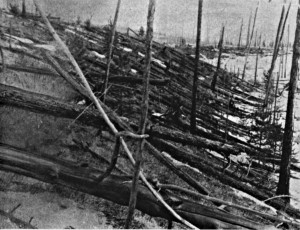
    Fallen trees at the Tunguska impact site

    Dan Yeoman from NASA’s Jet Propulsion Laboratory stated in an interview in 2008, “the Tunguska event is of great importance not only because of the devastation caused to a thankfully remote area, but also as it is the only modern era event of this type where we actually have first-hand accounts.

  • Alien encounters and the man from Grenada

    Alien encounters and the man from Grenada

    The month of August indeed belonged to the tiny rover that could — Curiosity. We were all hooked right from the landing and until those first images of the red planet were beamed back. Not even Will.i.am could spoil it for us. We revelled in everything in between, from the missed high-fives, peanuts, Neil deGrasse Tyson’s conversation with the rover, to — yes, unfortunately — Will.i.am’s new single being broadcast from the surface. Curiosity even spawned this generation’s cultural hallmark that is the fake twitter account. If there is any one milestone that denotes you’ve reached a certain level of cultural status… it’s the fake twitter account. From Mrs Rupert Murdoch to dead literary figures, the fake twiteratti are just as important as the real ones.

    In an odd roundabout way, all of this got me thinking about a bizarre event that happened in 1977.

    The United Nations debating such topics as aliens and extra-terrestrial encounters of any kind seems like something confined to the annals of science fiction. And yet, the most significant debate any international body has had on the prospect of alien encounter happened at the 32nd session of the United Nations General Assembly, for reasons unbeknown to me and probably many at the committee.

    Member nations and delegations convened at the 32nd session of the General Assembly to listen to the man from Grenada, Sir Eric M. Gairy, the Prime Minister and Minister for External Affairs of Grenada (evidently taking his title to its farthest logic conclusion — what could be more external than space?).

    He began with a reading from the Bible — Psalm 100, then launching into an engaging speech that touched on freedom and independence of nations, human rights, wars and conflicts. It quickly took on another flavour. The smallest nation in the UN (at the time) had centre stage and was determined to make the most of it. Mr. Gairy began to speak of unidentified flying objects (UFOs) with the same unabashed enthusiasm he was getting a reputation for.

    He concluded by recommending that not only the UN take it seriously but they should set up a department to study UFOs. The UN already had a space outfit — the Of

  • Does my Science look big in this? August 2012 in review

    Does my Science look big in this? August 2012 in review

    August was a momentous month for science and technology. In my top five events are: NASA landed a car-sized rover on Mars; the first man to walk on the Moon, Neil Armstrong dies; Harvard scientist create a cyborg tissue; Swedish researchers detail how Parkinson’s disease spreads through the brain; and Voyager 2 turns 35.

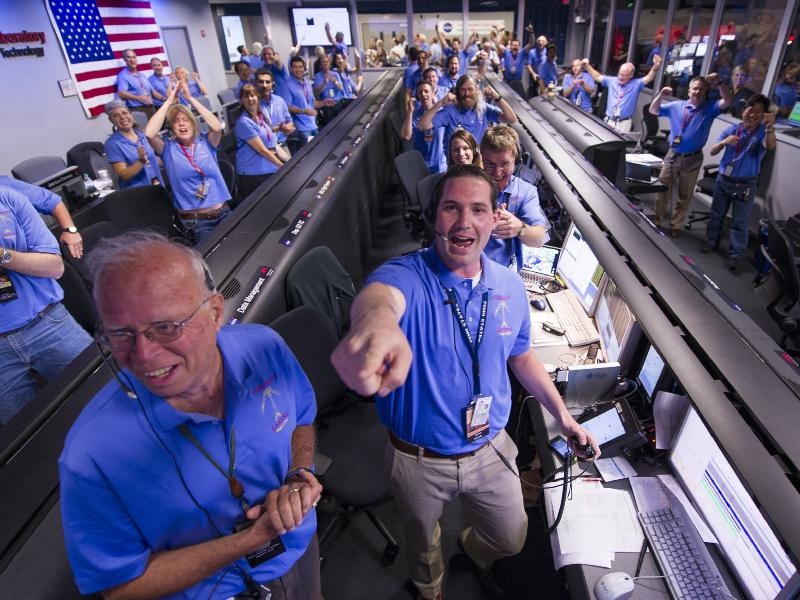
    Without a doubt the technology achievement of the month goes to NASA. They landed the rover, Curiosity, successfully on Mars at 1:31 a.m. EDT August 6, 2012. Ending a 36-week flight and beginning a two-year investigation.  What makes this noteworthy? For one the coverage and access NASA provided in real time. From the launch to the daily updates to the ‘on the spot’ coverage of the entrance-descent-landing sequence live from the Pasadena control-room. Showing that engineers and scientists are human after all.

    I was delighted to see the sky-crane landing working to perfection.  As the system were all bought to life one-by-one the science exploration staff are eagerly anticipating zapping, sampling and analysing rocks, regolith and atmosphere.

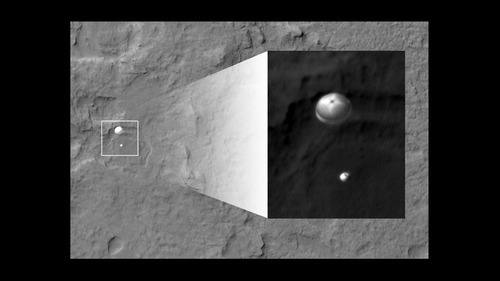
    Curiosity parachuting to the Martian surface. Photo credit NASA/JPL.

    “Today, the wheels of Curiosity have begun to blaze the trail for human footprints on Mars. Curiosity, the most sophisticated rover ever built, is now on the surface of the Red Planet, where it will seek to answer age-old questions about whether life ever existed on Mars, or if the planet can sustain life in the future,” said NASA Administrator Charles Bolden. “This is an amazing achievement, made possible by a team of scientists and engineers from around the world and led by the extraordinary men and women of NASA and our Jet Propulsion Laboratory. President Obama has laid out a bold vision for sending humans to Mars in the mid-2030’s, and today’s landing marks a significant step toward achieving this goal.”

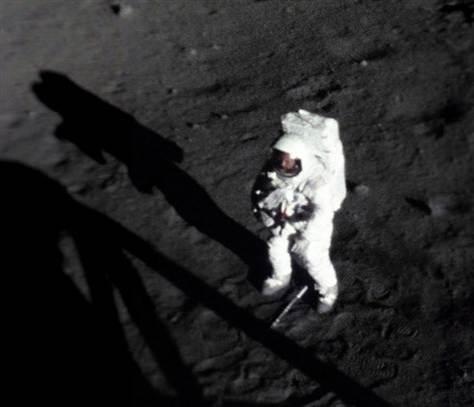
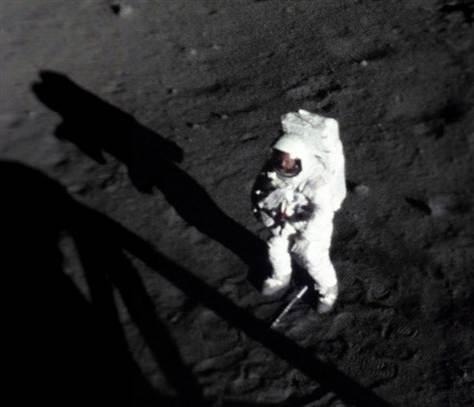
    The bold vision for sending humans to Mars was poignant. Neil Armstrong, the first man to walk on the moon during the 1969 Apollo 11 mission, died, following complications resulting from cardiovascular procedures. He was 82. Without a doubt Neil Armstrong, Buzz Aldrin and Michael Collins were childhood heroes to me. They along with the other astronauts of both the Apollo and Gemini missions were a key inspiration in firstly my interest in and secondly my career in science.

    The only picture taken of Neil Armstrong on the Moon. Neil was carrying the camera (seen in his hands here) during the entire moon-walk so all images captures Buzz Aldrin. This image was captured by a stationary camera on the Lunar landing module. Image credit NASA.

    “Houston, Tranquillity Base here. The Eagle has landed,” Armstrong said, telling a tense and waiting Earth that men had finally reached the lunar surface. Neil Armstrong was also a reluctant American hero who always believed he was just doing his job. A refreshing change from the current days of hyped useless celebrities and where the word awesome is applies to every mundane activity. Traveling to the Moon, that inspires a sense of awe.

    Meanwhile researchers at Harvard have grown cyborg tissues with embedded nanoelectronics. They have reported how they developed a system for creating nanoscale “scaffolds” which could be seeded with cells which later grow into tissue.

    Though a number of potential applications exist for the technology, the most near-term use may come from the pharmaceutical industry. Researchers could use it to more precisely study how newly developed drugs act in three-dimensional tissues, rather than thin layers of cultured cells. The system might also one day be used to monitor changes inside the body and react accordingly, whether through electrical stimulation or the release of a drug.

    Parkinson’s researchers at Lund University for the first time were able to follow events in which misfolded proteins travel from sick to healthy cells. This model has never before been identified so clearly in a living organism. The experiments also show how the transferred proteins attract proteins in the host cell leading to abnormal folding or “clumping” inside the cells. This is a cellular process likely to lead to the disease process as Parkinson’s progresses, and it spreads to an increasing number of brain regions as the patient gets sicker.

    The aim of the research is to better understand how Parkinson’s pathology progresses and thereby uncover novel molecular targets for disease-modifying treatments.

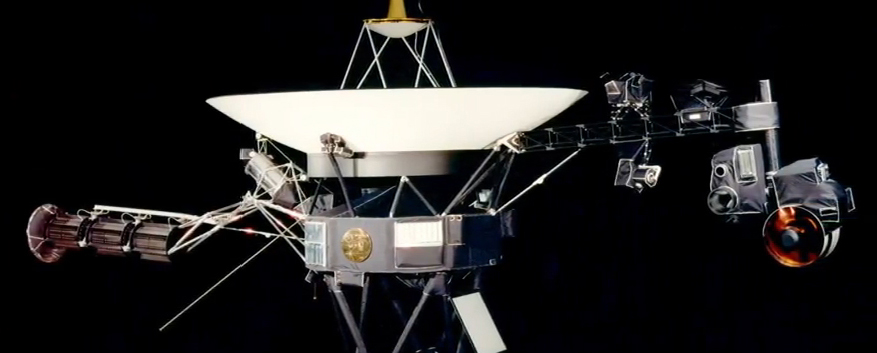
    Voyager 1. Image credit NASA/JPL

    Finally what an inspiring longevity story. Thirty-five years ago, NASA’s Voyager 2 spacecraft, the first Voyager spacecraft to launch, departed on a journey that would make it the only spacecraft to visit Uranus and Neptune and the longest-operating NASA spacecraft ever. Voyager 2 and its twin, Voyager 1, that launched 16 days later on Sept. 5, 1977, are still going strong, hurtling away from our sun. Mission managers are eagerly anticipating the day when they break on through to the other side – the space between stars.

    I trust you have enjoyed my idiosyncratic “five best new science and technology” stories of this past calender month. These were in most cases, but not exclusively so, announced through peer reviewed journals. These were those that I found most interesting, or influential, or of possible future impact.  No science applied to my choice, the choice was my responsibility alone!

  • Kepler Astronomers Find First Planetary System Around a Binary Star

    Kepler Astronomers Find First Planetary System Around a Binary Star

    NASA’s Kepler mission has found the first multi-planet solar system orbiting a binary star, characterized in large part by University of Texas at Austin astronomers using two telescopes at the university’s McDonald Observatory in West Texas. The finding, which proves that whole planetary systems can form in a disk around a binary star, is published in the August 28 issue of the journal Science.

    “It’s Tatooine, right?” said McDonald Observatory astronomer Michael Endl. “But this was not shown in Star Wars,” he said, referring to the periodic changes in the amount of daylight falling on a planet with two suns. Measurements of the star’s orbits showed that daylight on the planets would vary by a large margin over the 7.4-Earth-day period as the two stars completed their mutual orbits, each moving closer to, then farther from, the planets (which are themselves moving).

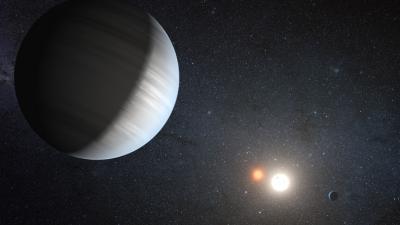
    The binary star in question is called Kepler-47. The primary star is about the same mass as the Sun, and its companion is an M-dwarf star one-third its size. The inner planet is three times the size of Earth and orbits the binary star every 49.5 days, while the outer planet is 4.6 times the size of Earth with an orbit of 303.2 days.

    Artist's concept of the Kepler-47 system.

    The outer planet is the first planet found to orbit a binary star within the “habitable zone,” where liquid water could exist and thus create a home for life. However, the planet’s size (about the same as Uranus) means that it is an icy giant, and not an abode for life. It’s a tantalizing taste of discoveries waiting to be made.

    The combination of observations from the NASA mission and McDonald Observatory allowed astronomers to understand the characteristics of Kepler-47’s two stars and two planets.

    The Kepler mission looks for minute dips in the amount of light coming from a star that might indicate a planet is passing in front of it, an event called a “transit.” The space telescope is also adept at identifying eclipsing binary stars, in which two stars pass in front of each other as they orbit each other. In the case of Kepler-47, they found both stellar eclipses and planet transits in one system.

    So Kepler astronomers Jerome Orosz (lead author on the study) and William Welsh of San Diego State University flagged the Kepler-47 system as worthy of follow up from the ground. They asked the McDonald Observatory Kepler team to work with them.

    Endl studied the binary star with the 9.2-meter Hobby-Eberly Telescope (HET, one of the world’s largest telescopes), as well as the 2.7-meter Harlan J. Smith Telescope at McDonald.

    “The challenging thing is that this is a very faint star,” Endl said, “about 6,000 times dimmer than can be seen with the naked eye.”

    He was taking spectra of the system — looking for characteristics in its light to indicate the motions of the primary star. (The secondary star is too faint to measure.) The McDonald observations enabled astronomers to calculate the mass of the primary star.

    These values, along with the Kepler eclipse and transit timings, were plugged into a model that calculated the relative sizes of all the bodies involved, Endl said.

    The Kepler team at McDonald Observatory also includes Bill Cochran (a co-Investigator of the Kepler mission), research scientist Phillip MacQueen, graduate students Paul Robertson and Eric Brugamyer, and recent graduate Caroline Caldwell.

    “This is the type of research where McDonald Observatory really excels,” Cochran said. “We have excellent scientific instruments on our telescopes, and the queue-scheduled operation of the HET allows us to obtain spectra at the optimal times when they will give us the best information about the stars.”

    Source.

  • It’s a wheel!  It’s a wheel – a wheel on Mars!

    It’s a wheel! It’s a wheel – a wheel on Mars!

    NASA’s rover Curiosity was safely on Mars.  It was a perfect landing.  The novel sky-crane method had proved its detractors wrong and its designers right.  What was needed then was signs that Curiosity was working as designed.  NASA had said that the first pictures may be anything up to 2 hours after landing.  A long time for the audiences, waiting, live, all over Earth.

    It's a wheel on Mars. Photo credit NASA/JPL

    “Got thumbnails.” Pause in the control centre, then someone else yells “Its a wheel, its a wheel!” “A wheel on Mars!”  For the second time that momentous afternoon the NASA/Jet propulsion Lab crowd erupted into spontaneous and joyful applause.  Not only had they landed the rover, Curiosity, safely on Mars, they had received the first images back from its cameras.  Sometimes the unscripted, unexpurgated exclamations make for the best history.

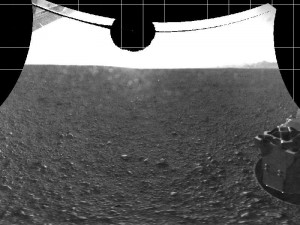
    The first two pictures were from the front and back navigation cameras.  They were low resolution black and white thumbnails taken through the dust caps that protected the cameras during landing.  As the minutes ticked by higher resolution images came through from the rover.  The business as usual, familiar image enhancement bought into sharp clarity the ‘first’ two images from the robot explorer.

    The 'first' image enhanced view from the rear hazard camera, Mars Curiosity Sol 0.

    The first week on Mars

    After the exuberance and press conference came the trademark NASA precision and methodical approach.  An approach that gets missions safely to Mars, at the same time can make the audacious appear mundane.

    Mission controllers at NASA’s Jet Propulsion Laboratory in Pasadena, are now checking out Curiosity’s subsystems and 10 instruments.  Curiosity is in the opening days of a two-year mission to investigate whether conditions have been favorable for microbial life and preserving clues in the rocks about possible past life.

    Mission team members are “living” on Mars time.  A Martian day is approximately 40 minutes longer than an Earth day, meaning team members start their shift 40 minutes later each day.

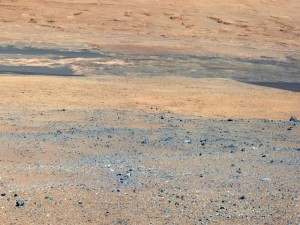
    View of Mount Sharp, Curiosity's roving destination. Image credit NASA/JPL

    Amongst the important system events in this first week was a software upgrade.  It took four days to successfully upgrade Curiosity’s software in its main and back-up computer.  The software had been uploaded during its trek to Mars, but not activated until now.  The software to date was focused on getting Curiosity through the Martian atmosphere and safely to its destination in Gale Crater.  The software upgrade is to cover its surface exploration activity, roving and controlling the various scientific instruments.

    Curiosity Ready to Roll

    “There will be a lot of important firsts that will be taking place for Curiosity over the next few weeks, but the first motion of its wheels, the first time our roving laboratory on Mars does some actual roving, that will be something special,” said Michael Watkins, mission manager for Curiosity from the Jet Propulsion Laboratory.

    Mission engineers are devoting more time to planning the first rove of Curiosity.  In the coming days, the rover will exercise each of its four steerable (front and back) wheels, turning each of them side-to-side before ending up with each wheel pointing straight ahead.  On a later day, the rover will drive forward about one rover-length 3 metres, turn 90 degrees, and then kick into reverse for about 2 metres.  Exciting times for the rover driver team!

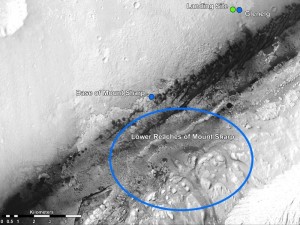
    This image shows the landing site of NASA's Curiosity rover and destinations scientists want to investigate. Photo credit NASA/JPL

    The scientists and engineers of NASA’s Curiosity rover mission have selected the first driving destination for Curiosity.  The target area, named Glenelg, is a natural intersection of three kinds of terrain.  The trek to Glenelg will send the rover 400 metres east-southeast of its landing site.  One of the three types of terrain intersecting at Glenelg is layered bedrock, which is attractive as the first drilling target.

    The choice described by Curiosity Principal Investigator John Grotzinger of the California Institute of Technology as, “With such a great landing spot in Gale Crater, we literally had every degree of the compass to choose from for our first drive.”  “We had a bunch of strong contenders.  It is the kind of dilemma planetary scientists dream of, but you can only go one place for the first drilling for a rock sample on Mars.  That first drilling will be a huge moment in the history of Mars exploration.”

    Grotzinger estimated the rover’s journey would take between three weeks and two months to arrive at Glenelg, where it will stay for roughly a month before heading to the base of Mount Sharp.

    It may be a full year before the remote-controlled rover gets to the base of the peak, which is within 20 kilometres of the rover’s landing site.

    Zapping rocks and doing science

    Before Curiosity heads off to Glenelg another first will occur.  The team in charge of Curiosity’s Chemistry and Camera instrument, is planning to give their mast-mounted, rock-zapping laser and telescope combination a thorough checkout.  ChemCam has “zapped” its first rock in the name of planetary science.  It was the first time such a powerful laser has been used on the surface of another world.

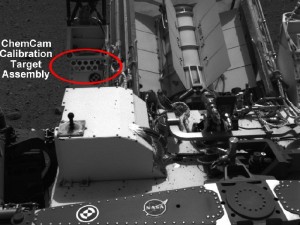
    The Chemistry Camera calibration target, as seen by the camera. Photo credit NASA/JPL.

    The technique is called ‘laser-induced breakdown spectroscopy’.  The high-powered, narrow-focused, laser beam vaporises the rock from a distance generating a plasma plume with temperatures in excess of 100,000°C.  At the high temperatures during the early plasma, the vaporised material breaks down into excited ionic and atomic species.  As it cools to 5,000–20,000°C the characteristic atomic emission lines of the elements can be recorded by the camera.  This data is compared to the ‘standards’ that the rover carries to identify the rock components.

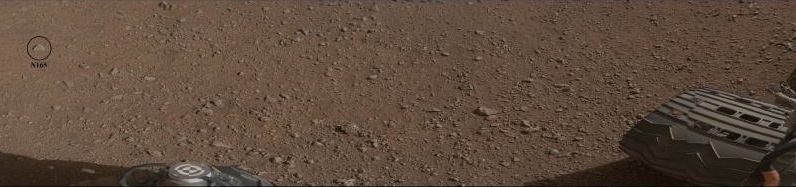
    The soon to be famous rock N165, target for testing the Chemistry Camera laser and analysis. Photo credit NASA/JPL.

    As Roger Wiens, principal investigator of the ChemCam instrument from the Los Alamos National Laboratory explained earlier, “Rock N165 looks like your typical Mars rock, about three inches wide. It’s about 10 feet away.” “We are going to hit it with 14 millijoules of energy 30 times in 10 seconds.  It is not only going to be an excellent test of our system, it should be pretty cool too.”

    Pretty cool indeed.

    First weather report in 30 years

    It is currently just above freezing point in gale Crater where Curiosity is.

    Grotzinger noted the team’s report on the Martian crater’s temperature was “really an important benchmark for Mars science”.

    “It’s been exactly 30 years since the last long duration monitoring weather station was present on Mars,” when Viking 1 stopped communicating with Earth in 1982,” he said.  Then Viking 1 lander recorded temperatures that varied from −17.2 °C to −107 °C.

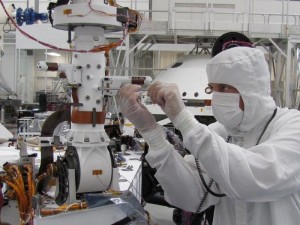
    Sensors on two finger-like mini-booms extending horizontally from the mast of NASA’s Mars rover Curiosity will monitor wind speed, wind direction and air temperature. One also will monitor humidity; the other also will monitor ground temperature. The sensors are part of the Rover Environmental Monitoring Station, provided by Spain for the Mars Science Laboratory mission.

    The weather station devices on Curiosity being tested prior to launch. Photo credit NASA/JPL.

    In this image, the spacecraft specialist’s hands are just below one of the Rover Environmental Monitoring Station mini-booms. The other mini-boom extends to the left a little farther up the mast.

    As Curiosity’s primary mission is for a full Martian year it will be able to record the seasonal variations that occur for Mars.

    On the ground radiation monitoring and weather conditions will be crucial for any future exploration or habitation by humans.  This mission by Curiosity represents an important step towards these aspirations.

  • Gale Crater Vista on Mars

    Gale Crater Vista on Mars

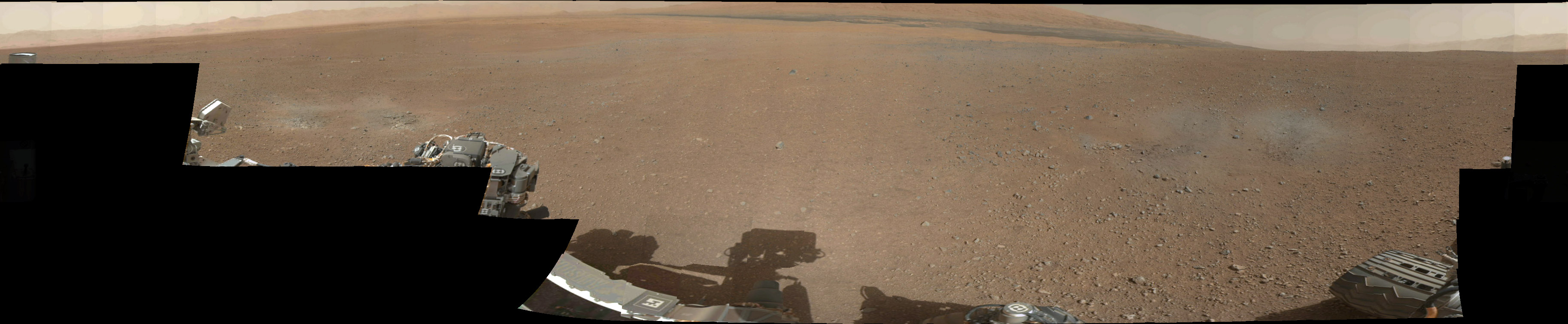
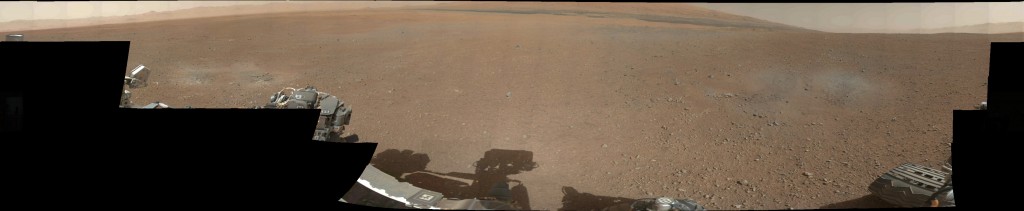
    This is the first 360-degree panorama in color of the Gale Crater landing site taken by NASA’s Curiosity rover. The panorama was made from thumbnail versions of images taken by the Mast Camera.

    Scientists will take a closer look at several splotches in the foreground that appear gray. These areas show the effects of the descent stage’s rocket engines blasting the ground. What appeared as a dark strip of dunes in previous, black-and-white pictures from Curiosity can be seen along the top of this mosaic, but the color images also reveal additional shades of reddish brown around the dunes, likely indicating different textures or materials.

    The images were taken on Aug. 9, 2012, by the 34-millimeter Mast Camera. This panorama mosaic was made of 130 images of 144 by 144 pixels each. Selected full frames from this panorama, which are 1,200 by 1,200 pixels each, are expected to be transmitted to Earth later. The images in this panorama were brightened in the processing. Mars only receives half the sunlight Earth does and this image was taken in the late Martian afternoon.

    Image Credit: NASA/JPL-Caltech/MSSS


  • The whole Earth-side of the Moon should be protected forever

    The whole Earth-side of the Moon should be protected forever

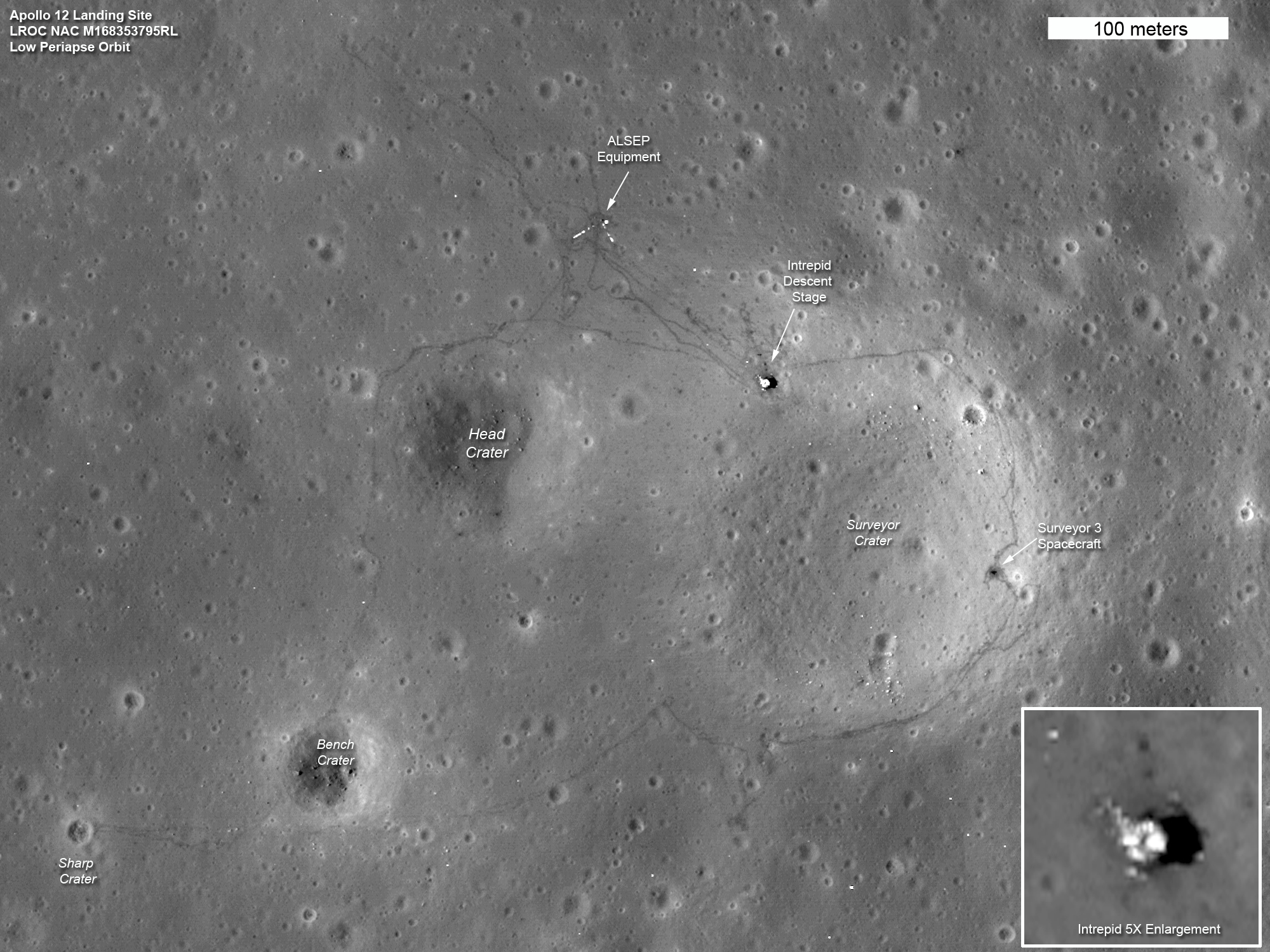
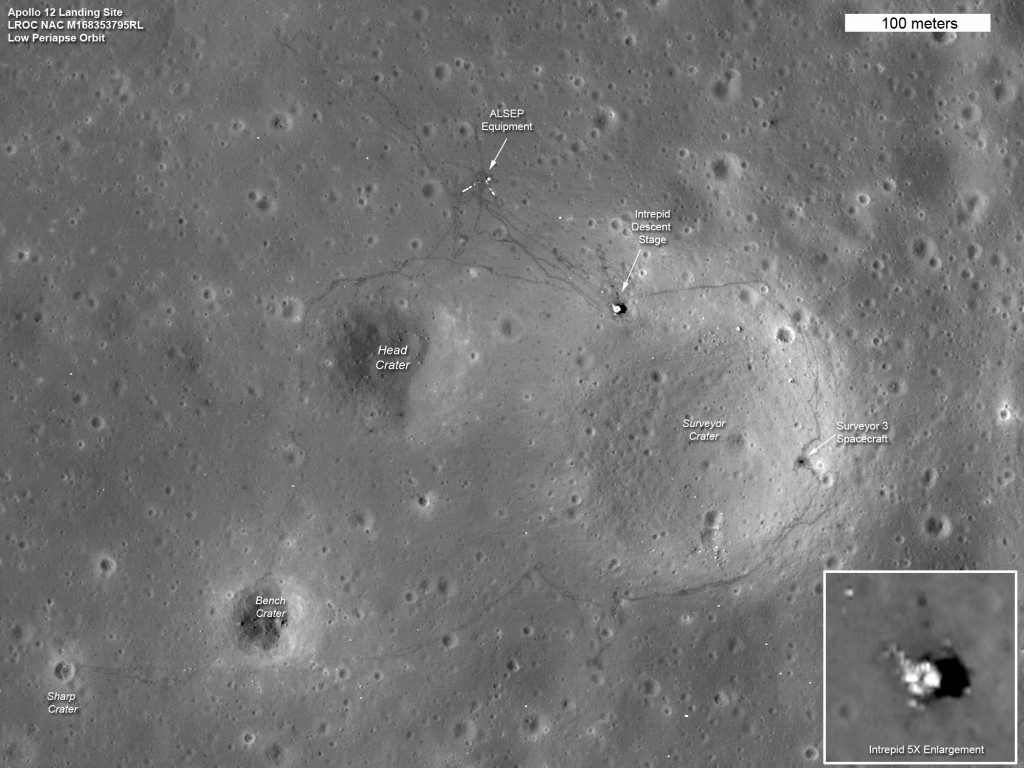
    Apollo 12 landing site, taken from NASA's Lunar Reconnaissance Orbiter in 2011

    Earlier this year, the New York Times had an interesting piece about museums seeking to protect small areas of the Moon around the Apollo landing sites. And a good thing too: “…the next generation of people visiting the moon might carelessly obliterate the site of one of humanity’s greatest accomplishments.”

    More recently, NASA has released draft guidelines around protecting the landing sites from damage.

    But isn’t that a bit like how Cairo almost swallows the Pyramids?

    Surely we need to go further? Much further?

    For thousands of years, all of Earth-bound humanity will gaze up on the Earth side of the Moon. And it’s exactly the same view looked upon by all of humanity throughout history.

    Surely that whole view is worthy of protection? After all, any changes made that are visible from Earth will be visible forever. There’s no atmosphere or weather to sweep away our transgressions over time. What is done on the Moon stays done…

    I raised these concerns with a NASA engineer a couple of years ago after his presentation at the Questacon national science museum about the (now ill-fated) Constellation project to return to the Moon.

    It seemed to me that the American disposable society mantra was writ large in their plans, with leftover bits free to crashland wherever once done with. It’s that sort of mentality that’s got us into a spacejunk problem in Earth orbit.

    I have no doubt that there will come a day – possibly while I’m still alive – that we are strip-mining parts of the Moon for minerals to build spaceships and Moonbase buildings and to fuel them.

    But surely there should be a commitment from all nations for this sort of permanent scarring to be limited to the far side (the incorrectly named dark side!) of the Moon only. And for communications facilities and potentially colonies to be positioned around the Earthside perimeter for minimal visual impact, while maintaining direct communications.

    There should also be strict controls on escape of artificial light. Surely the sort of light pollution that we spew pointlessly upwards from our Earth should not be shining back at us one day from the Moon?

    We owe our future generations that much, I believe.

    And while looking back – enjoy this handheld footage of the Earthrise, from Apollo 10, right out at the Moon, to very fitting music:

  • Mysterious Mars

    Mysterious Mars

    Mars is full of secrets and mysteries. The classic definition of a desert world, our planet’s arid sibling is a parched wilderness of dunes and planetwide dust storms. With a thin carbon dioxide atmosphere and only 38% the gravitational pull of Earth, there are a lot of puzzles about this cold and frosty little planet, and a lot of scientists who are longing to solve them.

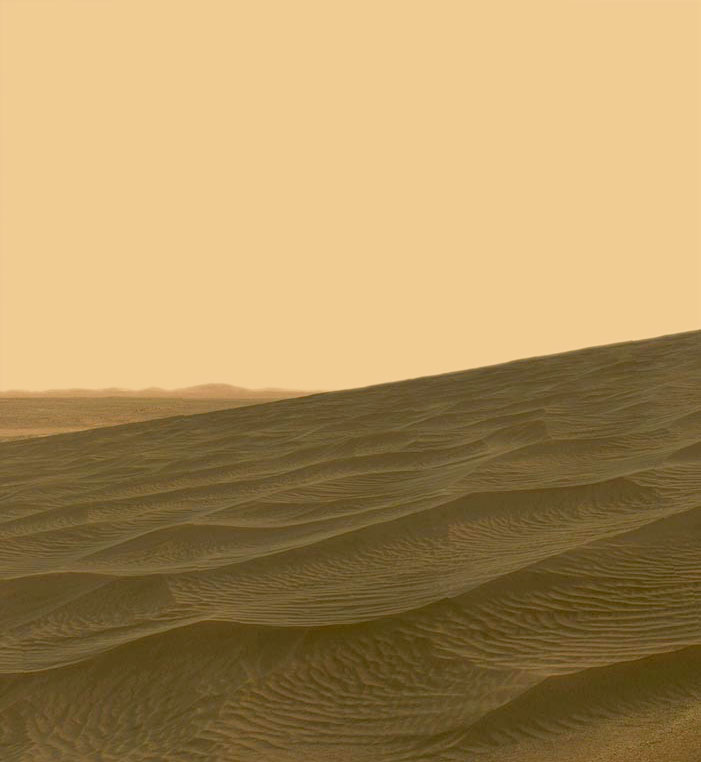
    El Dorado, Gusev Crater. Mars is a world of dust and dunes…

    By now, anyone keeping up with the news is bound to have heard that NASA’s Curiosity rover made a flawless descent through the atmosphere of Mars and is now busy eyeing up its new home in the Gale Crater. As was discussed previously here on Australian Science, a big question still on everyone’s mind is the same one which David Bowie sang about back in 1971. Is there life on Mars? However, it seems that NASA’s plans are not to answer this question directly. John Grotzinger, project scientist for the Curiosity mission, is quoted as saying; “Curiosity is not a life detection mission. We’re not actually looking for life; we don’t have the ability to detect life if it was there.” Instead, the main objective of Curiosity is to look for signs of life.

    The trouble is that looking for life directly is a difficult task. Back here on Earth, new discoveries are still being made frequently, with life being found in environments and habitats where no one was expecting. There’s a lot which we still don’t fully understand about life here on our own world. When we’re talking about another planet, it’s safe to say that all bets are off. As a result, Curiosity’s goal is to look for the various elements and chemical compounds which life might use – or might have used once upon a time when the planet may have been more hospitable. The focus has shifted from the search for life on Mars right now, to life which may once have lived there.

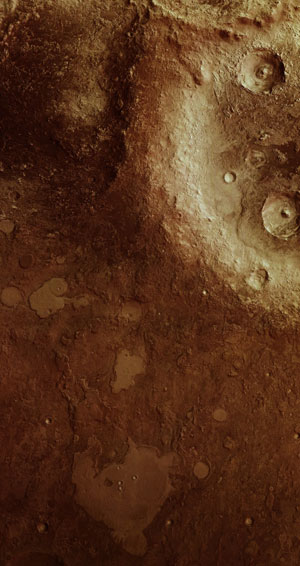
    Arabia Terra – one of the three locations on Mars where methane plumes have been spotted.

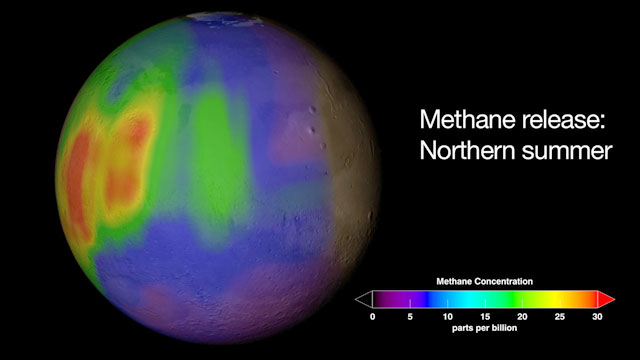
    One point which is worth remembering right now, however, is that there’s one big unsolved mystery about Mars. A gaseous mystery. Large quantities of methane have been detected in the martian atmosphere, which gives rise to a real puzzle. Methane is destroyed by sunlight, and with the thin atmosphere found on Mars, any methane should be rapidly broken apart by solar ultraviolet. The only possible conclusion is that the methane seen on Mars is being replenished somehow. There are only really two possibilities for how this might happen.

    One scenario sees the martian methane caused by a geological process called serpentinisation. This is where a type of mineral known as olivine (more familiar to us as the gemstone peridot) chemically reacts with water and carbon dioxide. The reaction creates methane and a green mineral called serpentine (commonly found in certain parts of Western Australia and Tasmania), and releases methane gas. If this is the process which is occurring, it would mean that not only is there a suitable amount of water somewhere under the surface of Mars, but there must also be geological activity for that water to continue being brought into contact with further olivine to react with. This would suggest that there are things which we don’t know about current geological processes on Mars.

    The other possibility, more radically, is that this methane is being produced by life. Here on Earth, bacteria known as methanogens are responsible for most of the methane present in Earth’s atmosphere. In fact, on Earth, methane is so regularly produced by living organisms that it can used as an indicator of biological activity.

    When three distinct plumes of methane were discovered on Mars in 2009, it was noted that there was an equal probability of either of those two scenarios being the source of the methane – and that both would be huge revelations in our understanding of our neighbouring world. So maybe the Curiosity rover isn’t set up to hunt for life, and maybe it won’t be directly looking for it. But I, for one, do hope it finds some clues about the origin of the mysterious martian methane. Just as any scientist should, I love a good mystery!

    The three methane plumes seen on Mars at South-East Syrtis Major, Nili Fossae and Arabia Terra.

    Image credits:
    Top – NASA JPL/Cornell
    Middle – ESA/DLR/FU Berlin (G. Neukum)
    Bottom – NASA

  • First Color Image of the Martian Landscape from Curiosity

    First Color Image of the Martian Landscape from Curiosity

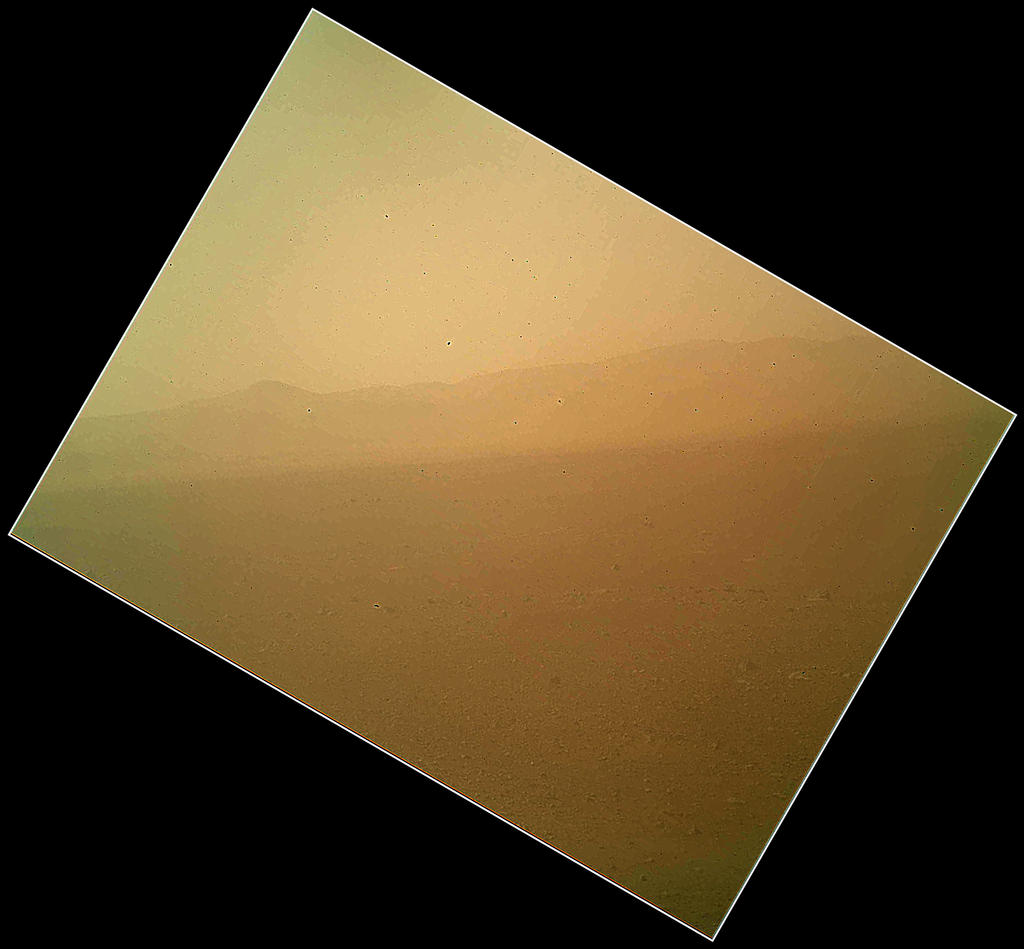
    This view of the landscape to the north of NASA’s Mars rover Curiosity acquired by the Mars Hand Lens Imager (MAHLI) on the afternoon of the first day after landing. (The team calls this day Sol 1, which is the first Martian day of operations; Sol 1 began on Aug. 6, 2012.)

    In the distance, the image shows the north wall and rim of Gale Crater. The image is murky because the MAHLI’s removable dust cover is apparently coated with dust blown onto the camera during the rover’s terminal descent. Images taken without the dust cover in place are expected during checkout of the robotic arm in coming weeks.

    First Color Image of the Martian Landscape Returned from Curiosity

    The MAHLI is located on the turret at the end of Curiosity’s robotic arm. At the time the MAHLI Sol 1 image was acquired, the robotic arm was in its stowed position. It has been stowed since the rover was packaged for its Nov. 26, 2011, launch.

    The MAHLI has a transparent dust cover. This image was acquired with the dust cover closed. The cover will not be opened until more than a week after the landing.

    When the robotic arm, turret, and MAHLI are stowed, the MAHLI is in a position that is rotated 30 degrees relative to the rover deck. The MAHLI image shown here has been rotated to correct for that tilt, so that the sky is “up” and the ground is “down”.

    When the robotic arm, turret, and MAHLI are stowed, the MAHLI is looking out from the front left side of the rover. This is much like the view from the driver’s side of cars sold in the USA.

    The main purpose of Curiosity’s MAHLI camera is to acquire close-up, high-resolution views of rocks and soil at the rover’s Gale Crater field site. The camera is capable of focusing on any target at distances of about 0.8 inch (2.1 centimeters) to infinity. This means it can, as shown here, also obtain pictures of the Martian landscape.

    Image Credit: NASA/JPL-Caltech/Malin Space Science Systems

    Source

  • Interview with lead Mars Curiosity rover driver Matt Heverly

    Interview with lead Mars Curiosity rover driver Matt Heverly

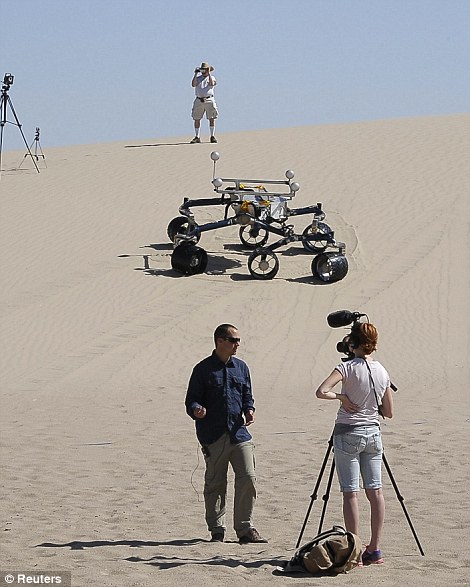
    Matt Heverly during testing of rover double "Scarecrow" in the desert near Death Valley. Source: Daily Mail UK

    When the Mars Science Laboratory – Curiosity – touches down on Mars today, one of the people there ready to take control of it will be Matt Heverly.

    Matt is an engineer with NASA’s Jet Propulsion Laboratory in Pasadena, California and has been working on the design and build of Curiosity, as well as being one of the drivers of the lone surviving rover currently on Mars – Opportunity.

    And Matt has been appointed by NASA as the lead driver for Curiosity.

    Last week I interviewed Matt about this important role, about driving rovers in general, and about the science work that he’ll be helping with.

    When Matt came online, he’d quite literally been in the “Mars Yard” conducting some testing with Curiosity’s twin, and he had parked it right behind himself before joining me on Skype. You can see the rover in the background.

    (There are a couple of spots where the Skype signal dropped down and a warning dialogue came over the screen. I wanted to get the interview posted prior to the landing day, so no finessing the video editing…)

    Interview with Matt Heverly – Mars Curiosity lead rover driver from Alan Kerlin on Vimeo.


    There are actually two “twins” of Curiosity used for testing back here on Earth. The one behind Matt is an exact twin is all respects except the plutonium power supply. The other – nicknamed Scarecrow – is a slimmed down version that is designed to weigh as much as Curiosity would in the lower gravity of Mars. It is used to test driving conditions. The following video shows you Scarecrow in action in the Mars Yard:

    We also talked about Athlete – a rover design originally destined for the Moon. Check this video of Athlete busting some moves:


  • Where to land Mars Curiosity for the best science? Interview with Marion Anderson, who helped choose the landing site.

    Where to land Mars Curiosity for the best science? Interview with Marion Anderson, who helped choose the landing site.

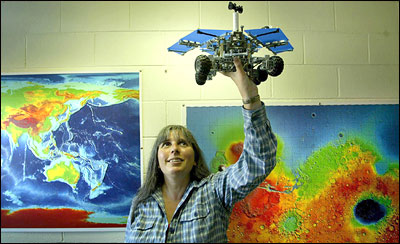
    Australian geologist Marion Anderson, with a model of Curiosity's predecessor rover Opportunity. Source: The Age

    You’ve sunk more than $2 billion into a car-sized rover and you’re ready to send it to explore Mars. But where exactly on Mars do you send it?

    Of course you want it and its controllers back here to be able to do the best possible science. So apparently that is exactly what NASA did – consulted the geology scientists of the world.

    One of those scientists was Marion Anderson of Melbourne’s Monash University.

    In this interview recorded on 2 August 2012, Marion explains to me what went into the selection of Gale Crater as the landing site for the Mars Curiosity rover, what to expect from the rover as it begins to explore the crater after its landing there on Monday 6 August, and why Curiosity is NOT looking for life, despite what many media people are saying (running time 20 mins).


    Marion also talks about her role in selecting the landing sites for those other Mars rovers Spirit and Opportunity, and where next after Mars?

    If you are interested in learning more about the geology of Mars, I highly recommend the one-hour lecture by Richard Pogge titled The Deserts of Mars from an entire – free – university course in Astrobiology from Ohio State University (also available on iTunes).

    In the interview you’ll hear Marion talk about how Mount Sharp in the centre of Gale Crater is actually higher than the surrounding crater walls – some five kilometres high. In this lecture, listen for an explanation why Olympus Mons is the highest volcanic cone in our Solar System, and probably explaining the height of Mount Sharp too.