Category: Science

  • The Search for Exoplanets

    The Search for Exoplanets

    It seems like another day goes by and there’s another discovery of more exoplanets!  On January 7, just one week into 2013, astronomers from the Kepler Mission Space Observatory announced the discovery of the latest exoplanet, the creatively named KOI-172.02.  At this stage it appears that KOI-172.02 is an Earth-like planet candidate orbiting a star similar to our own sun. It almost seems like old news when scientists announce the discovery of a planet orbiting another star in our galaxy!

    As at January 15, 2013 a total of 859 such planets have been identified (details can be found here).  These are certainly exciting times for astronomers, but just how do astronomers search for exoplanets?

    There are a number of methods used to detect exoplanets including astrometry, the transit method, radial velocity, gravitational microlensing, pulsar timing, eclipsing binaries, circumstellar disks and coronagraphy.  Each method of observation has its pros and cons, is used in different circumstances, and produces different results.  I will give an overview of each technique:

    Astrometry is a technique that requires astronomers to precisely measure a star’s position in the sky, and then make more observations of the stars movement over time.  If the star has an orbiting planet or planets, then the gravitational influence of the objects will cause the star to move in a tiny circular or elliptical orbit around the common centre of mass. Finding Earth-mass planets by astrometry requires extreme (sub-microarcsecond or 1 millionth of an arcsecond!!) precision. As the motion of the star is so small, this method has not yet been very productive in detecting exoplanets. However it’s expected that astrometric accuracy from ground-based telescopes will improve and become more useful.
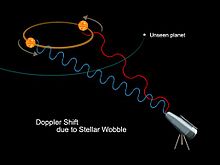
    Doppler Shift
    Doppler Shift (Image courtesy of NASA)

    One method that is very productive is the Radial Velocity method.  This method requires the measurement of the velocity of a star’s centre of mass. Variations in the star’s radial velocity can be deduced from displacements in the star’s spectral lines due to the Doppler effect. If the motion of the star is towards the observer, then the received wavelengths are shorter than those emitted by the source, and longer if the motion is away from the observer. This is similar to the Doppler effect we observe in sound waves when a fire-engine passes us and the pitch of its siren changes! The Anglo-Australian Planet Search was a long-term program that searched for giant planets around more than 240 nearby solar type stars and as of 2010, discovered more than 30 exoplanets using the Doppler method. This method has been by far the most productive method of discovering exoplanets.

    Another popular and effecitve method of detecting exoplanets is the Transit Method which measures the faint dip in brightness of a star when a planet transits the star (passes in front of it as observed from earth).  As an exoplanet transits in front of its parent star, the observed brightness of the star drops by a very small amount. This method has emerged as one of the prevailing techniques to search for exoplanets. The amount by which the star dims depends on its size and on the size of the planet.  A local example of this phenomenon was the transit of Venus across the face of the Sun in June 2004 and July 2012.  The transit method is the second most productive method of detection, though confirmation from another method is usually considered necessary as dips in apparent brightness can arise from events other than a planetary transit.  The Kepler Observatory uses the transit method and as of January 2013 it has discovered 2740 candidate exoplanets.
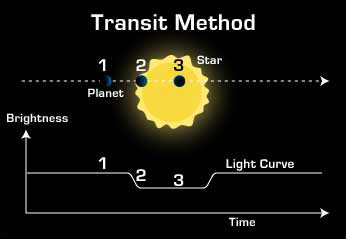
    Transit Method
    Transit Method (Image courtesy of NASA)

    One of the more exciting, yet complex methods is  Gravitational Microlensing. This method is used when the gravitational field of a star (close to us) acts like a lens and magnifies the light of a distant background star.  When the alignment is exact you might think that the background star would be hidden from view, however the gravitational field of the foreground star bends the light of the background star towards us. This method has the advantage of being very sensitive to planets at large angular separations/distances from the parent stars. This makes gravitational microlensing one method well suited to finding low-mass planets.  One major disadvantage is that the event can’t be repeated, as the alignment is unlikely to occur again.  Also the planets tend to be very distant, so the other methods are unable to confirm the observations.

    A pulsar  is a fast-spinning neutron star that emits radio waves at very regular intervals  as it rotates. We can use the Pulsar Timing method to discover exoplanets.  Slight changes in the timing of its observed radio pulses can be used to track changes in the pulsar’s motion caused by the presence of planets. The presence of a planet orbiting a star affects the timing of the regular signals emitted by the star itself. This phenomenon can be used to detect planets around a pulsar. This method is very sensitive and is capable of detecting planets of a very small mass. In 1992, Wolszczan and Frail used this method to discover the first exoplanet around the pulsar PSR 1257+12. Unfortunately pulsars are pretty rare, so this method is not going to produce a large number of exoplanet discoveries. Also, it’s unlikely that life could survive on planets orbiting pulsars since high-energy radiation there is intense.

    When a double star (binary) system is aligned such that the stars pass in front of each other in their orbit, the system is called an eclipsing binary star system. Astronomers can use the Eclipsing Binaries method to discover exoplanets. If a planet has a large orbit that carries it around both members of an eclipsing double star system, then the planet can be detected through small variations in the timing of the stars’ eclipses of each other.

    Disks of dust surround many stars, and this dust can be detected because it absorbs ordinary starlight and re-emits it as infrared radiation. The  Circumstellar Dust Disks method detects features in dust disks that may suggest the presence of planets.  Dust is generated by collisions of small objects, including comets and/or asteroids, and radiation pressure from stars will push the dust particles out into stellar space.  Therefore any detection of dust around a star indicates the possibility of recent collisions and other objects.

    Lastly, a  Coronagraph is an object when attached to a telescope, blocks out the direct light from a star so that nearby objects, which otherwise would be hidden in the star’s bright glare, can be observed. In the past coronagraphs have been developed to view the corona of the Sun, but new versions of similar instruments are being used to find extrasolar planets around nearby stars.  Coronagraphs can be attached to either ground or space based telescopes.  While stellar and solar coronagraphs are similar in concept, they are quite different in design.  This is so that observations can be made of exoplanets which are much more distant than our own sun. A stellar coronagraph concept is currently being studied to fly on the Terrestrial Planet Finder mission. On ground-based telescopes, a stellar coronagraph can be combined with adaptive optics to search for planets around nearby stars.
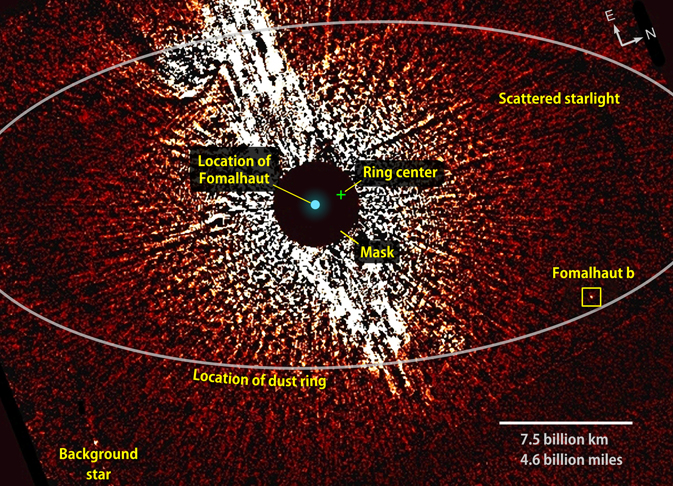
    Circumstellar Dust Disk
    Coronographic Mask showing Dust Disk (Image Courtesy of NASA)

    Astronomers at the Harvard Smithsonian Centre for Astrophysics have recently estimated that as many as 17 billion earth sized planets exist in the Milky Way Galaxy alone! Yes, Billion! So I think that we’ll continue to hear about exciting new exoplanet discoveries all the way through 2013 and well beyond.  By the way – if you’re really into exoplanets and consider yourself a ‘citizen scientist’ you can help discover new exoplanets!  Planet Hunters is an organisation that encourages ordinary folks with no scientific training at all to help find planets from data provided by the Kepler Observatory! If you’re the first person to identify an exoplanet using their data, you’ll be included paper describing the discovery.
  • The perils of space exploration: last flight of space shuttle Columbia

    The perils of space exploration: last flight of space shuttle Columbia

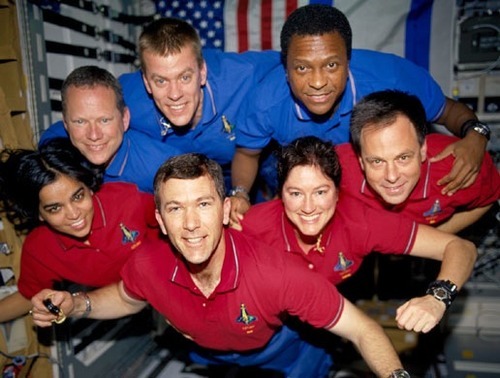
    The 28th and last flight (STS-107) of the space shuttle Columbia was ten years ago. Launched on January 16, 2003 Columbia was destroyed at about 0900 EST on February 1, 2003 while re-entering the atmosphere after its 16-day scientific mission. The destruction of the shuttle killed all seven astronauts on board.

    image
    The traditional “in-flight” picture of the crew. This picture was taken from a camera recovered from the crash debris. Photo credit NASA.

    An illustrious career

    Columbia was the first of the space shuttles to fly, it was successfully launched on April 12, 1981, the 20th anniversary of the first human spaceflight by Yuri Gagarin in Vostok 1, and returned on April 14, 1981, after orbiting the Earth 36 times. The first flight of Columbia (STS-1) was commanded by John Young, a Gemini and Apollo veteran who was the ninth person to walk on the Moon in 1972, and piloted by Robert Crippen, a rookie astronaut who served as a support crew member for the Skylab and Apollo-Soyuz missions.

    Columbia has an illustrious career as part of the US space program, featuring many ‘firsts’. It was the first true manned spaceship. It was also the first manned vehicle to be flown into orbit without benefit of previous unmanned “orbital” testing; the first to launch with wings using solid rocket boosters. It was also the first winged reentry vehicle to return to a conventional runway landing, weighing more than 99-tons as it was braked to a stop on the dry lakebed at Edwards Air Force Base, California.

    image
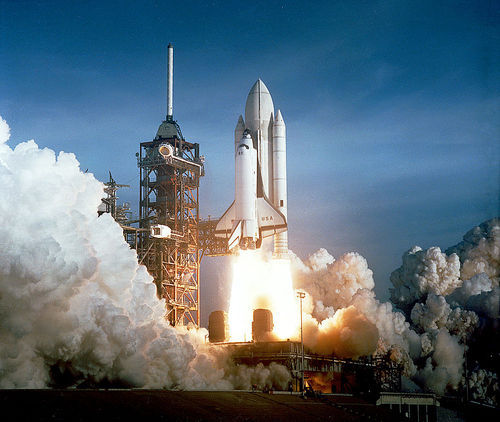
    NASA PHOTO: The April 12, 1981 launch at Pad 39A of STS-1, just seconds past 7 a.m., Columbia carries astronauts John Young and Robert Crippen into an Earth orbital mission scheduled to last for 54 hours, ending with unpowered landing at Edwards Air Force Base in California.

    Its second flight, STS-2 on November 12, 1981 marked the first re-use of a manned space vehicle. A year later it became the first 4-person space vehicle – bumping this to six on its sixth flight (STS-9) on November 28, 1983. This flight also featured both the first flight of the reusable laboratory ‘Spacelab’ and the first non-American astronaut on a space shuttle, Ulf Merbold. STS-93, launched on July 23, 1999, was commanded by Eileen Collins, the first female Commander of a US spacecraft.

    Space Shuttle Columbia flew 28 flights, spent 300.74 days in space, completed 4,808 orbits, launched 8 satellites and flew 201,497,772 km in total, including its final mission. Its penultimate flight (STS-109) was the third of the highly publicised servicing and upgrade flights to the Hubble Space Telescope.

    The fatal flight

    The rockets fire. Amidst the thundering fiery roar the shuttle lifts majestically from the launch pad. Unnoticed at the time, at 81.9 seconds after launch a foam insulating block disintegrates upon hitting the leading edge of the shuttles left-wing. The launch continues as scheduled. One hour after launch Columbia was in orbit and the crew began to configure it for their 16-day mission in space.

    The next day, routine analysis of high-resolution video from the tracking cameras reveals the debris strike. Multiple groups within the mission team review the tapes. They assess the possibility of damage and decide that an image is required of the wing. They make a request to the NASA ground management for imaging of the wing in-orbit.

    However, it was considered “of low concern” that the carbon matrix could be damaged by the foam block. The engineers were over-reacting. The Space shuttle Program managers declined to get the Columbia imaged – or alert the shuttle crew. In fact the crew were told that the impact was a “turn-around issue”, something they had seen before and would be a maintenance check only. Titanic-like the mission continued.

    Scientifically the mission was great success. The shuttle crew worked around the clock to ensure that maximum scientific value was achieved. Including an investigation of the web-spinning abilities of the Golden orb spider under low gravity. An experiment designed by students from Glen Waverley Secondary College, in Melbourne Australia.

    The morning of re-entry all appears calm and normal in the mission control room. As re-entry started the crew are seen to be in good spirits and looking forward to coming home.

    Then while travelling at Mach 24.1, during the 10-minute fiery re-entry, when the leading edge reaches temperatures in excess of 1550 Celsius, the damaged thermal protection panels on the wing overheated – then failed catastrophically. The wing and shuttle disintegrating.

    The nearly 84,000 pieces of debris from the shuttle are stored in a 16th floor office suite in the Vehicle Assembly Building at the Kennedy Space Center.

    The seven crew members who died aboard this final mission were: Rick Husband, Commander; Willie McCool, Pilot; Michael Anderson, Payload Commander; David Brown, Mission Specialist 1; Kalpana Chawla, Mission Specialist 2; Laurel Clark, Mission Specialist 4; and Ilan Ramon, Payload Specialist 1.

    Two other died in the search for the debris: Jules Mier (Debris Search Pilot) and Charles Krenek (Debris Search Aviation Specialist).

    image
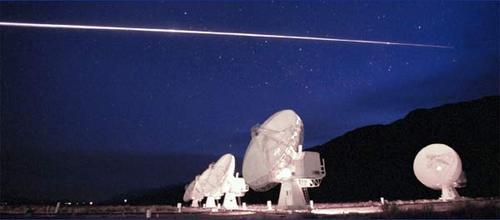
    NASA PHOTO: Final descent, Columbia streaking over the Owens Valley Radio Observatory in Big Pine, California

    Is spaceflight perilous? Or an unforgiving adventure?

    It is rather remarkable that NASA had launched men into space sixteen times during the the Mercury and Gemini programs without a casualty – although there had been some scary moments.

    Compared to the cramped and tiny Mercury capsule the Apollo command module was, in spaceflight terms, a luxury liner. So when a spark ignited the oxygen atmosphere of the Apollo 1 capsule on January 27, 1967 killing three astronauts it was shocking for both NASA and the public. The last communication from the Apollo 1 capsule was not revealed for a long time to the public:

    Fire! We’ve got a fire in the cockpit! We’ve got a bad fire…..get us out. We’re burning up…..

    The last sound was a scream, shrill and brief. After this nothing at NASA would be quite the same again.

    The fatal Apollo 1 fire was also unexpected. At the time of the fire the crew of Gus Grissom, John Young and Roger Chaffee were perched atop an empty Saturn V rocket involved in routine testing of the capsule control systems.

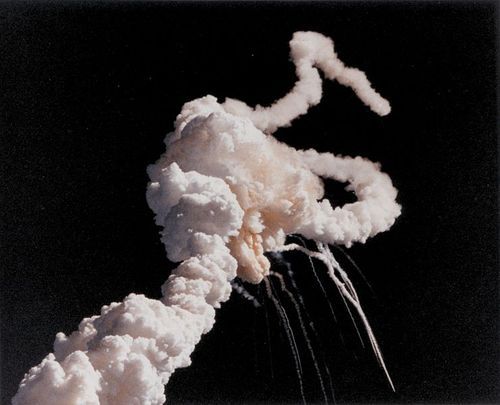
    The 1986 Challenger disaster was equally shocking – and far more public. The explosion 73 seconds after lift off claimed shuttle crew and vehicle. The cause of explosion was determined to be an o-ring failure in the right solid rocket booster. Cold weather was determined to be a contributing factor. The subsequent investigation and changes delayed the next shuttle launch to late 1988.

    image
    Space Shuttle Challenger’s smoke plume after its in-flight breakup, resulting in its crash and the deaths of all seven crew members. Photo credit NASA.

    You could say that space exploration in itself is not inherently dangerous. But to an even greater degree than aviation, it is terribly unforgiving of any carelessness, incapacity or neglect. Gus Grissom has been quoted as saying during the pioneering Mercury missions:

    If we die we want people to accept it. We hope that if anything happens to us it will not delay the program. The conquest of space is worth the risk of life.

    I’m not sure that Gus Grissom would have accepted these deaths as an acceptable risk of human spaceflight.

  • The Case for Neptune

    The Case for Neptune

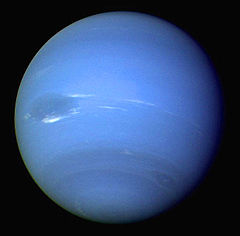
    Take a moment to consider Neptune. The eighth planet in our solar system, the planet farthest from the Sun, and the third most massive planet in our solar system.  Also one of the least visited, and consequently one of the least understood planets in our solar system. Neptune was discovered in 1846.  Forty years later, in 1886, astronomer Sir Robert Ball wrote ‘Besides this brief sketch of the discovery of Neptune, we have little to tell with regard to this distant planet.  With a good telescope and a suitable magnifying power we can indeed see that Neptune has a disc, but no features on that disc can be identified’.

    Unfortunately in the last 126 years not much has changed. Due to its enormous distance from Earth (~ 30 Astronomical Units) Neptune remains little more than a blurry disk in the eyepiece of the most powerful ground based telescopes.  In the past astronomers  studied Neptune by examining the planet as it occulted, or passed in front of the light of another object, usually a star, allowing scientists to calculate its diameter, chemical composition, and temperature.  The opportunity to study the gas giant only improved when Voyager flew by Neptune in 1989, and the Hubble Space Telescope was launched in 1990.

    Voyager 2 launched in 1977, and reached Neptune on the 25th of August 1989 (click here for an impressive animation of the Voyager 2 flyby of Neptune). Although Voyager 2 began imaging the planet from about 35,000,000 million miles out, most of the data we have today is from a 24 hour period, during which Voyager 2 passed 4,500 kilometres above Neptune’s north pole at an eye watering 67,000 km per hour.  During the trip to Neptune Voyager gathered about 5 trillion bits of information or about .5 of a Terabyte of data. That doesn’t sound much now, but back in 1977 the 3 computers on the Voyager spacecraft had a combined memory of 68Kb, so Voyager sent back almost 15 million times more data that could be stored in it’s memory!!

    Scientists were thrilled by the data from Voyager 2 and set to work learning as much as they could about the distant blue planet.  We learnt that Neptune is mostly composed of gas, is likely to have a rocky or metallic core, and that the majority of Netpune’s mass is hydrogen and helium, with traces of water, methane, ammonia, and other compounds.  Thanks to Voyager 2 we learnt an enormous amount about Neptune’s atmosphere, weather systems, magnetic field, moons, and ring system.  But that was over 30 years ago – and we now have more questions than answers.

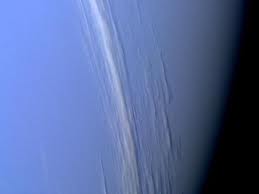
    Images from Voyager 2 showed that the most obvious feature of Neptune is its stunning blue colour, the result of methane in the atmosphere.  Voyager 2 also revealed a more dynamic and turbulent atmosphere than anyone expected.  Neptune’s atmosphere consists of layers of clouds, banded features, and unexpected structures, including what was termed the Great Dark Spot (GDS). Neptune generates the strongest jet streams anywhere in the solar system, reaching speeds of up to 2,400 kms per hour. Voyager detected weak auroras, similar to those on Earth, but because of Neptune’s complex magnetic field, the auroras appear over wide regions of the planet, not just near the planet’s poles.  Despite what we do know, the structure and composition of Neptune’s atmosphere remains poorly understood. What accounts for the relatively high percentage of methane and lack of hydrogen and helium? What is the energy source responsible for powering the incredibly high speed winds and variable storm systems? What happened to the Great Dark Spot (observed by Voyager in 1989, but no where to be seen when Hubble observed the planet in 1994). Why is the temperature of Neptune’s thermosphere, a staggeringly high 750K (4760 degrees celsius)?  How can Neptune be so cold and distant from the Sun, and yet radiate so much energy?

    Thanks to Voyager 2 we know that Neptune’s magnetic field is approximately 25 times stronger than Earths, and that it’s lopsided (like Uranus), at 47to the rotation axis and offset from the planet’s centre.  Although we suspect that Neptune’s magnetic field is generated by currents within Neptune’s icy mantle – we do not fully understand why Neptune’s magnetic field is oriented the way it is, or what processes could generate such an off-kilter magnetic field.

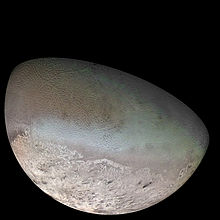
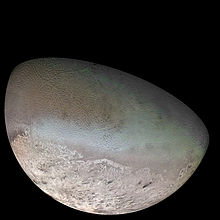
    Voyager 2 image of Triton (Credit Nasa)
    Voyager 2 image of Triton (Credit NASA)

    Before Voyager 2, Neptune was thought to have 2 moons, Triton and Nereid. Voyager 2 discovered 6 new moons, and since Voyager’s visit, astronomers have discovered a further 5 moons.  Most of what we know of Triton, Neptune’s largest satellite, was acquired in a single encounter by the Voyager 2 spacecraft, which imaged about 40% of its surface.  If scientists were surprised by the images from Neptune, they were stunned by the images of Triton.  Triton, is an icy moon with a surface temperature of -235o, the coldest place known in the solar system.  Voyager’s images revealed a geologically active planet, geysers spewing nitrogen gas and dust particles high into the atmosphere, rocky outcrops, canyons, and plains of frozen methane.  Triton has a very thin nitrogen atmosphere with small amounts of methane, above a scarred and cracked surface.  Triton showed no fresh impact craters, an indication of an active planet experiencing periodic resurfacing.  But there’s still a lot to learn. Perhaps the most tantalising questions are about Neptune’s largest moon.  Was Triton formed near Neptune, or is it a captured object from the Kuiper belt?  What is the composition of Triton, and what causes the geologic activity, and has the distribution of the ice geysers changed dramatically since the Voyager flyby?  Will further analysis of Triton tell us more about the solar system, and our place in it?  Is there a sub surface ocean? Could Triton harbour life?

    Earth-based observations during the 1980s suggested that there were a number of partial rings surrounding Neptune, and Voyager 2 discovered a system of equatorial, circular rings.  Although Voyager 2 gave us a good look at Neptune’s rings, the details of their composition is still uncertain, we don’t know how long they’ve been there, or even if they are stable.

    Despite the valuable insights bought to us by the Voyager mission, the Hubble Space Telescope and other studies, clearly there are still a number of questions about Neptune that still need to be answered. Technology has advanced enormously since 1977 and any new mission would be well equipped to examine Neptune, its rings and a number of its moons.  A mission to Neptune would enable us to learn more about our outer solar system, and exploration of Triton may provide our best opportunity to examine the surface and atmosphere of a Kuiper Belt Object in orbit around a planet in our solar system.  In 2003 NASA proposed a Neptune Orbiter/Triton Explorer, however, that mission appears defunct.  Neither NASA nor ESA have any current or future plans for the exploration of Neptune.

    I think that needs to change.

  • Is India a nation of geeks?

    Is India a nation of geeks?

    Angela Saini, in her book Geek Nation: how Indian science is taking over the world, wants to convince us that Indian science is taking over the world. Now any well read student of the physical and mathematical sciences will be able to provide you with notable scientific contributions. Even the Indian constitution abjures: “It shall be the duty of every citizen of India to develop the scientific temper”. Does “Indian science” exist, and if so what makes it special?

    First, pause and contemplate the following statistics. India is the world’s largest democracy: with a population over 1.23 billion (more than 1 in 6 of the world’s 7.14 billion total population are Indian). India has 415 living languages, with 22 having more that 1 million native speakers – 41% of the population speak Standard Hindi – India’s official language. Some states have their own language as the sole language; Maharashtra (capital Mumbai) has 72 million native Marathi speakers. There are 28 Indian states, the smallest Arunachal Pradesh has 1.3 million people, while the largest, the Hindi speaking Uttar Pradesh, has 199.6 million people, and includes the growing cities of of Lucknow and Kanpur. India is also birthplace to four of the world’s major religions, of which Hinduism has 80.5% of the Indian population as followers. India has a large Muslim following at 13.4% of its population, the third largest Muslim population in the world. Despite so many languages the 2010 adult literacy is 63%, with 8% internet users and a staggering 61 mobile phones per 100 of population. With an improved 88% having satisfactory water facilities only 31% of the population has satisfactory sanitation facilities.

    These statistics underlie what a competent revelation Saini’s book is. The diversity of topics is to be applauded. Saini has a breezy, almost whimsical style in introducing topics and providing Indian settings for an perspective of each topic.

    In particular I liked her mature handling of two hot-button topics: nuclear power and genetically modified foods. To many in the developed world energy and food security are lifestyle discussions – in India they are of life-and-death importance for many millions of the population, both now and the future.

    Saini manages a well-reasoned discussion of the energy option for India – looking in detail at one important option. A visit to the Bhabha Atomic Research Centre provides a first hand glimpse of India’s nuclear aspirations, and reasoning behind it. The ensuing discussion on the indigenous development of thorium based nuclear technologies was both fascinating and compelling. From an economic point of view this development would seem to be a necessity if India is to manage its growth and not burn coal and become a major polluter such as the USA or China. They see this as a crucial intermediate step to a solar energy future. My caution is that India is yet to sign either nuclear ratification or nuclear weapons non-proliferation treaties, a point the author fails to mention.

    Similarly a trip around the markets provides a great introduction into genetically modifies crops. India is by both legislation and custom a country of small rural-family run farms. These rural communities are poor and very much at the mercy of the elements. Saini presents a reasoned and sensitive discussion on the development of genetically modified crops (such as a long-life banana) that are relevant to ordinary Indians. There is a greater acceptance of these crops amongst the rural farmers than you first might imagine – provided they are cheap and preferably developed in India.

    In addition Saini provides a fascinating look at the development of tuberculosis drugs, the use of electronic documents to speed up the notoriously slow bureaucratic and legal systems of India, as well as electronics and information systems companies. We are taken to the Vikram Sarabhai Space Centre to get a first-hand update on the Indian space program and aspirations. Saini comments, “There’s something unimaginably ambitious about the speed and scale of India’s space programme, as if it’s no longer content fulfilling its early goals of sending up satellites so ordinary people could have colour television and cheaper mobile phone connections. Now it seems India has something else to prove.” With a successful first moon-shot India has established itself as a space power – only lacking a manned mission.

    In amongst all of this excellent investigation and examination there was one discordant section. “The mindreading machine” discusses a the use of an Indian lie-detector test based on brain wave measurements. The test has been used as legal evidence in cases, including one of murder, in Indian courts. Saini voices disquiet at this ‘science’ yet at no stage does she state the obvious – that this is not science. There are no theories supporting its claims, no peer review nor double-blind tests to give any credence to the claims. I expect that a science writer would point this out, explicitly; Saini doesn’t.

    Including this item in the book highlights a very fascinating aspect of what Saini sees as quintessential Indian science. Indian science nurtures the nutty, allowing questions to be asked and curiosity to be followed before they are shouted down by a conservative mainstream view of what is appropriate science. Interesting scientific and technological achievements aside this for me, is the book’s the defining point – India is having an impact far beyond the scientific statistics and measures. Saini’s book is a welcome and worthwhile look at the the idiosyncrasies and successes of the scientific and technological side of India. I’m not convinced it will take over the world, it will certainly influence and impact the direction of science and technology – that will be interesting to participate in.

  • Weekly Science Picks

    Weekly Science Picks

    The midlife crisis is more complicated than first thought. It might be time to stop blaming troubled marriages and feeling obsolete in a sea of younger colleagues. A study published in the Proceedings of the Natural Academy of Sciences has revealed that chimpanzees and orangutans also experience a midlife crisis.

    Having a midlife crisis may not just be the result of a troubled marriage or the thought that life may be halfway over. It might be part of primate biology. That’s right, hardwired into us.

    Economist Andrew Oswald told ABC Science that it might be beneficial.

    “Maybe discontent lights a fire under people, causing them to achieve more for themselves and their family.”

    A shiny new red sports car might just indeed lead to better things.

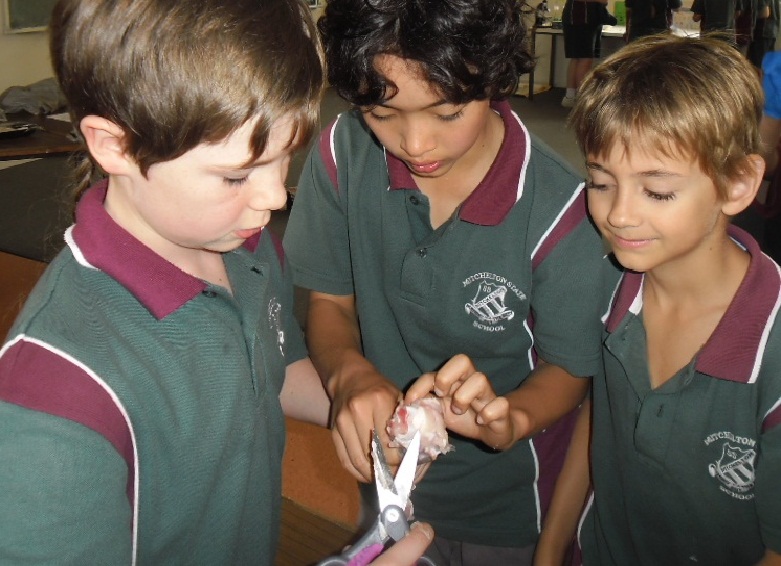
    Danielle Spencer runs a science club at Mitchelton State School in Queensland and explored where gender stereotypes in science began. Where does the perception that men do the “hard” sciences and women do the “soft” sciences come from? A group of 45 primary school students were surveyed and it was found that a majority of students thought that science was accessible to both genders.

    When asked why there are more men than women in engineering roles, the students responded with gender based answers like “Girls like dancing and other jobs.” and “Women are more suited to caring and developing jobs like childcare and nursing.”. There was no response that challenging this observation. This was despite 75% of the group thinking that science was accessible to them. It is disheartening to hear.

    Students were asked whether their science club should be split into a boys only and girls only science club, there was overwhelming support for a combined science club. There was an appreciation and acknowledgement that irrespective of gender, everyone had a valuable contribution. At the moment this cohort of students believe that science is something that everyone can do. The question remains though, how do we get adults to believe this?

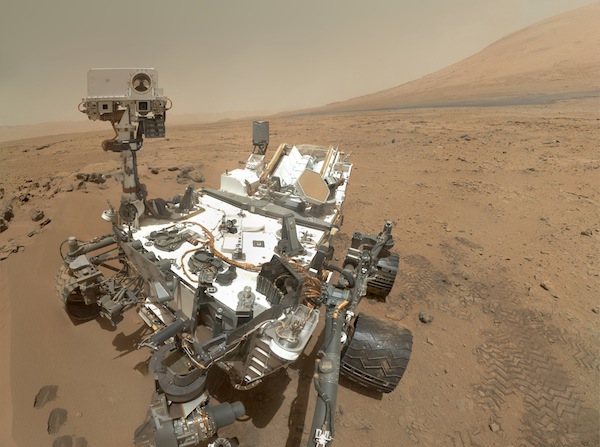
    As this week drew to a close, attention focused on NASA’s Jet Propulsion Laboratory in Pasadena, California. A story broke at NPR reporting that the Curiosity Rover may have found some exciting news. Project Scientist at the Mars Science Laboratory, John Grotzinger was quoted to saying:

    “We’re getting data from SAM as we sit here and speak, and the data looks really interesting.”

    SAM, the Sample Analysis at Mars  is a miniaturised chemistry lab. On board is a Gas Chromatograph, Quadrupole Mass Spectrometer, Tunable Laser Spectrometer as well as sample processing systems that allow heating and chemically treating samples. Normally these instruments would fill the space in a laboratory but on Curiosity it’s around the size of a microwave. SAM is being used to collect information about the past and present chemistry of Mars. As well as this SAM is also identifying organic and inorganic chemical molecules known to be important to life on Earth.

    So what has SAM found? Nothing has been confirmed but it does sound like there is something especially when Grotzinger says:

    “This data is gonna be one for the history books.”

    We will have to wait at least several weeks before NASA makes an announcement.

    New Zealand’s volcano, Mount Tongariro made it into this week’s news with an eruption on Wednesday. Luckily there have been no reports of damage or injuries. However, a group of travellers and journalists hiking at the time witnessed and filmed the eruption.


  • Weekly Science Picks

    Weekly Science Picks

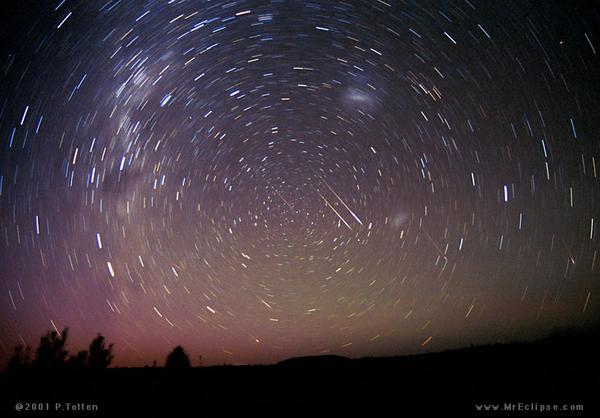
    Ah, the weekend! Time to kick back, relax, and look back over everything that’s happened over the past few days. And I’m rather happy to say that some quite interesting things have happened, including the Leonid meteor shower which peaked on Friday night (though if you step outside after dark and watch the sky, you may still see a few stragglers). So what else has caught my eye this week, science-wise?

    Well first off, the Curiosity Rover has been busy over on the planet next door. I can’t help but find everything about the Curiosity rover exciting, especially as it’s paving the way for actual manned exploration to another planet. As many people will agree, no matter how sophisticated a rover can be, it will never be as good as a team of properly equipped geologists exploring a site in person. As it turns out, this idea just came a step closer to being reality…

    Astronauts Could Survive Mars Radiation, Curiosity Rover Finds

    The findings demonstrate that Mars’ atmosphere, though just 1 percent as thick as that of Earth, does provide a significant amount of shielding from dangerous, fast-moving cosmic particles.


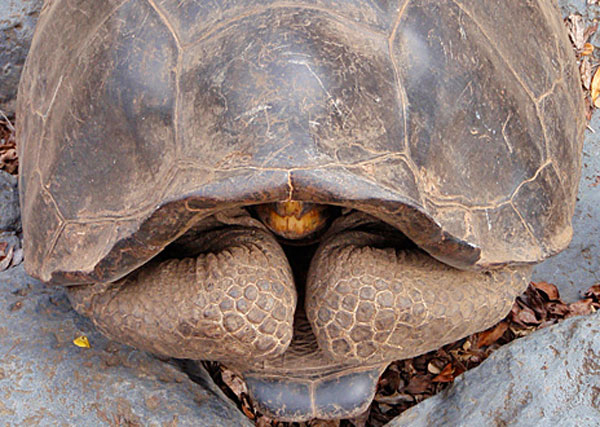
    Some people may recall the death of an aged tortoise nicknamed Lonesome George, so called because he was thought to be the last surviving member of his species. I know I do, and was rather saddened by it. While it may be an inescapable part of the way life on our planet works, there’s something quite humbling about being forced to simply watch a species go extinct and not be able to do anything about it. But then, was George’s death really the end of the story? As it happens, perhaps not…

    DNA tests show Lonesome George may not have been last of his species

    “These giant tortoises are of crucial importance to the ecosystems of the Galapagos Islands, and the reintroduction of these species will help preserve their evolutionary legacy,” said Danielle Edwards, postdoctoral research associate at Yale and lead author on the study.


    Lisa Grossman at New Scientist discusses the phenomenon of rogue planets – planets roaming interstellar space after being forcibly ejected from their home systems. It’s a concept which I’ve thought about in great detail in the past, as have many others, including astrophysicists, astrobiologists, and science fiction authors.

    Astrophile: Lonely planet roams with stellar outcasts

    The wanderers are no longer gravitationally linked, but they are headed in the same direction. “Like when you kick a clod of sand, the grains don’t stick together anymore but they have the same common motion,” Delorme says.


    In chemistry, I’ve always held a certain fascination with noble gas compounds. Molecules formed from atoms which aren’t supposed to react and form molecules always seemed rather exotic and curious. Several of these compounds have been predicted involving Xenon, one of the heaviest noble gasses. And there may be a lot of Xenon trapped inside the Earth this way…

    Professor predicts stable compounds of oxygen and ‘inert’ gas xenon

    “In addition to providing a likely solution to the missing xenon paradox and clarifying essential aspects of xenon chemistry, our study may result in practical applications,” says [Artem R.] Oganov. “For example, the ability of xenon to form strong chemical bonds with oxygen and other elements, and to be trapped in crystalline defects, suggests their use as non-classical luminescence centers and active sites for catalysis”.


    And to end on a humourous note, XKCD wrote a comic this week describing the Apollo Spacecraft and Saturn V rockets using only the 1000 most commonly used words in the English language. The result was slightly hilarious and rather enlightening about how often writers like myself use words which aren’t in that top 1000. A testament to XKCD’s popularity is how many people in the online space and astronomy communities mentioned it – including at least one astronaut!

    xkcd: Up Goer Five

    Lots of fire comes out here. This end should point toward the ground if you want to go into space. If it starts pointing toward space you are having a bad problem and you will not go into space today.


    Hope you’re having a good weekend!


  • Setting up a science club in a primary school: Why you should!

    Setting up a science club in a primary school: Why you should!

    Last week, I dissected a chicken leg and while many may believe such a thing is not extraordinary having done it so many times, the ordinary became the extraordinary when I saw it through the eyes of a child in our recently established science club.
    The research on extra-curricular clubs is growing and with it there is mounting evidence of the benefit to students. In 2010 Blomfield and Barber from Murdoch University published an article which asserted that “Extracurricular participation was positively associated with higher academic track enrolment, university aspirations, and school belonging, and negatively associated with skipping school

  • Interview: Keri Bean—Mars meteorologist, Curiosity Rover team member

    Interview: Keri Bean—Mars meteorologist, Curiosity Rover team member

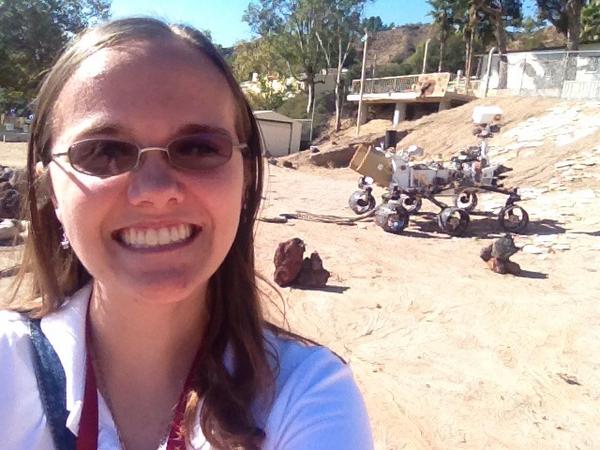
    Keri Bean in the NASA JPL Mars Yard, with the Curiosity test-bed twin ‘Maggie’

    Keri Bean is a meteorologist specialising in the atmospherics of other planets. She is on the team operating the Curiosity Rover for NASA’s Mars Science Laboratory mission. Prior to MSL, Keri has had roles in the missions for other Mars rovers Spirit and Opportunity, a prototype Moon rover, the Phoenix Mars Lander, and the Hubble Space telescope. And she’s just 25 years old! That’s a pretty incredible CV to rack up already.

    In this interview, Keri talks with me about her work on MSL and the other missions, plus how and why she got into space science. It all started when a tornado hit her pre-school.

    Australian Science on SoundCloud.

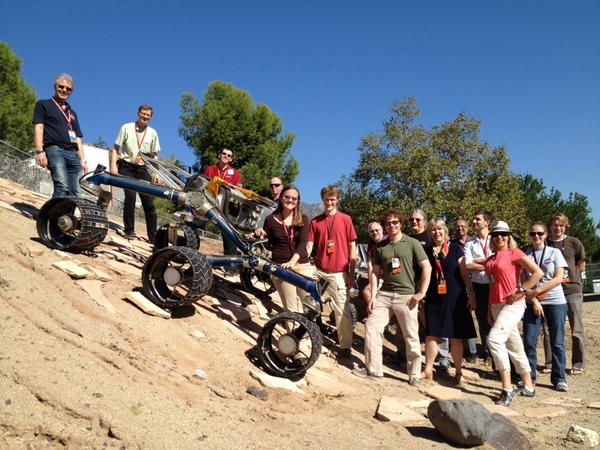
    Keri (centre) with many of the MSL team and ‘Scarecrow’, the other Curiosity test rover (Scarecrow is lighter than Curiosity so that it mirrors the lower Mars gravity).

    A GIF of the partial solar eclipse by Mars moon Phobos, as captured by the Curiosity rover—an image capture task coordinated by Keri.

    A photo of Phobos (highly zoomed it, and hence quite grainy) taken by Curiosity just after dusk on 21 September using one of its Mastcams, showing its ‘potato’ shape.

    The ‘Chariot’ Lunar rover prototype for which Keri worked on camera design (and which James May managed to have a minor accident with when filming an episode of Top Gear!).

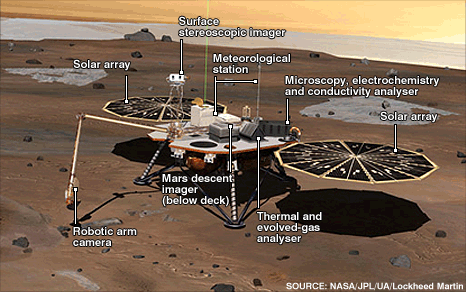
    The Mars Phoenix Lander.

  • Weekly Science Picks

    Weekly Science Picks

    It seems the rate of everything has increased exponentially. A very bold, vague, yet intriguing statement, you might say.

    During the course of the past 2 weeks, Hurricane Sandy devastated the East Coast of America, followed closely by a nor’easter. So my science picks for this week center on the themes of natural disasters, planning, global warming and Space, and the rate of which we have to increase our thinking and innovation in order to get ahead of these issues, before they become serious problems.

    So let’s get started.

    I was out of town when Hurricane Sandy struck. My neighborhood in Brooklyn was pretty much untouched. While I heard reports from friends not having power, and subways and airports being closed, it wasn’t until watching the hurricane relief telethon that I realized the magnitude of destruction. And I chose the following article by our very own Charles Ebikeme because it is important to remember that Haiti has yet to recover from several rounds of natural disasters. The U.S. will rebuild. Considering a large portion of the Haitian population still remains housed in tents from the earthquake, will they be able to rebuild? Before the next natural disaster strikes?

    Sandy’s aftermath by Charles Ebikeme

    While most of the focus of western media centred on the damage Sandy caused in America, especially this close to a Presidential election; there were few news outlets that reported what had passed in the Caribbean — outside the death tolls and damaged infrastructure. Indeed, as it is becoming more and more apparent, it is always the blogosphere that provides an adequate source of information. Hurricane Sandy’s progression was followed by bloggers on the ground, giving another side of the story we don’t often get to see.

    But it is in Haiti, a country that has yet to recover from tropical storm Isaac that hit in August of this year, as well as the earthquake of 2010, that felt the worst of Sandy’s wrath. 1.8 million people in Haiti are affected by the storm, according to the United Nations relief agency.

    This next story appears in the current issue of Scientific American and drives home the point why immediate action on climate change, energy and planning (community planning) is necessary to attempt to prevent incidences such as Sandy, or at least lessen the amount of destruction as much as possible. Obama won re-election this week. And while there is no shortage of issues to tackle, the President needs to implement an energy policy for this country. And it’s called global warming, so I hope the world can come together within the next four years and knock out a sound plan.

    Global Warming: Faster Than Expected? by John Carey

    The potential for faster feedbacks has turned some scientists into vocal Cassandras. Those experts are saying that even if nations do suddenly get serious about reducing greenhouse gas emissions enough to stay under the 450-ppm limit, which seems increasingly unlikely, that could be too little, too late. Unless the world slashes CO2 levels back to 350 ppm, “we will have started a process that is out of humanity’s control,

  • Tasting colours and seeing sound: Synaesthesia

    Tasting colours and seeing sound: Synaesthesia

    Kandinsky: “Composition 8”

    One hears a sound but recollects a hue, invisible the hands that touch your heartstrings,

  • Weekly Science Picks

    Weekly Science Picks

    With the exponential growth of scientific research, there were a plethora of articles which could have been reported this week. A few that caught my attention are listed below.

    A Future of Genetically Superior Humans

    On Wednesday it was reported that geneticists have moved into an area of research previously believed to be highly unethical. Researchers at the Oregon Health and Science University took steps to prevent women from giving birth to children with genetic diseases. “That kind of genetic engineering has been ruled off-limits,” says Marcy Darnovsky of the Centre for Genetics and Society. As the Dartmouth bioethicist Ronald Green mentions, this kind of research could lead to generations of genetically superior humans. A concerning concept, I’m left with visions of the novel Brave New World by Aldous Huxley warning of such actions. http://www.npr.org/blogs/health/2012/10/24/163509093/geneticists-breach-ethical-taboo-by-changing-genes-across-generations

    The Dangers of Pumpkin Carving

    In light of Halloween this Wednesday
    , this article caught my attention as families throughout Canada and the USA begin carving pumpkins in preparation for this spooky holiday. “Even with optimal treatment, injuries from pumpkin carving accidents may leave people with compromised hand function,

  • Open Access Explained!

    Open Access Explained!

    We wrote about Open Access many times: here, here, here, here, and here, and since it’s Open Access week everywhere in the world- it is good to be reminded what is OA – Open Access. This time Nick Shockey and Jonathan Eisen take us through the world of open access publishing and explain just what it’s all about.


  • The Continuing Saga of the Genetically Modified Plant

    The Continuing Saga of the Genetically Modified Plant

    Mutant Fruits, Photo Source: Wikipedia

    GM (Genetically Modified) Foods

    “Jack! Did you see that potato move?! He’s a GM, that one, he’s sprouted eyes and I bet he’ll grow legs next! He’s gonna round up his buddies and take over the farm!

  • Payload

    Payload

    Source: http://www.payloadfilm.com/about/

    Science Fiction

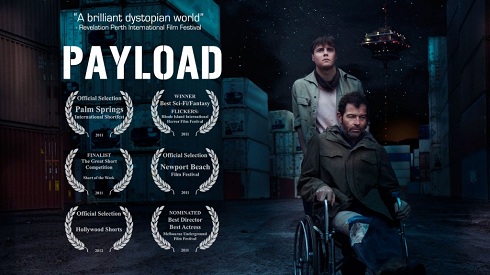
    This may not be the usual topic for a blog post normally displayed on Australian Science, but when our editor Danica mentioned she saw this great Aussie short and asked if one of us writers wanted to do a narrative, I jumped at it. The next 17:55 of my lunch break left me in awe.

    A movie doesn’t have to be a full length feature to have an impact or drive home a message. And Payload really packs a punch. There were so many messages; messages of a society that travelled down a drainpipe. Clarke’s Town is a place that would have just about every council of the United Nations mired in details and confusion and working round the clock. The issues raised in this fictional setting being human trafficking, prostitution, the sale of human organs or body parts, smuggling, security, poverty, gender, food, clothing, education… corruption is everywhere. You get a sense of normalcy among the Carter clan, but that normalcy is faced against the outside operations of a world that does not make sense,which is far bigger than the Carters. Sacrifice is the only way for survival.

    Clarke’s Town is a functioning spaceport, which is a character in and of itself in this story. This spaceport, this crawler, is painted as an escape to freedom and perhaps to normalcy – from dystopia to utopia. Is that why the mother never came back? Is Davinia “Dave” Carter now saved from what one can only suspect was to be a dreadful and despairing existence? Simon Carter may have been doing what he had to do, but he is Davinia’s hero. The main characters – Simon, Adam Carter (the father) and Kate Henshaw – each went through a visible transformation, almost a metamorphosis of sorts. They took what little there was of a moral high ground when it came to the reasoning of right and wrong (no matter how wrong). With Davinia, as she says goodbye to Simon at the spaceport, she leaves you with the thought that her transformation, her payload, is yet to come. I find it rather apropos the meaning of the name Davinia/David is “beloved”.

    I’m having a hard recalling when exactly was the last time a movie moved me as much as this little motion picture has. From the setting, to the haunting yet soothing tones of the music, it makes you think what society, our world, would be like without some of the resources we take for granted every day. More so, I think it makes you think about some of the countries, or communities, in this world just struggling to gain access to basic resources.

    Writer and director Stuart Willis mentioned extending Payload into a feature – set 10 years later when Earth is being evacuated. Will answers be given to the questions raised in the short? My synapses are already firing up hypothetical synopses. If there were a motion picture category for the Nobel Prize, I would say award it to Mr. Willis straight away.

    Watch the movie.