Author: Danica Radovanovic

  • The Best of Australian Science: July 2013

    The Best of Australian Science: July 2013

    It’s the time of the month once more, when we look back and and remind ourselves of July’s wonderful variety of science and technology stories, covering space, technology, health, environment, education, and more. I hope you’ll enjoy these stories.

    Contact us if you’d like to join our team of science and tech bloggers and authors – please read the Editor’s note.

    Until next month’s Australian Science review, stay curious and scientifically passionate.


    Australia’s evolving drug landscape by Charles Ebikeme

    Last month, the Australian Parliament was debating a bill on patent law and public health called the Intellectual Property Laws Amendment Bill 2013. It is said that the legislation gives Australian governments greater powers to exploit patents without authorisation from the patent owner via stronger provisions for Crown use and compulsory licensing. Perhaps something more along the lines of what Thailand enacted in 2007. Thailand played the global system to their advantage, exploiting a clause in the 1995 World Trade Organisation agreement on intellectual property that gives governments a large amount of freedom to bypass patents on drugs if they face any kind of health crisis. Read more>>


    Are Australians Really Getting Dumber? by Magdeline Lum

    The Australian Academy of Science has found that when it comes to science Australians are getting dumber in its latest report on science literacy. Compared to three years ago, less people in Australia know that the Earth’s orbit of the sun takes one year. Among 18-24 year olds 62% surveyed knew the correct answer, a fall from 74% three years ago. Other results would also send scientists into a tail spin of despair, with 27% of respondents saying that the earliest humans lived at the same time as dinosaurs, though an improvement from 30% of respondents in 2010 who thought this.

    What does this all say? If you take the face value of the press release and the ensuing media coverage, Australians are getting dumber.  I’m a scientist who dedicates a significant proportion of time to science outreach activities and announcements like this get sent my way. They get sent my way not because I moonlight as a science journalist but because people genuinely want to know what I think and feel about such a survey. Read more>>


      Could Australian Terrain Help Train Future Mars Explorers? by Elizabeth Howell

    How do you rehearse for a Martian space trip? Simulations can only bring astronauts so far when they’re figuring out a mission. A typical person training for the International Space Station can expect a combination of classroom work, spacewalk rehearsals in the water, and robotic arm training using articles that are very close to the real deal. Exploring another world is a complex problem yet again. Astronauts in the Apollo mission received hundreds of hours in geology training, for example, and flew to areas ranging from Meteor Crater in Arizona to the site of a huge crater in Sudbury, Ont. Read more>>


    Pluto’s new moons named: Spock still homeless by Kevin Orrman-Rossiter

    The dwarf planet, Pluto, can still generate plenty of public interest – if the naming of its two recently discovered moons is anything to go by. After their discovery, the leader of the research team, Mark Showalter, called for a public vote to suggest names for the two objects. The on-line contest, aptly named ‘Pluto Rocks!‘, concluded with Vulcan as the outright favorite, after aWilliam Shatner led push by Star Trek fans. The names Cerberus and Styx ranking second and third respectively.  The International Astronomical Union (IAU) has announced that the names Kerberos and Styx have officially been recognised for these fourth and fifth moons of Pluto. A decision that is probably correct, even if it proves not to be the most popular. Read more>>


    Talking Carbon, Talking Solutions – Australians Want Action by Kelly Burnes

    The issues of climate change and carbon pricing have been caught in a purgatorial pinball game over the past 12 months. No wonder there is confusion, doubt and general misunderstanding on climate change among the populace considering the political battle lines drawn between parties in state houses, parliament buildings and capitols worldwide. But a recent study put forth by The Climate Institute, titled Climate of the Nation 2013: Australian attitudes on climate change, seeks to elevate the dialogue. The authors of the report actually talked to people to get their views on climate change. They asked questions, they listened and they documented the responses. Perhaps politicians could add that tactic to their constituent playbook. Read more>>


     Pacific plant could be good news for anxiety sufferers by Markus Hammonds

    A clinical study on kava, a Pacific plant, has found that it has properties which could be extremely useful in treating the symptoms of anxiety. The plant has been used recreationally in Pacific societies, in places like Polynesia and Hawaii, for a long time but this is apparently the first proper clinical study of the plant.

    Now, I must admit, I’m writing this story because I have some anecdotal experience with kava (piper methysticum) myself. Simply, I’ve been an insomniac on and off for most of my adult life. It can be an inconvenience, but I mostly have it under control. Read more>>

    ‘Rockin’ it and learning and the same time’ by Danielle Spencer

    “Theory in science gets tricky.
  • The Best of Australian Science: June 2013

    The Best of Australian Science: June 2013

    This month, we’d like to welcome our new writer Elizabeth Howell, who’s brought us some fascinating contributions about space and astronomy. She joins us for another month filled with a plethora of interesting things! A wonderful variety of science and technology stories, covering astronomy, education, technology, health, environmental, and more.

    Stay curious and scientifically passionate and innovative!

    For those interested in science blogging and contributing to Australian Science – contact us and check out the Editor’s note.

    From fables to Facebook: Why do we tell stories? by Lauren Fuge

    Throughout human history, stories have existed across all cultures in all forms, from ballads, poems, songs to oral history, plays, novels. Some narratives have evolved along with the human species—we are consistently drawn back to ancient parables, fables and fairytales, constantly reworking them into modern contexts.

    Narrative is a gift unique to the human species, but how as it survived for so long? Is it a by-product of evolution or essential to survival? What drove us to painstakingly inscribe portraits on rocky walls in ochre and charcoal, to compose and listen to lengthy ballads of heroes’ tales, to nosily read people’s Facebook statuses about their day, to devour novels and films like we’re hungry for fictional worlds? Read more>>


    Could The Next Australian In Space Be A Paying Tourist? by Elizabeth Howell

    A flurry of press articles went out this week after NASA announced its eight new astronaut candidates. The agency touted these people, who range from doctors to fighter pilots, as a generation of astronauts that will at last be trained for missions beyond Earth’s orbit. The agency is eyeing the moon, and Mars, as eventual destinations for astronauts in the coming decades. The long-term plan for NASA keeps shifting every few years, but right now it is embracing a sort of “flexible destination

  • The Best of Australian Science: May 2013

    The Best of Australian Science: May 2013

    The month of May saw us publish a plethora of interestingness –  a wonderful variety of science and technology stories from within the fields of education, technology, space, internet technology, biology, environmental science, and more. We hope you enjoy them!

    For those interested in science blogging and contributing to Australian Science – contact us and check out the Editor’s note.

    All You Need is a Minute to Learn Physics, an interview with Henry Reich by Magdeline Lum

    I was skeptical when I stumbled on Henry Reich’s MinutePhysics Youtube channel one night. How could anyone explain light, The Big Bang or relativity in just minutes and be understood? I decided to watch one in the expectation that I would be sent to sleep. It was well past midnight. In the end, I didn’t go to sleep until after I had watched every MinutePhysics video in existence. I was hooked. It all started with an explanation of what fire is. Read more>>

    Quantum computing: Australian researchers store data on a single atom! by Markus Hammonds

    Quantum computers will work using quantum bits, or qubits for short, which are analogous to the digital bits used in computers like the one which you’re using to read this article. Recently, a team of engineers at the University of New South Wales (UNSW) has successfully demonstrated, for the first time ever, how a single atom can be act as a qubit, effectively showing the first step in building an ultra fast quantum computer. And they might just have created the best qubit ever made.

    A quantum computer is, simply, a computer which makes use of quantum mechanical phenomena to perform calculations.Well, I say “simply

  • Google’s Conversational Voice Search Activated on Chrome

    Google’s Conversational Voice Search Activated on Chrome

    If you remember the article Conversations with Google, you may recall it’s been predicted that the next mode of interaction with Google search will be natural language conversation where Google will be able to follow the course of the conversation and provide new results and suggestions. Well, as of this Wednesday it’s become a reality.

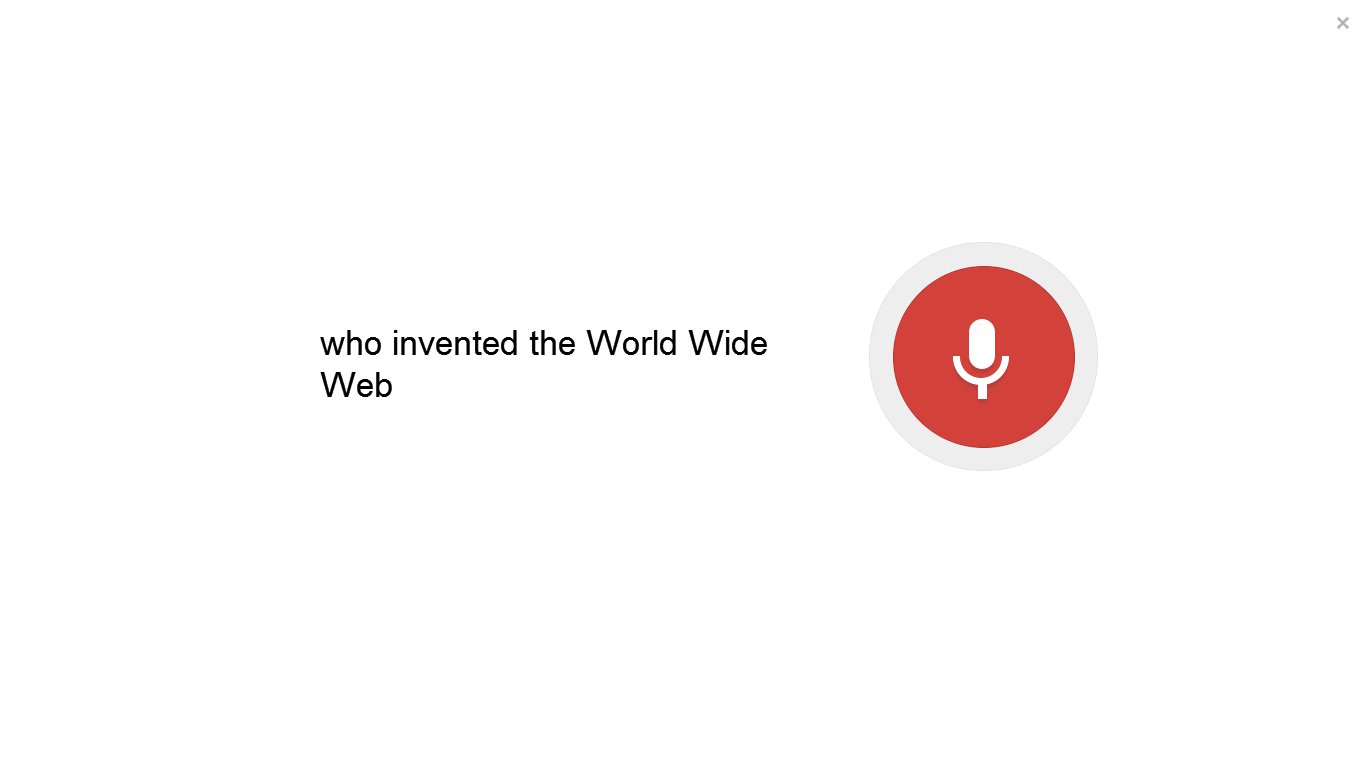
    Google presented conversational voice search at Google I/O a week ago. It’s a kind of search designed to be more like natural language and human speech than the technically constructed search inquiries that people use daily to retrieve information.  You can just click the microphone in the search box, ask your question in a natural way, and get spoken answers. Conversational voice search is not a Chrome desktop version of Google Now, even if it might look like that; it has none of the predictive answers that Google Now provides.

    The conversational search feature has a natural language and semantic search integrated into it, and after the initial testing yesterday while it’s far from perfect, it presents one of those significant changes. Speaking your search into the box is not a new thing, but having a conversation with the search engine  and being able to search by voice is what makes the difference in the human-computer interaction. And being able to speak a search inquiry and getting an answer read back to you is pretty impressive. The feature is similar to how the Google Search App works for the iPhone or Android.

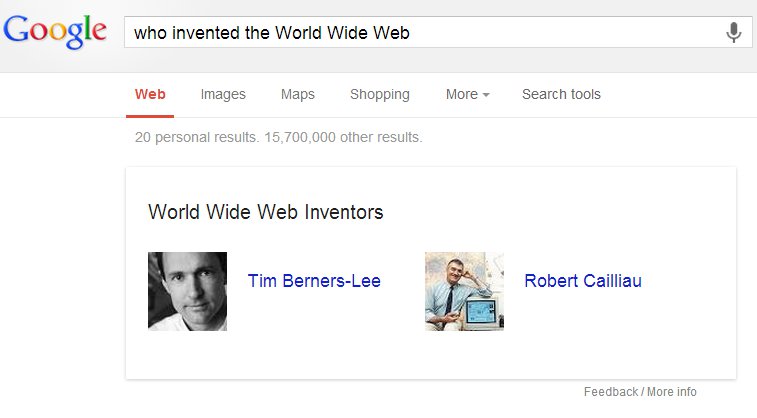
    As a test, I asked “Who invented the World Wide Web?”

    web

    The Chrome voice feature responded with correct answer, “Tim Berners-Lee and Robert Cailliau…”.

    web1

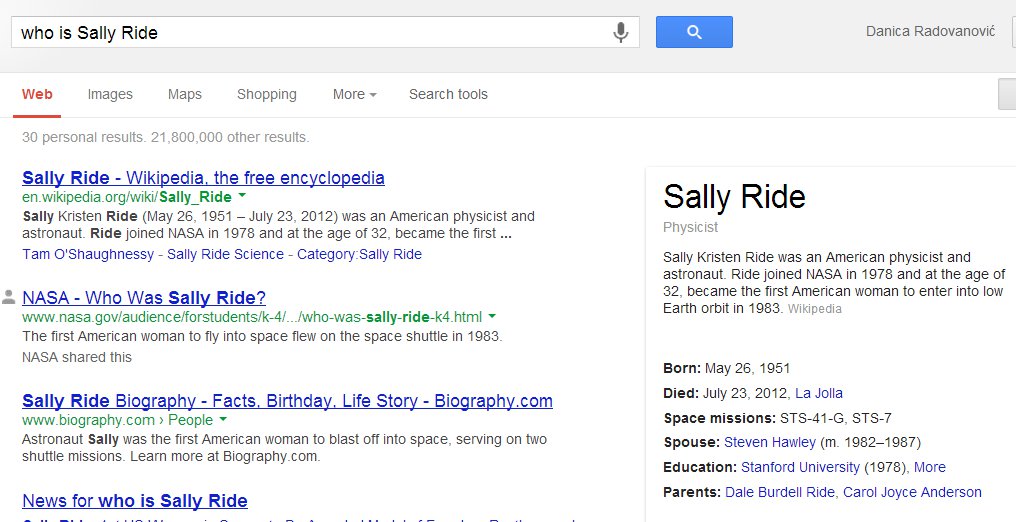
    Conversational voice search does not always work right as you go further on into a conversation. Chrome didn’t follow up with voice feedback on questions “Where the World Wide Web was invented?”. Other search inquiries such as “who is Sally Ride?” include voice feedback “According to Wikipedia…” and then Chrome provides a brief synopsis.

    ride

    For another test, a simple weather related inquiry, I asked, “What’s the weather like in Paris?” and then “Do I need umbrella for the weekend in Paris?”. I got back a full spoken report of today’s weather, along with a forecast for this weekend. What is really impressive is that you can continue with voice search by asking further questions in a way you could never do with regular search (i.e. you can use other references from previous inquiry).

    While not yet perfect, conversational search is still very appealing; we’ll see how this feature will be developed by engineers. The conversational search  question-and-answer feature is now available to users of  the latest version of Chrome 27 browser, which Google released this Tuesday.

  • The Best of Australian Science: April 2013

    The Best of Australian Science: April 2013

    It is time to recount April’s highlights, the most read and interesting articles from the month in the fields of science, education, internet technologies, space, and among others.

    If you are interested in science blogging and contributing to Australian Science – contact us and check out the Editor’s note.

    Until next month’s review,  stay curious, scientifically and artistically passionate. I hope you’ll enjoy these stories.

    A Supernova Post-Mortem in Radio Waves by Markus Hammonds

    Supernova which are close enough to see with the naked eye are rare beasts. This was, and still is, the only one close enough and visible enough to see properly with modern telescopes, giving us some of the best information we’ve ever had about how an exploding supernova interacts with the dusty interstellar clouds which surround it.

    The latest observations of this literally awesome event come courtesy of a team of astronomers working in Australia and Hong Kong, led by Giovanna Zanardo at the International Centre for Radio Astronomy Research (ICRAR). Using CSIRO’s Australia Telescope Compact Array in New South Wales, the researchers have published the highest resolution images of the stellar explosion’s aftermath ever taken. More>>


    The CO2 Bargaining Business by Kelly Burnes

    Does anyone think this 2-degree goal is achievable? You know, that we can keep global temperatures from increasing 2°C? It’s time to admit that it cannot be. It’s time to set new goals. Goals not based on single-digit bargaining at the next climate convention. Some of the world’s nations agreed to limiting global warming to 2°C (3.6°F) over pre-industrial temperature levels four years ago; a voluntary goal. Our approach to tackling climate change has been to put, what seems to be, arbitrary limits on CO2 emissions while not seeking to take accountability for the issues causing those emissions. This goes for both the developed world and the emerging market economies. More>>


    New light on dark matter: space station magnet attracts praise by Kevin Orrman-Rossiter

    The visible matter in the universe, such as you, me, the stars and planets, adds up to less than 5% of the universe. The other 95% is dark, either dark matter or dark energy. Dark matter can be observed indirectly through its interaction with visible matter but has yet to be directly detected.

    Cosmic rays are charged high-energy particles that permeate space. The AMS is designed to study them before they have a chance to interact with Earth’s atmosphere. An excess of antimatter within the cosmic rays has been observed in two recent experiments – and these were labelled as “tantalising hints

  • The Best of Australian Science: March 2013

    The Best of Australian Science: March 2013

    Another month behind us with plenty of interesting and intriguing articles written by Australian Science authors, bloggers, and researchers, and it is time to recapitulate the most read stories and share them with you. I hope you’ll enjoy these articles.

    Note: If you are interested in science blogging and contributing to Australian Science – contact us and check out the Editor’s note.


    Combating the rise of the superbugs: The health and scientific challenges of antibiotic resistance by David Borradale

    It’s hard to imagine the world prior to antibiotics, a world where even a deep laceration could frequently spell significant illness or even death due to infection. Thankfully, since the discovery of penicillin in 1929 by Alexander Fleming, we now have a range of potent antibiotics to treat many of the various types of bacterial infection.

    There is a problem though, bacteria are great survivors and have been competing against other bacteria and microorganisms for billions of years. As  Professor Matt Cooper from the University of Queensland  puts it “Billions of years ago, bacterial species were engaged in an arms race against each other and the chemicals they developed to kill one another have been modified into today’s antibiotics

  • Work, Play & Learn! Using libraries for Social Learning, Impact and Collaboration

    Work, Play & Learn! Using libraries for Social Learning, Impact and Collaboration

    The digital information and knowledge paradigm in the 21st century requires skills such as digital literacy, critical thinking, problem solving, skills in communication, and collaboration for overcoming present social and digital inequalities. Those skills go beyond pure technological affordances and they could easily be obtained through collaborative learning practices and social interaction between individuals from different backgrounds and areas of expertise.

    Libraries, as environments for social learning and collaboration, present facilitators of education and knowledge. With accelerating dissemination of information in a digital age, libraries emphasise their activities on providing an information commons. In other words, an informal interactive learning place that encourages its visitors to communicate, contribute, participate, and engage with the library. This new dynamic leads towards a collaborative, social construction, and sharing of information and knowledge.

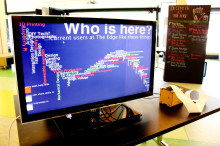
    One of the researchers at the Urban Informatics Research Lab at Queensland University of Technology (QUT), interaction designer and interactive technology developer Mark Bilandzic, explores how informal learning environments can support the social side of learning, as well as how smart space technology can be designed to enhance social learning among users? As a part of Bilandzic’s research, he designed a system with the purpose of enhancing awareness of opportunities for social learning and collaboration – called “Gelatine

  • Best of Australian Science: February 2013

    Best of Australian Science: February 2013

    February brought many exciting events, visits, conferences, interviews, and a bevy of intriguing articles written by Australian Science writers/authors. It is time to recapitulate that enthusiasm here and share with you highlights from the month in the fields of science, education, internet technologies, space, and among others.

    If you are interested in science blogging and contributing to Australian Science – contact us and check out the Editor’s note.

    Until next Australian Science month review,  stay curious, and geeky, scientifically and artistically passionate. I hope you’ll enjoy these stories.

    Women in Space – Valentina Tereshkova  by Sharon Harnett

    This article is the first in a series of articles in which I will profile every woman astronaut, cosmonaut and taikonaut who has been into space.  The last time I checked 58 women have travelled into space, by the end of this year there may be a few more!  We’re going to start this series at the beginning – with Russian cosmonaut Valentina Tereshkova, the first woman in space. Read more>>


    Could the next generation of electronics be made with graphene?  by Markus Hammonds

    One of the biggest potentials for graphene, however, is in electronics. As graphite (a naturally occurring mineral), carbon is semiconductive. Due to the way carbon atoms are arranged in this hexagonal pattern, it leaves some electrons free to move across the material in a way not entirely unlike the way the motion of free electrons allows metals to be conductive. However, pure graphite isn’t really very conductive. Read more>>

    Australia’s National Science Agency – Focused on the Future by Kelly Burnes

    Wanting to learn more about this group’s work and impact, I reached out toDr Stefan Hajkowicz, the Theme Leader for CSIRO Futures. This is our digital conversation about science, education, energy, and what Australia must do to secure its future.

    To our readers, if you have not done so already, check out the CSIRO Futures website for reports and projects to learn more. You’ll find some thought-provoking, fascinating topics guaranteed to make you put your strategic thinking cap on and get lost in a world of ‘what-ifs’. Read more>>


    Australian Science travelled to Canberra for the linux.conf.au (Linux Conference Australia) at the beginning of the month that brought plenty of interesting keynote speakers. For Open Source fans and advocates, don’t miss to read and listen to the interviews as well as the wrap up of the conference: Linux.conf.au 2013: ‘Nerdvana’ in Canberra. Interview transcripts are available with each article.

    Radia Perlman at LCA 2013 by Jessica Smith 

    Later in the week, I had the pleasure of heading off to lunch with Radia and a small group of fellow delegates during a break in technical sessions. She is engaging and thoughtful, and concerned as much with solutions for societal issues as solutions for thorny networking challenges. Radia is eternally self-effacing, and repeatedly claimed that she had “never done anything difficult

  • Connecting the Quantum Dots

    Connecting the Quantum Dots

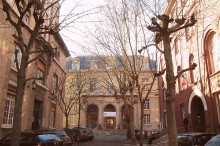
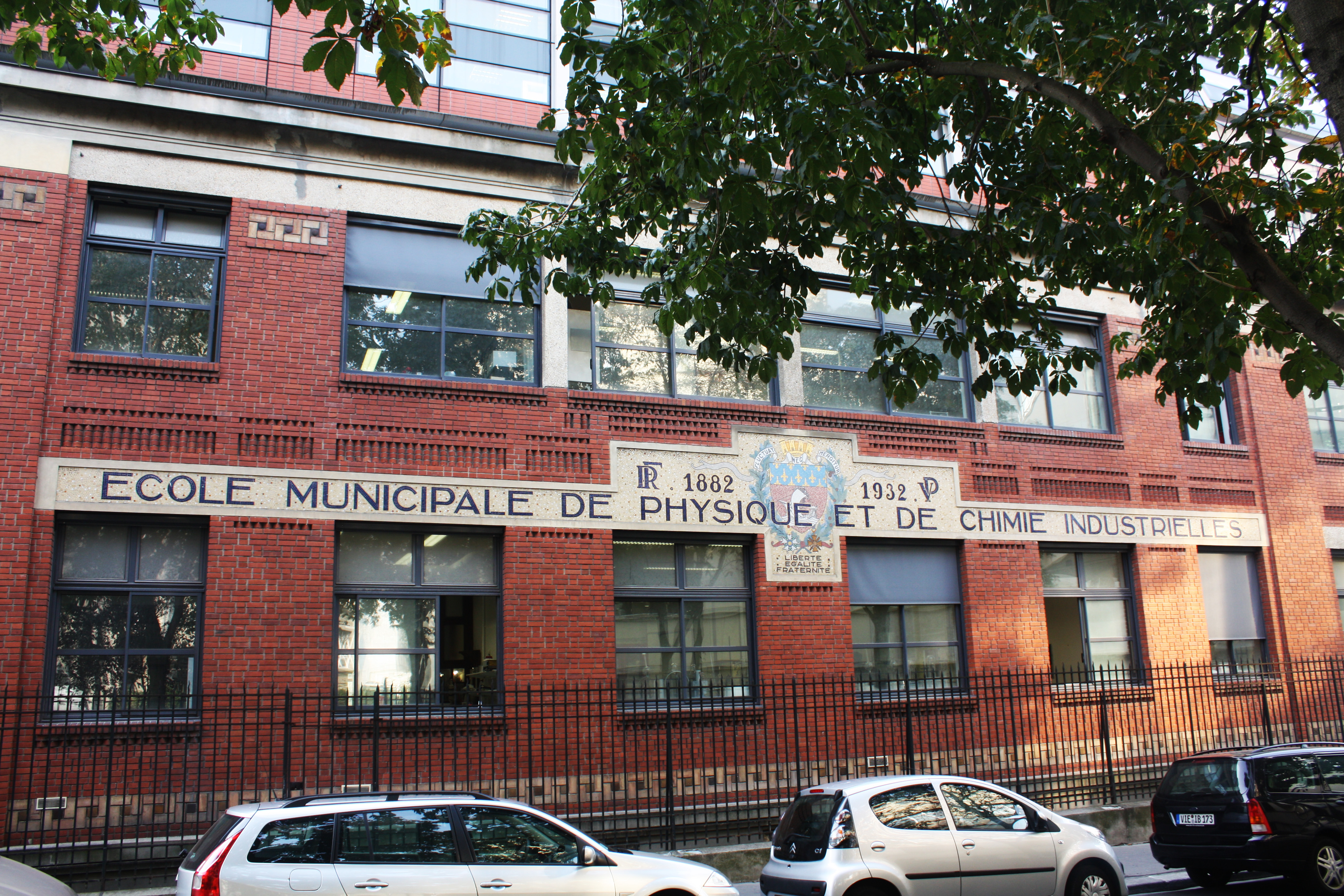
    Last week, after I spent a couple of days  in Brest, Brittany at a ESF, EU workshop/seminar brainstorming with other internet and scientific researchers on interesting topics related to  internet science and innovation,  I got myself back to Paris. I visited a French national institute with an international reputation for  scientific excellence – ESPCI (École supérieure de physique et de chimie industrielles) and the CNRS department of Physics, Quantum Foundations – a group dedicated to  research on quantum effects in materials. Also, I took the opportunity to meet up with two Australian Science writers who reside in Paris: Rayna, and Charles.

     ESPCI Paris Tech stands for Physics and Chemistry Higher Educational Institution (a French “Grande École d’ingénieurs”). Founded in 1882, ESPCI is a major institution of higher education – an internationally renowned research center, gathering  leading scientific innovators like Nobel Prize laureates Pierre and Marie Curie, Paul Langevin, Frédéric Joliot-Curie, Pierre-Gilles de Gennes, and Georges Charpak.

    ESPCI ParisTech
    ESPCI ParisTech

    At ESPCI, I met with Arjen Dijksman, a physicist and researcher interested in tiny semiconductive nanoparticles, known as “quantum dots

  • Best of Australian Science: January 2013

    Best of Australian Science: January 2013

    It’s the time of the month when it’s good to look back and be reminded of all of January’s wonderful science and technology stories. The beginning of the year is a time for new beginnings and regenerations, and a time to wrap things up and recapitulate an exciting month. I hope you’ll enjoy these stories. If you are interested in science blogging and contributing to Australian Science – contact us and check out the Editor’s note.

     2013: The Year to Come by Charles Ebikeme

    In 2013 expect the comet Ison to garner some column inches towards the back end of the year. In early 2013 October it will pass very near Mars and possibly be visible to rovers and orbiting spacecraft. The newly discovered comet could develop a spectacular tail, becoming as bright as the full Moon as it passes by our Sun. The comet is currently falling toward the Sun from between the orbits of Jupiter and Saturn. There is a chance it won’t survive this encounter. Whatever survives will then pass nearest the Earth in late 2013 December. Read more>>


    The Higgs: An Unexpected Boson by Markus Hammonds

    Physicists are interesting folk, and I’m sure some would be fascinated if this turned out to be something new. Fabiola Gianotti, director of the ATLAS experiment at CERN has appeared noticeably excited before by the prospect of new and unknown physics being discovered. However, the other thing about physicists is that by their nature, they need to be highly skeptical, particularly when it comes to their own work. Adam Falkowski, a Paris-based particle physicist, states what most researchers are probably thinking on his blog Résonaances – that the result is most likely due to a “a systematic problem

  • Weekly Science Picks

    Weekly Science Picks

    Last weekend in January brought exciting and interesting events, reports, and readings.  Monthly editorial is coming out next week, don’t miss wonderful readings written by Australian Science writers and bloggers. Enjoy in this week science picks, and have a great weekend!

    Library services in the digital age  – new report by the Pew Internet Research

    The internet has already had a major impact on how people find and access information, and now the rising popularity of e-books is helping transform Americans’ reading habits. In this changing landscape, public libraries are trying to adjust their services to these new realities while still serving the needs of patrons who rely on more traditional resources. In a new survey of Americans’ attitudes and expectations for public libraries, the Pew Research Center’s Internet & American Life Project finds that many library patrons are eager to see libraries’ digital services expand, yet also feel that print books remain important in the digital age.

    In the past generation, public libraries have reinvented themselves to become technology hubs in order to help their communities access information in all its new forms,

  • The Highlights of 2012

    The Highlights of 2012

    As 2012 draws to a close and the new year begins, now is a good time to wrap things up and recapitulate the year just passed. It’s been an exciting year with plenty of interesting happenings in science, technology, and education. Despite the fact that we aren’t especially keen on top 10 lists (because all of our authors are fantastic and inspirational), here are a few of the highlights from the past year. We hope you enjoy them!

    Mr Boson, I presume…? / A Brand New Boson

    The news that CERN had detected a signature matching the much sought after Higgs boson was the biggest news this year in physics. While physicists at the LHC still aren’t 100% certain what they’ve found, one thing is for certain – they’ve definitely discovered something never before seen, and it definitely seems to match what’s expected for the Higgs boson. Now it’s up to the theorists to work out if this will confirm existing theories, or if it will require brand new physics to be devised to explain it!

    “It’s a bit like spotting a familiar face from afar,

  • Best of Australian Science: November 2012

    Best of Australian Science: November 2012

    It’s the last day of November, my research project is getting into its final stage, and  here I’m wrapping up this exciting month with plenty of wonderful science and technology stories, events, and new sci-blogging contributors.  We have new female bloggers joining the Australian Science knowledge and sci-blogging community. The initiative I had in mind couple of weeks ago, to invite and encourage girls and women in science, technology, and education, is coming to fruition. We started a Women in Science section, encouraging young female scientists and bloggers to write, interact, and get their ideas and voice heard.
    Also, we started the new initiative called Education Thursdays (hashtag #EducationThursdays) where teachers and  curriculum leaders at different levels of education blog and write about their experiences and share their ideas on gender issues in science, STEM, participation, and engagement. I invite here, both students and teachers/educators, if interested, to write and join our team and, each Thursday, contribute and share with others.

    Take a look at the wonderful stories and articles on neuroscience, space, genetics, biology, environment,  astrobiology, cosmic evolution, physics, quantum mechanics, education, publishing, and technology. The best of Australian Science for November 2012:

    Tasting colours and seeing sound: Synaesthesia by Lauren Fuge

    One hears a sound but recollects a hue, invisible the hands that touch your heartstrings,

  • Best of Australian Science: October 2012

    Best of Australian Science: October 2012

    October was a busy month with plenty of events, meet-ups,  moving, research progress, writings, beautiful change of season, new members of the sci-blogging community, and other exciting things. Also, lot of wonderful writings by Australian Science authors, science bloggers, and new intiatives and design of the site that we are working on for some time now.

    Check out our great stories on astronomy, genetics, biology, environment, physical geography, seismology, genetic engineering, public policy, biodiversity, marine biology, oceanography, education, publishing, and technology. The best of Australian Science for October 2012:

    My mega grab-bag of astronomy resources for teachers, students, telescope beginners and space fans by Alan Kerlin

    Whether you are a parent, teacher, student or simply an interested enthusiast, here are a number of interesting sites, podcasts, and social media people for you to draw on as you get going in amateur astronomy. Podcasts provide an amazing resource – all free. Most are available via iTunes, the original publishers’ websites, or a raft of other podcast aggregators. There are very good apps to allow you to download podcasts to your smartphone for listening when suitable. Read more>>>

    For sale: One world class infrared telescope by Markus Hammonds

    The world’s largest and most productive dedicated infrared observatory just went on the market in an unprecedented attempt to try and prevent it from being shut down and dismantled. In a bold move, the directors of the United Kingdom InfraRed Telescope (UKIRT), based on Mauna Kea in Hawaii, have just released a prospectus detailing the telescope’s impressive achievements and capabilities in the hopes that they can find sponsorship and save the observatory from certain doom. That may sound melodramatic, but doom genuinely is the most fitting description. Read more>>>

    The evolution of human mortality by Charles Ebikeme

    How long until we live forever? The general consensus is that we are getting older and living longer. Despite consequences and kryptonite, it is getting easier to stay alive. Heaven can wait, it seems. Every year each baby born is expected to live 3 months longer than its predecessor of the previous year. This has been the case for the last 160 years. A stunning display of the ability we humans have to prolong the length of life. Read more>>>

    Ada Lovelace Day: celebrating women in science, technology, engineering and maths by Jessie MacAlpine

    In the 1800s, Ada Lovelace, an English mathematician, worked with inventor Charles Babbage on a plan for an “analytical engine.