Author: Danica Radovanovic

  • 60 second science: Engaging with the ‘Youtube Generation’

    60 second science: Engaging with the ‘Youtube Generation’

    Being one of the International judges for the International Science Video Competition, I have talked with Brendan O’Brien, the convenor of the  “60 second science“.

    What is “60 second science”?

    60SecondScience is a fully online International Video Competition sponsored by the Department of Education (DEECD-Innovation Next Practice Division), Victoria, Australia. Since its first iteration in 2008, it has enjoyed relentless growth and appeal, from 30 Victorian school-only participants, to over 300 science videos uploaded in 2011, with over 400 registering from 22 countries. The competition links directly to required student outcomes over a number of Science, Citizenship and ICT Standards. Valuable prizes are distributed each year, as determined by a prestigious International panel of judges.

    Why is this competition used in the Science Classrooms?

    Teachers can engage the interests and skills of students in a way that increases the depth of their science knowledge as they hone their multimedia skills.  Many of today’s students are an entrenched part of  the ‘youtube generation’ and are more than comfortable with being producers of content, whereas other generations were comfortable as mere consumers of content. Many students are ‘over’ powerpoint reports by the time they get to secondary settings, and are happy to shoot video on their smart-phones, flipcams, videocameras or webcams. The competition is easily adapted to be used not as an add-on, but as a contingent element within the existing science curriculum.

    How is this Video competition used in Secondary/High School Science Classrooms?

    A.     Teachers give students the option of making a 60second video to demonstrate their understanding of a topic or unit of work they are studying/researching in any area of the secondary science curriculum. Eg Newton’s Laws, The States of Matter, Forces, Chemistry. Projectile Motion, Chemical Bonding,  This is often done as an alternative to producing a written report, poster or Powerpoint.

    B.     Teachers give the student teams the option to make a ‘prac report video’ instead of the standard ‘written’ prac report. Eg. The Law of Reflection, Heart-rate, Thermal expansion, Displacement Reactions.
    In both cases, students are required to research deeply and collaborate closely to refine their understandings and condense their knowledge to convey their key concepts and ideas into the 60second format.

    Students work with their teacher on a particular science topic or integrated study unit, and produce a video over a number of weeks as part of their weekly routine. This can be used as a science teaching strategy at any grade level. E.g. Grade 1 Temperature, Grade 3 Capillary Action, Grade 4 Mould on Bread, Grade 6 Plant Osmosis

    How does “60 second science” support Multicultural Classrooms?

    The LOTE Divisions encourage entrants to use Languages Other Than English. Eg Chinese, French, Cantonese, Malayalam, Italian.

    There are several divisions such as International Open – for professional/amateur film-makers, teachers, non-school-age citizens, International primary / elementary school division, International secondary / high school division, International LOTE – with English sub-titles and spoken in a Language Other Than English; as well as the Best Cinematography – for videos in any Division, Best Animation – for videos in any Division and for the others. The ‘Winner’ gets a Certificate and an offer of free online video production and science workshop for teachers and students.

    You can register for the competition by 1 August 2012, and upload videos by 26 August 2012. Please find all other details and contact the convenor on the official web site.
  • Science Online 2012 – wrapping up the unconference

    Science Online 2012 – wrapping up the unconference

    The Science Online 2012 (un)conference on science and the Web is over. It gathered many bloggers, scientists, scholars, journalists world wide, actively engaging, interacting, writing, and communicating on science, social media, technology, art.  The conference offered numerous sessions throughout three days (January 19-21, 2012) on different topics ranging from Cybersecurity and Digital rights,  Dealing with Scientific Data to  Semantic Web, WikipediaTeaching Science Journalism in the Era of Social Media, Digital Preservation and Science Online. There were practical sessions on podcasts, creating eBooks, on art and science, and  Making Beautiful Maps.

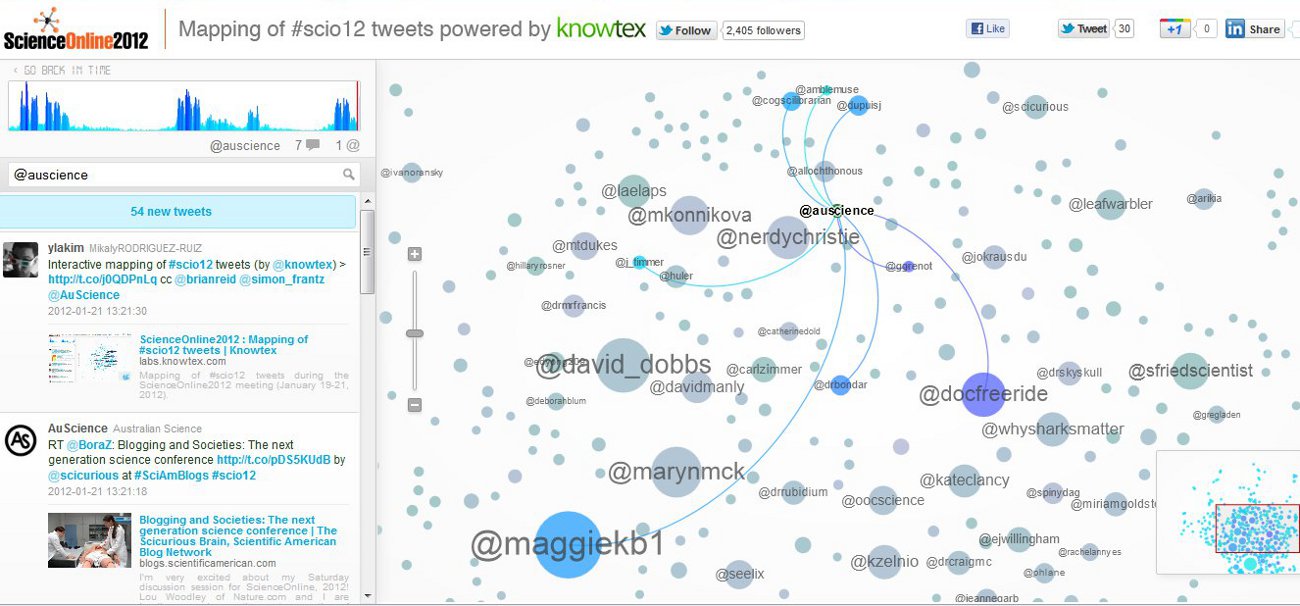
    We talked about the conference and the power of the scientific community earlier last week, and we have been live tweeting during the event, virtually, on our Twitter feed – Australian Science. You can check out the tweets with the hashtag  #scio12. There is a wonderful archive of scio12 tweets : 27,000+ total tweets from 12/26/ to 01/23.  Also, check out the beautiful visualisation of #scio12 tweets, an interactive map.

    There has been lot of interactions during the sessions and off sessions with the colleagues who were there, sharing impressions of the meeting and in between events as well as the reactions and blog posts on the conference. This is the list of all blog posts and articles about the conference, and media coverage.

    And Bora already announced ScienceOnline2013 planning wiki – Program Suggestions that already started to fill in with program sessions proposals.

    Selected interesting sources, videos and music mash-ups:

    #SciAmBlogs – the post-#scio12 blues

    Science Online 2012 #scio12 Photo/music mash-up

    Science Online 2012: Communicating with Images  (video)

    Science Online Youtube channel with #scio12 videos


  • Open access: Opening the Science

    Open access: Opening the Science

    Open access databases, archives, repositories are hopefully present, for almost a decade, in technology, education, science, and the iron gates systems are slowly behind us; we can say that the technology, science, and academia are striving to be more and more open.

    There is an international movement that uses the Internet to throw open the locked archives, libraries, online databases, information flow in general,  that once hid and restricted knowledge.

    One of the definitions of ‘open’ denotes ‘a piece of knowledge is open if you re free to use, reuse, and redistribute it.

  • ScienceOnline2012 – The power of the Scientific Community

    ScienceOnline2012 – The power of the Scientific Community


    I want to share some of my personal experiences from the past meetings of the Science online unconference as someone who have participated and attended the conference. I have attended Science Online twice: I have held a session on Open access e-resources in the networked world (2009) and held a workshop – Social Media for the Scientists (2010); interacted, being overwhelmed with positive energy, had wonderful conversations with  scientists, journalists, educators, bloggers, Web developers, and scholars.

    And it all started several years ago, thanks to the initiative and organization of Bora Zivkovic and Anton Zuiker, in Bora’s words:

    “…upon my return from a bloggercon of some kind, I was enthused by the atmosphere at the event and thought to myself how nice it would be to have something similar but with a focus on science. I posted my thoughts on the blog and received many enthusiastic comments and e-mails. But I did not really have a good concept or ideas how to actually make it happen.

    Enter Anton Zuiker. At one of our regular monthly blogger meetups which he organized at the time, Anton took me aside and suggested we work on this project together. It was do-able, he thought, if we did it smart.

    Several months later, the first conference became a reality.

    And people loved it and made sure we understood that this was not going to be a one-time event, but something we’ll have to organize every year. So we did.

  • WWW12 Conference: Transformation of the Social Web

    WWW12 Conference: Transformation of the Social Web

    This year the World Wide Web conference (or WWW12) is taking place in Europe (Lyon, France) . It was first conceived as an idea in 1989 by Tim Berners-Lee at CERN in Geneva while the first conference of the series was held in 1994. Ever since  then World Wide Webn has became an annual event changing location between North America, Europe, and Asia. The official keynote speakers are announced,  and we can expect interesting forum for researchers and practitioners in Web technologies to discuss and exchange positions on current and emergent Web topics.

    The WWW Conference series aims to provide the world a premier forum for discussion and debate about the evolution of the Web, the standardisation of its associated technologies, and the impact of those technologies on society and culture. The conferences bring together researchers, developers, users and commercial ventures – indeed all who are passionate about the Web and what it has to offer;  it is stated as the primary mission of the conference. The series provides an open forum in which all opinions can be presented, subject to a strict process of peer review.

    What is interesting for WWW12 is that this year the specific focus is the most important topics on a global concern in information-communication and web technologies in our society.  The focus is on the social evolution on how web changes our world (World Digital Solidarity), how to reduce digital divide and social inequalities using the web (remember previous discussions of mine on digital divides and what I said). Another is Web Accessibility initiative that aims on “web for all