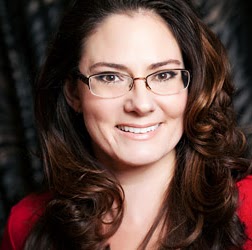
Joanne Manaster is a cell and molecular biology lecturer at the University of Illinois. She currently works as an online course developer and lecturer of science courses for the School of Integrative Biology. Prior to this current position, Joanne has taught histology, cell biology, and tissue engineering laboratories to biology and bioengineering students for nearly 20 years. Beside her academic career, she is a science writer and communicator, science video host, and STEM advocate. Joanne has run a girls’ bioengineering camp, and helped with the iGEM synthetic biology team and other outreach activities. She also makes video reviews of popular science books as well as whimsical science experiments with cats, cookies, gummy bears and make-up.
Welcome to Australian Science! Would you, please, tell our readers a little bit more about yourself? What is your scientific background, and your professional scope?
Thank you for asking me to join you!
I am a faculty lecturer at the University of Illinois. I initially started my college studies with plans to head to medical school but through my course of studies I found I really clicked with cell and molecular biology and was very adept at lab work. Through various opportunities, I also discovered I had a knack for explaining scientific concepts so eventually changed my path to teach at the university level. I studied muscle development at the microscopic level in grad school and eventually transitioned to teaching cell biology and histology.
How did you initially get interested in science? When did you start to express your curiosity for science?
I always loved nature and had a fascination with human health. I spent a lot of time in nature and did a lot of reading on science topics. I didn’t know any scientists. I knew they existed from reading textbooks, but the whole field seemed shrouded in mystery. However, I understood what doctors did and thought that becoming a physician would be a valid way to pursue my passion for science. As I mentioned above, it wasn’t until college that I realized how scientists did their work, and could then consider that as a career path.
It is interesting to mention that you are a former international model, back in the days of your adolescence. Did you find something scientific in the world of modeling and fashion?
As far as modeling goes, I was discovered while I was in high school. Initially, I wasn’t enthusiastic about it but realized it would be a great way to earn money for medical school. While I was modeling, I wasn’t thinking about it in any scientific manner as I was learning to interact with a very new and somewhat foreign world. It wasn’t until I completed my science training in college did I really start to see how science explained just about everything. In my course of teaching students, I also began to see the value in piquing their interest by talking about things they could relate to in terms of science, and that extends to my online outreach!
Would you tell us more about your role within executing online courses for current and future science teachers?
After many years of giving lectures and running laboratory classes which overlapped with my online outreach, I realized that I could apply my ability to communicate online to my instructing position so I transitioned to teaching cutting edge biology through my online program for middle school and high school teachers who want to obtain their Master of Science Teaching. I have designed and executed three courses for this program so far: The Human Genome and Bioinformatics, Evolution and Medicine and Emerging Infectious Diseases. I enjoy mixing primary scientific literature with popular science communication to both train the teachers and to give them resources for their classrooms. Teachers make the best students!
You have a very unique approach for science book reviews using video as a format for presentation, encouraging everyone to read. Other videos are an interesting and whimsical introduction to the world of science disguised in everyday items. How did you get inspired to make such videos?
Book reviews are a natural for me. I love to read and I love science! The gummi bear videos began from a question asked by one of my college students. He asked if a gummy bear could be liquefied through the process of sonication (using high frequency sound waves). I then considered how I could subject the gummy bears to other lab techniques!
One of my favorite videos is Cats In Sinks, which was inspired by a fun website that showed numerous cats in sinks and it made me think I could talk about theoretical vs. experimental science by trying to figure out how many cats could fit in my large lab sink.
I also really enjoyed using cookies as my models of blood cells to create a series about those cells called “Blood Cell Bakery
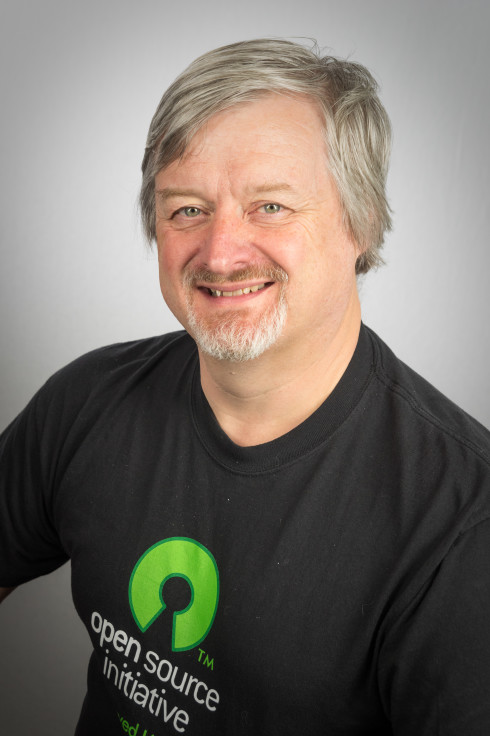
One could call Simon Phipps a real eclectic geek, having in mind his background and activism globally: from campaigning for digital liberties, open data, open source software and political transparency, through his columns at InfoWorld to presidenting at the Open Source Initiative.
Simon studied electronic engineering at the University of Southampton, after which he worked for IBM, being involved in introducing the Java programming language, then he was leading Sun’s open source projects for Sun Microsystems – where he also worked on open source licenses. When Sun Microsystems and Oracle merged in 2010, Simon joined ForgeRock startup as Chief Strategy Officer. Now, he heads his own consulting company, Meshed Insights Ltd.
He is the president of the Open Source Initiative (OSI) since 2012 – the non-profit organisation that advocates for open source software and builds bridges between open source communities and maintains the open source licenses. Also, he is a board director at the Open Rights Group in the UK and on the advisory board of Open Source for America.
Simon has been giving talks at many conferences on open source, free software, digital rights, etc. I had a chance to meet Simon couple of years ago in Oxford (UK), at the Transfer Summit conference on open innovation, development and collaboration, and ever since I’ve been following his work online and offline.
Welcome to Australian Science. Would you, please, tell our readers a little bit more about yourself? Where do you come from, both geographically and philosophically?
I’m originally from south London but have lived in Southampton for 35 years. I’ve been programming computers and making electronics since I was a teenager, with other interests in general science. I’ve always been fascinated by networks and the capacity for action at a distance, so my career has embraced many aspects of both.
Back in the days of Sun Microsystems, you were leading Sun’s open source projects, and later got involved in the Open Source Initiative. How did you initially get interested in open source software?
At one point I ran a company that helped programmers create and distribute software as Shareware. I realised most people who use software could be trusted to support the developers behind it; our business was successful as a result! That opened my eyes to the deeper reality that underlies open source software. If you remove the obstacle of needing permission to contribute, a community will naturally collaborate to create what they need individually and share it with everyone else. So when I arrived at Sun from IBM, I already believed that open source was a crucial part of the new society emerging because of the Internet. At Sun I was privileged to oversee the relicensing of pretty much the whole of Sun’s software portfolio, including Java, identity management, Solaris, and much more. The legacy we created is still important, especially the code that has ended up as LibreOffice and the ongoing releases of Java under the GPL.
Would you explain to our readers what do Open Source Initiative (OSI), beside promoting open-source software, do for the Internet, science, research, and academia?
OSI was formed in 1998 as the steward of the then-newly-coined “Open Source
Henry Story studied Analytic Philosophy at Kings College London, Computing at Imperial College, worked for AltaVista where he developed the BabelFish machine translation service, worked at Sun Microsystems on Blogging platforms and the development of the Social Web where he developed the decentralised identity and authentication protocol known as WebID, which is under standardisation at the W3C (World Wide Web Consortium). He contributed to the Atom syndication format at the IETF (The Internet Engineering Task Force), to the Linked Data Protocol at the W3C, and is currently writing an Open Source platform for co-operating systems in Scala based on all those standards.
Henry has been giving talks on the philosophy of the Social Web at the Sorbonne University, and various other places. We took a moment to have a conversation with Henry on very interesting topics – from the early years of the World Wide Web, first search engines, Semantic Web, metadata and ontologies, to the current initiatives within the Web Consortium (W3C), WebID Incubator group activities and its impact on the scientific research.
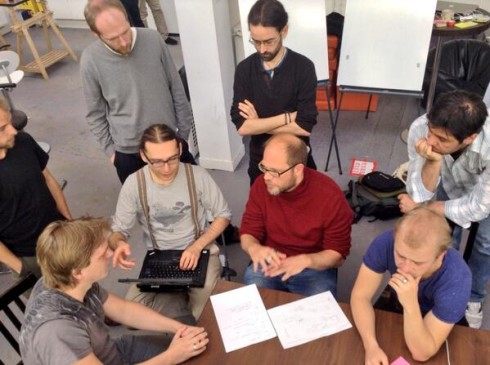
Henry in red at the OuiShare labs workshop in Paris in May 2014.
Welcome! Would you, please, tell our readers a little bit more about yourself? Where do you come from, both geographically and philosophically? What is your scientific background, and your professional scope?
Hi, thanks for inviting me over. My background is one that crosses frontiers: both geographic/national ones as well as disciplinary ones. I somehow found myself at the intersection of philosophy, logic, programming, web architecture, standards and social networks development and recently startup creation. Furthermore my work has been more and more about exactly this: how to help people co-operate across such disciplinary boundaries in a global open manner.
To help make sense of this tangle it helps to go back a little bit in time. My father is English and received his PhD in Washington DC, my mother is Austrian and a sculptor, and both lived in France where my father taught until recently political economy at the INSEAD Business school. That explains the geographical/national tangle.
INSEAD is also where I learnt computing on a DEC 2020 around 1980 as I was 13 or so. I wanted to ask the computer how to solve the Rubix cube. Of course I was told that it would not be that easy. I had to learn to communicate with the machine and learn how to ask the question. This lead me to learn the programming language Basic, and soon after that Pascal which was a revelation – no GOTO loops needing rewriting whenever a new line was added to the program – just procedures. So I wondered what could there be that was better. I discovered Lisp which made it easy to conceive of a program that could write itself, and from there the questions of Artificial Intelligence and so of philosophy started to open up.
I could see around 1984 the beginnings of the internet appear as I went to the Centre Mondial in Paris that had Lisp Machines available and connections to 4 different centres around the world.
But at the time computers were changing too quickly – I was stunned when I saw the 1984 Apple Macintosh in a shop window, and how it had left the terminal behind for just a graphical interface – so I decided to learn something which seemed more stable and took maths, physics and English literature for A levels (in the UK) and then later analytic philosophy at Kings College London, which was the philosophy that emerged out on the work by Frege and later Bertrand Russel of mathematical logic. I returned to computers to do a MSc at Imperial College later, where I learnt about Unix, Prolog, Agent Oriented Programming, Functional Programming, and Category Theory. At the time I was wondering how all this would come in useful. How would they tie up together? It turns out that in my work on building a distributed decentralised secure social web what I learnt in philosophy as well as what I learnt at Imperial College are all immensely relevant. Indeed in the last few years I have been giving talks on the philosophy of the Social Web at the Sorbonne, and various other venues that do just that.
At the time I did not know it. At Imperial College we had participated in the early stages of the Web. We were using Sun workstations, publishing web pages, and I even saw the birth of Java, the language that promised to allow one to write code that could run on every computer – a must for distributing programs on the World Wide Web. Its success was assured as it was released with Netscape Navigator in 1995. I learnt it, wrote a little Fractal Applet for my homework, put it on my web page, and flew to San Francisco to the first JavaOne conference. In the UK most job agencies had either not heard of the web, or had no access to it. But in California it was completely different. When I told a student at Berkeley about my Web page he asked me for the URL, had a look at it on the spot and suggested I go to the WestTech conference in San Jose. There were 400 tech companies there looking to employ young people – the biggest equivalent in the UK I had seen was a job fair with 40 companies. As I was about to leave a few days later I received a call from AltaVista the top search engine at the time which had indexed 50 million web pages (!) which was a lot at the time. The web was growing exponentially as every person who wrote a web page linked up to other web pages they found interesting hoping to receive perhaps a link back in return, and so make their page visible on the web. This turned every publisher into a web advocate. I went to the interview and got the job. Finally I was back in the US 28 years after I had left it as a child of 5.
This one is very interesting for those who remember the early days of World Wide Web and the first translation engines. In the 90’s you worked as a senior software engineer for AltaVista on the BabelFish machine translation service. What happened with BabelFish?
Yes, at AltaVista, Louis Monier one of the founders with Mike Burroughs, presented me with the project to adapt the Systran translation engines as a web service. Those translation machines had an old history. In the 1960s they were written in assembly code – the low level code machines understand – and had slowly been ported to C, a low level but more easily portable language which operating systems are written in. But they were not designed to be run on the biggest web service at the time, with potentially 100s of thousands or even millions of users.
As the translations were not always that good I played on this weakness by naming the machine babelfish.altavista.com, in reference to the character from the BBC Comedy Series «The Hitch Hikers Guide to the Galaxy»: a fish that when placed in a person’s ear could feed on brainwave energy and translate every known language in the universe. I pushed out a quick version, and it was immediately very successful. Then I spent a lot of time trying to write a more advanced version in Java, but the compilers at the time produced code that ran much too slowly. Finally around 1999 big speedups arrived making it competitive with C, and it was possible to launch the final version of the servers, and move up to a million or 2 translations a day.
AltaVista’s big advantage initially was Digital Equipment Corporation’s 64 bit machines, that were 10 years ahead of Intel, allowing massive and efficient indexes to be built. AltaVista started by fetching the initial pages of Yahoo a human built directory of interesting web pages, retrieving links to pages, then fetching those, and so on recursively. It would then index all the words it found allowing users to instantaneously find information on the web. Sadly AltaVista never was able to take full account of the links between the pages to help with the ranking. Google worked out how to use the information that each web page author published when he links a web page to another one, thereby voting for it in a sense. Using the collective intelligence of the World Wide Web, Google came to produce more and more relevant results, overtaking AltaVista in 2001 as the largest search destination in the World.
Furthermore AltaVista was constantly undermined by management changes. First it was bought by Compaq (which was later to be bought by HP), then it was sold to CMGI which popped in the dot com bust of 2001, was then bought by Yahoo, and finally Yahoo closed it recently. I left well before in 2000 to join a translation startup, then came back to Europe.
In the end these hand written translators were overrun by Google’s translators tuned by statistical algorithms working on massive amounts of published text available on the web or scanned from books.
Also, you’ve been working on the Semantic Web since 2004 at Sun Microsystems. Semantic Web explorations and practical implementations were so popular, what happened to Semantic Web?
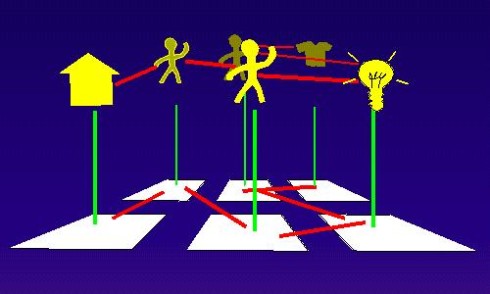
Tim Berners-Lee the inventor of the Web, first spoke of the Semantic Web in 1994 at the first World Wide Web conference, as a way to enable the web to not just be a web of linked human readable pages, but also a web of linked data. As the web was a hyper-text system, so the semantic web could become a hyper-data publication platform allowing people to connect data across organisational and national boundaries.
Tim Berners Lee’s www 1994 slide on the semantic web
The first RDF standards appeared in the period 1999-2001. Blogging, one of the first applications of RDF, was started at the end of the millennium, and growing at exponential speeds. Around 2004 I had some time for myself and decided to write a blog. I found that James Gosling – the father of Java – had written and Open Source blog editor called BlogEd. I used that, fixed some bugs in it, then adapted it with a local RDF store. As a result he offered me a job at Sun Microsystems which I gladly took.
Sun Microsystems was a great company that had produced in 1981 the first colour graphical work station running Unix, the internet operating system, based on open standards that had emerged from the break up of AT&T. In 2004 Sun was emerging from the dot com bust, and was facing strong competition from Linux, the open source Unix clone developed in a distributed manner by a world wide community of engineers, which powered Google’s servers since the beginning, and was making inroad everywhere. But Sun had produced some of the best technology around, created a huge Unix and Java community. The CEO Jonathan Schwartz in a bold move had decided to move all of Sun’s code Open Source to compete with Linux. He also allowed and even encouraged us to all blog online, so that we could present a human face of what was a research focused engineering company.
What did blogging add to the web? In short it allowed everyone to publish information and let others know through a syndication feed (RSS then Atom a.k.a RFC 4287, which I contributed to) to subscribe to their updates. This allowed increasing distribution of content publication, allowing everyone to get the latest updates from their preferred authors world wide without needing to wait for the search engines to index those pages, a process which could potentially take months to reach updates, as they had to crawl the whole web for content.
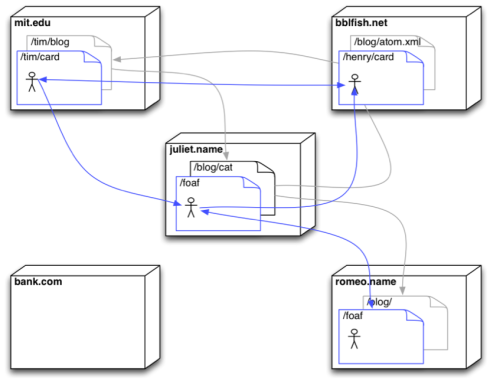
Another very interesting application of the semantic web was FOAF – the Friend of a Friend ontology, put together by Dan Brickley and Libby Miller, and that was evolving in a friendly open source manner through open online discussions. FOAF allowed one to publish one’s profile on one’s web server, and link one’s profile to that of one’s friends who also published it on their web server. So just as with blogging and the web, everybody could participate in a distributed social web.
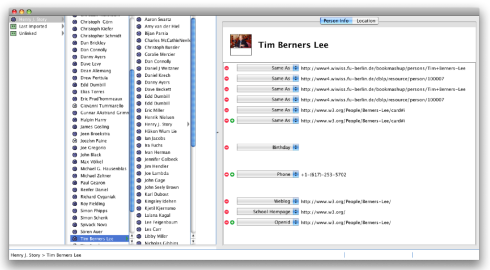
I wrote a distributed Address Book called Beatnik (take a look at this video), which made it easy to see how one could drag a FOAF profile from a web page onto the address book, and it would show you someone’s friends. You could then click on one of the friends to find their name, photo, contact information find out potentially where they currently were on the globe and follow explore their friends. All of this was totally distributed.
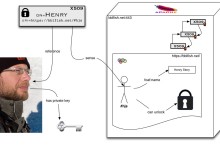
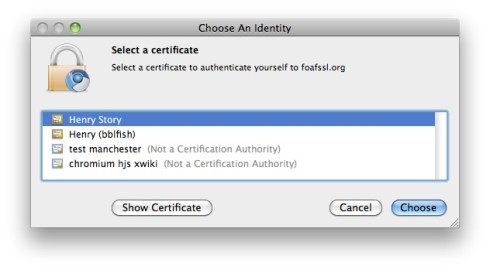
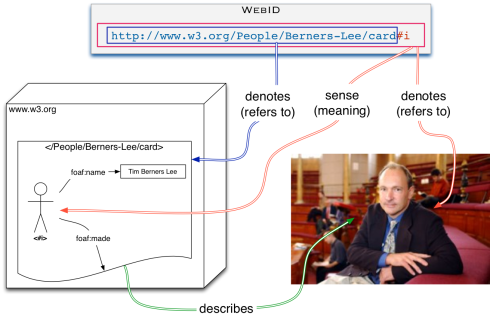
But at the time Facebook was starting to grow and people wanted privacy too. So the criticism I received was that this was all and good for publishing open distributed social networks but that one could not publish confidential information. To do that one needed a global identification system, so that one could connect to any web server one had never before gone to, authenticate with a global identifier, and be then given access to the resource if allowed. There was a standard for doing this that was gaining traction called OpenID, but OpenID was very slow requiring 7 http connections and required the user to type a URL in by hand. Having worked on large sites such as AltaVista this seemed to me very inefficient. I wondered if one could reduce those 7 connections down to one, while also removing the need for the user to even type anything. I asked around on the IETF mailing lists and by luck a few people answered, each one with a third of the solution. WebID was born. It allowed us to use TLS the security system used for commercial transactions on the web and built into every browser to enable authentication in one click to any web site securely using public key cryptography.
What we found was a beautiful hack to transform a system that was up to then used in a purely centralised manner, into a purely decentralised one. Usually client side certificates require one to have a certificate authority to sign the users information. This is expensive, cumbersome, not very flexible, and on the whole not even as trustworthy as it should be. WebID bypasses the certificate authority, and moves trust to the Social Web of published relations between people.
Would you explain to our readers a bit about the W3C WebID Incubator, for those in the science and technology who may not be familiar with the Incubator? Would you tell us more about your role within W3C WebID Incubator group?
We initially developed the protocol on an open mailing list called foaf-protocols. There we tested the ideas by listening to feedback from implementors from every walk of life. In a few years we had verified that this indeed could work correctly. We found the weaknesses in certain browsers and sent them bug reports. We slowly improved the description of the protocol. But as it became clear that it was workable and that we had nearly a dozen implementations we thought it would be time to go through a more formal process, and create a more formal looking document that would give people confidence in it. There the unofficial mailing list was no longer the correct venue.
Very early on I had sat down next to Tim Berners Lee to show him what we were calling at the time foaf+ssl protocol, and he immediately understood it even suggesting we use the name WebID. Tim had some of his students use it to work on developing a big picture of what this was leading to, which he called Socially Aware Cloud storage. So later when we asked him if we could have a space on the W3C to put together a standard for WebID. He approved completely. Nevertheless there are a lot of standards for identity competing for each other, and so this was a bit of a political mine field, and we settled for a low profile Incubator group status of which I am the chair.
Can you share with us some personal notes regarding the WebID Incubator, any challenges you faced along the way, and the outcome?
The beauty of WebID is its simplicity. So my role as the WebID Incubator group chair has been to try to keep it that way. I think small standards that do one thing well but that are designed to compose with other standards work best.
There was a lot of pressure by some folks who came in later to make things much more complex. Usually when one looks closer at those protocols, that complexity hides some centralising architectural presupposition, a number of security issues, or wishful thinking as to how things may work.
I did make a mistake initially by allowing myself to be argued into making WebID more general than it needed to be. It felt nice: it felt like we could have a standard that would encompass all identity systems. This is an easy mistake to make. It is one thing to design a protocol to make it easy to generalise, but it is another one to make it so general that it is difficult to implement. And initially what is needed is to keep it simple and clear so that implementors can follow a spec to write an implementation that works. Vendors often have an opposite need in that the more complexity they can manage the more they can distinguish themselves (they can tick more boxes on their software features set). This is where the rough consensus and working code mottos of the IETF and the W3C are key. A standard comes from having interoperable implementations written by different organisations that may not even know of each other’s existence. If nobody can implement the full standard, then it is not well specified enough.
So under the good advice of Tim Berners-Lee a couple of years ago we decided to return back to the roots and create two specs, one that defines what a WebID is independently of authentication, and another that defines the WebID over TLS authentication. This means that we can get WebID to work with potentially other authentication mechanisms such as BrowserID (now called Mozilla Persona) that was a rising star a few years ago, but has run into trouble because it only had the promise of being decentralised sometime in the future, perhaps….
It now ties in very nicely with a number of emerging standards at the W3C such as:
•The Linked Data Protocol: is a standard to turn the web into a read/write web that has been Tim Berners-Lee’s ambition since the beginning. It takes the best of WebDAV and the Atom protocols that came before it, but simplifies them by integrating them in the semantic web. The Linked Data Protocol is being worked on by IBM, Oracle, Fujitsu, and a number of other companies. I represent Apache there, and probably had one of the first implementations of it, which I worked on with Alexandre Bertails of the W3C that was part of a proof of concept that led to the formation of the Working Group.
•Web Access Control: is a simple ontology and a pattern of linking a resource to it so that a client can (if allowed to) work out who has access to a resource and edit (using LDP) the access control rules which are themselves expressed in RDF. Authentication can be done with WebID over TLS, or other methods. This is still just a wiki page but it has a number of implementations.
Finally, what are you currently working on? Where do you see this leading to? How do you see this impacting the scientific research?
We have now the standards to build a platform for distributed creation, edition, and protection of any kind of information resource be it textual, image, video or data on the web, in way to allow the whole world to connect in ways only dreamed of until now. This of course opens up huge spaces of possibilities in every field.
We have built an implementation of this in Scala, a very interesting programming language that compiles to Java byte code or to JavaScript (with Scala-JS), available under an Apache licence on the read-write-web GitHub repository.
Scala is multi-paradigm programming language that mixes Object Oriented and Functional concepts, which in a world where Moore’s law can only continue progressing through parallelization is becoming essential. Consider that Sun’s latest CPU the T5 cpu contains 16 cores for a maximum of 128 threads per processor, for a total of 1024 on an 8 socket system. Old style Object Oriented programming with mutable objects requires complex systems of locks that are prone to dead-locks. Here mathematical programming which is what functional programming is all about is the cure. By working with non mutable data structures (objects) in a functional way that composes – hence the importance of Category Theory which is the study of such composability – one can guarantee that code can be parallelised.
With the advent of LDP+WAC+WEBID we now not only have paralellisation inside one CPU but now across organisations, where our servers potentially have to communicate constantly with 1000s of other servers. Here again the functional nature of Scala makes asynchronous programming vastly more efficient than traditional thread based programming, saving GB of RAM just to process connections on the internet.
With the advent of Scala-JS we can now envisage writing code that works inside the web browser as well as on the server. So we have now come to build a fully distributed agent platform with declarative and inferential semantics (RDF), speech/document acts (LDP) powered by functional programming languages, bringing together all the fields that I had studied twenty years ago at Imperial College in London.
This platform will allow researchers to connect up seamlessly, link up different data sets together, tie articles to the data sets they were based on, link research up with enterprises, banks, governments and individuals in a seamless manner, whilst still always allowing divergence of opinion and subjectivity to remain, and without the very real danger of polical/economic control that centralised networks present.
The big project is now to re-build all the tools that we have to work with this platform, to create easy user interfaces that need to be aware of the subjectivity of information, so as to allow anybody to always ask about any piece of information: where did this come from? Who said it? What was it the logical consequence of? It should be possible to take different points of views on data: skeptical, trusting, etc… to see what kinds of possibilities are entailed by it.
At present we are busy building a platform for co-operating systems using all the above mentioned standards and tools. The platform is open allowing students, researchers or anyone else to join us on the read-write-web project. We are already working with non-profit organisations such as the French Virtual Assembly that are connecting a number of non profit actors in a network based on a concept they call ‘pair to pair’ where pair stands for project actor idea resource.
Thank you Henry for taking your time to talk with me. Thank you for the Interview!
In the past few years you probably read everywhere about the “new big thing ” – the big data promise, opportunities, challenges, etc. What is actually big data? A new concept, a social media buzzword, or maybe something else? The first mention of “big data
Are you watching the new Cosmos: A Spacetime Odyssey – the scientific documentary television series? I am, and I’m thoroughly enjoying it! The series is a follow-up to the 1980 television series Cosmos: A Personal Voyage, which was presented by Carl Sagan. The all new Cosmos: A Spacetime Odyssey science documentary consists of thirteen episodes and just like the original program, continues to use a storytelling approach to present complex astronomy and science concepts in an accessible and entertaining manner. The episodes feature the latest information which has been updated since the 1980 series and uses substantial computer-generated special effects and animation to illustrate and enhance the narration.
The series is hosted and presented by astrophysicist and science communicator Neil deGrasse Tyson, who was inspired by Sagan as a college student. He created a new version of the series, aiming to reach a wider audience and not just those specifically interested in the sciences.
The entire Cosmos: A Spacetime Odyssey series is dedicated to exploring how we discovered different laws of nature and explaining how scientists found our Earthly coordinates in space and time in relation to the universe and created a vision of the cosmos. Listening to the great narratives, watching the stars, and contemplating the scale of space and time relative to Earth, is enough to humble any scientifically curious soul.
Recently, I had a chance to attend and participate at the ICUD International Conference: Digital Discrimination and Social Networks that took place takes on March 13 and 14, 2014 in Barcelona, Spain. The ICUD Project aims to Creatively Unveil hidden forms of Discrimination on the Internet, especially on social network sites such as Facebook, and provide practical tools to combat discrimination online. This project is lead by www.asceps.org, and is co-funded by the European Union’s DG Justice: Fundamental Right and Citizenship programme.
It was a wonderful opportunity and space for interaction, discussion, learning and exchange of ideas and experiences: for social workers, academics, researchers, educators, Internet experts, NGOs, activists, young people and anyone interested in the issues surrounding discrimination on the Internet, especially in regards to social networking sites.
Complex topics like teen usage of Internet tools and social networks, racial discrimination, digital divides, network strategy against discrimination, hate speech, online gaming communities, LGBT issues, presence and representations of women online, youth and identity were discussed during the two-day conference.
Each session, talk, workshop and panel contributed to the ICUD conference and discussion, I’m selecting here few of them, for other details please see the references.
Game Over Hate: Building Better Online Gaming Communities
A project and an initiative Game Over Hate (Germany/Portugal) that was presented during the first day of the conference – had the goal to tackle hate in online gaming environments and to foster inclusive gaming communities.
Participants had a chance to discuss the most profitable branch of the entertainment industry (video games), the massive online communities that exist around it and how everything comes together in a world of hate speech, trolling and rape culture.
In this workshop there was a discussion about the role of the internet as both entertainment and as an alternative to offline socialisation by looking at the impact, size and scope of the new online gaming communities. Through interaction, some stereotypes about games were unmasked. There was an interesting discussion on how players interact online, what types of games they play and what happens when so many people cooperate and compete online.
In an effort to understand this, workshop leaders look into cases from different communities, such as Anita Sarkeesian (FeministFrequency), Phil Fish (FEZ), Carolyn Petit (GameSpot), Zoe Quinn (Depression Quest), and “Fat, Ugly or Slutty
Whether you are a web creator, blogger, engineer, educator, journalist, marketing specialist or a scientist, with ever-emerging opportunities to share information on digital platforms, the importance to keep digital skills up-to-date is vital.
Here’s our list of top ten online useful tools for helping and fostering digital literacy skills on web, in everyday work.
Buffer Business Tools
If you are a content creator, writer or analyst on the web, the best features Buffer has to offer that can help with your increasingly complex social publishing needs are: the analytics and reporting for business customers. Buffer also added graphs so you can visualize your stats and you can compare post types, like posts per day and clicks or retweets.
Beside the fact that Buffer have an option to add multiple team members and more social accounts in your team, there is a Business analytics now offering integration with Google Analytics as well. This option enables much easier to track and report on your specific marketing campaigns, or those of your clients. More at: https://bufferapp.com/
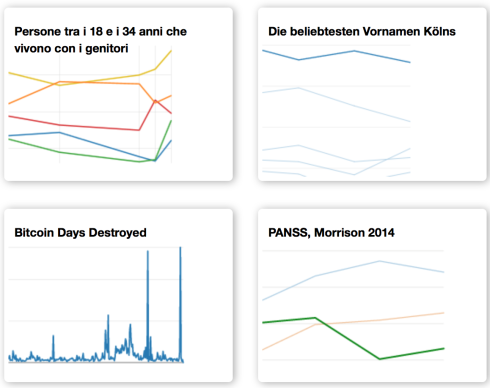
Datawrapper is a great open source tool helping anyone to create simple, correct and embeddable charts in minutes, for visualising large datasets. This tool reduces the time needed to create a correct chart and embed it into any website from hours to seconds. You can clean up your data, upload it and choose from numerous interactive formats to help you create the content and tell your story. The hosted service is free, or you can install it on your own server for maximum control. You can even make the data downloadable for interested readers and clients. More at: http://datawrapper.de
Google Media Tools
Google’s Media Tools present a toolbox of exciting digital tools that can enhance newsgathering and exposure across television, radio, print and online, suitable for journalists, reporters, web content creators, and those involved in social media analytics. These tools feature range from Develop & Publish, learning how to visualize data using Google Maps, improving your audience engagement through Google+, Google Earth Pro to Advanced Search, that provide an advanced super powered search capabilities, and allows you to filter your results by region, keyword and time. More at: http://www.google.com/get/mediatools/
LinkedIn Instream Ads
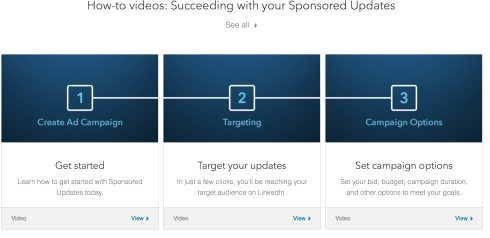
LinkedIN Sponsored Updates enables you to put custom in-stream content in front of the specific LinkedIn professionals your business wants to work with.
Assuming you already have a Company Page and that you are publishing regular updates to your followers, the next step is to turn on the LinkedIn Sponsored Updates option that provides a native solution for rapidly increasing awareness and shaping the perception of your brand, products, and services.
More at: http://business.linkedin.com/marketing-solutions/content-marketing/sponsored-updates.html
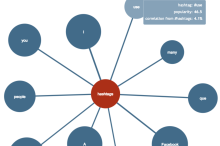
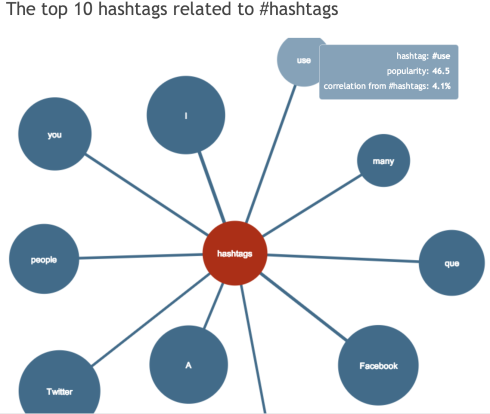
Hashtagify.me – The Most Advanced Twitter Hashtags Search Engine
Hashtafigy is a free tool that promotes the best use of hashtags by finding and understanding them in a quick, intuitive, visual way. Hashtags are one of the best ways to find and reach the right audience for your message on social media, and this tool helps innovators with the visualisation of Twitter hashtags related to a particular tag.
Hashtagify.me allows you to search among 26,995,169 Twitter hashtags and quickly find the best ones for your need based on their popularity, relationships, languages, influencers and other metrics.
School of Data
School of Data brings free online tutorials, courses and tools for those who are working with data and open data. School of Data works to empower civil society organisations, journalists, analysts, scientists, researchers, and citizens with the skills they need to use data effectively. Many of the groups who are closest to the problems currently “lack the skills to use data effectively — and even an awareness of the potential of data for their work. School of Data’s mission is to teach people how to gain powerful insights and create compelling stories using data.
As an advocate of women in science, I am illustrating why supporting the presence of women researchers as the voices of science today plays the crucial role, by presenting four stories of women who have changed the world in the male-dominated world of science, and still have been overlooked throughout their careers.
Beside well known women scientists who had to deal with biases against them in the STEM, such as Ada Lovelace, Marie Curie, Vera Rubin, Hedy Lamarr and many others who invented the core technologies that make civilization possible, here are four female scientists who did groundbreaking work and have made those contributions in spite of astonishing hurdles due to sexism.
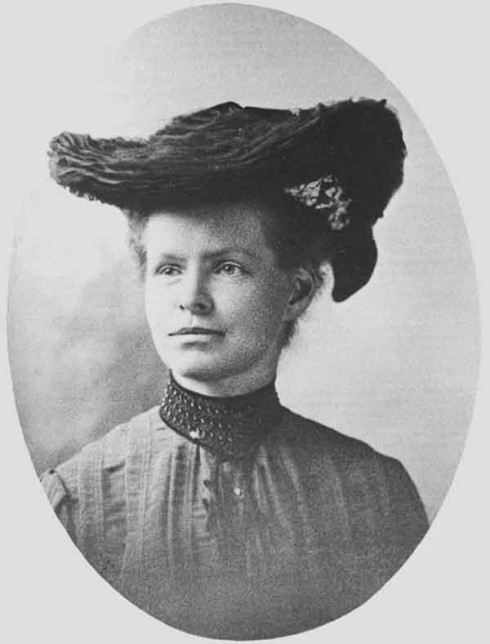
Nettie Stevens, born on 7 July, 1861, in Cavendish, Vermont, was an American biologist and geneticist who was one of the first scientists to find that sex is determined by a particular configuration of chromosomes.
She received a Ph.D. in biology from Bryn Mawr College in 1903 and remained at the college as a research fellow in biology for a year, as reader in experimental morphology for another year, and as associate in experimental morphology from 1905 until her death, in 1912.
She discovered that chromosomes determined sex, and in her first study, she looked at sex determination in the common mealworm. Investigating the mealworms, she found that the males contained reproductive cells with both X and Y chromosomes whereas the females contained only those with X. She proposed that these two chromosomes be called X and Y, and explained that sex is inherited as a chromosomal factor and that males determine the gender of the offspring. Her work on sex determination was published as a Carnegie Institute report in 1905.
“At the time, the chromosomal theory of inheritance was not yet accepted, and it was commonly believed that gender was determined by the mother and/or environmental factors.
So, in no particular order, here are ten of our favourite articles from 2013. We hope you’ll enjoy these stories. Stay curious and scientifically passionate!
When I first read this story, I was struck by how often we focus on happy stories like Marie Curie’s, and how the story of someone like Clara Immerwahr remains largely forgotten. She had a tremendous amount of potential, as evidenced by her being the first female to receive a Ph.D at the University of Breslau, an endeavor that is certainly not for the faint-hearted even now. One can only wonder at the ‘might-have-beens’ if she had had the same support and encouragement that Marie Curie did, if she had not married Haber, or if Haber had been a different kind of person. These examples highlight that talent alone is not enough; we need to encourage that talent by promoting equality and recognizing our own biases when it comes to women in STEM. Read more>>
Obtaining a senior academic position for any aspiring young academic is one of those uphill struggles with roads lined with self doubt, setbacks and sacrifice. Some call it the way to tenure-track, in my mind it’s one of those ill-defined paths through a potentially haunted forest inhabited with monsters, gigantic poisonous spiders and creepy people who communicate by screaming. It can be harder still to even reach that point, particularly for young women. While the number of women professors in Europe, N. America and Australia has increased over the last decade, universities still have a disproportionately small number of women in senior professorial positions. Read more>>
The MWA is a powerful telescope in its own right, but what is even more exciting is it will form part of a larger project in the coming years. The Square Kilometre Array will link radio telescopes on two continents — Australia and Africa — to get a fine look at the sky in radio wavelengths. MWA is just one part of this array. There will also be dish receptors in eight countries in Africa, with the core and some mid-frequency aperture arrays in South Africa’s Karoo desert. Read more>>
A HIV vaccine, known as SAV001-H has shown promising results in an early clinical trial, with no adverse effects reported and importantly, a significant increase reported in HIV specific antibodies in participants who received the vaccine. In this trial, 33 HIV positive participants were randomly allocated to one of two groups: half into a treatment group receiving the vaccine and half into a placebo group who did not receive the vaccine. The participants were followed up at regular periods, testing safety of the vaccine and antibody response over a one year period. Read more>>
The Australian Academy of Science has found that when it comes to science Australians are getting dumber in its latest report on science literacy. Compared to three years ago, less people in Australia know that the Earth’s orbit of the sun takes one year. Among 18-24 year olds 62% surveyed knew the correct answer, a fall from 74% three years ago. Other results would also send scientists into a tail spin of despair, with 27% of respondents saying that the earliest humans lived at the same time as dinosaurs, though an improvement from 30% of respondents in 2010 who thought this. What does this all say? If you take the face value of the press release and the ensuing media coverage, Australians are getting dumber. Read more>>
Storytelling is one of our most fundamental communication methods, for an obvious reason: narrative helps us cognise information. Telling intelligible, coherent stories to both ourselves and others helps our brains to organise data about our lives and our world. But when we askwhy stories are so effective at helping us cognise information, the answers are surprising: it seems that somewhere in the otherwise ruthless process of natural selection, evolution has wired our brains to prefer storytelling over other forms of communication. Read more>>
Plastic. Seems it has extended its reach into the farthest corners of the universe. An earliest post described how plastic has changed our lives, for better…and for worse. ADD link to earlier post. That post largely reflected on the growing problem of plastic in the oceans and the effect on plant and animal life. Now, it seems that plastic threatens our freshwater lakes now too. Read more>>
Long distance weather reports are now a commonality. The report for 2MASSJ22282889-431026 is somewhat unusual. It forecasts wind-driven, planet-sized clouds, with the light varying in time, brightening and dimming about every 90 minutes. The clouds on 2MASSJ22282889-431026 are composed of hot grains of sand, liquid drops of iron, and other exotic compounds. Definitely not the first place to spend a summer holiday. Not that 2MASSJ22282889-431026 (or 2M2228 as it is known in The Astrophysical Journal Letters) will appear on a travel itinerary anytime soon. For 2M2228 is a brown dwarf, 39.1 light years from earth. Read more>>
Seven miles above the Earth’s surface, where the weather is born, lies the troposphere – the lowest layer of Earth’s atmosphere. Up there, where the clouds dance around, are bacteria that can make it rain, and are important for the formation of clouds. The atmospheric microbiome is a concept and field of study that is gaining importance. As we come to grips with a changing climate and environment, understanding more and more our Earth ecosystem remains vital. With hurricane damage in the US and elsewhere seemingly on an exponential increase in recent decades, it is important to mitigate for the worst. Read more>>
Computing is also an incredibly fast moving field of technology, and research is finally taking us towards the exciting world of quantum computing! Quantum computers will work using quantum bits, or qubits for short, which are analogous to the digital bits used in computers like the one which you’re using to read this article. Recently, a team of engineers at the University of New South Wales (UNSW) has successfully demonstrated, for the first time ever, how a single atom can be act as a qubit, effectively showing the first step in building an ultra fast quantum computer. And they might just have created the best qubit ever made. Read more>>
It is time to recount November’s highlights, the most read and interesting articles from the month in the fields of science, education, internet technologies, biology, environment, health, among others.
If you are interested in science blogging and contributing to Australian Science – contact us and check out the Editor’s note.
Stay curious and scientifically passionate! I hope you’ll enjoy these stories.
I have written before about the need to encourage our girls to pursue science in school and beyond. From my experience, girls at school are often reluctant to participate in science at first, until they are shown the possibilities that science offers. Girls need people to aspire to. Girls need to be shown that they are just as capable. With the recent celebration of Ada Lovelace Day last month, I set two of my young 12 year old female students on a mission: to find out about the significance of the day and explore the roles of females in science. The following piece is their writing. Read more>>
Digital inequalities such as digital divides are a big issue in the information society, potentially influencing engagement in political, social, and educational life. They create marginalized, excluded groups who do not have access to the Internet, to information, or maybe to the necessary skills for using these devices and social applications. At some point, these people will not be able to engage fully in social, economic or political life.
The notion of being social on the Web is constantly evolving since we are connected not only via computers but also via mobile phones and other handheld devices. There is no doubt that these technologies, along with social media and apps, help to bridge the present digital divides, by providing an interactive and engaging platform for otherwise excluded voices, globally.
However, it is still a challenge, not only to make those technologies available everywhere, but also to create programs and initiatives for educating, engaging, empowering and interacting so that those digital gaps would break down or at least lessen.
Despite the way in which social media and mainstream news like to talk about ‘’new digital divides’’, they are not new at all. From my own research in the field (a new the book where I contributed with the chapter), it seems that the core issue is not always about technology as a liberator (that breaks down the digital divide), but that the central issues are about social power, access to information and skills (even to the level of fundamental literacy).
Opening up the access to knowledge and its deployment in everyday work and education is crucial for producing the results and fostering the competences of the members of one’s society. Access to information is the key to an individual’s position in society.
We are all participating on a daily basis in a networked world and we are the creators and the producers of the content online, all together in the same hyper-connected world where the issues and patterns of inclusion and exclusion need to be observed and addressed.
Although there is still limited access to the Internet in some developing countries, connectivity continues to grow and mobile technology and social media applications are playing vital roles in shaping the trends of social activism and raising awareness, in the context of freedom of expression and giving citizens a voice to address social issues. According to the International telecommunications Union, about 70% of mobile phone users are in developing countries, mostly in the global South – making mobile devices the
It’s been a long October which brought many exciting, interesting and controversial events in the science online community. Starting with the good news as Peter Higgs was awarded Nobel Prize in Physics, then some not-so-good news surrounding Urban Scientist Danielle Lee and her terrible experience with (now former) editor at biology online – explained more here and here. Then as Ada Lovelace day approached, some other totally unexpected events popped out in the science blogosphere that brought many of us to stop and think about ethics and professionalism, not only in science but in other areas such as internet technologies, the academic world, and so on.
Let’s have a quick look at some of the interesting science-related stories and happenings over the past thirty days, we hope you’d enjoy the most interesting stories for October. Stay curious and scientifically passionate!
Lana Ostojic is a young applied science professional with the real-world experience in criminal forensics. She is a researcher at the Research and Development Department at the Office of Chief of Medical Examiner (OCME), NYC. Lana is also a PhD candidate at the University of Belgrade, Faculty of Molecular Biology and Physiology. Her primary field is molecular biology and physiology. Read more>>
Have you ever noticed that people who spend more time outdoors, particularly those who garden regularly, are often cheery? While the exercise, sunshine and general health benefits of being outdoors contributes to a happy disposition, scientists have discovered that some of this cheer comes from a certain bacteria that lives in the soil.
Mycobacterium vaccae, a soil dwelling bacteria, has been found to affect our brains in a similar way to antidepressants. It activates brain cells to produce serotonin, a hormone that helps regulate mood and sleep. Low levels of serotonin are often correlated with moodiness, feeling down and depression. Read more>>
Ada Lovelace Day is a day for celebrating the achievements of women in STEM (Science, Technology, Engineering and Math) fields. Recently, the New York Times published a fantastic article by Eileen Pollack, “Why Are There Still So Few Women in Science
It’s the time of the month once more, when we look back and and remind ourselves of September’s variety of science and technology stories, news and articles covering space, health, biology, physics, education, and more. We hope you’ll enjoy these stories.
This month, we’d like to welcome our new writer Buddhini Samarasinghe, who is a molecular biologist, with experience in cancer research. Some of her upcoming stories will be bringing us fascinating contributions about the molecular mechanisms of cancers.
As well, here is our usual monthly roundup. A wonderful variety of science and technology stories, covering astronomy, education, technology, health, environment, and more!
It is always a bad sign when crowds gather. On the morning of Wednesday March 21 in the year 1900, a crowd began to gather in Sydney. A thousand people had gathered outside the offices of the Board of Health in Macquarie Street. They had gathered because bubonic plague had broken out. People had already started to die from the Black Death. Panic was the only course of action.
The Government had stockpiled Haffkine’s serum (named after the Russian bacteriologist that developed it in a makeshift laboratory in a corridor of Grant Medical College) — a new plague vaccine, and had used it to inoculate front
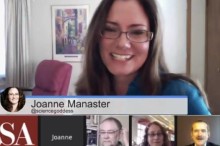
 Joanne Manaster is a cell and molecular biology lecturer at the University of Illinois. She currently works as an online course developer and lecturer of science courses for the School of Integrative Biology. Prior to this current position, Joanne has taught histology, cell biology, and tissue engineering laboratories to biology and bioengineering students for nearly 20 years. Beside her academic career, she is a science writer and communicator, science video host, and STEM advocate. Joanne has run a girls’ bioengineering camp, and helped with the iGEM synthetic biology team and other outreach activities. She also makes video reviews of popular science books as well as whimsical science experiments with cats, cookies, gummy bears and make-up.
 One could call