Category: News

  • New grants to accelerate research uptake

    New grants to accelerate research uptake

    Queensland’s researchers, scientists and their commercial partners are encouraged to apply for grants of up to half a million dollars under the state government’s new science and research funding program.

    The Accelerate Partnerships funding program was opened by Queensland Chief Scientist Dr Geoff Garrett AO who said universities and research organisations with their industrial or commercial partners could apply for research grants from the $8.75 million Accelerate Science and Innovation Program.

    Dr Garrett said collaboration and the translation of research into tangible outcomes were the key focuses of the program. “The Queensland Government will be supporting new projects that will deliver benefits for Queensland through the creation of innovative products, technologies or processes that will have practical application within five years,

  • Weekly Science Picks

    Weekly Science Picks

    It’s Sunday again! It’s our time to give a brief review of the most amazing science and technology news that have appeared on the web during this week. The task was quite challenging, but we made it. We proudly present you the top stories of this Weekly Science Picks.

    Body bacteria: Can your gut bugs make you smarter?

    Far from being freeloading passengers, many of these microbes actively help digest food and prevent infection. And now evidence is emerging that these tiny organisms may also have a profound impact on the brain too. They are a living augmentation of your body – and like any enhancement, this means they could, in principle, be upgraded. So, could you hack your microbiome to make yourself healthier, happier, and smarter too?

    Geoengineering side effects could be potentially disastrous, research shows

    Science academies around the world as well as some climate activists have called for more research into geoengineering techniques, such as reflecting sunlight from space, adding vast quantities of lime or iron filings to the oceans, pumping deep cold nutrient-rich waters to the surface of oceans and irrigating vast areas of the north African and Australian deserts to grow millions of trees. Each method has been shown to potentially reduce temperature on a planetary scale.

    Proteins to plastics: chemistry as a dynamic discipline

    Chemistry is the most central of scientific disciplines and underpins the physical, material and biological world. Opportunities are abundant in the field of chemistry, as most major advances take place at the interface of two or more disciplines and chemistry sits at the core of trans-disciplinary research.

    Water detected in a planet outside our solar system

    Water has been detected in the atmosphere of a planet outside our solar system with a new technique that could help researchers to learn how many planets with water, like Earth, exist throughout the universe. The team of scientists that made the discovery detected the water in the atmosphere of a planet as massive as Jupiter that is orbiting the nearby star tau Boötis.

    That’s all for this time. Please stay thirsty for new scientific stories and news!

  • Quantum Entanglement Animated

    Quantum Entanglement Animated

    PhD Comics has released the third video in an animated series explaining Quantum concepts and devices.

    This one focuses on Quantum Entanglement and features the work of Caltech physicists Jeff Kimble and Chen-Lung Hung. Meanwhile Jorge Cham, creator of PhD Comics, provides the accompanying animation.

    Source and image.

  • Harvard Free Online Courses

    Harvard Free Online Courses

    A quick note: Shaye J.D. Cohen, a professor of Hebrew Literature and Philosophy at Harvard, has recently released his second free course on iTunes.

    The first course was called The Hebrew Scriptures in Judaism & Christianity. The new one, simply titled The Hebrew Bible,

  • Rocks around the clock: asteroids pound tiny star

    Rocks around the clock: asteroids pound tiny star

    Asteroids hit the Earth, the Moon and even, it seems, distant stars.

    Scientists using CSIRO’s Parkes telescope and another telescope in South Africa have found evidence that a tiny star called PSR J0738-4042 is being pounded by asteroids — large lumps of rock from space.

    “One of these rocks seems to have had a mass of about a billion tonnes,” CSIRO astronomer and member of the research team Dr Ryan Shannon said.

    PSR J0738-4042 lies 37,000 light-years from Earth in the constellation of Puppis.

    The environment around this star is especially harsh, full of radiation and violent winds of particles.

    “If a large rocky object can form here, planets could form around any star. That’s exciting,” Dr Shannon said.

    The star is a special one, a ‘pulsar’ that emits a beam of radio waves.

    As the star spins, its radio beam flashes over Earth again and again with the regularity of a clock.

    In 2008 Dr Shannon and a colleague predicted how an infalling asteroid would affect a pulsar. It would, they said, alter the slowing of the pulsar’s spin rate and the shape of the radio pulse that we see on Earth.

    “That is exactly what we see in this case,” Dr Shannon said.

    “We think the pulsar’s radio beam zaps the asteroid, vaporising it. But the vaporised particles are electrically charged and they slightly alter the process that creates the pulsar’s beam.”

    Asteroids around a pulsar could be created by the exploding star that formed the pulsar itself, the scientists say.

    The material blasted out from the explosion could fall back towards the forming pulsar, forming a disk of debris.

    Astronomers have found a dust disk around another pulsar called J0146+61.

    “This sort of dust disk could provide the ‘seeds’ that grow into larger asteroids,” said Mr Paul Brook, a PhD student co-supervised by the University of Oxford and CSIRO who led the study of PSR J0738-4042.

    In 1992 two planet-sized objects were found around a pulsar called PSR 1257+12.  But these were probably formed by a different mechanism, the astronomers say.

    Source and image.

  • The Art of Restoring Classic Films

    The Art of Restoring Classic Films

    Why have cinephiles, from the era of Laserdiscs through that of DVDs and now Blu-rays, so consistently respected The Criterion Collection? Speaking as one such cinephile, we could point to a number of factors: their curatorial bent toward important films, their production of rich supplementary features, their always impressive pieces of cover art.

    But Criterion has become increasingly known for the considerable work they put in not at the end of the process, when they package a classic or potentially classic motion picture for maximum aesthetic and intellectual appeal (and your purchase), but at the beginning, when they track down the actual celluloid film in the first place, often aged or damaged, and engage in the often painstaking task of returning it to the prime of visual and sonic life.

    Source and image.

  • Weekly Science Picks

    Weekly Science Picks

    We have come to the end of one more week and it’s time to summarise what has happened during this week. As usual, the task was quite challenging, but we made it. Here is the review of the most exiting and fascinating news from the world of science and technology.

    Science and Religion, Genome Cryptography, and the Coolest Science Fact

    Last week, thousands of scientists gathered in Chicago, Illinois, to share their latest research with the world. Here are some of our favorite stories from the meeting, held each year by AAAS, which publishes Science.

    Is this whale-shaped plane the future of airliners?

    Spotting an Airbus A380 at an airport can still create great excitement. The giant, double-decker plane can seat between 500 and 850 people, depending on how much space is given to space-saving economy class, and how much goes to higher-paying passengers with all that extra leg room. It’s an aviation giant, the biggest passenger-carrying aircraft ever to fly the skies.

    Asteroid 2000 EM26: ‘potentially hazardous’ space rock to fly close to Earth

    But it is defined as a potentially hazardous near-Earth object (NEO) large enough to cause significant damage in the event of an impact. Scientists estimate the asteroid, travelling at 27,000mph, is 270 metres (885ft) wide.

    Why does the brain remember dreams?

    Some people recall a dream every morning, whereas others rarely recall one. In a new study, research shows that the temporo-parietal junction, an information-processing hub in the brain, is more active in high dream recallers. Increased activity in this brain region might facilitate attention orienting toward external stimuli and promote intrasleep wakefulness, thereby facilitating the encoding of dreams in memory.

    That’s all for this Weekly Science Picks. Until next meeting, stay thirsty for new scientific stories.

  • New analysis promises better weed management of the Lake Eyre Basin

    New analysis promises better weed management of the Lake Eyre Basin

    A new cost-effective weed management analysis has been developed to help protect one of the most unique regions in the world – the 120 million ha Lake Eyre Basin.

    A team of experts developed the framework for cost-effective investment in weed management in the Lake Eyre Basin (LEB). The aim of the project was to help guide future investment in management activities for invasive species in the LEB.

    Dr Jennifer Firn, project leader and Queensland University of Technology senior lecturer and visiting scientist at CSIRO’s Climate Adaptation Flagship, said substantial amounts have been invested in invasive species management to reduce negative impacts on natural assets and agricultural production in the basin.

    “What is unclear is whether the invasive weed species currently being targeted represent the best investment so we brought together and a broad range of stakeholders including policy makers, managers, scientists and community representatives to find the best strategies

  • Pilbara marine health check – good and bad news

    Pilbara marine health check – good and bad news

    A health and wellbeing check up of World Heritage-listed reef ecosystems in the Pilbara region of Western Australia will provide a critical baseline of marine conditions to government, industry and researchers.

    The 300km swathe of coastline to be surveyed during the five year, $12 million Pilbara Marine Conservation Partnership includes two major marine parks and also areas under development for ports, and oil and gas extraction and processing.

    The partnership, a joint venture between CSIRO’s Wealth from Oceans Flagship and The University of Western Australia, will be the first whole of ecosystem study for the region’s unique marine environment.

    “Our research will help government and industry balance the environmental sustainability of the Pilbara with its increasing broad sector use,” CSIRO lead scientist Dr Russ Babcock said.

    “Over the next five years we want to find out everything we can about the health and makeup of the region, as well as observe and evaluate any localised changes, so we can give the best possible advice to future use managers on how they can act sustainably.”

    Dr Babcock and his team have recently returned from their first exploratory tour of the region, where they were scouting survey sites.

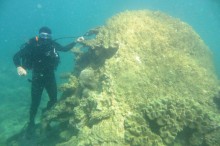
    Some unwelcome discoveries were made, including the bleaching and decimation of a pocket of ancient coral heads – many up to 400 years old – that have provided an important record of reef health.

    “We suspect this bleaching event was due to marine heatwaves that occurred in the region over the past few summers, and to see it up close was sobering,” said Dr Babcock.

    “But to offset this loss, some reefs only a short distance north showed much less damage and will continue to contribute to a healthy ecosystem.

    “By studying these sorts of variations and finding out why they occur, we can improve our overall understanding of the marine environment in the region, and how we can best preserve it”.

    The University of Western Australia’s Professor Shaun Collin said the study would set a precedent for future development in the Pilbara.

    “This study will develop a greater understanding of the dynamics of coral and fish communities in the region, which in turn will provide us with the ecological indicators of potential human impacts,” Professor Collin said.

    “With it, we can provide a research baseline for decision making in the region that will strike the right balance between environmental conservation and industry development.”

    Source and image.

  • How Does Bacteriography Work?

    How Does Bacteriography Work?

    Stephen Fry is taking part in a curious science experiment. It involves creating a portrait of the writer/comedian/science enthusiast, using nothing but his own bacteria and cells.

    According to the web site of The Big Bang UK Young Scientists & Engineers Fair, the “bacteriographs

  • Weekly Science Picks

    Weekly Science Picks

    It’s the end of this week, so it’s our time to summarise the most incredible and fascinating news from the area of science and technology. After careful consideration, we decided to share the following highlights with you.

    Genetic Forensics Wakes a Dragon

    A genetic investigation into the illegal trade of sailfin dragons has unearthed a surprise: a new species of the rainbow-colored lizards that resemble small dinosaurs. The finding highlights just how little is known about these mysterious and threatened animals.

    Why birds can’t avoid hitting your car windscreen

    It’s not just a superstition – a bird hitting your car windscreen really is an omen of death. No, not for you, but for the poor bird. It’s estimated that at least 80 million birds are killed this way every year in the United States alone. That’s not just distressing and dangerous for drivers. It’s a potentially significant source of fatalities to some rare and endangered bird species, which is why wildlife researchers and conservationists would like to understand more about why they fail to avoid oncoming vehicles.

    Nuclear fusion breakthrough raises hopes for ultimate green energy source

    The scientists generated more energy from fusion reactions than they put into the nuclear fuel, in a small but crucial step along the road to harnessing fusion power. The ultimate goal – to produce more energy than the whole experiment consumes – remains a long way off, but the feat has nonetheless raised hopes that after decades of setbacks, firm progress is finally being made.

    New pathway for fear discovered deep within brain

    Fear is primal. In the wild, it serves as a protective mechanism, but for humans, fear is more complex. A normal amount keeps us safe. But too much fear, like PTSD, can prevent people from living healthy lives. Researchers are working to understand how the brain translates fear into action. Today, scientists announce the discovery of a new neural circuit that links the site of fear memory with a brain area that controls behavior.

    That’s all for this Weekly Science Picks. Until next time, stay curious and scientifically passionate.

  • Researchers to debunk super spending myths

    Researchers to debunk super spending myths

    Researchers from CSIRO and Monash University in Melbourne are putting the spending habits of retirees under the microscope in an effort to understand the finer details behind how they use and manage their super in retirement.

    “We’re looking to understand what retirees need, how long their super lasts and what investment options and financial products might best suit them throughout their retirement so we can figure out how their super could work smarter,

  • Could Our Software be Unhackable?

    Could Our Software be Unhackable?

    A team from ULCA and MIT recently came to very interesting results. Namely, they offer hope that encryption could protect not just an output, but an entire program. Too good to be true, ha? This new method of program obfuscation could lead to ultra-secure software that keeps your personal information safe from potential attackers.

    The idea of obfuscating a program has been around for decades. But, the security and hacking communities have been able to defeat all these measures. Cryptographic experts have long been tinkering with stronger approaches, but it nothing happened until now.

    Cryptographers have been chasing the idea of a so-called “black box obfuscator