Category: Technology

  • Radio quiet, please!

    Radio quiet, please!

    Originally conceived over 20 years ago, there’s a project being undertaken by scientists and engineers across the whole world to help us all better understand the mysteries of the galaxy and the very beginnings of the Universe. It’s estimated to be completed by around 2024,costing $1.85 billion AUS (€1.5 billion). Once completed, it’s set to be the most complex and technologically advanced machine ever built by humanity. It will use enough optic fibre to wrap twice around the Earth and will need a computer capable of performing 10^18 operations per second – about three million times the number of stars in our galaxy. It will produce over 980 Exabytes of data every day (equivalent to about 15 million 64GB iPods) and to cope with that, it will need to handle data transfer rates over 10 times as high as the current global internet traffic. No, it isn’t a starship. But it might just be the next best thing.
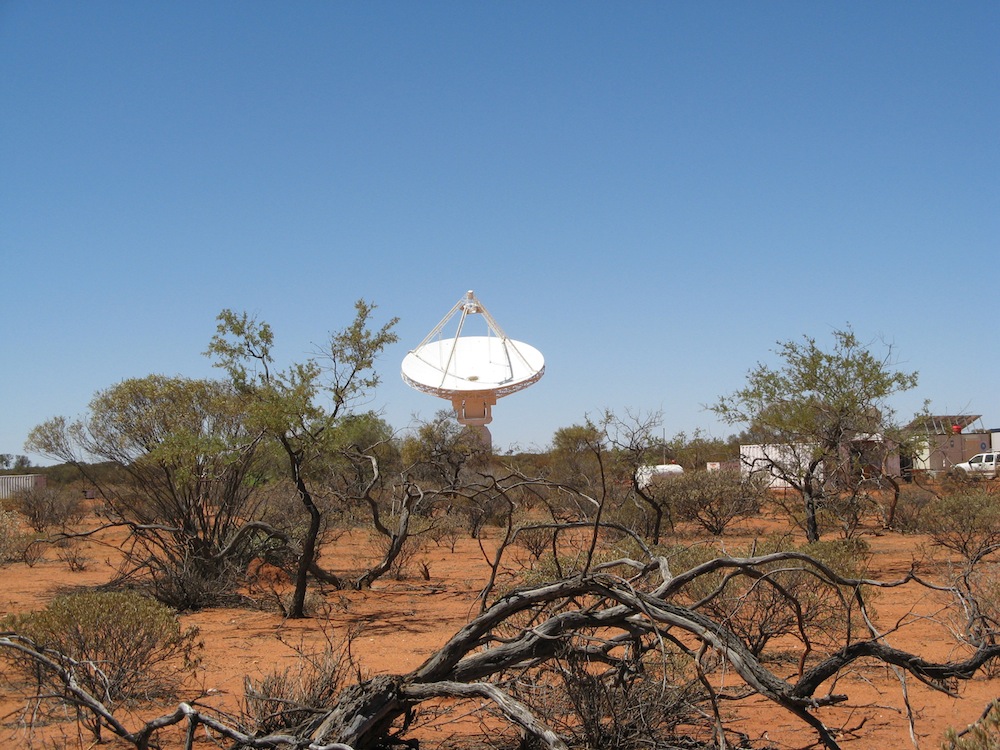
    One of the first components of the SKA, constructed in Western Australia. Credit: Dave DeBoer, CSIRO.

    The Square Kilometre Array (SKA) is one of the most ambitious scientific projects ever devised, and when completed it will comprise a huge number of telescope antennae which will work as one to form a single radio telescope so powerful that it could detect an airport radar on a planet 50 light years away. The sensitivity of any telescope is defined by the area it uses to collect data. With optical telescopes, this is the size of the mirror, and with radio telescopes it’s typically the size of the dish. The SKA gets its name because when fully constructed, all of the detectors and antennae that make it up will have a combined area of one square kilometre, or one million square metres. To put that properly into perspective, the Green Bank Telescope is currently the largest steerable single dish radio telescope, and its area is just under 8000 square metres.

    Being astronomy’s answer to the large hadron collider, the SKA is a staggeringly large international collaboration. I was lucky enough to attend a major meeting regarding the planning of the SKA (the headquarters are to be based here in the UK in Manchester), and the myriad different languages and nationalities represented was impressive to say the least. Over 24 major organisations from countries spanning 5 continents are involved in the project, ranging from universities to industrial engineering companies. New technologies, both software and hardware, are still being developed as a result of this project. Based on the huge data storage and transfer requirements of a machine as complex as the SKA, many of those new technologies are likely to feed straight back into society by offering profound improvements to computing resources like the internet. In fact, as the world’s largest project for sorting and storing data, the SKA is expected to be literally bigger than Google!
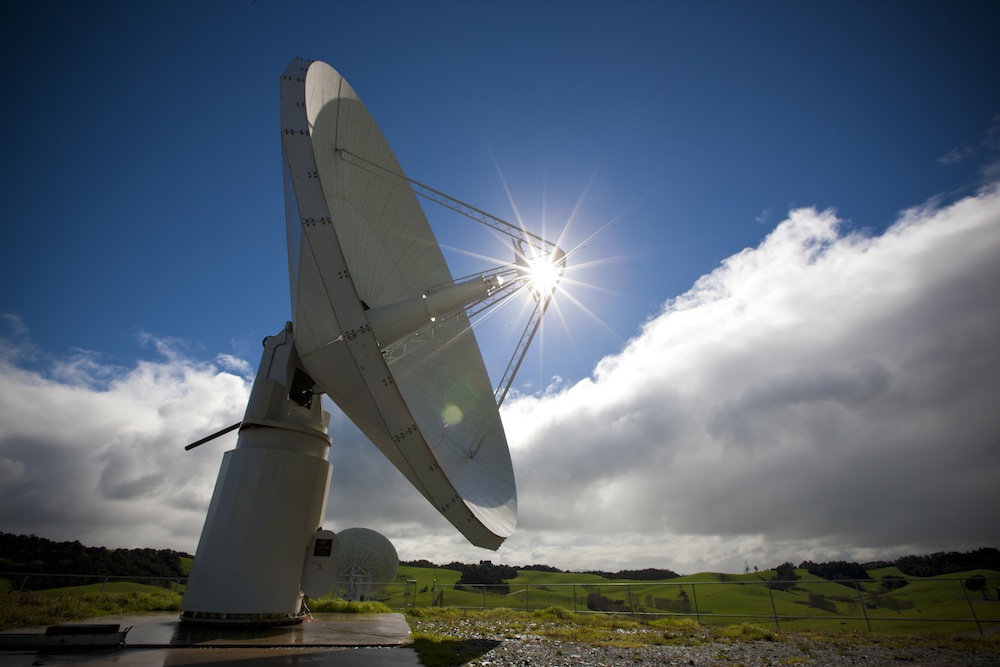
    The Warkworth antenna in New Zealand – an important part of early SKA science. Credit: Alex Wallace.

    The most difficult decision, understandably, has been where precisely to build it. Humanity has an unfortunate tendancy to fill the atmosphere of our planet with noise, bouncing radio waves to and fro and filling the air with radio frequency chatter. A radio telescope array this sensitive needs to be placed somewhere quiet to gain the full benefits, and the most recent decision has been to effectively split the SKA into two components, to be built in Southern Africa and Australia. While this may seem like an odd thing to do, it actually makes perfect sense. The SKA actually has three types of antenna operating at different frequencies. Intended to cover a huge range of radio frequencies (from 70 to 100000 MHz), three types of antenna are needed, because no single technology can actually operate across such a wide range. So the decision was made to build the lowest frequency detectors across Australia, centred at Murchison in outback Western Australia. Murchison is blessed with being one of the few places on our planet which isn’t flooded with FM radio at the low end of the frequency scale. From a radio astronomer’s point of view, it’s the quietest place on Earth.

    This is set to be complemented by the higher frequency steerable dishes which are set to be constructed across Africa. Both South Africa and Australia have put extensive efforts into developing the SKA, and Australian-developed technology is still set to be implemented in the African telescopes. This will mean a huge influx to the African astronomical community and numerous African nations won’t lose out on the economic boost from contributing to such a prestigious project. It’s an ideal situation where everyone wins.

    All in all, it’s an exciting time to be an astronomer. An epic project like this is likely to attract all manner of researchers from across the world to both continents. Just maybe, it could also finally help us to answer the really big questions, like how the galaxy formed, how the Universe began, and whether or not there’s anyone else out there.
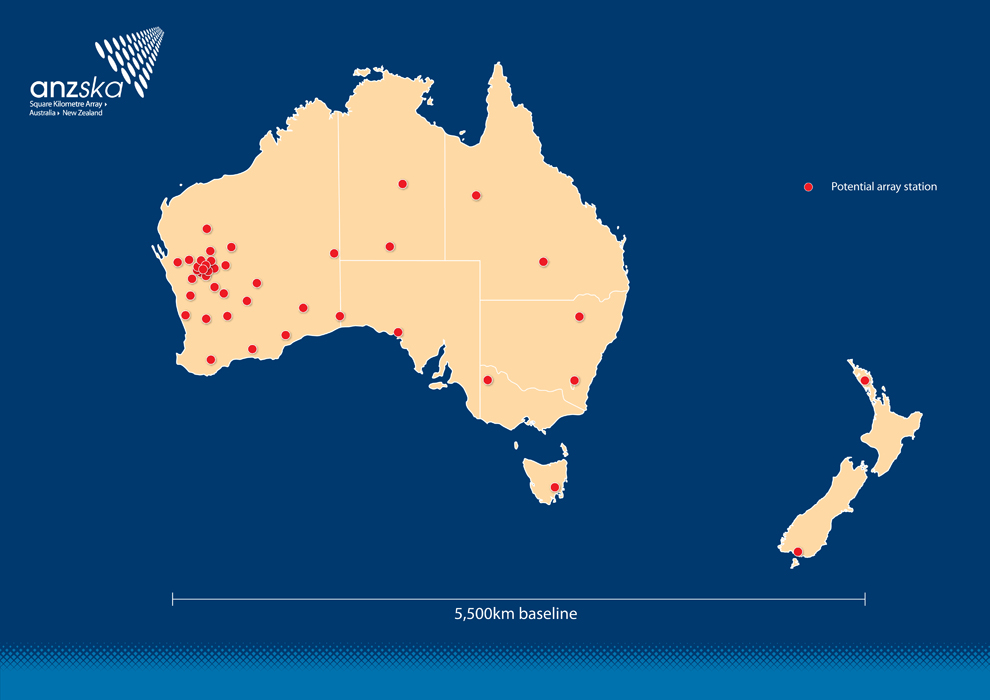
    A map of prospective SKA sites. Credit: anzska
  • What lies ahead in Australia’s Digital Future: A Snapshot of Australia’s Digital Future to 2050

    What lies ahead in Australia’s Digital Future: A Snapshot of Australia’s Digital Future to 2050

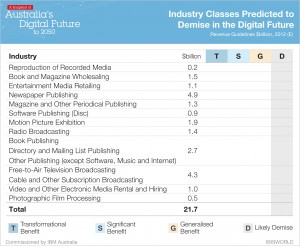
    Industry Classes Predicted to Demise in the Digital FutureFiber to the Premises was only introduced to homes in 2009. This was made possible with the help of the government in partnership with internet providers. In 2010, Telstra introduce increases the data allowances on their plans allowing their users to use the internet more. This applies to mobile and internet plans. Australia is only beginning to harness the potential of broadband technology.

    With this in mind, IBM conducted a research to determine the progress of digital technology in Australia. On June 14, 2012, a report titled “A Snapshot of Australia’s Digital Future to 2050” was released indicating how information and communications technology would be an important resource. This details the changes that would happened to Australia’s digital technology and how it would affect the economy and different industries.

    IBM commissioned Phil Ruthven, who is the Founder and Chairman of IBISWorld. The report is a projection of how numerous industries would be affected by the progress and innovations to information and communications technology. This indicates how this technology can benefit a lot of industries and improve their work. It also hints about how some industries can harness the potential of this digital technology to their advantage. Sadly, part of the report indicates how the technology would cause negative effects on some industries and may lead to some of these industries being obsolete. You can find more details about the report here:

    Although there are 15 industries that would not find sustainability in this technology, they would only contribute a minimal about of revenue to the economy. The boom that other industries would experience would cover the losses. The report boasts of $1 trillion revenue for Australia by 2050 with the help of this utility. Currently, the resource is generating $131 billion as revenue. Information and communication technology would also benefit a lot of industries like mining, education, and health care. With how high speed internet is being used today, we can really see how this can produce promising developments in the future. The report provided ways on how industries can profit by incorporating the use of this utility as part of their business. Big and small businesses are setting up shop in the virtual market. Harnessing the potential of this promising technology now would help your business gain stability.

    Australia would face a lot of great development with the help of this utility as this would improve the potential of a lot of industry. The quality of education would improve. Australia would be able to enhance Tourism, making it a really profitable industry. Together with this, the possibility of Health Tourism, as Health would also benefit from the use of this technology. Australia would be able to provide quality services that are essential Business Process Outsourcing.

    The report created a study on different industries and determined how they can compete with the help from information and communications technology. This indicates how the industry can benefit from the use of this resource and how it can affect growth and profit. This also provides ideas on how an industry can adapt and use this technology to their advantage. About 10% from the total number of industries would not be able to operate without this technology, and the industries included in this percentage generate 25% of the country’s revenues. This is the reason why different industries are urged to use this enhanced technology.

    Determining the sustainability of the industry was carefully determine with the help of a criterion and ranking that is created for the study with the help of information that is available in IBISWorld’s Industrial Database. This carefully determined as to whether an industry would experience substantial benefits in the use of the technology and the gravity of its effect. This also determines which industries would be able to evolve with the help of the technology that is introduced. It is the same criterion that determined as to which industry may suffer due to the progress that is brought about by the development of other industries and the economy as caused by this technology.

    The benefits would also produce a substantial benefit to consumers. As part of the development of information and communications technology, consumers who use the technology would get more out of the service. This would improve the technology we use at home like the internet or the telephone. With better technology, the possibility of working at home is realized. This would allow people to work full-time at home while doing business with different industries even those overseas. This also opens opportunities for small businesses as the technology provides them a level playing field with big companies. Also, with the development of this technology there would be lesser need for resources or the possibility of improving the prices of resources making it easier to create a profitable business.

    The report is definitely an eye-opener to a lot of industries. The year 2050 can be very vague. It is impossible to determine how your business would be after 40 to 35 years. Having this report truly helps allowing business to make well-formed plans that would change their business. The use of enhanced information and communication technology really shows great promise. You can even see how broadband technology affects businesses today. The report claims that the technology would evolve fast and does not take much time to generate profit. The report also helps in showing people which industries would benefit from the technology and would exhibit great development. This would be great information for potential investors. Also, with the reports about possible revenues, it really poses more possibilities for progress to Australia’s economy. This would also help in attracting international investors.

    IBM hopes to show the potential in information and communications technology and how this can affect Australia and its 509 industries. The report shows a lot of significant benefits and very minimal consequential effects. The report is favors by a lot of economist calling year 2050 “The Trillion Dollar Digital Age”. There are industries that did not fare well on some of economists’ projection and the report provides a possible solution. Some industries can enjoy a transformative benefit with the help of this technology. The report really helps in showcase the possibilities that lie in the Australia’s Digital Future.

    For further information and complete findings download the report:www.ibm.com/ibm/au/digitalfuture

    Twitter: #ausdigitalfuture

  • Is Communication a Lost Art?

    Is Communication a Lost Art?

    So how far away are we from planet Earth morphing into Holodeck 5 and we all have Geordi La Forge glasses? There are several pairs of augmented reality glasses already on the market, many from brands you’ve probably never heard of, but then I’m sure you have heard of Google and their latest project in the foray.

    No longer information at your fingertips, oh no, information at your eyelashes. And much more than information, as some researchers and visionaries have conjured up all sorts of ways to use these glasses. From finding directions to a new coffeehouse, online dating, downloading music, answering a phone call, no need for a handheld device.

    Some have taken it a step further. Dr. Michio Kaku, Professor of Theoretical Physics at the City University of New York, seems to believe these glasses will forever change the way we interact with the world. He speaks about when you walk into a crowded room, say for a networking event where you are looking to land a new job. Your glasses will steer you who to speak with in that industry. A big red arrow will point them out to you. But in your glasses, their entire biography is laid out before your eyes. Where they went to school, how many brothers and sisters they have, the name of their dog – you have all this information. Likewise, someone wearing these glasses would have all this information about you. What questions will you ask? What would be left to discover about the people you meet at this event? What is their left to converse about? Oh right, work. You can talk about work.

    The art of conversation involves the asking of questions. Wouldn’t these reality glasses just negate the need to speak with anyone? Is technology reducing our social ability to communicate with the spoken language? Is it in fact devolving our language? Or are we evolving and becoming more efficient that we no longer require the use of our vocal chords? Getting a bit far out there.

    Social media has connected us, we keep “in touch

  • Measuring Network Performance with M-Lab

    Measuring Network Performance with M-Lab

    Measurement Lab is an open platform for researchers to deploy Internet measurement tools. By enhancing Internet transparency, M-Lab helps sustain a healthy, innovative Internet. What this explanatory video to learn why M-Lab is important to researchers, network engineers and policy makers. M-Lab is a collaborative effort founded in 2009 by Googler Vint Cerf and a number of network researchers and industry partners, including Google.

    M-Lab’s goal is to provide researchers, consumers, policymakers, and anyone else who wants good, intelligible information about the Internet,  with open data about network performance.

    The nuts and bolts of M-Lab start with a widely-distributed server platform maintained and managed by the M-Lab Collaborative. These servers are purpose-built to support broadband measurement, and are consistently deployed to exact specifications. This means that the data they collect is consistent — important when you’re contrasting global network performance. Researchers host open-source, active broadband measurement tools on these servers, and users access these tools, run tests, and get real-time information on their network performance. Each time a user runs a test (about 200,000 times a day), data is collected and put into the public domain. So far, it’s 516 terabytes and growing.


    M-Lab is a head-to-tail solution for high quality, open data. And the best part is that it’s all open. From the testing methodology described in the open source code of the tools, to the server documentation, to the data collected, scientists and others can vet exactly what is being measured, how it’s measured, and what precisely this says about networks and performance. M-Lab’s momentum is generated by working together from a shared source of data to progress the state of networks.

     Source.

  • Sensitizing National Agricultural Research System on Free Open Source Software

    Sensitizing National Agricultural Research System on Free Open Source Software

    Courtesy Véronique Fritière

    The food grain production in India is reaching an all-time record of 252.56 million tonnes for the year 2011-12. However, as per the report of Sainath (2012) the daily per capita availability of food grains has fallen from 474.9 grams during 1992-96 to 440.4 grams during 2007-2010. This needs a great attention as the population is increasing and there is growing demand for food and nutritional requirements in the country. The one of the United Nation‘s ‘Millennium Development Goals‘ is reduction of extreme poverty and hunger in the world. Hence, it is the responsibility of the country’s National Agricultural Research System (NARS) to make interventions in the sustainable agriculture and to feed its burgeoning population with the recommended nutritional requirements.

    When we see at the Indian agriculture, it is rainfed and is very much dependent on the monsoon. Apart from this, it is also facing tough competition from various biotic and abiotic factors and global climatic changes. Marketing of the produce is also a big challenge due to volatile local and global markets. The NARS having the responsibility for the agricultural research, education and extension is looking at the possible interventions for sustainable agriculture and food security. It needs to advise the farmers and policy makers at various levels in the value chain of agricultural production. As agriculture being the principal occupation in the country, timely communication of agricultural information assumes a greater priority as it would help in taking informed decisions. Therefore, use of Information and Communication Technologies (ICTs) in NARS, assumes an important role in all the efforts towards sustainable food production and food security.

    Increased use of ICTs would benefit farming in making available the right information at right time. However, the affordability of hardware and software had become the major constraints for the wide adoption of ICTs in the developing countries and in India. This situation could easily be overcome by the adoption of Free Open Source Software (FOSS) products/applications. The FOSS applications developed by the community developers/programmers, who believe in the philosophy that the software should be freely available to all in world to modify, improve, adapt and share. The adoption of FOSS would increase the access to ICTs by overcoming the price barrier compared to the expensive commercial/proprietary software packages. The FOSS products which are built on open standards and protocols allow sharing of information/knowledge across all the technologies and help in collaborating with everyone in the country and world. The advantage with the FOSS is that there would be flexibility in choosing wide variety of software flavors and could migrate from one platform to another easily.

    In NARS, however the use/adoption of FOSS products/applications is minimal. Even if at all they are being used, it is because of convenience and not because of FOSS philosophy. Many of the institutions in NARS don’t train its students during their degree programmes and train their staff by capacity building programmes because of lack awareness and availability of FOSS trainers in the system. Many believe and argue that proprietary software is easy to use and they are more secure when compared to FOSS and moreover they say that they would get commercial technical support for all the proprietary software. In the NARS since the first establishment of Agricultural Research Information System units which are now renamed as Agricultural Knowledge Management Units (AKMU) centers, had established ICT infrastructure with proprietary software and now they are hesitating to switch over to FOSS. And the decision makers in the institutions prefer to be in the system they are familiar with rather than exploring the available FOSS products. When funds are earmarked for the procurement of software and progress is measured in terms of the money spent, the institutions continue to use proprietary software in NARS.

    Under National Agricultural Innovation Project (NAIP) Component – I, though considerable efforts have been made for the use and development of FOSS products, not many of the institutions have adopted the application of FOSS. As it can be seen that under the AGROWEB-Digital Dissemination System for Indian Agricultural Research (ADDSIAR) project, though there is a mention of use of open source software for content management, not all the projects partners have adopted/used FOSS. In the ADDSIAR project, the ICAR could built its website on Drupal; and the IARI and NAARM institutes could built their websites on Joomla. The NAARM had used Moodle for its e-learning initiatives for its students. The other projects in which we could see use and adoption of FOSS are the ‘Rice Knowledge Management Portal’ (RKMP) by DRR and ‘Agropedia‘ being developed on AgriDrupal under NAIP project lead by IIT Kanpur. It is surprising that under another NAIP project, Strengthening Statistical Computing for NARS proprietary software SAS is being used for training & capacity building NARS researchers but there is no use of FOSS statistical software ‘R‘. In the precision farming and plant genetic resource conservation and exploration projects too, where Geographic Information Systems (GIS) software is extensively used, there is no mention of using FOSS software like OSGeo which could be effectively used. However, in most of the GIS trainings programmes, commercial proprietary software is used rather than FOSS. In the Project Information & Management System of ICAR, to add the projects, one has to use only Internet Explorer and other Internet browsers do not work.

    In NARS, about 100 scholarly societies are registered and they publish scholarly journals and organize conferences, seminars, and symposiums. All of them uses email for the paper submission and makes available them in printed books/CD-ROMs to all the attendees. However, the non attendees never get access to the abstracts, papers, and proceedings. When, the conference proceedings are managed and made available online, then the there would be greater reach of information and research outputs. The FOSS products from Public Knowledge Project’s Open Conference Systems (OCS) and Open Journal Systems (OJS) could effectively used by these scholarly societies for the conference and journal publication. In NARS, only KAU‘s Journal of Tropical Agriculture, UASD‘s Karnataka Journal of Agricultural Sciences and ‘Indian Agricultural Research Journals‘ of ICAR’s  NAIP project are using OJS and OCS is never used till date. Similarly the FOSS products viz., AgriDrupal, AgriOcean DSpace and VocBench from the ‘Agricultural Information Management Standards‘ of Food and Agricultural Organization could be used in NARS for the knowledge dissemination. During the past year, we could only see only one short course on FOSS in development of agricultural information and communication management system organized by CIRG.

    This shows that NARS needs sensitization and capacity building in use and application of FOSS in agricultural research. For this, a new initiative FOSKIARD (Free and Open Software and Knowledge Initiatives in Agricultural Research for Development) has been taken up by FOSS evangelists in NARS. It intends to conduct sensitization & capacity building workshops at various institutes of NARS and impress upon the NARS managers for the need of creation of central AKMU computer labs with FOSS operating systems like Ubuntu. From the workshops it is expected that the agricultural researchers, FOSS developers, free knowledge advocates and legal experts can meet, interact and could work for the development of applications of FOSS products relevant to agriculture for sharing agricultural information and research outputs for public good.

  • No Place to Go But Up

    No Place to Go But Up

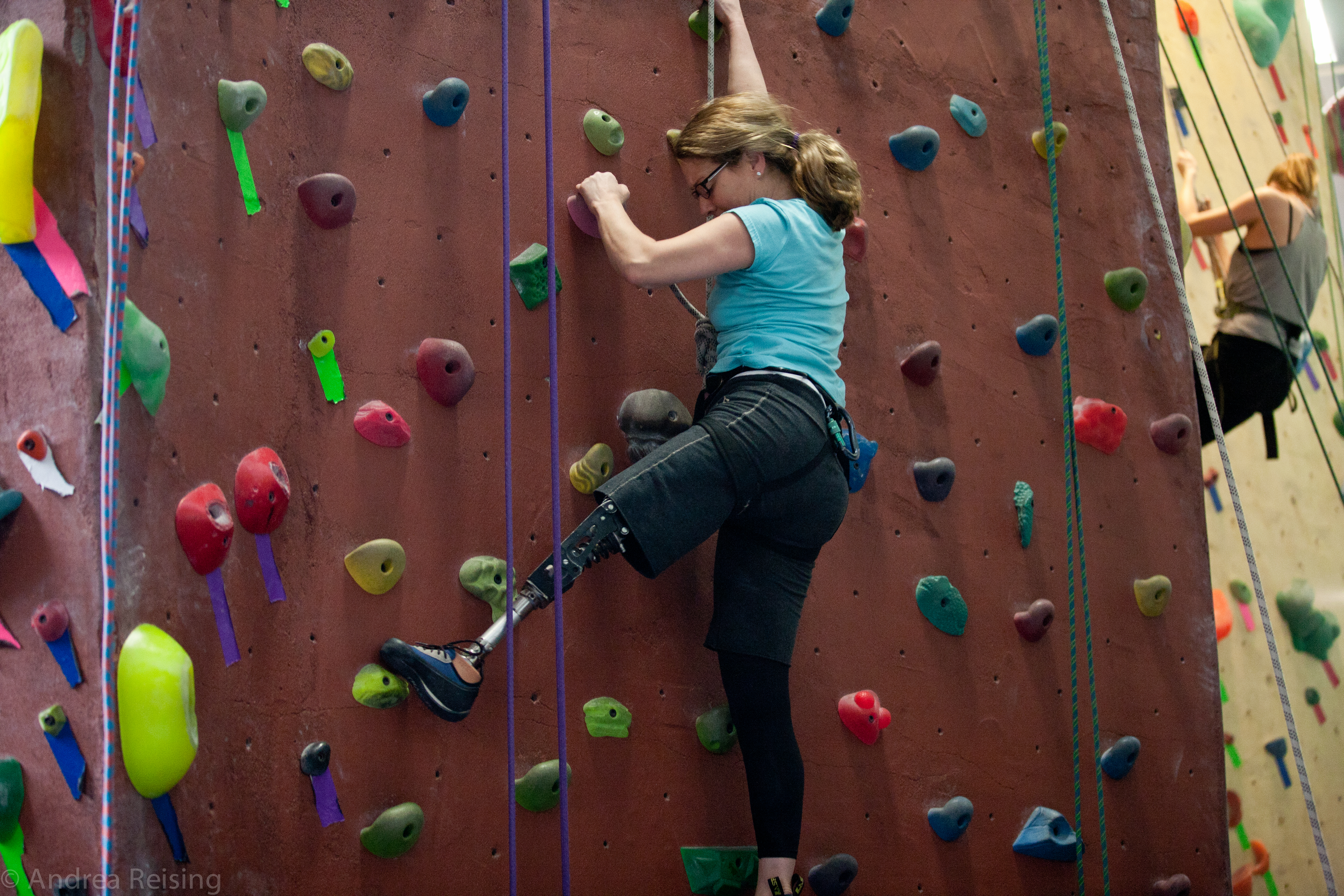
    Adaptive Climbing Participant Tackles the Wall

    ad•ap•ta•tion [ad-uhp-tey-shuhn] – a form or structure to fit a changed environment

    The most powerful natural species are those that adapt to environmental change without losing their fundamental identity which gives them their competitive advantage.

  • “Smarter, more competitive, more productive

    “Smarter, more competitive, more productive

    There is no doubt in the mind of Australia’s Chief Scientist, Professor Ian Chubb, the future will be shaped by science technology, engineering and mathematics.  Unfortunately, he finds that at present the standing of science, as an expert authority, is being challenged.  Furthermore, Ian Chubb finds that the science message is getting lost in the white noise of the mainstream media.  I was heartened to hear his positive words about science communication, social media, science and technology education and innovative Australian workplaces.

    These were the messages from Ian Chubb at an address he gave as part of NICTA’s Big Picture Seminar series on Wednesday March 28, 2012 at the University of Melbourne.

    It was refreshing to see Australia’s Chief Scientist out and about and addressing public forums such as this one.  Although judging by the faces, the suits and the overheard conversations at the drinks and nibbles prior to the address, I think this was definitely a speech to the science and technology faithful.  That is a pity, his words were worth  exposure and considered comment in the mainstream Australian media.

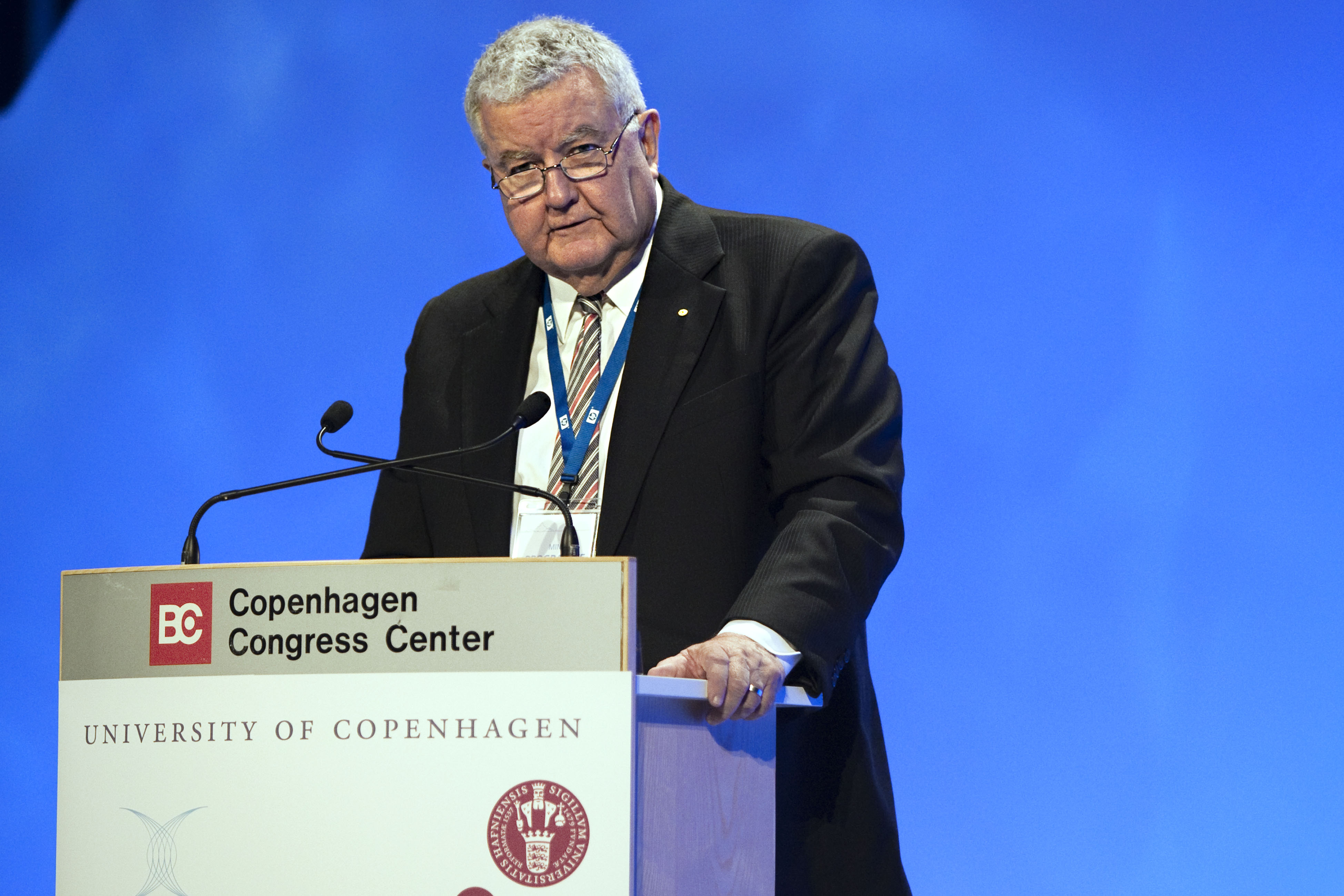
    Prof. Ian Chubb at the Climate congress, Copenhagen 2009, March 10-12. Opening session.

    Professor Ian Chubb emphasises Mathematics, Engineering and Science provide the enabling skills and knowledge that underpin every aspect of modern life. They help us understand the natural world and enable us to respond as humans to this world with a constructed view aimed at improving the lot of human kind.

    In Australia, as in many economies, we have observed a decline in the number of people choosing a career in these disciplines.  Not only that, the STEM subjects (Science Technology Engineering and Mathematics), as he called them, are taken for granted or simply ignored.   Although it is obvious without at least an appreciation of these subjects, a modern citizen is hampered in their ability to critically evaluate and make informed decisions about the issues that are shaping their future. Among his many roles as Australia’s Chief Scientist, Professor Ian Chubb has been charged with examining this decline and offering strategies to address it.

    Professor Ian Chubb is eminently suited to this task.  He was appointed to the position of Chief Scientist on 19 April 2011 and commenced the role on 23 May 2011. Prior to his appointment as Chief Scientist, Professor Ian Chubb was Vice-Chancellor of the Australian National University.  Professor Chubb’s research focused on the neurosciences.  Although he jokingly said on the night he would prefer not to be quizzed, on science specifics, by such an informed audience.  He has co-authored some 70 full papers and co-edited one book all related to his research. In 1999 Professor Chubb was made an Officer of the Order of Australia (AO) for “service to the development of higher education policy and its implementation at state, national and international levels, as an administrator in the tertiary education sector, and to research particularly in the field of neuroscience

  • Technology and the Meaning of Life

    Technology and the Meaning of Life

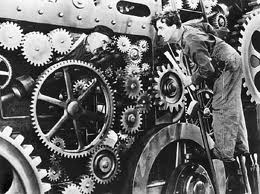
    Modern Times, Charlie Chaplin (1936)

    The endless cycle of idea and action,
    Endless invention, endless experiment,
    Brings knowledge of motion, but not stillness;
    Knowledge of speech, but not of silence;
    Knowledge of words, and ignorance of the Word.

    Where is the Life we have lost in living?
    Where is the wisdom we have lost in knowledge?
    Where is the knowledge we have lost in information?

    – T. S. Elliot


    We uncouple technologies, such as computing and road building, from our deepest human values. The questions asked by T. S. Elliot become irrelevant as we refuse to acknowledge the human context.

    Students at universities become mainly focused on “practical knowledge” that leads to high paid jobs. The values by which we guide our technological development and application become afterthoughts. We must wonder if technology now controls human life more than humans control technology.

    Information technology is valued above wisdom. There is no “wisdom technology”. It’s easier to understand information technology then wisdom. A high school student can quickly grasp computer programming, but it takes almost an entire lifetime to mature to wisdom. People who think of themselves as wise because they have read some books are dangerous. Wisdom is lived, not mastered as procedures and facts that can be scored on an exam sheet.

    Data and information are the “atomic” components of knowledge. These components don’t make a lot of sense by themselves. Water is composed of molecules, which are in turn composed of atoms of hydrogen and oxygen. We could say that molecules are like information and atoms (a level further down) are like data. But such an understanding does not allow us to understand the “wetness” of water. Wetness is an emergent phenomenon that is experienced by sentient human beings. When we look at a friend, we just don’t see atoms and molecules, we see a friend.

    Meaning is the real food of human life. Our real task is to arrange education, family, society, moral training, technology and economic arrangements in way that allows meaningful human life to unfold for as many people as possible. Clearly, we have remarkable technologies. But do we have enough meaning?

    _________________
    Image: Charlie Chaplin, ‘Modern Times’, classic silent movie, 1936. Worth locating a copy for viewing.


  • About cybism, viractualism and Immersion into Noise

    About cybism, viractualism and Immersion into Noise

    Art world is in direct contact today with science and technology. But, net-art is in difficulty since web 2.o explosion and this thing represent a new artist situs. I discussed about the curent artist situs, about cybism and viractualism with Joseph Nechvatal.

    Joseph Nechvatal is a post-conceptual art digital artist and art theoretician who creates computer-assisted paintings and computer animations, often using custom-created computer viruses. Since 1986, Joseph Nechvatal has worked with ubiquitous electronic visual information, computers and computer-robotics. In 2002, he extended that artistic research into the field of viral artificial life through his collaboration with the programmer Stéphane Sikora. Books: Towards an Immersive Intelligence: Essays on the Work of Art in the Age of Computer Technology and Virtual Reality (1993-2006), published by Edgewise Press in 2009, Immersion Into Noise, Open Humanities Press/ 2011.

    Rares Iordache: What is the current artist situs in digital culture? The idea becomes a machine that makes the art, says Sol LeWitt. After some good years net-art seems to enter in obscurity. I have to say that web 2.0 introduce the relative in scheme, and user became (v)user. Everything is relative to clicking, to be online. What is the current trend in art world?

    Joseph Nechvatal: Cybism is a new sensibility emerging in art respecting the integration of certain aspects of science, technology and consciousness – a consciousness struggling to attend to the prevailing current spirit of our age. This cybistic zeitgeist I identify as being precisely a quality-of-life desire in which everything, everywhere, all at once is connected in a rhizomatic web of communication. Therefore, cybism is no longer content with the regurgitation of standardized repertoires. Rather I detect in art a fertile attraction towards the abstractions of advanced scientific discovery – discovery now stripped of its fundamentally reductive logical methodology. Moreover, cybism can be used to characterize a certain group of researchers and their understanding of where cultural space is developing today. Cybists reflect on system dynamics with a hybrid blending (cybridization) of the computational supplied virtual with the analog. Digitization is a key metaphor for the cybists only in the sense that it is the fundamental translating system today.

    *

    RI: I said recently that we live in a viral culture, were information spreads very fast and we are all affected by technology. The mechanism is similar to virus spreading, even rizhomatic. You connect your theory, viractualism, with this technological stage. In a recent essay you talk about viractualism in webbed digital age and viral viractualism.

    JN: My concept of viractuality-and viractualism-emerged out of the research I conducted in virtual reality at the Centre for Advanced Inquiry in the Interactive Arts, in the U.K.. It begins with the realization that every new technology disrupts previous rhythms of consciousness. I believe that the viractual realm is now the authentic domain of art in the information age. This concept is central to my work as an artist. The basis of the viractual conception is that virtual producing computer technology has become a significant means for making and understanding contemporary art and that this brings us as artists to a place where we find the emerging of the computed (the virtual) with the uncomputed corporeal (the actual). This merger-which tends to contradict some dominant techno clichés of our time-is what I call the ‘viractual’. The blending of computational virtual space with ordinary viewable space indicates the subsequent emergence of a new topological cognitive-vision of connection between the computed virtual and the uncomputed corporeal world.

    *

    RI: In your book, Immersion into Noise, you theorize the immersive noise consciousness, as a ontological unification stage of consciousness. It seems to be a phenomenological operation, which is based on self-re-programmablity. Everything is put on the brackets, and after that is re-composed at another level. What is immersive art-of-noise role in this ecuation?

    JN: Immersion Into Noise is intended as a conceptual handbook useful for the development of a personal-political-visionary art of noise. On a planet that is increasingly technologically linked and globally mediated, how might noises break and re-connect in distinctive and productive ways within practices located in the world of art and thought?  That is the question I explore in Immersion Into Noise.

    *

    RI: Can we talk about noise as a relevant element to re-symbolize, to stabilze the instability of an existent body/mint rupture?

    JN: The method used in Immersion Into Noise reflects on the insights noise suggests to the traditional western history of unified being (which indeed engenders extraordinarily deep conflicts). This entailed a review of past and present approaches towards ontology and an analysis of a variety of artistic maneuvers. I thus outlined an integrative noise philosophy by tracing the visual noise impetus through its various expressions so as to examine the immersive noise philosophy from all possible sides. Of principal interest was the discussion of subject/object cognition.

    *

    Interview published in Net-Art 2.II

    Towards an Immersive Intelligence: Essays on the Work of Art in the Age of Computer Technology and Virtual Reality (1993-2006) was published by Edgewise Press in 2009.

  • Occupy the Internet! Why is so viral this expression?

    Occupy the Internet! Why is so viral this expression?

    The animated occupation soldiers are in front of the line and they espect the orders to occupy the internet. This is a real battle, because people took to the streets of internet to show their messages. Many websites are occupied, in fact there is a list with the websites currently being occupied. fffff.at published here a list with such websites and you can use the Occupy Service. You copy and paste a code into any HTML page to your website or to websites you control (or, attention, you can get control of).
    This thing represents the effect of some acts like SOPA, PIPA or ACTA. Occupation movement implies an “army

  • Google Gets an Upgrade

    Google Gets an Upgrade

    According to Google’s Grzegorz Czajkowski, many of the things people are involved in can be represented in the form of graph, including professional activities and personal relationships. The company was the first to use advanced graph analysis methods like PageRank to get more from the Web.

    Using graphs in a dynamic environment like the society brings a new angle to computational power and scalability. Google applies the Bulk Synchronous Parallel Model in its scalable graph analysis by using a framework known as Pregel. Pregel simplifies the calculation of PageRank and scales clusters autonomously without requiring programmers to intervene manually. As a result, the software engineers have more time to concentrate on the algorithm itself.

    The Basics of PageRank

    PageRank uses the random suffer model that assumes that Web surfers use a linear method when following links until their interests stop or they stop browsing. All the clicks away from the source documents reduce the PageRank. Of course, the actual process is more complex, with the typical value of PageRank dampening being 0.15.

    The entire Web can be treated like a graph, where all the pages and index-able files are regarded as ‘vertices’ and the links as ‘edges.’
    The vertices are usually initialised with starting values that, interestingly, make no major influence on the end-result. Pregel runs
    through a series of super-steps after initialisation by updating values and sending messages to other vertices.

    Related Frameworks and Methodologies

    According to Bill Slawski of SEO by the Sea, there’s more behind Pregel and Google, which uses other techniques like FlumeJava and Dremel. The company uses Pregel because it is ‘expressive’ and easy to program.
    Software engineers have designed their own frameworks and toolkits, especially when dealing with multi-step graph operations.

    Characteristics and Benefits of Dremel

    Nested data

    Interactive speed

    Trillion-record, multi-terabyte datasets

    Columnar processing and storage

    Aggregation tree architecture

    Spam analysis

    Analysing crawled Web documents

    In situ data access

    Crash reporting for Google Products

    OCR results from Google Books

    Tracking the install of Android Market apps

    Resource monitoring for work run in Google’s data centres

    Debugging map tiles on Google Maps

    FlumeJava

    Google users started using FlumeJava in May 2009. It is simpler than MapReduce and can control executor and optimizer if necessary. Hundreds of people use pipelines with processing capacities ranging from gigabytes to petabytes every month.
    Google employs interchangeable tools and systems that multiple groups can use.


    References:

    http://arxiv.org/abs/1201.2261
    http://arxiv.org/ftp/arxiv/papers/1201/1201.2261.pdf
    http://arxiv.org/a/petrovic_d_1

  • Google Science Fair 2012:  Everyone has a question. What’s yours?

    Google Science Fair 2012: Everyone has a question. What’s yours?


    On January 11th  2012, Google has launched the second annual international online Science Fair, a a unique opportunity for young people to engage with the scientific community at large. This competition encourages students  to be curious, ask questions, get engaged with their peers, and perform science experiments to answer those questions.  The organisers believe that science fairs help students to explore their vision and curiosity through science. It allows any student with an Internet connection and a Google account (more…)

  • The Elevator of the Future

    The Elevator of the Future

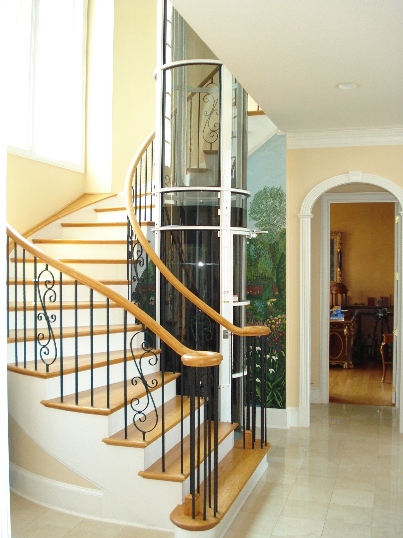
    vacuum-elevator-1A home elevator is set to become a practical transportation alternative to staircases with the development and production of vacuum elevators. Owning a home elevator is more feasible and cost effective with vacuum elevators because they take up a smaller amount of space compared to a traditional elevator and offer easy installation at an affordable price.
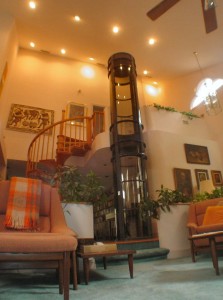
    Vacuum elevators are built from lightweight aluminum and polycarbonate material. Installing one inside a home is a simple task because these elevators do not require excavation for a pit or hoist. A vacuum elevator occupies just one square meter of floor space and can easily fit inside any two story home. It only takes a few hours to install and does not require the same degree of maintenance that a traditional home elevator needs. The best part is that a vacuum elevator can be installed in a home at a much lower cost than a traditional elevator.

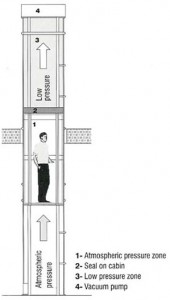
    Using a vacuum elevator is completely safe. It is designed to use a difference in air pressure to move the elevator cab up and down. There are separate atmospheric pressure and low pressure zones and a vacuum pump moves the air to make the lift elevate or descend. No cables are needed to control it. Using air instead of mechanical components to start and stop the elevator creates a smooth starting and stopping motion. The elevator also uses locks to hold the cab exactly at floor level each time it stops.

    vacuum-elevator-2vacuum-elevator-3Residential vacuum elevators hold much less weight than traditional commercial elevators. They are only rated to carry up to 450 pounds, which is more than enough for residential use. This type of elevator operates just as safely as a traditional elevator.
    Daytona Elevator is the leading distributor of these new residential vacuum elevators. The Florida based company already offers a whole range of home transportation devices. These products include stair lifts, curved stair lifts, vertical stair lifts, dumbwaiters and traditional home elevators. With this latest offering of vacuum elevators, Daytona Elevator is helping the future meet the present in a way that benefits consumers looking for home transportation solutions.

    Go to http://www.daytonaelevator.com for more info…


  • The Development of Mobile Phones

    The Development of Mobile Phones

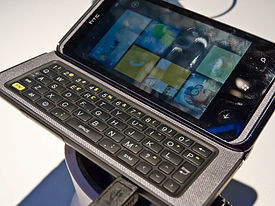
    HTC_7_ProThe developement of mobile phones has become so fast that it is difficult to keep up with it. If we look back at how it looked like in the past and where it is nowadays it is incredible to see how it has changed. With all their benefits they have become an irreplacible parts of our lives.

    Basics:

    A mobile phone (also known as a cellular phone, cell phone and a hand phone) is a device which can make and receive telephone calls over a radio link whilst moving around a wide geographic area. It does so by connecting to a cellular network provided by a mobile network operator. The calls are to and from the public telephone network which includes other mobiles and fixed-line phones across the world. By contrast, a cordless telephone is used only within the short range of a single, private base station. [1]
    The history of mobile phones charts the development of devices which connect wirelessly to the public switched telephone network. Early devices were bulky and consumed high power and the network supported only a few simultaneous conversations. Modern cellular networks and microprocessor control systems allow automatic and pervasive use of mobile phones for voice and data communications. [2]
    Before cellular phones existed there where several mobile solutions available for example Push to Talk(PTT) Mobile Telephone System(MTS) and Advanced Mobile Telephone Service(AMTS) to name a few. The …As far back as the late 1930’s Radiophones where a very important and vital means of mobile communication for the armed forces. When Analogue mobile phones where first launched they quickly became known as cellphones because they allowed the mobile phone user to travel between cell sites. Motorola the american corporation is widely believed to be the first manufacturer in the world to produce portable mobile phones that did not rely on a motor vehicle for its power. The first mobile phone call to be made on a portable phone was early in the 1970’s.
    When did mobile phones enter the consumer market place?Once the strong far Eastern manufacturers saw how rapidly mobile phone usage was growing and being taken up by the consumer as well as being a ‘must have’ business tool, they lost no time in mounting a serious challenge including such manufacturers as Sony Ericcson, Sharp, LG. Panasonic, Samsung, NEC and many more.
    Since the early 1990’s researchers have realised the potential of incorporating other devices into mobile phones. The camera was recognised as a very beneficial device to include. The first patent was filed as far back as 1994 by AT&T and it is claimed that the first mobile camera phone was invented in 1997 by Phillipe Kahn. By 2007 85% of mobile phones manufactured had a camera included and they are now referred to as camera phones. [3]
    As early as 1947, it was realized that small cells with frequency reuse could increase traffic capacity substantially and the basic cellular concept was developed. However, the technology did not exist.
    1953 -AT&T proposed to the FCC a broadband mobile telephone system to operate in the 800 MHz region.
    1970 -FCC announced a tentative allocation of 75 MHz in the 800 MHz region and invited industry to submit proposals for achieving communication objectives and demonstrating feasibility.
    1971 -AT&T responds with a technical report asserting feasibility by detailing how a “cellular system” might be composed. No other proposed systems were submitted to the FCC.
    1974 -FCC makes a firm allocation of 40 MHz for mobile telephone service and solicited applications for developmental Systems to prove the feasibility of so-called “Cellular Systems” but because of the beginnings of Bell Systems divestiture proceedings, ruled that Western Electric could not manufacture cellular terminal equipment. This was because Western Electric makes the network equipment and the restriction from selling both terminal and network products was to prevent further monopolization.
    1975 -AT&T applied for authorization to operate a developmental cellular system in Chicago.
    1977 -License granted in March of 1977. Illinois Bell Telephone constructs and operates a developmental cellular system.
    1978 -Mid 1978 the Equipment Test phase commenced. The Service Test-phase started in late 1978. Twenty-one hundred mobile sets were procured from three suppliers for the test and the system served over 2000 trial customers.
    1981 -FCC issues standard rules and due to the direction already taken, In the Bell System divestiture proceedings, now rules that Western Electric is permitted to manufacture cellular terminals as well as the network equipment.
    In the years between 1974 and 1981, AT&T Bell Labs worked with all other cellular terminal vendors to develop their cellular phones so that consumers would have quality products available to use on the cellular network. [4]
    The definition of an approach supporting an End-User in the development of mobile applications is a hard task because of the characteristics and the limitations of mobile device interfaces. In this paper we present an approach and a tool to enable End-Users to visually compose their own applications directly on their mobile phone. To this aim, a touchable interface and an ad-hoc visual language have been developed, enabling the user to compose simple focused applications, named MicroApps. The user has not in charge the creation of the user interface that is automatically generated. [5]

    Conclusion:

    It is amazing to observe the development of mobile phones  considering their from where they started. The technology experts’ ideas are running wild bringing us some mobile phone novelties constantly and we are left only to keep imagining what is next to come.

    References:

    [1] http://en.wikipedia.org/wiki/Mobile_phone
    [2] http://en.wikipedia.org/wiki/History_of_mobile_phones
    [3] http://www.ukphoneshop.com/news/general-interest/the-history-and-the-development-of-mobile-phones-mobile-phone-networks-and-mobile-ph/829/
    [4] http://inventors.about.com/gi/dynamic/offsite.htm?site=http://www.wave-guide.org/archives/waveguide_3/cellular-history.html
    [5] ”MicroApps Development on Mobile Phones” Stefania Cuccurullo, Rita Francese, Michele Risi and Genoveffa Tortora