Category: Technology

  • The Next Generation IT Security System

    The Next Generation IT Security System

    Spies, communication, and secret codes! Cryptography is the art of encrypting and decrypting messages. It has existed as long as people have distrusted each other and looked for the forms of secure communication. Cryptographic techniques have evolved over the centuries. The aim is always the same – the code-makers work to stay ahead of the code-breakers. Today’s most common encryption methods are threatened by the potential creation of the quantum computer. In other words, quantum cryptography promises more secure communication than any existing technique.

    Introduction

    Quantum cryptography is focused on the unique behavior of microscopic objects which enable users to securely develop secret keys. The work on quantum cryptography was begun by Stephen J. Wiesner in the late 1960’s. The first protocol for sending a private key using quantum techniques is published in 1984 by Bennett and Brassard. The development of quantum cryptography is based on “public-key

  • The Fuel of the Future

    The Fuel of the Future

    It seems it came time to say goodbye to gasoline. As it is known, the petroleum resources are running out and very soon we will stay without them. Also, it pollutes air and it causes a great risk to human’s health. And finally, there is a money concerns. People are no longer willing to pay high prices that oil companies are charging for it. And why should they, if there are a lot of different alternative sources of energy. Automotive industry knows all of this and it is investing a lot of time and money to find and develop the fuel of the future.

    The search is on, but what will the fuel of the future be? Believe or not, the answer is simple. An air! It’s all around us. It’s free. And most importantly, it is not polluting. Sounds unbelievable, we know. But, it is not that simple as it appears.

    ­­Unluckily, air alone cannot be used as a fuel. First of all, energy has to be stored in it by squeezing the air using a mechanical air compressor. Once the compressed air is released, it expands. The expanding air can be used to drive the pistons that power an engine.

    Amazingly, the idea of using compressed air to power a vehicle is not new. Early prototypes of an air-powered vehicle were constructed before the invention of the internal combustion engine.

    air car

    How Compressed Air Can be Used as a Fuel?

    ­By the laws of physics, uncontained gases will fill any given space. On the other hand, compressing a gas into a small space is a way to store energy. When the gas expands again, that energy is released to do work. That’s the basic principle which governs an air car.

    It is expected that the first air cars will have air compressors built into them. After a drive, you’ll be able to take the car home, put it into the garage and plug in the compressor. The compressor will use air from around the car to refill the compressed air tank. Unfortunately, this is a rather slow method of refueling. It will probably take up to two hours for a complete refill. If this idea catches on, air refueling stations will become available at ordinary gas stations. Filling your tank at the pump should probably take about 3 minutes.

    How Compressed Air Car Can be Caracterised Nowadays?

    Today’s compassed air cars are far from perfect. As anything else, this technology has its advantages and disadvantages. Here are the main pluses and minuses of this technology.

    Pluses

    1. It uses no gasoline or other bio-carbon based fuel.

    2. Refueling could be done at home using an air compressor or at service stations. The energy required for compressing air is produced at large centralized plants.

    3. Compressed air engines reduce the cost of vehicle production, because there is no need to build a cooling system, spark plugs, starter motor, or mufflers.

    4. The rate of self-discharge is very low opposed to batteries that deplete their charge slowly over time. Therefore, the vehicle may be left unused for longer periods of time than electric cars.

    5. Expansion of the compressed air lowers its temperature; this may be exploited for use as air conditioning.

    6. Reduction or elimination of hazardous chemicals such as gasoline or battery acids/metals

    7. Some mechanical configurations may allow energy recovery during braking by compressing and storing air.

    Minuses

    1. The principal disadvantage is the indirect use of energy. Energy is used to compress air, which – in turn – provides the energy to run the motor. Any conversion of energy between forms results in loss.

    2. When air is compressed to fill the tank, its temperature increases up. If the stored air is not cooled while the tank is being filled, then when the air cools off later, its pressure decreases and the available energy decreases.

    3. Refueling the compressed air container using a home or low-end conventional air compressor may take as long as 4 hours, though specialized equipment at service stations may fill the tanks in only 3 minutes.

    4. The overall efficiency of a vehicle using compressed air energy storage, using the above refueling figures, is around 5-7%. For comparison, well to wheel efficiency of a conventional internal-combustion drivetrain is about 14%.

    Conclusion

    Despite these drawbacks, big car companies are still exploring the use of compressed air in a hybrid drivetrain setup. Compressed air vehicles are also remarkably quiet and, discounting the air compressors themselves, produce absolutely no emissions. They’re also very, very cheap to operate. This could make them ideal city service vehicles. Until then, compressed air cars have a long, long way to go.

  • Challenges of Wireless Cryptography

    Challenges of Wireless Cryptography

    As companies and individuals increasingly use wireless technologies for their significant communications, they also must be assured of security using proper cryptographic algorithms. The major fields of applications are mobile e-commerce transactions, e-mails and corporate data transaction. On the other hand, as wireless systems grow in popularity and carry valuable information, hackers are directing their attacks on these novel targets. The need for secure wireless transport of audio, video and data across wide area networks has become crucially important for almost everyone. This is a great issue because wireless devices were not originally designed with security as a top priority. Nowadays, wireless security is becoming a very important and challenging area of research and development. In this article we discuss the potentials of wireless security protocols (WEP, WPA and WPA2/802.11i) used today and security aspects of wireless communication systems as well.

    Introduction

    Mobility and broadband media services are two crucial demands of modern telecommunication networks. The fast progress in wireless communication systems, smart card technologies and personal communication systems provides new opportunities and challenges for scientist and engineers working on the security problems of new communication systems and technologies. In general, public-key cryptography offers a lot of solutions to many of concerning security problems in communication systems. However, big computational requirements have limited the use of public-key cryptography on wireless communication systems.

    Encryption mechanisms can be classified as: symmetric or asymmetric. The both are of static state. A new approach follows the stream key generation mechanism, which involves time dimension into the key generation and brings up dynamic keys, one per each data record. The symmetric key is taken into consideration, but in a dynamic streaming environment. A static key is generated once and stored at location for performing encryption later. On the other hand, a dynamic key is initialized by a central authority.

    In WLANs, privacy is obtained by data protected with encryption. Without encryption, any other standard wireless device can read all traffic in network. There are three major generations of security approaches:

    (1)   WEP (Wired Equivalent Privacy),
    (2)   WPA (Wi-Fi Protected Access),
    (3)   WPA2/802.11i (Wi-Fi Protection Access, Version 2).

    Each of these protocols can have name that is personal and enterprise template. In this article, it will be listed and explained the main sorts of wireless protocols.

    Wired Equivalent Privacy (WEP)

    Wired Equivalent Privacy (WEP) is a security algorithm for IEEE 802.11 wireless networks. Introduced in September 1999, its intention was to provide data confidentiality comparable to that of a traditional wired network. WEP is recognized thanks to the key of 10 or 26 hexadecimal digits. It is widely in use and is frequently the first security option given to users by router configuration tools.

    In the sender side, WEP uses four operations to encrypt the data (plaintext). Firstly, the secret key used in WEP algorithm is 40-bit long and has a 24-bit Initialization Vector (IV). This vector is focused to acting as the encryption/decryption key. At second, the resulting key behaves as the seed for a Pseudo-Random Number Generator (PRNG). Thirdly, the plaintext is put into a integrity algorithm and focuses using the plaintext again. Fourthly, the result of key sequence and IV will go to RC4 algorithm. In other words, a final encryption message is made by attaching the IV in front of the Cipher text.

    In the recipient side, WEP uses five operations to decrypt the received side (IV + Cipher text). Firstly, the Pre-Shared Key and IV are used to form a secret key. At second, the Cipher text and Secret Key go to CR4 algorithm and as a result there is a plaintext. At third, the IV and plaintext will separate. Fourthly, the plaintext goes to Integrity Algorithm to make a new IV and finally the new IV compared to original IV.

    Two methods of authentication may be applied to WEP: Open System authentication and Shared Key authentication. Here will be discussed WEP authentication in the Infrastructure mode which is between a WLAN client and an Access Point. All this can be applied to the Ad-Hoc mode as well. In Open System authentication, the WLAN client need not provide its credentials to the Access Point during authentication. Any client can authenticate with the Access Point and then attempt to associate. In fact, no authentication happens. WEP keys can be used for encrypting data frames. The client must have the correct keys.

    In Shared Key authentication, the WEP key is used for authentication in a four step challenge-response handshake:

    1.   The client sends an authentication request to the Access Point.

    2.   The Access Point replies with a clear-text challenge.

    3.   The client encrypts the challenge-text using the configured WEP key, and sends it back in another authentication request.

    4.   The Access Point decrypts the response. If this matches the challenge-text the Access Point sends back a positive reply.

    After all this, the pre-shared WEP key is also used for data frames encryption using RC4. At first glance, it might seem that Shared Key authentication is more secure than Open System authentication, although the latter offers no real authentication. But, it is quite the opposite. It is possible to derive the key-stream used for the handshake by capturing the challenge frames in Shared Key authentication. It has been advised to use Open System authentication for WEP authentication, rather than Shared Key authentication.

    The major weaknesses and enhancements of WEP protocol are given in reference [1] and are as follows:

    1.   WEP does not prevent forgery of packets.
    2.   WEP does not prevent replay attacks. An attacker can simply record and reply packets as desired and they will be accepted as legitimate.
    3.   WEP uses RC4 improperly. The used keys are very weak and can be brute-forced on standard computers quickly using freely available software.
    4.   WEP re-uses IVs. Many cryptanalytic methods can decrypt data without knowing the encryption key.
    5.   WEP allows an attacker to undetectably modify a message without knowing the encryption key.
    6.   Key management is lack and updating is poor.
    7.   Problem in the RC4 algorithm.
    8.   Easy forging of authentication messages.

    Implemented non-standard fixes of WEP protocol are as follows:

    I. WEP2

    This stopgap enhancement to WEP was present in some of the early 802.11i drafts. It was implementable on some (not all) hardware not able to handle WPA or WPA2, and extended both the IV and the key values to 128 bits. It was hoped to eliminate the duplicate IV deficiency as well as stop brute force key attacks. After it became clear that the overall WEP algorithm was deficient (and not just the IV and key sizes) and would require even more fixes, both the WEP2 name and original algorithm were dropped. The two extended key lengths remained in what eventually became WPA’s TKIP.

    II. WEP plus

    WEP plus, also known as WEP+, is a proprietary enhancement to WEP by Agere Systems (formerly a subsidiary of Lucent Technologies) that enhances WEP security by avoiding “weak IVs”. It is only completely effective when WEP plus is used at both ends of the wireless connection. As this cannot easily be enforced, it remains a serious limitation. It also does not necessarily prevent replay attacks, and is ineffective against later statistical attacks that do not rely on weak IVs.

    III. Dynamic WEP

    Dynamic WEP refers to the combination of 802.1x technology and the Extensible Authentication Protocol. Dynamic WEP changes WEP keys dynamically. It is a vendor-specific feature provided by several vendors such as 3Com. The dynamic change idea made it into 802.11i as part of TKIP, but not for the actual WEP algorithm.

    Wi-Fi Protected Access (WPA)

    Wi-Fi Protected Access (WPA) and Wi-Fi Protected Access II (WPA2) are two security protocols and security certification programs developed by the Wi-Fi Alliance to secure wireless computer networks.

    WPA became available in 2003. The Wi-Fi Alliance intended WPA as an intermediate measure to take the place of WEP pending the availability of the full IEEE 802.11i standard. WPA could be implemented through firmware upgrades on wireless network interface cards designed for WEP. Since the changes required in the wireless access points (APs) were more extensive than those needed on the network cards.

    The WPA protocol implements much of the IEEE 802.11i standard. Specifically, the Temporal Key Integrity Protocol (TKIP) was adopted for WPA. WPA also includes a message integrity check. This is designed to prevent an attacker from capturing, altering and/or resending data packets. This replaces the cyclic redundancy check (CRC) that was used by the WEP standard. WPA uses a message integrity check algorithm called Michael to verify the integrity of the packets.

    Wi-Fi Protection Access, Version 2 (WPA2)

    WPA2 has changed WPA. WPA2 demands testing and certification by the Wi-Fi Alliance and uses the mandatory elements of IEEE 802.11i. In particular, it introduces CCMP, which is a new AES-based encryption mode with strong security. After only several years, WPA2 certification is mandatory for all new devices to bear the Wi-Fi trademark. The Wi-Fi Alliance intended it as an intermediate measure in anticipation of the availability of the more secure and complex WPA2. WPA2 became available in 2004 and is common shorthand for the full IEEE 802.11i (or IEEE 802.11i-2004) standard.

    Conclusion

    Wireless and mobile networks are rapidly extending their capabilities. In addition to their increasing bandwidth and because of their flexibility and freedom they are becoming the communication infrastructure of choice. Wireless communication provides a user the capability of conducting commerce at anytime, with nearly anyone, from anywhere, using a mobile communication channel. This mobile communication channel can also be used as an access method to the Internet.

    References:

    1.   Cryptography and Network Security: Principles and Practice, William Stallings, Prentice-Hall, Inc., New Jersey, 1999.
    2.   Designing and Developing 802.11n Wireless Networks, Jim Geler, Cisco Systems, Inc., 2010.
    3.   Wireless Mesh Networking: Architectures, Protocols and Standards, Yan Zhang, Jijun Luo, Honglin Hu, Auerbach Publications, Taylor & Francis Group, New York, 2007.
  • The Future of Energy Transmission is Wireless

    The Future of Energy Transmission is Wireless

    Try to imagine a simpler life. The life without wires. Try to imagine you are recharging your laptop computer, your mobile phone or even your car on the road so conveniently as surfing the Internet – wirelessly. Well, the future came few years ago. The scientist from MIT made an experiment which will change the world forever!

    It was 2007. The group of physicists led by Professor Marin Soljacic successfully made the first efficient non-radiative power transfer at a distance of 2 meters turning on a 60 W light bulb. Energy transfer was 40% efficient. The rest is the history! This work in wireless energy transfer is related to the work of Nikola Tesla at the beginning of 20th century. However, it has some significant differences. Unlike Tesla’s unsuccessful efforts at long-range wireless energy transfer, the MIT group focuses only on short-range transfer. On the other hand, Tesla coils resonantly transfer power with electric fields, while the MIT experimental set up uses coupling primarily via magnetic fields.

    MarinSoljacic
    Innovation & Science In Practice: How Can We Transmit Power Wiressly..?

    All the great things in this world are simple, so that’s how Soljacic’s story begins. Like many of us, Soljacic often forgets to recharge his mobile phone, and when it is about to die it emits an unpleasant noise. “Needless to say, this always happens in the middle of the night,” he said. “So, one night, at 3 AM, it came to me: Wouldn’t it be great if this thing charged itself?” He began to wonder if any of the physics principles he knew of could turn into new ways of transmitting energy.

    Let’s have a closer look at this experiment!

    As it is known, wireless transmission of energy has challenged scientists and engineers throughout history. This phenomenon takes place in any system where electrical energy is transferred from a transmitter, to single or multiple receivers, without the use of wires. At moderate distances, non-radiative energy transfer occurs. It involves the use of stationary electromagnetic fields around the coils rather than fields that spread in all directions.

    Let’s explain this better! When two coils are out of range of one another’s electromagnetic fields, there is no energy transfer as the fields around the coils are not strong enough to interact over large distances. Similarly, if two isolated coils oscillate at different frequencies, no power transfer will occur. On the other hand, if two resonating coils, with the same frequency fields, are placed within a few meters of each other, streams of energy move from the transmitting coil to the receiving coil. One coil can simultaneously send energy to several receiving coils, as long as they all resonate at the same frequency.

    If a coil generates electromagnetic waves in a highly angular waveguide, which is a structure which guides waves, this will cause the emitting of evanescent waves. Evanescent waves are near-field standing waves that have exponential decay with distance. If a proper resonant waveguide is brought near the transmitter, the evanescent waves can allow the energy to tunnel to the power drawing waveguide.

    The efficiency of the system that contains two resonant coils and wirelessly transfers power can be appreciably improved by:

    1.   Silver-plating the coils, which should increase the amount of charge through the wire and directly affect the current intensity

    2.   Working with more elaborate geometries for the resonant objects.

    Everything started in 2007. But, what is happening today? The best review on how things go nowadays is given in the following video material.
    In conclusion … We do not need to imagine anything. The future is already here. We only need to face it up and enjoy the progress of the Human Kind.

    Image source.


  • A Scytale – Cryptography of the Ancient Sparta

    A Scytale – Cryptography of the Ancient Sparta

    We continue with the series of articles about cryptography. More precisely, this one can be defined as a brief review of its history and the most significant ciphering device of ancient world. The initial post about this topic can be found here.

    Going back through time, the Mankind always had the need to transform the message and to keep the information hidden. One of the oldest cryptography tools was a Spartan scytale. It is a tool used to perform a transposition cipher, consisting of a cylinder with a strip of parchment wound around it on which is written a message. The ancient Spartans and Greeks, in general, are told to have used this cipher to communicate during military campaigns.

    Scytale


    The idea of the scytale ciphering is as follows. The recipient uses a rod of the same diameter on which he wraps the parchment to read the message. It has the advantage of being fast and not prone to mistakes which is a necessary characteristic when on the battlefield. If not, it can be easily broken. Since the strip of parchment hints strongly at the method, the ciphertext would have to be transferred to something less suggestive.

    From indirect evidence, the scytale was first mentioned by the Greek poet Archilochus who lived in the 7th century B.C. The ancient Greeks used this cipher to communicate during military campaigns. Sender and recipient each had a cylinder of exactly the same radius. The sender wound a narrow ribbon of parchment around his cylinder. Then he wrote on it lengthwise. After the ribbon is unwound, the writing could be read only by a person who had a cylinder of exactly the same circumference.

    Imagine that each column wraps around the dowel one time that is the bottom of one column is followed by the top of the next column.

    For instance, the original message can be: kill king tomorrow midnight

    Wrapped message:

    k i l l k i n g
    t o m o r r o w
    m i d n i g h t

    Encoded message: ktmioi lmd lon kri irg noh gwt

    The key parameter in the scytale encryption is the number of letters that can be recorded on one wrap ribbon around the dowel. In the example, the maximum is 3, since there are 3 rows in the wrapped message. The last row was covered with blank spaces before the message was encoded. It is called the wrap parameter. If you don’t know the wrap parameter you cannot decode a message.

    In conclusion, the Spartan scytale is one of the earliest encryption devices in the history. It was used by the Spartan Military for encoding message sent between commanders. In modern cryptography techniques, the scytale can be replaced with appropriate matrix system. Using the similar approach, the message can be ciphered using that method.

  • Introduction to Cryptographic Basics

    Introduction to Cryptographic Basics

    Cryptography is the practice and study of techniques for secure communication in the presence of third parties. More generally, it is about constructing and analyzing protocols that overcome the influence of third parties and which are related to various aspects in information security such as data confidentiality, data integrity, authentication, and non-repudiation. Modern cryptography intersects the disciplines of mathematics, computer science, and electrical engineering. Applications of cryptography include ATM cards, computer passwords, and electronic commerce. In this article I introduce the Symmetry Law which can be useful for symmetric encryption of information.

    The Symmetry Law

    The symmetry of the set of the encrypted information is the characteristic that separates the set of such ciphered information into two identical or symmetric or mirrored parts. In binary logics, the symmetry is the property of XOR and XNOR functions. Some algorithms based on these two functions can produce the symmetric result. In the coming theorems all this will be explained and proved.

    Firstly, let start with the logic function XOR and XNOR and let prove their symmetry.

    Later, I will show how some ciphering algorithms based on these two functions or their combinations can be used for constructing the set of symmetric encrypted information.

    Exclusive-OR or XOR function

    Exclusive-OR or XOR function can be defined as follows. A true output (1) results if one, and only one, of the inputs to the gate is true (1). On the other hand, if both inputs are false (0) or both are true (1), a false output (0) results. Its behavior is summarized in the truth table. A way to remember XOR is “one or the other but not both”.

    The truth table of XOR function:

    xor truth table

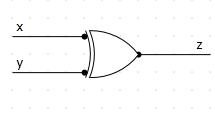
    The logic gate of XOR function is given in Figure 1.

    XOR Gate

    Figure 1. XOR gate drawn in Logic Circuit software

    As it is obvious from the truth table, an XOR function gives a set of symmetric output results for the different input combinations. That leads to conclusion that the XOR function is a symmetric function.

    Exclusive-NOR or XNOR function

    Exclusive-NOR or XNOR function is the inverse of the exclusive-OR or XOR function. It behaves according to its truth table. A high output (1) results if both of the inputs to the gate are the same. On the other hand, if one but not both inputs are high (1), a low output (0) results.

    The truth table of XNOR function:

    xnor truth table

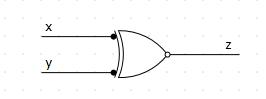
    The logic gate of XNOR function is shown in Figure 2.

    XNOR Gate

    Figure 2. XNOR gate designed in Logic Circuit software

    Theorem 1:

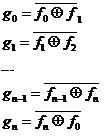
    Let assume that we observe a set of a-bit binary information, where a ≥ 3. The set of information contains different combinations of 0s and 1s. In that case, the source message can be represented using the weight coefficients. This is given in Equation (1).

    eq1

    Where:

    n – the highest value of the weight coefficient for the message; n ≥ 2,

    f – the weight coefficient for the message.

    Let also assume that an encrypted message or a cipher can be presented as array of the weight coefficients, where number of digits for the message and number of digits for the cipher are the same. This is shown in Equation (2).

    eq2

    Where:

    n – the highest value of the weight coefficient for the cipher; n ≥ 2,

    g – the weight coefficient for the cipher.

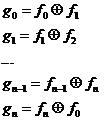
    If the following algorithm (3) is applied, as a result the symmetric or mirrored set of encrypted or ciphered information will be gotten.

    eq3

    The Proof:

    The law will be proved using the case of the set of 4-bit binary information.

    The set of 4-bit binary information:

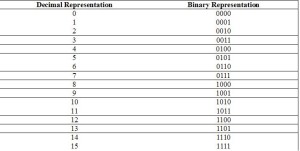
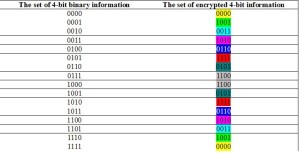
    Let observe the set of 4-bit binary information, which consists of 4 bits of information and has 2ª = 16 combinations. In this case, a number of bits or digits is a = 4. These combinations cover the set of the following decimal numbers: from 0 to 2ª – 1 = 15. All these combinations are given in Table 1 as follows.

    Table 1.

    table1

    Solution:

    The results of such a provided ciphering process are given in Table 2. It is obvious that the set of the encrypted information is completely symmetric or mirrored, which is the consequence of the symmetric nature of XOR logic function. Table 2 is shown as follows.

    Table 2.

    table2

    Theorem 2:

    Let assume that we observe a set of a-bit binary information, where a ≥ 3. The set of information contains different combinations of 0s and 1s. In that case, the source message can be represented using the weight coefficients. This is given in Equation (3).

    eq4

    Where:

    n – the highest value of the weight coefficient for the message; n ≥ 2,

    f – the weight coefficient for the message.

    Let also assume that an encrypted message or a cipher can be presented as array of the weight coefficients, where number of digits for the message and number of digits for the cipher are the same. This is shown in Equation (4).

    eq5

    Where:

    n – the highest value of the weight coefficient for the cipher; n ≥ 2,

    g – the weight coefficient for the cipher.

    If the following algorithm (5) is applied, as a result the symmetric or mirrored set of encrypted or ciphered information will be gotten.

    eq6

    The Proof:

    The law will be proved using the case of the set of 4-bit binary information.

    The set of 4-bit binary information:

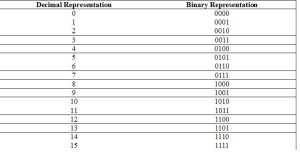
    Let observe the set of 4-bit binary information, which consists of 4 bits of information and has 2ª = 16 combinations. In this case, a number of bits or digits is a = 4. These combinations cover the set of the following decimal numbers: from 0 to 15. All these combinations are given in Table 3 as follows.

    Table 3.

    table3


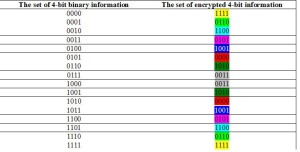
    The results of such a provided ciphering process are given in Table 4. It is obvious that the set of the encrypted information is completely symmetric or mirrored, which is the consequence of the symmetric nature of XNOR logic function. Table 4 is illustrated as follows.

    Table 4.

    table4

    Conclusions

    This article provides a brief review of the results the author got during her research. The author plans to continue her research and to publish her findings into this magazine. The initial step has been made and the facts about the Symmetry Law have been shared with the audience. This is not the final version of the law, only the initial step. As research goes further, the author will be that free to publish the results.

    Reference:

    1.   Digital Systems – Principles and Applications, Ronald J. Tocci & Neal S. Widmer, Prentice-Hall International, Inc., 1998.

  • Tools of the Future

    Tools of the Future

    Like they say, a carpenter is only as good as his tools – and this sentiment stands true in almost every profession we work in. Whether it’s something as simple as a pen and paper or more complex scientific equipment, we rely heavily on tools in both our personal and business lives. So what lies in the not-so-distant future? We take a look.

    Technology tools

    One type of technology that has been verging on the edge of mainstream usage for the past couple of years is holograms. Web-conferencing tools such as Skype have become a home and office staple – but could we soon be seeing people in three dimensions? The technology is there – it has been used to great effect particularly in music concerts as well as at some airports – so it’s not a question of if they will , but when will holograms become the norm.


    Holograms
    Credit: Image courtesy of: Science Daily


    The biggest changes in technology tools are predicted to come in the form of communication. It’s hard to imagine life without the internet – and it’s only been properly available for less than 20 years. As communication channels become faster and more powerful, the need for on-site offices will diminish and people will increasingly work from home.


    Tools for future disasters

    There’s nothing we can do to prevent natural disasters, but we can minimise the damage caused. In recent years, geographical information systems (GIS) have been crucial to pre- and post- disaster management, and this area is certainly one that will continue to advance, grow, and save millions of lives.


    Credit: Image courtesy of: NYTimes


    Aside from complex GIS software, innovative scientists and inventors are hard-at-work creating real-life tools that can save lives on the ground when disaster strikes. One of the most positive creations has been developed by a Japanese engineering company. After surviving the devastating 2011 earthquake and tsunami in Japan, they have designed survival pods, called ‘Noah’, which work like buoys; up to four people can get inside them and float atop a tsunami for up to two hours, potentially saving their lives.


    Hand tools

    There will always be a place for the good ol’ hammer and nail (although you never know), but with everything else seemingly going digital or robotically-driven, what is the future for hand tools?


    ToolBloke
    Credit: Image courtesy of: Tool Bloke


    Already, robots are taking over a lot of manual labour, particularly in large factories such as car manufacturing plants. They are more efficient and after the initial costs, are cheaper to run.


    But there is still room for something else lying somewhere between robots and humans. This is most evident in the fast developing technology in the world of medical science. To overcome the problem of health practitioner shortages, particularly in remote areas, robotic surgery is becoming the next big thing. A surgeon doesn’t even need to be in the room to perform complex surgeries. The technology is already being used, but there is still huge room for growth, with millions being invested into it.


    Credit: Image courtesy of: Wired


    As Guang-Zhong Yang from the Hamlyn Centre for Robotic Surgery said, ‘You have a human, which is pretty good in terms of decision-making, and learning. You have a robot, which is good at doing precise movements. Why not use a combination of both?’. Precisely. There’s plenty of space for the two of us – both in medicine and elsewhere.

  • Voice Analysis Software – Innovative or Invasive?

    Voice Analysis Software – Innovative or Invasive?

    A new voice analysis software that aims to decipher your inner feelings has made a splash into the innovative technology scene, with mixed reactions. In a case of machines helping machines, a computational voice analysis software created by a startup in Tel Aviv, Israel, can actually detect emotions in a person’s voice and share that through a machine. The phrase ‘it’s not what you say, it’s how you say it’ comes to mind.


    What can it do?


    The software is still in its early stages, but the developers say that it is able to determine whether or not a person’s happy attitude actually has frustration lying beneath it, or vice versa.

    Currently, the software can detect around 400 variations of different moods. Unlike other similar software, it doesn’t use trigger words such as ‘ridiculous’ or ‘outrageous’ to do its analysis, instead its algorithm is based on the tone and frequency of a voice.

    The software can also pinpoint a consumer’s personality, which can affect their purchasing habits. For example, if a person is conservative, a marketer or salesperson would want to offer them a product that is tried and tested, as opposed to an innovative person who might be more drawn to the latest products.


    Emotions - Ticketbis
    Image source: Ticketbis


    How was it developed?


    To develop the software, the emotions of over 70,000 people speaking in 30 different languages were analysed. The startup’s research was inspired by an Israeli study done in the 1990’s that looked at how babies understood and responded to the moods of adult speech prior to learning how to speak themselves.


    What can it be used for?


    Although there are several researchers that are developing similar products, the one created by said company, Beyond Verbal, is targetting call centres and customer service departments. By using the software, the people at the other end of the line can gain insight into a caller’s mood, intention and personality.

    For example, a customer may lodge a help ticket with a call centre, and while on the phone the operator can determine whether the caller is getting agitated, is upset or is genuinely happy – despite how they might first come across. This can help the operator treat the consumer accordingly.

    Going forward, the technology used in the software could potentially be used for a wide variety of situations, including within the legal system.

    Why doesn’t everyone love it?
    Despite the technology being undoubtedly clever, not everyone is so convinced. One key point that is raised is that the software can only determine a person’s mood at the time of that one phone call, which isn’t helpful for long-term customer relations.

    The issue of privacy also comes up. Not everyone would feel comfortable knowing that they are being analysed as they speak – and if they did, would they subconsciously act different, thus skewing results?

    With all new technology comes doubts and concerns. For every positive there is someone pointing out the negatives.


    Further reading:


    1. To infinity and Beyond Verbal: The Web app revolutionizing the science of voice analysis. Available at http://www.digitaltrends.com/social-media/exploring-beyond-verbal-the-technology-of-emotions-analytics/

    2. Beyond Verbal secures $2.8M, detects human emotions and character through voice recognition. Available at http://venturebeat.com/2013/05/09/beyond-verbal-secures-2-8m-detects-human-emotions-and-character-through-voice-recognition/

    3. Could voice analysis software give away lying CEOS? New system picks up tiny ‘tells’ which could warn investors of fraud. Available at http://www.dailymail.co.uk/sciencetech/article-2096153/Could-voice-analysis-software-away-lying-CEOS-Harvard-researchers-test-warn-investors-fraud-ahead.html


    Featured image source: Stanford University


  • Concrete: a thoroughly modern material

    Concrete: a thoroughly modern material

    450px-BlocosConcrete and cement. Words synonymous with solidity and well, staidness. Cement is probably the most ubiquitous building material of the late 20th century – yet it may provide some very 21st century surprises. Researchers at the University of Alicante have developed a cement material incorporating carbon nanofibres in its composition, turning cement into an excellent conductor of electricity. Similarly scientists from the USA, Japan, Finland and Germany have unraveled the formula for transforming liquid cement into liquid metal – opening up its use in the profitable consumer electronics marketplace for thin films, protective coatings, and computer chips.

    The warmer side of concrete

    Concrete is a composite material composed of coarse granular material (the aggregate or filler) embedded in a hard matrix of material (the cement or binder) that sets and hardens independently, filling the space among the aggregate particles and gluing them together. Concrete made from such mixtures was first used in Mesopotamia in the third millennium B.C. and later in Egypt. It was further improved by the Ancient Macedonians and three centuries later on a large scale by Roman engineers. They used both natural pozzolans (such as pumice) and artificial pozzolans (ground brick or pottery) in these concretes. Many excellent examples of structures made from these concretes are still standing, notably the huge dome of the Pantheon in Rome and the massive Baths of Caracalla. The vast system of Roman aqueducts also made extensive use of hydraulic cement.

    Misleadingly low, the Pantheon's exterior dome steps outwards as it meets the uppermost ring of the drum. Photo credit: Anthony M. Wikimedia Commons.

    Conventional concrete is a poor conductor of electricity. To obtain a cement-like compound that is effective as a heating element, it then should have a low resistivity. This has been achieved by the addition of conductive materials such as carbon fibres, for example. This new technology, developed and patented by the University of Alicante Civil Engineering Department’s Research Group in Multifunctional Concrete Conductors, allows, among other functions, the material to heat up due to the passage of current.

    The technology allows buildings’ premises to heat or prevents the formation of ice on infrastructure, such as highways, railways, roads, airstrips and other elements. In this way, a new conductive compound with much more interesting properties is achieved since it keeps the structural properties of concrete and does not compromise the durability of the structures themselves. This new product has a great versatility, since any existing structure or surface can be coated with it, keeping thermal control in it by applying continuous electric current. At present, the research group has developed trials to test the technology in plasters with carbonaceous materials. These tests have given very satisfactory results, obtaining optimal properties of heating the material with minimum energy consumption.

    21st century metallic-glass cement

    A team of scientists from the USA, Japan, Finland and Germany have made a metallic-glass cement. This new material has lots of applications, including as thin-film resistors used in liquid-crystal displays – basically the flat panel computer monitor that you are probably reading this from at the moment. The team have demonstrated how make and understand the cement-to-metal transformation, which has positive attributes including better resistance to corrosion than traditional metal, less brittleness than traditional glass, conductivity, low energy loss in magnetic fields, and fluidity for ease of processing and molding. Previously, only metals have been able to transition to a metallic-glass form. Cement does this by a process called electron trapping, a phenomena only previously seen in ammonia solutions. Understanding how cement joined this exclusive club opens the possibility of turning other solid normally insulating materials into room-temperature semiconductors.

    This phenomenon of trapping electrons and turning liquid cement into liquid metal was found recently, but not explained in detail until now. Now that the conditions needed to create trapped electrons in materials are known, other materials can be developed and tested to find out if we can make them conduct electricity in this way. The results were reported in the journal the Proceeding of the National Academy of Sciences in the articleNetwork topology for the formation of solvated electrons in binary CaO-Al2O3 composition glasses.”

    Close-up visualizations of (A) the HOMO and (B) LUMO single-particle electron states in the 64CaO glass. Both states are spin-degenerate, and h1 labels the cavity (cage) occupied by LUMO. Yellow and magenta stand for different signs of the wave-function nodes. (C) Simulation box and the electron spin-density of the 64CaO glass with one oxygen subtracted at h2—that is, with two additional electrons. The two electrons have the same spin and they occupy separate cavities, h1 (boundary, also shown in B) and h2 (center, location of removed oxygen), which are separated by 12 Å from each other. (D) Cage structure around the spin-density of one electron cor- responding to the h2 cavity (close-up from C). Al, gray; Ca, green; O, red.

    The team of scientists studied mayenite, a component of alumina cement made of calcium and aluminum oxides. They melted it at temperatures of 2,000 degrees Celsius using an aerodynamic levitator with carbon dioxide laser beam heating. The material was processed in different atmospheres to control the way that oxygen bonds in the resulting glass. The levitator keeps the hot liquid from touching any container surfaces and forming crystals. This let the liquid cool into glassy state that can trap electrons in the way needed for electronic conduction.

    The scientists discovered that the conductivity was created when the free electrons were “trapped” in the cage-like structures that form in the glass. The trapped of electrons provided a mechanism for conductivity similar to the mechanism that occurs in metals. To uncover the details of this process, scientists combined several experimental techniques and analyzed them using a supercomputer.

    These developments are sure to provide an impetus for a new look at old building material.

  • New technology to measure soil carbon

    New technology to measure soil carbon

    Carbon is a hot topic at the moment, particularly with Rudd’s plan to move from the Carbon Tax to an Emissions Trading Scheme. But while the politicians argue over the economic implications, researchers at the University of Sydney have developed an instrument that could help drive policy to deal with the environmental impacts of carbon.

    The Carbon Soil Bench measures carbon levels in the soil, cheaper, faster and more accurately than current methods. The Bench is essentially a large furnace on wheels that works by burning a sample of soil and measuring how much carbon dioxide is released. Because the Bench can take samples up to 2.5cm in diameter and a meter in length (up to 500 grams of soil), the variation in results common to current methods is reduced.

    Current methods use a point analysis on 0.5 grams of soil, requiring crushing and mixing samples in an attempt to produce a ‘representative’ sample. The 0.5 gram sample is then selected from this mix. The Bench, by contrast, can measure up to half a kilo at once, the process taking only 10 minutes.

    This technology is exciting as soil has the ability to store carbon (via sequestration), however measuring the capacity of soil to do so, until now, has been difficult. The Bench may pave the way for a more serious look at how Australian land can contribute to environmental improvements by capturing carbon.

    The team, Robert Pallasser, Professor Alex McBratney and Associate Budiman Minasy, have created a video of the bench in action, which can be viewed on youtube:

  • Google’s Conversational Voice Search Activated on Chrome

    Google’s Conversational Voice Search Activated on Chrome

    If you remember the article Conversations with Google, you may recall it’s been predicted that the next mode of interaction with Google search will be natural language conversation where Google will be able to follow the course of the conversation and provide new results and suggestions. Well, as of this Wednesday it’s become a reality.

    Google presented conversational voice search at Google I/O a week ago. It’s a kind of search designed to be more like natural language and human speech than the technically constructed search inquiries that people use daily to retrieve information.  You can just click the microphone in the search box, ask your question in a natural way, and get spoken answers. Conversational voice search is not a Chrome desktop version of Google Now, even if it might look like that; it has none of the predictive answers that Google Now provides.

    The conversational search feature has a natural language and semantic search integrated into it, and after the initial testing yesterday while it’s far from perfect, it presents one of those significant changes. Speaking your search into the box is not a new thing, but having a conversation with the search engine  and being able to search by voice is what makes the difference in the human-computer interaction. And being able to speak a search inquiry and getting an answer read back to you is pretty impressive. The feature is similar to how the Google Search App works for the iPhone or Android.

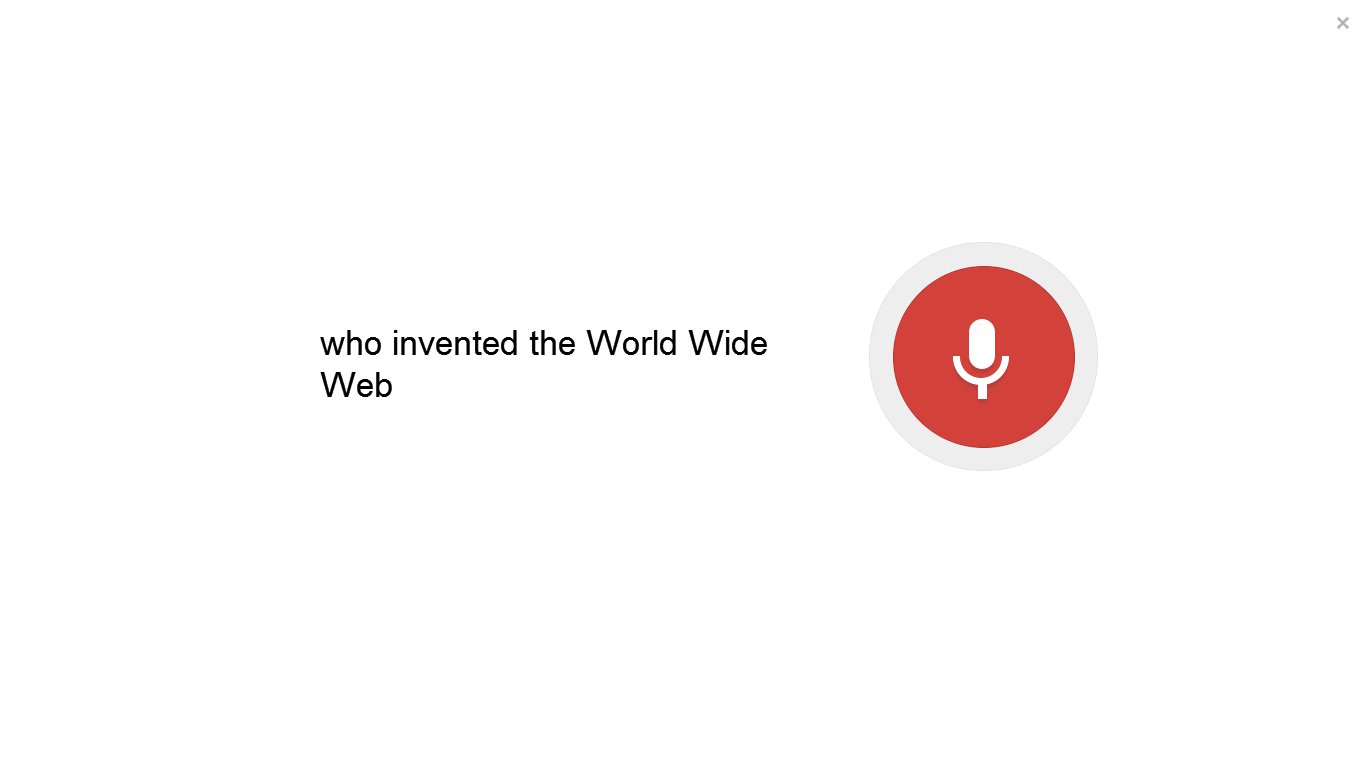
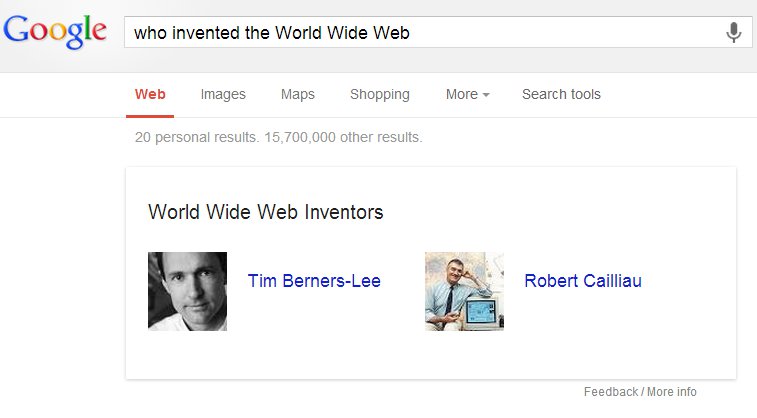
    As a test, I asked “Who invented the World Wide Web?”

    web

    The Chrome voice feature responded with correct answer, “Tim Berners-Lee and Robert Cailliau…”.

    web1

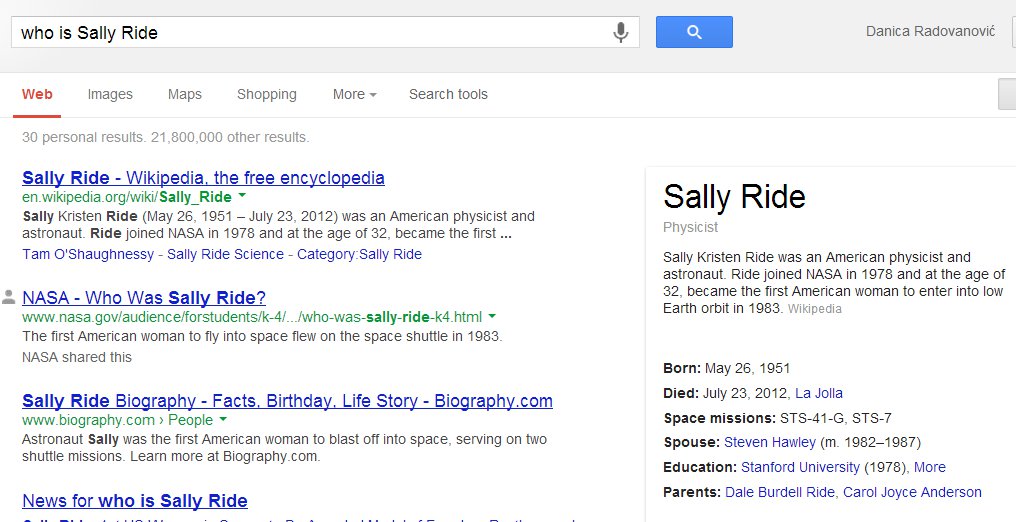
    Conversational voice search does not always work right as you go further on into a conversation. Chrome didn’t follow up with voice feedback on questions “Where the World Wide Web was invented?”. Other search inquiries such as “who is Sally Ride?” include voice feedback “According to Wikipedia…” and then Chrome provides a brief synopsis.

    ride

    For another test, a simple weather related inquiry, I asked, “What’s the weather like in Paris?” and then “Do I need umbrella for the weekend in Paris?”. I got back a full spoken report of today’s weather, along with a forecast for this weekend. What is really impressive is that you can continue with voice search by asking further questions in a way you could never do with regular search (i.e. you can use other references from previous inquiry).

    While not yet perfect, conversational search is still very appealing; we’ll see how this feature will be developed by engineers. The conversational search  question-and-answer feature is now available to users of  the latest version of Chrome 27 browser, which Google released this Tuesday.

  • Quantum computing: Australian researchers store data on a single atom!

    Quantum computing: Australian researchers store data on a single atom!

    Computers are everywhere these days. They play us music, tell us when to wake up, remind us that we’re late for an appointment, and provide us with entertainment. Even if we don’t realise it, so ingrained in our lives are computers that the world would be a very different place without them. Computing is also an incredibly fast moving field of technology, and research is finally taking us towards the exciting world of quantum computing!

    Quantum computers will work using quantum bits, or qubits for short, which are analogous to the digital bits used in computers like the one which you’re using to read this article. Recently, a team of engineers at the University of New South Wales (UNSW) has successfully demonstrated, for the first time ever, how a single atom can be act as a qubit, effectively showing the first step in building an ultra fast quantum computer. And they might just have created the best qubit ever made.

    A quantum computer is, simply, a computer which makes use of quantum mechanical phenomena to perform calculations. Well, I say “simply”… Let’s step back a moment. The simplest form of computers involve actual moving objects, and using the positions of those objects to perform calculations. This is essentially how an abacus works, if you’ve ever used one. The earliest computers to be designed, automated this process, using mechanisms. Charles Babbage’s famous, albeit never built, Analytical Engine worked on exactly this basic principle, and if it had been constructed it would have truly been the world’s first computer.

    Essentially, the way these old mechanical computers work is to use the positions of their mechanical parts to perform mathematical and logic functions. This is actually the fundamental way in which all computers work. Since the discovery of electricity and the invention of electronics, computers have worked using electric circuits – effectively using the position of electrons instead of the position of actual moving parts. As technology has progressed, computers have become faster, smaller, and more reliable, until the world around us today.

    In modern electronics, silicon is king. Silicon-based electronics are the standard used everywhere, though they’re reaching the limit of what they’re capable of. For the next generation of electronics, some people are beginning to advocate new materials, such as graphene, over silicon. But ultimately, others have a higher goal. Proponents of quantum computing believe that in the future, the most vital components of computers will not be electronics at all, but single atoms.

    In quantum mechanics, any single particle, from an electron to an atomic nucleus, has a set of properties which can often be changed quite easily. Where past computers used motion of mechanical parts and modern computers use motion of electrons, quantum computers will use changes in the properties of these particles to perform their calculations.

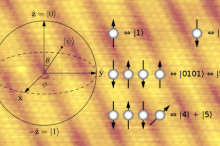
    One such quantum property is known as spin (the same property behind magnetism), and this is what the UNSW engineers managed to manipulate. They based their qubit on a single silicon atom and demonstrated how they used changes in the nuclear spin of the nucleus to store and retrieve information. Andrea Morello at UNSW’s School of Electrical Engineering and Telecommunications described how; “We have adapted magnetic resonance technology, commonly known for its application in chemical analysis and MRI scans, to control and read-out the nuclear spin of a single atom in real time.

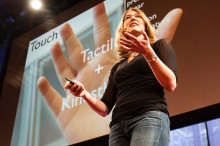
  • Haptography: The Technology of Touch

    Haptography: The Technology of Touch

    As we move through the world, we have an innate sense of how things feel — the sensations they produce on our skin and how our bodies orient to them. Can technology leverage this? In this fun, fascinating TED-Ed lesson, learn about the field of haptics, and how it could change everything from the way we shop online to how dentists learn the telltale feel of a cavity.

    Katherine Kuchenbecker works on incorporating the sense of touch directly into virtual objects. Imagine being able to feel textures on your digital screens.

    Is it possible to incorporate the sense of touch into the digital world?

  • Work, Play & Learn! Using libraries for Social Learning, Impact and Collaboration

    Work, Play & Learn! Using libraries for Social Learning, Impact and Collaboration

    The digital information and knowledge paradigm in the 21st century requires skills such as digital literacy, critical thinking, problem solving, skills in communication, and collaboration for overcoming present social and digital inequalities. Those skills go beyond pure technological affordances and they could easily be obtained through collaborative learning practices and social interaction between individuals from different backgrounds and areas of expertise.

    Libraries, as environments for social learning and collaboration, present facilitators of education and knowledge. With accelerating dissemination of information in a digital age, libraries emphasise their activities on providing an information commons. In other words, an informal interactive learning place that encourages its visitors to communicate, contribute, participate, and engage with the library. This new dynamic leads towards a collaborative, social construction, and sharing of information and knowledge.

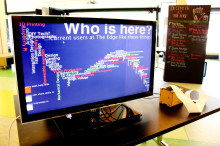
    One of the researchers at the Urban Informatics Research Lab at Queensland University of Technology (QUT), interaction designer and interactive technology developer Mark Bilandzic, explores how informal learning environments can support the social side of learning, as well as how smart space technology can be designed to enhance social learning among users? As a part of Bilandzic’s research, he designed a system with the purpose of enhancing awareness of opportunities for social learning and collaboration – called “Gelatine