Blog

  • Ocean Chemistry Unbalanced

    Ocean Chemistry Unbalanced


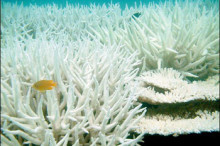
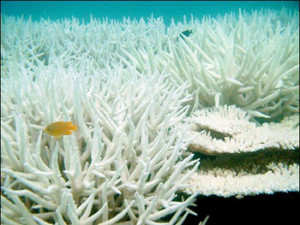
    Coral reef after a bleaching event. Source: © 2003. Reef Futures. Courtesy Ray Berkelmans, Australian Institute of Marine Science. Via www.lerner.org.
    Coral reef after a bleaching event. Source: © 2003. Reef Futures. Courtesy Ray Berkelmans, Australian Institute of Marine Science. Via www.lerner.org.

    Ocean acidification is a decrease in the pH of the oceans, caused by the uptake of CO2 from the atmosphere. It’s a problem; a real problem. One that marine ecologist Jane Lubchenco, head of the National Oceanic and Atmospheric Administration called global warming’s “equally evil twin.

  • How does the first “selfie

    How does the first “selfie

    On November 19, the Oxford Dictionaries announced that “selfie

  • The Future of Energy Transmission is Wireless

    The Future of Energy Transmission is Wireless

    Try to imagine a simpler life. The life without wires. Try to imagine you are recharging your laptop computer, your mobile phone or even your car on the road so conveniently as surfing the Internet – wirelessly. Well, the future came few years ago. The scientist from MIT made an experiment which will change the world forever!

    It was 2007. The group of physicists led by Professor Marin Soljacic successfully made the first efficient non-radiative power transfer at a distance of 2 meters turning on a 60 W light bulb. Energy transfer was 40% efficient. The rest is the history! This work in wireless energy transfer is related to the work of Nikola Tesla at the beginning of 20th century. However, it has some significant differences. Unlike Tesla’s unsuccessful efforts at long-range wireless energy transfer, the MIT group focuses only on short-range transfer. On the other hand, Tesla coils resonantly transfer power with electric fields, while the MIT experimental set up uses coupling primarily via magnetic fields.

    MarinSoljacic
    Innovation & Science In Practice: How Can We Transmit Power Wiressly..?

    All the great things in this world are simple, so that’s how Soljacic’s story begins. Like many of us, Soljacic often forgets to recharge his mobile phone, and when it is about to die it emits an unpleasant noise. “Needless to say, this always happens in the middle of the night,” he said. “So, one night, at 3 AM, it came to me: Wouldn’t it be great if this thing charged itself?” He began to wonder if any of the physics principles he knew of could turn into new ways of transmitting energy.

    Let’s have a closer look at this experiment!

    As it is known, wireless transmission of energy has challenged scientists and engineers throughout history. This phenomenon takes place in any system where electrical energy is transferred from a transmitter, to single or multiple receivers, without the use of wires. At moderate distances, non-radiative energy transfer occurs. It involves the use of stationary electromagnetic fields around the coils rather than fields that spread in all directions.

    Let’s explain this better! When two coils are out of range of one another’s electromagnetic fields, there is no energy transfer as the fields around the coils are not strong enough to interact over large distances. Similarly, if two isolated coils oscillate at different frequencies, no power transfer will occur. On the other hand, if two resonating coils, with the same frequency fields, are placed within a few meters of each other, streams of energy move from the transmitting coil to the receiving coil. One coil can simultaneously send energy to several receiving coils, as long as they all resonate at the same frequency.

    If a coil generates electromagnetic waves in a highly angular waveguide, which is a structure which guides waves, this will cause the emitting of evanescent waves. Evanescent waves are near-field standing waves that have exponential decay with distance. If a proper resonant waveguide is brought near the transmitter, the evanescent waves can allow the energy to tunnel to the power drawing waveguide.

    The efficiency of the system that contains two resonant coils and wirelessly transfers power can be appreciably improved by:

    1.   Silver-plating the coils, which should increase the amount of charge through the wire and directly affect the current intensity

    2.   Working with more elaborate geometries for the resonant objects.

    Everything started in 2007. But, what is happening today? The best review on how things go nowadays is given in the following video material.

    In conclusion … We do not need to imagine anything. The future is already here. We only need to face it up and enjoy the progress of the Human Kind.

    Image source.


  • A Scytale – Cryptography of the Ancient Sparta

    A Scytale – Cryptography of the Ancient Sparta

    We continue with the series of articles about cryptography. More precisely, this one can be defined as a brief review of its history and the most significant ciphering device of ancient world. The initial post about this topic can be found here.

    Going back through time, the Mankind always had the need to transform the message and to keep the information hidden. One of the oldest cryptography tools was a Spartan scytale. It is a tool used to perform a transposition cipher, consisting of a cylinder with a strip of parchment wound around it on which is written a message. The ancient Spartans and Greeks, in general, are told to have used this cipher to communicate during military campaigns.

    Scytale


    The idea of the scytale ciphering is as follows. The recipient uses a rod of the same diameter on which he wraps the parchment to read the message. It has the advantage of being fast and not prone to mistakes which is a necessary characteristic when on the battlefield. If not, it can be easily broken. Since the strip of parchment hints strongly at the method, the ciphertext would have to be transferred to something less suggestive.

    From indirect evidence, the scytale was first mentioned by the Greek poet Archilochus who lived in the 7th century B.C. The ancient Greeks used this cipher to communicate during military campaigns. Sender and recipient each had a cylinder of exactly the same radius. The sender wound a narrow ribbon of parchment around his cylinder. Then he wrote on it lengthwise. After the ribbon is unwound, the writing could be read only by a person who had a cylinder of exactly the same circumference.

    Imagine that each column wraps around the dowel one time that is the bottom of one column is followed by the top of the next column.

    For instance, the original message can be: kill king tomorrow midnight

    Wrapped message:

    k i l l k i n g
    t o m o r r o w
    m i d n i g h t

    Encoded message: ktmioi lmd lon kri irg noh gwt

    The key parameter in the scytale encryption is the number of letters that can be recorded on one wrap ribbon around the dowel. In the example, the maximum is 3, since there are 3 rows in the wrapped message. The last row was covered with blank spaces before the message was encoded. It is called the wrap parameter. If you don’t know the wrap parameter you cannot decode a message.

    In conclusion, the Spartan scytale is one of the earliest encryption devices in the history. It was used by the Spartan Military for encoding message sent between commanders. In modern cryptography techniques, the scytale can be replaced with appropriate matrix system. Using the similar approach, the message can be ciphered using that method.

  • Weekly Science Picks

    Weekly Science Picks

    Well, it’s my turn to pick my favourite science news this week on Australian Science. And I must apologise for being slightly late with this. The reason is that I’ve only just got home to Tokyo after spending all week in Taipei for a conference on interstellar dust! As with any good conference, it’s been fun and fascinating but also rather tiring. If anyone’s curious to know more about what went on, the twitter hashtag #lcod2013 is where myself and others were giving internet commentary over the past week.

    Also, between talks, twitter is where I heard most of this week’s worldwide science happenings. So here are a few of the things which caught my eye…


    Firstly, Katie Mack (a long term inspiration to me) wrote an article for The Research Whisperer on the perils of the academic lifestyle and being a science nomad – and how that affects your personal life. Being still very recently relocated to Japan myself, this strikes something of a chord with me. It’s worth reading for anyone considering a science career themselves. while I personally rather enjoy the nomadic nature of this job, it’s certainly not for everyone. And I have yet to see how I feel about it a couple more years down the line…

    Academic scattering

    As for me, I confess I haven’t figured it out. I have two years left on my contract in Australia and no idea whatsoever which country I’ll end up in next. I’m applying broadly, and there’s no guarantee I’ll have a choice about location if I want to stay on the path toward becoming tenure-track faculty at a major research institution. When it’s not unusual for a single postdoc job to have 300 applicants, and faculty jobs are even more selective, getting even one offer is considered a huge win.


    Moving on to life of a different kind, a brand new species has been discovered in the waters off the coast of California. And anyone who’s been reading my articles awhile will know how exciting I find the discovery of new species! This time around, it’s a somewhat scary looking new species of crustacean. Don’t worry though. It only eats copepods.

    New Alien-like Crustacean Species Identified in California Waters

    The frail crustacean, which is only a few millimeters in length, was discovered by scientists from the University of Seville in Spain and the Museum of Natural History in Canada, who had published a taxonomic description of the new species in the journal Zootaxa.


    Meanwhile in space… When people talk of space stations and lasers, a lot of us will immediately think of Star Wars. Or whatever other sci fi we might prefer. However, up in orbit around Earth, our own space station is preparing to use lasers for a rather less destructive purpose – to transmit video back to use down here on the ground.

    Pew! Pew! Laser On The Space Station Will Beam Video To Earth

    “Optical communications (also referred to as ‘lasercomm’) is an emerging technology wherein data is modulated onto laser beams, which offers the promise of much higher data rates than what is achievable with radio-frequency (RF) transmissions.

  • The Health Risks of Energy Drinks

    The Health Risks of Energy Drinks

    The slim-lined cans promise an energy hit that will have you flying through your day of study, work or play. Energy drinks are now a popular choice for teenagers and young adults as opposed to a good old cup of coffee. One study found energy drinks are consumed by 30-50% of adolescents and young adults (Seifert SM, Schaechter JL, Hershorin ER and Lipshultz SE). But do these fizzy, sugary and caffeine-loaded “supplements

  • The Future of Fertility Treatment: Advanced Embryo Selection

    The Future of Fertility Treatment: Advanced Embryo Selection

    It is incredible just how far science and technology have come over the last few decades. In the past, men and women with fertility problems had very few options. Nowadays, there are more options than ever before and fertility treatments are becoming increasingly advanced and reliable.

    The latest breakthrough in fertility treatments is here in Australia, where a new technique in preimplantation genetic diagnosis (PGD) technology, called Advanced Embryo Selection has shown promising results in reducing a woman’s risk of miscarriage.


    What is Advanced Embryo Selection (AES)?

    Up to 70 per cent of embryos created are abnormal, meaning that they will not result in a healthy baby being born. AES is a form of preimplantation genetic diagnosis, which refers to genetic profiling of embryos prior to transfer into a patient. Advanced Embryo Selection is a new, more advanced PGD technique that allows scientists to select the best embryos for implantation in advance, decreasing the risk of miscarriage and increasing IVF pregnancy rates by up to 65%.


    How does Advanced Embryo Selection Work?

    Prior to implantation, all 24 chromosomes of a developing embryo are screened to determine whether or not there are any extra or missing chromosomes, which would inhibit a successful pregnancy.

    By studying the individual chromosomes, scientists can identify whether or not a particular embryo would potentially result in a miscarriage, would not initiate a pregnancy at all or might result in birth defects such as Down Syndrome.

    It takes approximately 36 hours to do the tests that will determine the potential success rate of an embryo. It is claimed to be the world’s fastest and most precise embryo selection test available.


    Benefits of Advanced Embryo Selection

    While typical non-selective lVF treatment is more than suitable for a lot of women, there are a range of benefits to using Advanced Embryo Selection as a preferred/additional technique.

    The key benefit of AES is that chromosomes are accurately assessed prior to implantation, minimising the risk of miscarriage and failed pregnancies. It can mean less stress for the women involved and the process can be completed overnight so that embryos do not need freezing while results are pending.

    Additionally, a patient’s IVF cycle can continue uninterrupted while the AES process is happening, largely due to the quick turn around time for results.

    The tests on embryos are done from a single cell, which is biopsied on day three of embryo growth. This means that a patient will have more embryos available for testing.


    Who is Advanced Embryo Selection for?

    Advanced Embryo Selection is suitable for a lot of people with fertility problems, however it can be particularly beneficial for women who fit the following criteria:

    However, it is best to speak to your GP or fertility specialist about whether or not AES is suitable for your circumstances.


    What is the Advanced Embryo Selection Process?

    As mentioned above, the AES process involves a single-cell analysis from a three day old embryo. This single cell’s DNA is then multiplied thousands of times using comparative genomic hybridization technology, which is placed on a DNA chip.

    This DNA is then assessed against normal male and female DNA. It is at this stage that scientists can detect whether or not an embryo is suitable for transfer. Only those that have a normal, healthy chromosomal profile will be chosen.


    Further reading:

    http://ivf.com.au/fertility-treatment/genetic-testing-pgd/advanced-embryo-selection

    http://qfg.com.au/fertility-treatment/genetic-testing-pgd/advanced-embryo-selection

    http://www.carefertility.com/genetics-programme-sc2/what-is-pgd-what-is-genetic-diagnosis-sj1/

    Image credit: Flickr

    PDF Resource Credit: Dr Michael Flynn

  • The one Toolie that’s welcome at Schoolies

    The one Toolie that’s welcome at Schoolies

    Over 28,000 students will descend on the Gold Coast for the start of schoolies this week, and while the party may be chaos, emergency departments on the Gold Coast already know how many patients will be coming through the door.

    Thanks to CSIRO technology hospitals will also know how serious the cases will be and if they will be admitted to hospital.

    Dr James Lind, Director of Access and Patient Flow at Gold Coast Health says using CSIRO’s Patient Admission Prediction Tool (PAPT) has been crucial for dealing with big events such as Schoolies, helping to reduce waiting times and ensure schoolies get the best treatment where and when they need it.

    “We know in this first week of the Schoolies festival there will be around 2700 presentations to our emergency department in total and around 20 per cent of these will be schoolies,

  • Introduction to Cryptographic Basics

    Introduction to Cryptographic Basics

    Cryptography is the practice and study of techniques for secure communication in the presence of third parties. More generally, it is about constructing and analyzing protocols that overcome the influence of third parties and which are related to various aspects in information security such as data confidentiality, data integrity, authentication, and non-repudiation. Modern cryptography intersects the disciplines of mathematics, computer science, and electrical engineering. Applications of cryptography include ATM cards, computer passwords, and electronic commerce. In this article I introduce the Symmetry Law which can be useful for symmetric encryption of information.

    The Symmetry Law

    The symmetry of the set of the encrypted information is the characteristic that separates the set of such ciphered information into two identical or symmetric or mirrored parts. In binary logics, the symmetry is the property of XOR and XNOR functions. Some algorithms based on these two functions can produce the symmetric result. In the coming theorems all this will be explained and proved.

    Firstly, let start with the logic function XOR and XNOR and let prove their symmetry.

    Later, I will show how some ciphering algorithms based on these two functions or their combinations can be used for constructing the set of symmetric encrypted information.

    Exclusive-OR or XOR function

    Exclusive-OR or XOR function can be defined as follows. A true output (1) results if one, and only one, of the inputs to the gate is true (1). On the other hand, if both inputs are false (0) or both are true (1), a false output (0) results. Its behavior is summarized in the truth table. A way to remember XOR is “one or the other but not both”.

    The truth table of XOR function:

    xor truth table

    The logic gate of XOR function is given in Figure 1.
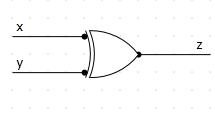
    XOR Gate

    Figure 1. XOR gate drawn in Logic Circuit software

    As it is obvious from the truth table, an XOR function gives a set of symmetric output results for the different input combinations. That leads to conclusion that the XOR function is a symmetric function.

    Exclusive-NOR or XNOR function

    Exclusive-NOR or XNOR function is the inverse of the exclusive-OR or XOR function. It behaves according to its truth table. A high output (1) results if both of the inputs to the gate are the same. On the other hand, if one but not both inputs are high (1), a low output (0) results.

    The truth table of XNOR function:

    xnor truth table

    The logic gate of XNOR function is shown in Figure 2.
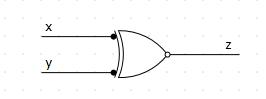
    XNOR Gate

    Figure 2. XNOR gate designed in Logic Circuit software

    Theorem 1:

    Let assume that we observe a set of a-bit binary information, where a ≥ 3. The set of information contains different combinations of 0s and 1s. In that case, the source message can be represented using the weight coefficients. This is given in Equation (1).

    eq1

    Where:

    n – the highest value of the weight coefficient for the message; n ≥ 2,

    f – the weight coefficient for the message.

    Let also assume that an encrypted message or a cipher can be presented as array of the weight coefficients, where number of digits for the message and number of digits for the cipher are the same. This is shown in Equation (2).

    eq2

    Where:

    n – the highest value of the weight coefficient for the cipher; n ≥ 2,

    g – the weight coefficient for the cipher.

    If the following algorithm (3) is applied, as a result the symmetric or mirrored set of encrypted or ciphered information will be gotten.
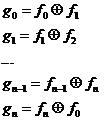
    eq3

    The Proof:

    The law will be proved using the case of the set of 4-bit binary information.

    The set of 4-bit binary information:

    Let observe the set of 4-bit binary information, which consists of 4 bits of information and has 2ª = 16 combinations. In this case, a number of bits or digits is a = 4. These combinations cover the set of the following decimal numbers: from 0 to 2ª – 1 = 15. All these combinations are given in Table 1 as follows.

    Table 1.
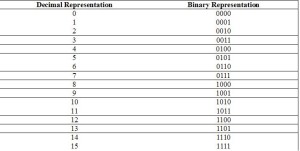
    table1

    Solution:

    The results of such a provided ciphering process are given in Table 2. It is obvious that the set of the encrypted information is completely symmetric or mirrored, which is the consequence of the symmetric nature of XOR logic function. Table 2 is shown as follows.

    Table 2.
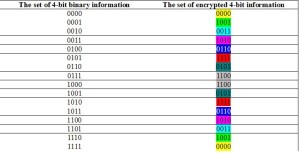
    table2

    Theorem 2:

    Let assume that we observe a set of a-bit binary information, where a ≥ 3. The set of information contains different combinations of 0s and 1s. In that case, the source message can be represented using the weight coefficients. This is given in Equation (3).

    eq4

    Where:

    n – the highest value of the weight coefficient for the message; n ≥ 2,

    f – the weight coefficient for the message.

    Let also assume that an encrypted message or a cipher can be presented as array of the weight coefficients, where number of digits for the message and number of digits for the cipher are the same. This is shown in Equation (4).

    eq5

    Where:

    n – the highest value of the weight coefficient for the cipher; n ≥ 2,

    g – the weight coefficient for the cipher.

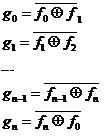
    If the following algorithm (5) is applied, as a result the symmetric or mirrored set of encrypted or ciphered information will be gotten.
    eq6

    The Proof:

    The law will be proved using the case of the set of 4-bit binary information.

    The set of 4-bit binary information:

    Let observe the set of 4-bit binary information, which consists of 4 bits of information and has 2ª = 16 combinations. In this case, a number of bits or digits is a = 4. These combinations cover the set of the following decimal numbers: from 0 to 15. All these combinations are given in Table 3 as follows.

    Table 3.
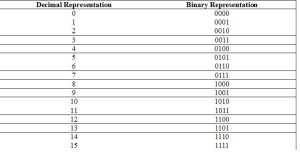
    table3


    The results of such a provided ciphering process are given in Table 4. It is obvious that the set of the encrypted information is completely symmetric or mirrored, which is the consequence of the symmetric nature of XNOR logic function. Table 4 is illustrated as follows.

    Table 4.
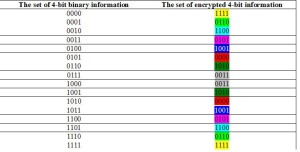
    table4

    Conclusions

    This article provides a brief review of the results the author got during her research. The author plans to continue her research and to publish her findings into this magazine. The initial step has been made and the facts about the Symmetry Law have been shared with the audience. This is not the final version of the law, only the initial step. As research goes further, the author will be that free to publish the results.

    Reference:

    1.   Digital Systems – Principles and Applications, Ronald J. Tocci & Neal S. Widmer, Prentice-Hall International, Inc., 1998.
  • Tools of the Future

    Tools of the Future

    Like they say, a carpenter is only as good as his tools – and this sentiment stands true in almost every profession we work in. Whether it’s something as simple as a pen and paper or more complex scientific equipment, we rely heavily on tools in both our personal and business lives. So what lies in the not-so-distant future? We take a look.

    Technology tools

    One type of technology that has been verging on the edge of mainstream usage for the past couple of years is holograms. Web-conferencing tools such as Skype have become a home and office staple – but could we soon be seeing people in three dimensions? The technology is there – it has been used to great effect particularly in music concerts as well as at some airports – so it’s not a question of if they will , but when will holograms become the norm.


    Holograms
    Credit: Image courtesy of: Science Daily


    The biggest changes in technology tools are predicted to come in the form of communication. It’s hard to imagine life without the internet – and it’s only been properly available for less than 20 years. As communication channels become faster and more powerful, the need for on-site offices will diminish and people will increasingly work from home.


    Tools for future disasters

    There’s nothing we can do to prevent natural disasters, but we can minimise the damage caused. In recent years, geographical information systems (GIS) have been crucial to pre- and post- disaster management, and this area is certainly one that will continue to advance, grow, and save millions of lives.


    Credit: Image courtesy of: NYTimes


    Aside from complex GIS software, innovative scientists and inventors are hard-at-work creating real-life tools that can save lives on the ground when disaster strikes. One of the most positive creations has been developed by a Japanese engineering company. After surviving the devastating 2011 earthquake and tsunami in Japan, they have designed survival pods, called ‘Noah’, which work like buoys; up to four people can get inside them and float atop a tsunami for up to two hours, potentially saving their lives.


    Hand tools

    There will always be a place for the good ol’ hammer and nail (although you never know), but with everything else seemingly going digital or robotically-driven, what is the future for hand tools?


    ToolBloke
    Credit: Image courtesy of: Tool Bloke


    Already, robots are taking over a lot of manual labour, particularly in large factories such as car manufacturing plants. They are more efficient and after the initial costs, are cheaper to run.


    But there is still room for something else lying somewhere between robots and humans. This is most evident in the fast developing technology in the world of medical science. To overcome the problem of health practitioner shortages, particularly in remote areas, robotic surgery is becoming the next big thing. A surgeon doesn’t even need to be in the room to perform complex surgeries. The technology is already being used, but there is still huge room for growth, with millions being invested into it.


    Credit: Image courtesy of: Wired


    As Guang-Zhong Yang from the Hamlyn Centre for Robotic Surgery said, ‘You have a human, which is pretty good in terms of decision-making, and learning. You have a robot, which is good at doing precise movements. Why not use a combination of both?’. Precisely. There’s plenty of space for the two of us – both in medicine and elsewhere.

  • Weekly Science Picks

    Weekly Science Picks

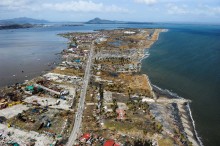
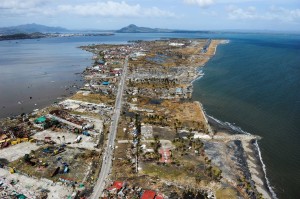
    Destruction in the Philippines. Photograph by Bullit Marquez, AP, via National Geographic

    Good morning. Or good afternoon, or evening, depending on your time zone. But it’s time for Weekly Science Picks, so let’s take a look at some of the stories making headlines in the world of science this week.

    CLIMATE.

    2013 ‘one of warmest’ on record by Roger Harrabin

    Dr Steve Rintoul, research team leader at Australia’s CSIRO Marine and Atmospheric Research division, said: “A more significant point is that global-average temperature in each of the last three decades has been warmer than any prior decade dating back to 1850, as reported in the recently released IPCC report. It provides compelling evidence that human activities are primarily responsible for the warming over the last 50 years.”


    In the light of climate, why the need for action is so dire.

    5 Reasons the Philippines Is So Disaster Prone by Dan Vergano

    From earthquakes to volcanic eruptions to previous super typhoons, death tolls following cataclysmic events in the Philippines tend to be high. Here are 5 reasons why:


    I recall the movie “A Beautiful Mind” when the term schizophrenia comes up. It’s a beautiful movie about the life of John Nash,a mathematician working in differential geometry, game theory and partial differential equations. It depicts the highs and lows of a mental rollercoaster. This next article sheds light on new research, theories, and a little bit of controversy.

    Forget the headlines – schizophrenia is more common than you might think by Daniel Freeman and Jason Freeman

    We tested the level of paranoia among the general public by asking volunteers to take a virtual reality tube train ride, during which they shared a carriage with a number of computer-generated “avatars”. These avatars were programmed to behave in a strictly neutral fashion, yet over 40% of participants reported that the avatars showed hostility towards them.

    Here’s the perfect story to read over breakfast! Pancakes and Maths anyone?

    Flipping pancakes with mathematics by The Guardian, Notes&Theories, Dispatches from the Science Desk

    Thus the so-called pancake sorting problem was born. How many flips are required to turn a disordered stack of pancakes into an ordered stack?


    It’s amazing how the designs architects draft on paper come to being before our eyes. Check out this gallery of slinky-esque buildings.

    These Skytwisters Are the 21st Century’s Answer to the Skyscraper by  Vince Miklos 

    We live in the age of the twisty, twirly, spun-up skyscraper. From the pages of conceptual architectural journals, to the streets of many cities, these eye-boggling wonders look like some of the most futuristic buildings in the world.


    Hope you enjoyed this week’s edition. Have a great weekend. And stay thirsty for knowledge.

  • Black hole jets pack a powerful punch

    Black hole jets pack a powerful punch

    High-speed ‘jets’ spat out by black holes pack a lot of power because they contain heavy atoms, astronomers have found.

    Black-hole jets recycle matter and energy into space and can affect when and where a galaxy forms stars.

    “Jets from supermassive black holes help determine a galaxy’s fate — how it evolves,” said CSIRO’s Dr Tasso Tzioumis, a member of the research team.

    “So we want to understand better the impact jets have on their environment.”

    The work, led by Dr María Díaz Trigo of the European Southern Observatory, is published in the journal “Nature” today.

    Astronomers have known for decades that black-hole jets contain electrons, which are low-mass particles.

    But using the European Space Agency’s XMM-Newton space telescope and CSIRO’s Compact Array radio telescope in northwest NSW, the research team found the first evidence of heavy atoms — iron and nickel — in the jets from a ‘typical’ black hole known as 4U1630-47.

    An iron atom is about 100,000 times more massive than an electron. When a massive particle is moving it carries more energy than a lighter particle moving at the same speed.

    “Heavy atoms have been seen in jets from one other system, SS433, but that’s a very unusual system, an oddball, whereas this system is quite typical, much more likely to represent black holes in general,” Dr Tzioumis said.

    While 4U1630-47 is a small black hole, a few times the mass of the Sun, the physics of black holes “is scalable”, he said, meaning that the finding would apply to larger black holes.

    The discovery suggests that jets are powered by the black hole’s accretion disk — a belt of hot gas swirling around the black hole — and not by the spin of the black hole itself, which would be more likely to produce jets containing only light particles.

    The jets from 4U1630-47 are travelling fast, at two-thirds the speed of light.

    When such fast-moving jets containing heavy particles smash into matter in space, they could generate gamma rays and neutrinos, which might be detectable with current and future telescopes.

    Source and image.

  • Social media and mobile technologies in bridging digital divides

    Social media and mobile technologies in bridging digital divides

    Digital inequalities such as digital divides are a big issue in the information society, potentially influencing engagement in political, social, and educational life. They create marginalized, excluded groups who do not have access to the Internet, to information, or maybe to the necessary skills for using these devices and social applications. At some point, these people will not be able to engage fully in social, economic or political life.

    The notion of being social on the Web is constantly evolving since we are connected not only via computers but also via mobile phones and other handheld devices. There is no doubt that these technologies, along with social media and apps, help to bridge the present digital divides, by providing an interactive and engaging platform for otherwise excluded voices, globally.
    However, it is still a challenge, not only to make those technologies available everywhere, but also to create programs and initiatives for educating, engaging, empowering and interacting so that those digital gaps would break down or at least lessen.

    Despite the way in which social media and mainstream news like to talk about ‘’new digital divides’’, they are not new at all. From my own research in the field (a new the book where I contributed with the chapter), it seems that the core issue is not always about technology as a liberator (that breaks down the digital divide), but that the central issues are about social power, access to information and skills (even to the level of fundamental literacy).

    Opening up the access to knowledge and its deployment in everyday work and education is crucial for producing the results and fostering the competences of the members of one’s society. Access to information is the key to an individual’s position in society.
    We are all participating on a daily basis in a networked world and we are the creators and the producers of the content online, all together in the same hyper-connected world where the issues and patterns of inclusion and exclusion need to be observed and addressed.

    Although there is still limited access to the Internet in some developing countries, connectivity continues to grow and mobile technology and social media applications are playing vital roles in shaping the trends of social activism and raising awareness, in the context of freedom of expression and giving citizens a voice to address social issues. According to the International telecommunications Union, about 70% of mobile phone users are in developing countries, mostly in the global South – making mobile devices the

  • If Ada can, so can we

    If Ada can, so can we

    I have written before about the need to encourage our girls to pursue science in school and beyond. From my experience, girls at school are often reluctant to participate in science at first, until they are shown the possibilities that science offers. Girls need people to aspire to. Girls need to be shown that they are just as capable. With the recent celebration of Ada Lovelace Day last month, I set two of my young 12 year old female students on a mission: to find out about the significance of the day and explore the roles of females in science. The following piece is their writing.  

    Ada Lovelace was born in 1815 and died in 1852. She was the daughter of the famous poet Lord Byron and Anne Isabella Byron. Her parents separated when she was only 1 month old which made her life very hard and held her back from being successful. Despite this, Ada Lovelace was a mathematician at a time when females were not into those kinds of things. We now have a day in October every year to remember and celebrate what she did and what other women do in science.

    Back then science wasn’t something that women did, so men would just do it. Women were not known for being scientists. Women didn’t work as much as men did. Women were the ones who looked after the house while men were at work. It would not be common for women to be seen working back when Ada was young. Ada never had a female scientist to influence her but she still went for it. Maybe having hardship like when her parents separated made her not worry what people thought. There were still a few female scientists but not enough to show that women were just as important as men.

    Women were very courageous to be scientists back then because men were always the ones with the good jobs while women were mostly at home. There are more women role models these days to encourage young women to become scientists. This means that more women want to be equal to men and have just as good jobs. Now women have just as many rights as men do and this is a good thing because women are standing up for themselves and taking part in jobs that only men used to do. One of the reasons this is happening is because there are more female scientists to be role models for other women.

    It is important for girls like us to have good female scientist role models because even if someone doesn’t like science as much as others they still get the idea that women are allowed to be scientists without men over-taking them. Girls like us find it good to have these sorts of role models because that makes us not only think about male scientists but women scientists and for once females are equal to men in science.

    We personally would not enter a science field because that isn’t on our radar and neither of us think it’s the kind of thing that we would be great at. But that doesn’t mean that science is for males. All it means is that we would not like to be scientists. There are plenty of girls out there who do want to be scientists because there are more females who are encouraging them to be what they want to be. I think that science is not something that only one gender can do. Both male and female are able to do science because it’s not like males are smarter than females and both genders can be anything that they want to be. I think that female scientists have definitely grown from where they used to be. Overall women scientists did become as equal to men, thanks to people like Ada Lovelace.

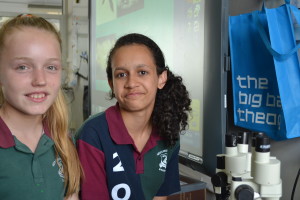
    Eva Hall & Rowena FuhlbohmDSC_0346


    Now neither Eva nor Rowena is particularly gifted in science but they are inquisitive and eager young things. I would also imagine that neither of these girls will enter science fields professionally, but what was important for them I think, are the following highlights;

    1. they collaborated on this piece together,
    2. they completed this piece of writing in addition to their normal curricular studies,
    3. they believe in gender equality in science, and
    4. they believe that women like Ada Lovelace led the way.