Many commentators agree that the field of media studies will become more and more important in the coming years.
The European Science Foundation (ESF) publication “Media studies: new media and new literacies
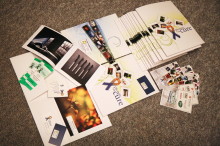
Many commentators agree that the field of media studies will become more and more important in the coming years.
The European Science Foundation (ESF) publication “Media studies: new media and new literacies
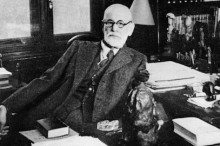
As David Bowie had his cocaine period, so too did Sigmund Freud, beginning in 1894 and lasting at least two years.
Unlike the rock star, the doctor was just at the beginning of his career, “a nervous fellow

Reconstructing the history of our Galaxy has just become a whole lot easier, thanks to a team of international astronomers led by Dr Luca Casagrande from the Research School of Astronomy and Astrophysics.
By examining both the light and soundwaves from stars, the team has developed a more precise way to deduce the ages of stars and to pinpoint when our Galaxy’s big events happened.
The development will help astronomers study the properties of ancient stars and help them better understand the formation and evolution of the Milky Way.
“We might also uncover evidence for violent events in the past, such as collisions with other galaxies,

Like many right-brained people, artist and critic Matt Collings finds higher math mystifying, a word that implies both bewilderment and wonder.
Faced with the equations that make, for example, Stephen Hawking’s work possible, most of us are left similarly slack-jawed. Collings aptly describes the realm of theoretical physics—which so contradicts our everyday experience—as “an alien world,

From Tolstoy to Tumblr, a compendium of timeless wisdom on life.
In March of 1884, Leo Tolstoy resolved in his diary to create a “circle of reading
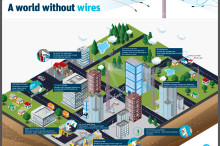
CSIRO has released a report on “spectrum crunch” and the role of ubiquitous connectivity in future wireless applications.
The threat of ‘peak data’ and what that could mean for the way we connect and access essential services in the future, is the focus of a report released by CSIRO.
Director of CSIRO’s Digital Productivity and Services Flagship Dr Ian Oppermann said wireless technology had been adopted at “breakneck pace” in Australia and around the world.
“The data rates that people now expect from their mobile services are about a hundred times the amount we thought possible only two decades ago,” Dr Oppermann said.
The report, World Without Wires, points out that wireless communications rely on the availability of radiofrequency spectrum. The spectrum has practical limits and more spectrum cannot be created so we are faced with a finite resource and growing demands to use it.
Today’s technologies and infrastructure will be hard pressed to support further increases in demand, both in terms of speed and volume, for wireless data and services over the coming decades.
Many global cities, including here in Australia, are fast approaching the point of ‘peak data’ – where user demand for wireless internet, telephony, and other services can no longer be fully accommodated by the available radiofrequency spectrum.
“Currently the useable spectrum is divided up and allocated to various uses, such as TV/radio broadcast, emergency services, and mobile phone communications for example,” Dr Oppermann said.
“In the future, how spectrum is allocated may change and we can expect innovation to find new ways to make it more efficient but the underlying position is that spectrum is an increasingly rare resource.
“Some estimates suggest that spectrum demand will have almost tripled by 2020, and existing infrastructure will need to rapidly expand its currently available capacity if it’s to meet this demand.
“With more and more essential services, including medical, education and government services, being delivered digitally and on mobile devices, finding a solution to “peak data” will become ever more important into the future.”
World Without Wires examines the role that ubiquitous access to high-speed wireless connectivity will play in enabling a range of future applications and social developments, including:
(1) The replacement of digital TV and telephony services by internet-based, personalised streaming services
(2) Widespread sensing technologies that optimise and improve almost every aspect of our daily lives
(3) The widespread use of wireless positioning technologies, from making driverless cars the norm to enhancing retail experiences through “virtual concierges”
(4) “Tele-services” as the default model of service delivery for government and businesses, with education, healthcare and other public goods being delivered via private digital networks
(5) A radical improvement in the way existing wireless infrastructure accommodates ongoing growth in service demands, including smaller cells, smarter antennae, and beyond.
“Such developments will have a profound impact on both Australia and the rest of the world, constituting significant market opportunities, and a chance to deliver widespread public good from our wireless research and enterprise community,” Dr Oppermann said.

Today, we bring you the CS50, Harvard’s Introductory Computer Science course, taught by Professor David Malan, which appeared last year.
Why revisit an updated version of the same class a year later? For one thing, the material has been updated. And, as you can tell by the rousing reception Malan receives from the audience at the start of the first lecture (above), Malan is kind of a big deal. From his opening boom of “This is CS50,
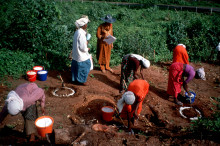
Experts from countries around the Indian Ocean rim are meeting this week in India to discuss ways to improve their disaster resilience and improve management of future climate risk.
The meeting of Indian Ocean Rim Climate Change Adaptation Officials, under the auspices of the Indian Ocean Rim Association (IORA), is the first meeting of delegates from around the Indian Ocean rim to discuss the implications of future climate risk. The workshop, which is being co-organised by CSIRO, was announced as part of a $1.175 million package during the IORA Council of Ministers’ Meeting in Perth in November 2013.
Workshop convenor, Ms Jennifer Sutton from the CSIRO Climate Adaptation Flagship, said the workshop would share information and plans about practical ways to help communities, farmers, industry and policymakers adapt to climate changes expected around the Indian Ocean rim, including for small island developing states. The meeting would discuss what actions are being taken and determine possible options for future action.
“Around 50 delegates will share knowledge of the impacts of climate change on the livelihoods of the people of the Indian Ocean rim, to identify the best ways to increase resilience,

Researchers looking at the origins of life on Earth have come up with a new explanation for how the earliest molecular material was able to replicate in the primordial soup.
They have found that hydrogen peroxide, an ingredient commonly associated with hair bleach, may have been the key to the early replication of RNA – the polymeric molecule that is thought to have existed before cellular life and DNA.
The research sheds new light on how the earliest forms of life developed, and helps explain the mystery of why new forms of life don’t emerge on modern Earth.
“The problem of how life originated is enormously complicated,

If you think Ancient history doesn’t matter to your life today, think again.
Created by The Royal Institution and the animation shop 12Foot6, this short animated video reminds us that the Greeks gave us some of the most basic concepts used in mathematics — concepts that we still use to navigate our modern world today. As with drama and philosophy, everything goes back to the Ancient Greeks.
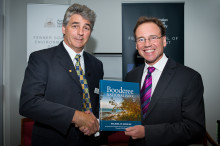
A new book detailing the rich diversity of life in one of Australia’s greatest and most popular national parks, the Booderee National Park, has been written in a unique collaboration between ANU researchers, Parks Australia managers and the Wreck Bay Aboriginal Community.
Booderee National Park, at Jervis Bay south of Sydney, receives more than 450,000 visitors annually – more than Kakadu and Uluru National parks combined – and is a major part of Australia’s tourism infrastructure.
The book contains stunning images of the park, its plants and wildlife, and examines research spanning more than a decade into the park’s biodiversity.
The authors find the park, which covers 6,600 hectares of land and coast, is both thriving and surviving, despite challenges posed by the large number of visitors, and from bushfires, invasive plants species and feral pests, such as the Red Fox.
“This park is a crucial part of the nation’s tourism infrastructure, but it still maintains its ecological integrity,

Universities in Australia should prepare themselves for a fundamental change in their relationship with employers, who increasingly want students with particular skills rather than degree qualifications.
Employers were moving past the 20th-century model in which students removed themselves while they studied for a bachelor’s degree, and then possibly a master’s degree, before entering the workforce. This is a fundamental change. The credential is still important but it’s actually the skills that are attached to it that will drive the economy forward.
What employers want to know today is what skills candidates have gained and how they have applied them in the field.
The tendency is as follows. People want to go to university because they believe it will help them get a good job and a better quality of life. But, from employers’ perspective, the value of a degree is actually waning.
So, what should be the purpose of a good education system? To provide a proper education, nice knowledge and maybe ability to process the facts or something else?
First of all, an education system must follow the current trends regarding industry and market. No one needs experts who are good at theoretical level only. Today’s employees must be good in resolving practical problems, because that’s what the country needs for a strong economy and stable system.
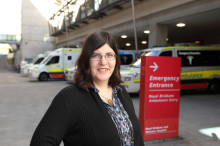
Robots on hospital wards, smart apps on mobile devices and home-monitoring systems will transform our health system a report released by CSIRO has revealed.
The report A Digitally-enabled Health System looks at how the Australian health system can reduce costs and deliver quality care.
“We know Australia’s health system faces significant challenges including rising costs, an ageing population, a rise in chronic diseases and fewer rural health workers,
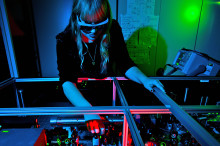
Physicists from the Australian National University and the University of Queensland have demonstrated a software-based quantum amplifier, which has the potential to expand the use of ultra-secure quantum cryptographic communications.
The development could lead to new ways to guarantee security of everyday communications, including financial transactions and email.
“This has the potential to guarantee security for any kind of information you want to transmit, from particularly sensitive information, like banking data or electoral results, to personal emails,