Author: Editorial Board

  • The Occupation of Parents Defines Kid’s Results at School

    The Occupation of Parents Defines Kid’s Results at School

    Children who have at least one parent working in IT, business or engineering are the best performing students in Australia.

    An OECD report into the connection between student performance and their parents’ occupations has also found the kids of subsistence farmers, salespeople and machine operators are the lowest performing students in the nation’s schools.

    Not only were the kids of information and communications technology (ICT) workers top of the country in maths and science, they were also the best in terms of reading.

    By Australian Information Industry Association, ICT workers’ skills include the analytical, the innovative, the creative thinking, the can-do, curiosity and solving business problems.

    These means that the children of ICT workers are enjoying the benefits of being exposed to all of those skills and being inspired in their family environment to take risks.

    But, that’s not the end of the story. The gap between Australia and the top maths performers is so big that the children of a Shanghai (China) subsistence farmer will perform as well as the offspring of an Australian health or teaching professional.

  • State of the Climate 2014: A clear picture of Australia’s climate

    State of the Climate 2014: A clear picture of Australia’s climate

    A definitive report on observed changes in long term trends in Australia’s climate has been released today by CSIRO and the Bureau of Meteorology.

    Bureau Chief Executive Dr Rob Vertessy said temperatures across Australia were, on average, almost 1°C warmer than they were a century ago, with most of the warming having occurred since 1950.

    “Australia’s mean temperature has warmed by 0.9°C since 1910,

  • Google’s Military Robots are Here

    Google’s Military Robots are Here

    Computers and robots will become smarter and more adept than human beings in 15 years time. Computers develop an almost-organic intelligence gleaned from experience, and will be able to tell jokes and flirt with humans.

    How real is this? Well, it’s quite real. Internet search giant Google has spent billions buying up the world’s top robotics companies. These corporations include DeepMind, a British company which specializes in machine learning, and Boston Dynamics, which makes advanced military robots.

    We present you some of their solutions in the following video material.

  • New grants to accelerate research uptake

    New grants to accelerate research uptake

    Queensland’s researchers, scientists and their commercial partners are encouraged to apply for grants of up to half a million dollars under the state government’s new science and research funding program.

    The Accelerate Partnerships funding program was opened by Queensland Chief Scientist Dr Geoff Garrett AO who said universities and research organisations with their industrial or commercial partners could apply for research grants from the $8.75 million Accelerate Science and Innovation Program.

    Dr Garrett said collaboration and the translation of research into tangible outcomes were the key focuses of the program. “The Queensland Government will be supporting new projects that will deliver benefits for Queensland through the creation of innovative products, technologies or processes that will have practical application within five years,

  • Quantum Entanglement Animated

    Quantum Entanglement Animated

    PhD Comics has released the third video in an animated series explaining Quantum concepts and devices.

    This one focuses on Quantum Entanglement and features the work of Caltech physicists Jeff Kimble and Chen-Lung Hung. Meanwhile Jorge Cham, creator of PhD Comics, provides the accompanying animation.

    Source and image.

  • Harvard Free Online Courses

    Harvard Free Online Courses

    A quick note: Shaye J.D. Cohen, a professor of Hebrew Literature and Philosophy at Harvard, has recently released his second free course on iTunes.

    The first course was called The Hebrew Scriptures in Judaism & Christianity. The new one, simply titled The Hebrew Bible,

  • Rocks around the clock: asteroids pound tiny star

    Rocks around the clock: asteroids pound tiny star

    Asteroids hit the Earth, the Moon and even, it seems, distant stars.

    Scientists using CSIRO’s Parkes telescope and another telescope in South Africa have found evidence that a tiny star called PSR J0738-4042 is being pounded by asteroids — large lumps of rock from space.

    “One of these rocks seems to have had a mass of about a billion tonnes,” CSIRO astronomer and member of the research team Dr Ryan Shannon said.

    PSR J0738-4042 lies 37,000 light-years from Earth in the constellation of Puppis.

    The environment around this star is especially harsh, full of radiation and violent winds of particles.

    “If a large rocky object can form here, planets could form around any star. That’s exciting,” Dr Shannon said.

    The star is a special one, a ‘pulsar’ that emits a beam of radio waves.

    As the star spins, its radio beam flashes over Earth again and again with the regularity of a clock.

    In 2008 Dr Shannon and a colleague predicted how an infalling asteroid would affect a pulsar. It would, they said, alter the slowing of the pulsar’s spin rate and the shape of the radio pulse that we see on Earth.

    “That is exactly what we see in this case,” Dr Shannon said.

    “We think the pulsar’s radio beam zaps the asteroid, vaporising it. But the vaporised particles are electrically charged and they slightly alter the process that creates the pulsar’s beam.”

    Asteroids around a pulsar could be created by the exploding star that formed the pulsar itself, the scientists say.

    The material blasted out from the explosion could fall back towards the forming pulsar, forming a disk of debris.

    Astronomers have found a dust disk around another pulsar called J0146+61.

    “This sort of dust disk could provide the ‘seeds’ that grow into larger asteroids,” said Mr Paul Brook, a PhD student co-supervised by the University of Oxford and CSIRO who led the study of PSR J0738-4042.

    In 1992 two planet-sized objects were found around a pulsar called PSR 1257+12.  But these were probably formed by a different mechanism, the astronomers say.

    Source and image.

  • The Art of Restoring Classic Films

    The Art of Restoring Classic Films

    Why have cinephiles, from the era of Laserdiscs through that of DVDs and now Blu-rays, so consistently respected The Criterion Collection? Speaking as one such cinephile, we could point to a number of factors: their curatorial bent toward important films, their production of rich supplementary features, their always impressive pieces of cover art.

    But Criterion has become increasingly known for the considerable work they put in not at the end of the process, when they package a classic or potentially classic motion picture for maximum aesthetic and intellectual appeal (and your purchase), but at the beginning, when they track down the actual celluloid film in the first place, often aged or damaged, and engage in the often painstaking task of returning it to the prime of visual and sonic life.

    Source and image.

  • New analysis promises better weed management of the Lake Eyre Basin

    New analysis promises better weed management of the Lake Eyre Basin

    A new cost-effective weed management analysis has been developed to help protect one of the most unique regions in the world – the 120 million ha Lake Eyre Basin.

    A team of experts developed the framework for cost-effective investment in weed management in the Lake Eyre Basin (LEB). The aim of the project was to help guide future investment in management activities for invasive species in the LEB.

    Dr Jennifer Firn, project leader and Queensland University of Technology senior lecturer and visiting scientist at CSIRO’s Climate Adaptation Flagship, said substantial amounts have been invested in invasive species management to reduce negative impacts on natural assets and agricultural production in the basin.

    “What is unclear is whether the invasive weed species currently being targeted represent the best investment so we brought together and a broad range of stakeholders including policy makers, managers, scientists and community representatives to find the best strategies

  • The Importance of Mathematics Teaching in Australian Education

    The Importance of Mathematics Teaching in Australian Education

    There is a concerning question nowadays in Australia which started as a debate of University lecturers who said high school physics is at a very low level of quality and focused on the history of physics at the expense of rigorous mathematical analysis and problem-solving. As a result, they said, students often arrive at university with a distorted view of what physics is and whether they are good at it.

    Introduction

    To define the goals of mathematics teaching, it is necessary to consider what mathematics is and does and what might be the purposes for teaching mathematics to school students. The basic argument is that the emphasis in school mathematics should be predominantly on practical and useable mathematics that can enrich not only students’ employment prospects but also their ability to participate fully in modern life and democratic processes.

    The Goals of Mathematics Teaching

    There is a broad consensus among policy makers, curriculum planners, school administrations and business and industry leaders that mathematics is an important element of the school curriculum. Rubenstein (2009), for example, offers a compelling description of the importance of mathematics from the perspective of mathematicians, as well as the challenges Australia is facing due to the decline in mathematics enrolments in later year university mathematics studies.

    Part of the context in which this debate is being conducted is that schools are confronting the serious challenge of disengaged students. In their report on the national Middle Years Research and Development Project, Russell, Mackay and Jane (2003) made recommendations for reform associated with school leadership and systematic school improvement, especially emphasising the need for more interesting, functionally relevant classroom tasks which can enhance engagement in learning. Additionally, there is said by some to be a serious decline in the number of students completing later year university level mathematics studies, thereby threatening Australia’s future international competitiveness and capacity for innovation. These claims feed calls for more mathematical rigour at secondary level, as preparation for more advanced learning in mathematics. Unfortunately, these claims are presented by the protagonists as though teachers must adopt one perspective or the other.

    In one of the major presentations at the Teaching Mathematics? Make it count conference, Ernest (2010) delineated both perspectives. He described the goals of the practical perspective as follows: students learn the mathematics adequate for general employment and functioning in society, drawing on the mathematics used by various professional and industry groups. He included in this perspective the types of calculations one does as part of everyday living including best buy comparisons, time management, budgeting, planning home maintenance projects, choosing routes to travel, interpreting data in the newspapers, and so on. Ernest also described the specialised perspective as the mathematical understanding which forms the basis of university studies in science, technology and engineering.

    Conclusion

    A necessary corollary to incorporating these dual perspectives in mathematics teaching and learning in pedagogy is a consideration of the ways that teachers might engage their students in more productive learning. The research strongly suggests that teachers incorporate both types of mathematical actions in tasks for their students to undertake when learning mathematics.

    References:

    [1] Peter Sullivan, Australian Education Review – Teaching Mathematics: Using research-informed strategies, 2011.

  • Pilbara marine health check – good and bad news

    Pilbara marine health check – good and bad news

    A health and wellbeing check up of World Heritage-listed reef ecosystems in the Pilbara region of Western Australia will provide a critical baseline of marine conditions to government, industry and researchers.

    The 300km swathe of coastline to be surveyed during the five year, $12 million Pilbara Marine Conservation Partnership includes two major marine parks and also areas under development for ports, and oil and gas extraction and processing.

    The partnership, a joint venture between CSIRO’s Wealth from Oceans Flagship and The University of Western Australia, will be the first whole of ecosystem study for the region’s unique marine environment.

    “Our research will help government and industry balance the environmental sustainability of the Pilbara with its increasing broad sector use,” CSIRO lead scientist Dr Russ Babcock said.

    “Over the next five years we want to find out everything we can about the health and makeup of the region, as well as observe and evaluate any localised changes, so we can give the best possible advice to future use managers on how they can act sustainably.”

    Dr Babcock and his team have recently returned from their first exploratory tour of the region, where they were scouting survey sites.

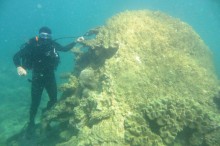
    Some unwelcome discoveries were made, including the bleaching and decimation of a pocket of ancient coral heads – many up to 400 years old – that have provided an important record of reef health.

    “We suspect this bleaching event was due to marine heatwaves that occurred in the region over the past few summers, and to see it up close was sobering,” said Dr Babcock.

    “But to offset this loss, some reefs only a short distance north showed much less damage and will continue to contribute to a healthy ecosystem.

    “By studying these sorts of variations and finding out why they occur, we can improve our overall understanding of the marine environment in the region, and how we can best preserve it”.

    The University of Western Australia’s Professor Shaun Collin said the study would set a precedent for future development in the Pilbara.

    “This study will develop a greater understanding of the dynamics of coral and fish communities in the region, which in turn will provide us with the ecological indicators of potential human impacts,” Professor Collin said.

    “With it, we can provide a research baseline for decision making in the region that will strike the right balance between environmental conservation and industry development.”

    Source and image.
  • How Does Bacteriography Work?

    How Does Bacteriography Work?

    Stephen Fry is taking part in a curious science experiment. It involves creating a portrait of the writer/comedian/science enthusiast, using nothing but his own bacteria and cells.

    According to the web site of The Big Bang UK Young Scientists & Engineers Fair, the “bacteriographs

  • Researchers to debunk super spending myths

    Researchers to debunk super spending myths

    Researchers from CSIRO and Monash University in Melbourne are putting the spending habits of retirees under the microscope in an effort to understand the finer details behind how they use and manage their super in retirement.

    “We’re looking to understand what retirees need, how long their super lasts and what investment options and financial products might best suit them throughout their retirement so we can figure out how their super could work smarter,