Author: Editorial Board

  • Could Our Software be Unhackable?

    Could Our Software be Unhackable?

    A team from ULCA and MIT recently came to very interesting results. Namely, they offer hope that encryption could protect not just an output, but an entire program. Too good to be true, ha? This new method of program obfuscation could lead to ultra-secure software that keeps your personal information safe from potential attackers.

    The idea of obfuscating a program has been around for decades. But, the security and hacking communities have been able to defeat all these measures. Cryptographic experts have long been tinkering with stronger approaches, but it nothing happened until now.

    Cryptographers have been chasing the idea of a so-called “black box obfuscator

  • Study into the Media Environment of Japanese Schools

    Study into the Media Environment of Japanese Schools

    NHK (the Japanese Broadcasting Corporation) has been providing educational services for schools across Japan since the days of radio as an important element in their mission as a public service broadcaster. School radio started in 1935, and school TV in 1953, at the same time as the start of TV broadcasting in Japan. Furthermore, NHK released the online service “NHK Digital Curriculum

  • ANU astronomers discover oldest star

    ANU astronomers discover oldest star

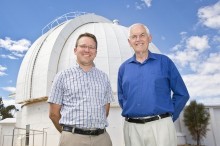
    A team led by astronomers at The Australian National University has discovered the oldest known star in the Universe, which formed shortly after the Big Bang 13.7 billion years ago.

    The discovery has allowed astronomers for the first time to study the chemistry of the first stars, giving scientists a clearer idea of what the Universe was like in its infancy.

    “This is the first time that we’ve been able to unambiguously say that we’ve found the chemical fingerprint of a first star,

  • New maps reveal locations of species at risk as climate changes

    New maps reveal locations of species at risk as climate changes

    An international team of scientists has produced global maps showing how fast and in which direction local climates have shifted.

    In research published in the journal Nature, CSIRO and an international team of scientists revealed global maps showing how fast and in which direction local climates are shifting. This new study points to a simpler way of looking at climatic changes and their likely effects on biodiversity.

    As climate change unfolds over the next century, plants and animals will need to adapt or shift locations to track their ideal climate.

    “The maps show areas where plants and animals may struggle to find a new home in a changing climate and provide crucial information for targeting conservation efforts,

  • The Future is Coming from MIT!

    The Future is Coming from MIT!

    Imagine you have a completely transparent screen on which you can project whatever you want. Only few years ago, all that seemed as a dream, but today it appears the challenge has been resolved. The group of scientist from MIT led by fascinating Professor Marin Solja

  • Do We Live in The Matrix?

    Do We Live in The Matrix?

    In 1963, Philip K. Dick won the coveted Hugo Award for his novel The Man in the High Castle, beating out such sci-fi luminaries as Marion Zimmer Bradley and Arthur C. Clarke. Of the novel, The Guardian writes, “Nothing in the book is as it seems. Most characters are not what they say they are, most objects are fake.

  • What Should a Good ESL Teacher Know?

    What Should a Good ESL Teacher Know?

    While the number of immigrants in English-speaking countries such as Australia is rapidly increasing, the number of qualified ESL (English as a second language) teachers is not meeting this growing demand. Being an ESL teacher is not the easy job. It requires a lot of skills and training. But, what are the facts that a good ESL teacher should know?

    Becoming an ESL teacher gives a unique multi-cultural opportunity. One of the biggest advantages of getting a TEFL (Teaching English as a Foreign Language) qualification is the chance to work abroad. Despite “formal

  • Texting teen driver takes out top science award

    Texting teen driver takes out top science award

    Just how dangerous is texting or making calls on your mobile phone while driving? Thanks to 14-year-old Conroy Cheers from Melbourne we may all soon know.

    Conroy was named as one of the winners of the BHP Billiton Science and Engineering Awards in Melbourne today.

    Conroy’s first place in the Investigations category of the awards was for developing a method to measure the risks of texting while driving, and also making hands-on and hands-free voice calls.

    Using a readily available driving simulator, Conroy ‘drove’ the streets texting friends, calling his family and measured how his driving was affected. Conroy hopes the process will allow people to experience firsthand the dangers of texting while driving.

    “I have loved science and engineering in any size or shape, for as long as I can remember,” Conroy said.

    “I always get excited at the prospect of ‘making stuff’, and also enjoy riding my bike and reading. My ambition is to become a scientist or an engineer, perhaps in the field of nanotechnology.”

    Winner in the Engineering section was 18-year-old Ethan Buston from Wollongong, NSW.

    Ethan created the SMART (Stroke Management with Augmented Reality Technology) system – a camera based augmented reality system that aims to aid the recovery and increase the safety of stroke patients. By manipulating what they can see, a clearer visual picture is provided to the patient.

    “Science is my life and one of my major passions,” Ethan said.

    “I love the discovery that comes with science and using that discovery to help benefit others.”

    Since 1981 the BHP Billiton Science and Engineering Awards have been Australia’s most prestigious school science awards.

    “Science will always be at the core of understanding how we address human, environmental and business challenges while engineering helps us find the way to do it,” BHP Billiton Chief Executive Officer Andrew Mackenzie said.

    “That’s why we have supported these awards for over 30 years.

    “As a global natural resources company, scientists and engineers are an integral part of our present and future, and fundamental to the ongoing development of society.”

    The awards reward young people who have undertaken practical research projects, which demonstrate innovative approaches and thorough scientific or engineering procedures.

    “This year’s finalists are tackling at high school some things that are being tackled in leading research laboratories,” CSIRO Chief Executive Megan Clark said.

    “They have taken on great challenges, like wireless power transmission, bamboo bikes, food production, pollution and helping stroke victims to recover. They inspire  us with their courage.

    “We are proud to be associated with our partners BHP Billiton and the Australian Science Teachers Association.”

    The awards are sponsored by BHP Billiton and are managed by CSIRO and are a partnership between BHP Billiton, CSIRO and the Australian Science Teachers Association. The awards are also supported by Intel Corporation.

    Source and image.

  • Guess What? Bill Gates Lost his Chess Match in 79 Seconds!

    Guess What? Bill Gates Lost his Chess Match in 79 Seconds!

    Last November Magnus Carlsen, then only 22 years old, became the Chess World Champion when he soundly defeated Viswanathan Anand in a best-of-12 series match held in Chennai, India. Carlsen won three games, tied ten, and lost none. Only the second chess champion from the West since World War II (and the first since the “eccentric genius

  • Teen innovators head to head for top science awards

    Teen innovators head to head for top science awards

    From a glove which controls computers to bikes made from bamboo, the finalists in this years’ BHP Billiton Science and Engineering Awards cover a diverse range of science and engineering that can teach us all a little something about innovation.

    The winners of the awards will be announced in Melbourne next week by the Chief Executive Officer of BHP Billiton, Andrew Mackenzie, and CSIRO Chief Executive, Megan Clark.

    Ben Beagley from Victoria’s St Kevin’s College has been selected as a finalist in the awards for developing an organic light-weight bamboo bike.

    Using the bamboo in his garage, Ben designed and constructed a cheaper alternative to the traditional bike that uses the strength and flexibility of bamboo to replace heavy, industrial metal components

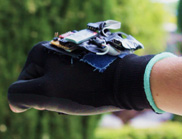
    Jake Coppinger from Canberra has come up with The Swirlesque, a wearable glove which allows the user to make natural gestures for human-computer interaction and perform actions.

    Swirlesque detects hand gestures and acts upon them in intelligent ways such as controlling a music player on a smartphone, control a computer, a TV, a home media centre, or a light bulb.

    Other finalists include an app to warn drivers of approaching emergency vehicles, removing nutrients and pollutants using wetland plants, and a forward facing rowing machine.

    “Science will always be at the core of understanding how we address human, environmental and business challenges while engineering helps us find the way to do it,

  • Bio robots make a splash in the Indian Ocean

    Bio robots make a splash in the Indian Ocean

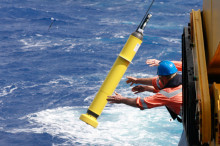
    Robotic floats armed with revolutionary new sensors will be launched in the Indian Ocean, as part of a new India-Australia research partnership to find out what makes the world’s third largest ocean tick – and how both nations can benefit from it.

    The Indian Ocean contains vast fisheries and mineral resources that are of strategic importance to both Australia and India. It also plays a direct role in driving the climates of its surrounding regions – home to more than 16 per cent of the world’s population.

    The new ‘Bio Argo’ floats, to be launched in mid 2014, will enhance the already successful Argo float technology to measure large-scale changes in the chemistry and biology of marine ecosystems below the Indian Ocean’s surface.

    The Argo floats are a network of 3600 free-floating sensors, operating in open ocean areas that provide real-time data on ocean temperature and salinity.

    The ‘Bio Argo’ floats will include additional sensors for dissolved oxygen, nitrate, chlorophyll, dissolved organic matter, and particle scattering. They will target specific gaps in our understanding of Indian Ocean ecosystems of immediate concern to India and Australia, such as the Bay of Bengal and the waters of north Western Australia.

    CSIRO’s Dr Nick Hardman-Mountford said the pilot project, led by CSIRO in collaboration with the Indian National Institute of Oceanography (CSIR-NIO) and the Indian National Centre for Ocean Information Services, will improve our understanding of cause and effect in the Indian Ocean’s climate and ecosystems.

    “By studying the Indian Ocean in this detail, we can investigate the origin and impact of marine heatwaves like the one that devastated the coral reefs and fisheries off north Western Australian in 2011 – and improve our prediction of them in the future,” Dr Hardman-Mountford said.

    CSIR-NIO Director, Dr Wajih Naqvi, said the novel technological innovation will give researchers from both countries a new understanding of the Indian Ocean.

    “We expect the technology being utilised in this project to provide new insights into the biogeochemistry of the Indian Ocean and how it is being impacted by human activities,” Dr Naqvi said.

    The proposed advances in ocean observation, ecosystem understanding and resources management, which will benefit the entire Indian Ocean Rim, can only occur through collaboration between India and Australia.

    Dr Nick D’Adamo, Head of the Perth Programme Office supporting UNESCO’s Intergovernmental Oceanographic Commission (IOC) – a partner in the project – praised the collaborative nature of the project.

    “By combining the research capabilities of India and Australia we will see an improved ability to predict and prepare for global climate change, as well as better conservation of marine biodiversity,” Dr D’Adamo said.

    The $1 million project was funded in part by the Australian Government under the Australia-India Strategic Research Fund.

    Source and image.

  • Is Maturity That Important for School Starters?

    Is Maturity That Important for School Starters?

    Over the decades experts were debating what age is the most appropriate for school beginning. Many believe that a child’s ability to make friends, follow instructions and take care of themselves is the real indicator if they are ready to start school, rather than understanding their letters and numbers. On the other hand, parents do not want their children to feel incapable, because they are not going to be there to help them. They want to give their children the best possible start. So, what would be the right age for children to start their schooling?

    Children in Australia begin school at age of 5. It is younger than almost anywhere else in the developed world – up to two years ahead of students in top-performing countries such as Finland and Korea.

    Experts warn the early transition could be detrimental to the learning and well-being of students, especially those from disadvantaged backgrounds. In a major international study of 15-year-olds in 2012, 58 % of Australian students said they started primary school at the age of 5, 27 % started at 6, and only 3 % at 7. 12 % were aged 4. That means the average starting age among Australians was 5.2-years-old, which was lower than most developed countries and similar to Britain.

    On the other hand, in the highest-performing education systems in the world such as Singapore, Shanghai and Finland, the average starting age was almost 7 years old, with 13 % of students in Shanghai starting at 8.

    The leading world experts suggest that 5 is just too young to start formal learning. Children should be engaged in informal play-based learning until the age of about 7.

    The benefits of delaying formal schooling are particularly significant for disadvantaged children, who are often forced into school early in Australia by the high costs of childcare.

    The issue of a later starting age has been raised in submissions to the federal government’s public inquiry into childcare and early childhood learning.

    In conclusion, some claim the emotional, social, psychological, physical and cognitive development are all impeded negatively for the vast majority of children by this push down in the early years. On the other hand, there is a theory which says that the starting age that is not that important but rather what children are doing at school. For instance, in a kindergarten, there is a balance between what’s often called play-based learning and what is a more traditional learning of children sitting at tables.

  • Will the Humans be Able to Cure Cancer Soon?

    Will the Humans be Able to Cure Cancer Soon?

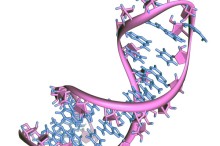
    A great discovery has just arrived! Very exciting time for the world of medicine is coming! For the first time in history, scientists have been able to take out all the RNA from a single living cell as it is still in its natural microenvironment.

    A multi-disciplinary team from the University of Pennsylvania has published this discovery in Nature Methods It was the first-of-its-kind way to isolate RNA from live cells in their natural tissue microenvironment without damaging nearby cells. Now researchers can analyse how cell-to-cell chemical connections impact individual cell function and overall protein production.

    As it is known, even cells of seemingly the same type are not identical at the molecular level. Most knowledge about variability in gene expression was from studies using heterogeneous groups of cells grown in culture.

    The new method provides a unique way to study cell function. Basically, it could be developed into a new way to study the effects of drugs inside the body. The tool is used it to show that a neuron interacting with its neighbors expresses a very different set of genes than a neuron grown in culture.

    In general, studying the molecular makeup of single cells is quite challenging. Most lab tests require much more starting material than one cell can offer. However, while analysing a large number of cells at once, it tends to muddy the results. The reason for that is researchers are taking an average of what is happening in each cell.

    In conclusion, this is an important contribution for medicine. Take, for instance, a tumor. Two different cells in the same tumor can have different DNA mutations and also other molecular changes that contribute to their deranged state. So, when scientists want to estimate whether a tumor has a particular mutation that can be treated with a particular drug, they may not know if that drug will attack all or even most of the cells in that tumor.

  • Did You Know This About Einstein?

    Did You Know This About Einstein?

    The following story is so amazing, so that’s why we decided to share it with you. Imagine Albert Einstein. Image 1931. Imagine the Yale Puppeteers of that time. Here we are. Our journey can begin.

    The Yale Puppeteers, consisting of Forman Brown, Harry Burnett, and Roddy Brandon, came together in the 1920s and spent almost the next seven decades touring the United States, putting on satirical performances that featured puppets in starring roles. They also staged performances at the Turnabout Theater from 1941 to 1956, turning it into a Hollywood institution.

    In 1965, while speaking to the Los Angeles Times, Harry Burnett reflected on his career and recalled how the puppet troupe “entertained Charles Chaplin, Greta Garbo, Lionel Barrymore,