Author: Editorial Board

  • Insect’s mating secrets key to protecting Aussie farms

    Insect’s mating secrets key to protecting Aussie farms

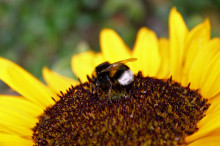
    CSIRO scientists are combining micro sensing, sterile insect technology and new insect trapping systems to protect our farms from one of Australia’s most economically damaging pest – the Queensland fruit fly.

    Although only 8mm in length the Queensland fruit fly, or Q-fly, is a highly mobile insect capable of infecting a wide range of major fruit and vegetable crops, including stone and tropical fruits. The spread of Q-fly in Australia’s eastern states is threatening the nation’s A$6.9 billion horticultural industry, which relies on both domestic and international trade.

    Until recently, farmers located in areas where Q-fly is present have used agri-chemicals – such as dimethoate and fenthion – to prevent and manage incursions. However, after a long period of review, the Australian Pesticides and Veterinary Medicines Authority has recently restricted the use of these insecticides.

    According to CSIRO researcher Dr Paul De Barro, increased Q-fly numbers can also threaten status of pest free areas.

    “We believe that our sterile insect technology (SIT), through development of a male-only line of Q-fly, will offer a new environmentally friendly, sustainable and cost effective approach to assist in managing this damaging pest.” Dr De Barro said.

    “SIT is a scientifically proven method for suppressing or eradicating fruit fly populations and managing their potential impacts in horticulture production areas.”

    This biological control method has already been used with great success around the world and in South Australia to combat the Mediterranean fruit fly. However, the development of male-only sterile Q-fly is a first.

    “Despite all our knowledge of fruit flies, we do not actually know where they go to breed,” Dr De Barro said.

    “When you’re looking to deploy sterile male flies to disrupt the mating cycle this information is a critical piece of the puzzle.”

    By using micro sensing technology on Q-flies, as we have done with honey bees in Tasmania, CSIRO will be able to answer that question and, most importantly, understand where to deploy sterile Q-flies and also how to make better use of other management options such as new trapping systems and pheromone baits.

    “It will tell us how many sterile flies we will need to release and most importantly, when to release them,” Dr De Barro said.

    “Combining SIT with other sensor technologies represents a game-changing opportunity as it not only provides us with information about how the Q-fly interacts with its natural environment, but offers real opportunities to reduce the cost of current monitoring networks for fruit fly.”

    According to Horticulture Australia Limited’s David Moore, General Manager R&D Services, this initiative is the first effort in a long time at investing in medium to long term research that will provide a sustainable solution to Australia’s fruit fly problem and its impact on production and market access.

    “There is still a lot of work to be done but compared to examples of overseas best practice along with the shared vision and dedicated support of key investors and industry, we’re confident that this project will deliver real impact for Australian farming communities,” Mr Moore said.

    CSIRO, Horticulture Australia Limited, Plant and Food Research, the Department of Primary Industries and Regions South Australia and New South Wales Department of Primary Industries are working together to develop a male only line of sterile Q-fly.

    Source and image.

  • abNormal: A Short Documentary on the Science of Being Different

    abNormal: A Short Documentary on the Science of Being Different

    What do a dancer, a chess player, a visual artist, a trumpeter, an architect, and a cab driver have in common?

    In the case of the dancer, the chess player, the visual artist, the trumpeter, the architect, and the cab driver profiled in trained molecular biologist and neuroscientist and The Rough Guide to the Brain author Barry J. Gibb’s abNormal above, they share… well, abnormality, in some sense or another. This half-hour documentary, which Gibb made in consultation with psychologist and neuroimaging researcher Chris Frith, “points a microscope at human behaviour, asking viewers to question their perceptions of others and even of themselves.

  • 10 Tips for Making Online Video a Joined-Up Experience

    10 Tips for Making Online Video a Joined-Up Experience

    Today, video plays an ever-increasing role in education. However, there is a major difference between an ad hoc, disjointed approach to video and a joined-up approach that sees video embraced as an integral part of university life. Here are a few things to look for from an online video platform:

    1. Ease of use

    An intuitive user interface is essential to maximise adoption. Staff and students should not have to worry about file formats and streaming and should be able to click a couple of buttons to upload, download or view content. Look for user-friendly video authoring tools, editing tools and support for sharing via social media sites.

    2. Multi-device support

    Choose a video solution that works seamlessly on mobile platforms too, so that the viewer has the best possible experience on a wide range of devices.

    3. Protect students and staff

    Ensure that a robust set of security controls are built in. Check for varying levels of access control, a range of user authentication options, and moderation of uploaded content. A flexible digital rights management solution is also essential.

    4. Accessible and discoverable rich media content

    Choose a solution that supports multiple content input options – manual uploading, in batch or via an API. It should allow you to organise content into meaningful categories and offer a good search function that extends to custom metadata. The ability to perform in-video search across libraries of transcribed content is useful.

    5. Consider the cloud

    Hosting your own video library can take up a lot of storage space. A cloud deployment removes the costs associated with adding more storage on campus, provides scalability and flexibility, enables automated updates for adding new functionality, and enables videos to be stored securely in the cloud by your platform provider.

    6. Integration and future-proofing

    Make sure that your video solution can be easily integrated into your existing technology framework and that it adapts to current workflows, such as your Learning Management System.

    7. Market your content externally

    Choose a video solution that makes it easy to market your university’s achievements and USPs to attract new students and to publicise research. A good platform will allow you to undertake live events online, record and broadcast them as VOD content, feed your content to third-party partners (e.g. YouTube/ iTunesU) and create RSS feeds.

    8. Measurement drives learning

    Use the analytics feature to undertake back-end analysis of how effective your rich media content is at engaging viewers and learn from what works and what does not. Some basic analytics and metrics include bandwidth monitoring and tracking individual students’ viewing of coursework videos.

    9. Support for distance/blended learning courses

    As the number of blended and distance learning courses continues to rise, it is useful to choose a solution that supports remote learning (e.g. support for webcam recording).

    10. Ease of integrating third-party licensed video content

    More and more third parties are now licensing professionally produced video content for use in classrooms digitally. Choose a platform that makes it easy for lecturers to incorporate educational video
    programming from content rights owners.

    Video allows you to reach and engage today’s YouTube generation with new and exciting teaching and learning techniques. The trick is to make your video solution an integral, joined-up part of your university’s culture in order to benefit from the resulting step-change in learning that can be achieved.

    Source and image.

  • Australian soil carbon map sets a baseline for future gains

    Australian soil carbon map sets a baseline for future gains

    A new CSIRO-developed map of Australia’s stored soil carbon provides an important benchmark against which Australia can track future changes in soil carbon storage or carbon sequestration.

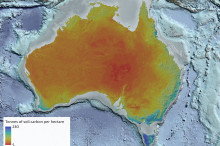
    Providing the most detailed and accurate representation of soil organic carbon stocks, to a depth of 30 cm, at a national scale, the 2010 soil organic carbon map for Australia, draws on soil sampling data and innovative prediction methods. The map includes an estimate of soil carbon stock and an estimate of the uncertainty for approximately two billion football-field-sized blocks (90m by 90m) across Australia.

    “This map is the first effective nationwide baseline of organic carbon levels in the top 30 cm of soil, which comes with estimates of uncertainty,” according to lead researcher, Dr Raphael Viscarra Rossel.

    Until now, estimates of soil organic carbon across the breadth of Australia have not been available or were largely uncertain because of large gaps in data and the limits of past measurement and spatial modelling.

    “The map provides a reliable benchmark for Australia to monitor the influence that changes in land cover, climate, land management and greenhouse gas offset activities have on soil carbon stocks and associated carbon dioxide removal from the atmosphere,” Dr Viscarra Rossel said.

    In assembling the new map, CSIRO drew on three major datasets, including CSIRO’s National Soil and Spectral databases and the national Soil Carbon Research Program – a nationally coordinated research program led by CSIRO, universities and state government agencies and funded by the Australian Government and the Grains Research and Development Corporation.

    The map and its prediction methods provide new insight into the environmental drivers that determine the distribution of soil carbon across the nation, its diverse bioregions and its states and territories.

    “Australia’s largest soil organic carbon stores per hectare occur in the cool, temperate zones, which have higher-than-average rainfall and extensive rainforests and eucalyptus forests,” Dr Viscarra Rossel said.

    “These larger stocks of organic soil carbon tend to coincide with southern states and regions fringing the coastlines, where wetter and cooler conditions produce more vegetation growth with slower decomposition and loss of carbon dioxide. South Australia, due to its large amount of desert, is an exception; its soils contain the least amount of organic carbon per hectare, followed by northern and western jurisdictions and regions exposed to Mediterranean, subtropical and tropical climates.”

    The average amount of organic carbon in the top 30 cm of Australian soil was estimated to be 29.7 tonnes per hectare and the total stock for the continent at 25.0 gigatonnes (Gt= 1000 million tonnes) with a 95 per cent confidence of being within the range of 19.0 to 31.8 Gt. The total stock in agricultural regions of Australia is 12.7 Gt with 95 per cent confidence of being within the range of 9.9 to 15.9 Gt.

    The new map and associated estimates and uncertainties have important applications, according to Dr Viscarra Rossel.

    “The maps of the estimates and their uncertainty are for 2010 and could be used to:

    (1) set a baseline from which Australia’s national soil carbon stocks could be monitored

    (2) guide the design of national soil monitoring networks

    (3) help guide future soil sampling designed to improve estimates of Australia’s soil carbon stocks

    (4) help to assess the potential of Australian soil to sequester carbon

    (5) improve Australia’s terrestrial carbon budgeting

    (6) assist with strategies to mitigate and adapt to the effects of a changing climate.”

    This work was published this week in the journal, Global Change Biology through CSIRO’s Sustainable Agriculture Flagship.

    Source and image.

  • Richard Feynman Explains How Rubber Bands Work

    Richard Feynman Explains How Rubber Bands Work

    The world is a dynamic mess of jiggling things, if you look at it right.

    When you see an ordinary rubber band stretched around and holding together a stack of stuff over a long period of time, you’re actually witnessing a miraculous force of physics at work — a perpetual pounding of the atoms as they struggle to hold these chains together against the outward push of the stack, vibrating with extraordinary vigor just to accomplish this seemingly mundane task. That peeling away of the mundane to reveal the magnificent is the greatest gift and most lasting legacy of Richard Feynman — champion of scientific culture, graphic novel hero, crusader for integrity, secret artist. Indeed, it was this very talent that earned Feynman the moniker “the Great Explainer

  • Volcanoes helped species survive ice ages

    Volcanoes helped species survive ice ages

    An international team of researchers has found evidence that the steam and heat from volcanoes and heated rocks allowed many species of plants and animals to survive past ice ages, helping scientists understand how species respond to climate change.

    The research could solve a long-running mystery about how some species survived and continued to evolve through past ice ages in parts of the planet covered by glaciers.

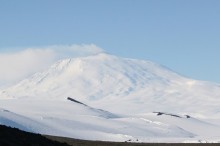
    The team, led by Dr Ceridwen Fraser from the Australian National University and Dr Aleks Terauds from the Australian Antarctic Division, studied tens of thousands of records of Antarctic species, collected over decades by hundreds of researchers, and found there are more species close to volcanoes, and fewer further away.

    “Volcanic steam can melt large ice caves under the glaciers, and it can be tens of degrees warmer in there than outside. Caves and warm steam fields would have been great places for species to hang out during ice ages,

  • The Science of What Motivates Us, Animated

    The Science of What Motivates Us, Animated

    “When the profit motive gets unmoored from the purpose motive, bad things happen.

  • The Origin of Water on Earth

    The Origin of Water on Earth

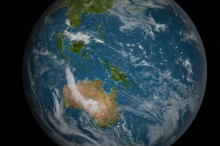
    The reason that there is clearly more water on the Earth than on the other planets of the Solar System has not been clarified. There are few theories on how the world’s oceans were formed over the past 4.6 billion years.

    Some of the most likely contributory factors to the origin of the Earth’s oceans are as follows:

    (1) The cooling down of the primordial world to the point where the outgassed volatile components were held in an atmosphere,
    (2) Comets, trans-Neptunian objects or water-rich meteoroids,
    (3) Measurements of the ratio of the hydrogen isotopes deuterium and protium point to asteroids,
    (4) Biochemically, during the Great Oxygenation Event, via redox reactions and photosynthesis,
    (5) Gradual leakage of water stored in hydrous minerals,
    (6) Photolysis: radiation can break down chemical bonds on the surface,
    (7) Planetesimals heated by the decay of aluminum.

    The reasons why we have water on Earth are presented in the following video material.

  • Learn Right From Wrong – Oxford’s Free Course

    Learn Right From Wrong – Oxford’s Free Course

    Oxford University professor Marianne Talbot has a number of excellent philosophy podcasts online, some of which we’ve previously featured on the site. Today, we bring you Talbot’s A Romp Through Ethics for Complete Beginners (Web – iTunesU – YouTube), which addresses one of philosophy’s central questions: what is the right way to conduct yourself in life?

    The problem may, at first, seem somewhat trivial. “Live whichever way you want, as long as you’re going to be a good person,

  • Why Do We Cry?

    Why Do We Cry?

    Everyone’s had one of those days when everything seems to go wrong. At this point, some of us resort to nature’s tried and true stress relief method – crying. But, why do we cry? Is there any scientific explanation to this phenomenon?

    Basically, there are some research explanations which we would like to present you through the following video material.

  • How to Remain Cyber Safe?

    How to Remain Cyber Safe?

    Over the decades security experts all around the world have been debating what sort of protection is the most suitable for a PC. So, what do you think you should do to keep your computer cyber safe?

    Below are some key steps to protecting your computer from intrusion:

    Keep Your Firewall Turned On

    A firewall assists in protecting your computer from hackers who might try to gain access to crash it, delete information, or even steal passwords or other sensitive information. Software firewalls are widely recommended for single computers. For multiple networked computers, hardware routers typically provide firewall protection.

    Install or Update Your Antivirus Software

    Antivirus software is designed to prevent malicious software programs from embedding on your computer. If it detects malicious code, like a virus or a worm, it works to disarm or remove it. Viruses can infect computers without users’ knowledge. Most types of antivirus software can be set up to update automatically.

    Install or Update Your Antispyware Technology

    Spyware is just what it sounds like—software that is surreptitiously installed on your computer to let others peer into your activities on the computer. Some operating systems offer free spyware protection, and inexpensive software is readily available for download on the Internet or at your local computer store.

    Keep Your Operating System Up to Date

    Computer operating systems are periodically updated to stay in tune with technology requirements and to fix security holes. Be sure to install the updates to ensure your computer has the latest protection.

    Be Careful What You Download

    Carelessly downloading e-mail attachments can circumvent even the most vigilant anti-virus software. Never open an e-mail attachment from someone you don’t know, and be wary of forwarded attachments from people you do know.

    Turn Off Your Computer

    With the growth of high-speed Internet connections, many leave their computers on and ready for action. The downside is that being “always on” renders computers more susceptible.

  • The Science of Which Came First, the Chicken or the Egg, Animated

    The Science of Which Came First, the Chicken or the Egg, Animated

    What the ancient proto-chicken has to do with how wolves became dogs.

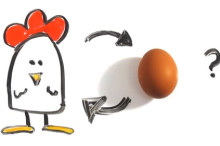
    Since the dawn of recorded history, philosophers have pondered which came first, the chicken or the egg, as a causality dilemma exploring grander existential inquiries into the origin of life and the universe. But, it turns out, science has an answer that bypasses the metaphysical and dives right into the nitty-gritty of the tangible and concrete. In yet another illuminating animation, AsapSCIENCE enlist evolutionary biology in answering the age-old question, comparing the process to how dogs became dogs and ultimately demonstrating that — like much of science — the solution may have more to do with semantics and nomenclature than with actual scientific evidence.

    Source and image.

  • Scientists: accelerate your career with collaborative, high impact fellowships

    Scientists: accelerate your career with collaborative, high impact fellowships

    Queensland’s researchers and scientists are encouraged to apply for fellowships to help them develop and establish their professional reputations through innovative, practical and applied research, working closely with business.

    The $3 million Accelerate Fellowships funding program was opened today by Queensland Chief Scientist Dr Geoff Garrett AO who said the program will support scientists to undertake research that can have a positive impact on Queensland.

    “Early career fellowships will offer a researcher with up to five years’ post-PhD research experience $180,000 over three years to support them lead and manage a research project, with close engagement with business partners.

    “Mid-career fellowships will offer $300,000 over three years for a researcher with five to ten years’ post-PhD experience to lead a research team to deliver a significant research project,

  • The Chemistry of Sriracha

    The Chemistry of Sriracha

    If you head over to the Huy Fong Foods web site, they’ll tell you that Sriracha, their ever-popular Thai condiment, is “made from sun ripen chilies which are ground into a smooth paste along with garlic and packaged in a convenient squeeze bottle.