
“We see with the eyes, but we see with the brain as well.










The tenacious and troublesome Crofton weed (Ageratina adenophora), as it is commonly known, has been running rampant in eastern coastal Australia since it ‘escaped’ from being an ornamental plant in Sydney gardens.
It has taken hold on Lord Howe Island, a World Heritage Area, where it is found mainly in non-accessible areas, making manual removal and herbicide control impractical.
Crofton weed is a serious environmental weed that has invaded agricultural lands as well as 150 reserves in NSW managed by the National Parks and Wildlife Service (NPWS). It reduces the ecological value of bush land but also affects grazing land on farms by diminishing their carrying capacity.
The weed spread rapidly during the 1940s and 1950s creating dense infestations, particularly along waterways and disturbed areas, inhibiting native regeneration and threatening several vulnerable or endangered native species and communities, including those on Lord Howe Island.
The new biological control agent is a rust fungus that originates from Mexico (where Crofton weed is native) and works by infecting the young leaves and stems of the plant, stunting development and disrupting its ability to reproduce.
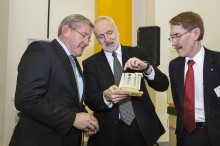
Dr Louise Morin, plant pathologist from CSIRO’s Biosecurity Flagship, is leading the Crofton weed rust fungus release program.
“The release of this fungus in Australia is exciting because it could make a big difference in the management of Crofton weed populations,

The Speech Accent Archive: The English Accents of People Who Speak 341 Different Languages
Over the years, I’ve met with several foreign speaking partners.
Through conversation, I learn their language — Spanish, Korean, Japanese — and they learn mine — English. Many of them first got serious about their study of that more-or-less-international tongue with the goal of completely eliminating their native accent which, while demonstrably possible, takes so much additional effort as an adult that I’ve always advised them to just spend that time learning another language (or two) instead. Many, of course, come to that conclusion themselves, realizing that English speakers all over the world have created a legitimate culture of speaking English in all kinds of different ways, with all kinds of different accents, whether or not they learned the language from childhood. But it still makes one wonder: how many different accents do people speak it in? And what do they all sound like? Wonder no longer, for we have The Speech Accent Archive, created by Steven H. Weinberger of George Mason University’s Linguistics department, who introduces it in the video below.
The site, “established to uniformly exhibit a large set of speech accents from a variety of language backgrounds,