Blog

  • Sensitizing National Agricultural Research System on Free Open Source Software

    Sensitizing National Agricultural Research System on Free Open Source Software

    Courtesy Véronique Fritière

    The food grain production in India is reaching an all-time record of 252.56 million tonnes for the year 2011-12. However, as per the report of Sainath (2012) the daily per capita availability of food grains has fallen from 474.9 grams during 1992-96 to 440.4 grams during 2007-2010. This needs a great attention as the population is increasing and there is growing demand for food and nutritional requirements in the country. The one of the United Nation‘s ‘Millennium Development Goals‘ is reduction of extreme poverty and hunger in the world. Hence, it is the responsibility of the country’s National Agricultural Research System (NARS) to make interventions in the sustainable agriculture and to feed its burgeoning population with the recommended nutritional requirements.

    When we see at the Indian agriculture, it is rainfed and is very much dependent on the monsoon. Apart from this, it is also facing tough competition from various biotic and abiotic factors and global climatic changes. Marketing of the produce is also a big challenge due to volatile local and global markets. The NARS having the responsibility for the agricultural research, education and extension is looking at the possible interventions for sustainable agriculture and food security. It needs to advise the farmers and policy makers at various levels in the value chain of agricultural production. As agriculture being the principal occupation in the country, timely communication of agricultural information assumes a greater priority as it would help in taking informed decisions. Therefore, use of Information and Communication Technologies (ICTs) in NARS, assumes an important role in all the efforts towards sustainable food production and food security.

    Increased use of ICTs would benefit farming in making available the right information at right time. However, the affordability of hardware and software had become the major constraints for the wide adoption of ICTs in the developing countries and in India. This situation could easily be overcome by the adoption of Free Open Source Software (FOSS) products/applications. The FOSS applications developed by the community developers/programmers, who believe in the philosophy that the software should be freely available to all in world to modify, improve, adapt and share. The adoption of FOSS would increase the access to ICTs by overcoming the price barrier compared to the expensive commercial/proprietary software packages. The FOSS products which are built on open standards and protocols allow sharing of information/knowledge across all the technologies and help in collaborating with everyone in the country and world. The advantage with the FOSS is that there would be flexibility in choosing wide variety of software flavors and could migrate from one platform to another easily.

    In NARS, however the use/adoption of FOSS products/applications is minimal. Even if at all they are being used, it is because of convenience and not because of FOSS philosophy. Many of the institutions in NARS don’t train its students during their degree programmes and train their staff by capacity building programmes because of lack awareness and availability of FOSS trainers in the system. Many believe and argue that proprietary software is easy to use and they are more secure when compared to FOSS and moreover they say that they would get commercial technical support for all the proprietary software. In the NARS since the first establishment of Agricultural Research Information System units which are now renamed as Agricultural Knowledge Management Units (AKMU) centers, had established ICT infrastructure with proprietary software and now they are hesitating to switch over to FOSS. And the decision makers in the institutions prefer to be in the system they are familiar with rather than exploring the available FOSS products. When funds are earmarked for the procurement of software and progress is measured in terms of the money spent, the institutions continue to use proprietary software in NARS.

    Under National Agricultural Innovation Project (NAIP) Component – I, though considerable efforts have been made for the use and development of FOSS products, not many of the institutions have adopted the application of FOSS. As it can be seen that under the AGROWEB-Digital Dissemination System for Indian Agricultural Research (ADDSIAR) project, though there is a mention of use of open source software for content management, not all the projects partners have adopted/used FOSS. In the ADDSIAR project, the ICAR could built its website on Drupal; and the IARI and NAARM institutes could built their websites on Joomla. The NAARM had used Moodle for its e-learning initiatives for its students. The other projects in which we could see use and adoption of FOSS are the ‘Rice Knowledge Management Portal’ (RKMP) by DRR and ‘Agropedia‘ being developed on AgriDrupal under NAIP project lead by IIT Kanpur. It is surprising that under another NAIP project, Strengthening Statistical Computing for NARS proprietary software SAS is being used for training & capacity building NARS researchers but there is no use of FOSS statistical software ‘R‘. In the precision farming and plant genetic resource conservation and exploration projects too, where Geographic Information Systems (GIS) software is extensively used, there is no mention of using FOSS software like OSGeo which could be effectively used. However, in most of the GIS trainings programmes, commercial proprietary software is used rather than FOSS. In the Project Information & Management System of ICAR, to add the projects, one has to use only Internet Explorer and other Internet browsers do not work.

    In NARS, about 100 scholarly societies are registered and they publish scholarly journals and organize conferences, seminars, and symposiums. All of them uses email for the paper submission and makes available them in printed books/CD-ROMs to all the attendees. However, the non attendees never get access to the abstracts, papers, and proceedings. When, the conference proceedings are managed and made available online, then the there would be greater reach of information and research outputs. The FOSS products from Public Knowledge Project’s Open Conference Systems (OCS) and Open Journal Systems (OJS) could effectively used by these scholarly societies for the conference and journal publication. In NARS, only KAU‘s Journal of Tropical Agriculture, UASD‘s Karnataka Journal of Agricultural Sciences and ‘Indian Agricultural Research Journals‘ of ICAR’s  NAIP project are using OJS and OCS is never used till date. Similarly the FOSS products viz., AgriDrupal, AgriOcean DSpace and VocBench from the ‘Agricultural Information Management Standards‘ of Food and Agricultural Organization could be used in NARS for the knowledge dissemination. During the past year, we could only see only one short course on FOSS in development of agricultural information and communication management system organized by CIRG.

    This shows that NARS needs sensitization and capacity building in use and application of FOSS in agricultural research. For this, a new initiative FOSKIARD (Free and Open Software and Knowledge Initiatives in Agricultural Research for Development) has been taken up by FOSS evangelists in NARS. It intends to conduct sensitization & capacity building workshops at various institutes of NARS and impress upon the NARS managers for the need of creation of central AKMU computer labs with FOSS operating systems like Ubuntu. From the workshops it is expected that the agricultural researchers, FOSS developers, free knowledge advocates and legal experts can meet, interact and could work for the development of applications of FOSS products relevant to agriculture for sharing agricultural information and research outputs for public good.


  • Harvard and MIT offer free online education materials

    Harvard and MIT offer free online education materials

    Harvard University and the Massachusetts Institute of Technology (MIT) announced last week the launch of edX, a transformational partnership and initiative in online education. EdX presents a not-for-profit joint venture between these two institutions that will collaborate to “enhance campus-based teaching and learning and build a global community of online learners

  • Applying MacGyver Principles to Recycling Policy

    Applying MacGyver Principles to Recycling Policy

    MacGyver23 cm of string. 1 tyre iron. 3 broken shards of glass. 18 rolls of fiber insulation. 1 match. 2 cardboard boxes. 4 paperclips. Because you always need a paperclip.

    There was a fantastic TV show that aired in the United States when my brother and I were growing up in the late 1980s…MacGyver. No doubt many of you are aware of it as well as it aired across the globe – Australia, Europe, Taiwan, etc. It was my brother’s favourite show and I think it actually played quite a role in his ability to fix anything. Anything. If my computer breaks down I call him first.

    The articles mentioned above, the tire iron, broken glass and paperclips, cardboard boxes, may all sound like rubbish cast aside, items you’d find lying in the gutter on the streets of Manhattan or in a landfill. Should we simply leave these items lie there? Or, should we try to reclaim them? Putting them to some use to help us find a way out of our trash/recycling problem? How do we get to sustainability? Is it a farce? Does sustainability actually exist?

    We just had Earth Day. And remember World Water Day was not that long ago. Has the world changed? How many people drastically altered their consumption habits because of some message they read or heard on either of those days? Or were the same cheerleaders leading the chant for the home team that never quite seems to be able to score?

    How many people work in offices in the US – around the world? Let me tell you a story about my office. We have black colored trash bins for trash and blue colored bins for recyclables – paper, plastic, aluminum. I dutifully sort the refuse of my consumption day in and day out, as I do at home. Even though I know for a fact that the janitor combines both bins into his large trash can as he makes his way through the offices and workstations collecting those daily discarded items. On Earth Day, all the employees in my 36-story office building received a paper postcard informing us of how we could “redeem

  • Australian team nominated for European Inventor Award

    Australian team nominated for European Inventor Award

    Dr. Josef Theurer is nominated in the category Lifetime achievement for his railway track-laying machines

    Dr. John O’Sullivan and team nominated by European Patent Office for paving the way for Wi-Fi. Australian scientists laid world standard in modern communication and licence out their invention all over the globe.

    Battistelli: “The innovation led by Dr. O’Sullivan and team has impacted on our daily life to an extent that only few inventions have achieved before.

  • The social network of solitary lizards

    The social network of solitary lizards

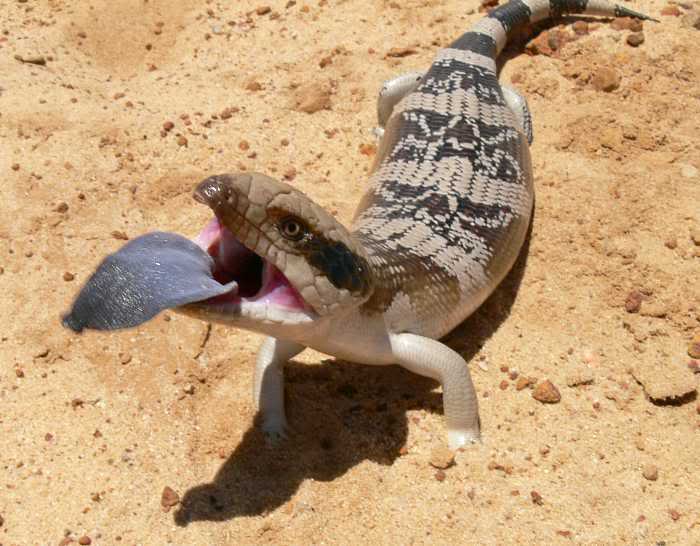
    Burra, South Australia. Dirt roads link sparsely populated towns and communities once home to copper miners that lived in tiny dugouts along the banks of the creek. Burra is a place capsulated by hot, dry summers and cool moist winters. Across the arid place a grey-brown reptile with short limbs and a large cumbersome head shuffles along the dirt in search of the place it calls home. No other living thing is in sight. For all intents and purposes, this lizard is the last being in existence.

    The Pygmy Bluetongue Lizard is the smallest of the genus Tiliqua and, unlike the other members of the genus, it has a pink tongue. Its home is a vertical burrow constructed by spiders. The bluetongue lizard is generally territorial and lives a  life of solitude. The solitary lizards rarely leave home, and when they do rarely for any great amount of time, taking solace within their holes for many months at a time and rarely encountering a neighbour outside of mating season.

    The lizard’s use of wolf and trapdoor spider holes as a home is only a recent discovery. It really makes no modifications to its lodging, using it for day time shelter, retreat sites for hiding, ambush sites for hunting passing prey, basking sites for thermoregulation, and birthing sites. Really from cradle to the grave.

    At the height of the mining boom, the population of miners living in the Burra region was in the area of 5000, approximately the number of lizards that currently roam the grasslands near Burra today. Bluetongue lizards are now endangered and under threat from climate change, the changing of the natural soil under its feet due to ploughing of native grassy understorey, and — most importantly — from parasites.

    The lizards are host to an ixodid tick, Bothriocroton hydrosauri, and an oxyurid nematode, Pharyngodon wandillahensis. Two parasites that don’t really go out of their way to be parasitic.

    How a host acts can be very beneficial for a parasite or pathogen. Parasites evolve to get the most out of their host… by hook or by crook. Some parasites go to great lengths to change the behaviour of their hosts. The Tom & Jerry dynamic witnessed in Toxoplasma gondii, and zombie ants are the more popular examples.

    One of the challenges of disease ecology in a wildlife setting is to identify and map how different parasites and pathogens spread and establish a foothold within a population. From influenza to measles to HIV to foot and mouth to real or hypothetical diseases, the modelling is all very similar. The patterns of contact among hosts within a population are likely to play a central role in how parasites spread. A good social network is key to any disease transmission.

    Why would the bluetongue lizard make a good animal to study the spread of disease through a population, given its less than social nature? And the more pertinent question of how can a parasite remain successful with an anti-social host? These were the questions that faced researchers at Flinders University in South Australia.

    The spread of parasites is one that often relies on the modification of host behaviour, but in the case of the tick and the nematode, the parasite takes advantage of the lizard’s less than social nature.

    The tick requires three hosts, and each developmental stage of the tick is on a different host. Larvae, nymphs and adult females each attach to a host, feed and then detach. The detached larvae and nymphs then moult to the next developmental stage. Whereas the female lay eggs that hatch into larvae.

    Tick activity and development occur in the spring and summer months when the weather is warm and the lizards are at their most adventurous (lizard activity is at its peak). The tick adopts a ‘sit and wait’ strategy to find its next host. Once detached from its host, it will move less than half a metre to find the next host. It simply waits for the lizard to find it.

    The oxyurid nematode has a more astute strategy. Lizards use their tongues to sense environmental cues, and the bluetongue lizard uses its tongue to inspect scats other lizards use to mark their territory. This is when transmission occurs.

    Both tick and nematode are working against the clock. The tick must be found by a lizard within a relatively short amount of time (40 days). Whereas the eggs of the nematode are thought to have no more than 10 days to find its next host before they die.

    The parasites rely on the more adventurous lizards within the population to be mobile enough to disperse the disease. Those that act as dispersers, wandering from neighbouring settlements. These dispersing lizards behave more cautiously, and are more likely to inspect any scats with its tongue as they move through occupied habitat. And thus, more likely to encounter a parasite.

    These parasites, unlike most, have to rely on the rare occasions of interpersonal contact patterns between lizards. These parasites have to rely on the social network of antisocial, solitary lizards.

  • Open Access India: Movement for Making Public Funded Research Open

    Open Access India: Movement for Making Public Funded Research Open

    The Open Access India

    The ‘Open Access‘ movement which is built on the principle that the publicly funded research should be freely accessible online is gaining momentum around the world. In India, according to the Registry of Open Access Repositories and Directory of Open Access Repositories nearly 80 repositories have been registered since 2004 and three of them are listed in the top 200 of world repositories ranking. However, this momentum is slow in the field of agricultural sciences when compared with other sciences in India. Only few institutional repositories viz., Eprints@IARI, Eprints@CMFRI, E-Repository@IIHR, DSpice@IISR along with a thematic repository ‘OpenAGRI‘ have been established till date. Following the calls from Budapest Open Access Initiative and Berlin Declaration, M.S. Swaminathan Research Foundation, the Indian Academy of Sciences and the Indian National Science Academy took lead in Open Access activities in India. During the 93rd Indian Science Congress held in Hyderabad, a ‘Optimal National Open Access Policy for India‘ was proposed and  the National Knowledge Commission of India had recommended an Open Access mandate for publicly funded research.  As per the University Grants Commission‘s regulations (2009), a digital repository of Indian Electronic Theses and Dissertation ‘Shodhganga‘ was set up and made accessible to all.

    However, the situation in the field of agricultural sciences is that earlier to the establishment of ‘Eprints@IARI’, an institutional repository of the Indian Agriculture Research Institute (IARI) in 2009 only the Journal of Tropical Agriculture from Kerala Agricultural University and  Karnataka Journal of Agricultural Sciences from University of Agricultural Sciences, Dharwad are the two Open Access Journals available. The National Agricultural Research System (NARS) comprising all the 97 ICAR institutes and 47 State Agricultural Universities (SAUs) is the largest system of the world. When the Council of Scientific and Industrial Research (CSIR) had adopted Open Access policy and made all its journals Open Access and has established institutional repositories for all its laboratories in 2009, the Indian Council of Agricultural Research (ICAR) in the year 2010, as a part of e-Publishing & Knowledge System  in Agricultural Research project under National Agriculture Innovation Project (NAIP), launched its two flagship journals on Open Journal Systems and declared them as Open Access. It is now offering hosting support to scholarly societies on its ‘epubs‘ platform for their journals. Under another NAIP project, a thesis repository, ‘KrishiPrabha‘ was established for NARS. However, unlike ‘Shodhganga’ it is only available to NARS institutions for online viewing and without full-text download permission. In the NARS, more than 100 scholarly societies are functioning and the use of the community developed tools & techniques for sharing and enriching the research information on the web by these societies is uncommon. Though under the NAIP, the entire NARS is being provided with the access to relevant corporate journals under the project Consortium for e-Resources in Agriculture. The access to the enormous outputs from Indian agricultural research which had aided in the advancement of agricultural science are being restricted for sharing openly with the world.

    At this backdrop, seeing the slow pace of growing Open Access momentum in India, a group of agricultural researchers formed a voluntary group called ‘Open Access India’ (OAIndia) in July 2011 on ‘Facebook’ with an aim to take up the advocacy on ‘Open Access’ and to make agricultural information openly available, accessible and effectively used for farming in the country. Till date the group had grown to the membership of 1990 and to have a wider reach, OAIndia had created its page on Facebook, and groups on Linkedin, on Google groups and on openaccessweek.org. The group is listed in the Open Access Directory as one among the 15 groups formed on Facebook on Open Access.

    The aims & objectives of ‘OAIndia’ are as follows:

    • Advocacy – sensitizing the researchers, policy makers and general public on the need to make data & information generated through public funds openly available.
    • Development of community e-infrastructure, capacity building and framework for ‘Open Access’ policies for sharing data & information.

    In the NARS, researchers have generated extensive data and are stored in data books and project reports. Many a times, much of the data exists as unpublished (Grey Data) and once the researcher leaves the organization, the data is lost. Timely release of this data would help the researchers to carry forward the research for attaining the important scientific goals without ‘reinventing the wheel’ and in the light of recently approved National Data Sharing and Accessibility Policy for India, the discussion on the development of data standards, collection & analysis, sharing, archiving and rewarding policies assumes a considerable importance. To take forward its aims and objectives, the OAIndia had started consultations with various agencies working for the open knowledge to seek support for the creation of  community owned Open Repository for all the researchers to voluntarily archive data & information whose institution did not have any infrastructure for the same.

    Now, the OAIndia now had become partner with MyOpenArchive an international Non-Profit Organization for advocating “green road

  • Connected and Free: World Wide Web professionals at #WWW2012

    Connected and Free: World Wide Web professionals at #WWW2012

    This is the Part II from the highlights of the World Wide Web 2012 (#WWW2012) conference and here are some notes of mine but this time focusing on people, attendants who have been actively participating in the web professionals meeting and their impressions of the conference. 

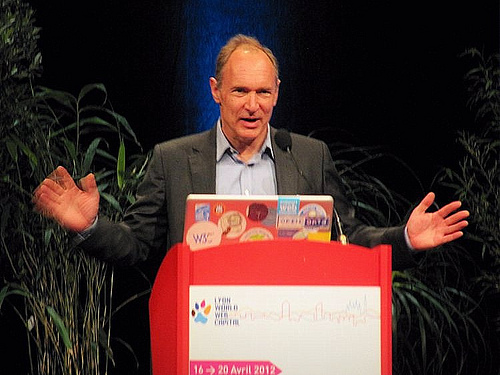
    Beside numerous tracks, sessions, workshops, and tutorials – the #WWW2012 offered interesting keynotes by the leading and prominent professionals in Web industry, research, and policy. The main keynote speakers were Tim Berners Lee, the inventor of Web, Bernard Stiegler – a director of IRI (Innovation and Research Institute) at the Georges Pompidou Center in Paris, a professor at the University of Technology of Compiègne where he teaches philosophy, Chris Welty – a Research Scientist at the IBM T.J. Watson Research Center in New York, and Neelie Kroes, a Vice President of the European Commission and European Digital Agenda Commissioner.

    I asked some of the many colleagues, peers, and presenters about their preferred event on the World Wide Web 2012 conference, and what presentation/session/keynote/workshop made the best impression on them, and why.  Here are some interesting thoughts.

    New software paradigm, and Social Media in Response to a Crisis

    I’ll start with volunteers at the conference since they had a great job to do and many of them are web researchers, students, and professors.

    Jean-Tiare LE BIGOT: “I am currently studying telecommunications in Lyon (France) and attended the www2012 as a Volunteer. In my spare time, I try to create an archive of network status map.  As a Volunteer, it has been quite tricky for me to choose and attend the presentations. Nonetheless, I had the luck to see all keynotes in the auditorium. As many of the attendees, I appreciated TBL talk on the values of the Web and also the debate of the following day. But the one I preferred was the one by Chris Welty. He talked about IBM’s Watson project and the steps which enabled Watson to defeat humans in the Jeopardy show. I really enjoyed the humor in his explanations when he showed us the biggest fails :). ”

    Watson is an Artificial Intelligence system designed to answer real world questions as in the Jeopardy show or financial/medical world. During his presentation, Chris Welty stressed on point: Machine’s understanding is in no way the same as human’s. This is to illustrate this point that he showed us some failed answer which is obvious for a human being. An example:

    Source

    Cindy Hui:  I am a post-doctoral researcher at the Rutgers University. My research includes modeling and simulation, social networks, social computing, and disaster research. I presented a paper at Social Web for Disaster Management Workshop titled “Information Cascades in Social Media in Response to a Crisis: A Preliminary Model and a Case study.”

     “There were so many interesting workshops and sessions at WWW2012 that covered such a variety of topics, but I mostly attended the ones that focused on social networks and social media since those are my areas of interest.  In particular, I was very excited about the Social Web for Disaster Management and the Making Sense of Microposts workshops since there’s such a growing focus on how to analyze and make use of these community-driven, collective information from various social media platforms. It really brings together people from computer science, social science and policy practitioners, each contributing important pieces to the overall focus.

  • Global Web, Society and Knowledge at #WWW2012

    Global Web, Society and Knowledge at #WWW2012

    The 21st International World Wide Web Conference, (#WWW2012) for web professionals is over. Lyon convention center (Lyon, France) gathered many prominent computer and social science specialists, web and mobile technologies creators, internet researchers and scholars, developers, users and commercial ventures – actively engaging, interacting, writing, and communicating on web, Internet, social media, digital technologies, and emerging applications.

    Recently finished #WWW2012 conference offered numerous workshops, sessions, tutorials, interesting  keynotes from 16 – 20 April 2012 in Lyon, France on different topics, and in particular on a global concern in information-communication and web technologies in our society. The main theme of the WWW2012 is Society and Knowledge, and Future direction of the Web , and through numerous sessions and presentations it covered social, technological,  and philosophical issues, which are critical web research subjects at the moment, as well as the actual topic of Internet and democracy, free access to services, freedom of expression, regulation and censorship, control and copyright.

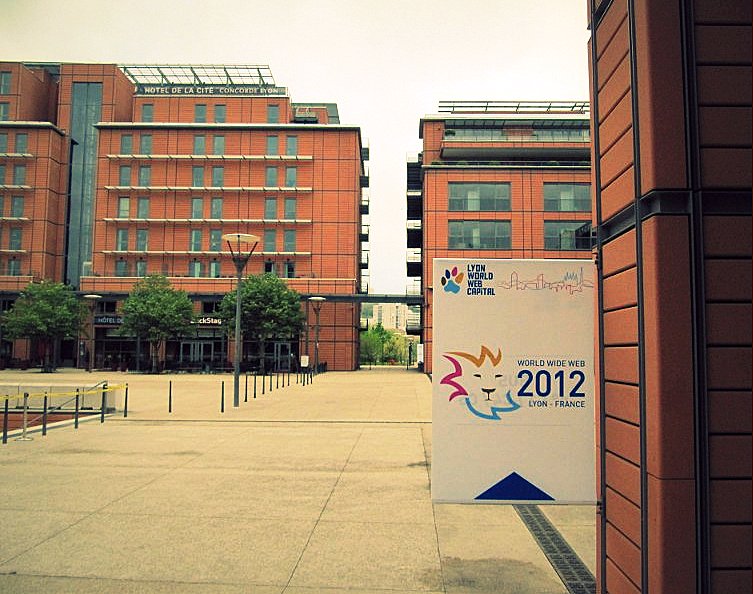
    #www2012, Lyon Convention Center, Cité de Congrès. Photo credit: D. Radovanovic

    Topics ranging from Web Search (information retrieval, ranking, relevance feedback, interactive search), Web Mining (clustering, classification, and summarization of Web data, predicting trends from web content, Web measurements, Web evolution), Social Networks (user-driven recommender systems, link prediction, social search, social mining, analysis of reputation), Data and Content Management, Semantic Web, Video on Web, as well as the topics on Security, Privacy, Trust and Abuse on the Internet were covered from different perspectives and approaches, but all related to the evolution of the Web.

    I am selective here with some presentations, workshops, and papers since it was physically impossible to be present parallel at all events and tracks (see below some stats section on papers being presented). I didn’t count the number of participants at the conference, but I can estimate more than 2,000 participants in total.  These are just some of my thoughts jotted down on workshops, sessions, and presentations as Part I of the #WWW2012 highlights.

    Making Sense of Micro posts: Big things come in small packages

    As I wrote earlier this year for the second time around I was in the Program Committee for the #MSM12 or Making Sense of Microposts workshop at #WWW2012 that offered up a very interesting pool of presentations and papers.  In particular I would point out the keynote by Greg Ver Steeg – Information Theoretic Tools for Social Media who talked about interesting information theoretic measures for social media and how can we estimate these quantities, e.g., how well one user’s activity can predict another’s.  He also presented techniques for estimating entropies (the case for spatio-temporal events, for textual information, etc.)  You can find Greg’s presentation slides here.

    My role at the #WWW2012 was also as a presenter of a research paper Small talk in the Digital Age: Making Sense of Phatic Posts. I was giving a talk on the phatic communication, and phatic posts – why tweets and Facebook updates on weather, food, and other trivia are very useful both for online communities and human relationships, and for the sustainability of the social network systems. I wrote earlier about here, here (The Scientific American), and here. Other interesting papers on microposts, sentiment analysis and semantics, information extraction, visualisation, search and networks – could be here found and downloaded.

    The award for best paper went to the authors of the paper: Alleviating Data Sparsity for Twitter Sentiment Analysis. The authors presented the semantic feature set where they extract semantically hidden concepts from tweets and then incorporate them into classi

  • Here be Dragons

    Here be Dragons

    On May 11, a Dragon will mate with the International Space station.  Rather than some mythical creature, this Dragon is of human artifice.  The Dragon’s rendezvous and berthing with the International Space Station presages a new chapter in human exploration of space.

    The significance of this event is Dragon is a reusable spacecraft, developed, and built by the American company Space Exploration Technologies, SpaceX, as it is more commonly known.  Established in 2002, SpaceX has developed a new family of launch and cargo and crew capsules from the ground up.

    The commercial race to space

    NASA has now “set it sights on exploring once again beyond low earth orbit.

  • How many genes does it take to vote?

    How many genes does it take to vote?

    “2 genes predict voter turnout

  • Discovering Fake Consumer Reviews With GSRank

    Discovering Fake Consumer Reviews With GSRank

    spam-formulaResearchers at University of Illinois at Chicago and Google have just introduced a new spam-fighting metric called GSRank which is a product of behavioural observation of spammer groups. The model which outperforms all existing spam fighting methods includes relationships between groups, individual activities and also observes reviewed products. It appears that flagging groups of product review spammers is easier than labelling them individually:

    Basic Pattern of Fake Reviews

    Observing a small group of three fake reviewers/accounts lead to the following findings:

    1. Same product reviewed by the common group.
    2. High rating by group members.
    3. Narrow time window within all rated products.
    4. Group reviewed the same set of products.
    5. Quick to rate. Usually first or among first to review.

    The first step in product review analysis is to build a reference dataset. This involves data mining followed by labelling and defining group spam behaviour indicators. Group and individual behavioural statistics are examined and ranking experiments are conducted to train the system. The evaluated results are not only fast but also highly accurate.

    Practical Application

    This research don’t only help stores (Amazon) and their customers but it also carries much wider potential. Search engines can now apply GSRank model to discover fake reviews and normalise their aggregate ratings for products, places and various other features.

    References

    [1] Mukherjee, A., Liu, B., Glance, N., – Spotting Fake Reviewer Groups in Consumer Reviews, WWW 2012, April 16–20, 2012, Lyon, France.

  • In the Quest to Tell the Story for Science

    In the Quest to Tell the Story for Science

    Skills learned in science have a carryover effect into other areas of life, and ultimately have an impact in their chosen profession – influencing their thought process and how they carry out decisions. Whether kids choose science as a major in university and continue with it through to the job market, even at the earliest levels of schooling, science engages students to become leaders. Why? Because they are inquiring to learn about the environment around them, to find out what makes it tick, and to correct or enhance any “ticks


  • Battlefield Theory

    Battlefield Theory

    Imagine the scene — from the mouth and nose, through the pharynx into the trachea, separating into the left and right main bronchi at the larynx. This is the start of your airway. This is to be the site of inflammation, or rather, the site of battle. Across the landscape that is the airways, two sides are about to go to war. Invading pathogens versus human inflammatory cells. This war will eventually lead to pneumonia.

    To treat pneumonia we need to pin down the exact invading pathogen and treat accordingly. The most common types of infectious agents are viruses and bacteria. But of all the microorganisms that can cause pneumonia, most cases are down to only about two dozen species. Identifying the infecting agent, the actual cause of pneumonia, relies on a lengthy process; from a full patient history and examination, to imaging studies and epidemiological information, together with bacteriological tests.

    Despite all of this, in up to 50% cases of pneumonia, the causative pathogen remain unidentified.

    In and amongst the invading pathogens are other organisms that are just bystanders — colonizing the airway. Other commensal organisms in and amongst our instigators of war. In diagnosing pneumonia many are implicated and detecting these organisms in the airway does not necessarily mean they are the cause of infection. As such, any commensal organism that falls within a certain spread of criteria is thought to be the causative agent.

    The key to all of this is the difference between colonization and infection.

    To discriminate between the two types of organisms in a pneumonia infection — infectious and colonizing —  researchers from Japan came up with the “pneumonia battlefield“. The titled “Battlefield Hypothesis

  • No Place to Go But Up

    No Place to Go But Up

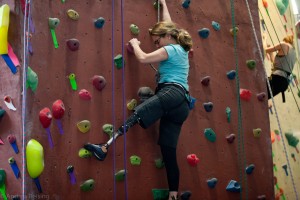
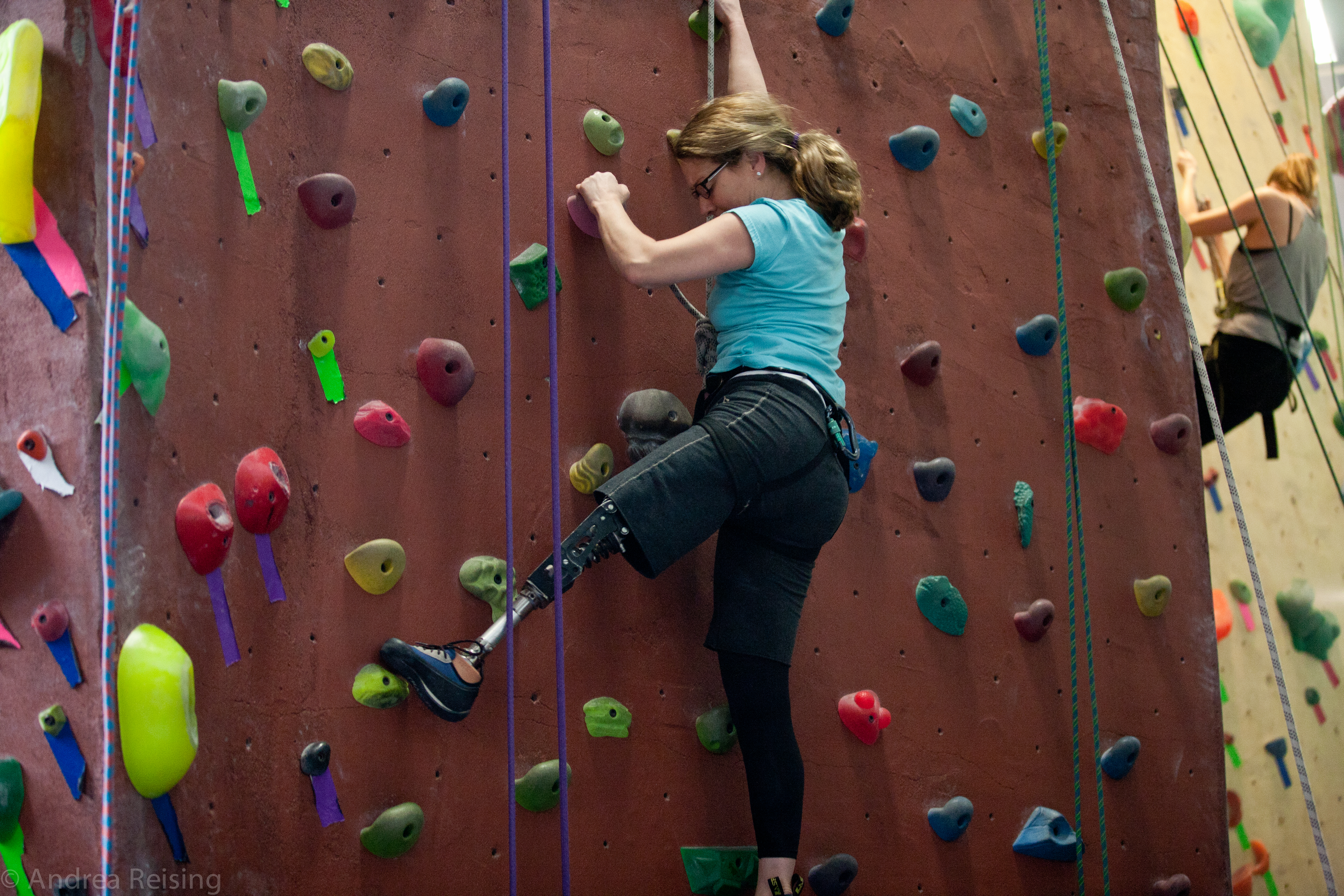
    Adaptive Climbing Participant Tackles the Wall

    ad•ap•ta•tion [ad-uhp-tey-shuhn] – a form or structure to fit a changed environment

    The most powerful natural species are those that adapt to environmental change without losing their fundamental identity which gives them their competitive advantage.