Blog

  • Cyber Skills Shortage in Australia

    Cyber Skills Shortage in Australia

    As we live in the era of digital technologies, cybersecurity concerns are getting more and more frequent and serious. The Government agencies and other organisations need to protect their IT facilities while cybercrime severity increases. Similarly, as everywhere in the world, Australia is facing up these issues as well. The trend shows that the entire world including Australia is suffering cyber skills shortage.

    Introduction

    Cybercrime started off with geeky teenage computer experts hacking email accounts and bypassing basic access control mechanisms for IT networks. The industry has developed over the years, and many amateurs now practice basic hacking tactics in the cyber space. However, the IT security industry still faces a global skills gap that could take as much as twenty years to fill in some of the most developed countries of the world.

    The Defence Science and Technology Organisation is looking for new recruits to Australia’s cyber army – a task that promises to be an uphill battle as Australia struggles to produce enough computer science engineers.

    Cyber-army cuts 

    Highly skilled computer science graduates are increasingly in demand in the private sector and many industry experts believe there are not enough cyber worriers popping out of the nation’s universities.

    As it is known, having strong cyber security is critical to having a strong economy. It’s not something that should be outsourced.

    In Australia, graduates were divided between IT support workers and network engineers, the latter of which are taught to build new network defence and critical enterprise systems which Australia lacks.

    The National ICT Australia (NICTA) has warned that “Australia could miss the chance to build an internationally competitive cyber security industry if it doesn’t … create market opportunities and challenging careers for our best computer scientists and software engineers.”

    Cyber wars coming up

    By some experts, funding from priority areas such as cyber security would not be cut. But many scientists fear Australia’s investment into cyber security is leaving the nation vulnerable to unknown threats.

    According to Tom Worthington from the Faculty of Engineering and Information Technology, the next war that Australia is involved in will start in cyber space and we won’t realise we are under attack until we have real problems. Also it takes years to train people in cyber security.

    There are some cyber schooling institutions such as the new ADFA “cyber range” training centre has begun educating Australian defence forces in network security but it is understood the new cyber security centre announced under the Gillard government is waiting to get opened.

    Usually under attack

    Recently a cyber strike brought down the Australian Federal Police website, part of a series of attacks on the organisation. The group believed to be responsible is also suspected of cyber attacks against the Royal Australian Air Force, the Reserve Bank of Australia and the spy agencies ASIO and ASIS.

    The issue is that no countries invest enough in cyber security, which is a very important area, and that countries which do not invest enough are forced to rely on expertise of the major powers.

    Conclusion

    In conclusion, as an example of a good industry practice we can mention that the Australian Government has teamed up with Telstra, NBN Co and PwC to hold the Cyber Security Challenge to address a skills shortage in the number of cyber security professionals in Australia. We hope these will somehow fill the existing gap.


  • Putting a value on environmental change

    Putting a value on environmental change

    The value of the global environment to human well-being, health and livelihoods fell by around US$20 trillion (A$21.5 trillion) a year between 1997 and 2011 due to loss of wetlands, coral reefs and tropical forests, a new study from a team of international researchers has found.

    The study, published in Global Environmental Change, found the total value of global ecosystem services in 2011 was US$124.8 trillion (A$134 trillion) a year, down from $US145 trillion a year in 1997. That compares to global GDP of just $US75.2 trillion in 2011.

    Global ecosystem services measure the value of ecological systems to human well-being, on top of the usual economic measures contained in gross domestic product (GDP) figures.

    “Nature is not just a pretty place. Nature is a large and important part of the real economy which adds to human well-being,

  • Investment in midwifery can save millions of lives of women and newborns

    Investment in midwifery can save millions of lives of women and newborns

    A report released today by UNFPA, the United Nations Population Fund together with the International Confederation of Midwives (ICM), WHO and partners reveals that major deficits in the midwifery workforce occur in 73 countries where these services are most desperately needed. The report recommends new strategies to address these deficits and save millions of lives of women and newborns.

    The 73 African, Asian and Latin American countries represented in the “State of the World’s Midwifery 2014: A Universal Pathway – A Woman’s Right to Health” suffer 96% of the global burden of maternal deaths, 91% of stillbirths and 93% of newborn deaths, but have only 42% of the world’s midwives, nurses and doctors. The report urges countries to invest in midwifery education and training to contribute to closing the glaring gaps that exist. Investments in midwifery education and training at agreed international standards can yield – as a study from Bangladesh shows – a 1,600% return on investment.

    “Midwives make enormous contributions to the health of mothers and newborns and the well-being of entire communities. Access to quality health care is a basic human right. Greater investment in midwifery is key to making this right a reality for women everywhere,” said Dr. Babatunde Osotimehin, UNFPA Executive Director.

    Midwives have a crucial role to play in the achievement of the Millennium Development Goals (MDGs) 4 (decrease child death) and 5 (increase maternal health). When educated to international standards and within a fully functional health system, they can provide about 90% of the essential care to women and newborns and can potentially reduce maternal and newborn deaths by two thirds. Despite a steady decline in maternal deaths in the 73 countries that are covered in the report – dropping yearly by 3% since 1990 – and newborn deaths – decreasing by 1.9% per year since 1990 – there is more these countries need to do to address the severe shortage of midwifery care.

    “Midwives are central to midwifery care and the lives of women and newborn babies. The report precedes the Lancet Special Series on Midwifery, which together with the report will provide the evidence to guide all policy-makers in their quest to end preventable maternal and newborn deaths,

  • What’s in the sheep genome? Wool see

    What’s in the sheep genome? Wool see

    After eight years of work, researchers have completed the first sequencing of the entire sheep genome.

    Scientists from CSIRO led an international research team to complete the sequencing, which could lead to more effective breeding strategies and new approaches to the management of sheep in Australia and around the world.

    With about 70m head of sheep in Australia and 1bn globally, the sequencing of the genome could have a massive impact for the rural economy given that sheep are a major source of meat, milk and wool products.

    “We investigated the completed genome to determine which genes are present in a process called gene annotation, which resulted in an advanced understanding of the genes involved in making sheep the unique animals that they are,

  • Weekly Science Picks

    Weekly Science Picks

    Good day to everyone! It’s the end of one more scientific week. Let us see what have happened during the last 7 days. First of all, this week sounds so futuristic and promises the exciting time in many areas of science and technology. The crucial questions we got at the moment are as follows. Will we eat the insects in the future? What is the tomorrow of genetics? How will the solar research look like in the coming period? Are we going quantum? Let us see what our this week’s choice says about that.

    How insects could feed the food industry of tomorrow

    Millions of maggots squirm over blackened pieces of fruit and bloody lumps of fetid flesh. A pungent stench of festering decay hovers over giant vats of writhing, feasting larvae. It’s more than enough to put most people off their lunch. Yet these juvenile flies could soon be just one step in the food chain away from your dinner plate.

    Genetic treatment using three-parent embryo may be ready in two years

    A controversial technique involving three-parent embryos, designed to prevent incurable genetic diseases, could be ready within two years but unless the government changes the law, prospective parents will be prevented from using it, scientists say.

    Our solar team sets a hot and steamy world record

    A team of solar thermal engineers and scientists at our Energy Centre in Newcastle have used the ample sunlight flooding their solar fields to create what’s called ‘supercritical’ steam – an ultra-hot, ultra-pressurised steam that’s used to drive the world’s most advanced power plant turbines – at the highest levels of temperature and pressure EVER recorded with solar power.

    Quantum criticality observed in new class of materials

    Quantum criticality, the strange electronic state that may be intimately related to high-temperature superconductivity, is notoriously difficult to study, but the first findings of a ‘quantum critical point’ in a category of materials known as ‘oxypnictides’ could lead to a broader understanding of the quantum phenomenon.

    These would be everything for this week, mates! Hope you enjoy this weekly review as I do.

  • Stephen Hawking Reveals the Conditions That Could Lead to England’s Victory at The World Cup

    Stephen Hawking Reveals the Conditions That Could Lead to England’s Victory at The World Cup

    Speaking at the Savoy Hotel in London, physicist Stephen Hawking told a crowd: “Ever since the dawn of civilisation, people have not been content to see events as unconnected and inexplicable.

  • Supercritical solar – new frontier for power generation

    Supercritical solar – new frontier for power generation

    CSIRO has used solar energy to generate hot and pressurised ‘supercritical’ steam, at the highest temperatures ever achieved in the world outside of fossil fuel sources.

    Supercritical steam is a breakthrough for solar energy and means that one day the sun could be used to drive the most advanced power stations in the world, currently only driven by coal or gas.

    CSIRO’s Energy Director, Dr Alex Wonhas said this milestone is a game-changer for the renewable energy industry.

    “It’s like breaking the sound barrier; this step change proves solar has the potential to compete with the peak performance capabilities of fossil fuel sources.

    “Instead of relying on burning fossil fuels to produce supercritical steam, this breakthrough demonstrates that the power plants of the future could instead be using the free, zero emission energy of the sun to achieve the same result,” Dr Wonhas said.

    Supercritical solar steam is water pressurised at enormous force and heated using solar radiation. Around 90 per cent of Australia’s electricity is generated using fossil fuel, but only a small number of power stations are based on the more advanced supercritical steam.

    The world record, set in May this year, was at a pressure of 23.5 megapascals (a measure of force per unit area), and temperatures up to 570 degrees Celsius. It is the combination of pressure and temperature demonstrated at scale that makes this such a breakthrough for solar power.

    Commercial solar thermal power plants around the world use subcritical steam, operating at similar temperatures but at lower pressure. If these plants were able to move to supercritical steam, it would increase the efficiency and help to lower the cost of solar electricity.

    The $9.7 million research program is supported by the Australian Renewable Energy Agency (ARENA) and is part of a broader collaboration with Abengoa Solar, the largest supplier of solar thermal electricity in the world. CSIRO and Abengoa Solar, with support from ARENA, are developing advanced solar storage to provide solar electricity at any time, day or night.

    The breakthrough was made at the CSIRO Energy Centre, Newcastle, home to Australia’s low emission and renewable energy research. The Centre includes two solar thermal test plants featuring more than 600 mirrors (heliostats) directed at two towers housing solar receivers and turbines.

    Although there is still work to be done before this technology is ready for commercialisation, ARENA CEO Ivor Frischknecht acknowledged the significant achievement saying it demonstrates the importance of research and development.

    “This breakthrough brings solar thermal energy a step closer to cost competitiveness with fossil fuel generated power,” said Mr Frischknecht.

    Source and image.

  • Media Education Futures: Coding skills not enough in an information society

    Media Education Futures: Coding skills not enough in an information society

    The need to learn coding as one of the civic skills needed in the 21st century has been particularly emphasised in the Western world.

    Whether coding skills should be included in the new national core curriculum is debated in Finland where IT companies have even organised coding clubs for children. However, the conclusion of the international conference Media Education Futures held at the University of Tampere, Finland, on 7 – 9 May was that coding skills alone are not enough in information societies.

    The conference brought together over 140 researchers, teachers and policymakers in the field of media education from 26 countries. According to the research results presented at the conference, for young people to develop the critical awareness they increasingly need in information societies, technical skills must be supported by pedagogy. Critical thinking is also based on creativity which is one of the starting points for competitiveness in all fields, even in the creative industries. The conference also called for increasing multidisciplinary cooperation in order to develop research in this field.

    The Media Education Futures Conference was co-organised by the School of Education and School of Communication, Media and Theatre, University of Tampere where the Media Education Master Program has been established earlier.

    At the MEF conference, it was also announced that a new International Master’s Degree Programme in Media Education (120 ECTS) will start in 2015 at the University of Tampere. The essential focus will be centred on developing expertise in the discipline of media education formed by media literacy linked to information and communication technology in learning, media production and critical thinking in media saturated societies. The emphasis encourages the development of conceptual awareness and practical skills that are necessary for competence in reading and writing media, also creating suitable learning environments.

    Source and image.

  • Technology deal secures commercial RAFT agent supply

    Technology deal secures commercial RAFT agent supply

    The global polymer industry will soon have access to commercial quantities of RAFT agents, thanks to a new licensing arrangement between Boron Molecular and CSIRO.

    Under the terms of the agreement announced today, Boron Molecular will have the right to mass-manufacture and sell RAFT chain transfer agents globally for both R&D and commercial purposes.

    CSIRO’s reversible addition-fragmentation chain transfer (RAFT) technology is a powerful method that allows users to tailor polymer properties with unprecedented control.

    Up until now companies have only been able to access much smaller ‘research’ quantities of the agent for R&D evaluation.

    With access to commercial volumes of RAFT agents, it is expected that the uptake of the technology in key markets will accelerate significantly, including in the biomedical, personal care, agriculture and the industrial and chemical sectors.

    Boron Molecular Director Zoran Manev said the agreement would allow the company to expand its expertise and manufacturing base.

    “This agreement with CSIRO broadens the scope of our business and enables us to offer, for the first time, RAFT agents to the marketplace. We are pleased to be able to offer quality agents in larger quantities for both evaluation and commercial purposes, and at competitive prices.

    “We expect that this will expedite the development of new polymer-derived products for a variety of markets,

  • Australians respect science but don’t know the details

    Australians respect science but don’t know the details

    A new report has found Australians have extremely positive attitudes about science and technology, although they’re not always clear about the details.

    The report, entitled How do Australians engage with science? presents preliminary findings from a national survey, designed by Dr Suzette Searle from the Australian National Centre for the Public Awareness of Science.

    The survey found 80 per cent of participants agreed that science was very important to solving many of the problems facing us as a society today, yet only 49 per cent could name an Australian achievement in science and technology.

    “It’s clear that most Australians think scientific research makes an important contribution to the economy, that they see careers in science as good careers, that they engage with information about science and technology frequently and recognise science and technology as part of everyday life,

  • New Advances in HIV Research

    New Advances in HIV Research

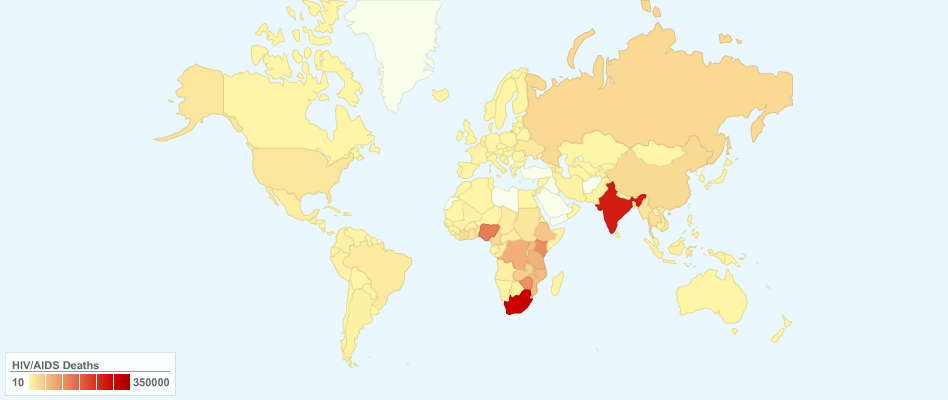
    Around the world, over 35 million people are living with HIV/AIDS, and over 2 million new cases are reported every year. All this for a disease that was only first discovered in 1981. (WHO, 2013) It’s clear that something needs to be done, and fortunately millions of dollars are being put into HIV research. The research being done can largely be broken up into three categories: prevention, treatment and cure.

    Here we take a look at the situation in Australia as well as some of the most promising advances in HIV research in each of these stages.

    HIV in Australia

    Many people think that HIV/AIDs is something that only occurs in developing nations. While 95% of cases do occur in low and middle income countries (AIDS, 2014), at the end of 2010 over 21,000 people were diagnosed as HIV positive in Australia and 6,787 had died as a result of an AIDs-related illness. (HIV Test Australia, 2014)

    People Living with HIV/AIDS by Country
    People Living with HIV/AIDS by Country

    Research into HIV/AIDs in Australia has been strong since 1980. The most prominent research organisation is the Kirby Institute at the University of New South Wales. The highly regarded institute was one of the first to receive a grant from the Bill & Melinda Gates Foundation outside of the United States, and continues to do ground-breaking, world-class research.

    Prevention

    At the annual Conference on Retroviruses and Opportunistic Infections (CROI), held in Boston on 3-6 March 2014, there was a major focus on research into HIV prevention.  One presentation by the Microbicide Trials Network discussed the use of a vaginal ring that offered both anti-HIV and contraceptive properties. (MTN, 2014)

    Another interesting development that was announced in April 2014 was the use of Australian coral and bee venom as a potential HIV prevention treatment. The National Cancer Institute identified a protein located in Australian coral reefs that is capable of blocking the HIV virus from interfering with human T cells. (U.S. Finance Post, 2014)

    Treatment

    Unfortunately we’re not at the stage where prevention efforts are prevalent enough not to need to continue researching treatment methods. Finding treatments mean that people who are living with HIV can lead longer and more satisfying lives.

    One of the major breakthroughs this year for Australian HIV patients was the lifting of the PBS benefits restrictions for patients at the early stages of the disease. Since March 2014, people at any stage of the disease now have access to subsidised treatment. (NAPWA, 2014)

    In terms of research,  speakers at this year’s CROI emphasised that studies over the past three years had shown that antiretroviral drugs such as the commonly used tenofovir were definitely effective, but the problem lied in people not adhering to taking the drugs. The antiretroviral drugs must be taken for pre-exposure prophylaxis (PrEP), and are an essential part of treatment.

    This made it clear that adherence needed to be the focus of research. A drug called GSK-744LA has been shown to offer good HIV protection in monkeys, and is a long-term injectable that would mean PrEP would change from a daily pill to a three-monthly injection. The drug will soon be tested in humans. (Aidsmap, 2014)

    Cure

    Although prevention and treatment research is incredibly valuable and is helping to minimise the number of people who contract and die from HIV/AIDS, a cure is what everybody is hoping for. Fortunately, some very positive research has been conducted in recent years.

    South Australian researchers recently claimed they had developed a DNA vaccine that could potentially help cure HIV, as well as hepatitis C. Adelaide University’s Professor Eric Gowans, said that although DNA vaccines have been incredibly successful in small animals, they have had less success in large animals and humans – but things are improving. The DNA vaccines work by stimulating the body’s immune response and combining with the white blood cells to kill either HIV or hepatitis C cells. (ABC, 2014)

    Image Credit: NIAIDThiagarajan Vardharaju

  • Weekly Science Picks

    Weekly Science Picks

    One more week finishes and as usual we got new discoveries and findings from the world of science and technology. A lot of amazing things have happened, staring from new findings in medicine to amazing stories from astronomy until wonderful news from zoology. And, in addition, we should not forget the winter at the Southern Hemisphere starts today. Here we would like to present more details on all of these.

    Do animals like drugs and alcohol?

    Tales of the tipsy pachyderms go back at least two centuries. In the 1830s, a French naturalist called Adulphe Delegorgue described stories from his Zulu guides of mysteriously aggressive behaviour in male elephants after they fed on the marula fruits. “The elephant has in common with man a predilection for a gentle warming of the brain induced by fruit which has been fermented by the action of the sun,” wrote Delegorgue.

    Mars volcano may have been site for life

    Mars’s Arsia Mons volcano is nearly twice as tall as Mt Everest, yet it is only the third tallest volcano on Mars. Its northwestern flank shows erosion patterns that typify the presence of a former glacier. This has been known since the 1970s.

    Winter is coming… or is it?

    Well what can we say, from June to August the days are a bit shorter and the temperatures tend to be cooler than the other months of the year. It’s hard to be more specific than that when you have a whole continent to speak for.

    Scientists control rapid re-wiring of brain circuits using patterned visual stimulation

    Researchers have shown for the first time how the brain re-wires and fine-tunes its connections differently depending on the relative timing of sensory stimuli. In most neuroscience textbooks today, there is a widely held model that explains how nerve circuits might refine their connectivity based on patterned firing of brain cells, but it has not previously been directly observed in real time.

    Finally, we should complete our Weekly Science Picks for this week. Please stay scientifically passionate and curious. New stories are coming soon!

  • The Best of Australian Science: May 2014

    The Best of Australian Science: May 2014

    It’s the end of May, 2014. It’s our time to summarise what we have done during this month. In fact, we are going to recount the best highlights for May.

    Here are the most exciting and interesting articles of this month.

    Security Challenges in Cloud Computing by Milica Djekic

    Cloud Computing is a jargon, in other words a new computing model, in which the public Internet is used to connect to provider’s hosted network, infrastructure, platform and/or applications to leverage reliable services. Cloud has left all other distributed computing structures/mechanisms far behind both in competition and in terms of popularity and success.

    Internet Research: Skills Your Students Should Have

    Internet research is the practice of using Internet information, especially free information on the World Wide Web, in research. Internet research has had a profound impact on the way ideas are formed and knowledge is created. Common applications of Internet research include personal research on a particular subject, students doing research for academic projects and papers, and journalists and other writers researching stories.

    Artificial Gravity Swimming Pool by Michelle Lee

    The idea of taking a space holiday, once the stuff of science fiction, is no longer a far flung fantasy. The major hurdle to a viable commercial space holiday venture has long been the provision of a reusable launch system. Until an orbital launch system similar to the reusability of aircraft is developed, we will remain earthbound. Efforts to overcome this barrier have been underway since an international conference on the subject in Bremmen, Germany in 1997. More recently, the Space X reusable launch system development program has progressed to the active test program stage.

    Satellite Hacking: A Closer Look to the Sky by Milica Djekic

    Satellites are vital to sustaining the current balance in the global economy, society, and advanced militaries. As such, states are increasingly recognizing satellites as critical infrastructure. They provide a significant role in climate and natural disaster monitoring, communication, early warning systems, global broadcasting, meteorology, navigation, precision strikes, reconnaissance, remote sensing, surveillance, and the advancement of science and understanding.

    Please stay curious and scientifically passionate! New stories are coming soon.

  • The Science of Dreams and Why We Have Nightmares

    The Science of Dreams and Why We Have Nightmares

    The psychology of our built-in nocturnal therapy.

    “The interpretation of dreams is the royal road to a knowledge of the unconscious activities of the mind,