Imagine you have a completely transparent screen on which you can project whatever you want. Only few years ago, all that seemed as a dream, but today it appears the challenge has been resolved. The group of scientist from MIT led by fascinating Professor Marin Solja
Blog
-
Weekly Science Picks
It’s Sunday again! It’s our time to give a brief review of the most amazing science and technology news that have appeared on the web during this week. The task was quite challenging, but we made it. We proudly present you the top stories of this Weekly Science Picks.
Early universe ‘warmed up’ later than previously believed: Research suggests a way to detect the earliest black holes
A new study reveals that black holes, formed from the first stars in our universe, heated the gas throughout space later than previously thought. They also imprinted a clear signature in radio waves which astronomers can now search for. The study is a major new finding about the origins of the universe.
Man gets bionic hand with sense of touch nine years after accident
A man who lost his left hand in a fireworks accident has described how he could feel things that he had not been able to feel for more than nine years after testing a bionic replacement with a sense of touch.
Is praising a child good or bad for them?
Your child presents you with their latest artistic creation. It’s a painting of a figure with very long thin legs, no body and big hair. It’s you. In the corner there’s a bit of yellow which you’re told is the Sun and beside it some patches of purple paint. If you’re being honest you’ve seen better, but as your child waits for your reaction, what do you say? “That’s amazing. It’s the best painting I’ve ever seen. It’s completely fantastic.
-

Do We Live in The Matrix?
In 1963, Philip K. Dick won the coveted Hugo Award for his novel The Man in the High Castle, beating out such sci-fi luminaries as Marion Zimmer Bradley and Arthur C. Clarke. Of the novel, The Guardian writes, “Nothing in the book is as it seems. Most characters are not what they say they are, most objects are fake.
-

Advances in the Robotics Industry: DARPA Robotics Challenge Trials
Every year it seems a new movie comes out that tells a story of robots going out of control and taking over the world. In reality, some of the world’s brightest minds are developing robots and software to help assist humans in a range of important work, including surgery, bomb detection and natural disaster assistance.
The DARPA Robotics Challenge Trials were developed to help support and advance those who work with this technology.
About the trials
The DARPA Robotics Challenge (DRC) is run by the American Defense Advanced Research Project Agency, and winners are awarded a $2 million grant to go towards further development of their robotic technology.
The purpose of the DARPA Robotics Challenge is to promote the use of robotics in assisting humans with natural and manmade disasters; in particular, the use of robots to do things that humans cannot safely do themselves.
Entrants are put through a series of simulated disaster response scenarios such as driving a vehicle, cleaning up debris and cutting through a wall.
Unlike the majority of robots used currently, which work in a very methodical, predictable fashion – such as those in factories – robots that are designed to work in unpredictable situations and environments serve an entirely different, more complex purpose.
DARPA said that robots in the trials generally have the intellectual ability of a two year old child. Although they will still require human commands such as ‘clear up that rubble in front of you’, they can understand a range of commands and implement them.
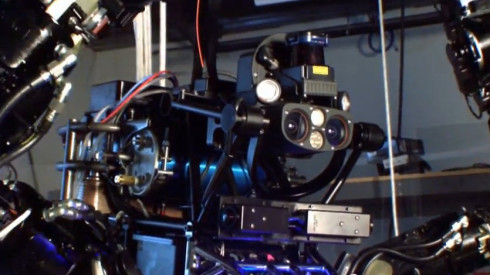
Photo by robots.net Categories of the trials
During the trials, there are seven different tasks that competitors have to complete. The complexity and variety of these tasks demonstrates just how advanced these robots are.
Vehicle
During the vehicle task, robots have to drive a vehicle around a pre-determined course that is lined with bollards and pylons and then get out of the vehicle and exit the scene at the end of the course.
Terrain
The terrain task requires robots to travel across three different terrains, which vary in difficulty and complexity. The terrains are made from a variety of blocks, which may shift during the competition.
Ladder
The third task has robots climbing a ladder that is secured at the base. The teams can choose to have either zero, one or two handrails on their course. They can also choose whether they want the ladder at a 60 or 75 degree angle.
Debris
The debris task is divided into three stages. First, the robot must lift and remove five pieces of debris, they will then lift and remove a further five pieces of debris; finally, they must exit through a doorway. The debris is made from a light material such as balsa wood. As long as the robot moves the debris out of its path, it is acceptable.
Door
There are three separate components of the door task. The robots must be able to open a push door, a pull door and a weighted pull door. The doors use a lever-style handle and have a 36
-

What Should a Good ESL Teacher Know?
While the number of immigrants in English-speaking countries such as Australia is rapidly increasing, the number of qualified ESL (English as a second language) teachers is not meeting this growing demand. Being an ESL teacher is not the easy job. It requires a lot of skills and training. But, what are the facts that a good ESL teacher should know?
Becoming an ESL teacher gives a unique multi-cultural opportunity. One of the biggest advantages of getting a TEFL (Teaching English as a Foreign Language) qualification is the chance to work abroad. Despite “formal
-
Applications of Nanotechnology in Medicine
Nanotechnology can be viewed as the science and engineering included in the design, synthesis, characterization, and application of materials and devices whose smallest functional organization is on the nanometer level or one billionth of a meter. At these scales, consideration of individual molecules and interacting groups of molecules becomes important. Applications to medicine imply materials and devices designed to interact with the body at molecular scales with a high degree of specificity.
Introduction
Nanotechnology and nanoengineering appear to produce important scientific and technological advances in diverse fields including medicine and healthcare. Materials and devices engineered at the nanometer scale imply controlled manipulation of individual constituent molecules and atoms in how they are arranged to form the bulk macroscopic substrate. This, in turn, means that nanoengineered substrates can be designed to exhibit very specific and controlled bulk chemical and physical properties as a result of the control over their molecular synthesis and assembly. For applications to medicine and healthcare, these materials and devices can be designed to interact with cells and tissues at a molecular level with a high degree of functional specificity, thus allowing a degree of integration between technology and biological systems. Nanotechnology is not in itself a single emerging scientific discipline but rather a meeting of traditional sciences such as chemistry, physics, materials science, and biology to bring together the required collective expertise needed to develop these novel technologies.
What is a Nanomaterial?
Nanoscience will impact the design and fabrication of new materials with innovative properties and functions. Contributions to this field include improving the properties of plastics, ceramics, coatings, composites, fibres and many more. Nanoscience also introduces an entirely new concept in material design. As a matter of fact, nature is a great source of inspiration to materials engineers.
The question: What is a‘nanostructured material’? must be considered. Nanostructured materials are solids or semi-solids characterized by a nano-sized inner structure. They differ from crystalline, microstructured and amorphous solids because of the scale order. In contrast, microstructured materials show structural variation only on a micron scale, whereas amorphous materials exhibit short-range order only. In nanostructured materials, the spatial order is at the nanoscale, which lies between the microscopic and the atomic scale.
Nanostructured materials differ from conventional polycrystalline materials in the size of the structural units of which they are composed. They can exhibit properties that are drastically different from those of conventional materials. This means that in a nanostructured material there is a large proportion of surface atoms. Due to the large surface area, bulk properties become governed by surface properties. Examples of nanostructured materials are nanoporous, nanocrystalline, nanocomposite and hybrid materials.
Methods in Nanotechnology
Different methods for the synthesis of nanoengineered materials and devices can accommodate precursors from solid, liquid, or gas phases. In general, most synthetic methods can be classified into two main approaches: “top down
-
Texting teen driver takes out top science award
Just how dangerous is texting or making calls on your mobile phone while driving? Thanks to 14-year-old Conroy Cheers from Melbourne we may all soon know.
Conroy was named as one of the winners of the BHP Billiton Science and Engineering Awards in Melbourne today.
Conroy’s first place in the Investigations category of the awards was for developing a method to measure the risks of texting while driving, and also making hands-on and hands-free voice calls.
Using a readily available driving simulator, Conroy ‘drove’ the streets texting friends, calling his family and measured how his driving was affected. Conroy hopes the process will allow people to experience firsthand the dangers of texting while driving.
“I have loved science and engineering in any size or shape, for as long as I can remember,” Conroy said.
“I always get excited at the prospect of ‘making stuff’, and also enjoy riding my bike and reading. My ambition is to become a scientist or an engineer, perhaps in the field of nanotechnology.”
Winner in the Engineering section was 18-year-old Ethan Buston from Wollongong, NSW.
Ethan created the SMART (Stroke Management with Augmented Reality Technology) system – a camera based augmented reality system that aims to aid the recovery and increase the safety of stroke patients. By manipulating what they can see, a clearer visual picture is provided to the patient.
“Science is my life and one of my major passions,” Ethan said.
“I love the discovery that comes with science and using that discovery to help benefit others.”
Since 1981 the BHP Billiton Science and Engineering Awards have been Australia’s most prestigious school science awards.
“Science will always be at the core of understanding how we address human, environmental and business challenges while engineering helps us find the way to do it,” BHP Billiton Chief Executive Officer Andrew Mackenzie said.
“That’s why we have supported these awards for over 30 years.
“As a global natural resources company, scientists and engineers are an integral part of our present and future, and fundamental to the ongoing development of society.”
The awards reward young people who have undertaken practical research projects, which demonstrate innovative approaches and thorough scientific or engineering procedures.
“This year’s finalists are tackling at high school some things that are being tackled in leading research laboratories,” CSIRO Chief Executive Megan Clark said.
“They have taken on great challenges, like wireless power transmission, bamboo bikes, food production, pollution and helping stroke victims to recover. They inspire us with their courage.
“We are proud to be associated with our partners BHP Billiton and the Australian Science Teachers Association.”
The awards are sponsored by BHP Billiton and are managed by CSIRO and are a partnership between BHP Billiton, CSIRO and the Australian Science Teachers Association. The awards are also supported by Intel Corporation.
-

Offices Tech Tools That Will Transform Our Future
With technology expanding at incredibly rapid rates and businesses today under constant pressure to perform and keep up with the global economy, technological tools and appliances are reaching new levels of innovation.
From virtual keyboards and sci-fi inspired glasses, these amazing tools are something every office should have as we move into the technology driven future:
Virtual Laser Keyboards
Bulky office appliances are fast being done away with in today’s digital era and this virtual keyboard is set to revolutionise the way we use computers. It is entirely laser projected (by a small cube), meaning you can set yourself up practically anywhere and type. The keyboard can be connected via Bluetooth to any device, including iPads, iPhones and most other tablets, laptops and desktops.
Holographic Telecommuters
At the University of Arizona, researchers are working on technology that will be able to project holographic images, like those we remember from Star Wars. If the technology takes off, it will awaken a whole new world for “dial in
-

Mars Colony Development: Mars One Supplier Update
All of the greatest explorations undertaken by humanity have been hindered by unexpected variables, the Mars One mission is no exception. The first settlers on Mars are currently projected to begin colonization in 2025, making homo sapiens an inter-planetary species. With so much progress and many promising suppliers to propel the mission there are plenty of reasons to be excited!
Mars One is an ambitious project that aims to make the human species multi-planetary. According to the Mars One website, “Mars One is a not-for-profit foundation that will establish a permanent human settlement on Mars.
-
Weekly Science Picks
We came to the end of this week and it is our time to recount the most exciting and incredible stories from the world of science and technology. As usual, we had to make a hard decisions and after a careful consideration we decided to promote the news as follows:
Dinosaur fossils from China help researchers describe new ‘Titan’
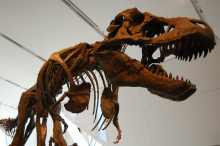
Paleontologists have characterized a new dinosaur based on fossil remains found in northwestern China. The species, a plant-eating sauropod named Yongjinglong datangi, roamed during the Early Cretaceous period, more than 100 million years ago. This sauropod belonged to a group known as Titanosauria, members of which were among the largest living creatures to ever walk the earth.
Fifth of Neanderthals’ genetic code lives on in modern humans
The last of the Neanderthals may have died out tens of thousands of years ago, but large stretches of their genetic code live on in people today. Though many of us can claim only a handful of Neanderthal genes, when added together, the human population carries more than a fifth of the archaic human’s DNA, researchers found.
How reintroducing wolves helped save a famous park
Wolves had been absent from Yellowstone National Park for more than 70 years when they were reintroduced in the 1990s – and their return had some surprising benefits.
Acid Treatment Could Provide Breakthrough Stem Cell Technique
Scientists have found a surprisingly simple way to turn mature cells back into a primitive state. Simply giving mouse blood cells an acid bath is enough to produce so-called pluripotent cells that can develop into any cell type in the body, they report in two new papers this week. The remarkable transformation contradicts many assumptions about cell biology and may ultimately lead to new ways to treat disease and injuries.
Please stay curious and scientifically passionate. New stories are coming soon!
-

Guess What? Bill Gates Lost his Chess Match in 79 Seconds!
Last November Magnus Carlsen, then only 22 years old, became the Chess World Champion when he soundly defeated Viswanathan Anand in a best-of-12 series match held in Chennai, India. Carlsen won three games, tied ten, and lost none. Only the second chess champion from the West since World War II (and the first since the “eccentric genius
-

The Best of Australian Science: January 2014
It’s the end of January, 2014. It’s our time to summarise what we have done during this month. Basically, we are going to recount the best highlights for January.
Here are the most exciting and most interesting articles of this month.
Four women researchers who were overshadowed in the sciences by Danica Radovanovic
As an advocate of women in science, I am illustrating why supporting the presence of women researchers as the voices of science today plays the crucial role, by presenting four stories of women who have changed the world in the male-dominated world of science, and still have been overlooked throughout their careers.
Grand Engineering Challenge – Economical Solar Energy by Milica Djekic
As a source of energy, nothing can be compared with the sun. Solar energy is so called renewable source of energy which means it has very vital and promising role on our whole civilization. Nowadays humans have to be very efficient and capable to use all these sources of renewable energy to harness our economical and social growth.
5 Eco-friendly Inventions that Australia can be Proud of by Michelle Lee
Australia is one of the world’s most eco-friendly countries. We have banned plastic bags in South Australia, put a tax on carbon and most homes have a government-issued recycling bin. However, much of the country’s environmental efforts happen behind the scenes – in construction, building and mining.
Does Spacetime Have Any Time Dimension?
The concept of time as a way to measure the duration of events is basically intuitive. Some researchers believe that this Newtonian idea of time as an absolute quantity and fourth dimension in spacetime is incorrect. They propose to replace these concepts of time with a completely new view: time as a measure of the numerical order of change.
The Next Generation IT Security System by Milica Djekic
Spies, communication, and secret codes! Cryptography is the art of encrypting and decrypting messages. It has existed as long as people have distrusted each other and looked for the forms of secure communication. Cryptographic techniques have evolved over the centuries. The aim is always the same – the code-makers work to stay ahead of the code-breakers. Today’s most common encryption methods are threatened by the potential creation of the quantum computer. In other words, quantum cryptography promises more secure communication than any existing technique.
Stay curious and scientifically passionate! New stories are coming soon.
-
Teen innovators head to head for top science awards
From a glove which controls computers to bikes made from bamboo, the finalists in this years’ BHP Billiton Science and Engineering Awards cover a diverse range of science and engineering that can teach us all a little something about innovation.
The winners of the awards will be announced in Melbourne next week by the Chief Executive Officer of BHP Billiton, Andrew Mackenzie, and CSIRO Chief Executive, Megan Clark.
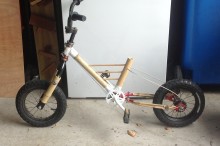
Ben Beagley from Victoria’s St Kevin’s College has been selected as a finalist in the awards for developing an organic light-weight bamboo bike.
Using the bamboo in his garage, Ben designed and constructed a cheaper alternative to the traditional bike that uses the strength and flexibility of bamboo to replace heavy, industrial metal components
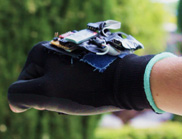
Jake Coppinger from Canberra has come up with The Swirlesque, a wearable glove which allows the user to make natural gestures for human-computer interaction and perform actions.
Swirlesque detects hand gestures and acts upon them in intelligent ways such as controlling a music player on a smartphone, control a computer, a TV, a home media centre, or a light bulb.
Other finalists include an app to warn drivers of approaching emergency vehicles, removing nutrients and pollutants using wetland plants, and a forward facing rowing machine.
“Science will always be at the core of understanding how we address human, environmental and business challenges while engineering helps us find the way to do it,
-
Bio robots make a splash in the Indian Ocean
Robotic floats armed with revolutionary new sensors will be launched in the Indian Ocean, as part of a new India-Australia research partnership to find out what makes the world’s third largest ocean tick – and how both nations can benefit from it.
The Indian Ocean contains vast fisheries and mineral resources that are of strategic importance to both Australia and India. It also plays a direct role in driving the climates of its surrounding regions – home to more than 16 per cent of the world’s population.
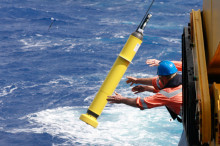
The new ‘Bio Argo’ floats, to be launched in mid 2014, will enhance the already successful Argo float technology to measure large-scale changes in the chemistry and biology of marine ecosystems below the Indian Ocean’s surface.
The Argo floats are a network of 3600 free-floating sensors, operating in open ocean areas that provide real-time data on ocean temperature and salinity.
The ‘Bio Argo’ floats will include additional sensors for dissolved oxygen, nitrate, chlorophyll, dissolved organic matter, and particle scattering. They will target specific gaps in our understanding of Indian Ocean ecosystems of immediate concern to India and Australia, such as the Bay of Bengal and the waters of north Western Australia.
CSIRO’s Dr Nick Hardman-Mountford said the pilot project, led by CSIRO in collaboration with the Indian National Institute of Oceanography (CSIR-NIO) and the Indian National Centre for Ocean Information Services, will improve our understanding of cause and effect in the Indian Ocean’s climate and ecosystems.
“By studying the Indian Ocean in this detail, we can investigate the origin and impact of marine heatwaves like the one that devastated the coral reefs and fisheries off north Western Australian in 2011 – and improve our prediction of them in the future,” Dr Hardman-Mountford said.
CSIR-NIO Director, Dr Wajih Naqvi, said the novel technological innovation will give researchers from both countries a new understanding of the Indian Ocean.
“We expect the technology being utilised in this project to provide new insights into the biogeochemistry of the Indian Ocean and how it is being impacted by human activities,” Dr Naqvi said.
The proposed advances in ocean observation, ecosystem understanding and resources management, which will benefit the entire Indian Ocean Rim, can only occur through collaboration between India and Australia.
Dr Nick D’Adamo, Head of the Perth Programme Office supporting UNESCO’s Intergovernmental Oceanographic Commission (IOC) – a partner in the project – praised the collaborative nature of the project.
“By combining the research capabilities of India and Australia we will see an improved ability to predict and prepare for global climate change, as well as better conservation of marine biodiversity,” Dr D’Adamo said.
The $1 million project was funded in part by the Australian Government under the Australia-India Strategic Research Fund.