Blog

  • The Value of Astronaut Photography of Earth

    The Value of Astronaut Photography of Earth


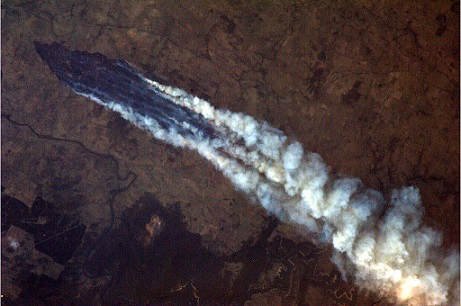
    A brushfire near Burrinjuck Dam in New South Wales, Australia. Credit: Chris Hadfield/NASA
    A brushfire near Burrinjuck Dam in New South Wales, Australia. Credit: Chris Hadfield/NASA

    Earthlings were spoiled when Chris Hadfield turned his camera to Earth. The astronaut, just returned in May from a five-month mission to the International Space Station, uploaded dozens of pictures of Australia to his Twitter feed and other social networks.

    His observations ranged from the whimsical — “Jackson Pollock would have been even further inspired by seeing the Outback from orbit” — to scientific: “Another of the Australian bushfires, this one near Burrinjuck Dam. Look closely and you can see the flames from orbit.”

    While the pictures may have appeared to be taken at random, astronauts receive serious training  in photography before undertaking any flight to the International Space Station.

    Their role as Earth ambassadors in orbit extends to also keeping watch over the planet. If their orbital track passes over a hurricane that threatens the Australian basin, or Outback fires that are threatening a town, NASA will request the astronauts take photos to assist Earthly emergency responders. Astronauts also take note of long-term changes in Earth’s environment.

    Science and disaster management
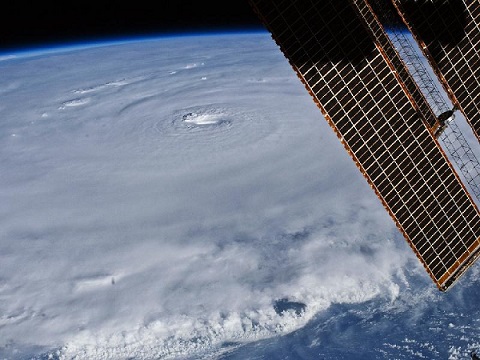
    Hurricane Earl near Puerto Rico in August 2010, as seen from the International Space Station. Credit: NASA
    Hurricane Earl near Puerto Rico in August 2010, as seen from the International Space Station. Credit: NASA

    The first astronaut photos took place along with the beginning of the space program. Both Soviet and American astronauts snapped pictures in the 1960s using small, handheld cameras. Photography took on a more serious role as missions progressed, perhaps most notably in the Apollo moon mission era of 1968-1972. Geologists on Earth depended on astronauts’ photography of features on the moon to help identify the context in which rocks appeared.

    Closer to Earth, however, astronauts play an important supplemental role in capturing images. There are many Earth-gazing satellites that orbit overhead, but sometimes their ground tracks — the path their spacecraft takes over the planet — do not fly over, say, a volcanic eruption soon enough.

    Also, satellites are preprogrammed machines that can only be altered with a great cost of time and effort. With astronauts, however, changing their program is a simple radio call away from a ground control center.

    NASA’s Gateway to Astronaut Photography of Earth website features thousands upon thousands of images taken by astronauts in its various programs. With the International Space Station now the agency’s main focus, the images can be taken by astronauts of any nationality — not just American. The space station partners ensure their respective astronauts receive instructions on how to observe the oceans, the environment and the weather from their orbital perch.

    Next, when the astronauts are in orbit, scientists will send along a list of photographic targets, NASA stated on its astronaut photography website.

    “Messages are routinely sent to the station crew members listing the best opportunities for photographing target site areas,” the agency wrote. “The sites include major deltas in South and East Asia, coral reefs, major cities, smog over industrial regions, areas that typically experience floods or droughts triggered by El Nino cycles, alpine glaciers, long-term ecological research sites, tectonic structures, and features on Earth, such as impact craters, that are analogous to structures on Mars.

    Scientific results from orbit
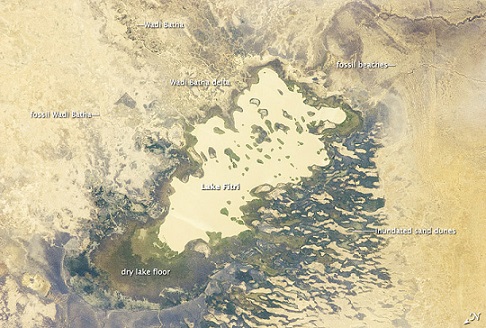
    Lake Fitri, an endorheic or “terminal
</p>
</div>
			<div style=

  • Neutron star glitch needs new theories to explain it

    Neutron star glitch needs new theories to explain it

    Neutron stars are some of the strangest and least understood objects in the entire Universe. Over 1.5 times the mass of our whole solar system, squeezed into an object comparable in size with a city, these curious objects wield titanic gravitational fields and, often, immense magnetic fields. They’re also so incredibly dense that it’s difficult to fully appreciate* And sometimes, for reasons we don’t fully understand, their rotational speed suddenly changes.

    These sudden changes in rotation are known as glitches, and they happen to a particular, rare type of neutron star, known as a magnetar – a neutron star with an exceptionally strong magnetic field, which occasionally undergoes violent outbursts known as starquakes. These starquakes have been known to cause the rotation speed of a neutron star to suddenly increase. But one of these oddities is an oddity among oddities. A magnetar known as 1E 2259+586 was recently observed not to speed up, but to slow down. The reason? No one knows.

    The team in charge of this work, led by Victoria Kaspi at McGill University, Montreal, summed up their observation in a press release by saying that it “constitute[s] a new theoretical challenge.” Now, to someone like me, this is very exciting. Specifically because this means that, working with existing theories, they don’t know what’s going on. It’s currently unexplainable. And when this sort of thing happens, it means we’ve discovered something which we didn’t know before.

    Any good scientist should be thrilled when they don’t understand something, because this means that there’s something new to understand. In this particular case, the fact that this magnetar seems to have done the opposite of what it should has managed to throw a spanner in the works**.

    1E 2259+586
    An x-ray image of the neutron star 1E 2259 586 in false colour. Low energy x-rays are shown in red, medium energy in green, and high in blue. Credit: ESA/XMM-Newton/M. Sasaki et al.

    “Astronomers have witnessed hundreds of events, called glitches, associated with sudden increases in the spin of neutron stars, but this sudden spin-down caught us off guard,” Kaspi explained. Indeed, the regular type of glitch is, we think, quite well understood.

    What precisely might be found beneath the ultra hard crust of a neutron star is a mystery. We might perhaps never be able to directly observe it and find out (neutron stars aren’t fond of guests, and have a tendency to turn anything which lands on them into a large thermonuclear explosion). But what we can deduce is that the interior of a neutron star is a kind of superfluid, composed mostly of neutrons. At the surface of a neutron star, high energy particles are accelerated outwards. This is known as a pulsar wind, and it’s the main mechanism through which neutron stars cool.

    As this pulsar wind carries away energy, it gradually grains energy and momentum from the surface of the neutron star. But this causes stress to build up under the surface. After enough stress builds up, the crust ruptures with an almighty crack. This causes the star to emit a huge burst of x-rays. It also allows the crust to catch up with the rotation speed of the interior. Neutron stars slow down when they’re ready to and not a moment sooner.

    The neutron star in question, 2259+586, lies around 10,000 light years away in the constellation of Cassiopaeia and rotates once every 7 seconds or so. In the x-ray image shown above, it’s quite obvious in high energy x-rays (coloured blue in the image). The lower energy x-rays show a pulsar wind nebula as those high energy particles streaming away from it crash headlong into the surrounding interstellar medium.

    Crust fractures in neutron stars sometimes go by the name of starquakes, and they can be caused by tangled up magnetic field lines too. But it’s this particular mechanism which causes these stars to glitch. 2259+586, however, is going against the grain. Because it’s been observed to do the opposite of what it should, this previously unknown phenomenon has been dubbed an ‘anti-glitch’. What’s more, not content with its abrupt slowdown, 2259+586 is also slowing its speed faster than it was previously observed to (an effect known as “spinning down”).

    Sometime in late April, before the anti-glitch was discovered, the Fermi space telescope picked up a powerful x-ray burst. Lasting just 36 milliseconds, the researchers believe that it was this burst which signalled the magnetar’s unprecedented drop in rotational speed. Robert Archibald, the lead author on the paper published on this work, explained, “What is really remarkable about this event is the combination of the magnetar’s abrupt slowdown, the X-ray outburst, and the fact we now observe the star spinning down at a faster rate than before.”

    As for why this has happened? Well, now we need to wait for the theoreticians to solve the puzzle. And, at least for some of us, that’s the fun part!

    Beautiful but deadly
    Artist’s impression of a starquake on a magnetar’s surface. Credit: NASA Goddard

    * As one tumblr user so wonderfully described it, “an average printed period, if it were as dense as a neutron star, would weigh about as much as a train car FILLED WITH BRICKS.”

    ** A star mangled spanner, perhaps?

  • Shenzhou 10: another step in China’s ‘Long March’ into space

    Shenzhou 10: another step in China’s ‘Long March’ into space

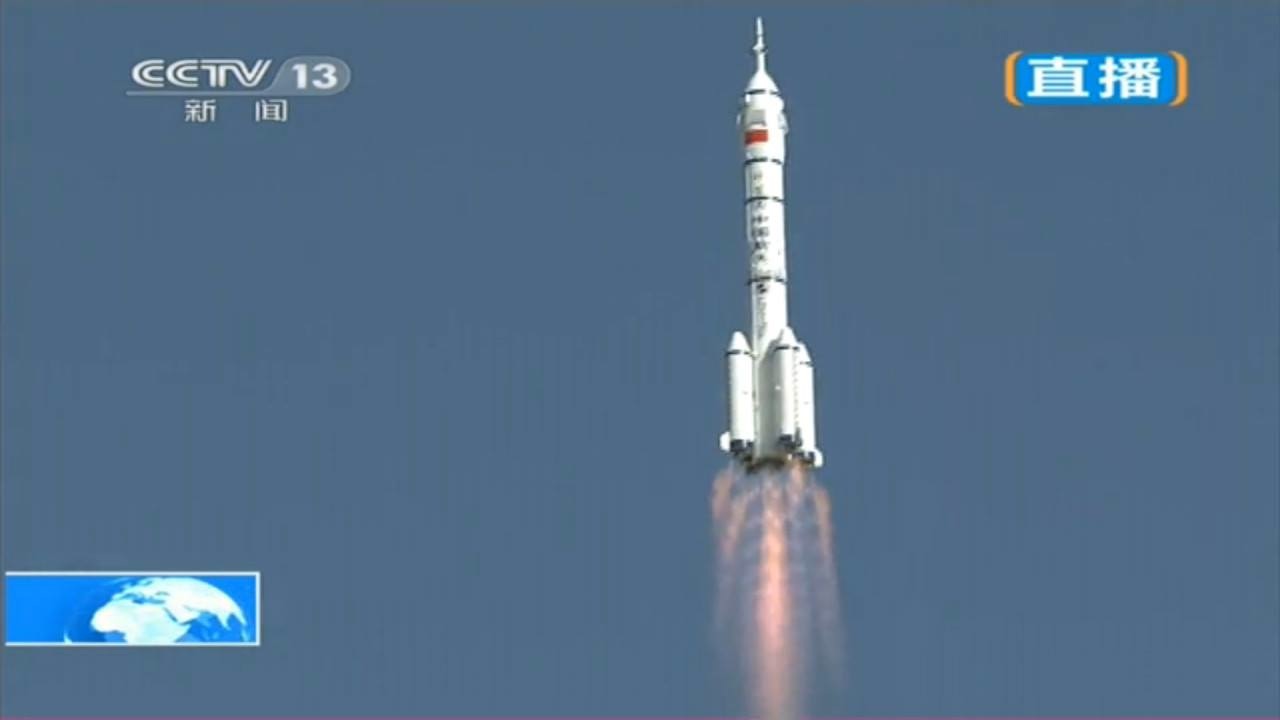
    The Long March 2F rocket, Shenzhou 10, seconds after its launch. Photo credit CCTV.
    The Long March 2F rocket, Shenzhou 10, seconds after its launch. Photo credit CCTV.

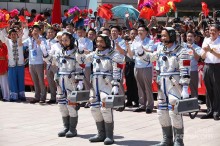
    The colorful and polished launch of Shenzhou 10 confirms that China has come of age as a spacefaring nation.  At 19:40 AEST on Tuesday June 11 (17:40 local time) three ‘yuhangyuan’, Chinese astronauts, embarked on China’s sixth crewed space mission. This second mission to Tiangong 1, the Chinese space station, is a credible step in mastering the art and engineering of space exploration. It was also a public relations success.

    Shenzhou 10 crew

    Announcing in early April, that Wang Yaping, a 33 year old Major in the PLA Air Force, was one of the 3-person Shenzhou 10 crew, silence then descended on the identity of the other crew members. Wang was named as the in-flight instructor. She becomes China’s second female and 9th astronaut to have flown. As the in-flight instructor Wang will give lectures to middle and elementary school students from orbit.

    Building the suspense the Chinese finally announcing the other two the names of the three person crew yesterday. Along with Wang the Shenzhou 10 crew are: Nie Haisheng (48) Commander of Shenzhou 10, a veteran of Shenzhou 6 in 2005, and a Major General in PLA Air Force, and Zhang Xiaoguang, 47 Assistant Pilot of Shenzhou 10, backup crew of Shenzhou 9 (along with Wang) and a Senior Colonel of PLA Air Force.

    This places the Chinese astronaut corps as a modern, relatively, gender balanced operation. Zhang and Nie both hale from the 1996 second astronaut selection. As have all male yuhangyuan to date including Yang Liwei, China’s first astronaut. The first group of astronauts were selected in 1971 in a hopelessly ambitious and quickly abandoned attempt to put astronauts into space in the 1970s. Wang, along with Liu Yang, China’s first female yuhangyuan, comes from China’s 2010 third group of yuhangyuan. The Chinese, at least to the outside world, have not followed the more memorable and colorful NASA lead of allowing astronaut groups to pick their nick-names.

    The heavenly palace

    With the launch a success, Nie will now chase, rendezvous and dock with an orbital laboratory, Tiangong (a mandarin word meaning “heavenly palace”), which was launched nearly two years ago on September 29, 2011.On November 2, 2011 China successfully docked the unmanned Shenzhou 8 with Tiangong. It remained docked for 14 days and then undocked and repeated the docking maneuver – proof that the first was not a fluke. It then was undocked, leaving Tiangong to its solitary orbit 370km above the earth’s surface.

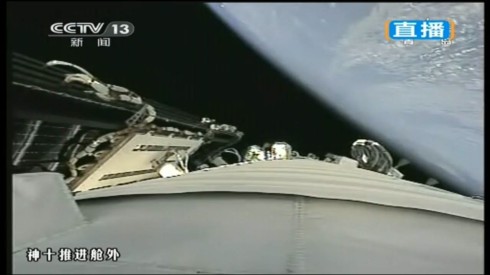
    Image of the interior of Shenzhou 10 after launch. China TV demonstrates its new openness and confidence.
    Image of the interior of Shenzhou 10 after launch. China TV demonstrates its new openness and confidence. Image credit CCTV.

    On June 18, 2012 a second craft docked with Tiangong. This time it was the crewed Shenzhou 9. The space station was then declared operational. China had joined Russia and the USA in having the capability to become space residents. The three person crew on Tiangong conducted experiments and aclimatised to the prolonged weightlessness for their 10 day mission.

    The normal pattern was for two to sleep in Tiangong and one to sleep in Shenzhou. At only 10.4m in length, Shenzhou is smaller than the 1971 Russian Salyut (13.1m) and the 1973 US Skylab (36.1m) space laboratories. Like these other first space laboratories Tiangong is designed with a limited lifespan. The current mission, Shenzhou 10, will be the last to Tiangong 1.

    Shenzhou 10

    As is the norm now the Shenzhou launch was covered live by the Chinese media. providing pictures, expert commentary and graphics depicting what was going on at the various stages of the launch. Shenzhou 10 is now safely in orbit and will spend the next few days approaching a suitable orbit for docking. The Shenzhou 10 will dock with the orbiting lab module Tiangong 1 several times.

    “The three astronauts will stay in orbit for 15 days, including 12 days when they will work inside the coupled complex of the Shenzhou 10 and Tiangong 1,” said Zhou Jianping, head designer of China’s manned space program. It is expected that they will set a Chinese record for time in orbit.

    The interesting point is that the mission profile for Shenzhou 10 is opaque. Although it is expected that the craft will be put through it’s docking paces – not something to be dismissed lightly – the scientific and engineering goals of this mission are less obvious that the recent Shenzhou missions.

    The view from the orbiting Shenzhou 10. Image credit CCTV.
    The view from the orbiting Shenzhou 10. Image credit CCTV.

    This will be the last Chinese human space mission for quite some time. The next Shenzhou missions are expected to fly to the Tiangong 2 laboratory. This will be an expanded version of Tiangong 1, similar in design to the Russian 1986 Mir space station. It is expected to be able to sustain 20-day visits. It will probably not be launched until around 2015 or possibly later. The gap between the flight of Shenzhou 10 and Shenzhou 11 could ultimately prove to be the longest hiatus in Chinese human spaceflight to date.

    Regional implications

    With this in mind it will be interesting to see how the Chinese promote this current mission once it is completed. Its success, or otherwise, will not aid any military space activities, nor directly any commercial space activities. It does provide a compelling message, I suggest, to its regional competitors. Human exploration is possibly the most expensive and prestigious space activity. I think we will find China promoting this expedition to its fullest, as it build on its robotic missions to the Moon over the next few years. Fully intending to continue its long march to put humans onto the moon and mars in the next few decades.

  • A world of ocean research awaits RV Investigator

    A world of ocean research awaits RV Investigator

    Just over a year ago construction of Australia’s Marine National Facility research vessel Investigator began with flat sheets of steel, and now the blue-water research vessel looks amazing.

    The Executive Director for CSIRO’s Future Research Vessel Project, Toni Moate, said Investigator, is challenging the way ocean and atmospheric research has been undertaken globally, as it will support scientists across a range of disciplines – oceanographic, climate, geological, fisheries and ecosystem research.

    “As much as possible, Investigator must be all things to all Australian marine scientists, as Australia has only one blue-water research vessel and this diverse and complex approach to marine and atmospheric science is unique to ocean research globally,” Ms Moate said.

    The 93.9 metre Investigator has room onboard for up to 40 scientists, who can stay at sea for up to 60 days and cover up to 10 000 nautical miles in a single voyage and will replace the Marine National Facility’s current vessel, Southern Surveyor, later this year when it’s delivered to Hobart.

    The contract to design, build and commission the vessel was awarded to Teekay Holdings Australia, which partnered with Sembawang Shipyard Pte Ltd in Singapore because of its track record and strong commitment to new technologies and innovation.

    “Investigator’s capabilities will allow for the rapid advancement of ocean dynamics and air-sea interactions and their implications for weather and climate, and scientists will be able to accurately describe marine ecosystems and enable more effective management of biodiversity and fisheries,” Ms Moate said.

    The vessel’s design will feature a core backbone of permanently fitted systems for sampling, data acquisition, management, and communication including winches, acoustic mapping and environmental monitoring instruments including:

    • a sonar and radar system housed under the ship that can map the seafloor to 7 000 metres
    • a deep water coring capability off the side deck which can take cores 24 metres long at a depth of 7 000 metres
    • the approximately 2 tonne radar will gather data from storms and clouds towering 20 kilometres over the tropical ocean to cold ice storms in the Antarctic, in a 300 kilometre diameter around the ship, and it will have a broad range of research applications
    • the dual drop keels can deploy scientific equipment four metres below the vessel’s hull, enabling acoustic instruments to be well below the bubble zone generated by the ship moving through the water
    • the ship is being built to comply with DNV-Silent-R, to minimise the noise from all the machinery on board. This will increase the range and resolution of seabed mapping, sub-surface imaging, and marine ecosystem monitoring instruments and it will allow scientists to provide better estimates of the number of fish and other species in the marine environment
    • research teams will be able to add purpose-built systems to support their own investigations, such as radiation and trace metal laboratories, deep-water dredging, coring and drilling devices, fishing nets, towed camera systems and remotely operated vehicles.

    In 2009 the Australian Government committed A$120 million to the purchase of a new research vessel for the Marine National Facility. The project is an initiative of the Australian Government being conducted as part of the Super Science Initiative and financed from the Education Investment Fund.

    Sea time onboard Australia’s Marine National Facility research vessel is available to all Australian scientists. The National Facility is operated by CSIRO on behalf of the nation.

    Source.

  • What do Mars and Australia have in common?

    What do Mars and Australia have in common?

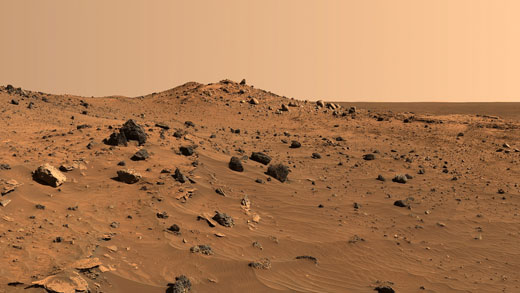
    If you’re expecting a punchline to that title, then guess again. It’s no joke. Surprisingly, Australia shares some remarkably similar geology to our neighbouring planet. Specifically the Red Centre, the arid heart of Australia, is the most Mars-like place on Earth!

    It’s possible that people may have mused on the similarities already. After all, with its strikingly rich colours, the Red Centre (more often known as the Outback) certainly looks like few other places on Earth. Without any vegetation, the colour of the soil and rocks in the region could easily resemble Mars in places. But evidently, this resemblance is more than just skin deep. The clue that lead to this fascinating realisation? Another of Australia’s most beautiful and iconic of things – opals.

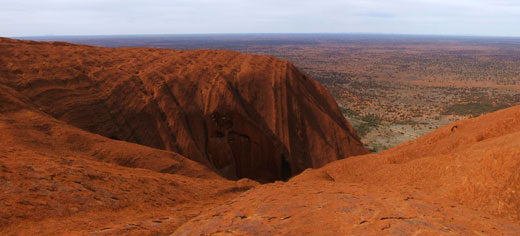
    Uluru view!
    A view from the top of Uluru, showing it’s distinctive red colour. Credit: Binarysequence/Wikimedia Commons

    Patrice Rey at the University of Sydney’s School of Geosciences was investigating how opals formed. It may be surprising to learn that opals are found in few other places on Earth, with roughly 90% of all opals worldwide having originated in Australian mines. Beautiful and sought after, there’s been a lot of mystery behind opals for a long time – specifically about how they form, why they’re found at such shallow depths under the Australian soil, and why they’re found nearly nowhere else on Earth.

    The story of these beautiful sparkly gemstones, it turns out, began around 100 million years ago. At the time, most of central Australia was covered by the Eromanga Sea. In times past, this huge epicontinental (inland) sea covered what is now known as the Eromanga Basin – spanning an area of one million square kilometres and reaching into much of what is now Queensland, the Northern territories, South Australia and New South Wales.

    During the Cretaceous period, when dinosaurs still ruled our planet, this sea would have been teeming with prehistoric life. But much like the dinosaurs, the Eromanga Sea was doomed. Around 100 million years ago, the climate of Earth began to change and the sea began to dry out. The sea dried out rapidly on geological timescales, to cover a much smaller area. The result was that the chemistry of the surrounding rocks began to change.

    As the Eromanga Sea dried out, pyrite minerals in the surrounding rocks began to release sulfuric acid, causing acid weathering on a huge scale – quite possibly the largest Earth has ever seen. The opaline silica which was created in the Australian rocks during this process would later go on to form into opals. But the big clue is the acid weathering – we only know of one other place in the Solar System where this has happened in the past. Planet Mars.

    While the predicament of prehistoric Australia is, as far as we know, unique on Earth, Mars actually shares a lot in common with this event. Except on Mars, we believe that the drying out of seas happened on a global scale. Hints of this were detected in 2008, when NASA’s twin Mars rovers, Spirit and Opportunity, detected several telltale clues in the Martian soil.

    The surface of Mars was found to hold opaline silica, iron oxides, and certain types of clay. All of these clues led areologists* to conclude that the surface of Mars had been subject to huge amounts of acid weathering. The exact same type of acid weathering which Rey and his fellow researchers have now discovered to have happened in Australia!

    An opal doublet from Andamooka, South Australia.
    An opal doublet from Andamooka, South Australia. Credit: CRPeters/Wikimedia Commons

    If you’re thinking that this means that there may be Martian opals waiting to be discovered somewhere on the planet next door, it’s hard to say. But it’s certainly a possibility! There is, however, one final step in the formation of opals. The opaline silica which was found on Mars is not yet true opal. In Australia, the surrounding rock has an impressive capability to neutralise acid. This means that after the ground in Australia became riddled with opaline silica, the surrounding conditions quickly went from acid to alkaline. When this happens before the silica trapped in rock cavities dehydrates and solidifies – voila! Opals! Of course, there’s a good chance that Mars may be home to some kinds of rock which can also neutralise acid the same way.

    So only time will tell. Perhaps someday in the future, Martian colonists may be using Mars opals to create the first ever jewellery made elsewhere in the Solar System!

    *An areologist studies the geology of Mars, seeing as technically the “geo” in geology refers to planet Earth.

    Could there be opals hiding under the Martian soil?
    Could there be opals hiding under the Martian soil? Credit: NASA/JPL


  • Industrial Food and Evolution

    Industrial Food and Evolution

    Brooklyn Grange, via Gothamist.com
    Brooklyn Grange, via Gothamist.com

    Back in 1748, William Cullen invented the first known refrigeration system at the University of Glasgow. Today, the refrigerator is something many take for granted. Probably, not much thought is given to refrigeration, but when you pause and think about it, heating and cooling has made one of the biggest contributions to modern society and in particular, society’s ability to be mobile.

    In the early 20th century, (and way before that, too) people lived near towns and villages and went to the market daily for their meats, cheeses and eggs; items that would spoil if not eaten soon. A relationship developed with the shopkeepers – they conveyed knowledge of foodstuffs, preparation and daily news. Employment centers were located where food was available. Fast forward to 1916 when Clarence Saunders opened the first supermarket, Piggly Wiggly, and the world became both smaller and larger at the same time (however perishable food items were not available till the 1920s). With the ability to keep food cool (temperature food usually kept at), people could move further out and store food in their new Frigidaires. Grocery stores could open and cater to new villages and towns. So in a way, the frozen food section has contributed to suburban expansion. For better or for worse. Refrigeration meant workers and their families could move further outside the town limits. Cities grew; suburbs grew.

    But it suddenly (within the past 5 or so years) seems hip to do things the old fashioned way. Although I don’t think city dwellers will return to storing their frozen food in ice houses down by the East River. At least I hope not. There is a sweep of urban agriculture casting its net across NYC and many other urban areas across the states. Even corporations like Whole Foods are getting in on the act. I grew up on a farm in the Midwest, one that raised soybeans, wheat, and hogs; so this rooftop farming seems more like industrial gardening to me. Spinach, lettuce, and other crudité are taking to the skies, bathing in hydroponics or even aeroponics in some setups.

    I see the benefits – trying to encourage and promote fresh produce in diets, especially for children and in low-income areas; transportation costs are cut since fruits and vegetables don’t have to be trucked or flown in; and emissions, such as greenhouse gases are reduced. I question how big of a dent rooftop gardening could have on transportation costs and deliveries at this stage. And how clean is the food sitting up on a rooftop in a dirty, smoggy city?

    Photo: James Baigrie; Styling: Lindsey Beatty, via myrecipes.com
    Photo: James Baigrie; Styling: Lindsey Beatty, via myrecipes.com

    A bigger issue I think we have to tackle is that of food waste. Mayor Mike Bloomberg has challenged restaurants to participate in a new city program designed to reduce the amount of food waste sent to landfills. More than 100 restaurants have signed on so far.

    Food security is a concept that many nations, including developed nations such as Australia and the United States are dealing with. In the U.S., one in four kids are hungry and do not have enough to eat. A film that really drives home the current status of food policy in America was released this past March. It’s called A Place at the Table and was produced by Top Chef star, Tom Colicchio. I highly encourage you to check it out, whether you live in Australia, Spain, Turkey, Kenya or the U.S., food is an issue central to people around the globe.

    The Food and Agriculture Organization of the United Nations released a report entitled The State of Food and Agriculture 2013. It attempts to address the attire by shining light on nutrition, production, the supply chain, and even the governance of food systems. As the report states, “Malnutrition in all its forms – undernutrition, micronutrient deficiencies, and overweight and obesity – imposes unacceptably high economic and social costs on countries at all income levels.

  • Weekly Science Picks

    Weekly Science Picks

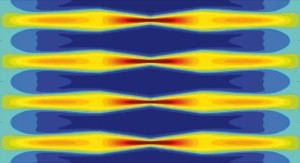
    Light waves, shown evolving in time in this simulation, create a cloaking effect at the middle where the light intensity goes to zero. via Nature.com
    Light waves, shown evolving in time in this simulation, create a cloaking effect at the middle where the light intensity goes to zero. via Nature.com

    Happy June! Happy World Oceans Day! Hard to believe it is June already. I finally have some time on my hands and caught up on some reading this week. So you’ll see two articles below that are from April. It’s a little bit of everything… so grab your coffee, tea or chocolate milk, head to the sofa or venture out to the veranda if it’s nice weather, and enjoy this edition of Weekly Science Picks!


    Cyber security, data breaches, governments listening in on the phone calls of their citizens (oh wait, the U.S. claims it’s just unique identifiers…), are all hot topics in this age of data immersion that we found ourselves. Well, read about the ‘time hole’. Engineers are doing some pretty cool things in this realm.

    Temporal cloak erases data from history by Zeeya Merali

    Electrical engineers have used lasers to create a cloak that can hide communications in a ‘time hole’, so that it seems as if they were never sent.


    Brain games are everywhere lately, whole startup companies are devoted to trying to entertain your neurons and increase your brain elasticity. I admit, I like a good competition of Words With Friends, but I’m pleased to see some research has been done on this topic.

    Brain Games Versus Nature Documentaries by Rachel Kaufman

    It seems brain-training games—online tests, quizzes, games, or flash cards designed to improve attention, memory, creativity, and concentration—are everywhere. But do they work? A recent study published in the journal PLoS ONE says … maybe not.


    City mouse, country mouse; city bird, country bird. Lately, there appears to be a slate of ‘unique’ research going on in the Animal Kingdom. A lot of it has been appearing on BBC News. Perhaps this research will lead to some exciting new developments in city health technologies.

    Biological clocks ‘beat quicker’ in cities by BBC News

    City living could have a major impact on the biological clocks of humans and animals, a new study has found.


    An ever greater number of people are able to ‘climb’ to the top of Mt. Everest and it is wreaking havoc on the conservation of that area. The terms have changed because the technology and the gear has improved to make it to the summit. Is there a solution? Not without putting some infrastructure and some hard policies in place.

    Nepal Himalayas: ‘Decentralising’ mountaineering remains uphill task by Navin Singh Khadka

    Figures from Nepal’s ministry of tourism figures show that the peaks Ama Dablam and Everest, both in the Khumbu region of eastern Nepal, see the largest number of expeditions, more than 30 every year.


    Another story involving hidden data, only this time it’s the kind that we would like to have out in the open and be able to access.

    A Hidden Victim of Somali Pirates: Science by Paul Salopek

    Scientists from around the globe, specializing in subjects as diverse as plate tectonics, plankton evolution, oceanography, and climate change, are decrying a growing void of research that has spread across hundreds of thousands of square miles of the Indian Ocean near the Horn of Africa—an immense, watery “data hole” swept clean of scientific research by the threat of Somali buccaneering.


    Something a little different to close out Weekly Science Picks – watch the video.

    The Lego House is going to be Lego paradise by Rob Bricken

    Stay thirsty for knowledge my friends. Stay thirsty.

  • World Oceans Day – 7 June 2013, Live Event

    World Oceans Day – 7 June 2013, Live Event

    The Great Barrier Reef, © Gary Bell/Oceanwidelmages.com, via Australian Conservation Foundation website
    The Great Barrier Reef, © Gary Bell/Oceanwidelmages.com, via Australian Conservation Foundation website

    Good morning Australians and to the rest of the world! Today is World Oceans Day and to celebrate this important day, a special, world first, 12-hour event will broadcast live from the Great Barrier Reef! Richard Fitzpatrick, a marine biologist and Emmy award-winning underwater cinematographer, along with other marine experts and reef ambassadors will take you on a journey as they showcase the diverse beauty and awe that is the Great Barrier Reef. The event starts 7 June 10:00 AM (AEST). The countdown is on and you can watch here at Queensland’s YouTube Channel!

    You’ll see live underwater broadcasts that include sharks, whales, manta rays and turtles. 30-minute panel sessions will take not only underwater at the reef, but from Lady Elliot Island and Reef HQ Aquarium. The panel discussion will feature both local and international marine biologists and experts who will highlight why protecting our oceans is so important.

    And why is it so important? Well, Australians, if you haven’t seen the news from yesterday, listen up.

    A new CSIRO study, reported by the Herald Sun, finds the ocean is littered with rubbish, 74 per cent of it is plastic and it is impacting sea creatures, including turtles, sea birds and whales. There are 5.2 pieces of debris for every person in Australia and 3.2 pieces of rubbish for every metre of beach. The waste is not coming from other countries, it is coming from cities and other major areas in Australia. And while Australia does have great waste management practices, It’s important to note that more must be done to keep the beaches and waters pristine. Take action on this World Oceans Day. Find a beach clean up, join a surf life saving club, volunteer at a conservation park – do something to help protect the ocean which is vital both to our global economies and societies.

  • Printing Australia’s largest flexible solar cells

    Printing Australia’s largest flexible solar cells

    Scientists have produced the largest flexible, plastic solar cells in Australia – 10 times the size of what they were previously able to – thanks to a new solar cell printer that has been installed at CSIRO.

    The printer has allowed researchers from the Victorian Organic Solar Cell Consortium to print organic photovoltaic cells the size of an A3 sheet of paper.

    According to materials scientist Dr Scott Watkins, printing cells on such a large scale opens up a huge range of possibilities for pilot applications.

    “There are so many things we can do with cells this size,

  • Manipulating Memory in the Hippocampus

    Manipulating Memory in the Hippocampus

    Modifying the levels of tomosyn protein in the hippocampus of mice, researchers noted over production of the protein led to a sharp decline in the ability to learn and memorize information.

    In the brain, cell-to-cell communication is dependent on neurotransmitters, chemicals that aid the transfer of information between neurons. Several proteins have the ability to modify the production of these chemicals by either increasing or decreasing their amount, or promoting or preventing their secretion. One example is tomosyn, which hinders the secretion of neurotransmitters in abnormal amounts.

    Dr. Boaz Barak of Tel Aviv University’s Sagol School of Neuroscience, in collaboration with Prof. Uri Ashery, used a method for modifying the levels of this protein in the mouse hippocampus — the region of the brain associated with learning and memory. It had a significant impact on the brain’s activity: Over-production of the protein led to a sharp decline in the ability to learn and memorize information, the researchers reported in the journal NeuroMolecular Medicine.

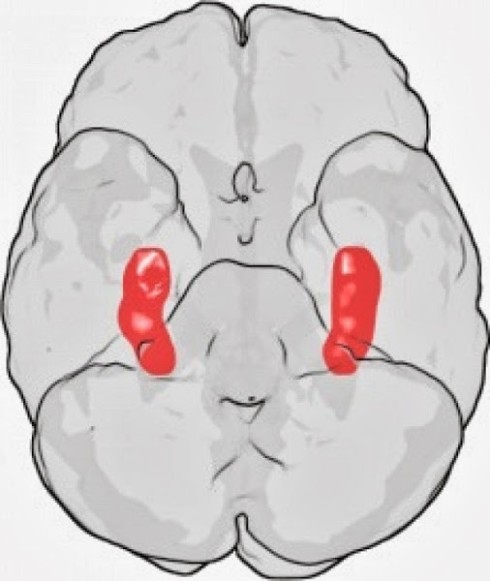
    Researchers created a virus which produces the tomosyn protein; a protein which hinders the secretion of neurotransmitters in abnormal amounts. Injecting the virus into the hippocampus region in mice,  researchers performed a series of behavioral tests designed to measure memory, cognitive ability and motor skills. The image shows the location of the hippocampi in the brain.
    Researchers created a virus which produces the tomosyn protein; a protein which hinders the secretion of neurotransmitters in abnormal amounts. Injecting the virus into the hippocampus region in mice, researchers performed a series of behavioral tests designed to measure memory, cognitive ability and motor skills. The image shows the location of the hippocampi in the brain.

    “This study demonstrates that it is possible to manipulate various processes and neural circuits in the brain,

  • An Animated Visualization of Every Meteorite Since 861 AD

    An Animated Visualization of Every Meteorite Since 861 AD

    Carlo Zapponi is data visualization designer at Nokia, who has created an amazing animation of the meteorites that have struck the earth. Only 3% of all recorded meteorites were seen falling since 861 AD. 34,513 have been recorded, only 1,042 have been seen falling. Now you can click any of the fallen meteorites at the image below, also you will see the visualization in full screen mode.

    Data from the Meteoritical Society.

  • CSIRO Chairman announces extension to Chief Executive contract

    CSIRO Chairman announces extension to Chief Executive contract

    CSIRO Chairman Mr Simon McKeon has announced that Chief Executive Dr Megan Clark has agreed to extend her term with CSIRO to the end of 2014.

    “The Board has full confidence in Dr Clark and supports the continuing execution of the CSIRO strategy which is focused on answering big questions and increasing Australia’s productivity through the organisation’s world class science capability,” Mr McKeon said.

    Dr Megan Clark, Chief Executive and CSIRO Board member.
    Dr Megan Clark, Chief Executive and CSIRO Board member.

    Under Dr Clark’s leadership over the past four and half years CSIRO has significantly increased its engagement with industry and the community. Dr Clark has set the CSIRO vision of building five global innovation precincts for Australia in plant and agricultural, resource, environmental, human life and materials and manufacturing sciences. She has also led a strong focus on ensuring the safety and welfare of CSIRO people and affiliates and embedding a values-based culture. Dr Clark will continue to implement the 2011-15 strategic objectives including providing a platform for the organisation under a future new Chief Executive to lead the development and implementation of the 2015-2020 Strategic Plan.

    “I am very proud of the impact that CSIRO is delivering to the nation under Megan Clark,” Mr McKeon said.

    “We’ve seen the Hendra virus vaccine developed and brought to market in three years, fast Wireless Local Area Networks are now licensed for use in billions of devices worldwide.These and many other examples are a demonstration of passionate leadership with a deep commitment to applied science.

    “CSIRO is well positioned to continue its 87-year role as a trusted advisor to the community, governments and industry.”


  • Weekly Science Picks

    Weekly Science Picks

    That time of the week again. Time to kick back with a sunday newspaper… but since newspapers are dead we bring you a weekly run-down of all things sciencey!

    We begin in space, with aliens. Australian Science’s Markus has a piece at Discover News on the search for extra-terrestial life and the feeling of finding it.

    The Wow! Signal: Intercepted Alien Transmission?

    “SETI, the search for extraterrestrial intelligence, has seen astronomers scouring the sky for decades in hopes of receiving artificially generated radio signals sent by alien civilizations. But then, there’s a good chance we’ve already found just such a signal. And 1977 saw the most tantalizing glimpse ever.

    Nicknamed the “Wow!

  • Preparing the ground for our electricity make-over

    Preparing the ground for our electricity make-over

    Change is a-coming! In 2050 CSIRO predicts that our homes and businesses could be powered by over 20 different energy sources and technologies. Together with our partners we are helping Australia’s electricity sector prepare for the monumental make-over required to undergo the transformation.

    This week in Sydney, CSIRO announced a A$13 million research collaboration between CSIRO and four leading Australian universities – University of Sydney, University of Newcastle, University of Queensland and University of New South Wales – to develop the nation’s capacity to plan and design the most efficient, low emission electricity grid for Australia.

    Launching the Future Grid Cluster today, Dr Tom Hatton, CSIRO Energy Group Executive, said the electricity sector is undergoing a huge transformation, a change not seen since the industrial revolution.

    “The Future Grid Cluster brings together Australia’s best research capabilities and provides a framework the electricity sector needs to make A$240 billion worth of decisions in the next two decades.”

    Dr Tom Hatton, CSIRO Energy Group Executive

    “We are facing unprecedented change in the electricity system over the next 20 to 30 years. We’re talking about change to a system that has seen stability for decades and has used technologies and energy sources that are predictable and controllable. Moving away from that is going to require a great deal of effort and capacity building,” Dr Hatton said.

    “The Future Grid Cluster brings together Australia’s best research capabilities and provides a framework the electricity sector needs to make A$240 billion worth of decisions in the next two decades.”

    Leader of the research program, University of Sydney’s Professor Tony Vassallo, said “Each university will contribute specialist knowledge and expertise and will work with CSIRO to develop a new suite of tools to understand, develop and optimise energy grids of the future.

    “This will assist decision makers in their choices about future grid development,”said Professor Vassallo.

    The project is supported by A$10 million worth of in-kind contribution from university partners and a A$3.2 million grant from the CSIRO Flagship Collaboration Fund – established to enable the skills of the wider Australian and global research community to be applied to the major national challenges targeted by CSIRO’s Flagship research program.


    More information on CSIRO’s Future Grid Cluster

    The research will build on CSIRO’s broad electricity sector and energy management work, including the industry-led Future Grid Forum that began in 2012.

    The research cluster launched today will draw together engineering, economic and policy aspects of grid development and optimisation with four major areas covered in the research:

    – Improved understanding of impacts of different loads, generation sources and energy storage on system security, led by University of Sydney

    – planning and co-optimisation of electricity and gas networks, led by University of Newcastle

    – economics of alternative network development paths and estimates of total cost and price impacts, led by University of Queensland

    – policy measures and regulatory changes to facilitate a smooth transition to a de-carbonised future grid, led by University of NSW.