All of the previous research has relied on self-reported measures of Facebook use (that is, survey questions). We know from research in other areas of human behavior that there are significant differences between actual and self reported behaviors. One of my favorite examples is a study where researchers found that up to 50% of self-reported non-smoking head and neck cancer patients were indeed smoking as measured by exhaled carbon monoxide levels and levels of a nicotine metabolite in their blood.
As you might imagine, differences between self-reported and actual uses of Facebook could drastically change or even negate findings of how Facebook use is related to the aforementioned outcomes. My latest paper published in Computers in Human Behavior, Comparing actual and self-reported measures of Facebook useexamines these differences.
Here is what I did: I paid students to allow me to install a monitor on their computers for one month. I also surveyed them to ask them how much time they spent on Facebook and how many times they logged in to the site. I also monitored/asked about other forms of tech/social media use (like Twitter and email).
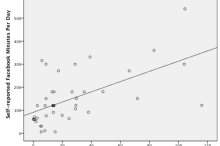
Here is what I found: As you can see in the scatterplot below, there was a significant positive correlation between self-reported and actual Facebook use (Pearson’s r = .587, p < .001).
However, and here is the really interesting part, students significantly overestimated the amount of time they spent on Facebook. They reported spending an average of 149 minutes per day on Facebook which was significantly higher than the 26 minutes per day they actually spent on the site (t(41) = 8.068, p < .001).
What is going on? In the paper, I go into much more detail about why there is such a large and significant difference between actual and self-reported Facebook use, as well as why the two are significantly correlated. In brief:
It could be that self-report questions aren’t specific enough to capture frequency of Facebook usage. Students may interpret a question asking “how much time do you spend on Facebook each day?
February brought many exciting events, visits, conferences, interviews, and a bevy of intriguing articles written by Australian Science writers/authors. It is time to recapitulate that enthusiasm here and share with you highlights from the month in the fields of science, education, internet technologies, space, and among others.
If you are interested in science blogging and contributing to Australian Science – contact us and check out the Editor’s note.
Until next Australian Science month review, stay curious, and geeky, scientifically and artistically passionate. I hope you’ll enjoy these stories.
This article is the first in a series of articles in which I will profile every woman astronaut, cosmonaut and taikonaut who has been into space. The last time I checked 58 women have travelled into space, by the end of this year there may be a few more! We’re going to start this series at the beginning – with Russian cosmonaut Valentina Tereshkova, the first woman in space. Read more>>
One of the biggest potentials for graphene, however, is in electronics. As graphite (a naturally occurring mineral), carbon is semiconductive. Due to the way carbon atoms are arranged in this hexagonal pattern, it leaves some electrons free to move across the material in a way not entirely unlike the way the motion of free electrons allows metals to be conductive. However, pure graphite isn’t really very conductive. Read more>>
Wanting to learn more about this group’s work and impact, I reached out toDr Stefan Hajkowicz, the Theme Leader for CSIRO Futures. This is our digital conversation about science, education, energy, and what Australia must do to secure its future.
To our readers, if you have not done so already, check out the CSIRO Futures website for reports and projects to learn more. You’ll find some thought-provoking, fascinating topics guaranteed to make you put your strategic thinking cap on and get lost in a world of ‘what-ifs’. Read more>>
Australian Science travelled to Canberra for the linux.conf.au (Linux Conference Australia) at the beginning of the month that brought plenty of interesting keynote speakers. For Open Source fans and advocates, don’t miss to read and listen to the interviews as well as the wrap up of the conference: Linux.conf.au 2013: ‘Nerdvana’ in Canberra. Interview transcripts are available with each article.
Later in the week, I had the pleasure of heading off to lunch with Radia and a small group of fellow delegates during a break in technical sessions. She is engaging and thoughtful, and concerned as much with solutions for societal issues as solutions for thorny networking challenges. Radia is eternally self-effacing, and repeatedly claimed that she had “never done anything difficult
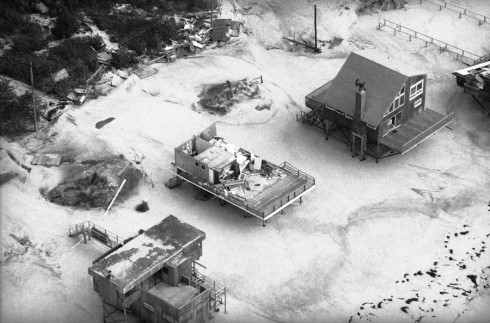
Hurricane Gloria devastation on Fire Island, New York, 28 Sept 1985. (AP Photo/Rick Maiman)
Climate Change
Last week I listened to a webinar on climate change discussing findings of the draft report from the National Climate Assessment and Development Advisory Committee. Not much has changed from the year 2000 report, or the 2009 report. Well, a few changes: the science has improved, climate change is now being stated directly as a result of human activity and the report is more accessible and understandable to the public at large. The public that actually takes the time to read it, that is. How communities engage with science and government is a hot topic and will continue to be. The idea of citizen scientists was mentioned during the webinar and it has been in the news quite a bit. I’ve written about it here, but after today’s presentation, it triggered some new thinking and I pondered it a bit more in terms of climate change and planning resilient communities.
Engineering Community Resilience
With the recent round of floods and bush fires, particularly in Queensland, Victoria and Tasmania, and with Hurricane Sandy in the northeastern United States, I’ve been thinking more about how we engineer our communities and our transportation networks to withstand the dramatic stresses placed on them by natural disaster events such as these. In the face of extreme and more frequent weather events, we must begin to look at how we protect investments, not how do we avoid it, but how do we work with it once faced with the situation; how can our societal networks “adapt” to natural events. After hitting the power-on button after a disaster, how long does it take before we are up and running at full speed? It’s definitely not automatic and there is a lag time, but the mission should be to reduce that lag time as much as possible. We can do that through better planning of our communities, both urban and rural, from top to bottom.
Outdated Planning Manual
Jane Jacobs in her book, The Life and Death of Great American Cities, wrote the way we plan cities is outdated. Those thoughts were from the late 1950s; I wonder what she would think at the progress, or lack of, made now. While Ms. Jacobs was not an urban planner, she was an astute observer of city life. We have been planning to the same model for years, basing our land use and transportation plans on activity centers and primary uses as if these things were completely and utterly independent. When in reality, today more so than ever, emphasis should be placed on the connections between and among uses, from primary to tertiary uses and beyond. Emphasis should also be placed on addressing aging infrastructure. Outdated, roads, buildings, bridges, sidewalks, subways, telephone lines, sewers; all of these facets of modern society that once made life convenient can actually make life more inconvenient if technology does not keep up with the pace of increasing population and demand. It is a tough task to balance the needs of a community, of a nation, but attention to rediscovering and reengineering our primary uses to connect with present and future day society has to be part of this century’s new planning paradigm.
Community Communication
How does this national climate assessment report actually impact individuals? What does the public need to know? What does government and science need to tell people? I think ultimately that people have a desire to know what goes on in their communities; but they’re busy, they elect people and trust them to hire staff that will get the job done. And there is this mentality that they just want things to work and society grows cranky when things don’t work. Think about water pipes. An invisible zigzagging network buried underground. Much thought isn’t given them until they burst and the faucets run dry. Adding to the problem is that the public doesn’t understand how antiquated our infrastructure is, be it water pipes, bridges, or telephone lines. And public refusal to pay for a system’s upgrading because water has always been cheap just adds to the complex ability to make change happen. But I believe it can.
It all boils down to communication, at the basic, most simplistic level. That’s why it is critical governments do a better job at explaining and giving information to citizens when disasters strike AND details about the recovery and clean up process OR explaining why adaptation and mitigation measures need to be taken because not everyone understands why systems that date back to the 19th century can’t handle pressures from the 21st century. I can’t speak for other countries, but the “red tape” political pomp and circumstance on parade in the U.S. needs to shift toward a “green tape” common sense implementation attitude. Waiting over three months for recovery funds to come through after Hurricane Sandy hit inhibits community rebuilding and cuts to the psychological core of those affected.
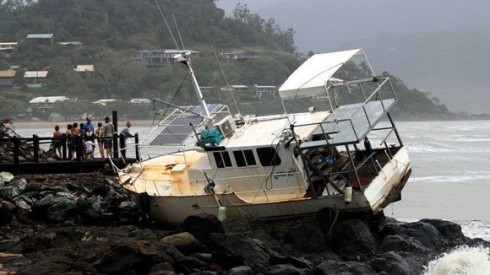
Cyclone Oswald, Eastern Australia, 29 Jan 2013. (itv.com, Photo: Reuters)
Citizen Scientists Participation
Popularity of science among the masses is growing and should be engaged. So how can citizen scientists help? With all this talk of using ordinary citizens to collect data for large-scale research projects and as budgets tighten and staffs decrease, I think there will be a greater role for the community at large to help provide answers to research questions. To start with, our scientific organizations will need to use the cerebral thought process of corporations. The scenario is not that citizen scientists will be out there running amok with data; a trained scientist would no doubt be in charge. Like a project manager would in a big corporation, they would have people reporting to them, following the protocols, procedures and plans they have discussed to achieve a certain goal. I think this is the way science will have to move in order to stay somewhat viable as we attempt to solve the looming problems we face in the future.
Science, the community, government and private industry all need to be present and active partners communicating as we move forward designing our cities and countrysides in a certainly uncertain world. Policy choices should have been made 10 plus years ago as an attempt to deal with climate change, but hindsight is always 20/20.While this piece speaks mainly to the developed world, we shouldn’t ignore therapid urbanization that is sweeping across the developing world, with many key urban issues not being fully explored. The municipal level has an opportunity to be a catalyst of change. As cities think about how to assess their risks and incorporate resiliency measures into their town planning, the population may actually be able to ebb and flow with climate disruptions.
Astronomy is quite notorious for being full of things we don’t entirely understand. Sometimes it really does feel as if the closer we look at the Universe, the less it makes sense. One thing in particular which seems to constantly evade our understanding is the way in which galaxies work. A lot of very smart people spend a lot of time taking telescope observations and creating computer simulations to try and understand how exactly a galaxy can form and evolve, and every now and again someone will discover something which doesn’t seem to fit with what they were expecting. Occasionally we find something like that which is, at least in cosmic terms, right in our back yard.
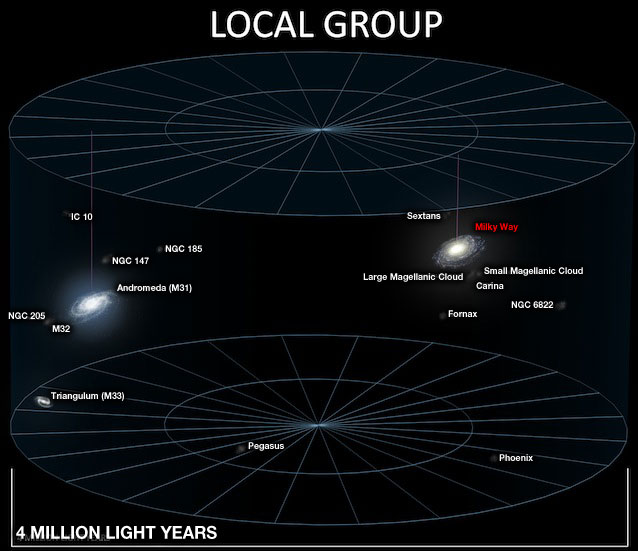
The Andromeda galaxy is practically a twin sister to our own Milky Way. Slightly larger than us but slightly less massive, Andromeda lies around 2.5 million light years away, and between them Andromeda and the Milky Way dominate the local group of galaxies. But Andromeda is not without fanciful tastes – it wears a skirt over a million light years in diameter, made up of dwarf galaxies.
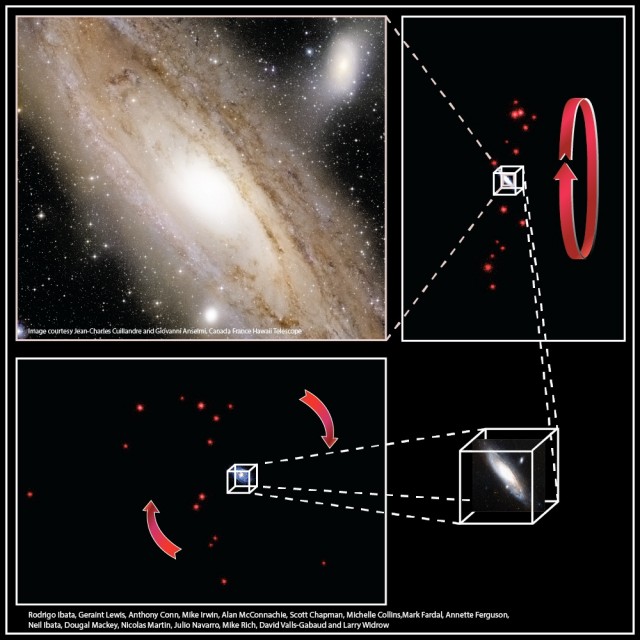
A recent study headed by Rodrigo Ibata at the Strasbourg Astronomical Observatory, France, and Geraint Lewis at the University of Sydney, Australia, found a host of new galaxies in the local group. The image below gives you an idea of the scale involved, but it doesn’t show the full story – There are actually over 54 galaxies in the Local Group. Andromeda is surrounded by a small swarm of 27 dwarf galaxies, and 13 of those dwarf galaxies orbit in the same plane, the same way the planets orbit the Sun. This means that Andromeda is surrounded by a disk-like shape, the largest cohesive structure in the local group. And it’s still very much a mystery as to why it exists.
Even here inside the largest galaxy for millions of light years, space is mostly empty, but the vast expanses of intergalactic space are so devoid of anything that it’s difficult to fully appreciate (to get even more perspective on this, click here and look at the full image!). But even in the face of this terrifying emptiness, galaxies live out their lives. They pull on each other and interract. They form and coalesce. Large galaxies devour smaller ones whole, and every so often, large galaxies smash together and tear each other apart. But none of the theories we have today quite explain Andromeda’s skirt.
Those 13 dwarfs orbit Andromeda once every 5.5 billion years or so, and Ibata, with his team of researchers, has suggested a couple of explanations for the disk. Firstly is that they formed in place as they are, and have been slowly twirling around Andromeda since before the Sun was born. They may have been created during a merger between two ancient galaxies, from a streamer of gas which was spun off. Or possibly, these galaxies are as old as Andromeda itself, forming at the same time amidst all of the dark matter attracted by Andromeda’s huge bulk. This would fit with the fact that those dwarf galaxies are made up of ancient stars, implying that this structure could be truly ancient.
Or perhaps it isn’t a disk at all. Perhaps we’re seeing a slew of galaxies recently pulled into Andromeda’s gravitational grip, and it’s purely by chance that they appear to be arranged into a disk shape. It’s entirely possible, and only further research will show if the disk structure is real or not. Combined with the recently discovered halo of gas surrounding the Milky Way, it seems there may be a lot lurking out there in intergalactic space that we don’t yet understand.
But either way, both of these hypotheses have problems with them. Neither is a perfect fit. In an interview, Nicolas Martin at the Strasbourg Astronomical Observatory explained that the fact that we don’t know why these galaxies are arranged the way they are is what makes this discovery so exciting;
“The presence of this thin, rotating disk of dwarf galaxies around Andromeda suggests a strong connection between the host galaxy Andromeda and its satellites. There is currently no satisfactory scenario that can explain all the properties of the satellites in the disk, but they all require a strong interplay between Andromeda and the satellites themselves.”
Image credits:
Top – Robert Gendler
Middle – Andrew Z. Colvin/Wikimedia Commons
Bottom – Rodrigo Ibata/PAndAS team
Being responsible for picking the week’s most interesting science stories is a fun and fascinating challenge. It pushes to me to look beyond my own interests and explore what others find compelling. So I trust you find my ‘science making news’ selection of interest and delight; explore the quantum, human, off-world and mathematical highs of the week.
On the human scale an international team of scientists has been investigating the antibiotic properties of sweat. More precisely they discovered how a natural antibiotic called dermcidin, produced by our skin when we sweat, is a highly efficient tool to fight tuberculosis germs and other dangerous bugs.
Their results could contribute to the development of new antibiotics that control multi-resistant bacteria.
The benefits of a good nights sleep once again are news. Researchers have shown that the disruption in the body’s circadian rhythm can lead not only to obesity, but can also increase the risk of diabetes and heart disease.
Our study confirms that it is not only what you eat and how much you eat that is important for a healthy lifestyle, but when you eat is also very important.
Disruption of body’s circadian clock increases risk of obesity, diabetes and heart disease. (Credit: Daniel Dubois, Vanderbilt University)
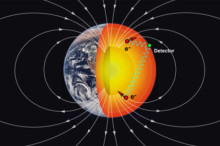
At the quantum scale, the particle physicists are at it again. Not content with discovering the Higgs Boson they are shedding light (pardon the pun) on a possible 5th force in nature. In a breakthrough physicists have established new limits on what scientists call “long-range spin-spin interactions” between atomic particles. These interactions have been proposed by theoretical physicists but have not yet been seen. If a long-range spin-spin force is found, it not only would revolutionize particle physics but might eventually provide geophysicists with a new tool that would allow them to directly study the spin-polarized electrons within Earth.
The most rewarding and surprising thing about this project was realizing that particle physics could actually be used to study the deep Earth.
The latest news from Mars is that curiosity has relayed new images that confirm it has successfully obtained the first sample ever collected from the interior of a rock on another planet.
Many of us have been working toward this day for years. Getting final confirmation of successful drilling is incredibly gratifying. For the sampling team, this is the equivalent of the landing team going crazy after the successful touchdown.
To wrap up with one further piece of geek excitement. On January 25th at 23:30:26 UTC, the largest known prime number, 257,885,161-1, was discovered on Great Internet Mersenne Prime Search (GIMPS) volunteer Curtis Cooper’s computer. The new prime number, 2 multiplied by itself 57,885,161 times, less one, has 17,425,170 digits. With 360,000 CPUs peaking at 150 trillion calculations per second, 17th-year GIMPS is the longest continuously-running global “grassroots supercomputing”project in Internet history.
Until next week’s Australian Science review, go geekily crazy and enjoy your weekend.
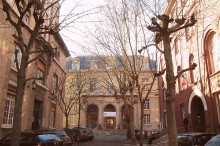
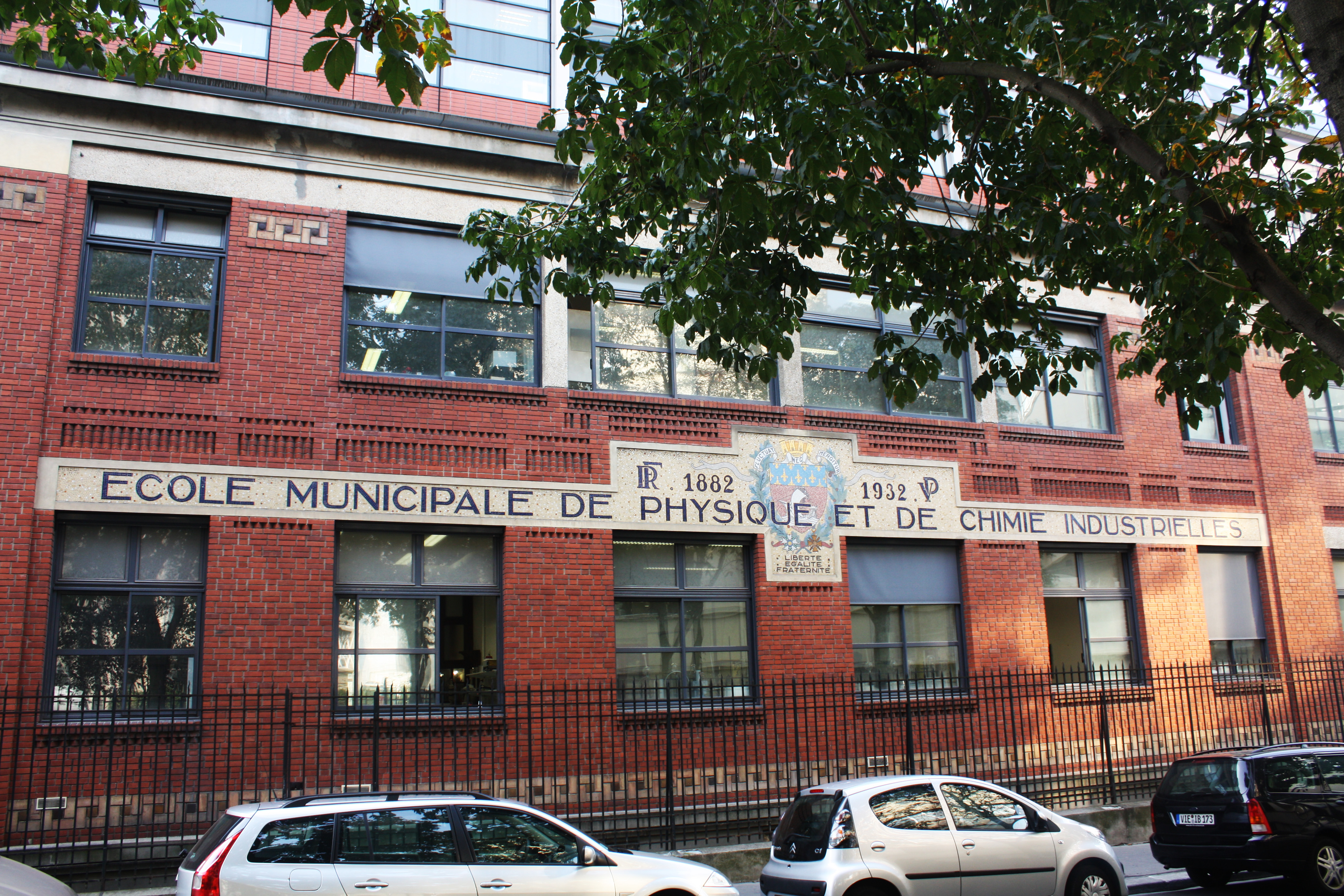
Last week, after I spent a couple of days in Brest, Brittany at a ESF, EU workshop/seminar brainstorming with other internet and scientific researchers on interesting topics related to internet science and innovation, I got myself back to Paris. I visited a French national institute with an international reputation for scientific excellence – ESPCI (École supérieure de physique et de chimie industrielles) and the CNRS department of Physics, Quantum Foundations – a group dedicated to research on quantum effects in materials. Also, I took the opportunity to meet up with two Australian Science writers who reside in Paris: Rayna, and Charles.
ESPCI Paris Tech stands for Physics and Chemistry Higher Educational Institution (a French “Grande École d’ingénieurs”). Founded in 1882, ESPCI is a major institution of higher education – an internationally renowned research center, gathering leading scientific innovatorslike Nobel Prize laureates Pierre and Marie Curie, Paul Langevin, Frédéric Joliot-Curie, Pierre-Gilles de Gennes, and Georges Charpak.
ESPCI ParisTech
At ESPCI, I met with Arjen Dijksman, a physicist and researcher interested in tiny semiconductive nanoparticles, known as “quantum dots
I have mentioned before that part of the reason why I like science so much is that you get to play with stuff. It might come as no surprise then that I begin each year with a game called “Mrs Spencer Says
Established in 2009 with funding support of A$2.3 million from the Government of Western Australia, WAGCOE brought researchers, industry, investors and government agencies together with the shared vision of creating zero-emission geothermal cities.
Representatives from the partner organisations of The University of Western Australia, CSIRO and Curtin University, as well as state government agencies and industry groups gathered at the Australian Resources Research Centre (ARRC) in south Perth today to reflect on WAGCOE’s achievements, and consider the future of geothermal energy in Australia.
WAGCOE Director Professor Klaus Regenauer-Lieb said the centre had strived to underpin a new era of energy development by developing local solutions.
“At WAGCOE we provided a world-class research and training environment where scientists developed local solutions to revolutionise energy development in Western Australia and contribute to the goal of powering zero-emission geothermal cities.”
Professor Klaus Regenauer-Lieb, WAGCOE Director
“When we consider the challenges of climate change and the need to develop reliable sources of renewable energy, the work of WAGCOE is less about the last four years, than the next 50 years,” Professor Regenauer-Lieb said.
“At WAGCOE we provided a world-class research and training environment where scientists developed local solutions to revolutionise energy development in Western Australia and contribute to the goal of powering zero-emission geothermal cities.”
Internationally, the work of WAGCOE led to the Geothermal Energy Association (GEA) identifying Perth as one of the top ten (number five) “Geothermal Cities” of the world. Unlike other entries to the list, however, Perth’s inclusion was unique as it was earned on the merit of plans to become the world’s first geothermally-cooled city.
Among WAGCOE’s other major achievements was the development of a 3-D computer model illustrating a comprehensive geological assessment of the entire Perth Basin, which will act as a template for future geothermal activities in the region.
The centre was also instrumental in securing A$20 million of Australian Government funding for the CSIRO Geothermal Project, which will aim to prove the viability of using geothermal energy on a large-scale by cooling the Pawsey Centre Supercomputer located at the ARRC facility in south Perth.
A successful CSIRO Geothermal project will provide enormous benefits to the geothermal industry, and make significant progress in establishing Perth as the world’s first geothermally-cooled city.
For further information about geothermal research and activities post-WAGCOE, please contact Professor Klaus Regenauer-Lieb on +61 8 6436 8693, or Klaus.Regenauer-Lieb@csiro.au
Source and image: WAGCOE Director Professor Klaus Regenauer-Lieb discusses the CSIRO Geothermal Project with project officer Jacqui Cook, at the ARRC site in Perth.
Following three years of research and planning, CSIRO and the Terrestrial Ecosystem Research Network (TERN) have opened Australia’s first large-scale rainforest research plot.
The plot, which is located at Robson Creek on the Atherton Tablelands near Cairns, will allow scientists to monitor the rainforest over the long term and answer questions about the health of this unique Australian environment and any impacts that might arise from climate change.
‘In preparing the plot for research, we established baseline data by identifying, mapping and measuring every tree that was greater than 10cm in diameter so we can continue to monitor them. We censused over 23 000 stems from 212 different species and there is estimated to be more than 400 plant species represented on the plot,’ said Matt Bradford, a field botanist who manages the Robson Creek site for the CSIRO.
‘It’s been a huge effort, but it’s a great place to be working. There’s such a diversity of life and some of the trees on site are well over a thousand years old.’
TERN and CSIRO are now inviting scientists from Australia and across the world to undertake research at the Robson Creek site, which is the largest rainforest plot that has ever been set up in Australia.
‘Already there are studies under way involving CSIRO and four Australian universities looking at the diversity of plants, birds, animals and insects and the dynamics of how things like water, carbon and gases move through the ecosystem,’ said Mr Bradford.
‘A state of the art flux measuring tower, part of TERN’s OzFlux network, will be installed on the site in coming months that will monitor gas exchange between the forest and the atmosphere, allowing us to observe how climate change might affect this ecosystem.’
The Robson Creek plot forms part of the Far North Queensland Rainforest Supersite, which carries out research on the rainforests of the World Heritage Wet Tropics region. The Rainforest Supersite is one of ten research ‘Supersites’ that make up the Australian Supersite Network established by TERN. These Supersites are enabling long-term monitoring of key Australian ecosystems and provide a unique opportunity for scientists to answer questions about species distribution, the potential for carbon storage and exchange, and the impacts of a changing climate.
‘We envisage that the Robson Creek plot will quickly become an important part of the global forest plot network that will allow for comparisons with other tropical forests and contribute to our understanding of how the world’s forests will adapt to any effects of climate change.’
Mr Bradford and other scientists will be speaking about the Supersites at the 2013 TERN Annual Symposium taking place this week in Canberra. For more information about the Symposium visit www.tern.org.au/Welcome-pg24024.html.
TERN is supported by the Australian Government through the National Collaborative Research Infrastructure Strategy and the Super Science Initiative.
Source and image: A Yellow Mahogany tree (Dysoxylum parasiticum) on the rainforest Supersite showing the unusual trait of bearing fruit on the stem.
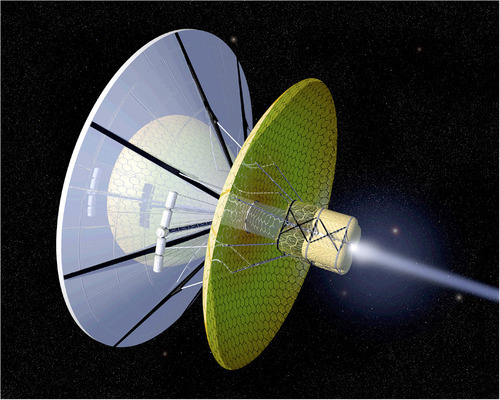
Massive objects moving at near light speeds do not occur naturally in the universe as we know it. If we detect such objects it is a reasonable to assume they are artificial artifacts from advanced intelligent life. This according to Garcia-Escartin and Chamorro-Posada, authors of a recent paper, is a low-cost, sure-fire way of searching for intelligent life outside earth.
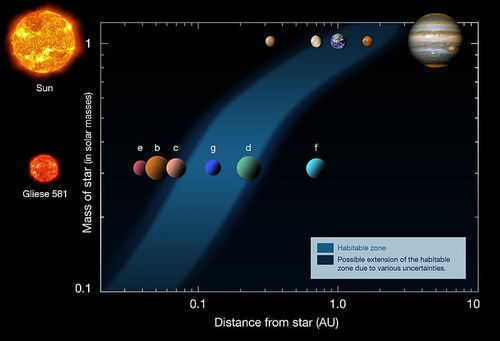
The habitable zone of Gliese 581 compared with our Solar System’s habitable zone. Image credit NASA.
Searching for life beyond earth is a grand and varied enterprise.
For a start we can look for exoplanets that fall inside the habitable zone of a star. A planet found in this zone may fulfill the requirements for life: liquid water, energy, elements and other nutrients, and appropriate physical conditions. Though we have located many exoplanets in recent times they are far from earth – many light years distant. For example one star system, Gliese 581, is 20.3 light years away (192,048,720,000,000 kilometres). With three planets in its habitable zone, we know nothing about conditions on them. The techniques used to find them can tell us nothing about their ecology – if any. Being in a habitable zone does not guarantee life. It is only in recent years that we have realised how inhospitable Venus and Mars are to life – despite being in our habitable zone.
By looking for alien signals or transmissions, as in the SETI programme, we extend our search from ‘possible life’ to intelligent life. For advanced civilisations we look for artificial illumination or interstellar probes.
Let’s face it though, to know we are not alone will require quite good proof for most of us (apart from the misguided minority of UFO believers), and especially for the skeptical scientists.
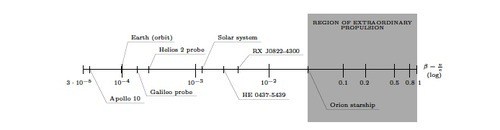
The intriguing proposition of Garcia-Escartin and Chamorro-Posada is based on three ideas. The first is that anything travelling faster than 3.3% of light speed (5,935,890 kilometres per hour) is artificial. All known natural objects travel slower than this speed, as do our current space probes. This speed was chosen as it is the estimated speed of the nuclear propulsion ship proposed by Freeman Dyson in the Orion project. Although the propulsion technology is feasible today the technological and economic hurdle of creating such a craft is way beyond our current means. Although it is certainly not inconceivable to achieve such interstellar travel in the next 100 years.
Scales of speed with respect to the speed of light in vacuum (logarithmic scale). The fastest man-made objects are in the range of velocities from 1/100,000 c to 1/1,000 c. Examples are the fastest manned ship, Apollo 10 on entry, the Galileo probe during its descent into Jupiter and the solar probe Helios 2. For comparison, we have included the average speed of Earth during its orbit around the Sun and the motion of the Solar System with respect to the cosmic microwave background frame. The fastest natural objects, like hypervelocity star HE 0437-5439 and neutron star RX J0822-4300, move in the scale of 1/1,000 c-1/100 c. We define a region of extraordinary propulsion (REP) for speeds which would point to an artificial object. The REP starts at the estimated speed for the nuclear propulsion Orion ship, which could be built with present human technology. Source original paper, Cornell University.
You are possibly thinking about now: “Doesn’t the mass of an object increases massively as its speed approaches light speed?” You would be correct, this consequence of Einstein’s theory of special relativity is demonstrated quite satisfactorily in particle accelerators around the world. To cover this the authors next identify a consequence of relativity theory: relativistic effects amplify the light reflected from a body travelling at near light speed – in some key situations. Allowing for the detection of ‘small’ objects.
This brings in the authors third criteria. Interstellar travel will be from one star system to another. The reflected-light magnifying effect would be greatest for the cases where earth is almost in line with the departure stellar system and the destination stellar system.
Earth’s position with respect to the ship’s trajectory. (a) Earth receives the light from the destination star reflected from an approaching ship. (b) Earth receives the light from the origin star reflected from an outbound ship. (c) Earth receives the light from a third star, which is reflected from the ship at an angle. Source original paper, Cornell University.
The authors propose to limit the first search to star systems that are reasonably close to each other (no further than 10 light years apart) to maximise the probability of stellar travel opportunities. Considering that Gliese 581, for example, is greater than 20 light years distance from us, I suggest that this criteria is too limiting.
The paper is an interesting, if not compelling, proposition. The authors do calculate what size an artifact would need to be, travelling at their minimum speed (3.3% light speed), to be detected at the distance of one of our closer stellar neighbours. Could such an artifact be detected by the Hubble or James Webb space telescopes, for example? What is the probability of success of such an experiment, compared to say the SETI experiments?
One idea I did find interesting is by focussing on detecting light reflected from ships, we do not need to assume any intention by the interstellar travellers to communicate with us. The ‘signal’ is independent of alien psychology. It is also independent of propulsion technology – we aren’t looking for any ‘signature’ of any particular technology, known or unknown.
It is an interesting paper. I’m not sure they have presented a compelling enough case to convince a funding body – yet.
Ah, the end of the week. Time to relax, unwind, and look over the most interesting things to happen this past week in science. While I may be biased, being an astronomer, the most exciting things to happen recently have all been about space!
The biggest news of the week was an asteroid passing so close to Earth that it came closer than many communication satellites. Coincidentally, shortly before this, a large meteor fell over Russia.
In a rather uncomfortable coincidence, a measure of the type of damage that can result from such rocks from space was demonstrated earlier on Friday when a meteor streaked across the sky and exploded over central Russia, raining fireballs over a vast area and causing a shockwave that smashed windows, damaged buildings and injured 1,200 people.
Rather more distantly, Pluto’s family seems to keep growing. Everyone’s favourite planet has now had a family of 5 moons discovered around it, and the public are being asked to help name them!
According to the New Horizons research team, after the discovery of P4 in June 2011 it was decided to wait to see if any more moons were discovered in order to choose names that fit together as a pair…
One of the big events of the science communication community online so far this year was the ScienceOnline2013 conference. Kelly Oakes gives a nice rundown at Scientific American.
What I took away from that afternoon was the idea that, most of the time, if you want to make something, you probably can. Don’t worry about finding the perfect tool, or the perfect idea. Try something and see if it works.
Sometime during that glorious decade known as the 1980s, a shipment landed in Houston, Texas. A shipment carrying more than its cargo. The point of origin was Japan. The shipment was used tires. The payload was Asian tiger mosquitoes.
Within years of landing in Texas the tiger mosquito, Aedes albopictus, rapidly displaced resident populations of Aedes aegypti mosquito. Both are important disease vectors. The native being considered the primary vector of breakbone fever — or dengue. And the Asian tiger mosquito recently emerging as the most important transmitter of chikungunya virus and yellow fever. By September 1986, the range of the Asian tiger mosquito had extended as far north as Utah. The demise of the native Aedes aegypti had already begun — representing not a transient ecological phenomenon, but the beginning of permanent colonisation, and resulting in rapid declines and extinctions of the native mosquito species.
Aedes aegypti originated in Africa and was introduced to the Americas between the 15th and 18th centuries, during the height of the slave trade and most likely on ships transporting slaves. They quickly established across the south eastern part of the US. Then what followed was a demise in the face of stiff competition and after centuries of habitation in America. An inadvertent metaphor for the “Post-America
CSIRO researchers are studying the Torres Strait tropical rock lobster fishery to develop a scientific approach to integrate cultural factors into natural resource management.
“Fisheries management traditionally involves balancing commercial gain and sustainability, but for Indigenous communities cultural and lifestyle factors can be just as important and these factors are more difficult to measure,” says Dr Eva Plaganyi of CSIRO’s Wealth from Oceans Flagship.
“Globally, small-scale fisheries employ around 38 million people and it’s important to look at the impact of natural resource management practices on their livelihood,” she says.
“Often research into fisheries management has focused on commercial businesses and overlooked the unique characteristics of Indigenous fishers. We wanted focus on economic needs as well as socio-cultural rights and values.”
Dr Eva Plaganyi, CSIRO Wealth from Oceans Flagship
The Torres Strait tropical rock lobster fishery has many stakeholders, including non-Indigenous commercial fishers and Indigenous fishers who fish for reasons ranging from subsistence to commercial. The social objectives of the fishery are spelled out in a treaty between Australia and Papua New Guinea that acknowledges and protects the traditional fishing practices of Indigenous people.
“Often research into fisheries management has focused on commercial businesses and overlooked the unique characteristics of Indigenous fishers. We wanted focus on economic needs as well as socio-cultural rights and values,” says Dr Plaganyi.
The multidisciplinary team of researchers brought together a range of sophisticated methods, from mathematics and modelling to social science interviews. Their results allow managers to understand the potential trade-offs when making a management decision that affects not only a resource but also the people who depend on it.
“Market-based management options might score highly in a capitalistic society, but we found that two key social indicators, namely equity and a sense of self-determination, underpin successful management,” says Dr Plaganyi.
“Indigenous communities have aspirations and cultural considerations that are simultaneously unique and important, and their communities are often communalistic rather than being driven solely by economic considerations. We have developed an objective scientific approach that reflects this and can be applied to natural resource management beyond fisheries,” she says.
The research described here is underpinned by extensive consultations with Indigenous fishers, as well as other sectors and managers. It builds on a long history of involvement in the Torres Strait, with CSIRO divers planning the 25th annual lobster survey this year.
This research was funded by Australian Fisheries Management Authority and CSIRO.
‘Integrating Indigenous Livelihood and Lifestyle Objectives in Managing a Natural Resource’will be published this week in the online early edition of Proceedings of the National Academy of Sciences.
Image: Panulirus ornatus, the tropical rock lobster.
Discovered in 1655 by Dutch astronomer Christiaan Huygens, Titan is one of Saturn’s 62 moons, named for a race of giants in Greek myth who were Saturn’s brothers and sisters. Over 5000 km in diameter, it’s roughly twice the size of our own Moon and is one of the largest moons in our solar system, second only to Jupiter’s Ganymede. It’s even bigger than the planet Mercury, and is covered with an orange haze that shields the secrets of its surface. That alone makes it interesting, but a glimpse into the workings of the planet makes it more intriguing still—astronomers even believe Titan could harbour life.
In the 1980s, the Voyager 1 and 2 spacecraft flew past Titan; in the 2005 Huygens probe parachuted through its atmosphere and landed on the surface; and the Cassini spacecraft still studies Titan from its orbit around Saturn. Their images and measurements have revealed a vibrant alien world beneath the haze—complete with rivers, lakes, and ice volcanoes.
Credit: NASA
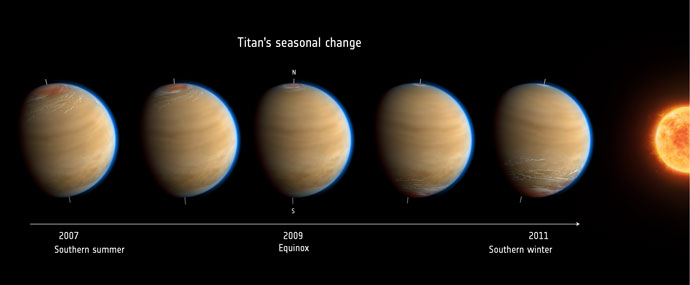
Titan is an incredibly frigid place, with an average temperature of -178 degrees Celsius (-289 Fahrenheit)—too brutally cold for life as we know it, but still of incredible interest to astrobiologists. It’s the only moon known to have an atmosphere—a thick and cloudy one, composed primarily of nitrogen—and it also exhibits weather and changing seasons. The orange haze that shrouds its surface is made up of trace gases such as benzene and hydrogen cyanide, and at the pole closest to the sun, sunlight heats the toxic orange haze and makes it circulate towards the other pole, so the gases concentrating there. Since a year on Titan lasts almost 30 Earth years, each season is 7 years long.
Titan’s seasonal changes. Credit: NASA
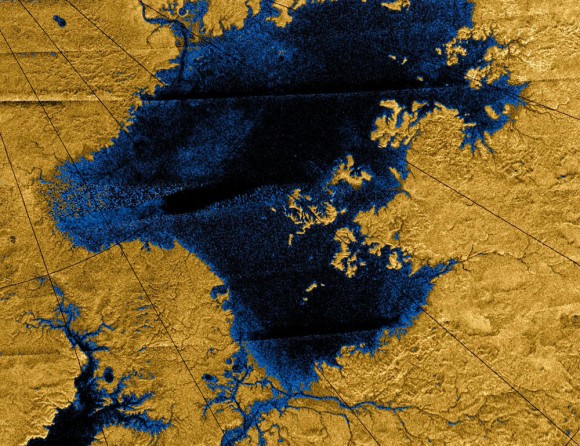
However, unlike Earth, its weather system is methane-based—and aside from Earth, Titan is the only object in the solar system to have permanent bodies of liquid on its surface, including an enormous river system that flows 400km across the moon’s surface to meet a large sea.
River network on Titan. Credit: Cassini
The darkness of the river in the image indicates a smooth surface, which in turn indicates that the river is not a dry bed, but filled with liquid—but this liquid is likely methane or ethane, which are more closely related to gasoline than water. Even though the mechanics seem to be similar, Titan’s weather would be alien to us because the skies fall with methane rain and lakes and oceans pool with liquid methane—but still, this presents possibilities of methane-based life.
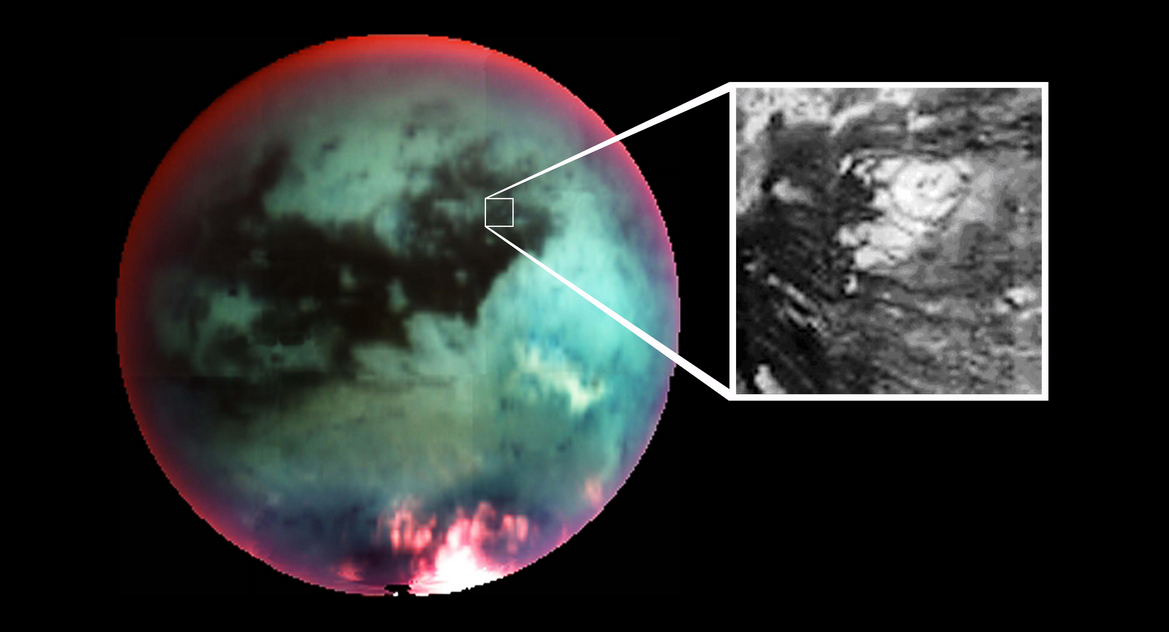
Credit: Cassini.
It is also suspected that Titan harbours cyrovolcanoes, which spew water ice and hydrocarbons into the atmosphere instead of lava. Speculations began after NASA’s Cassini spacecraft captured images of a landform on Titan’s surface called Sotra Facula. The images showed three conical features with material flowing from them, their peaks up to 1,500 metres tall, as well as several pits equally as deep. Researchers gravitated towards the idea that these landforms were cyrovolcanoes, as it would help explain a long-standing mystery of Titan’s thick, methane- and nitrogen-filled atmosphere. Calculations show sunlight would have broken the methane down long ago if something hadn’t been replenishing it, and a cyrovolcano is a good candidate—it could erupt methane, dragging it from the planet’s interior into the atmosphere.
Sotra Facula. Credit: APOD.
However, these intriguing surface features could have also been created by weather and meteorite strikes than by volcanic activity, and it is difficult to tell without further data. Researchers believe cyrovolcanoes might be fairly common on the frigid moons of the outer planets—one has been confirmed on another of Saturn’s moons, Enceladus—which is incredibly interesting, because volcanic activity would prove that Titan is an active world, and could increase the likelihood that this huge, distant moon may harbour life. While searing lava destroys life on Earth, ice volcanoes on Titan would provide a way to mix complex chemicals from the surface and the interior. It could bring life forms up to the surface so our instruments have a better chance of detecting them—because fascinatingly, Titan seems to have subsurface oceans.
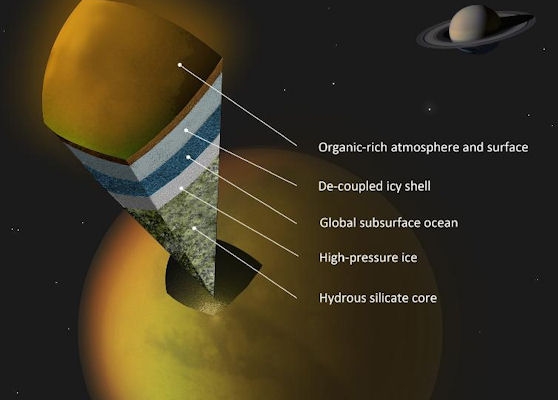
Further data from Cassini indicates that Titan has a layer of liquid water under its icy outer shell. The evidence is tidal—as Titan orbits Saturn, the planet’s powerful gravitational pull stretches and deforms the moon, like pulling and stretching an elastic band. If Titan were solely composed of rock, this stretching would only cause bulges (tides) of about 1 metre, but instead the moon experiences tides of about 10 metres—suggesting that its interior is not entirely solid. This ocean may not be enormous or deep; just a liquid layer between the solid mantle and the external icy shell would be enough to compress and bulge as Cassini has observed. Since Titan’s ice surface is composed mostly water ice, researchers believe its ocean could be liquid water.
However, just the presence of an ocean alone does not indicate life—researchers think that life is more likely to occur when the water comes into contact with rock, and we can’t currently tell if this exists beneath the surface.
Possible scenario for internal structure of Titan. Credit: NASA
Another intriguing phenomenon is the hydrogen gas flows through its atmosphere, and yet there is a lack of the chemical on the planet’s surface—so how did it disappear? One theory suggests that hydrogen-breathing, methane-based life forms consume the gas, similar to how we consume oxygen on Earth.
Liquid water, a possibly active interior, complex chemistry, a thick atmosphere, seasons, weather… All of these factors reflect the environment of life as we know it, so researchers have long thought that Titan is an excellent candidate to harbour life. None of these factors alone are solid evidence for life—they are just conditions necessary for it—but Titan is a fascinating place deserving of further study. Since its nitrogen-rich atmosphere is similar to Earth, just significantly colder, it also demonstrates how atmospheres of cold moons and planets behave, and thus allows us to speculate about how the atmospheres of exoplanets far from their stars might behave.
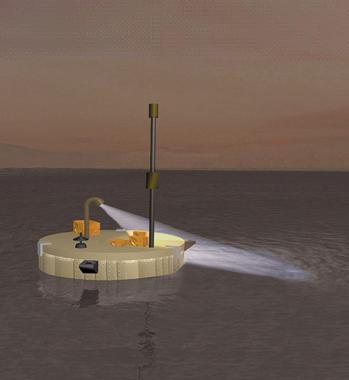
But our questions about Titan will remain unanswered until we obtain sufficient evidence to draw conclusions—but to do this, we need data. Two possible missions have recently been proposed. The first is the Titan Mare Explorer (TiME), which would have sent a floating buoy to land in Titan’s methane sea and measure the chemistry and organic composition, study the sea’s interaction with the atmosphere, and basically perform the first nautical exploration of this extraterrestrial ocean. It also would have observed Titan’s methane cycle to help us compare it to the water cycle on Earth. TiME was proposed to launch in 2016, but unfortunately it lost its funding to a Mars mission.
Artist’s concept for the TiME lander. Credit: NASA/ESA
Another possibility, however, is the Titan Saturn System Mission (TSSM), which is a proposed exploration of Saturn, Titan, and Enceladus—focusing on the complex phenomena the Cassini spacecraft has already noted. It is proposed to launch in 2020 and reach Titan by 2029, and during its 4-year-tenure, it would spend time circumnavigating Titan and studying its astrobiological potential. The mission consists of an orbiter and two Titan exploration probles—one that’s basically a hot air balloon, and another that land on the methane seas. One of the proposals for this second lander is the lake-lander of the discarded TiME mission, which will hopefully be included. TSSM, if it goes ahead, would be the first mission to extensively survey the organic chemistry and climate of the land, sea, and air of another world.
If life is detected on Titan, it would undoubtedly be moving and crucial to us as a species—not only because it’s the first extraterrestrial life we have detected, but also because it would behave differently to the water-based, oxygen-breathing life we’ve developed here. Even if life has not yet developed on Titan, the chemistry for life to form is present, so just give the moon four billion years…and who knows?