Blog

  • Ediacara: a “failed” evolutionary experiment?

    Ediacara: a “failed” evolutionary experiment?

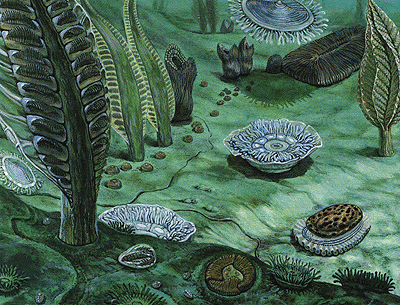
    The Ediacara Hills, north of the city of Adelaide in South Australia are a tumbling mass of ancient rocks. Sunbaked now, 580 million years ago they were a sea alive with soft-bodied organisms. These organisms varied greatly: from millimetres to metres in size; from “blob-like” to intricate in complexity; and from sturdy and resistant to a jelly-soft rigidity. They are all prosaically named the Ediacaran biota. A mundane name for what are the earliest known multicellular organisms on Earth.

    Turning over rocks and finding fossils

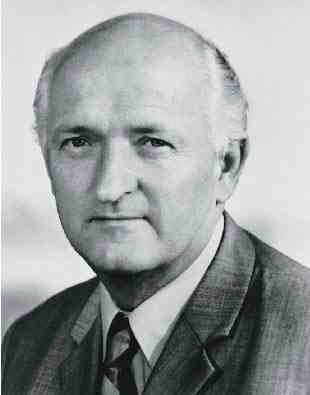
    In 1946, an Australian mining geologist named Reginald Sprigg was inspecting abandoned mines the Ediacara Hills. These hills take their name from the aboriginal Idiyakra, “water is present”. Serendipitously, while eating his lunch, Sprigg found fossilized imprints of soft-bodied organisms on the undersides of slabs of quartzite and sandstone. Most were round, disc-shaped forms that Sprigg dubbed “medusoids” from their seeming similarity to jellyfish. Others, however, resembled worms, arthropods, or even stranger things; quilted mattresses and mud-filled bags.
    image
    Reginald Sprigg. Photo credit: Wiki commons.

    Sprigg thought that these fossils were ancient and dating from the Cambrian era (541-485 million years ago). He submitted a paper to the journal Nature, but it was refused. Sprigg travelled to London and presented his findings to the 1948 International Geological Congress, but failed to excite either interest or belief.
    image
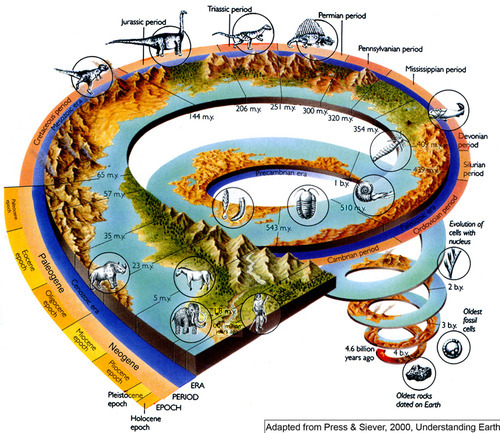
    A time-coil of the Earth’s ages from formation to the present age. Adapted from Press and Siever (2000) Understanding the Earth.

    These were not the first Precambrian soft-bodied fossils to be found and described — scattered reports of them had appeared in the scientific literature as far back as the mid-nineteenth century.

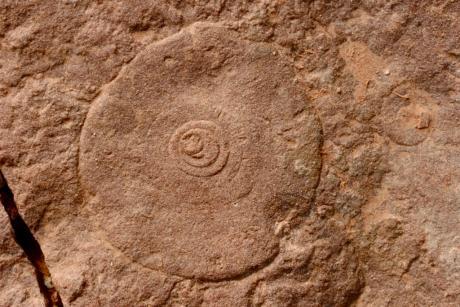
    The first Ediacaran fossils discovered were the disc-shaped Aspidella terranovica in 1868. Their discoverer, Scottish geological surveyor Alexander Murray, found them to lay below the the Cambrian strata that were then thought to contain the very first signs of life. It took a further four years for anybody to dare propose they could be fossils. Elkanah Billings‘ 1872 proposal was dismissed by his peers on account of their simple form. They were instead declared gas escape structures, inorganic concretions, or even tricks played by a malicious God to promote unbelief.
    image
    Aspidella. Image source Wikipedia.

    This one-sided debate soon fell into obscurity as no similar structures elsewhere in the world were then known. In 1933, Georg Gürich discovered specimens in Namibia. They were assigned to the Cambrian Period by the firm belief that life originated in the Cambrian, and no link to Aspidella was made.

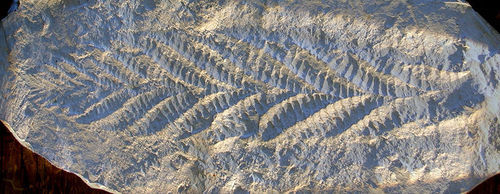
    It was not until the 1957 British discovery of the frond-shaped fossil Charnia in England’s Charnwood Forest that the pre-Cambrian was seriously considered as containing life. Due to the detailed geological mapping of the British Geological Survey there was no doubt that these fossils sat in Precambrian rocks.
    image
    The iconic Ediacaran Charnia. Image source Wikipedia.

    University of Adelaide palæontologist Martin Glaessner finally, in 1959, made the connection between this and the earlier finds. With a combination of improved dating of existing specimens and an injection of vigour into the search many more fossils were recognised.


    The naming the “Ediacaran” period

    Due to this punctuated discovery a plethora of different names existed for this pre-Cambrian period and its biota. In 1960 the French name “Ediacarien” was added to the competing terms “Sinian” and “Vendian” for late-Precambrian rocks, and these names were also applied to the life-forms. “Ediacaran” and “Ediacarian” were subsequently applied to the epoch or period of geological time and its corresponding rocks. In March 2004, the International Union of Geological Sciences ended the inconsistency by formally naming the terminal period of the Neoproterozoic after the Australian locality.

    The rise of the soft-bodied Ediacaran

    It took almost 4 billion years from the formation of the Earth for the Ediacaran organisms to first appear, 655 million years ago. Fossils of single-cell organisms are reported from an age 3,460 million years ago. The first uncontroversial evidence for life though is found 2,700 million years ago. Cells with nuclei certainly existed by 1,200 million years ago.

    The reason why it took so long for forms with an Ediacaran grade of organisation to appear is uncertain. A primary size-limiting factor is the amount of atmospheric oxygen. With the low oxygen levels in the early Earth, as low as 0.1% of today’s levels, organisms had to be simple. The oxygen cannot reach the centre of a complex organism quickly enough to supply its metabolic demand. So without sufficient oxygen life could only be very simple.

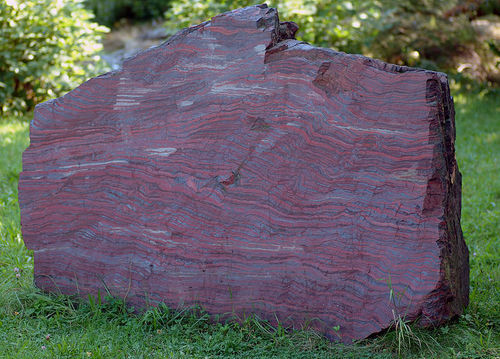
    On the early Earth, reactive elements such as iron and uranium existed in a reduced form, which would react with any free oxygen produced by photosynthesising organisms. Oxygen would not be able to build up in the atmosphere until all the iron had rusted and other reactive elements had also been oxidised.
    image
    Banded ironstone, sedimentary oxidised iron. Image source Wikipedia.

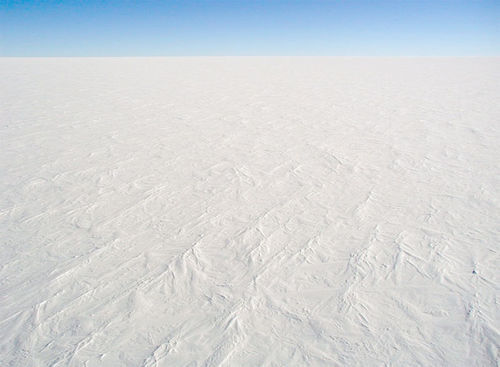
    Periods of intense cold have also been suggested as a barrier to the evolution of multicellular life. The period preceeding the Ediacaran is known as the Cryogenian. The greatest ice ages known to have occurred on Earth, possibly covering the entire planet, occurred during this period. These ‘snowball earth‘ events are still the subject of much scientific controversy, whether these glaciations were truly global or merely localised events. The diversity of life in modern Antarctica has also sparked disagreement over whether cold temperatures increase or decrease the rate of evolution.
    image
    Antarctica snow dome. Image source Wikipedia.

    Oxygen, is still seen as key to enable cells to cluster and differentiate. It seems to have accumulated in two pulses; the rise of small, sessile (stationary) organisms seems to correlate with an early oxygenation event, with larger and mobile organisms appearing around the second pulse of oxygenation – the rise of the Endiacaran.

    Life, but not exactly as we know it

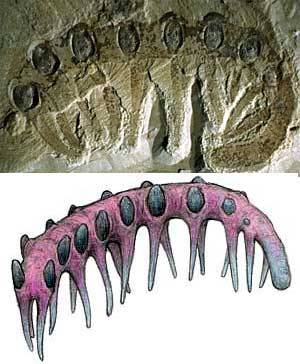
    The advantages of multicellularity include increased size and specialisation, physical protection and conditions for the development of complex behaviour. Unfortunately the soft-bodied physiology of the organisms have meant that fossil remains make their nature speculative and seem quite alien.
    image
    Microdictyon, fossil and artists impression. Image source Wikipedia.

    While some can be likened to modern jellyfish, corals and lichens, many others remain more enigmatic. For example the Charnia are lacking any mouth, gut, reproductive organs, or indeed any evidence of internal anatomy, their lifestyle was somewhat peculiar by modern standards; the most widely accepted hypothesis holds that they sucked nutrients out of the surrounding seawater by osmosis.

    The demise of the Ediacaran

    The Cambrian period is marked by the appearance of organisms who evolved the ability to precipitate minerals used for skeletons and hard shells. Organisms  which are more easily preserved as fossils than soft-bodied ones. This “Cambrian Explosion

  • Linux.conf.au 2013: ‘Nerdvana’ in Canberra

    Linux.conf.au 2013: ‘Nerdvana’ in Canberra

    During the last week of January, approximately 700 IT professionals and enthusiastic hobbyists descended on Canberra to jointly create an intensive learning experience. Each year the call goes out across the intertubes to gather together open source geeks for  Linux Conference Australia. Linux.conf.au, or simply LCA, is one of the largest open source conferences in the southern hemisphere, and one of the most highly-regarded conferences of its kind in the world. I was excited to attend LCA2013, as it was my first LinuxConf, despite being involved to a modest degree in the Linux and open source community for at least the last 15 years.

    Most days, the programme commenced with a keynote address by an IT industry luminary who had made a significant contribution to computer technology and open source. At every keynote address, the lower level of ANU’s Llewellyn Hall was packed with delegates, each toting a selection of wifi- or 3G-enabled devices. While I saw a healthy 55Mbps idle capacity on the Internet link provided by conference organisers (ably assisted by the network engineers at AARNET), once the assembled cohort of digital natives hit the link, all of that that capacity was rapidly utilised. 🙂

    The conference was opened on the Monday by Bdale Garbee, recently-retired Open Source & Linux Chief Technologiest at Hewlett-Packard, and a long-time contributor to the Debian Linux distribution. (Read Kelly Burnes’ article about Bdale at LCA2013, where you can also watch our video interview.)

    On the Tuesday, Radia Perlman enchanted the audience with her talk on the folklore of networking. Radia has been instrumental in developing several key networking protocols that underpin the interconnectedness of computers that we now take for granted. She gave a highly-technical yet accessible talk laced with humour and even nerdy poetry. (You can read my thoughts on Radia at LCA2013, and watch our video interview.)

    Andrew “bunnie

  • “Do what it takes to solve the problem, and no more”: a small talk with ‘Bunnie’ Huang

    “Do what it takes to solve the problem, and no more”: a small talk with ‘Bunnie’ Huang

    As a Free & Open Source Software (FOSS) geek, I was really looking very much forward to anything coming out from the linux.conf.au, better known as LCA. And for a huge bouquet of surprises, this year’s edition was one.

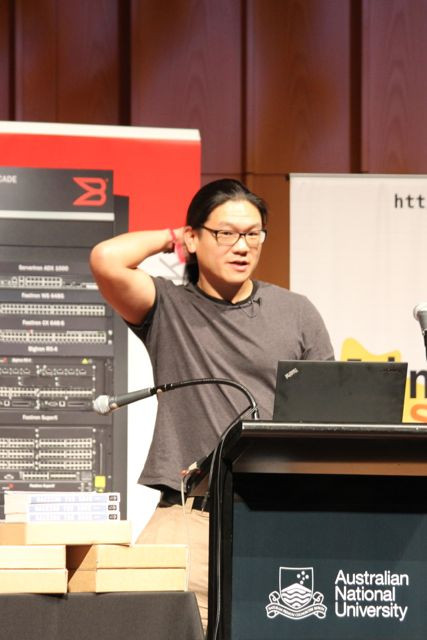
    Andrew "bunnie" Huang (@bunniestudios) at LCA2013: "Do what it takes to solve the problem, and no more". Photo by @kinshasha on Twitter
    Andrew “bunnie” Huang (@bunniestudios) at LCA2013: “Do what it takes to solve the problem, and no more”. Photo by @kinshasha on Twitter

    Along with Radia Perlman and Bdale Garbee, there was Andrew ‘bunnie’ Huang. He is a very interesting person, and his activities go beyond just-basic-nerdiness. Huang happens to be the person responsible for the jailbreaking of Microsoft’s Xbox360, something he wrote a book about in 2003. Moreover, he holds a PhD in engineering from the MIT. What I really like Bunnie for is all his great coverage of Chinese manufacturing, while sourcing suppliers for Chumby. Chumby is a gem: a totally open and hackable device designed from the ground up complete with open source hardware. This embedded computer provides internet access through a WiFi connection, and is able to run a wide range of software widgets once connected. The hardware being open, everyone willing to use Chumby is encouraged to get into the device and make it his/her own.

    You may be blinking a bit thinking “OMG, how come I don’t know this guy!

  • Weekly Science Picks

    Weekly Science Picks

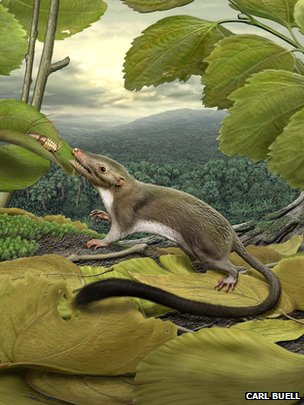
    Our long-lost ancestor... Photo Credit: Carl Buell
    Our long-lost ancestor… Photo Credit: Carl Buell

    It’s been an interesting week in the world of science, with the predominant story focused on just who our mammalian ancestor might be. Everyone has been covering this, the BBC, the New York Times and national Geographic. But some other newsworthy notes include new developments on graphene, a discussion on just how big the universe really is, and biodiversity 10,047 meters below the sea’s surface.

    Scientists are on a never ending quest to pinpoint exactly where we came from and this past week may have shown some significant process in that endeavor. And the story reported on by BBC below highlights some fascinating elements in the work of phylogeny. One of the most intriguing points of the story is in the tools scientists now have at their disposal for evolutionary research – MorphoBank.

    Earliest placental mammal ancestor pinpointed by Jason Palmer

    But the new work tackles the question of placental mammals in unprecedented detail, taking six years to develop a database of physical and genetic data some 10 times larger than any used previously – and taking a decidedly modern take on it.


    Exfoliation…and we’re not talking about ladies skin cleansing here. This next piece from our very own Markus Hammonds highlights exciting new research for the use of graphene in making high grade electronics.

    Could the next generation of electronics be made with graphene? by Markus Hammonds

    By using a process called exfoliation, the layers in this material are a mere 11 nm thick, and electrons are able to move freely through it without any scattering from impurities in the material (one of the main limiting factors in any system of electronics). Free from such obstructions, electroncs can flow through this new material at high speeds.


    Will we ever get our heads around how big the universe is? Astronomer Pete Edwards of the University of Durham seems to think not. See what you think in this video featured on The Guardian.

    How big is the universe…compared to a grain of sand?

    10,000 galaxies in a patch of sky the size of a grain of sand held at arm’s length…


    Is future shock real? Is it over? It’s all relative, I think, but makes for an interesting story about how we look at our past, present and future.

    How can you tell if you are suffering from Future Shock? by Charlie Jane Anders

    Instead of wondering where things are going, says Rushkoff, people have started to wonder about where things are right now. Around the time of the dotcom era, people became obsessed with speculating about the present. ” I think we have moved out of linear time and the historic sensibility altogether,” says Rushkoff, “and our current stress stems more from the simultaneity and instantaneity of the digital media environment, as well as the loss of narrative and other connections to organic time.”

  • World solar expert to shine light in Australia

    World solar expert to shine light in Australia

    Dr Manuel J Blanco joins CSIRO as Director of the Australian Solar Thermal Research Initiative (ASTRI).

    ASTRI is an A$87 million, eight year international collaboration transforming the energy industry in Australia by bringing down the cost of solar thermal, a unique energy technology that can create electricity, heat and fuels.

    “Australia has one of the best solar resources in the world. It is a natural fit for an international solar thermal research collaboration to use this resource and our expertise to make solar power the cheapest, cleanest energy source it can be.”

    Dr Manuel J Blanco, Director – Australian Solar Thermal Research Initiative

    Dr Blanco, a world-renowned solar scientist with almost three decades of academic, research and development managerial experience, comes to ASTRI from Spain’s National Renewable Energy Centre (CENER), where he was Director of the Solar Thermal Energy Department.

    Dr Blanco has made an invaluable contribution to the international solar thermal industry, including paving the way for the first commercial solar thermal system installed in Spain and chairing the International Energy Agency’s SolarPACES executive committee, the 20-country network for solar thermal collaboration.

    “Australia has one of the best solar resources in the world. It is a natural fit for an international solar thermal research collaboration to use this resource and our expertise to make solar power the cheapest, cleanest energy source it can be.

    “We will reduce the cost of solar thermal to just 12 cents a kilowatt hour by 2020 and provide zero-emission energy to people when they need it. It’s a technological leap but we will do it. We are working with the best in the world,

  • Linux – The Open Source Ecosystem

    Linux – The Open Source Ecosystem

    Bdale Garbee at LCA2013

    Australian Science travelled to Canberra for the linux.conf.au (Linux Conference Australia) last week and had the opportunity for exclusive one-on-one interviews with a number of the keynote speakers. You may have been a little hesitant reading the first word of the title of this article, ‘Linux’, but perhaps the ‘Open Source Ecosystem’ in the latter part put your mind at ease. We are a computing world, a society heavily dependent upon computers. Computers, in their many shapes and sizes, are touching even greater areas of our lives and reaching a far greater number of people than ever before. Open source is revolutionizing the way we communicate. So while we all may not understand coding and app development, we can understand the end products that allow us digital consumers to produce and share our experiences and stories. The person who has had a tremendous impact in the Linux world is Bdale Garbee. And this is his open source ecosystem.

    Bdale Garbee is a computer genius. Although he retired in 2012 after a long career with HP, serving as Open Source and Linux Chief Technologist, he shows no signs of slowing down. Quite the contrary, his workload may be picking up with the number of projects he is involved with, such as serving on the boards of The Freedombox Foundation and The Linux Foundation.


    “Linux – euphemism for entire open source ecosystem and idea of collaborated development and maintenance of software and related data

  • Rare echidna species not so extinct after all?

    Rare echidna species not so extinct after all?

    Speaking as a European, Australia has something of a reputation for having some rather unusual wildlife. Easily the most unusual are the small handful of monotreme species – the echidnas, and the duck-billed platypus. The only species of egg-laying mammals in the world today, these little creatures may once have been quite widespread. Now, however, they’re only found in Australia and New Guinea. One species in particular, the long-beaked echidna, is critically endangered. It was believed to have been extinct in Australia for over 30,000 years (and only found in New Guinea), since the last ice age. It was believed, that is, until recently. And the evidence for this rediscovery came from a rather surprising source.

    100 years ago, biologists worked a lot differently to the way they do today. Back then, it was common practice to travel to remote places and collect specimens – by way of hunting animals, shooting them, and getting a taxidermist to stuff them. While this bloodthirsty pokemon attitude may seem ghastly to our modern sensibilities, it was once simply the way things were done, and many such specimens are still on display in museums. Though it should be added that such specimen collecting is widely outlawed today.

    Nonetheless, one such specimen was found in London’s Natural History Museum. The creature had been “collected” in Australia in 1901, scientifically described, and had subsequently been stored and forgotten about entirely. I have to wonder what those researchers may have done if they’d realised the true significance of this unassuming little creature.

    The fascinating thing is really that this little preserved creature is the keystone for the entire study. Just one single specimen. However, it was very well documented and most certainly came from Australia. Its discovery was quite serendipitous too, when zoologist Kristofer Helgen from the Smithsonian Institution, Washington, was paying a visit to the London Natural History Museum.

    From the description it was tagged with, this echidna had been found on Mount Anderson, in sparsely populated Northwest Australia. Following up the find, researchers decided to investigate further. In West Kimberley, they spoke to some aboriginal communities where people recounted stories of how their parents used to hunt echidnas which were much larger than the others. Using photographs, they identified those large echidnas as the same long-beaked echidna species still found in New Guinea.

    So the big question is, are long-beaked echidnas still found in Australia today? This discovery does give us some more information about how adaptable these spiny little animals are; long-beaked echidnas can evidently survive in both arid Australian scrub land and lush New Guinea rainforests. Until a living animal is found, it’s impossible to make any definite statements. And finding them is no easy task. They’re nocturnal creatures, and the known populations of them in New Guinea are difficult to find. All the same, conservationists can be hopeful that long-beaked echidnas may not be extinct in Australia just yet.

  • Radia Perlman at LCA 2013

    Radia Perlman at LCA 2013

    A little before 9am on Tuesday 29th January, I filed into ANU’s Llewellyn Hall along with approximately 700 other Linux.conf.au delegates to listen to the daily keynote speech. I’m now a little embarrassed to admit that I had never heard of Radia Perlman. A little over an hour later, I was a fangirl.

    Radia delivered an engaging, funny, and highly-technical keynote address at LCA2013, and the audience of IT professionals and enthusiasts present lapped it up. In it, she placed the technical details of the network protocols she and her colleagues developed in an historical context. She half-jokingly explained that this was the only way in which anyone could hope to understand why the protocols we work with today include ‘features’ in their design that would otherwise seem crazy to an outside observer.

    In delivering her keynote, Radia gave us not just the technical detail behind the development of networking protocols, but also wove in details from her creative side, as well as tidbits about her children’s involvement in her technical life. The crowd was delighted as Radia shared with us the poem that she created (an ‘Algorhyme’) shortly after devising the Spanning Tree Protocol in 1985 while at DEC. For as she says, “Every algorithm deserves an algorhyme…” (You can hear Radia reciting her AlgoRhyme in Dan’s video interview with Radia below, and read the text here.) There is also a recording of Radia’s daughter, Dawn Perlner, singing the Algorhyme set to music by Radia’s son, Ray Perlner. Radia also mentioned her son Ray’s involvement in the creation of an AlgoRhyme V2 to mark the creation of her most recent network protocol, TRILL.

    Later in the week, I had the pleasure of heading off to lunch with Radia and a small group of fellow delegates during a break in technical sessions. She is engaging and thoughtful, and concerned as much with solutions for societal issues as solutions for thorny networking challenges. Radia is eternally self-effacing, and repeatedly claimed that she had “never done anything difficult

  • Australia’s National Science Agency – Focused on the Future

    Australia’s National Science Agency – Focused on the Future

    Our little blue marble...I find myself spending a lot of time thinking about the future of our society and planet – how we can solve problems of today and prevent those of tomorrow. Quite often I draw up battle plans on scrap paper in preparation for those policy battles we don’t even know exist yet, those looming around the corner. Thinking I knew the CSIRO website in and out, you can imagine my delight when I stumbled upon CSIRO Futures. This forward thinking, strategic planning group is dedicated to helping government and industry make the tough, and smart, choices that will be critical given our uncertain future.  

    Wanting to learn more about this group’s work and impact, I reached out to Dr Stefan Hajkowicz, the Theme Leader for CSIRO Futures. This is our digital conversation about science, education, energy, and what Australia must do to secure its future.

    Can you provide some historical background on CSIRO Futures? What was the impetus for the creation of this unit? How and when did it come about?

    The birth of CSIRO Futures was somewhat serendipitous. In 2009 we started a small internal think-piece to inform CSIRO strategic planning. It wasn’t ever intended for the outside world. However, at a major Industry and Government conference in Melbourne a video link to Boston Consulting Group (BCG) broke down. That was our lucky break. Someone from BCG was going to deliver a talk on “megatrends”. When the video link broke I was asked to step in and cover the session with our own homegrown megatrends. The audience loved the fact this work was also being done down-under and we subsequently received heaps of offers to present the work in boardrooms and at conference keynotes. We later received requests to do foresight research/consulting projects for industry sectors. So that’s when we set up CSIRO Futures. It’s now running pretty well. We’ve delivered a bunch of projects and more are in the pipeline. Our aim is to inform, engage and from time-to-time entertain.

    Can you describe your role as theme leader at CSIRO and the impact this role has had (or will have) on the future of science?

    This is an interesting role in CSIRO. In fact – I love it. I was appointed in July 2012 and it’s been fascinating and productive. This role is having impact in many ways. One way is that it’s making science accessible to people in industry, government and the community. For many people CSIRO means evidence-based, robust and well-researched information. When the CSIRO logo is mixed with imaginative stories about the future of the world there’s much interest. The aim is to mix science fact with science fiction to inform people’s decision making.

    The report “Our Future World: Global megatrends that will change the way we live

  • Women in Space – Valentina Tereshkova

    Women in Space – Valentina Tereshkova

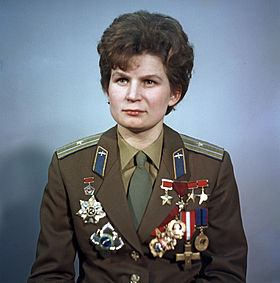
    This article is the first in a series of articles in which I will profile every woman astronaut, cosmonaut and taikonaut who has been into space.  The last time I checked 58 women have travelled into space, by the end of this year there may be a few more!  We’re going to start this series at the beginning – with Russian cosmonaut Valentina Tereshkova, the first woman in space.  (The feature image above is a collection of drawings of women astronauts by artist Phillip J Bond.  You can find Phillip’s wonderful series on women astronauts here.)

    Valentina Tereshkova

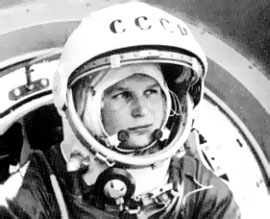
    Born in 1937, Tereshkova was a textile worker from Maslennikovo, a small village in the far west of Russia.  Tereshkova never yearned to go into space, she left school early to support her family, but continued her education by correspondence. Tereshkova worked in the local textile mill, and earned certification as a cotton spinning technology expert.  She went on to become the secretary of the local Komsomol (Young Communist League).  Tereshkova’s passion was parachuting. She was introduced to the sport of parachuting by a friend and was so taken by the sport she soon began parachuting regularly and set up the Textile Mill Workers Parachute Club.

    In 1962 when the Soviet Air Force advertised for 50 cosmonauts to join the new space program, it included 5 positions for women.  At the time Nikita Khrushchev thought that the U.S. was considering sending women from the Mercury Program into space. This spurred the Russians on to select a number of women for their own space program, with the aim of getting them into space before the US.

    Valentina Tereshkova
    Valentina Tereshkova (Photo Credit NASA)

    The requirement to be a cosmonaut did not include any piloting skills, but they did require all applicants to be experienced parachutists, under 170cm tall, under 70kg in weight, under 30 years of age, be fit and be ‘ideologically pure’.  Tereshkova met all the criteria.  In addition, she was the daughter of a local war hero who had been declared MIA (presumed dead) during the Russian/Finnish war.

    Tereshkova was one of 50 out of a pool of 400 applicants that were accepted for further testing.  Eventually 5 women passed the assessment test to become a cosmonaut. Over a period of 15 months the 5 women undertook all the same training that the men did, including weightless flights, isolation tests, centrifuge tests, rocket theory, spacecraft engineering, 120 parachute jumps and pilot training in jet fighters.  In a 2005 interview Tereshkova recalled that the training was strict and that they were ‘locked inside the classroom to study theory all day long’.  As Tereshkova was a civilian she was inducted into the Soviet Air Force as a Lieutenant so that she could become a member of the cosmonaut corps.

    Valentina Tereshkova
    Valentina Tereshkova (Image Credit Wikimedia)

    Tereshkova was originally intended to launch first in Vostok 5, and another female cosmonaut, Valentina Leonidovna Ponomaryova was to pilot Vostok 6. However, a few months before launch, the flight plan was altered so that Tereshkova would pilot Vostok 6 and Valery Bykovsky would pilot Vostok 5. In an interview Tereshkova was asked if the other members were jealous that she got to fly.  She responded ‘The other women were upset – but our friendship is still alive’.  She recalled that when she was driven off towards Vosktok 6 for the launch that her back up Irina Solovyova remained in the bus, fully clothed in her space suit, prepared for launch should Tereshkova not be ready or able to launch.

    At 1430 hours on 16 June 1963, 26 year old Russian Cosmonaut Valentina Tereshkova blasted into space aboard Vostok 6, becoming the first woman in space.  Tereshkova’s mission was to orbit the earth for 24 hours and to conduct a number of tests on herself to collect data on the female body’s reaction to spaceflight.  Soon after launch when she settled into orbit Tereshkova realised that the spacecraft was moving away from Earth, rather than heading towards it.  She quickly reported the error to ground control, which then provided a new landing algorithm.  However, this meant that her mission was extended to 2 days 22 hours and 50 minutes.  Because of this, Tereshkova spent more time in orbit than all the U.S. Mercury astronauts combined.  At the time there was no mention made of the potentially fatal miscalculation.  This information was only released in the 1990s.

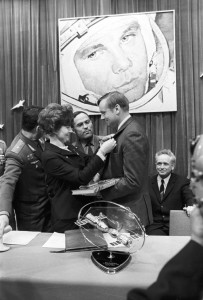
    Valentina Tereshkova, presenting a badge to U.S. astronaut Neil Armstrong in memory of his visit to the Gagarin Cosmonaut Training Center in Star City.
    Valentina Tereshkova, presenting a badge to U.S. astronaut Neil Armstrong in memory of his visit to the Gagarin Cosmonaut Training Center in Star City. Photo Credit RIA Novosti

    Although it’s often reported that Tereshkova got severe space sickness during her flight, in fact she found that it was actually the space food provided that made her ill.  However, this had no impact on her performance of her duties during the mission.

    Tereshkova orbited the earth 48 times and landed as planned, with only a minor bruise to her nose from impact with her helmet during landing.  In November of 1963 Valentina married cosmonaut Andrian Nikolayev   On June 8, 1964, she gave birth to their daughter Elena Andrianovna Nikolaeva-Tereshkova, who is now a doctor and was the first person to have both a mother and father who had travelled into space.  Tereshkova and Nikolayev divorced in 1982.

    After her flight, Tereshkova studied at the Zhukovsky Air Force Academy and graduated as a cosmonaut engineer. She went on to be a test pilot and instructor.  In 1977 she earned a doctorate in engineering. She went on to become a prominent member of the Communist Party of the Soviet Union, President of the Soviet Women’s Committee and prominent supporter of women’s rights. Tereshkova is considered a heroine in post-Soviet Russia.

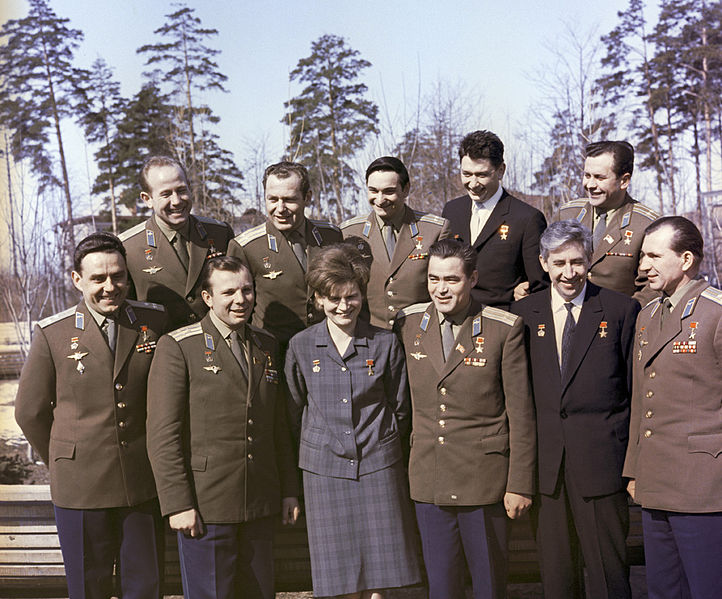
    Soviet cosmonauts
    Soviet cosmonauts (front row, from left): Vladimir Komarov, Yuri Gagarin, Valentina Tereshkova, Andrian Nikolayev, Konstantin Feoktistov, Pavel Belyaev, second row: Alexei Leonov, German Titov, Valery Bykovsky, Boris Yegorov, and Pavel Popovich. Photo Credit RIA Novosti

    Tereshkova and her fellow female cosmonauts were not considered by some to be a part of the cosmonaut corps, and were not considered for flight assignments on an equal basis with the ‘regular’ male cosmonauts. Unfortunately, during this period space flights manned by women were considered for propaganda purposes. There was fierce competition from the men for a flight position, and placing a woman on the flight would mean that she would be taking the place of a man.  An all female Voskhod flight was considered, but eventually cancelled.  There is some suggestion that male cosmonauts objected to the women in the corps as a distraction. None of the other four women in Tereshkova’s early group flew, and in October 1969 the pioneering female cosmonaut group was dissolved.  Even though there were numerous plans for further flights by women, it was a further 19 years before the second woman Svetlana Savitskaya, flew into space.

    Valentina was the recipient of many honours and awards including:

    • The Hero of the Soviet Union
    • Order of Lenin
    • Order of the October Revolution
    • Order of Merit for the Fatherland
    • Order of Friendship
    • Russian Federation State Prize
    • United Nations Gold Medal of Peace
    • Simba International Women’s Movement Award
    • Honorary Doctorate from University of Edinburgh
    • Named a crater on the moon ‘Tereshkova Crater’
    • Eduard Rhein Ring of Honor
    • Asteroid 1671 named Chaika (Her callsign for Vostok 6 ‘Seagull’)
    • Joliot-Curie Gold Medal

    Tereshkova is now 75 years old, living quietly and enjoying life with her grandchildren.  She remains the only woman in history to have made a solo space flight.

  • Could the next generation of electronics be made with graphene?

    Could the next generation of electronics be made with graphene?

    While it may look like little more than molecular chicken wire, graphene really is wonderful stuff. A sheet of carbon atoms naturally forms into a geometrically perfect set of hexagons and, since it was first chemically synthesised in 2004, researchers across the world have been investigating its potential for uses in a wide variety of ways – everything from DNA sequencing to hunting for it in interstellar space!

    One of the biggest potentials for graphene, however, is in electronics. As graphite (a naturally occurring mineral), carbon is semiconductive. Due to the way carbon atoms are arranged in this hexagonal pattern, it leaves some electrons free to move across the material in a way not entirely unlike the way the motion of free electrons allows metals to be conductive. However, pure graphite isn’t really very conductive. Pure graphene is a much better conductor, but a single sheet of atoms is quite delicate and difficult to engineer into anything by itself.

    The latest development in the story though, is courtesy of the Royal Melbourne Institute of Technology and the Commonwealth Scientific and Industrial Research Organisation (CSIRO), where research has been underway to make high grade electronics with graphene. Their recent success came from a layered material made from graphene and tiny crystals of molybdenum oxide. By using a process called exfoliation, the layers in this material are a mere 11 nm thick, and electrons are able to move freely through it without any scattering from impurities in the material (one of the main limiting factors in any system of electronics). Free from such obstructions, electroncs can flow through this new material at high speeds.

    You see, electronics is one of the fastest progressing types of technology in the world today. Moore’s Law is a principle which states that approximately every two years, the number of transistors in electronic circuitry – and therefore the overall speed of computers – doubles every two years. This trend has been continuing for over half a century now; the average mobile phone today probably has more computing power than Apollo 11 did when it travelled to the Moon.

    But the growth of electronics is predicted to start slowing down, not because technology will stop progressing, but because we’re expecting to reach the limit of what’s possible with our current silicon-based electronics technology. For electronics to continue improving, new and faster materials are required. Graphene-based technology may well hold the key to the future of electronics. CSIRO’s Serge Zhuiykov, spokesman for the Australian researchers involved in this project, believes it could be, stating, “Quite simply, if electrons can pass through a structure quicker, we can build devices that are smaller and transfer data at much higher speeds.

  • Weekly Science Picks

    Weekly Science Picks

    #Scio13

    This week Science Online kicked off in Raleigh, North Carolina. The unconference that brings together communicators of science in all their ilks — writers, bloggers, scientists themselves, filmmakers etc — the list goes on.

    “I write fiction in the form of grant proposals…

  • Science: It’s a Girl Thing?

    Science: It’s a Girl Thing?

    The role of gender has arisen in many a conversation in my science social circles as of late. Friend and fellow contributor to Australian Science Danielle Spencer sent the video “Science: It’s a Girl Thing!” a few weeks back. (You can view it below.) I had never seen it, but is has sure stuck with me. It’s an eyebrow raiser in my opinion. Viewing this well-produced, glossy video conjured up images of a James Bond feature film opener. (It is a European Commission production.) Smoke and mirrors, silhouettes, high heels, seems more of a teenybopper fashion show. Where is the relationship to science?

    I see beakers for measuring liquids, microscopes, and atomic elements and verbally hear the word science, but references to makeup and the overuse of pink cascading across the screen as a spilled bottle of nail lacquer might, I fail to see the relevance.

    Though to be fair, chemistry plays a quite a significant role in the production of cosmetics. And it is a $200+ billion dollar global industry. I got quite the kick out of teasing my brother who after college worked at P&G testing lipstick and diapers to ensure the products did not cause allergic reactions. (His role was in quality control and documenting participants’ feedback.) It’s an important role in the consumer products industry, to be sure.

    If the goal was to increase interest in and motivate girls to pursue careers in science, I think the video falls short. Sure it exudes fun, but fun about what? Fun in being a marine biologist? Fun in pursuing a career in biopharmaceutical research? Fun in developing advanced robotics for use in outer space?

    The clip has more of a cheerleader appeal than it does in the effort to encourage girls in their science education. (But, everyone can use someone in his or her corner cheering him or her on now and then.) It’s no wonder the video was taken down due to numerous complaints. I personally do not think science is a girl thing, or a boy thing, in the bigger picture, it has been and should remain to be a thing for humankind. Yes, men largely dominate the field. Women make choices to pursue science or another field for employment. What we need to do is to ensure that girls, and boys, are exposed to and supported in their science studies at an early age. Because science, it’s a fun thing.

    Image: Varying views of women’s role in science. Photo Attribution: By Merwart [Public domain], via Wikimedia Commons

  • New leader of CSIRO Astronomy and Space Science division

    New leader of CSIRO Astronomy and Space Science division

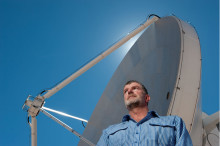
    CSIRO’s astronomy, spacecraft tracking and space science activities will be headed up by a new leader, with the announcement today that Dr Lewis Ball has been appointed as the incoming Chief for CSIRO’s Astronomy and Space Science (CASS) division.

    Dr Ball returns to CSIRO from his present role as Deputy Director at the Atacama Large Millimeter/sub-millimeter Array (ALMA) located in Chile. There he has led the successful commencement of ALMA’s scientific operation, currently the world’s largest and most complex astronomical observatory and a partnership involving 20 countries.

    “I look forward to enhancing and building on CSIRO’s national and international reputation in the fields of radio astronomy and space science. I’m excited and honoured to be leading such a world-class team and thrilled to be a part of the international SKA effort.”

    Previous to his ALMA appointment, Dr Ball had been with CSIRO for nine years in a number of management roles including leadership of CSIRO’s astronomy division from February 2009 to May 2010, first as Acting Director of the Australia Telescope National Facility (ATNF) and then as Acting Chief of Astronomy and Space Science.

    As the new CASS Chief, Dr Ball will lead approximately 280 staff and be responsible for a world-class national research facility for radio astronomy that includes three existing radio telescopes, as well as the 36-dish Australian Square Kilometre Array Pathfinder which begins operations this year.  Dr Ball will also be responsible for driving CSIRO’s contribution to the first phase of the Square Kilometre Array telescope in Australia and for heading up, on behalf of NASA, the Canberra Deep Space Communications Complex based at Tidbinbilla.

    Dr Ball’s appointment fills the role made vacant by Dr Phil Diamond, who left CSIRO in October 2012 to take up the position of Director General of the SKA Organisation.

    Group Executive for CSIRO’s Information Sciences, Dr David Williams, welcomed Dr Ball’s appointment.

    “Following an international recruitment search, we are delighted to see Lewis returning to CSIRO. Lewis has had enormous success in his career so far and we’re thrilled to have someone of such high calibre joining our leadership team,” Dr Williams said.

    Dr Ball added, “I look forward to enhancing and building on CSIRO’s national and international reputation in the fields of radio astronomy and space science. I’m excited and honoured to be leading such a world-class team and thrilled to be a part of the international SKA effort.”

    Dr Ball will commence as Chief of CSIRO’s Astronomy and Space Science division on March 18, 2013 and will be based at Marsfield in Sydney.

    Source.

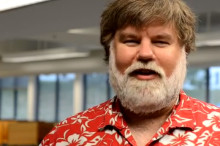
    Image: Dr Lewis Ball has been appointed as the incoming Chief for CSIRO’s Astronomy and Space Science (CASS) division. Photo credit: ALMA(ESO/NAOJ/NRAO), M. Alexander (ESO)